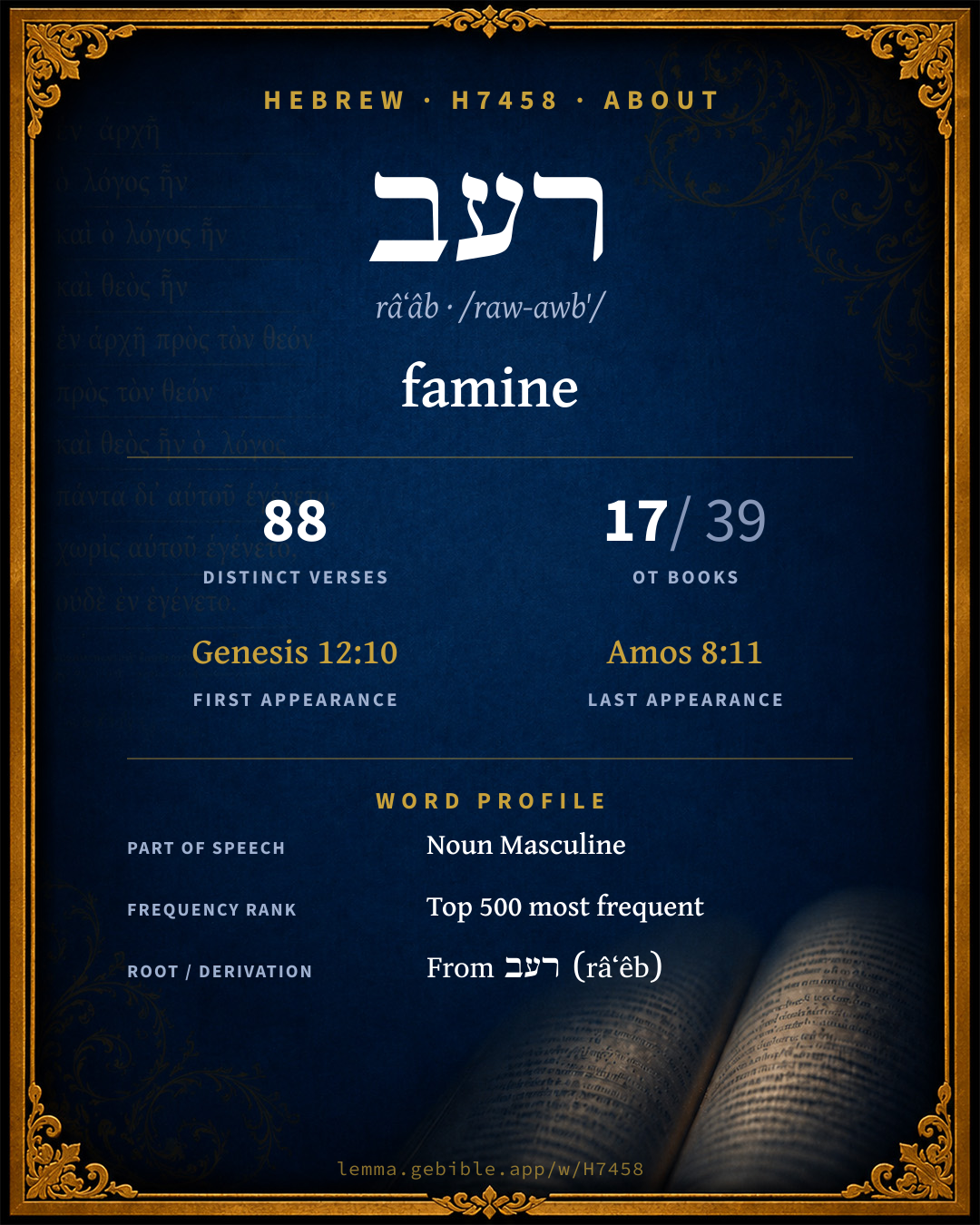
רָעָב
famine
‘famine’ is one of 3 main senses fuller range ↓
Full lexicon entry — Brown-Driver-Briggs (BDB)
From Brown-Driver-Briggs (BDB)
Where this word appears
See every Absolute-state word in the Hebrew Bible →
Grammar key — what these labels mean
Part of speech
- Noun
- A naming word — a person, place, thing, or idea.
Noun type
- Common
- A common noun — a general class of person, place, or thing (“king,” “city,” “water”), not a specific name.
State
- Absolute
- The independent form of a noun, not bound to a following word.
- Construct
- A noun bound to a following noun in a possessive / “of” relationship (the construct chain).
Gender
- Masculine
- Grammatically masculine.
Number
- Singular
- One.
Grammatical forms
- Noun, Common, Masculine, Singular, Absolute 100 times (99%)
- Noun, Common, Masculine, Singular, Construct 1 time (1%)
Parsed forms decoded from the imported morphology (morphhb / Westminster Leningrad Codex — WLC text public domain, morphhb tagging CC BY 4.0), counted across 101 parsed occurrences — not distinct verses.
Every verse where H7458 appears — 88 distinct verses across 17 books. Click any verse to open its interlinear word-by-word view. Verse text shown in the World English Bible for context — . Each verse’s Hebrew form is shown with its reference; the English is not keyword-highlighted, since the data carries no word-level English alignment. Use “Compare translations” on any verse to read it across multiple English versions. This concordance covers the Hebrew Bible; Septuagint (Greek Old Testament) occurrences are not indexed here.
Genesis 17 verses
- Genesis 12:10 רָעָ֖ב הָ/רָעָ֖ב n c ms ptcl def.art + n c ms There was a famine in the land. Abram went down into Egypt to live as a foreigner there, for the famine was sore in the land.
- Genesis 26:1 רָעָב֙ הָ/רָעָ֣ב n c ms ptcl def.art + n c ms There was a famine in the land, besides the first famine that was in the days of Abraham. Isaac went to Abimelech king of the Philistines, to Gerar.
- Genesis 41:27 רָעָֽב n c ms The seven lean and ill-favored cattle that came up after them are seven years, and also the seven empty heads of grain blasted with the east wind; they will be seven years of famine.
- Genesis 41:30 רָעָב֙ הָ/רָעָ֖ב n c ms ptcl def.art + n c ms There will arise after them seven years of famine, and all the plenty will be forgotten in the land of Egypt. The famine will consume the land,
- Genesis 41:31 הָ/רָעָ֥ב ptcl def.art + n c ms and the plenty will not be known in the land by reason of that famine which follows; for it will be very grievous.
- Genesis 41:36 הָ/רָעָ֔ב בָּ/רָעָֽב ptcl def.art + n c ms prep det + n c ms The food will be for a store to the land against the seven years of famine, which will be in the land of Egypt; that the land not perish through the famine."
- Genesis 41:50 הָ/רָעָ֑ב ptcl def.art + n c ms To Joseph were born two sons before the year of famine came, whom Asenath, the daughter of Potiphera priest of On, bore to him.
- Genesis 41:54 הָ/רָעָב֙ רָעָב֙ ptcl def.art + n c ms n c ms The seven years of famine began to come, just as Joseph had said. There was famine in all lands, but in all the land of Egypt there was bread.
- Genesis 41:56 וְ/הָ/רָעָ֣ב הָֽ/רָעָ֖ב conj + ptcl def.art + n c ms ptcl def.art + n c ms The famine was over all the surface of the earth. Joseph opened all the store-houses, and sold to the Egyptians. The famine was severe in the land of Egypt.
- Genesis 41:57 הָ/רָעָ֖ב ptcl def.art + n c ms All countries came into Egypt, to Joseph, to buy grain, because the famine was severe in all the earth.
- Genesis 42:5 הָ/רָעָ֖ב ptcl def.art + n c ms The sons of Israel came to buy among those who came, for the famine was in the land of Canaan.
- Genesis 43:1 וְ/הָ/רָעָ֖ב conj + ptcl def.art + n c ms The famine was severe in the land.
- Genesis 45:6 הָ/רָעָ֖ב ptcl def.art + n c ms For these two years the famine has been in the land, and there are yet five years, in which there will be neither plowing nor harvest.
- Genesis 45:11 רָעָ֑ב n c ms There I will nourish you; for there are yet five years of famine; lest you come to poverty, you, and your household, and all that you have."'
- Genesis 47:4 הָ/רָעָ֖ב ptcl def.art + n c ms They said to Pharaoh, "We have come to live as foreigners in the land, for there is no pasture for your servants' flocks. For the famine is severe in the land of Canaan. Now therefore, please let your servants dwell in the land of Goshen."
- Genesis 47:13 הָ/רָעָ֖ב הָ/רָעָֽב ptcl def.art + n c ms ptcl def.art + n c ms There was no bread in all the land; for the famine was very severe, so that the land of Egypt and the land of Canaan fainted by reason of the famine.
- Genesis 47:20 הָ/רָעָ֑ב ptcl def.art + n c ms So Joseph bought all the land of Egypt for Pharaoh, for the Egyptians sold every man his field, because the famine was severe on them, and the land became Pharaoh's.
Exodus 1 verse
Deuteronomy 2 verses
- Deuteronomy 28:48 בְּ/רָעָ֧ב prep + n c ms therefore shall you serve your enemies whom Yahweh shall send against you, in hunger, and in thirst, and in nakedness, and in want of all things: and he shall put a yoke of iron on your neck, until he have destroyed you.
- Deuteronomy 32:24 רָעָ֛ב n c ms [They shall be] wasted with hunger, and devoured with burning heat Bitter destruction; The teeth of animals will I send on them, With the poison of crawling things of the dust.
Ruth 1 verse
2 Samuel 2 verses
- 2 Samuel 21:1 רָעָב֩ n c ms There was a famine in the days of David three years, year after year; and David sought the face of Yahweh. Yahweh said, It is for Saul, and for his bloody house, because he put to death the Gibeonites.
- 2 Samuel 24:13 רָעָ֣ב n c ms So Gad came to David, and told him, and said to him, Shall seven years of famine come to you in your land? or will you flee three months before your foes while they pursue you? or shall there be three days' pestilence in your land? now advise you, and consider what answer I shall return to him who sent me.
1 Kings 2 verses
- 1 Kings 8:37 רָעָ֞ב n c ms If there be in the land famine, if there be pestilence, if there be blasting [or] mildew, locust [or] caterpillar; if their enemy besiege them in the land of their cities; whatever plague, whatever sickness there be;
- 1 Kings 18:2 וְ/הָ/רָעָ֖ב conj + ptcl def.art + n c ms Elijah went to show himself to Ahab. The famine was sore in Samaria.
2 Kings 5 verses
- 2 Kings 4:38 וְ/הָ/רָעָ֣ב conj + ptcl def.art + n c ms Elisha came again to Gilgal. There was a dearth in the land; and the sons of the prophets were sitting before him; and he said to his servant, Set on the great pot, and boil stew for the sons of the prophets.
- 2 Kings 6:25 רָעָ֤ב n c ms There was a great famine in Samaria: and, behold, they besieged it, until a donkey's head was sold for eighty [pieces] of silver, and the fourth part of a kab of dove's dung for five [pieces] of silver.
- 2 Kings 7:4 וְ/הָ/רָעָ֤ב conj + ptcl def.art + n c ms If we say, We will enter into the city, then the famine is in the city, and we shall die there; and if we sit still here, we die also. Now therefore come, and let us fall to the host of the Syrians: if they save us alive, we shall live; and if they kill us, we shall but die.
- 2 Kings 8:1 לָֽ/רָעָ֔ב prep det + n c ms Now Elisha had spoken to the woman, whose son he had restored to life, saying, Arise, and go you and your household, and sojourn wherever you can sojourn: for Yahweh has called for a famine; and it shall also come on the land seven years.
- 2 Kings 25:3 הָ/רָעָ֖ב ptcl def.art + n c ms On the ninth day of the [fourth] month the famine was sore in the city, so that there was no bread for the people of the land.
1 Chronicles 1 verse
2 Chronicles 3 verses
- 2 Chronicles 6:28 רָעָ֞ב n c ms If there be in the land famine, if there be pestilence, if there be blasting or mildew, locust or caterpillar; if their enemies besiege them in the land of their cities; whatever plague or whatever sickness there be;
- 2 Chronicles 20:9 וְ/רָעָב֒ conj + n c ms If evil come on us, the sword, judgment, or pestilence, or famine, we will stand before this house, and before you, (for your name is in this house), and cry to you in our affliction, and you will hear and save.
- 2 Chronicles 32:11 בְּ/רָעָ֥ב prep + n c ms Does not Hezekiah persuade you, to give you over to die by famine and by thirst, saying, Yahweh our God will deliver us out of the hand of the king of Assyria?
Nehemiah 2 verses
- Nehemiah 5:3 בָּ/רָעָֽב prep det + n c ms Some also there were that said, We are mortgaging our fields, and our vineyards, and our houses: let us get grain, because of the dearth.
- Nehemiah 9:15 לִ/רְעָבָ֔/ם prep + n c ms cs + sfx pers 3mp and gave them bread from the sky for their hunger, and brought forth water for them out of the rock for their thirst, and commanded those who they should go in to possess the land which you had sworn to give them.
Job 1 verse
Psalms 2 verses
Isaiah 3 verses
- Isaiah 5:13 רָעָ֔ב n c ms Therefore my people go into captivity for lack of knowledge; Their honorable men are famished, And their multitudes are parched with thirst.
- Isaiah 14:30 בָֽ/רָעָב֙ prep det + n c ms The firstborn of the poor shall feed, and the needy shall lie down in safety; and I will kill your root with famine, and your remnant shall be killed.
- Isaiah 51:19 וְ/הָ/רָעָ֥ב conj + ptcl def.art + n c ms These two things have happened to you. Who will bemoan you? Desolation and destruction, and the famine and the sword; how shall I comfort you?
Jeremiah 30 verses
- Jeremiah 5:12 וְ/רָעָ֖ב conj + n c ms They have denied Yahweh, and said, It is not he; neither shall evil come on us; neither shall we see sword nor famine:
- Jeremiah 11:22 בָּ/רָעָֽב prep det + n c ms therefore thus says Yahweh of hosts, Behold, I will punish them: the young men shall die by the sword; their sons and their daughters shall die by famine;
- Jeremiah 14:12 וּ/בָ/רָעָ֣ב conj + prep det + n c ms When they fast, I will not hear their cry; and when they offer burnt offering and meal-offering, I will not accept them; but I will consume them by the sword, and by the famine, and by the pestilence.
- Jeremiah 14:13 וְ/רָעָ֖ב conj + n c ms Then said I, Ah, Lord Yahweh! behold, the prophets tell them, You shall not see the sword, neither shall you have famine; but I will give you assured peace in this place.
- Jeremiah 14:15 וְ/רָעָ֔ב וּ/בָֽ/רָעָב֙ conj + n c ms conj + prep det + n c ms Therefore thus says Yahweh concerning the prophets who prophesy in my name, and I didn't send them, yet they say, Sword and famine shall not be in this land: By sword and famine shall those prophets be consumed.
- Jeremiah 14:16 הָ/רָעָ֣ב ptcl def.art + n c ms The people to whom they prophesy shall be cast out in the streets of Jerusalem because of the famine and the sword; and they shall have none to bury them-them, their wives, nor their sons, nor their daughters: for I will pour their wickedness on them.
- Jeremiah 14:18 רָעָ֑ב n c ms If I go forth into the field, then, behold, the slain with the sword! and if I enter into the city, then, behold, those who are sick with famine! for both the prophet and the priest go about in the land, and have no knowledge.
- Jeremiah 15:2 לָֽ/רָעָב֙ לָֽ/רָעָ֔ב prep det + n c ms prep det + n c ms It shall happen, when they tell you, Where shall we go forth? then you shall tell them, Thus says Yahweh: Such as are for death, to death; and such as are for the sword, to the sword; and such as are for the famine, to the famine; and such as are for captivity, to captivity.
- Jeremiah 16:4 וּ/בָֽ/רָעָב֙ conj + prep det + n c ms They shall die grievous deaths: they shall not be lamented, neither shall they be buried; they shall be as dung on the surface of the ground; and they shall be consumed by the sword, and by famine; and their dead bodies shall be food for the birds of the sky, and for the animals of the earth.
- Jeremiah 18:21 לָ/רָעָ֗ב prep det + n c ms Therefore deliver up their children to the famine, and give them over to the power of the sword; and let their wives become childless, and widows; and let their men be slain of death, [and] their young men struck of the sword in battle.
- Jeremiah 21:7 הָ/רָעָ֗ב ptcl def.art + n c ms Afterward, says Yahweh, I will deliver Zedekiah king of Judah, and his servants, and the people, even such as are left in this city from the pestilence, from the sword, and from the famine, into the hand of Nebuchadrezzar king of Babylon, and into the hand of their enemies, and into the hand of those who seek their life: and he shall strike them with the edge of the sword; he shall not spare them, neither have pity, nor have mercy.
- Jeremiah 21:9 וּ/בָ/רָעָ֣ב conj + prep det + n c ms He who remains in this city shall die by the sword, and by the famine, and by the pestilence; but he who goes out, and passes over to the Chaldeans who besiege you, he shall live, and his life shall be to him for a prey.
- Jeremiah 24:10 הָ/רָעָ֣ב ptcl def.art + n c ms I will send the sword, the famine, and the pestilence, among them, until they be consumed from off the land that I gave to them and to their fathers.
- Jeremiah 27:8 וּ/בָ/רָעָ֨ב conj + prep det + n c ms It shall happen, that the nation and the kingdom which will not serve the same Nebuchadnezzar king of Babylon, and that will not put their neck under the yoke of the king of Babylon, that nation will I punish, says Yahweh, with the sword, and with the famine, and with the pestilence, until I have consumed them by his hand.
- Jeremiah 27:13 בָּ/רָעָ֣ב prep det + n c ms Why will you die, you and your people, by the sword, by the famine, and by the pestilence, as Yahweh has spoken concerning the nation that will not serve the king of Babylon?
- Jeremiah 29:17 הָ/רָעָ֣ב ptcl def.art + n c ms thus says Yahweh of Hosts; Behold, I will send on them the sword, the famine, and the pestilence, and will make them like vile figs, that can't be eaten, they are so bad.
- Jeremiah 29:18 בָּ/רָעָ֣ב prep det + n c ms I will pursue after them with the sword, with the famine, and with the pestilence, and will deliver them to be tossed back and forth among all the kingdoms of the earth, to be an object of horror, and an astonishment, and a hissing, and a reproach, among all the nations where I have driven them;
- Jeremiah 32:24 וְ/הָ/רָעָ֖ב conj + ptcl def.art + n c ms Behold, the mounds, they are come to the city to take it; and the city is given into the hand of the Chaldeans who fight against it, because of the sword, and of the famine, and of the pestilence; and what you have spoken has happened; and, behold, you see it.
- Jeremiah 32:36 וּ/בָ/רָעָ֥ב conj + prep det + n c ms Now therefore thus says Yahweh, the God of Israel, concerning this city, about which you say, It is given into the hand of the king of Babylon by the sword, and by the famine, and by the pestilence:
- Jeremiah 34:17 הָ/רָעָ֔ב ptcl def.art + n c ms Therefore thus says Yahweh: you have not listened to me, to proclaim liberty, every man to his brother, and every man to his neighbor: behold, I proclaim to you a liberty, says Yahweh, to the sword, to the pestilence, and to the famine; and I will make you to be tossed back and forth among all the kingdoms of the earth.
- Jeremiah 38:2 בָּ/רָעָ֣ב prep det + n c ms Thus says Yahweh, He who remains in this city shall die by the sword, by the famine, and by the pestilence; but he who goes forth to the Chaldeans shall live, and his life shall be to him for a prey, and he shall live.
- Jeremiah 38:9 הָֽ/רָעָ֔ב ptcl def.art + n c ms My lord the king, these men have done evil in all that they have done to Jeremiah the prophet, whom they have cast into the dungeon; and he is likely to die in the place where he is, because of the famine; for there is no more bread in the city.
- Jeremiah 42:16 וְ/הָ/רָעָ֞ב conj + ptcl def.art + n c ms then it shall happen, that the sword, which you fear, shall overtake you there in the land of Egypt; and the famine, about which you are afraid, shall follow hard after you there in Egypt; and there you shall die.
- Jeremiah 42:17 בָּ/רָעָ֣ב prep det + n c ms So shall it be with all the men who set their faces to go into Egypt to sojourn there: they shall die by the sword, by the famine, and by the pestilence; and none of them shall remain or escape from the evil that I will bring on them.
- Jeremiah 42:22 בָּ/רָעָ֥ב prep det + n c ms Now therefore know certainly that you shall die by the sword, by the famine, and by the pestilence, in the place where you desire to go to sojourn there.
- Jeremiah 44:12 בָּֽ/רָעָב֙ וּ/בָ/רָעָ֖ב prep det + n c ms conj + prep det + n c ms I will take the remnant of Judah, that have set their faces to go into the land of Egypt to sojourn there, and they shall all be consumed; in the land of Egypt shall they fall; they shall be consumed by the sword and by the famine; they shall die, from the least even to the greatest, by the sword and by the famine; and they shall be an object of horror, [and] an astonishment, and a curse, and a reproach.
- Jeremiah 44:13 בָּ/רָעָ֖ב prep det + n c ms For I will punish those who dwell in the land of Egypt, as I have punished Jerusalem, by the sword, by the famine, and by the pestilence;
- Jeremiah 44:18 וּ/בָ/רָעָ֖ב conj + prep det + n c ms But since we left off burning incense to the queen of the sky, and pouring out drink-offerings to her, we have wanted all things, and have been consumed by the sword and by the famine.
- Jeremiah 44:27 וּ/בָ/רָעָ֖ב conj + prep det + n c ms Behold, I watch over them for evil, and not for good; and all the men of Judah who are in the land of Egypt shall be consumed by the sword and by the famine, until there be an end of them.
- Jeremiah 52:6 הָ/רָעָ֖ב ptcl def.art + n c ms In the fourth month, in the ninth day of the month, the famine was sore in the city, so that there was no bread for the people of the land.
Lamentations 3 verses
- Lamentations 2:19 בְּ/רָעָ֖ב prep + n c ms Arise, cry out in the night, at the beginning of the watches; Pour out your heart like water before the face of the Lord: Lift up your hands toward him for the life of your young children, that faint for hunger at the head of every street.
- Lamentations 4:9 רָעָ֑ב n c ms Those who are killed with the sword are better than those who are killed with hunger; For these pine away, stricken through, for want of the fruits of the field.
- Lamentations 5:10 רָעָֽב n c ms Our skin is black like an oven, Because of the burning heat of famine.
Ezekiel 12 verses
- Ezekiel 5:12 וּ/בָֽ/רָעָב֙ conj + prep det + n c ms A third part of you shall die with the pestilence, and with famine shall they be consumed in the midst of you; and a third part shall fall by the sword round about you; and a third part I will scatter to all the winds, and will draw out a sword after them.
- Ezekiel 5:16 הָ/רָעָ֨ב וְ/רָעָב֙ ptcl def.art + n c ms conj + n c ms when I shall send on them the evil arrows of famine, that are for destruction, which I will send to destroy you: and I will increase the famine on you, and will break your staff of bread;
- Ezekiel 5:17 רָעָ֞ב n c ms and I will send on you famine and evil animals, and they shall bereave you; and pestilence and blood shall pass through you; and I will bring the sword on you: I, Yahweh, have spoken it.
- Ezekiel 6:11 בָּ/רָעָ֥ב prep det + n c ms Thus says the Lord Yahweh: Smite with your hand, and stamp with your foot, and say, Alas! because of all the evil abominations of the house of Israel; for they shall fall by the sword, by the famine, and by the pestilence.
- Ezekiel 6:12 בָּ/רָעָ֖ב prep det + n c ms He who is far off shall die of the pestilence; and he who is near shall fall by the sword; and he who remains and is besieged shall die by the famine: thus will I accomplish my wrath on them.
- Ezekiel 7:15 וְ/הָ/רָעָ֖ב רָעָ֥ב conj + ptcl def.art + n c ms n c ms The sword is outside, and the pestilence and the famine within: he who is in the field shall die with the sword: and he who is in the city, famine and pestilence shall devour him.
- Ezekiel 12:16 מֵ/רָעָ֣ב prep + n c ms But I will leave a few men of them from the sword, from the famine, and from the pestilence; that they may declare all their abominations among the nations where they come; and they shall know that I am Yahweh.
- Ezekiel 14:13 רָעָ֔ב n c ms Son of man, when a land sins against me by committing a trespass, and I stretch out my hand on it, and break the staff of the bread of it, and send famine on it, and cut off from it man and animal;
- Ezekiel 14:21 וְ/רָעָ֞ב conj + n c ms For thus says the Lord Yahweh: How much more when I send my four sore judgments on Jerusalem, the sword, and the famine, and the evil animals, and the pestilence, to cut off from it man and animal!
- Ezekiel 34:29 רָעָב֙ n c ms I will raise up to them a plantation for renown, and they shall be no more consumed with famine in the land, neither bear the shame of the nations any more.
- Ezekiel 36:29 רָעָֽב n c ms I will save you from all your uncleanness: and I will call for the grain, and will multiply it, and lay no famine on you.
- Ezekiel 36:30 רָעָ֖ב n c ms I will multiply the fruit of the tree, and the increase of the field, that you may receive no more the reproach of famine among the nations.
Amos 1 verse
About this entry
At a glance — auto-summarized from this page’s data, not written by a person. Every figure links to its source below. This summary describes the numbers; it doesn’t interpret them.
רעב (râʻâb) is a Hebrew noun most often rendered “famine.” It first appears in Genesis 12:10. The Hebrew Bible uses it across 88 verses — moderately common. Jeremiah dominates its distribution — 30 of 88 verses. Not a single-sense word: explore its full sense range. For the data behind this summary, explore the sense tree and the renderings breakdown below.
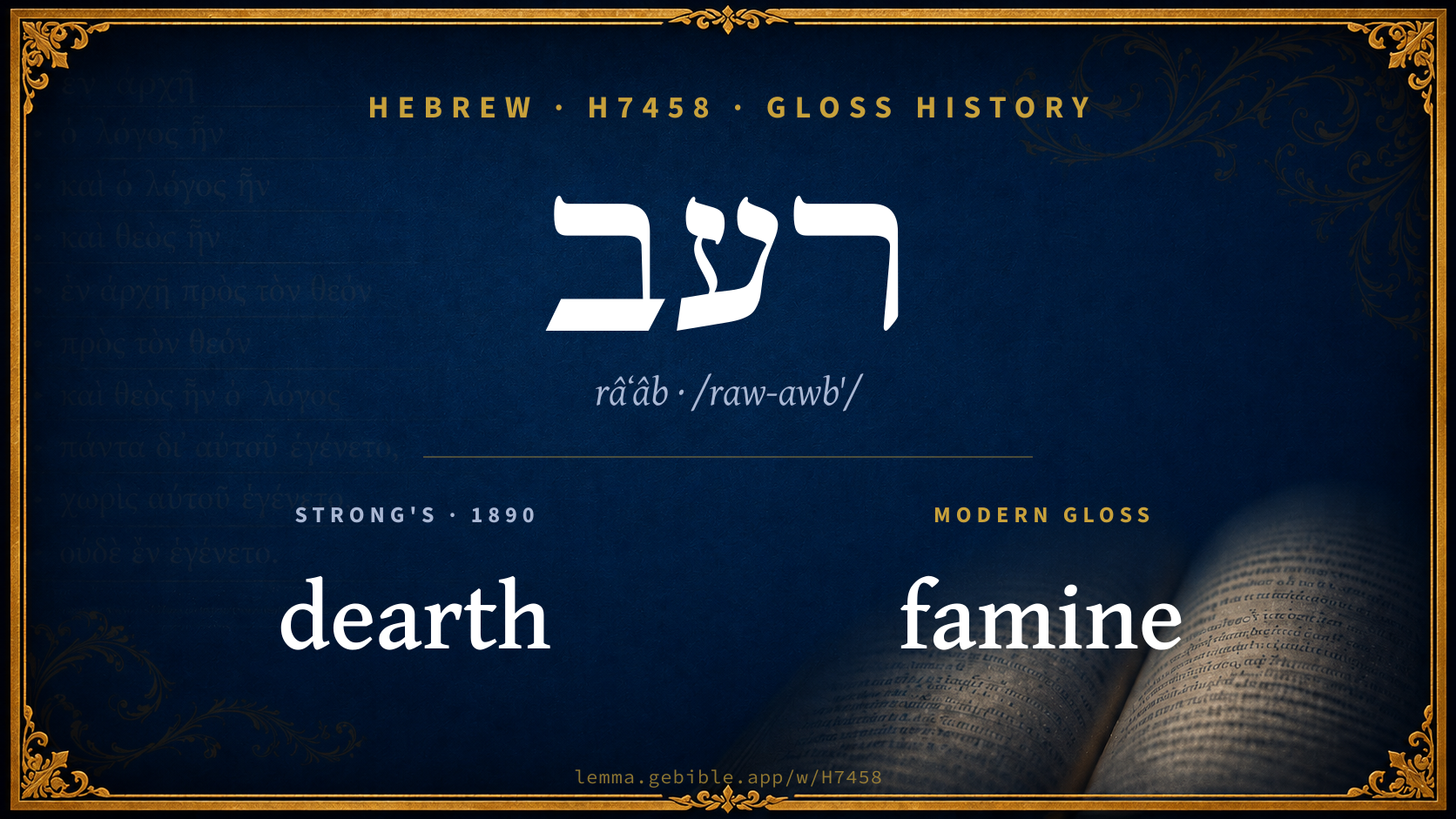
Gloss history
Strong's 1890 vs modern scholarship
About this word
Strong's H7458 catalogs a Hebrew word from the Hebrew Old Testament.
These counts are not copied from any lexicon or concordance. They are computed here, from the morphology-tagged Hebrew Old Testament. What Lemma adds →
- 88
- distinct verses
- The word appears in 88 distinct verses.
- 17 / 39
- OT books
- The word appears in 17 of 39 Old Testament books.
- #421
- by frequency
- Top 500 most frequent Hebrew words (rank 421 of 8,640 Hebrew words by occurrence).
View all 88 occurrences in the concordance →
By section of the Old Testament
By traditional corpus
Conventional, traditional groupings — biblical authorship is debated, so this is a traditional corpus grouping, not an authorship claim. Each share is this word’s portion of its verses in that division of the Hebrew canon. Each figure is a share of the word’s 88 distinct verses.
- Prophets (Nevi'im) 55 verses · 63%
- Torah (Pentateuch) 20 verses · 23%
- Writings (Ketuvim) 13 verses · 15%
How translations render this word
Counts come from each version’s own published word-to-Strong’s tagging or interlinear alignment — an approximate guide to how each version renders this word, not a word-level alignment the data otherwise carries. Because each total is that version’s own tagged count, the per-version totals vary from one another and need not match the appearance or distinct-verse counts above. These counts may also differ from a printed concordance because Lemma counts each distinctly tagged rendering and does not collapse phrase taggings into a single head-word total. This is a fixed set of word-tagged versions (KJV, ASV, BSB, ULT) and does not change with the reading translation you choose elsewhere. Each version’s license is shown beside its name below (and on Sources).
- King James Version: Famine 76×, Hunger 7×, Was a famine 4×
- American Standard Version: Famine 74×, Hunger 5×, Was a famine 4×
- Berean Standard Bible: Famine 81×, Hunger 5×, Or famine 5×
- unfoldingWord Literal Text: Famine 73×, Hunger 7×, Now the famine 2×
King James Version Public Domain
Renders H7458 across 101 tagged occurrences — most commonly:
Plus 11 renderings that appear only once — usually multi-word phrases or single function words the recovered tagging swept in, not distinct renderings.
American Standard Version Public Domain
Renders H7458 across 101 tagged occurrences — most commonly:
Plus 18 renderings that appear only once — usually multi-word phrases or single function words the recovered tagging swept in, not distinct renderings.
Berean Standard Bible Public Domain
Renders H7458 across 100 tagged occurrences — most commonly:
Plus 9 renderings that appear only once — usually multi-word phrases or single function words the recovered tagging swept in, not distinct renderings. Not rendered by a distinct English word in 1 further occurrence.
unfoldingWord Literal Text CC BY-SA 4.0
Renders H7458 across 89 tagged occurrences — most commonly:
Plus 5 renderings that appear only once — usually multi-word phrases or single function words the recovered tagging swept in, not distinct renderings.
Senses in the full BDB
What do BDB’s symbols mean?
BDB uses these scholarly abbreviations:
| Symbol | Meaning |
|---|---|
| 𝔊 | the Septuagint (the ancient Greek translation, LXX) |
| 𝔙 | the Vulgate (the Latin translation) |
| 𝔖 | the Syriac version (the Peshitta) |
| 𝔗 | the Targum (the Aramaic translation) |
| ψ | the Psalms |
| √ | root (the underlying root or stem) |
| ‖ | parallel passage (a synonymous or contrasted parallel) |
| † | the dagger: every passage where the word occurs is cited |
The 2 senses and sub-senses the full Brown-Driver-Briggs lexicon distinguishes for this word, in lexicon order (not ranked by frequency), with BDB’s own verbatim wording and sub-sense lettering. Shown in Hebrew script with BDB’s own scholarly abbreviations. The condensed entry is in the Lexicon Entry tab. See also the Forms in the corpus table below.
- 1. famine (in land, nation or city), Gn 12:10; 26:1; 41:30, 31 Ex 16:3 2 S 21:1; 24:13 = 2 K 4:38; 6:25 +; שְׁנֵי(הָ)ר׳ Gn 41:27, 30, 36, שְׁנַת ר׳ v 50, but also שָׁנִים ר׳ [שָׁלוֹשׁ] שֶׁבַע 2 S 24:13 (on gender v. AlbrZAW xvi (1896), 103) = 1 Ch 21:12; c. חזק (be) severe Gn 41:56, 57 1 K 18:2; 2 K 25:3 = Je 52:6, חזק עַל Gn 47:20; c. כָבֵד 12:10; 47:4, 13; גָּדוֹל 2 K 6:25; זַעלעֲפוֹת ר׳ La 5:10; מְזֵי ר׳ Dt 32:24 + Is 5:13 (v. [מָזֶה]), תַּחֲלוּאֵי ר׳ Je 14:18, חַלֲלֵי ר׳ La 5:9, אֲסֻפֵי ר׳ Ez 34:29; חִצֵּי הָר׳ 5:16; as scourge of י׳ (+ חֶרֶב, דֶּבֶ, etc.; especially Je Ez), Je 5:12; 11:22; 14:12; 21:7, 9 Ez 5:2; 6:11, 12 +, etc.; fig. of lack of י׳’s word Am 8:11. e.g. Genesis 12:10
- 2. hunger, of individual Je 38:9 Dt 28:48 (+ צָסָא, etc.), 2 Ch 32:11 (+ id.). e.g. Jeremiah 38:9
Senses from the full Brown-Driver-Briggs lexicon (Brown, Driver, Briggs; Oxford 1906 — public domain), digitized via Sefaria, supplemented by the OpenScriptures HebrewLexicon (CC BY 4.0). Full attribution on Sources.
Word origin
n.m. Gn 26:1 famine, hunger;—abs. ר׳ Gn 12:10 +; sf. רְעָבָם Ne 9:15;
— Brown-Driver-Briggs (Oxford 1906, public domain), digitized via Sefaria, supplemented by the OpenScriptures HebrewLexicon (CC BY 4.0). See Sources.
Derived from רעב (râʻêb) (H7456) — to be hungry.
Jastrow Dictionary
A second Hebrew/Aramaic lexicon for comparison, covering Aramaic and post-biblical (Talmudic, Targumic, Midrashic) usage that the biblical-Hebrew BDB does not. Matched by lemma rather than by Strong’s number, so a lemma may carry more than one Jastrow headword (shown separately below), and the entries cover usage well beyond the Bible.
רָעֵב I
- (b. h.) hungry. Gitt. 56ᵃ כל … כשהוא ר׳ וכ׳ whoever entered his house hungry like a dog came out satisfied. Lev. R. s. 34 (ref. to Is. LVIII, 10) אם זכיתם לרְעֵבוֹ של יעקב וכ׳ if you do good, you will give to the hungry one of Jacob, if not, to the satisfied one of Esau (to the Roman oppressor); a. fr., v. next w.—Pl. רְעֵבִים. Midr. Till. to Ps. CXVIII, 19 מאכיל ר׳ הייתי I have been a feeder of the hungry; זה השער של מאכיל ר׳ this is the gate for him who fed the hungry. Midr. Till. to Ps. CXLVI, 7 ומי הם הר׳ זה וכ׳ and who are the hungry (to whom the Lord gives bread)? Such as Elijah who was hungry &c.; a. e. e.g. Isaiah 58:10
רָעֵב II
- (b. h.) to be hungry. Succ. 52ᵇ אבר … מַרְעִיבוֹ שבע משביעו ר׳ a small organ is in man, when you starve it, it is satisfied, when you satisfy it, it is hungry; Snh. 107ᵃ. Mekh. B’shall., s. 4 ר׳ האכילו when the child was hungry, he gave him food; (Yalk. Ex. 233 נִרְעָב); a. e.
- 1. same. Mekh. l. c. ה׳ האכילו when Israel was hungry, he (the Lord) gave him food.
- 2. to starve, subject to privation. Succ. l. c. Snh. 65ᵇ (ref. to Deut. XVIII, 11 דורש אל המתים) זה המַרְעִיב עצמו וכ׳ that is he who fasts and spends the night in the cemetery in order that the spirit of impurity (unholy inspiration) may rest upon him. Ib. 100ᵃ כל המרעיב עצמו וכ׳ him who undergoes privations for the sake of studying the words of the Law in this world, the Lord will satisfy &c. Y. Keth. V, 30ᵇ האבר הזה הִרְעִיבָתוֹ השביעתו … הרעיבתו that certain organ, if she starves it, she makes it satisfied, the more she satisfies it, the more she makes it hungry, v. supra. Taan. 11ᵃ; a. e. e.g. Deuteronomy 18:11
- to be famished, v. supra.
רעב
- , Targ. Y. Num. XX, 11 וארעב ed. Vien., v. רְעַם II
רָעָב
- preced. art.) hunger, famine. Ber. 55ᵃ שלשה … ר׳ ושובע וכ׳ three things does the Lord himself announce; famine, plenty, and a good governor. B. Bath. 8ᵇ ר׳ קשה מחרב famine is a severer affliction than war. Ab. V, 8, v. בַּצּוֹרֶת; a. fr.
A Dictionary of the Targumim, the Talmud Babli and Yerushalmi, and the Midrashic Literature (Marcus Jastrow; London, Luzac, 1903) — Public Domain. Digitized via Sefaria. Digitized via Sefaria. Full attribution on Sources.
Forms in the corpus
The 54 distinct written forms H7458 takes in the Hebrew Bible, most frequent first — each parse links to that state’s occurrences in the concordance. Hebrew forms include their vowel points and cantillation, so a single lemma takes many written forms.
Same root — word family
Other BDB entries built from the same root as H7458, grouped by Strong’s listed origin. These share a root / origin per the lexicon — not necessarily a shared meaning. Each links to that word’s own entry.
Derives from
Shares the same root
Compare all same-root words → They share a root, not necessarily a meaning.
Septuagint verse parallels
This word appears in 80 verses that also exist in the Greek Old Testament (Septuagint), out of the 88 Hebrew verses it occurs in. You can read those verses in Greek by switching the Old Testament edition to the Septuagint.
Read these verses in the Septuagint
- Genesis 12:10
- Exodus 16:3
- Deuteronomy 28:48
- Ruth 1:1
- 2 Samuel 21:1
- 1 Kings 8:37
- 2 Kings 4:38
- 1 Chronicles 21:12
- 2 Chronicles 6:28
- Job 5:20
- Psalms 33:19
- Isaiah 5:13
This is a verse-level parallel only — the same verses exist in both the Hebrew and Greek Old Testaments. No word-level Hebrew↔Greek correspondence is claimed: the data carries no such alignment, so no Greek word is shown as this Hebrew word’s translation. Coverage is not total — the Septuagint omits the deuterocanon and renumbers the Psalms, so some Hebrew verses have no direct Greek parallel.