
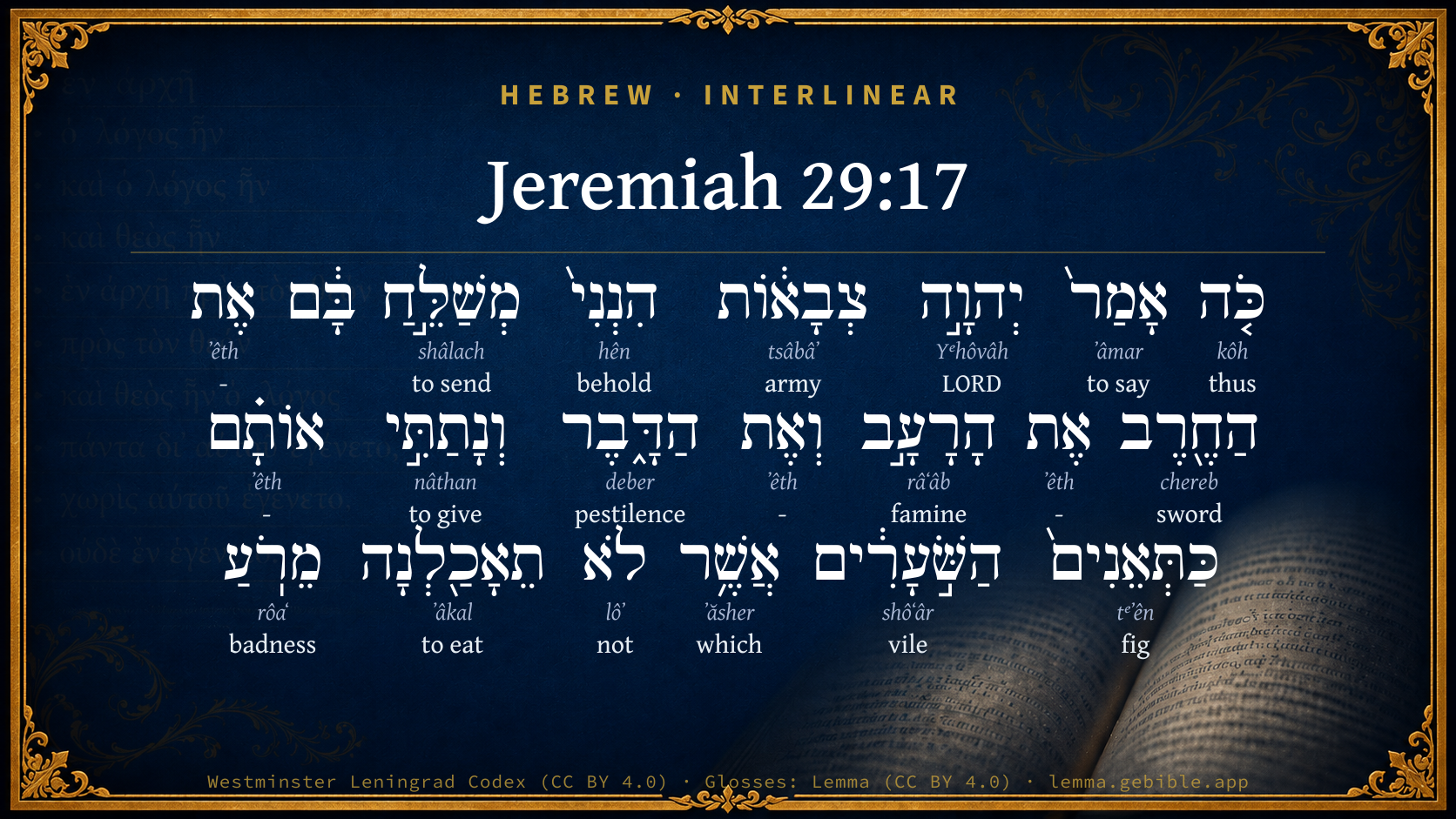
Jeremiah 29:17

Hebrew (Westminster Leningrad Codex) Jeremiah 29:17 appears in the Hebrew Old Testament. The text above is from the Westminster Leningrad Codex. Each word links to its Strong’s number, a concise gloss, and parsing drawn from the Open Scriptures Hebrew Bible morphology. Click any word for its full Brown-Driver-Briggs (BDB) entry.
Download image
Cite this verse

Jeremiah 29:17 (World English Bible). Public Domain. Lemma interlinear Bible study tool, https://lemma.gebible.app/v/jeremiah/29/17.

Show BibTeX & RIS
BibTeX
RIS
English Translation
thus says Yahweh of Hosts; Behold, I will send on them the sword, the famine, and the pestilence, and will make them like vile figs, that can't be eaten, they are so bad.
World English Bible · Public Domain
Highlights
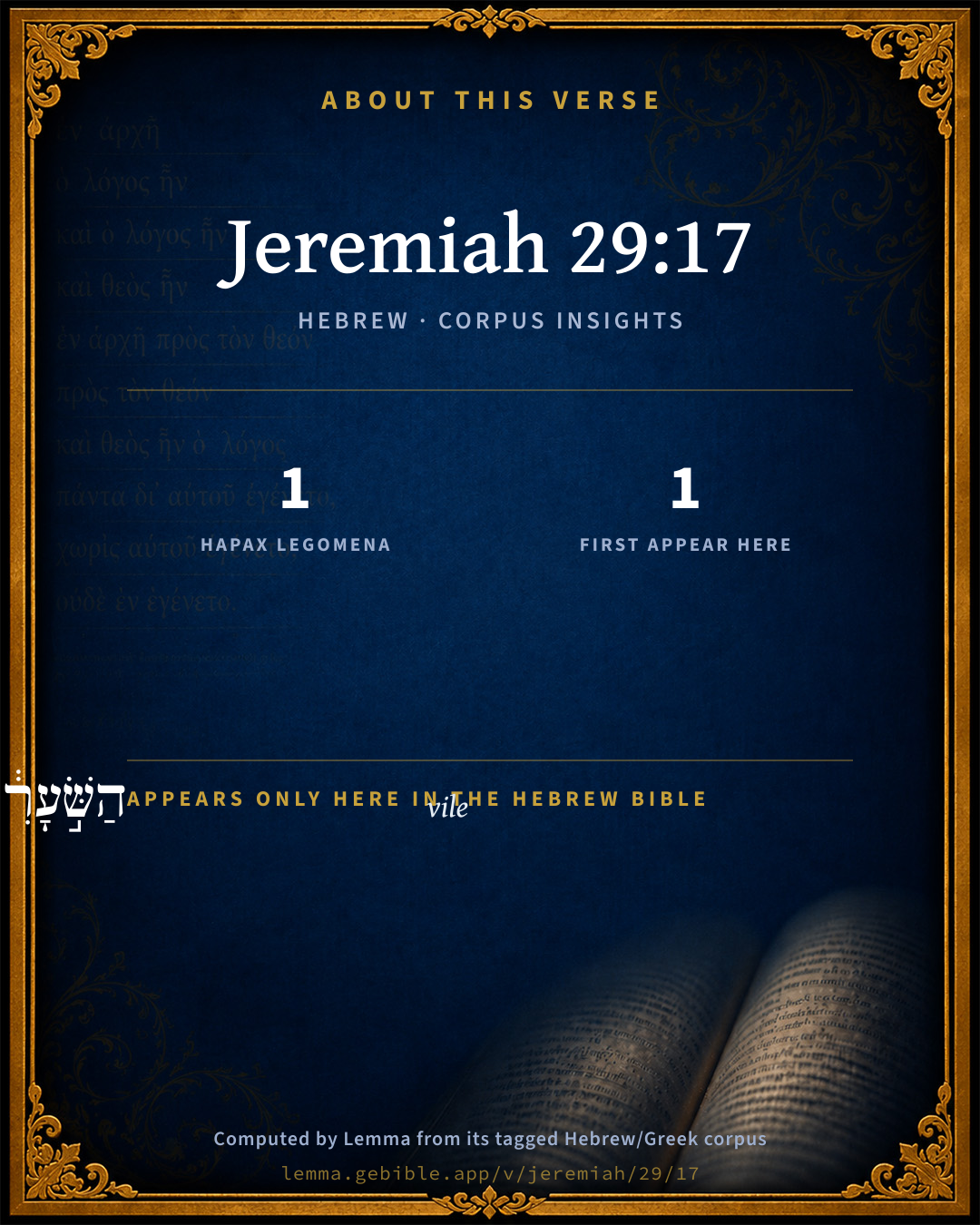
  • 1 hapax legomenon — only here in the Hebrew Bible
  • 1 first appearance in the Hebrew Bible
Full analysis ↓
Download a study sheet

One document with this verse’s original text, its word-by-word gloss line, the meaning frame, cross-references with their text, attributed commentary, and full source and license credits — printable, and it pastes into notes with its structure intact.

This verse Autodidact and up

Study sheet (.html) Plain text (.txt)

A passage Seminary Student

Up to 50 verses in one chapter. A passage sheet keeps up to 6 commentary sources and 12 cross-references per verse, in the order this page ranks them, and says so on the sheet whenever that leaves anything out. Ask for a single verse and you get the Autodidact verse sheet above.

Everything on this page stays free to read, with no account — the sheet is a download of what is already on screen, not access to it.

Want to remove ads? Support Godless Engineer
Compare translations 3

The same verse in 3 English versions, stacked beneath the original-language interlinear above. Click any original word for its lexicon entry.

Each is an independent rendering of the whole verse — the interlinear is not word-aligned to these translations.

Highlighted words mark where these versions differ — a whole-verse word diff, not a word-by-word alignment.

  • World English Bible Public Domain
    thus says Yahweh of Hosts; Behold, I will send on them the sword, the famine, and the pestilence, and will make them like vile figs, that can't be eaten, they are so bad.
  • King James Version Public Domain
    Thus saith the LORD of hosts; Behold, I will send upon them the sword, the famine, and the pestilence, and will make them like vile figs, that cannot be eaten, they are so evil.
  • unfoldingWord Literal Text CC BY-SA 4.0
    Yahweh of hosts says this, ‘See, I am about to send sword, famine, and disease on them. For I will make them like rotten figs that are too bad to be eaten.

unfoldingWord Literal Text — © unfoldingWord, licensed CC BY-SA 4.0. Word-aligned USFM3 via Door43 (git.door43.org/unfoldingWord/en_ult).

Versions to compare (up to 4)

3 of 4 selected

Show all 18 translations

Every available English version of this verse, each an independent rendering of the whole verse.

  • World English Bible Public Domain
    thus says Yahweh of Hosts; Behold, I will send on them the sword, the famine, and the pestilence, and will make them like vile figs, that can't be eaten, they are so bad.
  • Berean Standard Bible Public Domain
    this is what the LORD of Hosts says: “I will send against them sword and famine and plague, and I will make them like rotten figs, so bad they cannot be eaten.
  • Majority Standard Bible Public Domain
    this is what the LORD of Hosts says: “I will send against them sword and famine and plague, and I will make them like rotten figs, so bad they cannot be eaten.
  • King James Version Public Domain
    Thus saith the LORD of hosts; Behold, I will send upon them the sword, the famine, and the pestilence, and will make them like vile figs, that cannot be eaten, they are so evil.
  • American Standard Version (1901) Public Domain
    thus saith Jehovah of hosts; Behold, I will send upon them the sword, the famine, and the pestilence, and will make them like vile figs, that cannot be eaten, they are so bad.
  • Revised Version (1885) Public Domain
    thus saith the LORD of hosts: Behold, I will send upon them the sword, the famine, and the pestilence, and will make them like vile figs, that cannot be eaten, they are so bad.
  • Geneva Bible (1599) Public Domain
    Euen thus sayth the Lord of hostes, Beholde, I will sende vpon them the sworde, the famine, and the pestilence, and will make them like vile figges, that cannot bee eaten, they are so naughtie.
  • Douay-Rheims (1899) Public Domain
    Thus saith the Lord of hosts: Behold I will send upon them the sword, and the famine, and the pestilence: and I will make them like bad figs that cannot be eaten, because they are very bad.
  • Young's Literal Translation Public Domain
    Thus said Jehovah of Hosts, Lo, I am sending among them the sword, the famine, and the pestilence, and I have given them up as figs that `are' vile, that are not eaten for badness.
  • Literal Standard Version CC BY-SA 4.0
    thus said YHWH of Hosts: Behold, I am sending the sword, the famine, and the pestilence among them, and I have given them up as figs that [are] vile, that are not eaten because of badness.
  • Unlocked Literal Bible CC BY-SA 4.0
    Yahweh of hosts says this, 'See, I am about to send sword, famine, and disease on them. For I will make them like rotten figs that are too bad to be eaten.
  • unfoldingWord Literal Text CC BY-SA 4.0
    Yahweh of hosts says this, ‘See, I am about to send sword, famine, and disease on them. For I will make them like rotten figs that are too bad to be eaten.
  • Darby Bible Public Domain
    thus saith Jehovah of hosts: Behold, I will send against them the sword, the famine, and the pestilence, and will make them like the vile figs, that cannot be eaten for badness.
  • World Messianic Bible Public Domain
    the LORD of Hosts says: “Behold, I will send on them the sword, the famine, and the pestilence, and will make them like rotten figs that can’t be eaten, they are so bad.
  • Webster's Bible Public Domain
    Thus saith the LORD of hosts; Behold, I will send upon them the sword, the famine, and the pestilence, and will make them like vile figs, that cannot be eaten, they are so bad.
  • Free Bible Version CC BY-SA 4.0
    This is what the Lord Almighty says: I'm going to send war and famine and disease against them. I'll make them like rotten figs, so bad that they can't be eaten.
  • Bible in Basic English Public Domain
    This is what the Lord of armies has said: See, I will send on them the sword and need of food and disease, and will make them like bad figs, which are of no use for food, they are so bad.
  • JPS Tanakh (1917) Public Domain
    thus saith the LORD of hosts: Behold, I will send upon them the sword, the famine, and the pestilence, and will make them like vile figs, that cannot be eaten, they are so bad.

Literal Standard Version (2020), Covenant Press — licensed CC BY-SA 4.0. Text via the HelloAO Bible API (eBible.org). Unlocked Literal Bible (unfoldingWord) — licensed CC BY-SA 4.0. Text via the HelloAO Bible API (eBible.org). unfoldingWord Literal Text — © unfoldingWord, licensed CC BY-SA 4.0. Word-aligned USFM3 via Door43 (git.door43.org/unfoldingWord/en_ult). Free Bible Version, Dr. Jonathan Gallagher — licensed CC BY-SA 4.0. Text via the HelloAO Bible API (eBible.org).

Word by word

More ways to search: Search by grammar → Find every occurrence → Compare this word →

Practice this passage: Drill this verse → Learn its vocabulary →

הַשֹּׁ֣עָרִ֔ים
shôʻâr
H8182
“the · vile”
Particle, Definite Article + Adjective, Adjective, Masculine, Plural, Absolute
Part of Speech
Particle + Adjective
Type
Adjective
Gender
Masculine
Number
Plural
State
Absolute
Full BDB Definition

Origin: from H8176

TWOT: 2439a

horrid, disgusting, vile, offensive
  1. כֹּ֤ה kôh H3541 “thus” Adverb
  2. אָמַר֙ ʼâmar H559 “to say” Verb, Qal, Perfect, 3rd Person, Masculine, Singular
  3. יְהוָ֣ה Yᵉhôvâh H3068 “LORD” Noun, Proper
  4. צְבָא֔וֹת tsâbâʼ H6635 “armies” Noun, Common, Both, Plural, Absolute
  5. הִנְנִי֙ hên H2005 “behold · me” Particle, Demonstrative + Suffix, Personal, 1st Person, Common, Singular
  6. מְשַׁלֵּ֣חַ shâlach H7971 “sending” Verb, Piel, Participle Active, Masculine, Singular, Absolute
  7. אֶת ʼêth H853 “-” Particle, Direct Object
  8. הַחֶ֖רֶב chereb H2719 “the · sword” Particle, Definite Article + Noun, Common, Feminine, Singular, Absolute
  9. אֶת ʼêth H853 “-” Particle, Direct Object
  10. הָרָעָ֣ב râʻâb H7458 “the · famine” Particle, Definite Article + Noun, Common, Masculine, Singular, Absolute
  11. וְאֶת ʼêth H853 “and · -” Conjunction + Particle, Direct Object
  12. הַדָּ֑בֶר deber H1698 “the · pestilence” Particle, Definite Article + Noun, Common, Masculine, Singular, Absolute
  13. וְנָתַתִּ֣י nâthan H5414 “and · to give” Conjunction + Verb, Qal, Sequential Perfect, 1st Person, Common, Singular
  14. אוֹתָ֗ם ʼêth H853 “- · them” Particle, Direct Object + Suffix, Personal, 3rd Person, Masculine, Plural
  15. כַּתְּאֵנִים֙ tᵉʼên H8384 “like/as the · figs” Preposition, Determined + Noun, Common, Feminine, Plural, Absolute
  16. אֲשֶׁ֥ר ʼăsher H834 “which” Particle, Relative
  17. לֹא lôʼ H3808 “not” Particle, Negative
  18. תֵאָכַ֖לְנָה ʼâkal H398 “to eat” Verb, Niphal, Imperfect, 3rd Person, Feminine, Plural
  19. מֵרֹֽעַ rôaʻ H7455 “from · badness” Preposition + Noun, Common, Masculine, Singular, Absolute

About this verse

These counts appear in no published source. They are computed here, from the morphology-tagged text and Lemma’s own curated glosses. What Lemma adds →

21
words
17
distinct lemmas
Prophets
section

Notable vocabulary

1 hapax legomenon — a word that appears only here in the entire Hebrew Bible:

  • הַשֹּׁ֣עָרִ֔ים vile H8182

First appearance in Scripture

This word makes its first canonical appearance in the Hebrew Bible here:

  • הַשֹּׁ֣עָרִ֔ים vile H8182

Shared distinctive vocabulary

מֵרֹֽעַ badness H7455 occurs in 19 verses of the Hebrew Bible. Also found in:

Grammatical profile

  • 4 verbs
  • 7 nouns
  • 1 adjective
  • 1 preposition
  • 1 adverb
  • 7 particles

Verb forms

  • אָמַר֙ Qal · Perfect
  • מְשַׁלֵּ֣חַ Piel · Participle Active
  • וְנָתַתִּ֣י Qal · Sequential Perfect
  • תֵאָכַ֖לְנָה Niphal · Imperfect

Cross-references

12

Topical passages linked to Jeremiah 29:17 in the Treasury of Scripture Knowledge — connected by theme and wording, ordered by reader-vote popularity; previews shown in the World English Bible.

  • Jeremiah 24:8–10 As the bad figs, which can't be eaten, they are so bad, surely thus says Yahweh, So will I give up Zedekiah the king of Judah, and his princes, and the residue of Jerusalem, who remain in this land, and those who dwell in the land of Egypt,
  • Jeremiah 29:18 I will pursue after them with the sword, with the famine, and with the pestilence, and will deliver them to be tossed back and forth among all the kingdoms of the earth, to be an object of horror, and an astonishment, and a hissing, and a reproach, among all the nations where I have driven them;
  • Jeremiah 15:2–3 It shall happen, when they tell you, Where shall we go forth? then you shall tell them, Thus says Yahweh: Such as are for death, to death; and such as are for the sword, to the sword; and such as are for the famine, to the famine; and such as are for captivity, to captivity.
  • Jeremiah 24:1–3 Yahweh shown me, and, behold, two baskets of figs set before the temple of Yahweh, after that Nebuchadrezzar king of Babylon had carried away captive Jeconiah the son of Jehoiakim, king of Judah, and the princes of Judah, with the craftsmen and smiths, from Jerusalem, and had brought them to Babylon.
  • Jeremiah 27:8 It shall happen, that the nation and the kingdom which will not serve the same Nebuchadnezzar king of Babylon, and that will not put their neck under the yoke of the king of Babylon, that nation will I punish, says Yahweh, with the sword, and with the famine, and with the pestilence, until I have consumed them by his hand.
  • Jeremiah 34:17–22 Therefore thus says Yahweh: you have not listened to me, to proclaim liberty, every man to his brother, and every man to his neighbor: behold, I proclaim to you a liberty, says Yahweh, to the sword, to the pestilence, and to the famine; and I will make you to be tossed back and forth among all the kingdoms of the earth.
  • Jeremiah 43:11 He shall come, and shall strike the land of Egypt; such as are for death [shall be given] to death, and such as are for captivity to captivity, and such as are for the sword to the sword.
  • Jeremiah 52:6 In the fourth month, in the ninth day of the month, the famine was sore in the city, so that there was no bread for the people of the land.
  • Ezekiel 5:12–17 A third part of you shall die with the pestilence, and with famine shall they be consumed in the midst of you; and a third part shall fall by the sword round about you; and a third part I will scatter to all the winds, and will draw out a sword after them.
  • Ezekiel 14:12–21 The word of Yahweh came to me, saying,
  • Luke 21:11 There will be great earthquakes, famines, and plagues in various places. There will be terrors and great signs from heaven.
  • Luke 21:23 Woe to those who are pregnant and to those who nurse infants in those days! For there will be great distress in the land, and wrath to this people.

Cross-references courtesy of OpenBible.info (CC BY 4.0).

Hebrew and Greek witnesses Masoretic Hebrew ↔ Greek Septuagint

The same verse in the two great witnesses to the Old Testament, shown verse-for-verse.

These are two independent witnesses, not word-aligned to each other, and the Septuagint is shown in lemma (dictionary) form.

Hebrew Jeremiah 29:17 Masoretic · Westminster Leningrad Codex

כֹּ֤ה אָמַר֙ יְהוָ֣ה צְבָא֔וֹת הִנְנִי֙ מְשַׁלֵּ֣חַ בָּ֔ם אֶת הַחֶ֖רֶב אֶת הָרָעָ֣ב וְאֶת הַדָּ֑בֶר וְנָתַתִּ֣י אוֹתָ֗ם כַּתְּאֵנִים֙ הַשֹּׁ֣עָרִ֔ים אֲשֶׁ֥ר לֹא תֵאָכַ֖לְנָה מֵרֹֽעַ

thus says Yahweh of Hosts; Behold, I will send on them the sword, the famine, and the pestilence, and will make them like vile figs, that can't be eaten, they are so bad.

World English Bible · Public Domain

Greek LXX Structure differs

In the Septuagint, Jeremiah is about an eighth shorter than the Hebrew and arranges its material differently — the Oracles Against the Nations (Hebrew chapters 46–51) appear in the middle of the Greek book, after 25:13. Because the chapter and verse boundaries do not line up, a verse-for-verse comparison with the Hebrew is not shown.

A verse-for-verse comparison isn’t shown here because the chapters and verses don’t line up. Switch to the LXX edition with the MT / LXX toggle above to read the Greek directly.

Hebrew: Westminster Leningrad Codex (CC BY 4.0). Greek: Septuagint (public domain); English from a public-domain English Septuagint. How the Septuagint differs from the Hebrew →

Targum (Aramaic paraphrase)

1

The Targum is the ancient Jewish Aramaic paraphrase of the Hebrew Scriptures — an interpretive translation, not the Hebrew text itself. Onkelos (literal) and Pseudo-Jonathan (expansive) render the Torah, and Jonathan the Prophets. Coverage is partial: where no permissively-licensed English translation exists for a verse, only the Aramaic is shown. This is verse-level text, not a word-by-word alignment to the Hebrew.

  1. Targum Jonathan Prophets (Joshua–Malachi)
    כִּדְנַן אֲמַר יְיָ צְבָאוֹת הָאֲנָא מְגָרֵי בְּהוֹן יַת דְקַטְלִין בְּחַרְבָּא וּבְכַפְנָא וּמוֹתָא וְאֶתֵּן יַתְהוֹן כְּתֵינַיָא בִּישָׁתָא דְלָא מִתְאַכְלָן מִבִּישׁוּ:

    (no public-domain English translation for this verse)

    Targum Jonathan — Aramaic: “Mikraot Gedolot” (public domain). English: “Sefaria Community Translation” (CC0 1.0 (public-domain dedication)); “London "Chaldee Paraphrase," 1871” (public domain). Text via Sefaria.

Commentary

Notes on Jeremiah 29:17 from classic Christian and Jewish commentators (each source and its license shown beneath its notes). The classic Christian expositions comment on the surrounding passage and are grouped to its opening verse, so a note may address several verses; the Jewish commentaries on the Tanakh (Rashi and others) are per-verse, so they appear only where the commentator wrote on this verse.

Lemma curates 59 commentaries, every one of them public domain or Creative Commons licensed, each selected and text-cleaned for this edition rather than reprinted as found. About our sources →

Trapp's Complete Commentary

John Trapp

Jer 29:17 Thus saith the LORD of hosts; Behold, I will send upon them the sword, the famine, and the pestilence, and will make them like vile figs, that cannot be eaten, they are so evil.

Ver. 17. Behold, I will send upon them.] Jer 24:10; Jer 27:8.

And will make them like vile figs.] See Jer 24:8.

John Trapp, A Commentary or Exposition upon All the Books of the Old and New Testament (1647–1656) — public domain. Text from a community e-Sword module.

Geneva Bible (1599)

Geneva Bible translators

According to the comparison, Jer. 24:1, 2.

Whereby he assureth them, that there shall be no hope of returning before the time appointed.

Geneva Bible (1599) marginal notes — public domain. Text via Bolls.life.

Jamieson, Fausset & Brown

Robert Jamieson, A. R. Fausset & David Brown

vile figs--Hebrew, "horrible," or nauseous, from a root, "to regard with loathing" (see Jer 24:8, Jer 24:10).

Jamieson, Fausset & Brown — Commentary Critical and Explanatory on the Whole Bible (1871) — public domain (CC PDM 1.0). Text via the HelloAO Bible API.

Adam Clarke's Commentary

Verse 17. Behold, I will send upon them the sword] Do not envy the state of Zedekiah who sits on the throne of David, nor that of the people who are now in the land whence ye have been carried captive, (Jer 29:16,) for "I will send the sword, the pestilence, and the famine upon them;" and afterwards shall cause them to be carried into a miserable captivity in all nations, (Jer 29:18;) but ye see the worst of your own case, and you have God's promise of enlargement when the proper time is come. The reader will not forget that the prophet is addressing the captives in Babylon.

Adam Clarke's Commentary on the Bible (1810–1826) — public domain. Text from a community e-Sword/MySword module.

John Calvin's Commentaries

He says, I will pursue them with the sword, and famine, and pestilence The surrender of Jeconiah, as we have elsewhere seen, was voluntary; he was therefore more kindly received by the king of Babylon. At length the city was attacked, and as the siege was long, there was more rage felt against the king and the whole people, for the Chaldeans had been wearied by their obstinacy. Hence it was, that they dealt more severely with them. But nothing happened except through the just vengeance of God; for though they exasperated the Chaldeans, there is no doubt but that God blinded their minds so that they procured for themselves a heavier judgment. It was, then, a punishment inflicted on them by God; and hence rightly does Jeremiah testify that God was the author of those calamities, for the Chaldeans, as we have seen elsewhere, were only ministers and executioners of God’s vengeance; Jehovah of hosts then says, Behold, I will pursue you, etc.

He then adds, And I will make them like worthless figs He calls the figs here שערים, sherim, worthless; but in the twenty-fourth chapter he called them bad; still the meaning is the same. There is no doubt but that he refers to the prophecy which we there explained. For the Prophet saw two baskets of figs, in one of which were sweet figs, and in the other bitter. God asked, “What seest thou?” he said, “Good figs, very good, and bad figs, very bad.” God afterwards added, “The good and sweet figs are the captives; for I will at length shew mercy to them, and liberty to return shall be given them. They shall then be good figs, though now a different opinion is formed; for they who still lived at Jerusalem, think themselves more happy than the exiles; but the bad and bitter figs,” he says, “are this people who pride themselves, because they have not been led into captivity; for I will consume them with the pestilence, and the famine, and the sword.” This was the Prophet’s language in that passage. He now again declares that King Zedekiah and all the people would be like bitter and putrid figs, which, being so bad, are not fit to be eaten. He then adds, —

John Calvin's Commentaries (1540-1563) — public domain. Text from the Calvin Translation Society English edition (1840s-50s) via the Christian Classics Ethereal Library (ccel.org). Calvin's coverage is partial (roughly two-thirds of the Bible); uncommented books and verses are honest gaps, never fabricated. The 19th-century editor's footnotes and remarks are omitted so the notes are faithfully Calvin's own voice.

The Cambridge Bible for Schools and Colleges

gen. ed. J. J. S. Perowne

17. vile figs] Cp. Jer_24:2-8.

The Cambridge Bible for Schools and Colleges (gen. ed. J. J. S. Perowne; Cambridge University Press, 1878–1918) — public domain. Text from a community e-Sword module.

John Gill's Exposition

Thus saith the Lord of hosts, behold, I will send upon them the sword,.... The sword of the Chaldeans, by which many of them should fall, as they did. The Targum is,

"I will send upon them those that kill with the sword:''

who, though they were prompted to come against the Jews, through a natural and ambitious desire of conquering and plundering, yet were sent of God; nor would they have come, had he not willed and suffered it:

the famine and the pestilence; to destroy others that escaped the sword; both these raged while Jerusalem was besieged by the Chaldeans:

and will make them like vile figs, that cannot be eaten, they are so evil; to which they are compared, Jer 24:8. The sense is, that as they had made themselves wicked and corrupt, like naughty and rotten figs, so the Lord would deal with them as men do with such, cast them away, as good for nothing. The word (z) for "vile" signifies something horrible; and designs such figs so bad, that they even strike the eater of them with horror.

(z) "tanquam ficus horrendas", Junius & Tremellius, Piscator; so Stockius, p. 1129.

John Gill's Exposition of the Whole Bible (1746–1763) — public domain (CC PDM 1.0). Text via the HelloAO Bible API.

Haydock's Catholic Bible Commentary

CHAPTER XXIX.

George Leo Haydock (1774–1849), Haydock's Catholic Family Bible and Commentary, 1859 edition — public domain. Excludes Psalms (Douay-Rheims chapter numbering differs from Protestant) and Deuterocanonical books (Catholic canon only).

Whedon's Commentary on the Bible

Daniel D. Whedon

17. Vile figs — See Jer_24:2, etc. The adjective is very expressive in the original — shuddering — such figs as make one shudder to taste them.

Daniel D. Whedon (gen. ed.), Commentary on the Old and New Testaments (1874–1909) — public domain. Text from a community e-Sword module.

The Pulpit Commentary

I will send upon them, etc.; alluding to Jer_24:10. vile figs; literally, figs exciting a shudder. The figure involves an allusion Jer_24:2, Jer_24:3.

The Pulpit Commentary (1880–1919), ed. H.D.M. Spence-Jones & Joseph S. Exell — public domain. Text from a community e-Sword module.

Rashi

Rabbi Shlomo Yitzchaki (Rashi)

as the loathsome figs Heb. הַֹשֹּעָרִים, an expression of, ֹשַעֲרוּרִיָּה, “a disgraceful thing” (Hos. 6:10).

Rashi on the Tanakh — English translations: “The Judaica Press complete Tanach with Rashi, translated by A. J. Rosenberg” (CC BY 4.0); “Pentateuch with Rashi's commentary by M. Rosenbaum and A.M. Silbermann, 1929-1934” (public domain); “The Metsudah Tanach series, Lakewood, N.J” (CC BY 4.0); and “The Book of Joshua, Metsudah Publications, 1997” (CC BY 4.0). Text via Sefaria.

Lesson kit

Teaching starters — assembled from the data on this page, not authored interpretation. Every prompt links to the verse data it draws on. Edit before teaching.

Jeremiah, in the Prophets, opens this verse with 21 words (17 distinct Hebrew lemmas). Its most distinctive word is shôʻâr (“vile”). A historical commentator’s framing appears above. Read the whole chapter for the surrounding context.

Discussion questions

  1. The word shôʻâr carries the sense “vile.” How does it shape the verse?
  2. This verse holds 1 word here found nowhere else in the Hebrew Bible. What might the rare word draw attention to?
  3. The word “vile” first appears here in Scripture. What is being introduced at this debut?
  4. Genesis 41:19 shares the word «badness» with this verse. How do the two illuminate each other?
  5. These translations render this verse differently. What is at stake in choosing one wording over another?
  6. The verb «אָמַר֙» is Qal Perfect. How does its form color the action?
  7. Reading how Trapp's Complete Commentary and Geneva Bible (1599) read this verse, where do the two commentators agree and where do they part?

Things to notice

  • 1 word in this verse appears nowhere else in the Hebrew Bible.
  • 1 word makes its first canonical appearance in Scripture here.
  • These translations choose different wording for 18 words in this verse.
  • 17 distinct Hebrew lemmas span 21 words in this verse.

Reading settings

Reading text

Shown beneath each verse's original-language words.

Old Testament
Old Testament edition

Read the OT as the Masoretic Hebrew (MT) or the Greek Septuagint (LXX).

English shown for the Greek Septuagint (in the Hebrew ↔ Greek comparison).

Comparing translations? Open the Compare panel on any verse page to stack up to four side by side.