
Jeremiah 27:8

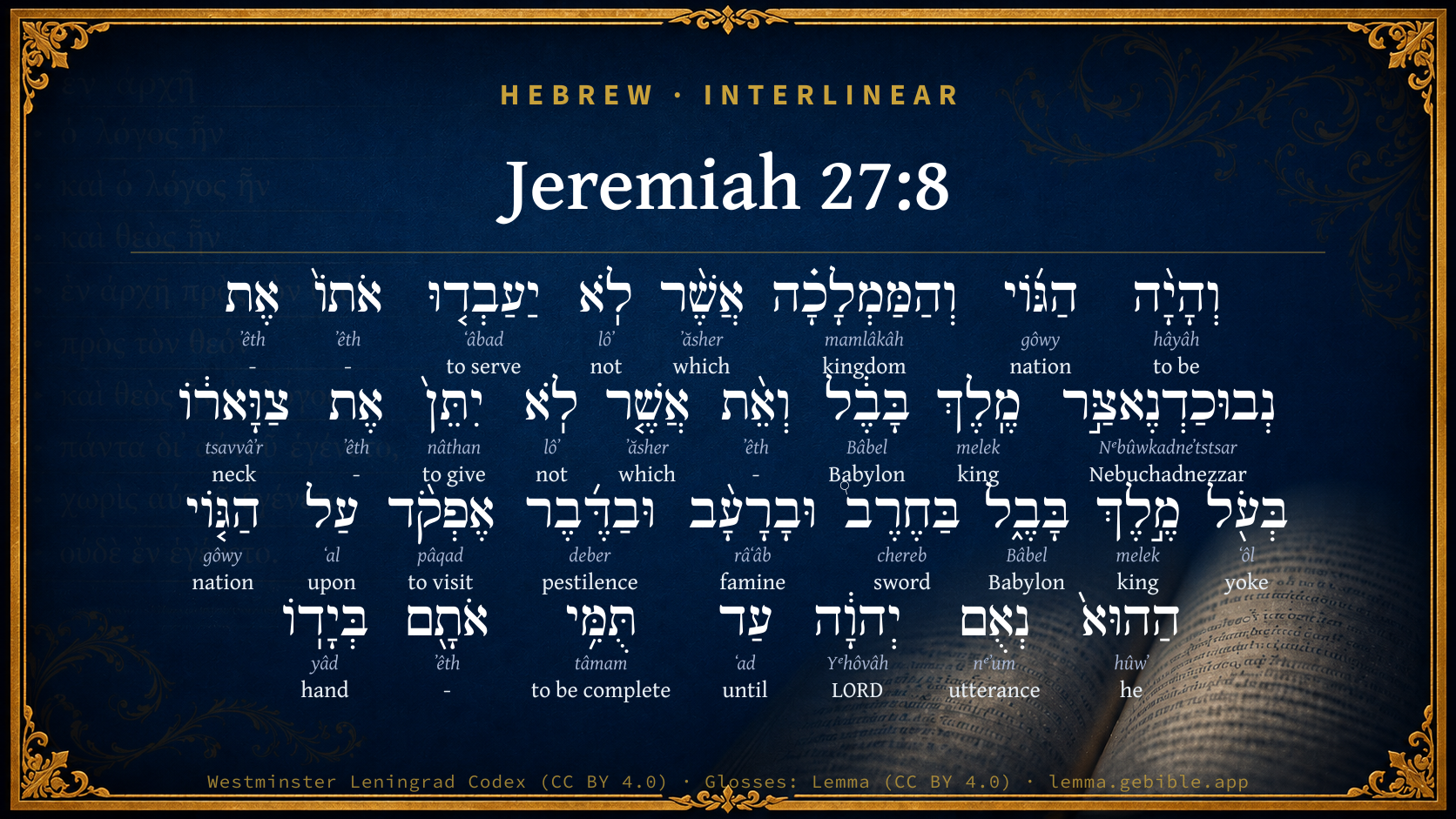
Hebrew (Westminster Leningrad Codex) Jeremiah 27:8 appears in the Hebrew Old Testament. The text above is from the Westminster Leningrad Codex. Each word links to its Strong’s number, a concise gloss, and parsing drawn from the Open Scriptures Hebrew Bible morphology. Click any word for its full Brown-Driver-Briggs (BDB) entry.
Download image
Cite this verse

Jeremiah 27:8 (World English Bible). Public Domain. Lemma interlinear Bible study tool, https://lemma.gebible.app/v/jeremiah/27/8.

Show BibTeX & RIS
BibTeX
RIS
English Translation
It shall happen, that the nation and the kingdom which will not serve the same Nebuchadnezzar king of Babylon, and that will not put their neck under the yoke of the king of Babylon, that nation will I punish, says Yahweh, with the sword, and with the famine, and with the pestilence, until I have consumed them by his hand.
World English Bible · Public Domain
Download a study sheet

One document with this verse’s original text, its word-by-word gloss line, the meaning frame, cross-references with their text, attributed commentary, and full source and license credits — printable, and it pastes into notes with its structure intact.

This verse Autodidact and up

Study sheet (.html) Plain text (.txt)

A passage Seminary Student

Up to 50 verses in one chapter. A passage sheet keeps up to 6 commentary sources and 12 cross-references per verse, in the order this page ranks them, and says so on the sheet whenever that leaves anything out. Ask for a single verse and you get the Autodidact verse sheet above.

Everything on this page stays free to read, with no account — the sheet is a download of what is already on screen, not access to it.

Want to remove ads? Support Godless Engineer
Compare translations 3

The same verse in 3 English versions, stacked beneath the original-language interlinear above. Click any original word for its lexicon entry.

Each is an independent rendering of the whole verse — the interlinear is not word-aligned to these translations.

Highlighted words mark where these versions differ — a whole-verse word diff, not a word-by-word alignment.

  • World English Bible Public Domain
    It shall happen, that the nation and the kingdom which will not serve the same Nebuchadnezzar king of Babylon, and that will not put their neck under the yoke of the king of Babylon, that nation will I punish, says Yahweh, with the sword, and with the famine, and with the pestilence, until I have consumed them by his hand.
  • King James Version Public Domain
    And it shall come to pass, that the nation and kingdom which will not serve the same Nebuchadnezzar the king of Babylon, and that will not put their neck under the yoke of the king of Babylon, that nation will I punish, saith the LORD, with the sword, and with the famine, and with the pestilence, until I have consumed them by his hand.
  • unfoldingWord Literal Text CC BY-SA 4.0
    And it shall be the nation and the kingdom that will not serve him, Nebuchadnezzar king of Babylon, and that will not put its neck in the yoke of the king of Babylon, with the sword and with the famine and with the plague I will visit upon that nation”—the declaration of Yahweh—“until I have finished them by his hand.

unfoldingWord Literal Text — © unfoldingWord, licensed CC BY-SA 4.0. Word-aligned USFM3 via Door43 (git.door43.org/unfoldingWord/en_ult).

Versions to compare (up to 4)

3 of 4 selected

Show all 18 translations

Every available English version of this verse, each an independent rendering of the whole verse.

  • World English Bible Public Domain
    It shall happen, that the nation and the kingdom which will not serve the same Nebuchadnezzar king of Babylon, and that will not put their neck under the yoke of the king of Babylon, that nation will I punish, says Yahweh, with the sword, and with the famine, and with the pestilence, until I have consumed them by his hand.
  • Berean Standard Bible Public Domain
    As for the nation or kingdom that does not serve Nebuchadnezzar king of Babylon and does not place its neck under his yoke, I will punish that nation by sword and famine and plague, declares the LORD, until I have destroyed it by his hand.
  • Majority Standard Bible Public Domain
    As for the nation or kingdom that does not serve Nebuchadnezzar king of Babylon and does not place its neck under his yoke, I will punish that nation by sword and famine and plague, declares the LORD, until I have destroyed it by his hand.
  • King James Version Public Domain
    And it shall come to pass, that the nation and kingdom which will not serve the same Nebuchadnezzar the king of Babylon, and that will not put their neck under the yoke of the king of Babylon, that nation will I punish, saith the LORD, with the sword, and with the famine, and with the pestilence, until I have consumed them by his hand.
  • American Standard Version (1901) Public Domain
    And it shall come to pass, that the nation and the kingdom which will not serve the same Nebuchadnezzar king of Babylon, and that will not put their neck under the yoke of the king of Babylon, that nation will I punish, saith Jehovah, with the sword, and with the famine, and with the pestilence, until I have consumed them by his hand.
  • Revised Version (1885) Public Domain
    And it shall come to pass, that the nation and the kingdom which will not serve the same Nebuchadnezzar king of Babylon, and that will not put their neck under the yoke of the king of Babylon, that nation will I punish, saith the LORD, with the sword, and with the famine, and with the pestilence, until I have consumed them by his hand.
  • Geneva Bible (1599) Public Domain
    And the nation and kingdome which will not serue the same Nebuchad-nezzar king of Babel, and that will not put their necke vnder the yoke of the King of Babel, the same nation will I visite, saith the Lord, with the sworde, and with the famine, and with the pestilence, vntill I haue wholy giuen them into his hands.
  • Douay-Rheims (1899) Public Domain
    But the nation and kingdom that will not serve Nabuchodonosor king of Babylon, and whosoever will not bend his neck under the yoke of the king of Babylon: I will visit upon that nation with the sword, and with famine, and with pestilence, saith the Lord: till I consume them by his hand.
  • Young's Literal Translation Public Domain
    And it hath come to pass, the nation and the kingdom that do not serve him -- Nebuchadnezzar king of Babylon -- and that which putteth not its neck into the yoke of the king of Babylon, with sword, and with famine, and with pestilence, I lay a charge on that nation -- an affirmation of Jehovah -- till I consume them by his hand.
  • Literal Standard Version CC BY-SA 4.0
    And it has come to pass, the nation and the kingdom that does not serve him—Nebuchadnezzar king of Babylon—and that which does not put its neck into the yoke of the king of Babylon, with sword, and with famine, and with pestilence, I lay a charge on that nation—a declaration of YHWH—until I consume them by his hand.
  • Unlocked Literal Bible CC BY-SA 4.0
    So the nation and the kingdom that does not serve Nebuchadnezzar, king of Babylon, and that does not put its neck under the yoke of the king of Babylon—I will punish that nation with the sword, with famine, and with the plague—this is Yahweh's declaration—until I have destroyed it by his hand.
  • unfoldingWord Literal Text CC BY-SA 4.0
    And it shall be the nation and the kingdom that will not serve him, Nebuchadnezzar king of Babylon, and that will not put its neck in the yoke of the king of Babylon, with the sword and with the famine and with the plague I will visit upon that nation”—the declaration of Yahweh—“until I have finished them by his hand.
  • Darby Bible Public Domain
    And it shall come to pass, that the nation and kingdom which will not serve the same Nebuchadnezzar king of Babylon, and that will not put their neck under the yoke of the king of Babylon, that nation will I visit, saith Jehovah, with the sword, and with the famine, and with the pestilence, until I have consumed them by his hand.
  • World Messianic Bible Public Domain
    “‘“‘It will happen that I will punish the nation and the kingdom which will not serve the same Nebuchadnezzar king of Babylon, and that will not put their neck under the yoke of the king of Babylon,’ says the LORD, ‘with the sword, with famine, and with pestilence, until I have consumed them by his hand.
  • Webster's Bible Public Domain
    And it shall come to pass, that the nation and kingdom which will not serve the same Nebuchadnezzar, king of Babylon, and that will not put their neck under the yoke of the king of Babylon, that nation will I punish, saith the LORD, with the sword, and with the famine, and with the pestilence, until I have consumed them by his hand.
  • Free Bible Version CC BY-SA 4.0
    Any nation or kingdom that doesn't serve Nebuchadnezzar king of Babylon and doesn't submit to him I will punish that nation by war and famine and plague, declares the Lord, until I let Nebuchadnezzar destroy it completely.
  • Bible in Basic English Public Domain
    And it will come about, that if any nation does not become a servant to this same Nebuchadnezzar, king of Babylon, and does not put its neck under the yoke of the king of Babylon, then I will send punishment on that nation, says the Lord, by the sword and need of food and by disease, till I have given them into his hands.
  • JPS Tanakh (1917) Public Domain
    And it shall come to pass, that the nation and the kingdom which will not serve the same Nebuchadnezzar king of Babylon, and that will not put their neck under the yoke of the king of Babylon, that nation will I visit, saith the LORD, with the sword, and with the famine, and with the pestilence, until I have consumed them by his hand.

Literal Standard Version (2020), Covenant Press — licensed CC BY-SA 4.0. Text via the HelloAO Bible API (eBible.org). Unlocked Literal Bible (unfoldingWord) — licensed CC BY-SA 4.0. Text via the HelloAO Bible API (eBible.org). unfoldingWord Literal Text — © unfoldingWord, licensed CC BY-SA 4.0. Word-aligned USFM3 via Door43 (git.door43.org/unfoldingWord/en_ult). Free Bible Version, Dr. Jonathan Gallagher — licensed CC BY-SA 4.0. Text via the HelloAO Bible API (eBible.org).

Word by word

More ways to search: Search by grammar → Find every occurrence → Compare this word →

Practice this passage: Drill this verse → Learn its vocabulary →

בְּעֹ֖ל
ʻôl
H5923
“in/at · yoke of”
Preposition + Noun, Common, Masculine, Singular, Construct
Part of Speech
Preposition + Noun
Type
Common
Gender
Masculine
Number
Singular
State
Construct
Full BDB Definition

Origin: from H5953

TWOT: 1628a

yoke
  1. וְהָיָ֨ה hâyâh H1961 “and · to be” Conjunction + Verb, Qal, Sequential Perfect, 3rd Person, Masculine, Singular
  2. הַגּ֜וֹי gôwy H1471 “the · nation” Particle, Definite Article + Noun, Common, Masculine, Singular, Absolute
  3. וְהַמַּמְלָכָ֗ה mamlâkâh H4467 “and · the · kingdom” Conjunction + Particle, Definite Article + Noun, Common, Feminine, Singular, Absolute
  4. אֲשֶׁ֨ר ʼăsher H834 “which” Particle, Relative
  5. לֹֽא lôʼ H3808 “not” Particle, Negative
  6. יַעַבְד֤וּ ʻâbad H5647 “to serve” Verb, Qal, Imperfect, 3rd Person, Masculine, Plural
  7. אֹתוֹ֙ ʼêth H853 “- · him” Particle, Direct Object + Suffix, Personal, 3rd Person, Masculine, Singular
  8. אֶת ʼêth H853 “-” Particle, Direct Object
  9. נְבוּכַדְנֶאצַּ֣ר Nᵉbûwkadneʼtstsar H5019 “Nebuchadnezzar” Noun, Proper
  10. מֶֽלֶךְ melek H4428 “king of” Noun, Common, Masculine, Singular, Construct
  11. בָּבֶ֔ל Bâbel H894 “Babylon” Noun, Proper
  12. וְאֵ֨ת ʼêth H853 “and · -” Conjunction + Particle, Direct Object
  13. אֲשֶׁ֤ר ʼăsher H834 “which” Particle, Relative
  14. לֹֽא lôʼ H3808 “not” Particle, Negative
  15. יִתֵּן֙ nâthan H5414 “to give” Verb, Qal, Imperfect, 3rd Person, Masculine, Singular
  16. אֶת ʼêth H853 “-” Particle, Direct Object
  17. צַוָּאר֔וֹ tsavvâʼr H6677 “neck · his” Noun, Common, Masculine, Singular, Construct + Suffix, Personal, 3rd Person, Masculine, Singular
  18. מֶ֣לֶךְ melek H4428 “king of” Noun, Common, Masculine, Singular, Construct
  19. בָּבֶ֑ל Bâbel H894 “Babylon” Noun, Proper
  20. בַּחֶרֶב֩ chereb H2719 “in/at the · sword” Preposition, Determined + Noun, Common, Feminine, Singular, Absolute
  21. וּבָרָעָ֨ב râʻâb H7458 “and · in/at the · famine” Conjunction + Preposition, Determined + Noun, Common, Masculine, Singular, Absolute
  22. וּבַדֶּ֜בֶר deber H1698 “and · in/at the · pestilence” Conjunction + Preposition, Determined + Noun, Common, Masculine, Singular, Absolute
  23. אֶפְקֹ֨ד pâqad H6485 “to visit” Verb, Qal, Imperfect, 1st Person, Common, Singular
  24. עַל ʻal H5921 “upon” Preposition
  25. הַגּ֤וֹי gôwy H1471 “the · nation” Particle, Definite Article + Noun, Common, Masculine, Singular, Absolute
  26. הַהוּא֙ hûwʼ H1931 “the · he” Particle, Definite Article + Pronoun, Personal, 3rd Person, Masculine, Singular
  27. נְאֻם nᵉʼum H5002 “utterance of” Noun, Common, Masculine, Singular, Construct
  28. יְהוָ֔ה Yᵉhôvâh H3068 “LORD” Noun, Proper
  29. עַד ʻad H5704 “until” Preposition
  30. תֻּמִּ֥י tâmam H8552 “to be complete · me” Verb, Qal, Infinitive Construct + Suffix, Personal, 1st Person, Common, Singular
  31. אֹתָ֖ם ʼêth H853 “- · them” Particle, Direct Object + Suffix, Personal, 3rd Person, Masculine, Plural
  32. בְּיָדֽוֹ yâd H3027 “in/at · hand · his” Preposition + Noun, Common, Both, Singular, Construct + Suffix, Personal, 3rd Person, Masculine, Singular

About this verse

These counts appear in no published source. They are computed here, from the morphology-tagged text and Lemma’s own curated glosses. What Lemma adds →

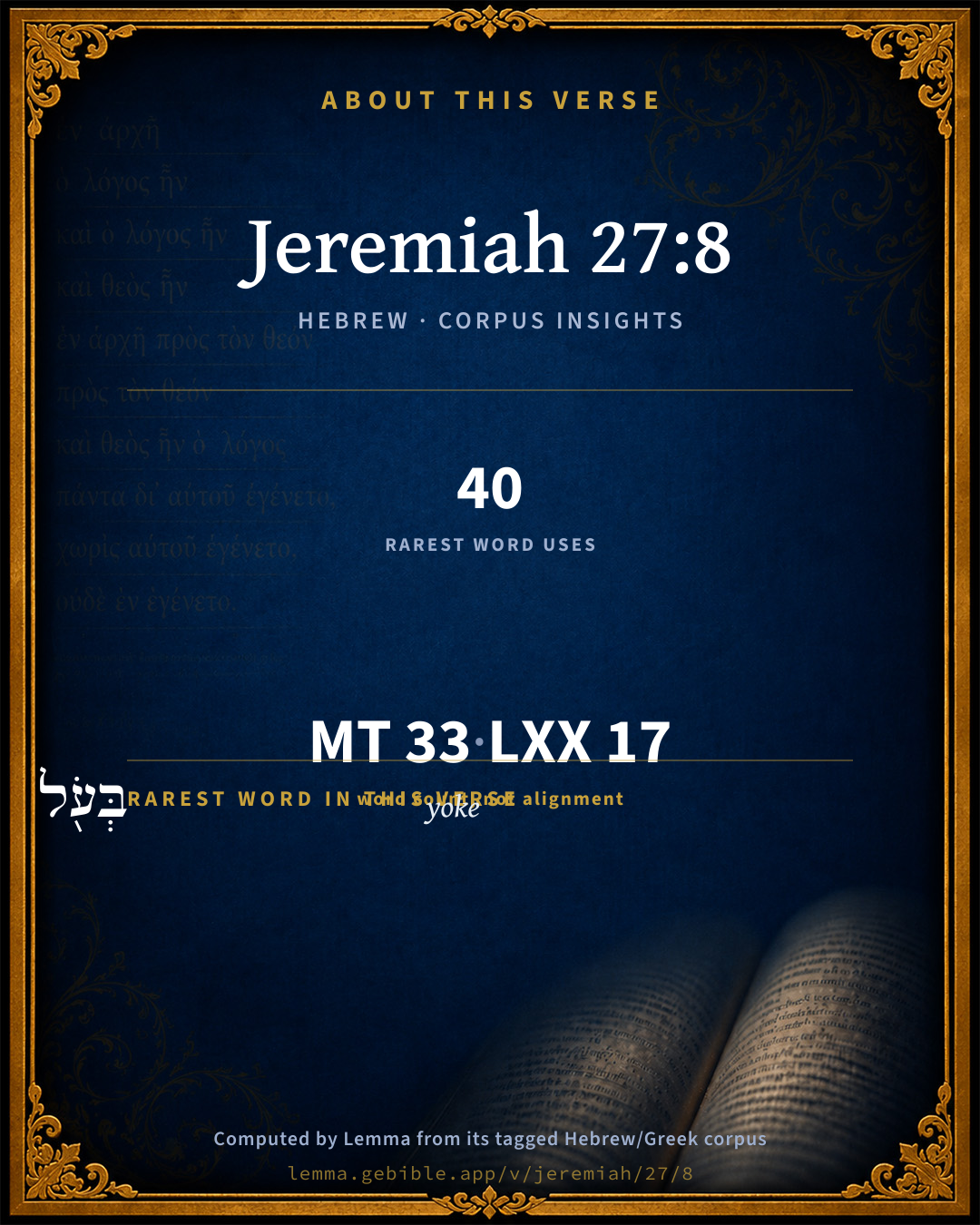
33
words
24
distinct lemmas
Prophets
section

Shared distinctive vocabulary

בְּעֹ֖ל yoke H5923 occurs in 34 verses of the Hebrew Bible. Also found in:

Grammatical profile

  • 5 verbs
  • 16 nouns
  • 1 pronoun
  • 2 prepositions
  • 9 particles

Verb forms

  • וְהָיָ֨ה Qal · Sequential Perfect
  • יַעַבְד֤וּ Qal · Imperfect
  • יִתֵּן֙ Qal · Imperfect
  • אֶפְקֹ֨ד Qal · Imperfect
  • תֻּמִּ֥י Qal · Infinitive Construct

Repetition

Words recur within this verse — often emphatic in Hebrew:

  • הַגּ֜וֹי nation H1471 ×2
  • מֶֽלֶךְ king H4428 ×2
  • בָּבֶ֔ל Babylon H894 ×2
  • אֲשֶׁ֨ר which H834 ×2
  • לֹֽא not H3808 ×2

Hebrew & Septuagint length

In the original languages it is 33 Hebrew tokens and 17 Greek tokens — but the two are counted differently (Hebrew bundles its prefixes and suffixes into one token; the Greek is in lemma form), so that isn’t a like-for-like length.

Cross-references

8

Topical passages linked to Jeremiah 27:8 in the Treasury of Scripture Knowledge — connected by theme and wording, ordered by reader-vote popularity; previews shown in the World English Bible.

  • Jeremiah 24:10 I will send the sword, the famine, and the pestilence, among them, until they be consumed from off the land that I gave to them and to their fathers.
  • Jeremiah 38:17–19 Then said Jeremiah to Zedekiah, Thus says Yahweh, the God of hosts, the God of Israel: If you will go forth to the king of Babylon's princes, then your soul shall live, and this city shall not be burned with fire; and you shall live, and your house.
  • Ezekiel 14:21 For thus says the Lord Yahweh: How much more when I send my four sore judgments on Jerusalem, the sword, and the famine, and the evil animals, and the pestilence, to cut off from it man and animal!
  • Ezekiel 17:19–21 Therefore thus says the Lord Yahweh: As I live, surely my oath that he has despised, and my covenant that he has broken, I will even bring it on his own head.
  • Jeremiah 25:28–29 It shall be, if they refuse to take the cup at your hand to drink, then shall you tell them, Thus says Yahweh of Hosts: You shall surely drink.
  • Jeremiah 40:9 Gedaliah the son of Ahikam the son of Shaphan swore to them and to their men, saying, Don't be afraid to serve the Chaldeans: dwell in the land, and serve the king of Babylon, and it shall be well with you.
  • Jeremiah 42:10–18 If you will still abide in this land, then will I build you, and not pull you down, and I will plant you, and not pluck you up; for I repent me of the evil that I have done to you.
  • Jeremiah 52:3–6 For through the anger of Yahweh did it happen in Jerusalem and Judah, until he had cast them out from his presence. Zedekiah rebelled against the king of Babylon.

Cross-references courtesy of OpenBible.info (CC BY 4.0).

Hebrew and Greek witnesses Masoretic Hebrew ↔ Greek Septuagint

The same verse in the two great witnesses to the Old Testament, shown verse-for-verse.

These are two independent witnesses, not word-aligned to each other, and the Septuagint is shown in lemma (dictionary) form.

Hebrew Jeremiah 27:8 Masoretic · Westminster Leningrad Codex

וְהָיָ֨ה הַגּ֜וֹי וְהַמַּמְלָכָ֗ה אֲשֶׁ֨ר לֹֽא יַעַבְד֤וּ אֹתוֹ֙ אֶת נְבוּכַדְנֶאצַּ֣ר מֶֽלֶךְ בָּבֶ֔ל וְאֵ֨ת אֲשֶׁ֤ר לֹֽא יִתֵּן֙ אֶת צַוָּאר֔וֹ בְּעֹ֖ל מֶ֣לֶךְ בָּבֶ֑ל בַּחֶרֶב֩ וּבָרָעָ֨ב וּבַדֶּ֜בֶר אֶפְקֹ֨ד עַל הַגּ֤וֹי הַהוּא֙ נְאֻם יְהוָ֔ה עַד תֻּמִּ֥י אֹתָ֖ם בְּיָדֽוֹ

It shall happen, that the nation and the kingdom which will not serve the same Nebuchadnezzar king of Babylon, and that will not put their neck under the yoke of the king of Babylon, that nation will I punish, says Yahweh, with the sword, and with the famine, and with the pestilence, until I have consumed them by his hand.

World English Bible · Public Domain

Greek LXX Structure differs

In the Septuagint, Jeremiah is about an eighth shorter than the Hebrew and arranges its material differently — the Oracles Against the Nations (Hebrew chapters 46–51) appear in the middle of the Greek book, after 25:13. Because the chapter and verse boundaries do not line up, a verse-for-verse comparison with the Hebrew is not shown.

A verse-for-verse comparison isn’t shown here because the chapters and verses don’t line up. Switch to the LXX edition with the MT / LXX toggle above to read the Greek directly.

On this verse, The Cambridge Bible for Schools and Colleges discusses the Septuagint’s reading. Read the note in Commentary ↓

Hebrew: Westminster Leningrad Codex (CC BY 4.0). Greek: Septuagint (public domain); English from a public-domain English Septuagint. How the Septuagint differs from the Hebrew →

Targum (Aramaic paraphrase)

1

The Targum is the ancient Jewish Aramaic paraphrase of the Hebrew Scriptures — an interpretive translation, not the Hebrew text itself. Onkelos (literal) and Pseudo-Jonathan (expansive) render the Torah, and Jonathan the Prophets. Coverage is partial: where no permissively-licensed English translation exists for a verse, only the Aramaic is shown. This is verse-level text, not a word-by-word alignment to the Hebrew.

  1. Targum Jonathan Prophets (Joshua–Malachi)
    וִיהֵי עַם וּמַלְכוּ דְלָא יִפְלְחוּן יָתֵיהּ יַת נְבוּכַדְנֶצאַר מַלְכָּא דְבָבֶל וְיַת דְלָא יִתֵּן יַת צַוְרֵיהּ בְּנִיר מַלְכָּא דְבָבֶל בְּחַרְבָּא וּבְכַפְנָא וּבְמוֹתָא אַסְעַר עַל עַמָא הַהוּא אֲמַר יְיָ עַד דְאֶמְסַר יַתְהוֹן בִּידֵיהּ:

    (no public-domain English translation for this verse)

    Targum Jonathan — Aramaic: “Mikraot Gedolot” (public domain). English: “Sefaria Community Translation” (CC0 1.0 (public-domain dedication)); “London "Chaldee Paraphrase," 1871” (public domain). Text via Sefaria.

Commentary

Notes on Jeremiah 27:8 from classic Christian and Jewish commentators (each source and its license shown beneath its notes). The classic Christian expositions comment on the surrounding passage and are grouped to its opening verse, so a note may address several verses; the Jewish commentaries on the Tanakh (Rashi and others) are per-verse, so they appear only where the commentator wrote on this verse.

Lemma curates 59 commentaries, every one of them public domain or Creative Commons licensed, each selected and text-cleaned for this edition rather than reprinted as found. About our sources →

Trapp's Complete Commentary

John Trapp

Jer 27:8 And it shall come to pass, [that] the nation and kingdom which will not serve the same Nebuchadnezzar the king of Babylon, and that will not put their neck under the yoke of the king of Babylon, that nation will I punish, saith the LORD, with the sword, and with the famine, and with the pestilence, until I have consumed them by his hand.

Ver. 8. And it shall come to pass that the nation, &c.] It is better, then, to serve a foreign prince than to perish by the sword, famine, or pestilence. It should not be grievous to any man to sacrifice all his outward comforts to the service of his life.

And that will not put their neck under the yoke.] The Lord disposeth of the kingdoms of the heathens also, though in such a way as may seem to us to be mere hap hazard.

That nation will I punish.] By seeking to shun a less mischief, they shall fall into a greater; if they escape frost, they shall meet with snow.

John Trapp, A Commentary or Exposition upon All the Books of the Old and New Testament (1647–1656) — public domain. Text from a community e-Sword module.

Tyndale Open Study Notes

Tyndale Open Resources

27:8 Babylon’s yoke: Cp. 21:8-10; 27:2-3.

Tyndale Open Study Notes — © Tyndale Open Resources, licensed CC BY-SA 4.0. Text via the HelloAO Bible API.

Jamieson, Fausset & Brown

Robert Jamieson, A. R. Fausset & David Brown

until I have consumed them by his hand--until by these consuming visitations I have brought them under his power.

Jamieson, Fausset & Brown — Commentary Critical and Explanatory on the Whole Bible (1871) — public domain (CC PDM 1.0). Text via the HelloAO Bible API.

John Calvin's Commentaries

After having promulgated his decree by the mouth of Jeremiah, God now adds a threatening, in order that the Jews as well as others might willingly, and with resigned and humble minds, undertake the yoke laid on them. The Prophet, indeed, as we have said, had the Jews more especially in view; but he extended, as it were by accident, his prediction to aliens. We hence see why this denunciation of punishment was added. It ought, indeed, to have been enough to say, that Nebuchadnezzar was God’s servant to subdue Judea; but as it was a hard thing for the Jews to receive that enemy, nor could they be induced to submit to him, it became necessary to add this threatening, “See what ye do, for ye cannot be stronger than God.” This threatening is indeed included in the former verse; but we know how tardy men are to learn, especially when any false impression has preoccupied their minds. As, then, the Jews refused the authority of Nebuchadnezzar, though the Prophet had testified to them that he was God’s servant, they would not have hesitated still to evade and to be refractory, had not their hardness and obduracy been broken by this commination.

And it shall be, that the nation and kingdom, which will not serve him, even Nebuchadnezzar, and not put their neck under his yoke, it shall be, that I shall visit that nation, etc. God speaks without distinction of all nations; but the Jews ought to have reasoned from the less to the greater; for if God would so severely punish the pride of the Gentiles, in case they withdrew themselves from under the yoke of Nebuchadnezzar, how much heavier and more dreadful vengeance ought the Jews to have dreaded, who had been warned by the Prophet, and who doubtless knew that this happened not to them by chance, but that it was God’s righteous judgment, by which their sins were punished? Were they obstinately to attempt to shake off the yoke from their neck, would not this have been to fight against God? We now, then, perceive that the Prophet spoke thus indiscriminately of all nations, that he might sharply rebuke the Jews; and he showed that their ferocity would be inexcusable were they not willingly to humble themselves.

By mentioning twice, Nebuchadnezzar king of Babylon, he seems to imply something important; for they might have objected and said, “What have we to do with a king so distant? and by what right does he now invade our countries? why is he not content with his own burdens? why does he not abide in his own city and in his own land?” And the name of Babylon was at the same time hateful, for they had carried on war with many nations, and reduced the Assyrians under their yoke, who were neighbors to the Jews, and the Assyrians were also in a manner connected with them; and their name was no doubt abhorred by the Jews, on account of the wars perpetually carried on by them. Hence God meets here these objections, and shows that however odious Babylon might be to the Jews, and that however remote Nebuchadnezzar might be from Judea, yet his yoke was to be borne, as it had been so appointed by God. This seems to me to be the reason why Jeremiah repeated the words, Nebuchadnezzar the king of Babylon

There is also a denunciation of punishment, that God would visit with pestilence, famine, and the sword We know that these words are commonly mentioned in Scripture, when it is God’s purpose to set forth the signs of his wrath. He has indeed various and innumerable ways by which he chastises us; but these are his most remarkable and most known scourges, the pestilence, the sword, and the famine. He then says, that he would visit the nations who would not obey King Nebuchadnezzar with these three scourges; and at the same time he shews what the end would be, until I slay, or consume them by his hand He not only threatens them with pestilence, famine, and the sword, but he also shows that the end would be such, that the nations who might at first obstinately resist, would yet be constrained to undertake the yoke, and to acknowledge Nebuchadnezzar as their king and master. This is the reason why he says, by his hand

Death might have seemed lighter, if only they could have escaped the tyranny of Nebuchadnezzar; but since both would happen to them, even to be consumed by famine, the sword, and the pestilence, and yet not to be able to escape bondage, it was a miserable prospect indeed. We now then perceive why God speaks of the hand of the King Nebuchadnezzar; it was, that the Jews might know that they could effect nothing by seeking means to escape, for they would at length, willing or unwilling, be brought under the hand and under the yoke of this king.

John Calvin's Commentaries (1540-1563) — public domain. Text from the Calvin Translation Society English edition (1840s-50s) via the Christian Classics Ethereal Library (ccel.org). Calvin's coverage is partial (roughly two-thirds of the Bible); uncommented books and verses are honest gaps, never fabricated. The 19th-century editor's footnotes and remarks are omitted so the notes are faithfully Calvin's own voice.

Ellicott's Commentary for English Readers

(8) That nation will I punish.—Better, I will visit. The three forms of punishment go naturally together. In Eze_14:21 they appear, with the addition of the “noisome beast,” as the four sore judgments of God.

A Bible Commentary for English Readers, edited by Charles John Ellicott (1878–1897) — public domain. Text from a community e-Sword module.

The Cambridge Bible for Schools and Colleges

gen. ed. J. J. S. Perowne

8. which … N. king of Babylon] not found in LXX, which also omits “and with the pestilence.”

until I have consumed them by] It is best (so Gi.) by the change of one letter in MT. (a change deriving some support from the Targ.) to render, until I have given them into.

The Cambridge Bible for Schools and Colleges (gen. ed. J. J. S. Perowne; Cambridge University Press, 1878–1918) — public domain. Text from a community e-Sword module.

John Gill's Exposition

And it shall come to pass, that the nation and kingdom which will not serve the same Nebuchadnezzar the king of Babylon,.... Will not, upon his approaching to them, invading and besieging them, submit and become tributary to him, as is more fully expressed in the next clause:

and that will not put their neck under the yoke of the king of Babylon; or voluntarily become subject to him, and pay a tax he shall impose upon them. This refers to, and explains the symbol of, Jeremiah's making and wearing yokes, Jer 27:2;

that nation will I punish, saith the Lord, with the sword, and with the famine, and with the pestilence; with one judgment after another; some will perish by the sword of the enemy, sallying out upon them, or endeavouring to make their escape; others by famine their provisions being spent through the length of the siege; and others by pestilence, or the plague, by the immediate hand of God:

until I have consumed them by his hand; Nebuchadnezzar's; by means of him; by his sword, and strait besieging them; or, "into his hand"; and so the Targum,

"until I have delivered them into his hand;''

having consumed multitudes by the sword, famine, and pestilence, will deliver the rest into his hands to be carried captive by him.

John Gill's Exposition of the Whole Bible (1746–1763) — public domain (CC PDM 1.0). Text via the HelloAO Bible API.

Matthew Poole's English Annotations

That is, that will not, upon Nebuchadnezzar’s coming against them, freely submit to his power, and yield themselves to his subjection. I will humble them by my sore judgments of sword, pestilence, and famine, and make them yield; and they shall not avoid what through their stubbornness they study to avoid, but shall at last be brought under by his power.

Matthew Poole's English Annotations on the Holy Bible (1683–1685) — public domain. Text from a community e-Sword/MySword module.

unfoldingWord translationNotes

Door43 World Missions Community

that does not put its neck under the yoke of the king

Being the king's slave is spoken of as being an animal on to the shoulders of which the king puts a yoke so it can do heavy work. AT: "and whose people do not willingly become slaves of the king" (See: Metaphor)

this is Yahweh's declaration

Yahweh speaks of himself by name to express the certainty of what he is declaring. See how you translated this in Jeremiah 1:8. AT: "this is what Yahweh has declared" or "this is what I, Yahweh, have declared" (See: First, Second, or Third Person)

I have destroyed it by his hand

The hand here could be a metonym for Nebuchadnezzar's power, or it could be a metonym for Nebuchadnezzar's armies. AT: "I have used Nebuchadnezzar's power to destroy it" or "I have enabled Nebuchadnezzar's armies to destroy i" (See: Metonymy)

translationWords

kingdom

yoke

punish

sword

famine

plague

unfoldingWord translationNotes — © Distant Shores Media and the Door43 World Missions Community, licensed CC BY-SA 4.0. Source: git.door43.org/Door43/en_tn.

Lesson kit

Teaching starters — assembled from the data on this page, not authored interpretation. Every prompt links to the verse data it draws on. Edit before teaching.

Jeremiah, in the Prophets, opens this verse with 33 words (24 distinct Hebrew lemmas). Its most distinctive word is ʻôl (“yoke”). A historical commentator’s framing appears above. Read the whole chapter for the surrounding context.

Discussion questions

  1. What does “yoke” (ʻôl) contribute to the verse as a whole?
  2. Genesis 27:40 shares the word «yoke» with this verse. How do the two illuminate each other?
  3. “nation” occurs 2× in this one verse. What is the effect of the repetition?
  4. These translations render this verse differently; the difference is in the English rendering, not the original. What questions does that raise?
  5. The verb «וְהָיָ֨ה» is Qal Sequential Perfect. How does its form color the action?
  6. Reading how Trapp's Complete Commentary and Tyndale Open Study Notes read this verse, where do the two commentators agree and where do they part?

Things to notice

Reading settings

Reading text

Shown beneath each verse's original-language words.

Old Testament
Old Testament edition

Read the OT as the Masoretic Hebrew (MT) or the Greek Septuagint (LXX).

English shown for the Greek Septuagint (in the Hebrew ↔ Greek comparison).

Comparing translations? Open the Compare panel on any verse page to stack up to four side by side.