Deuteronomy 32:24

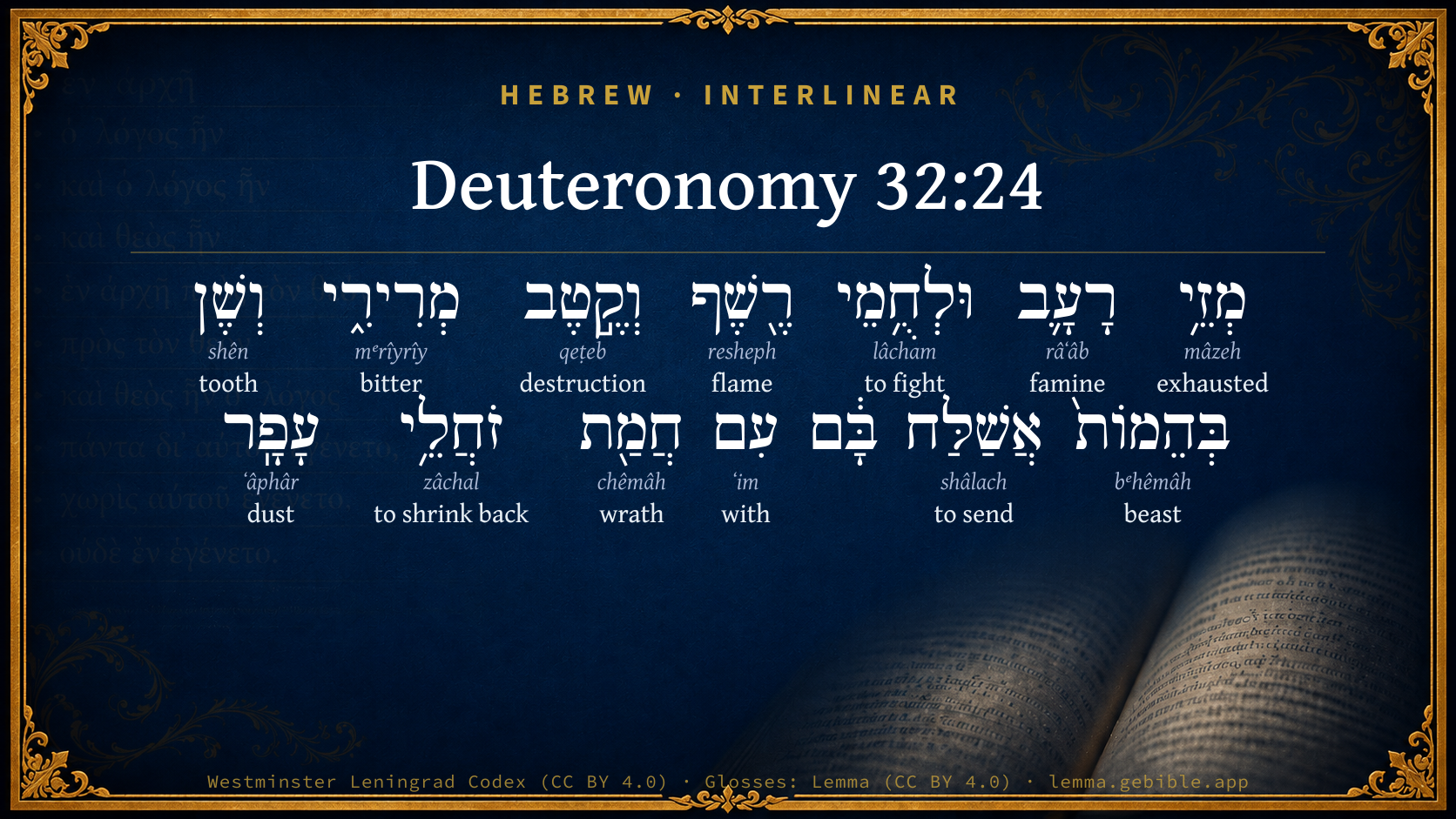
Hebrew (Westminster Leningrad Codex) Deuteronomy 32:24 appears in the Hebrew Old Testament. The text above is from the Westminster Leningrad Codex. Each word links to its Strong’s number, a concise gloss, and parsing drawn from the Open Scriptures Hebrew Bible morphology. Click any word for its full Brown-Driver-Briggs (BDB) entry.
Download image
Cite this verse

Deuteronomy 32:24 (World English Bible). Public Domain. Lemma interlinear Bible study tool, https://lemma.gebible.app/v/deuteronomy/32/24.

Show BibTeX & RIS
BibTeX
RIS
English Translation
[They shall be] wasted with hunger, and devoured with burning heat Bitter destruction; The teeth of animals will I send on them, With the poison of crawling things of the dust.
World English Bible · Public Domain
Highlights
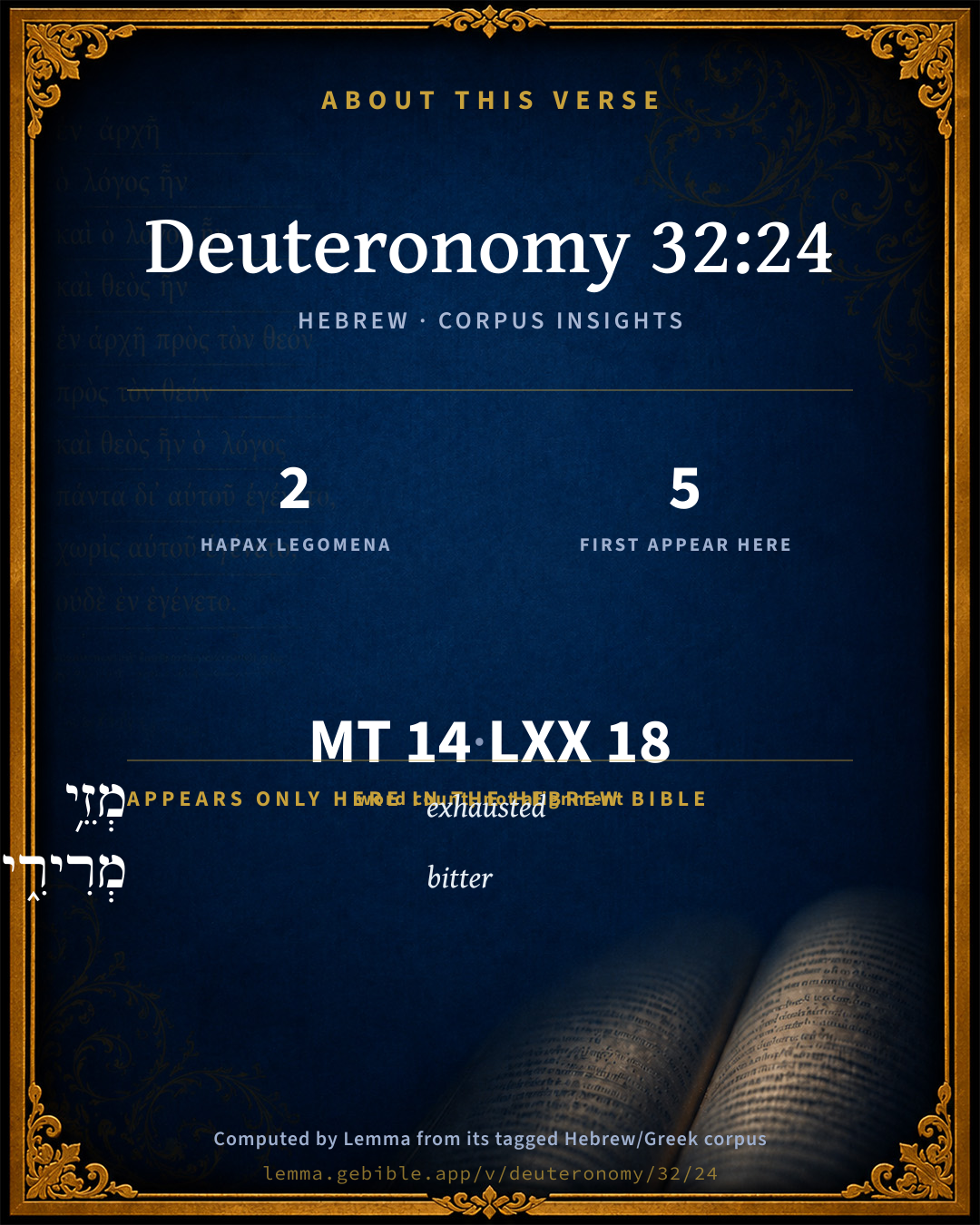
  • 2 hapax legomena — only here in the Hebrew Bible
  • 5 first appearances in the Hebrew Bible
Full analysis ↓
Download a study sheet

One document with this verse’s original text, its word-by-word gloss line, the meaning frame, cross-references with their text, attributed commentary, and full source and license credits — printable, and it pastes into notes with its structure intact.

This verse Autodidact and up

Study sheet (.html) Plain text (.txt)

A passage Seminary Student

Up to 50 verses in one chapter. A passage sheet keeps up to 6 commentary sources and 12 cross-references per verse, in the order this page ranks them, and says so on the sheet whenever that leaves anything out. Ask for a single verse and you get the Autodidact verse sheet above.

Everything on this page stays free to read, with no account — the sheet is a download of what is already on screen, not access to it.

Want to remove ads? Support Godless Engineer
Compare translations 3

The same verse in 3 English versions, stacked beneath the original-language interlinear above. Click any original word for its lexicon entry.

Each is an independent rendering of the whole verse — the interlinear is not word-aligned to these translations.

Highlighted words mark where these versions differ — a whole-verse word diff, not a word-by-word alignment.

  • World English Bible Public Domain
    [They shall be] wasted with hunger, and devoured with burning heat Bitter destruction; The teeth of animals will I send on them, With the poison of crawling things of the dust.
  • King James Version Public Domain
    They shall be burnt with hunger, and devoured with burning heat, and with bitter destruction: I will also send the teeth of beasts upon them, with the poison of serpents of the dust.
  • unfoldingWord Literal Text CC BY-SA 4.0
    wasted hunger and weakened plague and bitter contagion, and on the teeth of beasts, I will send them, with the poison of crawlers dust.

unfoldingWord Literal Text — © unfoldingWord, licensed CC BY-SA 4.0. Word-aligned USFM3 via Door43 (git.door43.org/unfoldingWord/en_ult).

Versions to compare (up to 4)

3 of 4 selected

Show all 18 translations

Every available English version of this verse, each an independent rendering of the whole verse.

  • World English Bible Public Domain
    [They shall be] wasted with hunger, and devoured with burning heat Bitter destruction; The teeth of animals will I send on them, With the poison of crawling things of the dust.
  • Berean Standard Bible Public Domain
    They will be wasted from hunger and ravaged by pestilence and bitter plague; I will send the fangs of wild beasts against them, with the venom of vipers that slither in the dust.
  • Majority Standard Bible Public Domain
    They will be wasted from hunger and ravaged by pestilence and bitter plague; I will send the fangs of wild beasts against them, with the venom of vipers that slither in the dust.
  • King James Version Public Domain
    They shall be burnt with hunger, and devoured with burning heat, and with bitter destruction: I will also send the teeth of beasts upon them, with the poison of serpents of the dust.
  • American Standard Version (1901) Public Domain
    `They shall be' wasted with hunger, and devoured with burning heat And bitter destruction; And the teeth of beasts will I send upon them, With the poison of crawling things of the dust.
  • Revised Version (1885) Public Domain
    They shall be wasted with hunger, and devoured with burning heat And bitter destruction; And the teeth of beasts will I send upon them, With the poison of crawling things of the dust.
  • Geneva Bible (1599) Public Domain
    They shalbe burnt with hunger, and consumed with heate, and with bitter destruction: I will also sende the teeth of beastes vpon them, with the venime of serpents creeping in the dust.
  • Douay-Rheims (1899) Public Domain
    They shall be consumed with famine, and birds shall devour them with a most bitter bite: I will send the teeth of beasts upon them, with the fury of creatures that trail upon the ground, and of serpents.
  • Young's Literal Translation Public Domain
    Exhausted by famine, And consumed by heat, and bitter destruction. And the teeth of beasts I send upon them, With poison of fearful things of the dust.
  • Literal Standard Version CC BY-SA 4.0
    Exhausted by famine, || And consumed by heat and bitter destruction—I also send the teeth of beasts on them, || With poison of fearful things of the dust.
  • Unlocked Literal Bible CC BY-SA 4.0
    They will be wasted by hunger and devoured by burning heat and bitter destruction; I will send on them the teeth of wild animals, with the poison of things that crawl in the dust.
  • unfoldingWord Literal Text CC BY-SA 4.0
    wasted hunger and weakened plague and bitter contagion, and on the teeth of beasts, I will send them, with the poison of crawlers dust.
  • Darby Bible Public Domain
    They shall be consumed with hunger, and devoured with burning heat, And with poisonous pestilence; And the teeth of beasts will I send against them, With the poison of what crawleth in the dust.
  • World Messianic Bible Public Domain
    They shall be wasted with hunger, and devoured with burning heat and bitter destruction. I will send the teeth of animals on them, with the venom of vipers that glide in the dust.
  • Webster's Bible Public Domain
    They shall be burnt with hunger, and devoured with burning heat, and with bitter destruction: I will also send the teeth of beasts upon them, with the poison of serpents of the dust.
  • Free Bible Version CC BY-SA 4.0
    They will waste away from hunger, destroyed by disease and poisonous plague. I will send wild animals to bite them with their teeth, the fangs of snakes that slide along the ground.
  • Bible in Basic English Public Domain
    They will be wasted from need of food, and overcome by burning heat and bitter destruction; and the teeth of beasts I will send on them, with the poison of the worms of the dust.
  • JPS Tanakh (1917) Public Domain
    The wasting of hunger, and the devouring of the fiery bolt, and bitter destruction; and the teeth of beasts will I send upon them, with the venom of crawling things of the dust.

Literal Standard Version (2020), Covenant Press — licensed CC BY-SA 4.0. Text via the HelloAO Bible API (eBible.org). Unlocked Literal Bible (unfoldingWord) — licensed CC BY-SA 4.0. Text via the HelloAO Bible API (eBible.org). unfoldingWord Literal Text — © unfoldingWord, licensed CC BY-SA 4.0. Word-aligned USFM3 via Door43 (git.door43.org/unfoldingWord/en_ult). Free Bible Version, Dr. Jonathan Gallagher — licensed CC BY-SA 4.0. Text via the HelloAO Bible API (eBible.org).

Word by word

More ways to search: Search by grammar → Find every occurrence → Compare this word →

Practice this passage: Drill this verse → Learn its vocabulary →

מְזֵ֥י
mâzeh
H4198
“exhausted of”
Adjective, Adjective, Masculine, Plural, Construct
Part of Speech
Adjective
Type
Adjective
Gender
Masculine
Number
Plural
State
Construct
Full BDB Definition

Origin: from an unused root meaning to suck out

TWOT: 1171a

sucked out, empty, exhausted
  1. רָעָ֛ב râʻâb H7458 “famine” Noun, Common, Masculine, Singular, Absolute
  2. וּלְחֻ֥מֵי lâcham H3898 “and · fought” Conjunction + Verb, Qal, Participle Passive, Masculine, Plural, Construct
  3. רֶ֖שֶׁף resheph H7565 “flame” Noun, Common, Masculine, Singular, Absolute
  4. וְקֶ֣טֶב qeṭeb H6986 “and · destruction” Conjunction + Noun, Common, Masculine, Singular, Absolute
  5. מְרִירִ֑י mᵉrîyrîy H4815 “bitter” Adjective, Adjective, Masculine, Singular, Absolute
  6. וְשֶׁן shên H8127 “and · tooth of” Conjunction + Noun, Common, Both, Singular, Construct
  7. בְּהֵמוֹת֙ bᵉhêmâh H929 “beasts” Noun, Common, Feminine, Plural, Absolute
  8. אֲשַׁלַּח shâlach H7971 “to send” Verb, Piel, Imperfect, 1st Person, Common, Singular
  9. עִם ʻim H5973 “with” Preposition
  10. חֲמַ֖ת chêmâh H2534 “wrath of” Noun, Common, Feminine, Singular, Construct
  11. זֹחֲלֵ֥י zâchal H2119 “shrinking back” Verb, Qal, Participle Active, Masculine, Plural, Construct
  12. עָפָֽר ʻâphâr H6083 “dust” Noun, Common, Masculine, Singular, Absolute

About this verse

These counts appear in no published source. They are computed here, from the morphology-tagged text and Lemma’s own curated glosses. What Lemma adds →

14
words
13
distinct lemmas
Pentateuch
section

Notable vocabulary

2 hapax legomena — words that appear only here in the entire Hebrew Bible:

  • מְזֵ֥י exhausted H4198
  • מְרִירִ֑י bitter H4815

First appearance in Scripture

These words make their first canonical appearance in the Hebrew Bible here:

  • מְזֵ֥י exhausted H4198
  • רֶ֖שֶׁף flame H7565
  • וְקֶ֣טֶב destruction H6986
  • מְרִירִ֑י bitter H4815
  • זֹחֲלֵ֥י to shrink back H2119

Shared distinctive vocabulary

וְקֶ֣טֶב destruction H6986 occurs in 3 verses of the Hebrew Bible. Also found in:

Grammatical profile

  • 3 verbs
  • 7 nouns
  • 2 adjectives
  • 2 prepositions

Verb forms

  • וּלְחֻ֥מֵי Qal · Participle Passive
  • אֲשַׁלַּח Piel · Imperfect
  • זֹחֲלֵ֥י Qal · Participle Active

Hebrew & Septuagint length

In English translation the verse runs 31 words from the Hebrew and 37 from the Septuagint (LXX English) — closely comparable.

A rough comparison of the two English renderings, which tokenize alike — not a word-level alignment.

Word counts can differ between the Hebrew and the Greek without any difference in meaning — e.g. the Hebrew direct-object marker אֵת has no separate Greek word, and Greek often adds the article ὁ.

In the original languages it is 14 Hebrew tokens and 18 Greek tokens — but the two are counted differently (Hebrew bundles its prefixes and suffixes into one token; the Greek is in lemma form), so that isn’t a like-for-like length.

Cross-references

20

Topical passages linked to Deuteronomy 32:24 in the Treasury of Scripture Knowledge — connected by theme and wording, ordered by reader-vote popularity; previews shown in the World English Bible.

  • Leviticus 26:22 I will send the wild animals among you, which will rob you of your children, destroy your cattle, and make you few in number; and your roads will become desolate.
  • Ezekiel 5:17 and I will send on you famine and evil animals, and they shall bereave you; and pestilence and blood shall pass through you; and I will bring the sword on you: I, Yahweh, have spoken it.
  • Genesis 3:14 Yahweh God said to the serpent, "Because you have done this, cursed are you above all cattle, and above every animal of the field. On your belly shall you go, and you shall eat dust all the days of your life.
  • Genesis 49:15 He saw a resting-place, that it was good, The land, that it was pleasant; He bows his shoulder to the burden, And becomes a servant doing forced labor.
  • Deuteronomy 28:22 Yahweh will strike you with consumption, and with fever, and with inflammation, and with fiery heat, and with the sword, and with blasting, and with mildew; and they shall pursue you until you perish.
  • Deuteronomy 28:53 You shall eat the fruit of your own body, the flesh of your sons and of your daughters, whom Yahweh your God has given you, in the siege and in the distress with which your enemies shall distress you.
  • Psalms 18:12–14 At the brightness before him his thick clouds passed, Hailstones and coals of fire.
  • Psalms 91:6 Nor of the pestilence that walks in darkness, Nor of the destruction that wastes at noonday.
  • Psalms 120:4 Sharp arrows of the mighty, With coals of juniper.
  • Isaiah 65:25 The wolf and the lamb shall feed together, and the lion shall eat straw like the ox; and dust shall be the serpent's food. They shall not hurt nor destroy in all my holy mountain, says Yahweh.
  • Jeremiah 14:18 If I go forth into the field, then, behold, the slain with the sword! and if I enter into the city, then, behold, those who are sick with famine! for both the prophet and the priest go about in the land, and have no knowledge.
  • Jeremiah 15:3 I will appoint over them four kinds, says Yahweh: the sword to kill, and the dogs to tear, and the birds of the sky, and the animals of the earth, to devour and to destroy.
  • Jeremiah 16:4 They shall die grievous deaths: they shall not be lamented, neither shall they be buried; they shall be as dung on the surface of the ground; and they shall be consumed by the sword, and by famine; and their dead bodies shall be food for the birds of the sky, and for the animals of the earth.
  • Lamentations 4:4–9 The tongue of the sucking child cleaves to the roof of his mouth for thirst: The young children ask bread, and no man breaks it to them.
  • Lamentations 5:10 Our skin is black like an oven, Because of the burning heat of famine.
  • Ezekiel 14:15 If I cause evil animals to pass through the land, and they ravage it, and it be made desolate, so that no man may pass through because of the animals;
  • Ezekiel 14:21 For thus says the Lord Yahweh: How much more when I send my four sore judgments on Jerusalem, the sword, and the famine, and the evil animals, and the pestilence, to cut off from it man and animal!
  • Amos 5:18–19 "Woe to you who desire the day of Yahweh! Why do you long for the day of Yahweh? It is darkness, And not light.
  • Amos 9:3 Though they hide themselves in the top of Carmel, I will search and take them out there; and though they be hid from my sight in the bottom of the sea, there I will command the serpent, and it will bite them.
  • Habakkuk 3:5 Plague went before him, And pestilence followed his feet.

Cross-references courtesy of OpenBible.info (CC BY 4.0).

Hebrew and Greek witnesses Masoretic Hebrew ↔ Greek Septuagint

The same verse in the two great witnesses to the Old Testament, shown verse-for-verse.

These are two independent witnesses, not word-aligned to each other, and the Septuagint is shown in lemma (dictionary) form.

Hebrew Deuteronomy 32:24 Masoretic · Westminster Leningrad Codex

מְזֵ֥י רָעָ֛ב וּלְחֻ֥מֵי רֶ֖שֶׁף וְקֶ֣טֶב מְרִירִ֑י וְשֶׁן בְּהֵמוֹת֙ אֲשַׁלַּח בָּ֔ם עִם חֲמַ֖ת זֹחֲלֵ֥י עָפָֽר

[They shall be] wasted with hunger, and devoured with burning heat Bitter destruction; The teeth of animals will I send on them, With the poison of crawling things of the dust.

World English Bible · Public Domain

Greek LXX Deuteronomy 32:24 Septuagint · lemma form

τήκω λιμός καί βρῶσις ὄρνεον καί ὀπισθότονος ἀνίατος ὀδούς θηρίον ἀποστέλλω εἰς αὐτός μετά θυμός σύρω ἐπί γῆ

They shall be consumed with hunger and the devouring of birds, and there shall be irremediable destruction: I will send forth against them the teeth of wild beasts, with the rage of serpents creeping on the ground.

LXX2012 (modern English Septuagint) · Public Domain

On this verse, Haydock's Catholic Bible Commentary discusses the Septuagint’s reading. Read the note in Commentary ↓

Hebrew: Westminster Leningrad Codex (CC BY 4.0). Greek: Septuagint (public domain); English from LXX2012 (modern English Septuagint) (Public Domain). How the Septuagint differs from the Hebrew →

Targum (Aramaic paraphrase)

2

The Targum is the ancient Jewish Aramaic paraphrase of the Hebrew Scriptures — an interpretive translation, not the Hebrew text itself. Onkelos (literal) and Pseudo-Jonathan (expansive) render the Torah, and Jonathan the Prophets. Coverage is partial: where no permissively-licensed English translation exists for a verse, only the Aramaic is shown. This is verse-level text, not a word-by-word alignment to the Hebrew.

  1. Targum Onkelos Torah (Genesis–Deuteronomy)
    נְפִיחֵי כָפָן וַאֲכוּלֵי עוּף וּכְתִישֵׁי רוּחִין בִּישָׁן וְשֵׁן חֵיוַת בָּרָא אֱגָרֵי בְהוֹן עִם חֲמַת תַּנִינַיָא דְזָחֲלִין בְּעַפְרָא

    (no public-domain English translation for this verse)

    Targum Onkelos — Aramaic: “Onkelos Genesis” (public domain); “Onkelos Exodus” (public domain); “Onkelos Leviticus” (public domain); “Onkelos Numbers” (public domain); “Onkelos Deuteronomy” (public domain). English: “Sefaria Community Translation” (CC0 1.0 (public-domain dedication)); “J.W. Etheridge. The Targums of Onkelos and Jonathan Ben Uzziel on the Pentateuch. London: Longmans, Green, 1862” (public domain). Text via Sefaria.

  2. Targum Pseudo-Jonathan Torah (Genesis–Deuteronomy)
    אַגְלֵי יַתְהוֹן בְּמָדַי וּבְעֵלָם מִגוֹ שִׁבְיַת בָּבֶל אָעִיקוּ לְהוֹן דְבֵית אֲגַג דִי מְתִילִין לְשֵׁידִין מְנַפְחֵי כְפָן וּלְמַזִיקֵי אֲכִילֵי עוֹף וְלִבְנֵי טִהֲרִירֵי כְּתִישֵׁי רוּחִין בִּישִׁין וְלִילִין וּמְרַוְוחֵי רְוָוחִין בִּישִׁין וְעַכּוּ"ם דִנְכִיתִין בְשִׁינֵיהוֹן הֵיךְ חֵיוַות בְּרָא אִיגְרֵי בְּהוֹן וַאֲטַלְטְלִינוּן בְּיַד אֲרַמָאֵי דְמַלְיָין אֲרִיסַן כְּחֵיוִין חוֹרְמָנַיָא זוֹחֲלוֹי דְעַפְרָא

    I will make them go into captivity in Media and Elam, in the captivity of Babel, the house of Agag who are like demons gaping with famine, and to corpses devoured by birds, and to stricken evil spirits of the noon, to Lillin and to spirits big with evil. And the Javanaee (Greeks) who bite with their teeth like wild beasts will I send against them, and will shake them by the hand of the Syrians venomous as basilisks, the serpents of the dust.

    Targum Pseudo-Jonathan — Aramaic: “Targum Jonathan on Genesis” (public domain); “Targum Jonathan on Exodus” (public domain); “Targum Jonathan on Leviticus” (public domain); “Targum Jonathan on Numbers” (public domain); “Targum Jonathan on Deuteronomy” (public domain). English: “The Targum of Jonathan ben Uzziel, trans. J. W. Etheridge, London, 1862” (public domain). Text via Sefaria.

Commentary

Notes on Deuteronomy 32:24 from classic Christian and Jewish commentators (each source and its license shown beneath its notes). The classic Christian expositions comment on the surrounding passage and are grouped to its opening verse, so a note may address several verses; the Jewish commentaries on the Tanakh (Rashi and others) are per-verse, so they appear only where the commentator wrote on this verse.

Lemma curates 59 commentaries, every one of them public domain or Creative Commons licensed, each selected and text-cleaned for this edition rather than reprinted as found. About our sources →

Trapp's Complete Commentary

John Trapp

Deu 32:24 [They shall be] burnt with hunger, and devoured with burning heat, and with bitter destruction: I will also send the teeth of beasts upon them, with the poison of serpents of the dust.

Ver. 24. Burnt with hunger.] Which makes men’s visages blacker than a coal. {Lam 4:8}

With burning heat,] i.e., With the burning carbuncle, or plague sore. See Hab 3:5.

John Trapp, A Commentary or Exposition upon All the Books of the Old and New Testament (1647–1656) — public domain. Text from a community e-Sword module.

Adam Clarke's Commentary

Verse 24. They shall be burnt with hunger] Their land shall be cursed, and famine shall prevail. This is one of the arrows.

Burning heat] No showers to cool the atmosphere; or rather boils, blains, and pestilential fevers; this was a second.

Bitter destruction] The plague; this was a third.

Teeth of beasts - with the poison of serpents] The beast of the field should multiply upon and destroy them; this was a fourth: and poisonous serpents, infesting all their steps, and whose mortal bite should produce the utmost anguish, were to be a fifth arrow. Added to all these, the sword of their enemies - terror among themselves, De 32:25, and captivity were to complete their ruin, and thus the arrows of God were to be spent upon them. There is a beautiful saying in the Toozuki Teemour, which will serve to illustrate this point, while it exhibits one of the finest metaphors that occurs in any writer, the sacred writers excepted.

"It was once demanded of the fourth Khaleefeh, (Aaly,) on whom be the mercy of the Creator, 'If the canopy of heaven were a BOW; and if the earth were the cord thereof; and if calamities were ARROWS; if mankind were the mark for those arrows; and if Almighty GOD, the tremendous and the glorious, were the unerring ARCHER; to whom could the sons of Adam flee for protection?' The Khaleefeh answered, saying, 'The sons of Adam must flee unto the Lord.'"

Adam Clarke's Commentary on the Bible (1810–1826) — public domain. Text from a community e-Sword/MySword module.

Ellicott's Commentary for English Readers

(24, 25)

“Consumed[8] with hunger, and devoured with pestilence, and bitter destruction—

[8] Or, possibly, “Regaled with hunger, and fed with bread of pestilence and bitter destruction,” &c.

I will also send the tooth of the beasts upon them, with the poison of crawling things of the dust.

Outside the sword bereaveth, and in the chambers terror:

Both young man and maiden, the suckling with the man of grey hairs.”

God’s four sore judgments are all depicted here—“the sword, and the famine, and the noisome beast, and the pestilence.” With Deu_32:25 comp. Jer_14:18, “If I go forth into the field, then behold the slain with the sword! and if I enter into the city, then behold them that are sick with famine! yea both the prophet and the priest go about into a land that they know not.”

A Bible Commentary for English Readers, edited by Charles John Ellicott (1878–1897) — public domain. Text from a community e-Sword module.

John Gill's Exposition

The sword without,.... Either without the city, the sword of the Roman army besieging it, which destroyed all that came out or attempted to go in; or in the streets of the city, the sword of the seditious, which destroyed multitudes among themselves:

and terror within; within the city, on account of the sword of the Romans, and the close siege they made of it; and on account of the famine and pestilence which raged in it, and the cruelty of the seditious persons among themselves; all these filled the people with horror and terror in their houses; and even in their bedchambers, as the word signifies, they were not free from terror; yea, from the temple, and inward parts, and chambers of that, which may be referred to, terror came, that being in the hands of the seditious; they sallied out from thence, and ravaged the city, and filled all places with the dread of them; and many, no doubt, through fear died, as well as by the sword and other judgments; which it is threatened

shall destroy both the young man and the virgin, the suckling also,

with the man of gray hairs; none of any age or sex were spared, even those unarmed; not the young man, for his strength and promising usefulness; nor the virgin for her beauty and comeliness; nor the suckling for its innocence and tenderness; nor the aged man through any reverence of his gray hairs, or on account of the infirmities of old age, but all would be destroyed; and never was such a carnage made at the siege of anyone city in the world before or since; no less than 1,100,000 persons perished in it, as Josephus relates (e).

(e) De Bello Jud. l. 6. c. 9. sect. 3.

John Gill's Exposition of the Whole Bible (1746–1763) — public domain (CC PDM 1.0). Text via the HelloAO Bible API.

Haydock's Catholic Bible Commentary

Birds. This refers in a particular manner to those who are deprived of sepulture, and hung on a gibbet, chap. xxvii. 26. Josephus (Jewish Wars vi. 12,) informs us, that the multitude of Jews who were to be crucified, was so great, that sufficient wood could not be procured to make crosses for them, nor was there place for them to stand. Hebrew, "they shall be burnt with hunger, and devoured with burning heat;" (Haydock) or with the disease called the carbuncle. (Calmet) --- But the Septuagint and Chaldean explain it of "birds." (Haydock) --- Bite. Septuagint, "with a painful contraction of the nerves." Chaldean, "infested with evil spirits." --- Beasts. Thus God forced the people of Samaria to obey his law, 4 Kings xvii. 25. --- Fury, "venom." (Pagnin) (Menochius)

George Leo Haydock (1774–1849), Haydock's Catholic Family Bible and Commentary, 1859 edition — public domain. Excludes Psalms (Douay-Rheims chapter numbering differs from Protestant) and Deuterocanonical books (Catholic canon only).

Matthew Poole's English Annotations

With hunger; with famine, which burneth and parcheth the inward parts, and makes the face black as a coal, Lam 4:8.

With burning heat; from fevers or carbuncles or other inflaming distempers.

Serpents of the dust, who feed upon the dust, Gen 3:14, and lurk in it, that they may surprise unwary passengers, Gen 49:17.

Matthew Poole's English Annotations on the Holy Bible (1683–1685) — public domain. Text from a community e-Sword/MySword module.

Whedon's Commentary on the Bible

Daniel D. Whedon

24. They shall be burnt with hunger, and devoured with burning heat — Consumed with fever and dire pestilence — with the poison of the crawlers of the dust.

Daniel D. Whedon (gen. ed.), Commentary on the Old and New Testaments (1874–1909) — public domain. Text from a community e-Sword module.

The Pulpit Commentary

Vers. 24, 25. The evils threatened are famine, pestilence, plague, wild beasts, poisonous reptiles, and war. They shall be burnt with hunger, etc.; render: Sucked out by hunger, consumed with pestilential heat, and bitter plague; I will send against them the tooth of beasts and the poison of things that crawl in the dust. When hunger, pestilence, and contagious disease had wasted and exhausted them, then God would send on them wild beasts and poisonous reptiles. Shall be burnt. The Hebrew word occurs only here; it is a verbal adjective, meaning, literally, sucked out, i.e. utterly exhausted; LXX, thkomenoi limw. Tooth of beasts and poison of serpents; poetical for ravenous and poisonous animals. (cf. Lev_26:22) Shall destroy; literally, shall make childless, shall bereave, viz. the land which is thought of as a mother whose children were destroyed. The verb is here sensu prsegnanti, shall bereave by destroying, etc.. (cf. 1Sa_15:23; Lam_1:20; Jer_18:21)

The Pulpit Commentary (1880–1919), ed. H.D.M. Spence-Jones & Joseph S. Exell — public domain. Text from a community e-Sword module.

John Wesley's Explanatory Notes

With hunger - With famine, which burns and parches the inward parts, and make the face black as a coal, Lam. iv, 8. Burning heat - From fevers or carbuncles, or other inflaming distempers.

John Wesley, Explanatory Notes Upon the Whole Bible (1754–1765) — public domain. Text via the GEBible commentary corpus.

Rashi

Rabbi Shlomo Yitzchaki (Rashi)

מזי רעב — Onkelos rendered this by “swollen by famine”. I have, however, no convincing proof for this meaning. In the name of R. Moses the Preacher of Toulouse have heard that it is the same as שעירי רעב, “hairy through hunger”, for an emaciated person grows much hair on his flesh.

In the Aramaic language the term for hair is מזיא, as e.g. in the phrase (Megillah 18a) “who was busying himself with his hair (במזיא)".

ולחמי רשף This means, the demons fight with them (לחם means “to battle”), — as it states, (Job. 5:7) “As the בני רשף fly upwards”, and they are the demons (Berachot 5a).

וקטב מרירי means and the destruction caused by a demon whose name is מרירי. The word קטב denotes “cutting off”, “destruction”, as in (Hosea 13:14) “I will be thy destruction (קטבך) O grave”.

ושן בהמת [I WILL SEND FORTH] THE TEETH OF CATTLE [UPON THEM] (i.e., even the teeth of cattle, not only of wild beasts) — It indeed happened once that lambs bit people and caused their death (Sifrei Devarim 321:8; cf. Rashi on Leviticus 26:22).

חמת זחלי עפר THE FURY OF THOSE CRAWLING IN THE DUST — i.e. the poison of serpents that crawl on their bellies upon the ground as the water trickles (זחל) upon the ground. The root זחל properly denotes the passage of water upon the dust, and it is similarly used as here of the passage of anything that proceeds in a shuffling manner upon the ground.

Rashi on the Tanakh — English translations: “The Judaica Press complete Tanach with Rashi, translated by A. J. Rosenberg” (CC BY 4.0); “Pentateuch with Rashi's commentary by M. Rosenbaum and A.M. Silbermann, 1929-1934” (public domain); “The Metsudah Tanach series, Lakewood, N.J” (CC BY 4.0); and “The Book of Joshua, Metsudah Publications, 1997” (CC BY 4.0). Text via Sefaria.

Lesson kit

Teaching starters — assembled from the data on this page, not authored interpretation. Every prompt links to the verse data it draws on. Edit before teaching.

Deuteronomy, in the Pentateuch, opens this verse with 14 words (13 distinct Hebrew lemmas). Its most distinctive word is mâzeh (“exhausted”). A historical commentator’s framing appears above. Read the whole chapter for the surrounding context.

Discussion questions

  1. How does “exhausted” (mâzeh) shape what this verse is saying?
  2. This verse holds 2 words here found nowhere else in the Hebrew Bible. What might the rare words draw attention to?
  3. 5 words here appear for the first time in Scripture. What is being introduced at this debut?
  4. Psalms 91:6 shares the word «destruction» with this verse. How do the two illuminate each other?
  5. These translations render this verse differently. What is at stake in choosing one wording over another?
  6. The verb «וּלְחֻ֥מֵי» is Qal Participle Passive. How does its form color the action?
  7. Reading how Trapp's Complete Commentary and Adam Clarke's Commentary read this verse, where do the two commentators agree and where do they part?

Things to notice

Reading settings

Reading text

Shown beneath each verse's original-language words.

Old Testament
Old Testament edition

Read the OT as the Masoretic Hebrew (MT) or the Greek Septuagint (LXX).

English shown for the Greek Septuagint (in the Hebrew ↔ Greek comparison).

Comparing translations? Open the Compare panel on any verse page to stack up to four side by side.