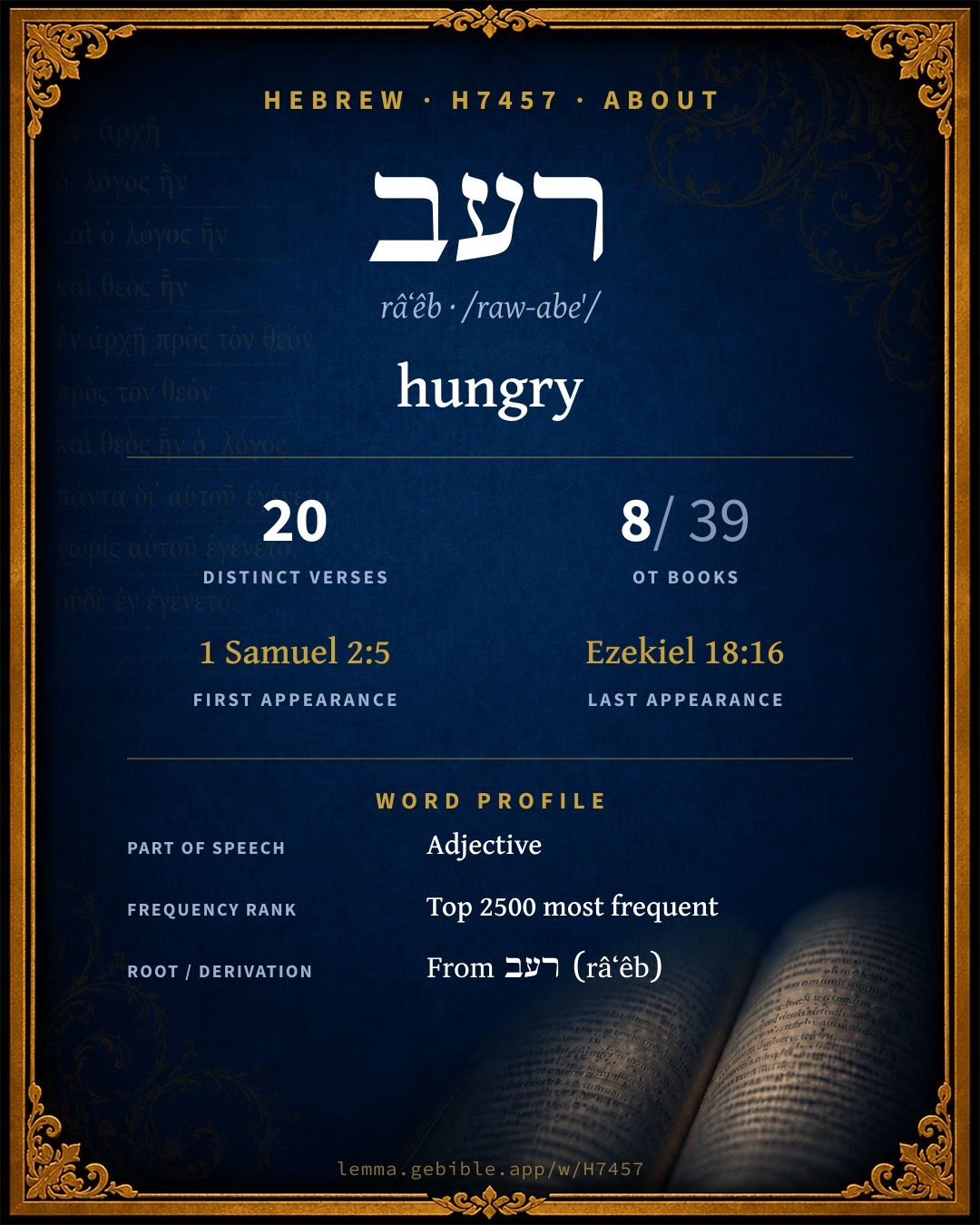
רָעֵב
hungry
‘hungry’ is one of 3 main senses fuller range ↓
Full lexicon entry — Brown-Driver-Briggs (BDB)
From Brown-Driver-Briggs (BDB)
Where this word appears
Grammar key — what these labels mean
Part of speech
- Adjective
- A word that describes or qualifies a noun.
State
- Absolute
- The independent form of a noun, not bound to a following word.
Gender
- Masculine
- Grammatically masculine.
- Feminine
- Grammatically feminine.
Number
- Singular
- One.
- Plural
- More than one (in Hebrew, generally three or more).
Grammatical forms
- Adjective, Adjective, Masculine, Singular, Absolute 12 times (60%)
- Adjective, Adjective, Masculine, Plural, Absolute 6 times (30%)
- Adjective, Adjective, Feminine, Singular, Absolute 2 times (10%)
Parsed forms decoded from the imported morphology (morphhb / Westminster Leningrad Codex — WLC text public domain, morphhb tagging CC BY 4.0), counted across 20 parsed occurrences — not distinct verses.
Every verse where H7457 appears — 20 distinct verses across 8 books. Click any verse to open its interlinear word-by-word view. Verse text shown in the World English Bible for context — . Each verse’s Hebrew form is shown with its reference; the English is not keyword-highlighted, since the data carries no word-level English alignment. Use “Compare translations” on any verse to read it across multiple English versions. This concordance covers the Hebrew Bible; Septuagint (Greek Old Testament) occurrences are not indexed here.
1 Samuel 1 verse
2 Samuel 1 verse
2 Kings 1 verse
Job 4 verses
- Job 5:5 רָ֘עֵ֤ב adj Adjective ms Whose harvest the hungry eats up, And take it even out of the thorns; The snare gapes for their substance.
- Job 18:12 רָעֵ֥ב adj Adjective ms His strength shall be famished, Calamity shall be ready at his side.
- Job 22:7 וּ֝/מֵ/רָעֵ֗ב conj + prep + Adjective Adjective ms You haven't given water to the weary to drink, And you have withheld bread from the hungry.
- Job 24:10 וּ֝/רְעֵבִ֗ים conj + Adjective Adjective mp So that they go around naked without clothing. Being hungry, they carry the sheaves.
Psalms 4 verses
- Psalms 107:5 רְעֵבִ֥ים adj Adjective mp Hungry and thirsty, Their soul fainted in them.
- Psalms 107:9 רְ֝עֵבָה adj Adjective fs For he satisfies the longing soul. He fills the hungry soul with good.
- Psalms 107:36 רְעֵבִ֑ים adj Adjective mp There he makes the hungry live, That they may prepare a city to live in,
- Psalms 146:7 לָ/רְעֵבִ֑ים prep det + Adjective Adjective mp Who executes justice for the oppressed; Who gives food to the hungry. Yahweh frees the prisoners.
Proverbs 2 verses
Isaiah 5 verses
- Isaiah 8:21 וְ/רָעֵ֑ב conj + Adjective Adjective ms They shall pass through it, sore distressed and hungry; and it shall happen that when they shall be hungry, they shall fret themselves, and curse by their king and by their God, and turn their faces upward:
- Isaiah 29:8 הָ/רָעֵ֜ב ptcl def.art + Adjective Adjective ms It shall be as when a hungry man dreams, and, behold, he eats; but he awakes, and his soul is empty: or as when a thirsty man dreams, and, behold, he drinks; but he awakes, and, behold, he is faint, and his soul has appetite: so shall the multitude of all the nations be, that fight against Mount Zion.
- Isaiah 32:6 רָעֵ֔ב adj Adjective ms For the fool will speak folly, and his heart will work iniquity, to practice profanity, and to utter error against Yahweh, to make empty the soul of the hungry, and to cause the drink of the thirsty to fail.
- Isaiah 58:7 לָֽ/רָעֵב֙ prep det + Adjective Adjective ms Isn't it to deal your bread to the hungry, and that you bring the poor who are cast out to your house? when you see the naked, that you cover him; and that you not hide yourself from your own flesh?
- Isaiah 58:10 לָֽ/רָעֵב֙ prep det + Adjective Adjective ms and if you draw out your soul to the hungry, and satisfy the afflicted soul: then shall your light rise in darkness, and your obscurity be as the noonday;
Ezekiel 2 verses
- Ezekiel 18:7 לְ/רָעֵ֣ב prep + Adjective Adjective ms and has not wronged any, but has restored to the debtor his pledge, has taken nothing by robbery, has given his bread to the hungry, and has covered the naked with a garment;
- Ezekiel 18:16 לְ/רָעֵ֣ב prep + Adjective Adjective ms neither has wronged any, has not taken anything to pledge, neither has taken by robbery, but has given his bread to the hungry, and has covered the naked with a garment;
About this entry
At a glance — auto-summarized from this page’s data, not written by a person. Every figure links to its source below. This summary describes the numbers; it doesn’t interpret them.
רעב (râʻêb) is a Hebrew adjective most often rendered “hungry.” Scripture first uses it in 1 Samuel 2:5. It turns up in 20 verses across 8 books, an uncommon footprint. It concentrates in Isaiah, which alone accounts for 25% of its uses. Not a single-sense word: explore its full sense range. For the data behind this summary, explore the sense tree and the renderings breakdown below.
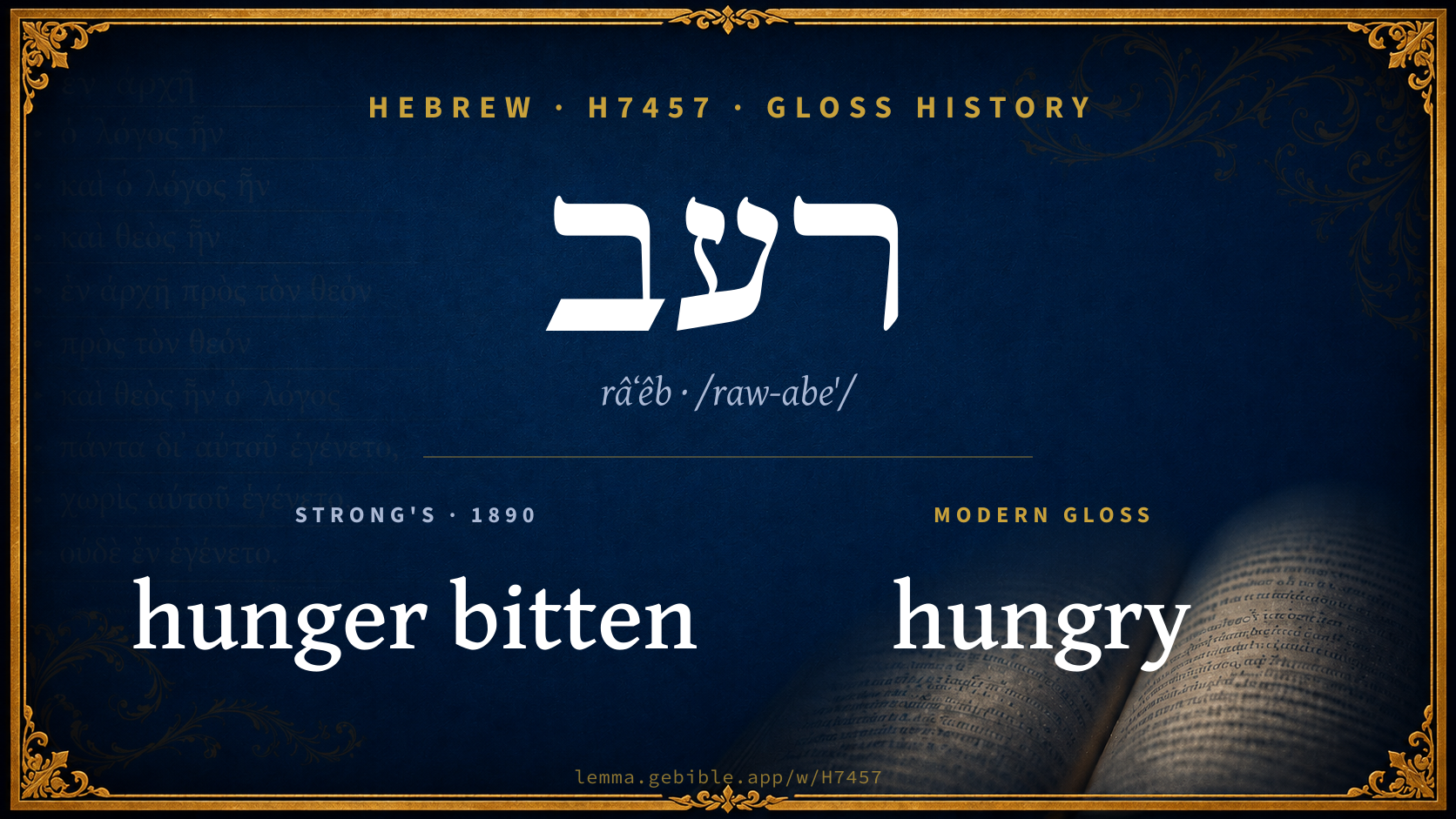
Gloss history
Strong's 1890 vs modern scholarship
About this word
Strong's H7457 catalogs a Hebrew word from the Hebrew Old Testament.
These counts are not copied from any lexicon or concordance. They are computed here, from the morphology-tagged Hebrew Old Testament. What Lemma adds →
- 20
- distinct verses
- The word appears in 20 distinct verses.
- 8 / 39
- OT books
- The word appears in 8 of 39 Old Testament books.
- #1,513
- by frequency
- Top 2500 most frequent Hebrew words (rank 1,513 of 8,640 Hebrew words by occurrence).
View all 20 occurrences in the concordance →
By section of the Old Testament
By traditional corpus
Conventional, traditional groupings — biblical authorship is debated, so this is a traditional corpus grouping, not an authorship claim. Each share is this word’s portion of its verses in that division of the Hebrew canon. Each figure is a share of the word’s 20 distinct verses.
- Prophets (Nevi'im) 10 verses · 50%
- Writings (Ketuvim) 10 verses · 50%
How translations render this word
Counts come from each version’s own published word-to-Strong’s tagging or interlinear alignment — an approximate guide to how each version renders this word, not a word-level alignment the data otherwise carries. Because each total is that version’s own tagged count, the per-version totals vary from one another and need not match the appearance or distinct-verse counts above. These counts may also differ from a printed concordance because Lemma counts each distinctly tagged rendering and does not collapse phrase taggings into a single head-word total. This is a fixed set of word-tagged versions (KJV, ASV, BSB, ULT) and does not change with the reading translation you choose elsewhere. Each version’s license is shown beside its name below (and on Sources).
BDB lists this Strong’s number as 3 distinct words (homographs). Each count above pools all of them and is not split by sense — see the Senses section below. A low-frequency rendering may belong to a different one of those words, not the primary meaning.
- King James Version†: Hungry 13×, Be hungry 2×
- American Standard Version†: Hungry 11×, Be hungry 2×
- Berean Standard Bible†: Hungry 9×
- unfoldingWord Literal Text†: Hungry 15×, Hungry one 2×
King James Version Public Domain
Renders H7457 across 22† tagged occurrences — most commonly:
Plus 7 renderings that appear only once — usually multi-word phrases or single function words the recovered tagging swept in, not distinct renderings.
American Standard Version Public Domain
Renders H7457 across 22† tagged occurrences — most commonly:
Plus 9 renderings that appear only once — usually multi-word phrases or single function words the recovered tagging swept in, not distinct renderings.
Berean Standard Bible Public Domain
Renders H7457 across 19† tagged occurrences — most commonly:
Plus 10 renderings that appear only once — usually multi-word phrases or single function words the recovered tagging swept in, not distinct renderings. Not rendered by a distinct English word in 1 further occurrence.
unfoldingWord Literal Text CC BY-SA 4.0
Renders H7457 across 20† tagged occurrences — most commonly:
Plus 3 renderings that appear only once — usually multi-word phrases or single function words the recovered tagging swept in, not distinct renderings.
Senses in the full BDB
Hebrew verbs can shift meaning by stem (binyan): Qal is the basic action, Niphal is often passive or reflexive, Piel often intensifies or makes it factitive, and Hiphil is typically causative. The senses below are grouped under the stem BDB assigns to each.
What do BDB’s symbols mean?
BDB uses these scholarly abbreviations:
| Symbol | Meaning |
|---|---|
| 𝔊 | the Septuagint (the ancient Greek translation, LXX) |
| 𝔙 | the Vulgate (the Latin translation) |
| 𝔖 | the Syriac version (the Peshitta) |
| 𝔗 | the Targum (the Aramaic translation) |
| ψ | the Psalms |
| √ | root (the underlying root or stem) |
| ‖ | parallel passage (a synonymous or contrasted parallel) |
| † | the dagger: every passage where the word occurs is cited |
The 4 senses and sub-senses the full Brown-Driver-Briggs lexicon distinguishes for this word, in lexicon order (not ranked by frequency), with BDB’s own verbatim wording and sub-sense lettering. Shown in Hebrew script with BDB’s own scholarly abbreviations. The condensed entry is in the Lexicon Entry tab. See also the Forms in the corpus table below.
רעב I be hungry (NH id. Hiph. and deriv.
Qal
- Pf. 3 ms. ר׳ Is 9:19; 44:12; 3 pl. רָעֵ֑בוּ ψ 34:11; Impf. 3 ms. יִרְעַב Is 8:21, 1 pl. נִרְעֵב Je 42:14, etc.;—be hungry Is 8:21 Gn 41:55 (E; of land, = have famine), Je 42:14 (לַלֶּחֶם), Is 49:10 (‖ צמא), 65:13 (‖ id.; opp. אכל), ψ 50:12 if I should be hungry (of י׳), Pr 6:30; 19:15. e.g. Isaiah 9:19
Hiphil
- : allow one to hunger, subj. י׳: Impf. 3 ms. וַיַּרְעִבֶ֑ךָ Dt 8:3 (opp. וַיַּאֲכִֽלְךָ), יַרְעִיב נֶפֶשׁ Pr 10:3. e.g. Deuteronomy 8:3
רעב II
- 1. famine (in land, nation or city), Gn 12:10; 26:1; 41:30, 31 Ex 16:3 2 S 21:1; 24:13 = 2 K 4:38; 6:25 +; שְׁנֵי(הָ)ר׳ Gn 41:27, 30, 36, שְׁנַת ר׳ v 50, but also שָׁנִים ר׳ [שָׁלוֹשׁ] שֶׁבַע 2 S 24:13 (on gender v. AlbrZAW xvi (1896), 103) = 1 Ch 21:12; c. חזק (be) severe Gn 41:56, 57 1 K 18:2; 2 K 25:3 = Je 52:6, חזק עַל Gn 47:20; c. כָבֵד 12:10; 47:4, 13; גָּדוֹל 2 K 6:25; זַעלעֲפוֹת ר׳ La 5:10; מְזֵי ר׳ Dt 32:24 + Is 5:13 (v. [מָזֶה]), תַּחֲלוּאֵי ר׳ Je 14:18, חַלֲלֵי ר׳ La 5:9, אֲסֻפֵי ר׳ Ez 34:29; חִצֵּי הָר׳ 5:16; as scourge of י׳ (+ חֶרֶב, דֶּבֶ, etc.; especially Je Ez), Je 5:12; 11:22; 14:12; 21:7, 9 Ez 5:2; 6:11, 12 +, etc.; fig. of lack of י׳’s word Am 8:11. e.g. Genesis 12:10
- 2. hunger, of individual Je 38:9 Dt 28:48 (+ צָסָא, etc.), 2 Ch 32:11 (+ id.). e.g. Jeremiah 38:9
רעב III hungry
Senses from the full Brown-Driver-Briggs lexicon (Brown, Driver, Briggs; Oxford 1906 — public domain), digitized via Sefaria, supplemented by the OpenScriptures HebrewLexicon (CC BY 4.0). Full attribution on Sources.
Word origin
I. vb. be hungry (NH id. Hiph. and deriv.; Assyrian rûbatu, hunger; Arabic رَغُبَ be roomy, voracious, رَغِبَ desire vehemently; Ethiopic ርኅበ be hungry);—
I. n.m. Gn 26:1 famine, hunger;—abs. ר׳ Gn 12:10 +; sf. רְעָבָם Ne 9:15;
II. adj. hungry;—abs. ר׳ 2 S 17:29 +; fs. רְעֵבָה ψ 107:9 Pr 27:7; mpl. רְעֵבִים 1 S 2:5 +;—hungry (sometimes + עָמֵא, עָיֵף), 2 S 17:29 2 K 7:12 Is 8:21 Pr 25:21 ψ 107:5; נֶפֶשׁ רְעֵבָה v 9 Pr 27:7; as subst. sg. a hungry man Is 29:8; 32:6; 58:7, 10 Ez 18:7, 16 Jb 5:5 (BevJPhil. xxvi. 304 proposes רָעָב, cf. Ez 7:15) 22:7, pl. 1 S 2:5 (opp. שְׂבֵעִים בַּלֶּהֶם), Jb 24:10 (‖ עָרוֹם), ψ 107:36; 146:7; יְהִי־רָעֵב אֹנוֹ Jb 18:12 (fig.) his strength grows hungry, i.e. fails (𝔙 Ew Di al.); 𝔖 De Bu Du (reading אָוֶן) al. his trouble grows hungry (i.e. ravenous for him), but ר׳ never elsewhere in this sense.
— Brown-Driver-Briggs (Oxford 1906, public domain), digitized via Sefaria, supplemented by the OpenScriptures HebrewLexicon (CC BY 4.0). See Sources.
Derived from רעב (râʻêb) (H7456) — to be hungry.
Jastrow Dictionary
A second Hebrew/Aramaic lexicon for comparison, covering Aramaic and post-biblical (Talmudic, Targumic, Midrashic) usage that the biblical-Hebrew BDB does not. Matched by lemma rather than by Strong’s number, so a lemma may carry more than one Jastrow headword (shown separately below), and the entries cover usage well beyond the Bible.
רָעֵב I
- (b. h.) hungry. Gitt. 56ᵃ כל … כשהוא ר׳ וכ׳ whoever entered his house hungry like a dog came out satisfied. Lev. R. s. 34 (ref. to Is. LVIII, 10) אם זכיתם לרְעֵבוֹ של יעקב וכ׳ if you do good, you will give to the hungry one of Jacob, if not, to the satisfied one of Esau (to the Roman oppressor); a. fr., v. next w.—Pl. רְעֵבִים. Midr. Till. to Ps. CXVIII, 19 מאכיל ר׳ הייתי I have been a feeder of the hungry; זה השער של מאכיל ר׳ this is the gate for him who fed the hungry. Midr. Till. to Ps. CXLVI, 7 ומי הם הר׳ זה וכ׳ and who are the hungry (to whom the Lord gives bread)? Such as Elijah who was hungry &c.; a. e. e.g. Isaiah 58:10
רָעֵב II
- (b. h.) to be hungry. Succ. 52ᵇ אבר … מַרְעִיבוֹ שבע משביעו ר׳ a small organ is in man, when you starve it, it is satisfied, when you satisfy it, it is hungry; Snh. 107ᵃ. Mekh. B’shall., s. 4 ר׳ האכילו when the child was hungry, he gave him food; (Yalk. Ex. 233 נִרְעָב); a. e.
- 1. same. Mekh. l. c. ה׳ האכילו when Israel was hungry, he (the Lord) gave him food.
- 2. to starve, subject to privation. Succ. l. c. Snh. 65ᵇ (ref. to Deut. XVIII, 11 דורש אל המתים) זה המַרְעִיב עצמו וכ׳ that is he who fasts and spends the night in the cemetery in order that the spirit of impurity (unholy inspiration) may rest upon him. Ib. 100ᵃ כל המרעיב עצמו וכ׳ him who undergoes privations for the sake of studying the words of the Law in this world, the Lord will satisfy &c. Y. Keth. V, 30ᵇ האבר הזה הִרְעִיבָתוֹ השביעתו … הרעיבתו that certain organ, if she starves it, she makes it satisfied, the more she satisfies it, the more she makes it hungry, v. supra. Taan. 11ᵃ; a. e. e.g. Deuteronomy 18:11
- to be famished, v. supra.
רעב
- , Targ. Y. Num. XX, 11 וארעב ed. Vien., v. רְעַם II
רָעָב
- preced. art.) hunger, famine. Ber. 55ᵃ שלשה … ר׳ ושובע וכ׳ three things does the Lord himself announce; famine, plenty, and a good governor. B. Bath. 8ᵇ ר׳ קשה מחרב famine is a severer affliction than war. Ab. V, 8, v. בַּצּוֹרֶת; a. fr.
A Dictionary of the Targumim, the Talmud Babli and Yerushalmi, and the Midrashic Literature (Marcus Jastrow; London, Luzac, 1903) — Public Domain. Digitized via Sefaria. Digitized via Sefaria. Full attribution on Sources.
Forms in the corpus
The 18 distinct written forms H7457 takes in the Hebrew Bible, most frequent first — each parse links to that state’s occurrences in the concordance. Hebrew forms include their vowel points and cantillation, so a single lemma takes many written forms.
| Form | Parsing | Example | Uses |
|---|---|---|---|
| לְ/רָעֵ֣ב | Adjective, Adjective, Masculine, Singular, Absolute | Ezekiel 18:7 | 2 |
| לָֽ/רָעֵב֙ | Adjective, Adjective, Masculine, Singular, Absolute | Isaiah 58:7 | 2 |
| הָ/רָעֵ֜ב | Adjective, Adjective, Masculine, Singular, Absolute | Isaiah 29:8 | 1 |
| וְ/רָעֵ֑ב | Adjective, Adjective, Masculine, Singular, Absolute | Isaiah 8:21 | 1 |
| וּ/רְעֵבִ֖ים | Adjective, Adjective, Masculine, Plural, Absolute | 1 Samuel 2:5 | 1 |
| וּ֝/מֵ/רָעֵ֗ב | Adjective, Adjective, Masculine, Singular, Absolute | Job 22:7 | 1 |
| וּ֝/רְעֵבִ֗ים | Adjective, Adjective, Masculine, Plural, Absolute | Job 24:10 | 1 |
| לָ/רְעֵבִ֑ים | Adjective, Adjective, Masculine, Plural, Absolute | Psalms 146:7 | 1 |
| רְ֝עֵבָ֗ה | Adjective, Adjective, Feminine, Singular, Absolute | Proverbs 27:7 | 1 |
| רְ֝עֵבָה | Adjective, Adjective, Feminine, Singular, Absolute | Psalms 107:9 | 1 |
| רְעֵבִ֑ים | Adjective, Adjective, Masculine, Plural, Absolute | Psalms 107:36 | 1 |
| רְעֵבִ֣ים | Adjective, Adjective, Masculine, Plural, Absolute | 2 Kings 7:12 | 1 |
| רְעֵבִ֥ים | Adjective, Adjective, Masculine, Plural, Absolute | Psalms 107:5 | 1 |
| רָ֘עֵ֤ב | Adjective, Adjective, Masculine, Singular, Absolute | Job 5:5 | 1 |
| רָעֵ֔ב | Adjective, Adjective, Masculine, Singular, Absolute | Isaiah 32:6 | 1 |
| רָעֵ֛ב | Adjective, Adjective, Masculine, Singular, Absolute | 2 Samuel 17:29 | 1 |
| רָעֵ֣ב | Adjective, Adjective, Masculine, Singular, Absolute | Proverbs 25:21 | 1 |
| רָעֵ֥ב | Adjective, Adjective, Masculine, Singular, Absolute | Job 18:12 | 1 |
Same root — word family
Other BDB entries built from the same root as H7457, grouped by Strong’s listed origin. These share a root / origin per the lexicon — not necessarily a shared meaning. Each links to that word’s own entry.
Derives from
Shares the same root
Compare all same-root words → They share a root, not necessarily a meaning.
Septuagint verse parallels
This word appears in 19 verses that also exist in the Greek Old Testament (Septuagint), out of the 20 Hebrew verses it occurs in. You can read those verses in Greek by switching the Old Testament edition to the Septuagint.
Read these verses in the Septuagint
- 1 Samuel 2:5
- 2 Samuel 17:29
- 2 Kings 7:12
- Job 5:5
- Psalms 107:5
- Proverbs 25:21
- Isaiah 8:21
- Ezekiel 18:7
This is a verse-level parallel only — the same verses exist in both the Hebrew and Greek Old Testaments. No word-level Hebrew↔Greek correspondence is claimed: the data carries no such alignment, so no Greek word is shown as this Hebrew word’s translation. Coverage is not total — the Septuagint omits the deuterocanon and renumbers the Psalms, so some Hebrew verses have no direct Greek parallel.