Lamentations 4:9

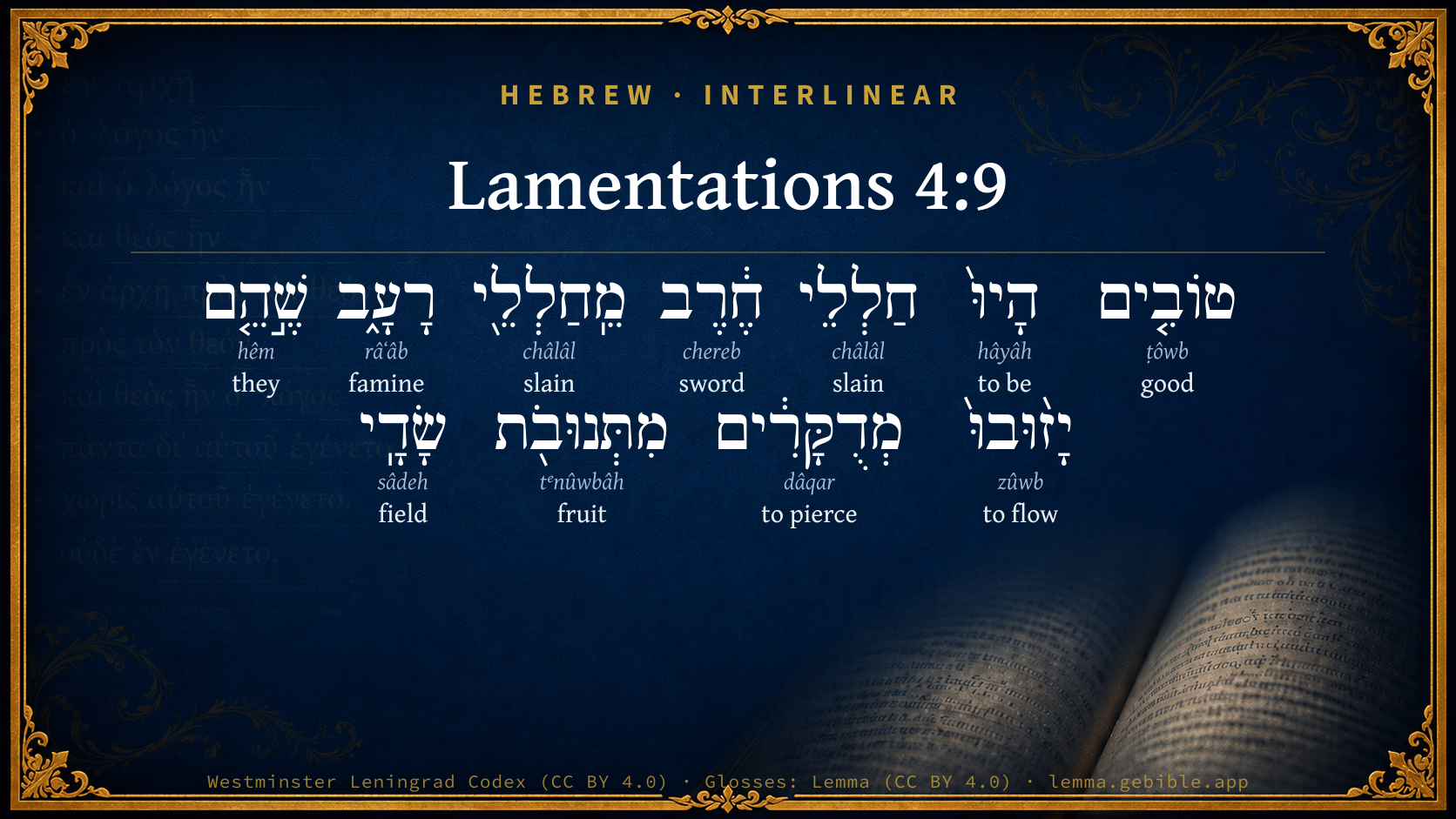
Hebrew (Westminster Leningrad Codex) Lamentations 4:9 appears in the Hebrew Old Testament. The text above is from the Westminster Leningrad Codex. Each word links to its Strong’s number, a concise gloss, and parsing drawn from the Open Scriptures Hebrew Bible morphology. Click any word for its full Brown-Driver-Briggs (BDB) entry.
Download image
Cite this verse

Lamentations 4:9 (World English Bible). Public Domain. Lemma interlinear Bible study tool, https://lemma.gebible.app/v/lamentations/4/9.

Show BibTeX & RIS
BibTeX
RIS
English Translation
Those who are killed with the sword are better than those who are killed with hunger; For these pine away, stricken through, for want of the fruits of the field.
World English Bible · Public Domain
Download a study sheet

One document with this verse’s original text, its word-by-word gloss line, the meaning frame, cross-references with their text, attributed commentary, and full source and license credits — printable, and it pastes into notes with its structure intact.

This verse Autodidact and up

Study sheet (.html) Plain text (.txt)

A passage Seminary Student

Up to 50 verses in one chapter. A passage sheet keeps up to 6 commentary sources and 12 cross-references per verse, in the order this page ranks them, and says so on the sheet whenever that leaves anything out. Ask for a single verse and you get the Autodidact verse sheet above.

Everything on this page stays free to read, with no account — the sheet is a download of what is already on screen, not access to it.

Want to remove ads? Support Godless Engineer
Compare translations 3

The same verse in 3 English versions, stacked beneath the original-language interlinear above. Click any original word for its lexicon entry.

Each is an independent rendering of the whole verse — the interlinear is not word-aligned to these translations.

Highlighted words mark where these versions differ — a whole-verse word diff, not a word-by-word alignment.

  • World English Bible Public Domain
    Those who are killed with the sword are better than those who are killed with hunger; For these pine away, stricken through, for want of the fruits of the field.
  • King James Version Public Domain
    They that be slain with the sword are better than they that be slain with hunger: for these pine away, stricken through for want of the fruits of the field.
  • unfoldingWord Literal Text CC BY-SA 4.0
    Better were the slain of the sword than the slain of hunger, for they waste away, pierced for lack of the fruits of the field. YODH

unfoldingWord Literal Text — © unfoldingWord, licensed CC BY-SA 4.0. Word-aligned USFM3 via Door43 (git.door43.org/unfoldingWord/en_ult).

Versions to compare (up to 4)

3 of 4 selected

Show all 18 translations

Every available English version of this verse, each an independent rendering of the whole verse.

  • World English Bible Public Domain
    Those who are killed with the sword are better than those who are killed with hunger; For these pine away, stricken through, for want of the fruits of the field.
  • Berean Standard Bible Public Domain
    Those slain by the sword are better off than those who die of hunger, who waste away, pierced with pain because the fields lack produce.
  • Majority Standard Bible Public Domain
    Those slain by the sword are better off than those who die of hunger, who waste away, pierced with pain because the fields lack produce.
  • King James Version Public Domain
    They that be slain with the sword are better than they that be slain with hunger: for these pine away, stricken through for want of the fruits of the field.
  • American Standard Version (1901) Public Domain
    They that are slain with the sword are better than they that are slain with hunger; For these pine away, stricken through, for want of the fruits of the field.
  • Revised Version (1885) Public Domain
    They that be slain with the sword are better than they that be slain with hunger; for these pine away, stricken through, for want of the fruits of the field.
  • Geneva Bible (1599) Public Domain
    They that be slaine with the sword are better, then they that are killed with hunger: for they fade away as they were striken through for the fruites of the fielde.
  • Douay-Rheims (1899) Public Domain
    Teth. It was better with them that were slain by the sword, than with them that died with hunger: for these pined away being consumed for want of the fruits of the earth.
  • Young's Literal Translation Public Domain
    Better have been the pierced of a sword Than the pierced of famine, For these flow away, pierced through, Without the increase of the field.
  • Literal Standard Version CC BY-SA 4.0
    Better have been the pierced of a sword || Than the pierced of famine, || For these flow away, pierced through, || Without the increase of the field.
  • Unlocked Literal Bible CC BY-SA 4.0
    Those who have been killed by the sword were happier than those killed by hunger, who wasted away, pierced by the lack of any harvest from the field.
  • unfoldingWord Literal Text CC BY-SA 4.0
    Better were the slain of the sword than the slain of hunger, for they waste away, pierced for lack of the fruits of the field. YODH
  • Darby Bible Public Domain
    The slain with the sword are happier than the slain with hunger; for these pine away, stricken through for want of the fruits of the field.
  • World Messianic Bible Public Domain
    Those who are killed with the sword are better than those who are killed with hunger; for these pine away, stricken through, for lack of the fruits of the field.
  • Webster's Bible Public Domain
    They that are slain with the sword are better than they that are slain with hunger: for these pine away, stricken through for want of the fruits of the field.
  • Free Bible Version CC BY-SA 4.0
    Those killed by the sword are better off than those who die of hunger, who slowly waste away in agony because the fields produce no crops.
  • Bible in Basic English Public Domain
    Those who have been put to the sword are better off than those whose death is caused by need of food; for these come to death slowly, burned up like the fruit of the field.
  • JPS Tanakh (1917) Public Domain
    They that are slain with the sword are better than they that are slain with hunger; for these pine away, stricken through, for want of the fruits of the field.

Literal Standard Version (2020), Covenant Press — licensed CC BY-SA 4.0. Text via the HelloAO Bible API (eBible.org). Unlocked Literal Bible (unfoldingWord) — licensed CC BY-SA 4.0. Text via the HelloAO Bible API (eBible.org). unfoldingWord Literal Text — © unfoldingWord, licensed CC BY-SA 4.0. Word-aligned USFM3 via Door43 (git.door43.org/unfoldingWord/en_ult). Free Bible Version, Dr. Jonathan Gallagher — licensed CC BY-SA 4.0. Text via the HelloAO Bible API (eBible.org).

Word by word

More ways to search: Search by grammar → Find every occurrence → Compare this word →

Practice this passage: Drill this verse → Learn its vocabulary →

מִתְּנוּבֹ֖ת
tᵉnûwbâh
H8570
“from · fruits of”
Preposition + Noun, Common, Feminine, Plural, Construct
Part of Speech
Preposition + Noun
Type
Common
Gender
Feminine
Number
Plural
State
Construct
Full BDB Definition

Origin: from H5107

TWOT: 1318c

fruit, produce
  1. טוֹבִ֤ים ṭôwb H2896 “good” Adjective, Adjective, Masculine, Plural, Absolute
  2. הָיוּ֙ hâyâh H1961 “to be” Verb, Qal, Perfect, 3rd Person, Common, Plural
  3. חַלְלֵי châlâl H2491 “slain of” Adjective, Adjective, Masculine, Plural, Construct
  4. חֶ֔רֶב chereb H2719 “sword” Noun, Common, Feminine, Singular, Absolute
  5. מֵֽחַלְלֵ֖י châlâl H2491 “from · slain of” Preposition + Adjective, Adjective, Masculine, Plural, Construct
  6. רָעָ֑ב râʻâb H7458 “famine” Noun, Common, Masculine, Singular, Absolute
  7. שֶׁ֣הֵ֤ם hêm H1992 “who/which · they” Particle, Relative + Pronoun, Personal, 3rd Person, Masculine, Plural
  8. יָז֨וּבוּ֙ zûwb H2100 “to flow” Verb, Qal, Imperfect, 3rd Person, Masculine, Plural
  9. מְדֻקָּרִ֔ים dâqar H1856 “pierced” Verb, Pual, Participle Passive, Masculine, Plural, Absolute
  10. שָׂדָֽי sâdeh H7704 “field” Noun, Common, Masculine, Singular, Absolute

About this verse

These counts appear in no published source. They are computed here, from the morphology-tagged text and Lemma’s own curated glosses. What Lemma adds →

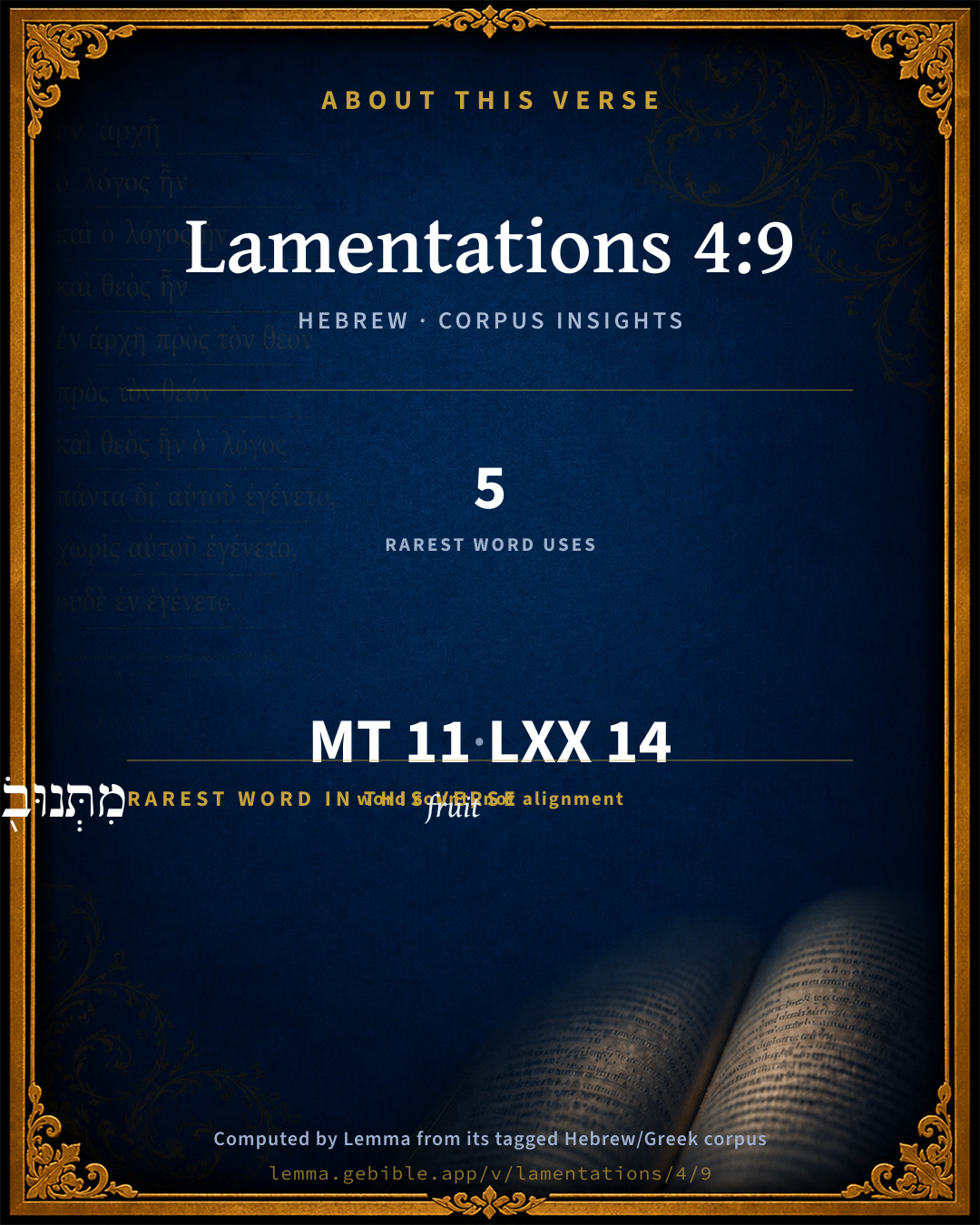
11
words
10
distinct lemmas
Prophets
section

Notable vocabulary

The rarest word here is מִתְּנוּבֹ֖ת fruit H8570 — appearing just 5 times in the whole Hebrew Bible.

Shared distinctive vocabulary

מִתְּנוּבֹ֖ת fruit H8570 occurs in 5 verses of the Hebrew Bible. Also found in:

Grammatical profile

  • 3 verbs
  • 4 nouns
  • 3 adjectives
  • 1 pronoun

Verb forms

  • הָיוּ֙ Qal · Perfect
  • יָז֨וּבוּ֙ Qal · Imperfect
  • מְדֻקָּרִ֔ים Pual · Participle Passive

Repetition

A word recurs within this verse — often emphatic in Hebrew:

  • חַלְלֵי slain H2491 ×2

Hebrew & Septuagint length

In English translation the verse runs 30 words from the Hebrew and 28 from the Septuagint (LXX English) — closely comparable.

A rough comparison of the two English renderings, which tokenize alike — not a word-level alignment.

Word counts can differ between the Hebrew and the Greek without any difference in meaning — e.g. the Hebrew direct-object marker אֵת has no separate Greek word, and Greek often adds the article ὁ.

In the original languages it is 11 Hebrew tokens and 14 Greek tokens — but the two are counted differently (Hebrew bundles its prefixes and suffixes into one token; the Greek is in lemma form), so that isn’t a like-for-like length.

Cross-references

4

Topical passages linked to Lamentations 4:9 in the Treasury of Scripture Knowledge — connected by theme and wording, ordered by reader-vote popularity; previews shown in the World English Bible.

  • Leviticus 26:39 Those of you who are left will pine away in their iniquity in your enemies' lands; and also in the iniquities of their fathers shall they pine away with them.
  • Jeremiah 16:4 They shall die grievous deaths: they shall not be lamented, neither shall they be buried; they shall be as dung on the surface of the ground; and they shall be consumed by the sword, and by famine; and their dead bodies shall be food for the birds of the sky, and for the animals of the earth.
  • Ezekiel 24:23 Your tires shall be on your heads, and your shoes on your feet: you shall not mourn nor weep; but you shall pine away in your iniquities, and moan one toward another.
  • Ezekiel 33:10 You, son of man, tell the house of Israel: Thus you speak, saying, Our transgressions and our sins are on us, and we pine away in them; how then can we live?

Cross-references courtesy of OpenBible.info (CC BY 4.0).

Hebrew and Greek witnesses Masoretic Hebrew ↔ Greek Septuagint

The same verse in the two great witnesses to the Old Testament, shown verse-for-verse.

These are two independent witnesses, not word-aligned to each other, and the Septuagint is shown in lemma (dictionary) form.

Hebrew Lamentations 4:9 Masoretic · Westminster Leningrad Codex

טוֹבִ֤ים הָיוּ֙ חַלְלֵי חֶ֔רֶב מֵֽחַלְלֵ֖י רָעָ֑ב שֶׁ֣הֵ֤ם יָז֨וּבוּ֙ מְדֻקָּרִ֔ים מִתְּנוּבֹ֖ת שָׂדָֽי

Those who are killed with the sword are better than those who are killed with hunger; For these pine away, stricken through, for want of the fruits of the field.

World English Bible · Public Domain

Greek LXX Lamentations 4:9 Septuagint · lemma form

καλός εἰμί ὁ τραυματίας ῥομφαία ἤ ὁ τραυματίας λιμός πορεύομαι κεντέω ἀπό γένημα ἀγρός

TETH. The slain with the sword were better than they that were slain with hunger: they have departed, pierced through from lack of the fruits of the field.

LXX2012 (modern English Septuagint) · Public Domain

Hebrew: Westminster Leningrad Codex (CC BY 4.0). Greek: Septuagint (public domain); English from LXX2012 (modern English Septuagint) (Public Domain). How the Septuagint differs from the Hebrew →

Commentary

Notes on Lamentations 4:9 from classic Christian and Jewish commentators (each source and its license shown beneath its notes). The classic Christian expositions comment on the surrounding passage and are grouped to its opening verse, so a note may address several verses; the Jewish commentaries on the Tanakh (Rashi and others) are per-verse, so they appear only where the commentator wrote on this verse.

Lemma curates 59 commentaries, every one of them public domain or Creative Commons licensed, each selected and text-cleaned for this edition rather than reprinted as found. About our sources →

Trapp's Complete Commentary

John Trapp

Lam 4:9 [They that be] slain with the sword are better than [they that be] slain with hunger: for these pine away, stricken through for [want of] the fruits of the field.

Ver. 9. They that be slain with the sword are better.] They suffer less pain in dying; they are soon despatched. See on Lam 4:6. But famine is a hard weapon.

“ Triste genus mortis miseris mortalibus omne:

Est tureen imprimis triste perire fame. ”

For these pine away.] By a lingering death, as Drusus the Roman, to whom food being denied, he had eaten the stuffings of his bed, saith Suetonius; and our Richard II, who was tantalised and starved to death at Pomfret Castle, where his diet being served in and set before him in the wonted princely manner, he was not suffered either to taste or touch thereof. {a}

Stricken through for want of the fruits of the field.] Those "precious fruits of the earth," as James the apostle calleth them. {Jas 5:7} These as a sword defend us from death; and the want of them, as a sword, runneth us through. In the time of Otho the emperor, there was so great a scarcity of bread grain in Germany for three years together that many thousands died of hunger; in remembrance of which great dearth there is yearly baked at Erfurt a little loaf, such as was then sold for much money. {b}

{a} Speed, 766.

{b} Melanchth.

John Trapp, A Commentary or Exposition upon All the Books of the Old and New Testament (1647–1656) — public domain. Text from a community e-Sword module.

Tyndale Open Study Notes

Tyndale Open Resources

4:9 Long sieges result in a serious lack of food. Even if people could get to the fields, they would find the crops destroyed or harvested to feed the soldiers.

Tyndale Open Study Notes — © Tyndale Open Resources, licensed CC BY-SA 4.0. Text via the HelloAO Bible API.

Geneva Bible (1599)

Geneva Bible translators

For lack of food they pine away and consume.

Geneva Bible (1599) marginal notes — public domain. Text via Bolls.life.

Jamieson, Fausset & Brown

Robert Jamieson, A. R. Fausset & David Brown

The speedy death by the sword is better than the lingering death by famine.

pine away--literally, "flow out"; referring to the flow of blood. This expression, and "stricken through," are drawn from death by "the sword."

want of . . . fruits--The words in italics have to be supplied in the original (Gen 18:28; Psa 109:24).

Jamieson, Fausset & Brown — Commentary Critical and Explanatory on the Whole Bible (1871) — public domain (CC PDM 1.0). Text via the HelloAO Bible API.

John Calvin's Commentaries

The beginning of the verse is without any difficulty; for the Prophet says that it happened better to those who immediately perished by the sword than to others who had to struggle with famine, according to what he had lately said, that the punishment of Sodom was more tolerable, because it was suddenly executed. Sudden death is the easiest And the Prophet, when complaining that the ungodly prospered, so that the faithful sometimes envied them, says that they die as it were in a moment, and are taken away from the world; but he says that the faithful are held, as it were, captive by the snares of death, and protract life in perpetual languor. For this reason the Prophet now says that the punishment of death would have been light to the Jews. And yet we know that. a violent death is regarded by us with horror. For he who dies on his bed is said to yield to his fate, as he seems to pay what he owes to nature; but, he who is slain by the sword is violently snatched away, and, as it were, contrary to nature. Violent death, then, is always horrible. But the comparison used by the Prophet amplifies the atrocity of their punishment, because it would have been more desirable to have been killed at once than to remain alive to struggle with famine.

And he expresses himself more clearly by saying that they pined away, having been pierced through by the fruits of the earth There is here some obscurity, but by the fruits of the earth, we are no doubt to understand all kinds of food. Some consider that “defect,” or failure, is to be understood. But the Prophet speaks much more emphatically, even that all the productions of the earth took vengeance on this wicked people, by refusing the usual supply. The earth is the servant of God’s bounty and kindness; for it is the same as though he with his hand extended food to us, when the earth opens its bowels; so also the productions of the earth are evidences of God’s paternal love towards us. Now, when the fruits of the earth withdraw themselves from us, they are as it were the weapons to execute God’s vengeance. So, then, the Prophet means that the Jews had been pierced through by the fruits of the earth, and thus had pined away; as though he had said, that they had not been pierced by the sword, but had been wounded by famine, for the productions of the earth became, as it were, swords, while yet they sustain, as we have said, the life of men.

John Calvin's Commentaries (1540-1563) — public domain. Text from the Calvin Translation Society English edition (1840s-50s) via the Christian Classics Ethereal Library (ccel.org). Calvin's coverage is partial (roughly two-thirds of the Bible); uncommented books and verses are honest gaps, never fabricated. The 19th-century editor's footnotes and remarks are omitted so the notes are faithfully Calvin's own voice.

Ellicott's Commentary for English Readers

(9) For want of . . .—The italics indicate the difficulty of the sentence. Literally the clause stands, from the fruits of the field, and it has been explained by some as referring to those that died in battle, stricken through while yet there were fruits, i.e., not doomed to perish slowly from hunger. The construction of Psa_109:24, however, “faileth of fatness”—i.e., for want of fatness—gives a sufficient support to the Authorised version.

A Bible Commentary for English Readers, edited by Charles John Ellicott (1878–1897) — public domain. Text from a community e-Sword module.

The Cambridge Bible for Schools and Colleges

gen. ed. J. J. S. Perowne

9. The two modes of death experienced in the siege are contrasted.

pine away] lit. as mg. flow away.

stricken through] See on Jer_37:10, where (mg.) “thrust through” is the same word in the Heb. As the expression seems scarcely applicable to those dying of hunger, the Heb. text is somewhat suspicious, but no obviously satisfactory emendation has been suggested.

The Cambridge Bible for Schools and Colleges (gen. ed. J. J. S. Perowne; Cambridge University Press, 1878–1918) — public domain. Text from a community e-Sword module.

John Gill's Exposition

They that be slain with the sword are better than they that be slain with hunger,.... Not that they are better with respect to their state after death, but with respect to their manner of dying. They that were slain by the sword of the Chaldeans, as many were, either upon the walls, or in sallies out against the enemy, these felt less pain, and had less terror of mind in dying, than those did who perished by famine; they died a lingering death, as it were by inches, and were in continual pain of body and uneasiness of mind:

for these pine away, stricken through for want of the fruits of the field: that is, those that died by famine gradually wasted or "flowed" away, their fluid parts by degrees went off; and though they were not run through with the sword, they were stabbed by famine, and were so distressed in body and mind as if a sword had pierced them; not having the fruits of the field, the corn and the wine, to support nature, and keep them alive. Jarchi's note is,

"they that were slain with hunger were inflated at the smell of the fruits of the field, when the enemies were roasting their flesh upon the grass without the wall; the smell entered into those that swelled by famine, and their bellies burst, and their excrements flowed out; and this is the death worse than that of being slain with the sword.''

And to this agrees the Targum,

"more happy are they that are slain with the sword than they that are slain with famine; for they that are slain with the sword flowed when their bellies were burst, by that which they ate of the fruits of the field; and those that were inflated with famine, their bellies burst through "want" of food.''

Most interpreters refer this clause to those that died of famine: but Gussetius (z) interprets it of those that were killed with the sword; and renders and paraphrases the words thus, "for they being stabbed, sent out"; by the open wounds, "a flux, which arose from the fruits of the field"; their food and nourishment being yet in their belly and veins, and so did not pine away through penury and famine; and their misery was short and light, in comparison of others: and so Abendana.

(z) Comment. Ebr. p. 225.

John Gill's Exposition of the Whole Bible (1746–1763) — public domain (CC PDM 1.0). Text via the HelloAO Bible API.

Haydock's Catholic Bible Commentary

For. Literally, "by the barrenness of the earth." (Haydock) --- Such a death was, no doubt, more painful than to perish quickly by the sword. (Calmet)

George Leo Haydock (1774–1849), Haydock's Catholic Family Bible and Commentary, 1859 edition — public domain. Excludes Psalms (Douay-Rheims chapter numbering differs from Protestant) and Deuterocanonical books (Catholic canon only).

Matthew Poole's English Annotations

During the siege many were killed by the enemies’ sword, many more perished by famine; the prophet saith the condition of those who perished by the sword was much better than the condition of those who perished by famine, because they had a quicker death, and were sooner despatched and put out of their pain; whereas they who perished by hunger died a miserable, lingering death, gradually pining away, because they wanted corn and herbs, the fruits of the field, to uphold their souls in life.

Matthew Poole's English Annotations on the Holy Bible (1683–1685) — public domain. Text from a community e-Sword/MySword module.

The Pulpit Commentary

The miserable condition just now described maintains a sad preeminence even when compared with the fate of the slain in battle. And why! For these pine away (literally, melt away), stricken through (with the pangs of hunger). The Authorized Version takes the subject of the second half of the verse to be the famished. But it is, perhaps, more natural to take it to be those wounded in a battle, to whom the expression, "stricken through," is actually applied in Jer_37:10 Jer_51:4. In this case the line had better be rendered thus: For those pine away, stricken through, leaving the fruits of the field (which they no longer need). The word rendered "pine away" would be particularly applicable to those who perished from loss of blood.

Sword and hunger.

I WORSE THINGS THAN WAR. Better, says the prophet, to be swiftly slain in battle than have the slow and gnawing death of hunger. None worthy the name of Christian can but appreciate and admire the zeal, devotion, and self-abnegation of those who toil incessantly in the things that make for peace. War is so dreadful an evil that hardly too strong things can be said against it. And one of the strong things said is with respect to the immense suffering produced by war. Yet after all there is a great deal that deceives imagination here. Suffering is crowded into a small space, and puts on a horrible aspect, and thus it looks huger than it is, and so when we are appalled at the continuance in the world of great wars full of carnage, we shall do well to recollect that war is by no means the worst of things so far as power of inflicting suffering is concerned. Evidently the prophet saw starvation as a more horrible thing than war. It may, of course, be said the war was the cause of the famine, and very likely it was, but then, what was the cause of the war? Good men in their enthusiasm come in with all sorts of ready remedies for great evils, not sufficiently considering how one evil is connected with another, and how the stopping up of one channel may only fill other channels all the more. Who can dry up the fountain of all evil? that is the question.

II THE DREADFUL ACCOMPANIMENTS OF FAMINE. IS there anything worse than the carnage of a battlefield? Yes; the pangs of a multitude slowly dying of starvation, There is death from disease, death from decay, death of the strong man in full health from violence; but worse than any surely is this slow torment of hunger. What an instance of the rigid way in which law binds us down, unless there be some Divine reason for interfering with the operations perceptible to us! He who intervened to feed the five thousand and the four thousand could have intervened to keep these wretched women from laying their hands on their own children for food. What necessity was there in the one case which there was not in the other? Some there must have been, though we may fail to grasp it as a whole. Doubtless if we could only see clearly it would then become manifest that there is no lack in the giving of food, but that it is we who lack wisdom in developing and distributing what is given. Y.

The Pulpit Commentary (1880–1919), ed. H.D.M. Spence-Jones & Joseph S. Exell — public domain. Text from a community e-Sword module.

unfoldingWord translationNotes

Door43 World Missions Community

Those who have been killed by the sword

Here the "sword" represents an enemy's attack. It can be stated in active form. AT: "Those whom enemy soldiers have killed" (See: Metonymy and Active or Passive)

those killed by hunger

Here "hunger" represents starvation. This can be stated in active form. AT: "those who starved to death" (See: Metonymyand Active or Passive)

who wasted away

"who became extremely thin and weak"

pierced by the lack of any harvest from the field

Here "harvest from the field" is a metonym that represents food to eat. Lack of food is spoken of here as if it were a sword that pierces people. AT: "who died because there was not enough food to eat" (See: Metonymy and Metaphor and Active or Passive)

The hands of compassionate women

Here the women are represented by their "hands." Because they were so hungry, women who had been compassionate in the past were no longer compassionate toward their children; instead they boiled them for food. AT: "Compassionate women" or "Women who had been compassionate in the past" (See: Synecdoche)

they became their food

"their children became the women's food"

the daughter of my people was

This is a poetic name for Jerusalem, which is spoken of here as if it were a woman. See how you translated this in Lamentations 2:11. AT: "my people were" (See: Metonymy and Personification)

translationWords

sword

compassion

children

unfoldingWord translationNotes — © Distant Shores Media and the Door43 World Missions Community, licensed CC BY-SA 4.0. Source: git.door43.org/Door43/en_tn.

Rashi

Rabbi Shlomo Yitzchaki (Rashi)

for they ooze, pierced, etc. The victims of hunger were swollen from the smell of the fruits of the field, for the enemies would roast meat on the grass outside the wall, and the aroma would go into those swollen from hunger, and their stomachs would split, and their feces would ooze. Now this is a more ignoble death than those who are slain by the sword.

pierced Heb. מְדֻקָרִים. Being split either by the swelling of hunger or by the stabbing of the sword is called דְקִירָה, piercing.

by the fruits of the field Because of the roots and grasses that they gathered and ate, their feces increased and were loathsome.

Rashi on the Tanakh — English translations: “The Judaica Press complete Tanach with Rashi, translated by A. J. Rosenberg” (CC BY 4.0); “Pentateuch with Rashi's commentary by M. Rosenbaum and A.M. Silbermann, 1929-1934” (public domain); “The Metsudah Tanach series, Lakewood, N.J” (CC BY 4.0); and “The Book of Joshua, Metsudah Publications, 1997” (CC BY 4.0). Text via Sefaria.

Lesson kit

Teaching starters — assembled from the data on this page, not authored interpretation. Every prompt links to the verse data it draws on. Edit before teaching.

Lamentations, in the Prophets, opens this verse with 11 words (10 distinct Hebrew lemmas). Its most distinctive word is tᵉnûwbâh (“fruit”). A historical commentator’s framing appears above. Read the whole chapter for the surrounding context.

Discussion questions

  1. How does “fruit” (tᵉnûwbâh) shape what this verse is saying?
  2. Deuteronomy 32:13 shares the word «fruit» with this verse. How do the two illuminate each other?
  3. “slain” occurs 2× in this one verse. What is the effect of the repetition?
  4. These translations render this verse differently. What is at stake in choosing one wording over another?
  5. The verb «הָיוּ֙» is Qal Perfect. How does its form color the action?
  6. Reading how Trapp's Complete Commentary and Tyndale Open Study Notes read this verse, where do the two commentators agree and where do they part?

Things to notice

Reading settings

Reading text

Shown beneath each verse's original-language words.

Old Testament
Old Testament edition

Read the OT as the Masoretic Hebrew (MT) or the Greek Septuagint (LXX).

English shown for the Greek Septuagint (in the Hebrew ↔ Greek comparison).

Comparing translations? Open the Compare panel on any verse page to stack up to four side by side.