
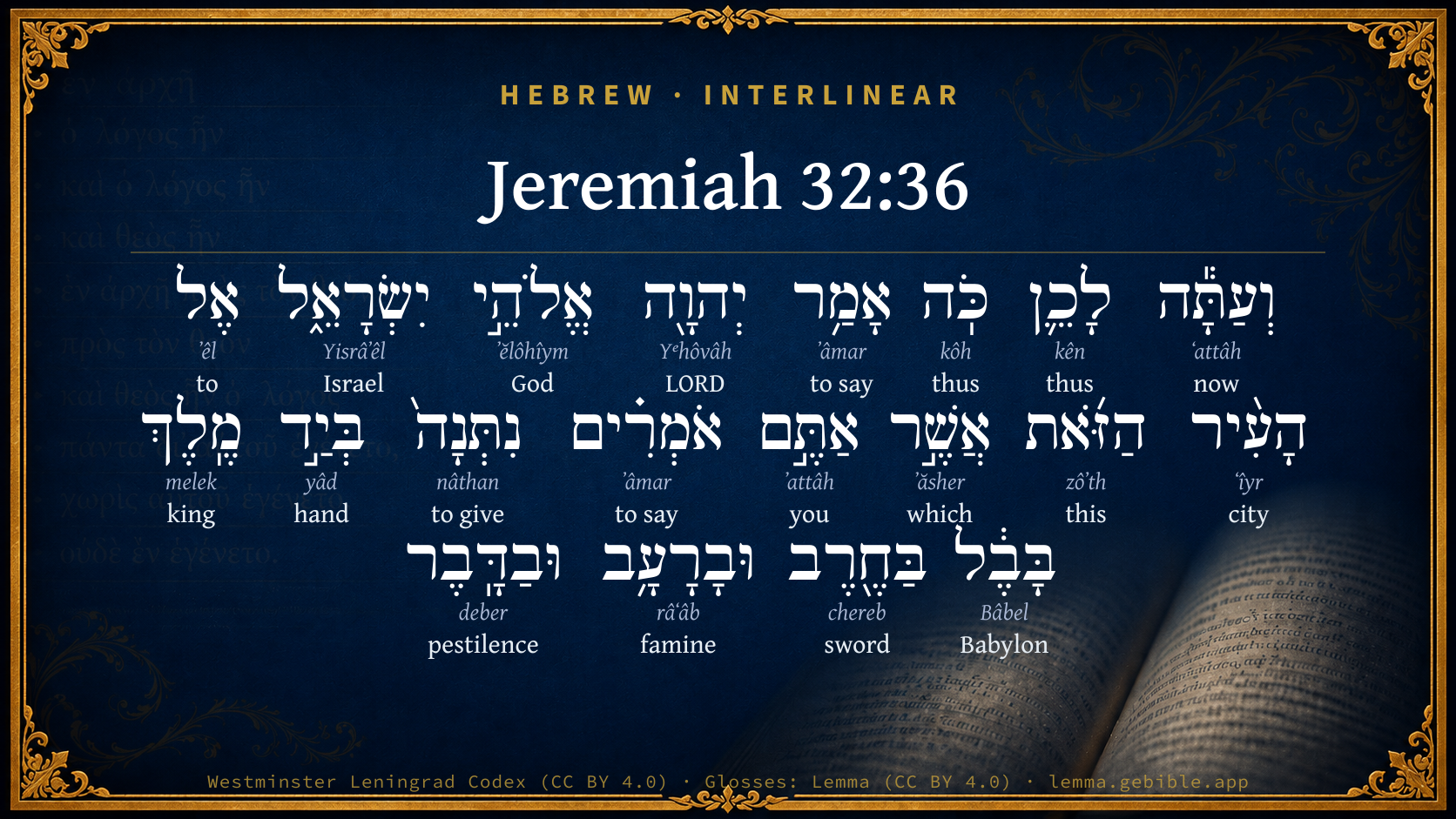
Jeremiah 32:36

Hebrew (Westminster Leningrad Codex) Jeremiah 32:36 appears in the Hebrew Old Testament. The text above is from the Westminster Leningrad Codex. Each word links to its Strong’s number, a concise gloss, and parsing drawn from the Open Scriptures Hebrew Bible morphology. Click any word for its full Brown-Driver-Briggs (BDB) entry.
Download image
Cite this verse

Jeremiah 32:36 (World English Bible). Public Domain. Lemma interlinear Bible study tool, https://lemma.gebible.app/v/jeremiah/32/36.

Show BibTeX & RIS
BibTeX
RIS
English Translation
Now therefore thus says Yahweh, the God of Israel, concerning this city, about which you say, It is given into the hand of the king of Babylon by the sword, and by the famine, and by the pestilence:
World English Bible · Public Domain
Download a study sheet

One document with this verse’s original text, its word-by-word gloss line, the meaning frame, cross-references with their text, attributed commentary, and full source and license credits — printable, and it pastes into notes with its structure intact.

This verse Autodidact and up

Study sheet (.html) Plain text (.txt)

A passage Seminary Student

Up to 50 verses in one chapter. A passage sheet keeps up to 6 commentary sources and 12 cross-references per verse, in the order this page ranks them, and says so on the sheet whenever that leaves anything out. Ask for a single verse and you get the Autodidact verse sheet above.

Everything on this page stays free to read, with no account — the sheet is a download of what is already on screen, not access to it.

Want to remove ads? Support Godless Engineer
Compare translations 3

The same verse in 3 English versions, stacked beneath the original-language interlinear above. Click any original word for its lexicon entry.

Each is an independent rendering of the whole verse — the interlinear is not word-aligned to these translations.

Highlighted words mark where these versions differ — a whole-verse word diff, not a word-by-word alignment.

  • World English Bible Public Domain
    Now therefore thus says Yahweh, the God of Israel, concerning this city, about which you say, It is given into the hand of the king of Babylon by the sword, and by the famine, and by the pestilence:
  • King James Version Public Domain
    And now therefore thus saith the LORD, the God of Israel, concerning this city, whereof ye say, It shall be delivered into the hand of the king of Babylon by the sword, and by the famine, and by the pestilence;
  • unfoldingWord Literal Text CC BY-SA 4.0
    So now therefore, I, Yahweh, the God of Israel, say this concerning this city, the city about which you are saying, ‘It is given into the hand of the king of Babylon by sword, famine, and plague.’

unfoldingWord Literal Text — © unfoldingWord, licensed CC BY-SA 4.0. Word-aligned USFM3 via Door43 (git.door43.org/unfoldingWord/en_ult).

Versions to compare (up to 4)

3 of 4 selected

Show all 18 translations

Every available English version of this verse, each an independent rendering of the whole verse.

  • World English Bible Public Domain
    Now therefore thus says Yahweh, the God of Israel, concerning this city, about which you say, It is given into the hand of the king of Babylon by the sword, and by the famine, and by the pestilence:
  • Berean Standard Bible Public Domain
    Now therefore, about this city of which you say, ‘It will be delivered into the hand of the king of Babylon by sword and famine and plague,’ this is what the LORD, the God of Israel, says:
  • Majority Standard Bible Public Domain
    Now therefore, about this city of which you say, ‘It will be delivered into the hand of the king of Babylon by sword and famine and plague,’ this is what the LORD, the God of Israel, says:
  • King James Version Public Domain
    And now therefore thus saith the LORD, the God of Israel, concerning this city, whereof ye say, It shall be delivered into the hand of the king of Babylon by the sword, and by the famine, and by the pestilence;
  • American Standard Version (1901) Public Domain
    And now therefore thus saith Jehovah, the God of Israel, concerning this city, whereof ye say, It is given into the hand of the king of Babylon by the sword, and by the famine, and by the pestilence:
  • Revised Version (1885) Public Domain
    And now therefore thus saith the LORD, the God of Israel, concerning this city, whereof ye say, It is given into the hand of the king of Babylon by the sword, and by the famine, and by the pestilence:
  • Geneva Bible (1599) Public Domain
    And nowe therefore, thus hath the Lord God of Israel spoken, concerning this citie, whereof ye say, It shalbe deliuered into the hand of the King of Babel by the sword, and by the famine, and by the pestilence,
  • Douay-Rheims (1899) Public Domain
    And now, therefore, thus saith the Lord the God of Israel to this city, whereof you say that it shall be delivered into the hands of the king of Babylon by the sword, and by famine, and by pestilence:
  • Young's Literal Translation Public Domain
    `And now, therefore, thus said Jehovah, God of Israel, concerning this city, of which ye are saying, It hath been given into the hand of the king of Babylon by sword, and by famine, and by pestilence,
  • Literal Standard Version CC BY-SA 4.0
    And now, therefore, thus said YHWH, God of Israel, concerning this city, of which you are saying, It has been given into the hand of the king of Babylon by sword, and by famine, and by pestilence:
  • Unlocked Literal Bible CC BY-SA 4.0
    So now therefore, I, Yahweh, the God of Israel, say this concerning this city, the city about which you are saying, 'It is given into the hand of the king of Babylon by sword, famine, and plague.'
  • unfoldingWord Literal Text CC BY-SA 4.0
    So now therefore, I, Yahweh, the God of Israel, say this concerning this city, the city about which you are saying, ‘It is given into the hand of the king of Babylon by sword, famine, and plague.’
  • Darby Bible Public Domain
    And now therefore Jehovah, the God of Israel, saith thus concerning this city, whereof ye say, It hath been given over into the hand of the king of Babylon by the sword, and by the famine, and by the pestilence:
  • World Messianic Bible Public Domain
    Now therefore the LORD, the God of Israel, says concerning this city, about which you say, “It is given into the hand of the king of Babylon by the sword, by the famine, and by the pestilence:”
  • Webster's Bible Public Domain
    And now therefore thus saith the LORD, the God of Israel, concerning this city, of which ye say, It shall be delivered into the hand of the king of Babylon by the sword, and by the famine, and by the pestilence;
  • Free Bible Version CC BY-SA 4.0
    Now about this city. You are correctly saying, “It's going be handed over to the king of Babylon through war and famine and disease.” However, this is what the Lord, the God of Israel, says:
  • Bible in Basic English Public Domain
    And now the Lord, the God of Israel, has said of this town, about which you say, It is given into the hands of the king of Babylon by the sword and by need of food and by disease:
  • JPS Tanakh (1917) Public Domain
    And now therefore thus saith the LORD, the God of Israel, concerning this city, whereof ye say: It is given into the hand of the king of Babylon by the sword, and by the famine, and by the pestilence:

Literal Standard Version (2020), Covenant Press — licensed CC BY-SA 4.0. Text via the HelloAO Bible API (eBible.org). Unlocked Literal Bible (unfoldingWord) — licensed CC BY-SA 4.0. Text via the HelloAO Bible API (eBible.org). unfoldingWord Literal Text — © unfoldingWord, licensed CC BY-SA 4.0. Word-aligned USFM3 via Door43 (git.door43.org/unfoldingWord/en_ult). Free Bible Version, Dr. Jonathan Gallagher — licensed CC BY-SA 4.0. Text via the HelloAO Bible API (eBible.org).

Word by word

More ways to search: Search by grammar → Find every occurrence → Compare this word →

Practice this passage: Drill this verse → Learn its vocabulary →

וּבַדָּֽבֶר
deber
H1698
“and · in/at the · pestilence”
Conjunction + Preposition, Determined + Noun, Common, Masculine, Singular, Absolute
Part of Speech
Conjunction + Preposition + Noun
Type
Common
Gender
Masculine
Number
Singular
State
Absolute
Full BDB Definition

Origin: from H1696 (in the sense of destroying)

TWOT: 399b

pestilence, plague - murrain, cattle disease, cattle-plague
  1. וְעַתָּ֕ה ʻattâh H6258 “and · now” Conjunction + Adverb
  2. לָכֵ֛ן kên H3651 “to/for · thus” Preposition + Adverb
  3. כֹּֽה kôh H3541 “thus” Adverb
  4. אָמַ֥ר ʼâmar H559 “to say” Verb, Qal, Perfect, 3rd Person, Masculine, Singular
  5. יְהוָ֖ה Yᵉhôvâh H3068 “LORD” Noun, Proper
  6. אֱלֹהֵ֣י ʼĕlôhîym H430 “God(s) of” Noun, Common, Masculine, Plural, Construct
  7. יִשְׂרָאֵ֑ל Yisrâʼêl H3478 “Israel” Noun, Proper
  8. אֶל ʼêl H413 “to” Preposition
  9. הָעִ֨יר ʻîyr H5892 “the · city” Particle, Definite Article + Noun, Common, Feminine, Singular, Absolute
  10. הַזֹּ֜את zôʼth H2063 “the · this” Particle, Definite Article + Pronoun, Demonstrative, Feminine, Singular
  11. אֲשֶׁ֣ר ʼăsher H834 “which” Particle, Relative
  12. אַתֶּ֣ם ʼattâh H859 “you” Pronoun, Personal, 2nd Person, Masculine, Plural
  13. אֹמְרִ֗ים ʼâmar H559 “saying” Verb, Qal, Participle Active, Masculine, Plural, Absolute
  14. נִתְּנָה֙ nâthan H5414 “to give” Verb, Niphal, Perfect, 3rd Person, Feminine, Singular
  15. בְּיַ֣ד yâd H3027 “in/at · hand of” Preposition + Noun, Common, Both, Singular, Construct
  16. מֶֽלֶךְ melek H4428 “king of” Noun, Common, Masculine, Singular, Construct
  17. בָּבֶ֔ל Bâbel H894 “Babylon” Noun, Proper
  18. בַּחֶ֖רֶב chereb H2719 “in/at the · sword” Preposition, Determined + Noun, Common, Feminine, Singular, Absolute
  19. וּבָרָעָ֥ב râʻâb H7458 “and · in/at the · famine” Conjunction + Preposition, Determined + Noun, Common, Masculine, Singular, Absolute

About this verse

These counts appear in no published source. They are computed here, from the morphology-tagged text and Lemma’s own curated glosses. What Lemma adds →

20
words
19
distinct lemmas
Prophets
section

Shared distinctive vocabulary

וּבַדָּֽבֶר pestilence H1698 occurs in 48 verses of the Hebrew Bible. Also found in:

Grammatical profile

  • 3 verbs
  • 10 nouns
  • 2 pronouns
  • 1 preposition
  • 3 adverbs
  • 1 particle

Verb forms

  • אָמַ֥ר Qal · Perfect
  • אֹמְרִ֗ים Qal · Participle Active
  • נִתְּנָה֙ Niphal · Perfect

Repetition

A word recurs within this verse — often emphatic in Hebrew:

  • אָמַ֥ר to say H559 ×2

Cross-references

10

Topical passages linked to Jeremiah 32:36 in the Treasury of Scripture Knowledge — connected by theme and wording, ordered by reader-vote popularity; previews shown in the World English Bible.

  • Jeremiah 32:3 For Zedekiah king of Judah had shut him up, saying, Why do you prophesy, and say, Thus says Yahweh, Behold, I will give this city into the hand of the king of Babylon, and he shall take it;
  • Jeremiah 32:24 Behold, the mounds, they are come to the city to take it; and the city is given into the hand of the Chaldeans who fight against it, because of the sword, and of the famine, and of the pestilence; and what you have spoken has happened; and, behold, you see it.
  • Jeremiah 32:28 Therefore thus says Yahweh: Behold, I will give this city into the hand of the Chaldeans, and into the hand of Nebuchadrezzar king of Babylon, and he shall take it:
  • Isaiah 43:24–25 You have bought me no sweet cane with money, neither have you filled me with the fat of your sacrifices; but you have burdened me with your sins, you have wearied me with your iniquities.
  • Isaiah 57:17–18 For the iniquity of his covetousness was I angry, and struck him; I hid [my face] and was angry; and he went on backsliding in the way of his heart.
  • Jeremiah 16:12–15 and you have done evil more than your fathers; for, behold, you walk every one after the stubbornness of his evil heart, so that you don't listen to me:
  • Ezekiel 36:31–32 Then shall you remember your evil ways, and your doings that were not good; and you shall loathe yourselves in your own sight for your iniquities and for your abominations.
  • Hosea 2:14 "Therefore, behold, I will allure her, And bring her into the wilderness, And speak tenderly to her.
  • Romans 5:20 The law came in besides, that the trespass might abound; but where sin abounded, grace did abound more exceedingly;
  • Ephesians 2:3–5 among whom we also all once lived in the lust of our flesh, doing the desires of the flesh and of the mind, and were by nature children of wrath, even as the rest.

Cross-references courtesy of OpenBible.info (CC BY 4.0).

Hebrew and Greek witnesses Masoretic Hebrew ↔ Greek Septuagint

The same verse in the two great witnesses to the Old Testament, shown verse-for-verse.

These are two independent witnesses, not word-aligned to each other, and the Septuagint is shown in lemma (dictionary) form.

Hebrew Jeremiah 32:36 Masoretic · Westminster Leningrad Codex

וְעַתָּ֕ה לָכֵ֛ן כֹּֽה אָמַ֥ר יְהוָ֖ה אֱלֹהֵ֣י יִשְׂרָאֵ֑ל אֶל הָעִ֨יר הַזֹּ֜את אֲשֶׁ֣ר אַתֶּ֣ם אֹמְרִ֗ים נִתְּנָה֙ בְּיַ֣ד מֶֽלֶךְ בָּבֶ֔ל בַּחֶ֖רֶב וּבָרָעָ֥ב וּבַדָּֽבֶר

Now therefore thus says Yahweh, the God of Israel, concerning this city, about which you say, It is given into the hand of the king of Babylon by the sword, and by the famine, and by the pestilence:

World English Bible · Public Domain

Greek LXX Structure differs

In the Septuagint, Jeremiah is about an eighth shorter than the Hebrew and arranges its material differently — the Oracles Against the Nations (Hebrew chapters 46–51) appear in the middle of the Greek book, after 25:13. Because the chapter and verse boundaries do not line up, a verse-for-verse comparison with the Hebrew is not shown.

A verse-for-verse comparison isn’t shown here because the chapters and verses don’t line up. Switch to the LXX edition with the MT / LXX toggle above to read the Greek directly.

On this verse, The Cambridge Bible for Schools and Colleges discusses the Septuagint’s reading. Read the note in Commentary ↓

Hebrew: Westminster Leningrad Codex (CC BY 4.0). Greek: Septuagint (public domain); English from a public-domain English Septuagint. How the Septuagint differs from the Hebrew →

Targum (Aramaic paraphrase)

1

The Targum is the ancient Jewish Aramaic paraphrase of the Hebrew Scriptures — an interpretive translation, not the Hebrew text itself. Onkelos (literal) and Pseudo-Jonathan (expansive) render the Torah, and Jonathan the Prophets. Coverage is partial: where no permissively-licensed English translation exists for a verse, only the Aramaic is shown. This is verse-level text, not a word-by-word alignment to the Hebrew.

  1. Targum Jonathan Prophets (Joshua–Malachi)
    וּכְעַן בְּכֵן כִּדְנַן אֲמַר יְיָ אֱלָהָא דְיִשְׂרָאֵל עַל קַרְתָּא הָדָא דְאַתּוּן אָמְרִין אִתְמְסָרַת בִּידָא דְמַלְכָּא דְבָבֶל בְּחַרְבָּא וּבְכַפְנָא וּבְמוֹתָא:

    (no public-domain English translation for this verse)

    Targum Jonathan — Aramaic: “Mikraot Gedolot” (public domain). English: “Sefaria Community Translation” (CC0 1.0 (public-domain dedication)); “London "Chaldee Paraphrase," 1871” (public domain). Text via Sefaria.

Commentary

Notes on Jeremiah 32:36 from classic Christian and Jewish commentators (each source and its license shown beneath its notes). The classic Christian expositions comment on the surrounding passage and are grouped to its opening verse, so a note may address several verses; the Jewish commentaries on the Tanakh (Rashi and others) are per-verse, so they appear only where the commentator wrote on this verse.

Lemma curates 59 commentaries, every one of them public domain or Creative Commons licensed, each selected and text-cleaned for this edition rather than reprinted as found. About our sources →

Trapp's Complete Commentary

John Trapp

Jer 32:36 And now therefore thus saith the LORD, the God of Israel, concerning this city, whereof ye say, It shall be delivered into the hand of the king of Babylon by the sword, and by the famine, and by the pestilence;

Ver. 36. And now therefore.] Or, Yet now notwithstanding, when God thus cometh in with his non-obstante what may not he do?

John Trapp, A Commentary or Exposition upon All the Books of the Old and New Testament (1647–1656) — public domain. Text from a community e-Sword module.

Joseph Benson's Commentary

Jer 32:36-39. Now therefore, &c. — In this and the following verses God returns an answer to the prophet’s expostulation, Jer 32:25. Or the words may be thus translated, But now, notwithstanding, [all this,] thus saith the Lord; concerning this city, whereof ye say, It shall be delivered into the hand, &c. — Many of the Jews now began to see that the Chaldeans would certainly take the city, and they became as much dispirited as before they were full of courage. By the sword and by the famine, &c. — The famine and pestilence, as well as the sword, seemed to fight for the king of Babylon, by the great havoc they made of the besieged, which rendered the taking of the city so much easier. Behold I will gather them out of all countries, &c. — See notes on Jer 23:3; Jer 23:8; Jer 29:14. I will bring them again, &c., and cause them to dwell safely — Though the city shall be taken, and the people shall go into captivity, yet they shall not be utterly lost, for I will gather them again, and they shall dwell here in quietness and safety as formerly. It is justly observed, however, by St. Jerome, in his notes on the place, that this promise, taken in its full extent, was not made good to those that returned from captivity, because they were frequently infested with wars, as well by the kings of Syria and Egypt, as by the rest of their neighbours, as appears from the history of the Maccabees; and were finally subdued and destroyed by the Romans. And they shall be my people, &c. — See note on Jer 24:7; Jer 30:22. And I will give them one heart and one way — When the ten tribes set up a distinct kingdom from that of Judah, they stood divided, not only in their civil interests, but also in respect to their religious worship. These distinctions, God here says, he would entirely abolish, so that Israel and Judah should be united, and become one nation and one church, living under the same civil government, and using the same forms of divine worship, equally acknowledging and serving the one living and true God. That they may fear me for ever — That they may worship and obey me in truth, as a people that have a real reverence for and fear of offending me; for the good of them and of their children — Which will be for the great advantage and happiness of them and their posterity as long as they shall continue so to do. This promise, in its full sense, will not be accomplished till the general conversion of Judah and Israel to Christianity, and their restoration and reunion in the latter days. See notes on Jer 3:18; Jer 30:3.

Joseph Benson's Commentary on the Old and New Testaments (1811–1818) — public domain. Text from a community e-Sword module.

Tyndale Open Study Notes

Tyndale Open Resources

32:36-44 The Lord affirmed that the destruction of Jerusalem would not bring an end to his plans. Beyond the immediate doom, the Lord planned a future of salvation and restoration for his people.

32:36-37 Jeremiah was responsible for repeating whatever the Lord told him, even if the messages seemed contradictory on the surface. Jeremiah had been saying for years that God was going to destroy the city. Now he was saying that God would rebuild the city. Cp. Isa 38:1-6.

Tyndale Open Study Notes — © Tyndale Open Resources, licensed CC BY-SA 4.0. Text via the HelloAO Bible API.

Geneva Bible (1599)

Geneva Bible translators

Read Jer. 30:16.

Geneva Bible (1599) marginal notes — public domain. Text via Bolls.life.

Jamieson, Fausset & Brown

Robert Jamieson, A. R. Fausset & David Brown

And now therefore--rather, "But now, nevertheless." Notwithstanding that their guilt deserves lasting vengeance, God, for the elect's sake and for His covenant's sake, will, contrary to all that might have been expected, restore them.

ye say, It shall be delivered into . . . king of Babylon--The reprobate pass from the extreme of self-confidence to that of despair of God's fulfilling His promise of restoring them.

Jamieson, Fausset & Brown — Commentary Critical and Explanatory on the Whole Bible (1871) — public domain (CC PDM 1.0). Text via the HelloAO Bible API.

John Calvin's Commentaries

God has hitherto been shewing that the Jews were worthy of that extreme punishment with which he had already visited the kingdom of Israel, and that they could not complain of extreme severity, though they were to rot in exile after the ruin of the city and the Temple, for they had polluted the land which ought to have been sacred to God, and had everywhere spread abroad their abominations, so that even the Temple was not free from their filth and defilements, and they had not thus offended for a short time, but, as we have seen, they had despised all warnings; and though God had been solicitous for their safety, they had yet proudly rejected and even extinguished his favor. As then they were of a disposition so wicked, and their impiety had become altogether incurable through so much hardness, God shews that he would render to them the reward due to their works, by wholly rejecting them. But now he adds the promise of favor, in order to shew that he would in such a manner be the avenger of wickedness, as ever to have a regard for the gratuitous covenant which he had made with Abraham.

We have already said often, that whenever God mitigates the bitterness of punishment with some hope of mercy, he has a peculiar respect to his chosen people. The word then is not indiscriminately addressed to all, when God declares that he will be at length merciful and propitious, for he encourages his chosen people alone, as I have said, to entertain hope. As then there were some godly seed remaining among the people, God intended to relieve them, so that they might not wholly despond.

We now see the Prophet’s object; and this truth ought to be carefully observed; for we shall be mistaken as to the doctrine taught by the Prophets, except we know, that after having threatened the wicked and the despisers of God, they then turn their discourse to the elect, to encourage them to bear patiently and with calm minds the punishment laid on them, as Jeremiah did in his own case when he exhorted the faithful to lay their mouth in the dust, and then patiently to wait for God, though he would for a time hide his face from Jacob, that is, from his Church. Jeremiah then, after having shewn that the Jews could not be too severely treated, because they had been wholly intractable, now adds,-

And now therefore, thus saith Jehovah, the God of Israel, concerning this city, or, to this city. The preposition אל al, signifies both, but it is more suitable to take it here in the sense of “concerning:” of which, it is added, ye say that it has been delivered into the hand of the king of Babylon This does not seem to be consistent with facts, for the Jews themselves had not announced this sentence respecting Jerusalem, but on the contrary they sturdily rose up against the Prophets, and made a clamor whenever the ruin of the city was announced. What then is meant when God upbraids them with speaking in this manner? To this I answer, that this had indeed proceeded from the Spirit of God, and also that the Prophets had been the testifiers and heralds of this punishment; but when the Jews saw that they could not escape, they then had such a dreadful apprehension of God’s judgment, that they became wholly stunned with fear; and thus it always happens to the despisers of God, for except he presses hard on them, they scorn all his threatenings; or they think that fables are told them, when God announces that he will execute on them his vengeance. But when they come to extremities, they are filled with amazement, and without any hope confess only that God is angry with them; hence their despair. The Prophet then does not without reason upbraid them with this — that they said that the city was delivered up to the Chaldean king, even while he was not only assailing it with a strong army, but was also assisted by the sword, the famine, and the pestilence as his associates. For before the siege pressed hard on them, they esteemed as nothing, according to what we have seen, all that Jeremiah declared to them; for he lost all his labor for nearly forty years, though the prophecy concerning the ruin of the city, exile, the rejection of the people, and the abolition of all holy things, was proclaimed daily. But now when they saw that the affair was serious, and that they could not escape God’s vengeance, they went to another extreme, and said, that God was false in his promises, that his covenant was void and useless, that they had in vain worshipped him, that he had deceived them and had given them false hopes, when he promised that he would dwell in the midst of them. It is, then, in this sense that they said, that the city was delivered up into the hand of the king of Babylon; it was the same as though they had said, that the hope of return had been cut off. For they wholly cast away the favor held forth by God, and said that all that Jeremiah had promised was vain, because terrors had laid such hold on their minds and feelings, that they could not entertain any hope of God’s mercy.

I have said that the case with all the reprobate is, that they deride God while he spares and bears with them; but when they find that he is a judge, then they do not look to his mercy, but he prostrate in despair as though they were lifeless.

John Calvin's Commentaries (1540-1563) — public domain. Text from the Calvin Translation Society English edition (1840s-50s) via the Christian Classics Ethereal Library (ccel.org). Calvin's coverage is partial (roughly two-thirds of the Bible); uncommented books and verses are honest gaps, never fabricated. The 19th-century editor's footnotes and remarks are omitted so the notes are faithfully Calvin's own voice.

The Cambridge Bible for Schools and Colleges

gen. ed. J. J. S. Perowne

36. thus saith the Lord] See on Jer_32:27.

ye say] better, with LXX, thou (Jeremiah) sayest, referring to his words in Jer_32:24. The MT. may have arisen from the influence of Jer_33:10.

36–44. See introd. summary to the section. There seems much more to be said for the genuineness of this group of vv. in the main than for that of the previous one, though here too (see note introducing the section) there is far from a general acceptance of them by commentators. They have comparatively little in common with other passages as regards phraseology, and they are more relevant to the question which Jeremiah had asked (Jer_32:24 f.). Jer_32:37 (which speaks as though a general dispersion had already taken place) and Jer_32:43 (referring to the land as already desolate) are perhaps the least defensible parts of the subsection.

The Cambridge Bible for Schools and Colleges (gen. ed. J. J. S. Perowne; Cambridge University Press, 1878–1918) — public domain. Text from a community e-Sword module.

John Gill's Exposition

Behold, I will gather them out of all countries,.... At the end of the seventy years' captivity; and which will have a greater accomplishment in the latter day, when the Jews shall be converted, and gathered from their present dispersion all over the earth:

whither I have driven them in mine anger, and in my fury, and in great wrath: or "whither I shall drive them", or "shall have driven them" (m); for as yet they were not thus driven and dispersed. A heap of words is made use of to express the greatness of the Lord's indignation at them for their sins, the cause of their expulsion out of the land:

and I will bring them again unto this place; the city of Jerusalem; as they were at the end of the seventy years' captivity; and when the promise was fulfilled, that they should purchase and possess fields and vineyards; and as they will likewise at the time of their conversion in the latter day:

and I will cause them to dwell safely; which yet they did not for any continuance after their return from Babylon; being, as Jerom observes, often molested by the Persians, Macedonians, and Egyptians; and at last destroyed by the Romans: their troubles in the times of the Maccabees are very notorious; so that this refers either to the first times of the Gospel, and to the Jews that then believed in Christ; or rather to times yet to come, and which are prophesied of at Jer 32:37.

(m) "quo dispulero eos", Schmidt; "quo depulero ipsos", Junius & Tremellius, Piscator.

John Gill's Exposition of the Whole Bible (1746–1763) — public domain (CC PDM 1.0). Text via the HelloAO Bible API.

Matthew Poole's English Annotations

The Jews now began to see that the Chaldeans would take the city, and to be as dead-hearted as before they were full of courage, and to give over themselves for ever as lost.

Matthew Poole's English Annotations on the Holy Bible (1683–1685) — public domain. Text from a community e-Sword/MySword module.

The Pulpit Commentary

And now therefore. This introduces the strange and lovely contrast to the gloomy picture which has gone before. It will be observed that there is no direct reference to Jerusalem, but the capital was only emphasized before as the heart of the nation, and it would, of course, be no comfort to say that Jerusalem"s inhabitants (alone) would be restored.

Vers. 36-41. The refiner"s fire.

The better part of Judah were cast as precious metal into a crucible by their being sent into exile at Babylon. And the effect was as that which results from such purifying process. Note

I WITHOUT DOUBT THEIR EXILE TRIED THEM AS FIRE. Fire is often the symbol of pain; and that there was indeed pain and sore distress in the exiles" lot is certain. Degradation, slavery, loss of their land, their high privileges as the people of God, in short, of their worldly all, had to be submitted to by them; and they lived, where they were permitted to live, at the mere caprice of a powerful, despotic, and merciless monarch. What that caprice could do, and often actually inflicted in the way of cruel tyranny and oppression, the books of the Bible which belong to the times of the Captivity, and the sculptures brought from those lands and now in the museums of this and other countries, clearly reveal the merciless slaughters and the horrible punishments, etc. And all this woe they had brought on others as their children who were entirely innocent of their parents" wrong. "The fathers had eaten sour grapes, aunt the children"s teeth were set on edge." And to add to their distress was the bitter reflection that they were designed to have filled a position so entirely different and better; that they were intended to be the first in the favour of God, but now had become last; and all this by their own persistent, wilful wickedness, wickedness persisted in spite of every kind of warning, protest, and entreaty that God could send them. Yes, it was as fire, as a furnace seven times heated.

II BUT IT WAS NEVERTHELESS AS A REFINER"S FIRE. It was to issue in their good. For it did not destroy them. They were to be brought out of all this woe. "I will bring them again" (ver. 37). And it should work them good by separating them from:

1. Their sins. They were torn away from the scenes, the people, the places, the manifold circumstances, which Were inseparable from that idolatry into which they had so often fallen.

2. And from those who tempted them thereto. For that loose, evil multitude which were dealt with apparently less sternly than themselves at the first, were the prompters and the persuaders to that wickedness which had wrought them so much harm. Those who were obnoxious and therefore, in Jer 24, compared to the figs which could not be eaten, were, though left awhile in the possession of their own land, at length destroyed. The corrupt and poisonous leaven was taken utterly away, so that that which was sound and healthful or capable of becoming so might be preserved. The pure ore was separated from the base alloy, the worthless dross, by the action of this refiner"s fire.

III IN PROOF OF THIS, note:

1. God brought them back to their own land.

2. They had given them "a heart to know" God.

3. And their after history proved this.

For they were a noble people for generations afterwards. Of course, there were the less worthy amongst them; but let their records be studied, their thrilling Maccabean history, for example, and it will be seen what a refining process that was through which they had been made as was so necessary for them and for mankind at large, who were to be blessed by means of them to pass. The absence of prophets and prophesyings, which is so marked a feature of the history written on that page which separates the Old Testament from the New, instead of being a reproach to them, is rather a proof that their general national health was such that the sharp surgery, the stern ministry, of the prophetic order was not then needed as it had been, so deplorably, in former days.

IV WHAT MADE THE DIFFERENCE between them and the baser sort who were destroyed. It was the possession of the Spirit of God. The holy fire enkindled by him had been all but quenched, but not entirely; the dying embers could be made to glow with radiant heat once again. But of that fire God has said, "It shall ever be burning on the altar, it shall never go out;" and though they had all but smothered it beneath the heap of idolatrous superstitions and practices, and other evil compliances with wrong, it was burning still. And the exile across that wide desert to the plains of Babylon let in again the air from heaven, and the fire burnt up once more. And that this might be, God dealt with them as he did, and as he ever does, blessed be his Name] in like circumstances.

CONCLUSION. Paul"s question, therefore, comes to our mind as we study such history as this: "Have ye received the Holy Ghost?" Seek him; for he will baffle the power of the destroyer, and, better still, if we will but follow his leading, he will keep us from ever needing to be cast into the crucible as these were, and from needing the refiner"s fire. That would have been best of all, but thank God there is a second best. "Covet earnestly the best gifts. C.

Vers. 36, 41. The bonds of abiding attachment to God.

Jeremiah has seen the war prospect, and it is one of siege, captivity, and destruction. He speaks as one who has the long threatened hour before his eyes (ver. 24). But God, looking from a higher point, sees the enduring bright result beyond. Observe in this passage

I GOD"S THOROUGH GOOD WILL TOWARDS HIS PEOPLE. His will is ever to show favour and do good to mankind. That will is always in action, but it can only be in manifestation when men themselves, by their spirit of submission to God and obedience to his directions, make such a manifestation possible. As he is thorough in his anger against the rebellious and idolatrous, so he is thorough in his favour towards the repentant. It is well that we should ever remember this deep good will of God to men when things are going wrong with us. The fault of untoward experiences may be in us or it may be in others; it cannot be in God. We must not put down to arbitrariness in him the painful workings of that law which manifests itself in sequence to human ignorance and folly.

II GOD"S SUFFICIENT OPPORTUNITY TO DO GOOD TO HIS PEOPLE. The confident tone that runs through this passage is most encouraging. Bad as the people have been, far as they have been driven, widely as they have been scattered, God can put all right again if only the people are willing to have it so. All God waits for is to hear the prodigal nation say, "I will arise and go to my Father." If only we give God the opportunity, he will make us to abound in supplies for our necessities and blessedness. We let many opportunities slip for doing good, and never do we use any such opportunity to the full. But God delights in the opportunities men give him, and here is an illustration of how he presses forward to use them. "I will plant them in this land assuredly with my whole heart and with my whole soul." Only be willing to be a plant of God"s own planting, and there is no reason why you should not feel the whole heart and soul of God going out for your highest good.

III GOD WORKING TOWARDS THE UNITY OF HIS PEOPLE. One is reminded of the unity proclaimed in Eph_4:3-6: one God, one people, one heart, one way, one covenant because an everlasting one, one character for the future. This unity stands out in contrast to the previous scattering. The previous scattering was only an outward symbol of the scattering within. If even the people had continued in Jerusalem, that would have given them no unity save the unity of place, which is the most precarious, mocking, and delusive of all unities. But the new unity is that of one heart. As one life flows through all the organs of the body, making the life of each the life of all and the life of all the life of each, so God will make it among his true people. God binds each to himself by the law written in the heart, and so all are bound to one another.

IV THE EVERLASTING COVENANT THUS MADE POSSIBLE. God has now found something deep in the heart of his people whereby he can get an abiding hold. His covenant finds a firm anchorage in the regenerated inward man. With one heart and one way there is a starting point for doing Divine good, not to one generation, but to many. How much good we may hinder by our spiritual blindness and indifference! And on the other hand, what copious showers of blessing may be the result of a timely turning to God! Y.

The Pulpit Commentary (1880–1919), ed. H.D.M. Spence-Jones & Joseph S. Exell — public domain. Text from a community e-Sword module.

unfoldingWord translationNotes

Door43 World Missions Community

which you are saying

Here "you" is plural. Possible meanings are 1) this refers to Jeremiah and those with him, or 2) it refers to all the people. (See: Forms of You)

It is given into the hand of the king of Babylon

Here "hand" means power or control. This can be translated in active form. AT: "Yahweh has given it to the king of Babylon" or "Yahweh has given the king of Babylon the power to rule it" (See: Metonymy and Active or Passive)

to gather them

"to gather my people"

wrath, fury, and great anger

All three words mean the same thing and emphasize how very angry he is. AT: "extreme anger" (See: Doublet)

in security

"where they are safe"

translationWords

Yahweh

God

hand

king

sword

famine

plague

cast out

wrath

anger

life

unfoldingWord translationNotes — © Distant Shores Media and the Door43 World Missions Community, licensed CC BY-SA 4.0. Source: git.door43.org/Door43/en_tn.

Lesson kit

Teaching starters — assembled from the data on this page, not authored interpretation. Every prompt links to the verse data it draws on. Edit before teaching.

Jeremiah, in the Prophets, opens this verse with 20 words (19 distinct Hebrew lemmas). Its most distinctive word is deber (“pestilence”). A historical commentator’s framing appears above. Read the whole chapter for the surrounding context.

Discussion questions

  1. The word deber carries the sense “pestilence.” How does it shape the verse?
  2. How does Exodus 5:3, which shares the word «pestilence», read alongside this verse?
  3. What does the repetition of “to say” (2× in this one verse) do in this verse?
  4. These translations render this verse differently. What is at stake in choosing one wording over another?
  5. «אָמַ֥ר» is a Qal Perfect verb. How does that grammatical form shape the action described?
  6. Compare how Trapp's Complete Commentary and Joseph Benson's Commentary read this verse. Where do they agree or differ?

Things to notice

Reading settings

Reading text

Shown beneath each verse's original-language words.

Old Testament
Old Testament edition

Read the OT as the Masoretic Hebrew (MT) or the Greek Septuagint (LXX).

English shown for the Greek Septuagint (in the Hebrew ↔ Greek comparison).

Comparing translations? Open the Compare panel on any verse page to stack up to four side by side.