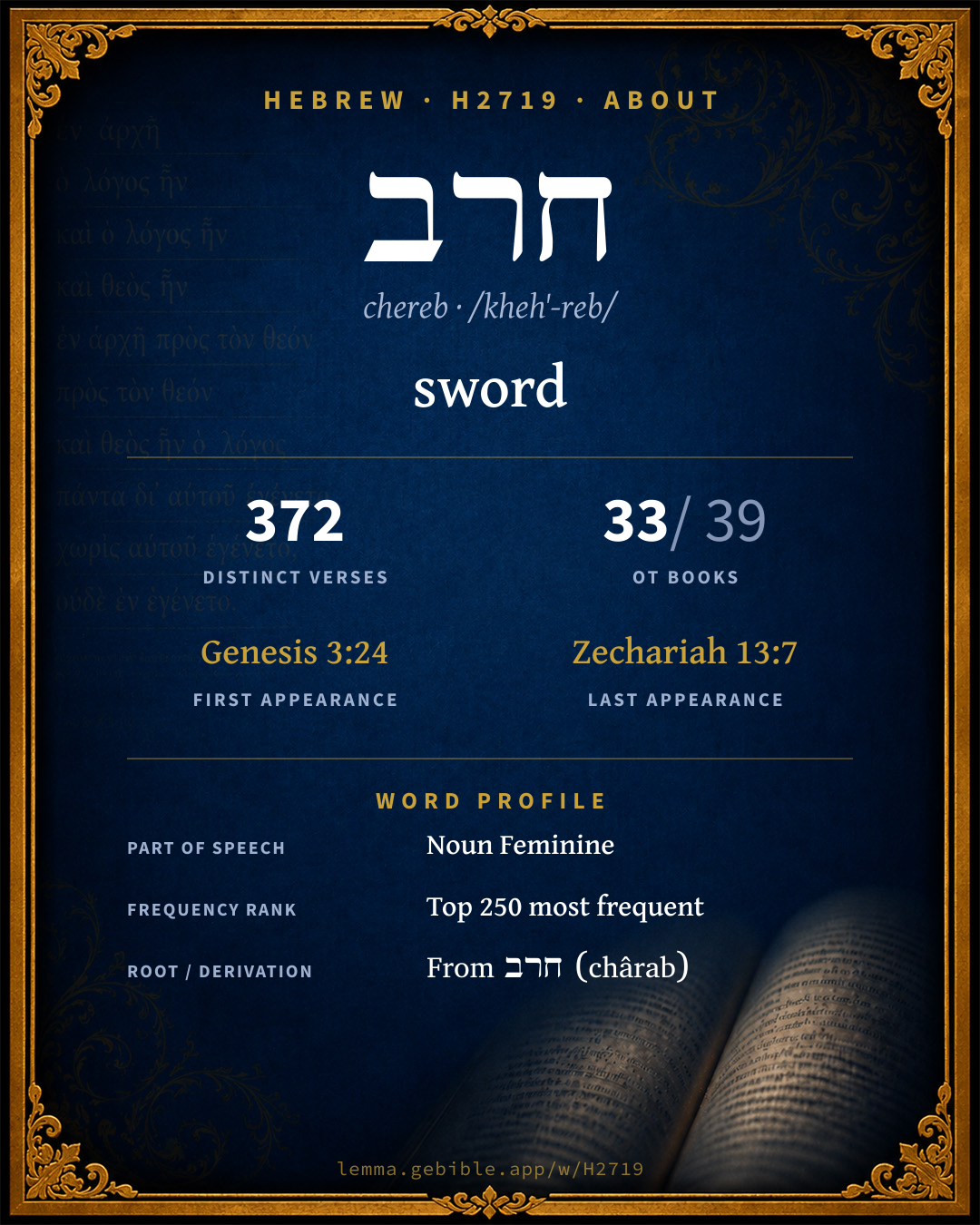
חֶ֫רֶב
sword
‘sword’ is one of 4 main senses fuller range ↓
Full lexicon entry — Brown-Driver-Briggs (BDB)
From Brown-Driver-Briggs (BDB)
Where this word appears
See every Absolute-state word in the Hebrew Bible →
Grammar key — what these labels mean
Part of speech
- Noun
- A naming word — a person, place, thing, or idea.
Noun type
- Common
- A common noun — a general class of person, place, or thing (“king,” “city,” “water”), not a specific name.
State
- Absolute
- The independent form of a noun, not bound to a following word.
- Construct
- A noun bound to a following noun in a possessive / “of” relationship (the construct chain).
Gender
- Feminine
- Grammatically feminine.
Number
- Singular
- One.
- Plural
- More than one (in Hebrew, generally three or more).
8 verses where H2719 appears in the Absolute state in the Book of 1 Kings. Filtered view — show all forms. Click any verse to open its interlinear word-by-word view. Verse text shown in the World English Bible for context — . Each verse’s Hebrew form is shown with its reference; the English is not keyword-highlighted, since the data carries no word-level English alignment. Use “Compare translations” on any verse to read it across multiple English versions. This concordance covers the Hebrew Bible; Septuagint (Greek Old Testament) occurrences are not indexed here.
1 Kings
- 1 Kings 1:51 בֶּ/חָֽרֶב prep det + n c fs It was told Solomon, saying, Behold, Adonijah fears king Solomon; for, behold, he has laid hold on the horns of the altar, saying, Let king Solomon swear to me first that he will not kill his servant with the sword.
- 1 Kings 2:8 בֶּ/חָֽרֶב prep det + n c fs Behold, there is with you Shimei the son of Gera, the Benjamite, of Bahurim, who cursed me with a grievous curse in the day when I went to Mahanaim; but he came down to meet me at the Jordan, and I swore to him by Yahweh, saying, I will not put you to death with the sword.
- 1 Kings 2:32 בַּ/חֶ֔רֶב prep det + n c fs Yahweh will return his blood on his own head, because he fell on two men more righteous and better than he, and killed them with the sword, and my father David didn't know it, [to wit], Abner the son of Ner, captain of the host of Israel, and Amasa the son of Jether, captain of the host of Judah.
- 1 Kings 3:24 חָ֑רֶב הַ/חֶ֖רֶב n c fs ptcl def.art + n c fs The king said, Get me a sword. They brought a sword before the king.
- 1 Kings 18:28 בַּ/חֲרָב֖וֹת prep det + n c fp They cried aloud, and cut themselves after their manner with knives and lances, until the blood gushed out on them.
- 1 Kings 19:1 בֶּ/חָֽרֶב prep det + n c fs Ahab told Jezebel all that Elijah had done, and withal how he had slain all the prophets with the sword.
- 1 Kings 19:10 בֶ/חָ֑רֶב prep det + n c fs He said, I have been very jealous for Yahweh, the God of hosts; for the children of Israel have forsaken your covenant, thrown down your altars, and slain your prophets with the sword: and I, even I only, am left; and they seek my life, to take it away.
- 1 Kings 19:14 בֶ/חָ֑רֶב prep det + n c fs He said, I have been very jealous for Yahweh, the God of hosts; for the children of Israel have forsaken your covenant, thrown down your altars, and slain your prophets with the sword; and I, even I only, am left; and they seek my life, to take it away.
About this entry
At a glance — auto-summarized from this page’s data, not written by a person. Every figure links to its source below. This summary describes the numbers; it doesn’t interpret them.
At its core, חרב (chereb) means “sword.” Not a single-sense word: explore its full sense range. With 372 verses in 33 books, it is a common word in the Hebrew Bible. Scripture first uses it in Genesis 3:24. Sharing its root, it stands alongside חרב, חרב and חרב. Dig into 372-verse concordance and the renderings breakdown below.
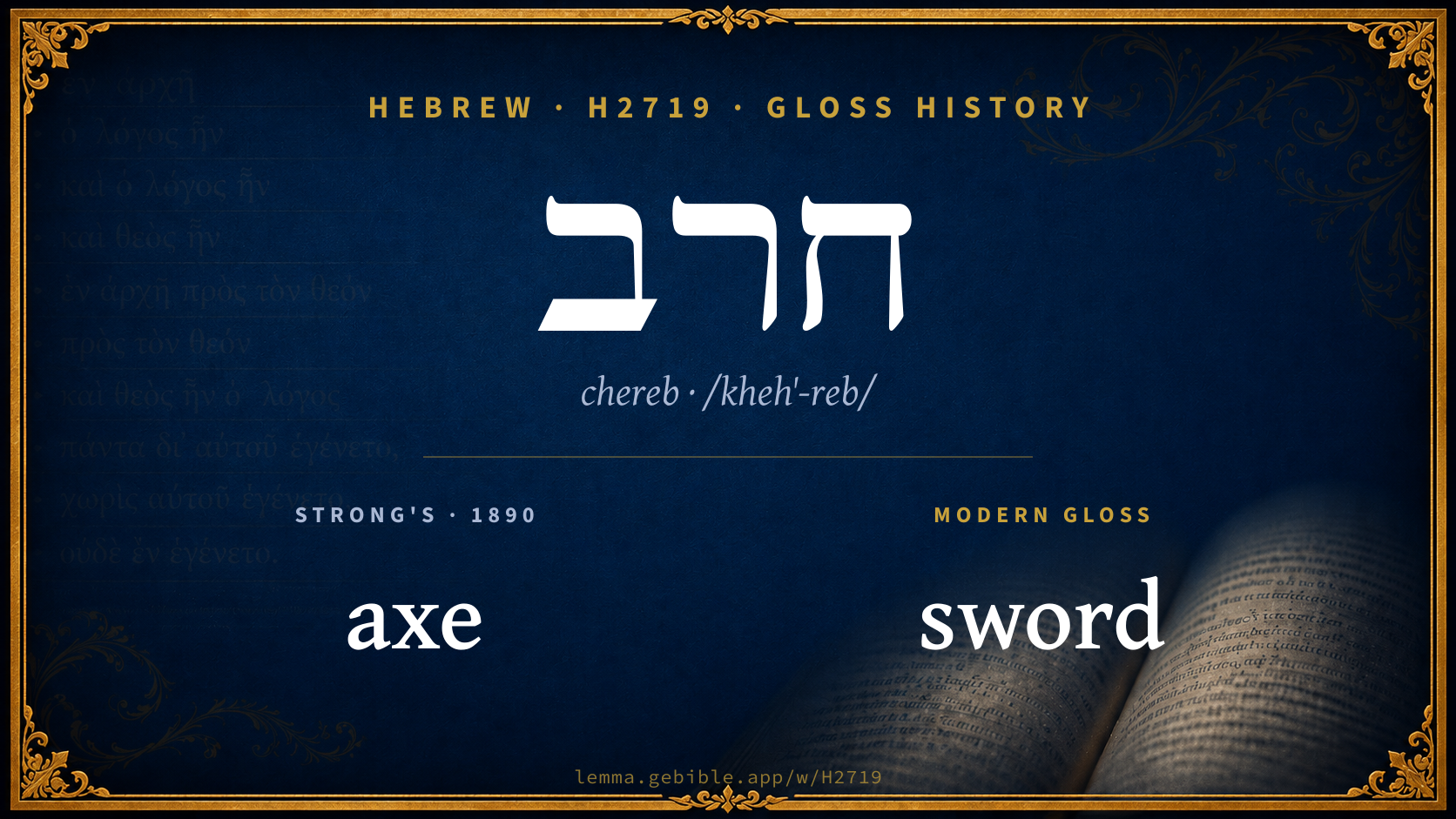
Gloss history
Strong's 1890 vs modern scholarship
About this word
Strong's H2719 catalogs a Hebrew word from the Hebrew Old Testament.
These counts are not copied from any lexicon or concordance. They are computed here, from the morphology-tagged Hebrew Old Testament. What Lemma adds →
- 372
- distinct verses
- The word appears in 372 distinct verses.
- 33 / 39
- OT books
- The word appears in 33 of 39 Old Testament books.
- #120
- by frequency
- Top 250 most frequent Hebrew words (rank 120 of 8,640 Hebrew words by occurrence).
View all 372 occurrences in the concordance →
By section of the Old Testament
By traditional corpus
Conventional, traditional groupings — biblical authorship is debated, so this is a traditional corpus grouping, not an authorship claim. Each share is this word’s portion of its verses in that division of the Hebrew canon. Each figure is a share of the word’s 372 distinct verses.
- Prophets (Nevi'im) 276 verses · 74%
- Writings (Ketuvim) 59 verses · 16%
- Torah (Pentateuch) 37 verses · 10%
How translations render this word
Counts come from each version’s own published word-to-Strong’s tagging or interlinear alignment — an approximate guide to how each version renders this word, not a word-level alignment the data otherwise carries. Because each total is that version’s own tagged count, the per-version totals vary from one another and need not match the appearance or distinct-verse counts above. These counts may also differ from a printed concordance because Lemma counts each distinctly tagged rendering and does not collapse phrase taggings into a single head-word total. This is a fixed set of word-tagged versions (KJV, ASV, BSB, ULT) and does not change with the reading translation you choose elsewhere. Each version’s license is shown beside its name below (and on Sources).
- King James Version: Sword 340×, Swords 16×, Dagger 3×
- American Standard Version: Sword 316×, Swords 14×, Shall the sword 3×
- Berean Standard Bible: Sword 339×, Swords 26×, Own sword 7×
- unfoldingWord Literal Text: Sword 319×, Sword of 20×, Swords 15×
King James Version Public Domain
Renders H2719 across 412 tagged occurrences — most commonly:
Plus 36 renderings that appear only once — usually multi-word phrases or single function words the recovered tagging swept in, not distinct renderings. Not rendered by a distinct English word in 1 further occurrence.
American Standard Version Public Domain
Renders H2719 across 411 tagged occurrences — most commonly:
Plus 65 renderings that appear only once — usually multi-word phrases or single function words the recovered tagging swept in, not distinct renderings.
Berean Standard Bible Public Domain
Renders H2719 across 405 tagged occurrences — most commonly:
Plus 23 renderings that appear only once — usually multi-word phrases or single function words the recovered tagging swept in, not distinct renderings. Not rendered by a distinct English word in 7 further occurrences.
unfoldingWord Literal Text CC BY-SA 4.0
Renders H2719 across 394 tagged occurrences — most commonly:
Plus 28 renderings that appear only once — usually multi-word phrases or single function words the recovered tagging swept in, not distinct renderings.
12 senses and sub-senses in the full BDB
What do BDB’s symbols mean?
BDB uses these scholarly abbreviations:
| Symbol | Meaning |
|---|---|
| 𝔊 | the Septuagint (the ancient Greek translation, LXX) |
| 𝔙 | the Vulgate (the Latin translation) |
| 𝔖 | the Syriac version (the Peshitta) |
| 𝔗 | the Targum (the Aramaic translation) |
| ψ | the Psalms |
| √ | root (the underlying root or stem) |
| ‖ | parallel passage (a synonymous or contrasted parallel) |
| † | the dagger: every passage where the word occurs is cited |
The 12 senses and sub-senses the full Brown-Driver-Briggs lexicon distinguishes for this word, in lexicon order (not ranked by frequency), with BDB’s own verbatim wording and sub-sense lettering. Shown in Hebrew script with BDB’s own scholarly abbreviations. The condensed entry is in the Lexicon Entry tab. See also the Forms in the corpus table below.
- 1.
- a. sword, as weapon of war Gn 48:22 (E), Ju 7:14, 20 1 S 21:9, and so in all periods; two-edged (short) sword ח׳ וְלָהּ שְׁנֵי פֵיוֹ֖ת גֹּמֶד אָרְכָּהּ Ju 3:16, cf. ח׳ פִּיּוֹת Pr 5:4 (in sim.), ח׳ פִּיפִיּוֹת ψ 149:6; v. also צוּר ח׳ edge of sword ψ 89:44. e.g. Genesis 48:22
- b. gird on sword = חָגַר הח׳ 1 S 17:39; 25:13(×3) ψ 45:4 (ח׳ הח׳ עַל יָרֵך), שִׂים על ירך Ex 32:27, cf. especially 2 S 20:8. e.g. 1 Samuel 17:39
- c. draw the sword הֵרִיק הח׳ Ex 15:9 Lv 26:33 Ez 5:2, 12; 12:14; 28:7, הוציא הח׳ Ez 21:8, 10, פתח הח׳ ψ 37:14 Ez 21:33, נטשׁ Is 21:15 (Gr Che לטשׁ v. infr.); usually שׁלף הח׳ Nu 22:23, 31 Jos 5:13 Ju 3:22; 8:10, 20; 9:54 1 S 17:51; 31:4 = 1 Ch 10:4; 21:16, and as characteristic of warriors שֹׁלֵף ח׳ Ju 20:2, 15, 17, 25, 35, 46 2 S 24:9 2 K 3:26, 1 Ch 21:5(×2); וַתִּדְבַּק יָדוֹ אֶל־הַח׳ 2 S 23:10, ins. also in ‖ 1 Ch 11:13 (Dr). e.g. Exodus 15:9
- d. whet, sharpen the sword לטשׁ הח׳ ψ 7:13 (cf. Is 21:15 supr.), but also שׁנן Dt 32:41 cf. ψ 64:4, הוּחַדָּה Ez 21:14, 16. e.g. Psalms 7:13
- e. put up the sword into the sheath הֵשִׁיב הח׳ אֶל־נְדָנָהּ 1 Ch 21:27 (sheath of sword is elsewhere תַּעַר 1 S 17:51 2 S 20:8 Je 47:6 Ez 21:8). e.g. 1 Chronicles 21:27
- f. slay with sword הרג בח׳ Jos 10:11; 13:22 +; in ימותו אנשׁים 1 S 2:33, insert בְּחֶרֶב before אנשׁים 𝔊 We Dr; rarely הכה בח׳ Jos 11:10 2 K 19:37 = Is 37:38; very often הִכָּה לְפִי־ח׳ smite according to the mouth of the sword i.e. as the sword can devour (2 S 2:26; 11:25) = without quarter Nu 21:24 (E) Dt 13:16a; 20:13 Jos 11:11, 12, 14 (all D) Ju 18:27; 21:10 1 K 10:25 Jb 1:15, 17; also c. העיר as sole obj. Jos 8:24; 10:28, 30, 32, 35, 37, cf. v 39; 19:47 Ju 1:8, 25; 20:37 1 S 22:19(×2) 2 S 15:14; הרג לפי־ח׳ †Gn 34:26 (J); החרים לפי־ח׳ Dt 13:16b (incl. הָעִיר in obj.), Jos 6:21 1 S 15:8, חלשׁ לפי־ח׳ †Ex 17:13 (E); נפל לפי־ח׳ Jos 8:24 Ju 4:16; וַיָּהָם י׳ … לפי־ח׳ Ju 4:15;—(לפי־ח׳ is chiefly in Jos and Ju (21 times), in Hexat. only JED; but Jb post-ex.). e.g. Joshua 10:11
- g. אכלה הח׳ etc., of the sword as devouring:—תֹּאכֵל חַרְבִּי בָשָׂר Dt 32:42 (poet.), 2 S 2:26; 11:25; 18:8 Is 1:20 Je 2:30 Je 46:10, 14 Na 2:14. e.g. Deuteronomy 32:42
- h. slain by sword is חֲלַל־ח׳ Nu 19:16 (P) and frequently Ez, חַלְלֵי־ח׳ 31:17, 18; 32:21, 25, 28, 29, 30, 32; 35:8 מְחֻלְלֵי ח׳ v 26 חללי־ח׳ (on text of 32:20, 22, 31 v. Co). e.g. Numbers 19:16
- i. שְׁבֻיוֹת ח׳ Gn 31:26 are captive of (taken by) sword. e.g. Genesis 31:26
- j. sword frequently agent of י׳ Ju 7:20 Is 34:6 Je 12:12; 47:6 etc.,—so Dt 28:22, but read חֹרֶב v. sub I. חרב (cf. on other hand 1 S 17:47); note especially Gn 3:24 לַהַט הח׳ הַמִּתְהַפֶּכֶת; poet. לַהַב ח׳ Na 3:3, בְּרַק ח׳ Dt 32:41. k. ח׳ fig. of tongue ψ 57:5 cf. 59:8; fig. of violence, war, etc., Gn 27:40; in sim. Pr 5:4 (of grievous end of dealings with strange women). e.g. Judges 7:20
- 2. knife ח׳ צֻרִים flint knives for use in circumcision Jos 5:2, 3 (v. WeSkizzen iii, 166); Ez 5:1, 2 ח׳ חַדָּה תַּעַר הַגַּלָּבִים (according to Co use of sword as razor is significant). e.g. Joshua 5:2
- 3. of tools used in hewing stone חַרְבְּךָ הֵנַפְתָּ עליה Ex 20:25; יִתֹּץ בח׳ Ez 26:9, according to most = tools, axes, ‘steel’ (Co ‘Eisen’), but poss. swords as implement read to hand; 2 Ch 34:6 Qr בְּחַרְבֹתֵיהֶם with their tools; read perhaps בְּחָרְבֹתֵיהֶם in their ruins, Be, who comp. ψ 109:10; v. חָרְבָּה sub II. חרב (𝔊 𝔙 om. חרב). e.g. Exodus 20:22
Senses from the full Brown-Driver-Briggs lexicon (Brown, Driver, Briggs; Oxford 1906 — public domain), digitized via Sefaria, supplemented by the OpenScriptures HebrewLexicon (CC BY 4.0). Full attribution on Sources.
Word origin
n.f. Is 21:15 sword (as weapon; Aramaic חַרְבָּא, ܚܰܪܒܳܐ, Zinj. חרב; Arabic حَرْبَةٌ dart, javelin) —abs. חֶ֫רֶב Gn 3:24 +; חָ֑רֶב Ex 17:13 +; cstr. חֶ֫רֶב Dt 33:29 +; sf. חַרְבִּי Ex 15:9 + 13 times; חַרְבְּךָ Gn 27:40 + 7 times; חַרְבֶּ֑ךָ 1 S 17:33 ψ 17:13; חַרְבּוֹ Nu 22:23 + 24 times; חַרְבְּכֶם Je 2:30 Ez 33:26; חַרְבָּם ψ 37:15; 44:4; pl. חֲרָבוֹת Is 21:15 + 5 times; cstr. חַרְבוֹת Jos 5:2 + 2 times; sf. חַרְבוֹתָיו Ez 26:9; חַרְבוֹתָם Is 2:4 + 5 times; חַרְבֹתֵיהֶם Mi 4:3 + 2 times;—
— Brown-Driver-Briggs (Oxford 1906, public domain), digitized via Sefaria, supplemented by the OpenScriptures HebrewLexicon (CC BY 4.0). See Sources.
Derived from חרב (chârab) (H2717) — to lay waste.
Jastrow Dictionary
A second Hebrew/Aramaic lexicon for comparison, covering Aramaic and post-biblical (Talmudic, Targumic, Midrashic) usage that the biblical-Hebrew BDB does not. Matched by lemma rather than by Strong’s number, so a lemma may carry more than one Jastrow headword (shown separately below), and the entries cover usage well beyond the Bible.
חָרִב I
- (b. h.) to be burned, dried up, ruined, waste. Snh. 22ᵃ כאלו ח׳ בה"מ וכ׳ as if the Temple had been destroyed in his days. Tosef. Men. XIII, 22 מפני מה חָרְבָה וכ׳ why was Shiloh destroyed?; Yoma 9ᵃ. Kil. IV, 1 (expl. קרחת הכרם) כרם שח׳ באמצעו a vineyard the central part of which is laid waste. Ib. V, 1; a. fr. [Num. R. s. 7, end בבל ח׳ מקדש, read: החריב. Taan. 29ᵃ כשח׳ טורנוס, read: כשחרש, v. Rabb. D. S. a. l.]
- to be destroyed. Erub. 18ᵇ. Yoma 39ᵇ שסופך עתיד לֵיחָרֵב that it is thy final destiny to be destroyed; a. fr.
- same. Pesik. R. s. 31 שיִתְחָרֵב. [Pirké d’R. El. ch. XXXIII, v. חָרַךְ.]
- to destroy, lay waste. Tosef. M. Kat. I, 5 מַחֲרִיבִין חורי וכ׳ you may destroy ant-stores (during the festive week). Num. R. s. 7, end שהֶחֱרִיבוּ בה"מ for they (the Romans) destroyed the Temple; a. fr.
- to be destroyed. Pes. 42ᵇ (ref. to Ez. XXVI, 2) אי מלאה זו הָחְרְבָה זו Ms. M. (ed. חרבה, v. Rabb. D. S. a. l. note 9) when the one (Jerusalem) is populated, the other (Caesarea) is laid waste; Yalk. Gen. 110 חֲרֵיבָה. e.g. Ezekiel 26:2
חֲרֵב
- Targ. Ez. XXVI, 2. Targ. Hos. XIII, 15. Targ. Is. XIX, 5; a. fr.—Naz. 32ᵇ דח׳ בה"מ that the Temple has been destroyed. Ib. דיִחְרוֹב that it will be destroyed. Gitt. 56ᵃ דלא לִיחֲרוֹב וכ׳ that Jerusalem may not be destroyed. Y. Ber. II, 5ᵃ top דברגליה חריב with whose arrival it was destroyed; a. fr.
- to destroy, lay waste. Targ. Is. XLII, 15. Targ. Jud. XVI, 24; a. fr.—Yoma 69ᵇ דאַחְרְבֵיה וכ׳ who destroyed the Temple. Taan. 29ᵃ top לאַחְרוּבֵי Ms. M. a. Rashi (ed. לַחְרוּבֵי); Gitt. 56ᵃ לַחְרוּבֵי; a. fr.
- to be destroyed. Y. Ber. l. c.
חָרֵב II
- preced. wds.)
- 1. ruined. Y. Ber. IV, 8ᵃ. Yalk. Gen. 110, p. חָרֵב I; a. fr.—Pl. חֲרֵבִים, חֲרֵי׳; f. חֲרֵבוֹת, חֲרֵי׳. Ex. R. s. 31 (ref. to Num. XXIV, 5) ומַשְׁכנותיך כשהם ח׳ thy pledges, when they are in ruins, v. מַשְׁכּוֹן; a. fr. e.g. Numbers 24:5
- 2. dry. Y. Sot. III, beg. 18ᶜ ח׳ של חטין the dry (oil-less) offering of wheat, opp. בלול. Kidd. 62ᵃ top; a. e.
חָרֵב
- ch., v. חָרוֹב
חֶרֶב
- 1. sword. Ḥull. 3ᵃ, v. חָלָל I. B. Bath. 8ᵇ ח׳ קשה וכ׳ death in war is a greater affliction than natural death. Snh. 116ᵃ מהם הרגו בח׳ some of them they put to death by the sword. Tanḥ. Balak 8; Num. R. s. 20 אא"כ שלף חַרְבּוֹ without drawing his sword. Ib. בח׳ חייהם live on their sword. Taan. III, 5 על הח׳ on the sword, i.e. when armies are passing the country. Ib. 22ᵃ ח׳ של שלום a friendly army passing; a. fr.
- 2. the sword-shaped handle of a plough. Kel. XXI, 2. Tosef. Kel. B. Bath. I, 7.—Pl. חֲרָבוֹת. Pesik. R. s. 21 ח׳ מכאן וכ׳ (soldiers with) swords here &c.; a. e.
חָרֶב
- same. Targ. Gen. XXXIV, 26. Ib. III, 24; a. fr.—Sabb. 123ᵇ, v. אוּשְׁכָּפָא; (Ar. scraping knife).
חָרֶב ²
- (חרב) dry eruption. Targ. Y. Deut. XXVIII, 27 Ar. ed. Koh. חרב (oth. ed. חרבא, חרבונא; Targ. ed. גרבא; h. text גרב).
A Dictionary of the Targumim, the Talmud Babli and Yerushalmi, and the Midrashic Literature (Marcus Jastrow; London, Luzac, 1903) — Public Domain. Digitized via Sefaria. Digitized via Sefaria. Full attribution on Sources.
Forms in the corpus
The 130 distinct written forms H2719 takes in the Hebrew Bible, most frequent first — each parse links to that state’s occurrences in the concordance. Hebrew forms include their vowel points and cantillation, so a single lemma takes many written forms.
The 60 most common forms are shown; 70 rarer forms follow in the full concordance.
Same root — word family
Other BDB entries built from the same root as H2719, grouped by Strong’s listed origin. These share a root / origin per the lexicon — not necessarily a shared meaning. Each links to that word’s own entry.
Derives from
Shares the same root
Derived from this word
Proper names from this root
People and places named from this root — a name, not an additional meaning of the word.
Compare all same-root words → Showing 4 of 7 — not the complete family. 1 of the same-root words is a proper name (a person or place). They share a root, not necessarily a meaning.
Septuagint verse parallels
This word appears in 338 verses that also exist in the Greek Old Testament (Septuagint), out of the 372 Hebrew verses it occurs in. You can read those verses in Greek by switching the Old Testament edition to the Septuagint.
Read these verses in the Septuagint
- Genesis 3:24
- Exodus 5:3
- Leviticus 26:6
- Numbers 14:3
- Deuteronomy 13:15
- Joshua 5:2
- Judges 1:8
- 1 Samuel 13:19
- 2 Samuel 1:12
- 1 Kings 1:51
- 2 Kings 3:26
- 1 Chronicles 5:18
This is a verse-level parallel only — the same verses exist in both the Hebrew and Greek Old Testaments. No word-level Hebrew↔Greek correspondence is claimed: the data carries no such alignment, so no Greek word is shown as this Hebrew word’s translation. Coverage is not total — the Septuagint omits the deuterocanon and renumbers the Psalms, so some Hebrew verses have no direct Greek parallel.