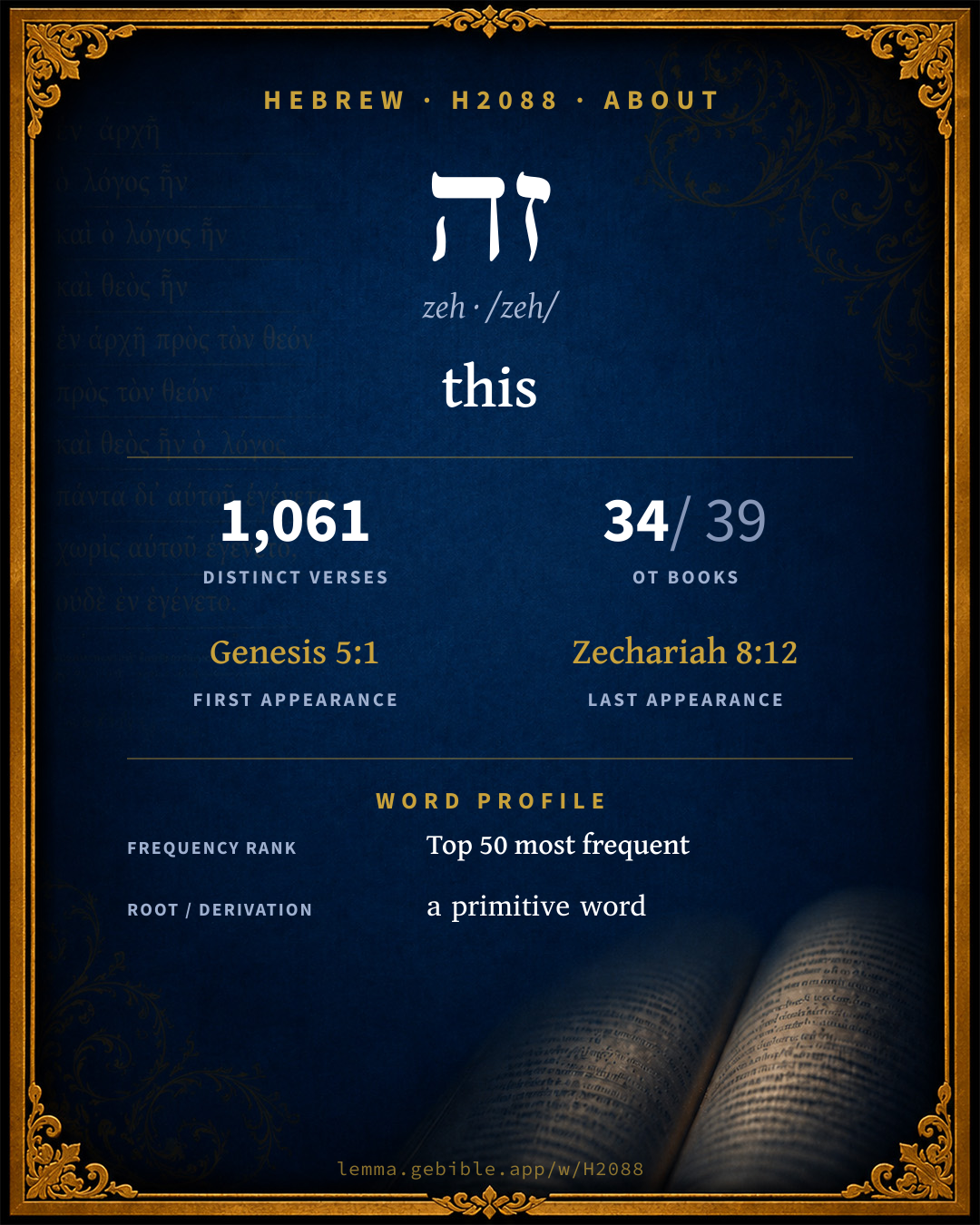
זֶה
this
also: this one, here, which, this...that fuller range ↓
Full lexicon entry — Brown-Driver-Briggs (BDB)
From Brown-Driver-Briggs (BDB)
Where this word appears
Grammar key — what these labels mean
Part of speech
- Pronoun
- A word standing in for a noun (“he,” “this,” “who”).
Gender
- Masculine
- Grammatically masculine.
Number
- Singular
- One.
Every verse where H2088 appears in the Book of Ezekiel — 23 distinct verses. Click any verse to open its interlinear word-by-word view. Verse text shown in the World English Bible for context — . Each verse’s Hebrew form is shown with its reference; the English is not keyword-highlighted, since the data carries no word-level English alignment. Use “Compare translations” on any verse to read it across multiple English versions. This concordance covers the Hebrew Bible; Septuagint (Greek Old Testament) occurrences are not indexed here.
Ezekiel
- Ezekiel 1:5 וְ/זֶה֙ conj + pron dem ms Out of the midst of it came the likeness of four living creatures. This was their appearance: they had the likeness of a man.
- Ezekiel 2:3 הַ/זֶּֽה ptcl def.art + pron dem ms He said to me, Son of man, I send you to the children of Israel, to nations that are rebellious, which have rebelled against me: they and their fathers have transgressed against me even to this very day.
- Ezekiel 8:5 הַ/זֶּ֖ה ptcl def.art + pron dem ms Then said he to me, Son of man, lift up your eyes now the way toward the north. So I lifted up my eyes the way toward the north, and see, northward of the gate of the altar this image of jealousy in the entry.
- Ezekiel 12:10 הַ/זֶּה֙ ptcl def.art + pron dem ms Say you to them, Thus says the Lord Yahweh: This burden [concerns] the prince in Jerusalem, and all the house of Israel among whom they are.
- Ezekiel 12:22 הַ/זֶּה֙ ptcl def.art + pron dem ms Son of man, what is this proverb that you have in the land of Israel, saying, The days are prolonged, and every vision fails?
- Ezekiel 12:23 הַ/זֶּ֔ה ptcl def.art + pron dem ms Tell them therefore, Thus says the Lord Yahweh: I will make this proverb to cease, and they shall no more use it as a proverb in Israel; but tell them, The days are at hand, and the fulfillment of every vision.
- Ezekiel 16:49 זֶ֣ה pron dem ms Behold, this was the iniquity of your sister Sodom: pride, fullness of bread, and prosperous ease was in her and in her daughters; neither did she strengthen the hand of the poor and needy.
- Ezekiel 18:2 הַ/זֶּ֔ה ptcl def.art + pron dem ms What do you mean, that you use this proverb concerning the land of Israel, saying, The fathers have eaten sour grapes, and the children's teeth are set on edge?
- Ezekiel 18:3 הַ/זֶּ֖ה ptcl def.art + pron dem ms As I live, says the Lord Yahweh, you shall not have [occasion] any more to use this proverb in Israel.
- Ezekiel 20:29 הַ/זֶּֽה ptcl def.art + pron dem ms Then I said to them, What means the high place whereunto you go? So the name of it is called Bamah to this day.
- Ezekiel 24:2 הַ/זֶּ֑ה הַ/זֶּֽה ptcl def.art + pron dem ms ptcl def.art + pron dem ms Son of man, write you the name of the day, [even] of this same day: the king of Babylon drew close to Jerusalem this same day.
- Ezekiel 40:1 הַ/זֶּ֗ה ptcl def.art + pron dem ms In the five and twentieth year of our captivity, in the beginning of the year, in the tenth [day] of the month, in the fourteenth year after that the city was struck, in the same day, the hand of Yahweh was on me, and he brought me there.
- Ezekiel 41:4 זֶ֖ה pron dem ms He measured the length of it, twenty cubits, and the breadth, twenty cubits, before the temple: and he said to me, This is the most holy place.
- Ezekiel 41:22 זֶ֚ה pron dem ms The altar was of wood, three cubits high, and the length of it two cubits; and the corners of it, and the length of it, and the walls of it, were of wood: and he said to me, This is the table that is before Yahweh.
- Ezekiel 43:13 וְ/זֶ֖ה conj + pron dem ms These are the measures of the altar by cubits (the cubit is a cubit and a handbreadth): the bottom shall be a cubit, and the breadth a cubit, and the border of it by the edge of it round about a span; and this shall be the base of the altar.
- Ezekiel 44:2 הַ/זֶּה֩ ptcl def.art + pron dem ms Yahweh said to me, This gate shall be shut; it shall not be opened, neither shall any man enter in by it; for Yahweh, the God of Israel, has entered in by it; therefore it shall be shut.
- Ezekiel 45:2 מִ/זֶּה֙ prep + pron dem ms Of this there shall be for the holy place five hundred [in length] by five hundred [in breadth], square round about; and fifty cubits for the suburbs of it round about.
- Ezekiel 45:7 מִ/זֶּ֣ה וּ/מִ/זֶּה֩ prep + pron dem ms conj + prep + pron dem ms [Whatever is] for the prince [shall be] on the one side and on the other side of the holy offering and of the possession of the city, in front of the holy offering and in front of the possession of the city, on the west side westward, and on the east side eastward; and in length answerable to one of the portions, from the west border to the east border.
- Ezekiel 46:20 זֶ֣ה pron dem ms He said to me, This is the place where the priests shall boil the trespass-offering and the sin-offering, [and] where they shall bake the meal-offering; that they not bring them forth into the outer court, to sanctify the people.
- Ezekiel 47:7 מִ/זֶּ֖ה וּ/מִ/זֶּֽה prep + pron dem ms conj + prep + pron dem ms Now when I had returned, behold, on the bank of the river were very many trees on the one side and on the other.
- Ezekiel 47:12 מִ/זֶּ֣ה וּ/מִ/זֶּ֣ה prep + pron dem ms conj + prep + pron dem ms By the river on the bank of it, on this side and on that side, shall grow every tree for food, whose leaf shall not wither, neither shall the fruit of it fail: it shall bring forth new fruit every month, because the waters of it issue out of the sanctuary; and the fruit of it shall be for food, and the leaf of it for healing.
- Ezekiel 47:15 וְ/זֶ֖ה conj + pron dem ms This shall be the border of the land: On the north side, from the great sea, by the way of Hethlon, to the entrance of Zedad;
- Ezekiel 48:21 מִ/זֶּ֣ה וּ/מִ/זֶּ֣ה prep + pron dem ms conj + prep + pron dem ms The residue shall be for the prince, on the one side and on the other of the holy offering and of the possession of the city; in front of the twenty-five thousand of the offering toward the east border, and westward in front of the twenty-five thousand toward the west border, answerable to the portions, it shall be for the prince: and the holy offering and the sanctuary of the house shall be in the midst of it.
About this entry
At a glance — auto-summarized from this page’s data, not written by a person. Every figure links to its source below. This summary describes the numbers; it doesn’t interpret them.
זה (zeh) is a Hebrew word most often rendered “this.” It also covers “this one”, “here”, and “which”, alongside “this” — see its full sense range. The Hebrew Bible uses it across 1,061 verses — among the most common. Debuting at Genesis 5:1, it then recurs through the corpus. Related forms include גה, דא and זה. For the data behind this summary, explore the sense tree and the renderings breakdown below.
Gloss history
Strong's 1890 vs modern scholarship
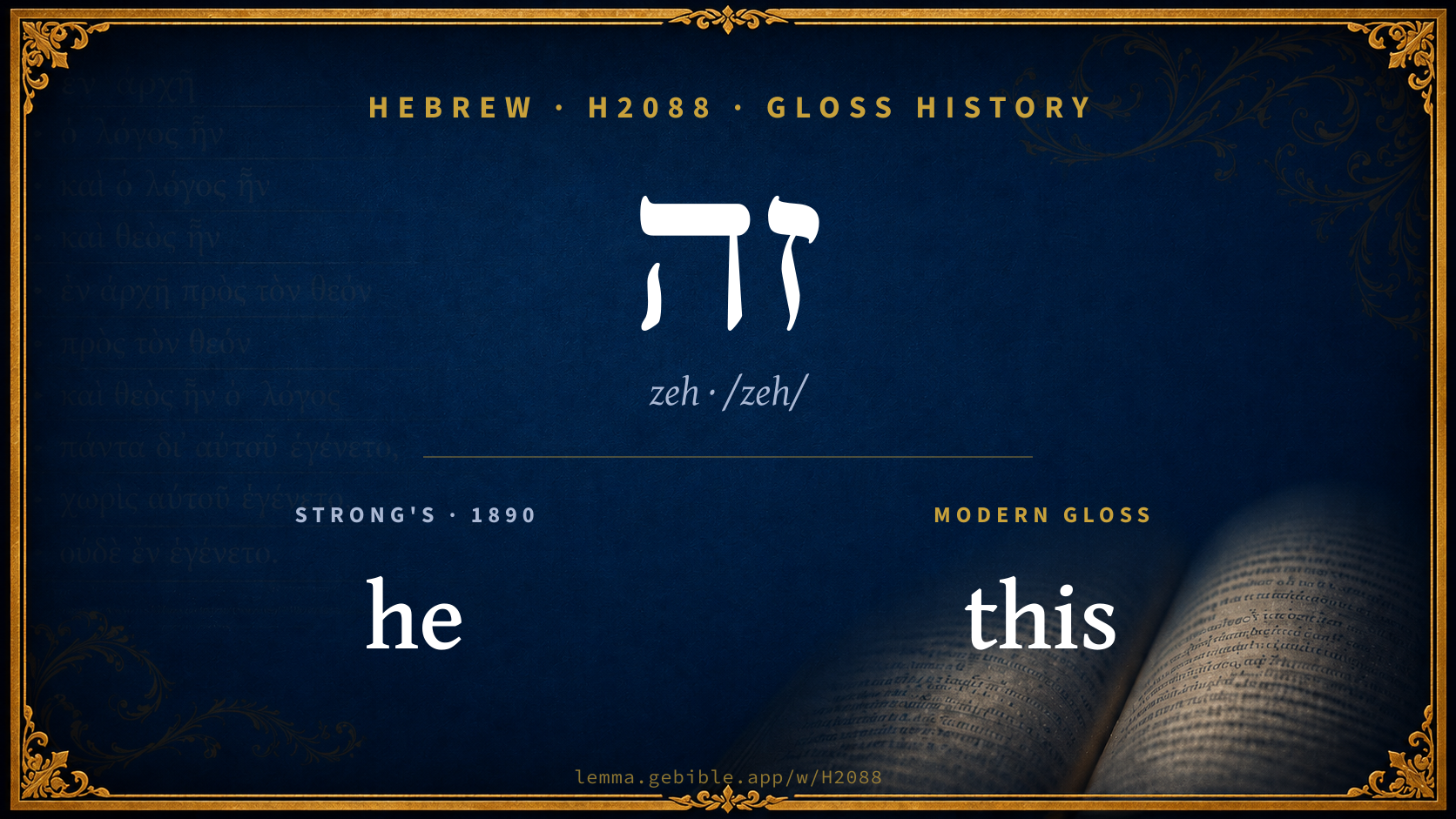
About this word
Strong's H2088 catalogs a Hebrew word from the Hebrew Old Testament.
These counts are not copied from any lexicon or concordance. They are computed here, from the morphology-tagged Hebrew Old Testament. What Lemma adds →
- 1,061
- distinct verses
- The word appears in 1,061 distinct verses.
- 34 / 39
- OT books
- The word appears in 34 of 39 Old Testament books.
- #31
- by frequency
- Top 50 most frequent Hebrew words (rank 31 of 8,640 Hebrew words by occurrence).
View all 1,061 occurrences in the concordance →
By section of the Old Testament
By traditional corpus
Conventional, traditional groupings — biblical authorship is debated, so this is a traditional corpus grouping, not an authorship claim. Each share is this word’s portion of its verses in that division of the Hebrew canon. Each figure is a share of the word’s 1,061 distinct verses.
- Prophets (Nevi'im) 569 verses · 54%
- Torah (Pentateuch) 310 verses · 29%
- Writings (Ketuvim) 182 verses · 17%
How translations render this word
Counts come from each version’s own published word-to-Strong’s tagging or interlinear alignment — an approximate guide to how each version renders this word, not a word-level alignment the data otherwise carries. Because each total is that version’s own tagged count, the per-version totals vary from one another and need not match the appearance or distinct-verse counts above. These counts may also differ from a printed concordance because Lemma counts each distinctly tagged rendering and does not collapse phrase taggings into a single head-word total. This is a fixed set of word-tagged versions (KJV, ASV, BSB, ULT) and does not change with the reading translation you choose elsewhere. Each version’s license is shown beside its name below (and on Sources).
- King James Version: This 6×, Other 3×, Hence 2×
- American Standard Version: This 7×, Hence 2×, Here 2×
- Berean Standard Bible: This 627×, These 54×, Is this 27×
- unfoldingWord Literal Text: This 890×, One 48×, Is this 44×
King James Version Public Domain
Renders H2088 across 37 tagged occurrences — most commonly:
Plus 22 renderings that appear only once — usually multi-word phrases or single function words the recovered tagging swept in, not distinct renderings. Not rendered by a distinct English word in 1 further occurrence.
American Standard Version Public Domain
Renders H2088 across 37 tagged occurrences — most commonly:
Plus 22 renderings that appear only once — usually multi-word phrases or single function words the recovered tagging swept in, not distinct renderings.
Berean Standard Bible Public Domain
Renders H2088 across 984 tagged occurrences — most commonly:
Plus other, less common renderings. Plus 84 renderings that appear only once — usually multi-word phrases or single function words the recovered tagging swept in, not distinct renderings. Not rendered by a distinct English word in 192 further occurrences.
unfoldingWord Literal Text CC BY-SA 4.0
Renders H2088 across 1,222 tagged occurrences — most commonly:
Plus other, less common renderings. Plus 41 renderings that appear only once — usually multi-word phrases or single function words the recovered tagging swept in, not distinct renderings.
27 senses and sub-senses in the full BDB
What do BDB’s symbols mean?
BDB uses these scholarly abbreviations:
| Symbol | Meaning |
|---|---|
| 𝔊 | the Septuagint (the ancient Greek translation, LXX) |
| 𝔙 | the Vulgate (the Latin translation) |
| 𝔖 | the Syriac version (the Peshitta) |
| 𝔗 | the Targum (the Aramaic translation) |
| ψ | the Psalms |
| √ | root (the underlying root or stem) |
| ‖ | parallel passage (a synonymous or contrasted parallel) |
| † | the dagger: every passage where the word occurs is cited |
The 27 senses and sub-senses the full Brown-Driver-Briggs lexicon distinguishes for this word, in lexicon order (not ranked by frequency), with BDB’s own verbatim wording and sub-sense lettering. Shown in Hebrew script with BDB’s own scholarly abbreviations. The condensed entry is in the Lexicon Entry tab. See also the Forms in the corpus table below.
- 1. standing alone:
- a. this one, sometimes contemptuously (especially with אֵת), Gn 2:23 לָזֹאת יִקָּרֵא אִשָּׁה כִּי מֵאִישׁ לֻקֳּחָה־זֹּאת, 5:29 זֶה יְנַחֲמֵנוּ …, 12:12; 38:28 Ex 10:7 עַד מָתַי יִהְיֶה זֶה לָנוּ לְמוֹקֵשׁ, 1 S 10:27 מַה יּוֹשִׁיעֵנוּ זֶה how shall this man save us? 16:8, 9; 21:16 that ye have brought אֶת־זֶה this fellow to play the madman against me? 25:21 in vain have I kept אֶת־כָּל־אֲשֶׁר לָזֶה all that this fellow hath etc. 2 S 13:17 אֶת־זֹאת, 1 K 22:27 אֶת־זֶה, Mi 5:4 Is 66:2; as a genit., Gn 29:27, 28 1 K 21:2; with a collective force Lv 11:4, 9 (= Dt 14:7, 9), v 21, 29 Ju 20:16, 17 (כָּל־זֶה), Jb 19:19 (with a plural verb). In a purely neuter sense (of an act, event, announcement, etc.) זאת is most common, as with עשׂה to do this Gn 3:14; 20:5, 6; 45:19 and often, שׁמעו זאת Am 8:4 Is 47:8; 48:1, 16; 51:21 al.; Gn 41:39 Ex 17:14 Dt 32:6 Ju 7:14; 21:3 לָמָה … הָֽיְתָה זֹאת (cf. Jb 1:13 ψ 118:23) 1 K 11:39 2 S 7:19 2 K 3:18 +; אֵין זֹאת 1 Sa 20:2b cf. Am 2:11; rarely so with אֶת־ †Jos 22:24 Je 9:11 ψ 92:7; as an accus. of limit., as regards this, in this, Ez 20:27; 36:37 Jb 19:26 (si vera l.), 33:12 in this thou art not just; (late) אַחֲרֵי זֹאת †Jb 42:16 Ezr 9:10, א׳ כל־זאת †2 Ch 21:18; 35:20; pointing forward to a foll. a clause, Gn 42:18; 43:11 Nu 8:24; 14:35 Is 56:2 Jb 10:13 etc.; Ex 9:16 1 S 25:31 Is 1:12 מִי בִקֵּשׁ זאת מִיֶּדְכֶם רְמֹס חֲצֵרָֽי׃; to one introduced by כִּי 2 S 19:22 ψ 102:19; 119:50, 56 (see also בְּזֹאת 6 b β): but זֶה also sometimes occurs similarly Ex 13:8 Pr 24:12 Jb 15:17 Ne 2:2 Ec 1:17; 2:15 גם זה הבל (so v 19, 21, 23 +), 7:18(×2); of a concrete obj., Ex 30:31 2 K 4:43 מָה אֶתֵּן זֶה לִפְנֵי מֵאָה אִישׁ: in late Heb., Ne 13:6 בְּכָל־זֶה during all this, 2 Ch 32:9 אַחַר זֶה; pointing forwards La 5:17 f. to כִּי ψ 56:10 Je 22:21. (See also below, 6 g.) e.g. Genesis 2:23
- b. repeated זֶה … זֶה, this … that, the one … the other or (if indefinite) another, Gn 29:27 (זֹאת), Ex 14:20 וְלֹא קָרַב זֶה אֶל זֶה, 1 K 3:23; 22:20 Is 6:3; 44:5 (3 times), ψ 75:8 זֶה יַשְׁפִּיל וְזֶה יָרִים, Jb 1:16–18; 21:23, 25 +. e.g. Genesis 29:27
- 2. In appos. to a subst.:
- a. preceding it (rare) Ex 32:1, 23 זֶה מֹשֶׁה, Ju 5:5 (= ψ 68:9) זֶה סִינַי this Sinai, Jos 9:12 זֶה לַחְמֵנוּ this our bread, 1 K 14:14 2 K 6:33 Is 23:13 זֶה הָעָם, ψ 34:7; 49:14; 104:25 זה הים גדול וג׳ this sea there is great and broad, 118:20 Ct 7:8 Ezr 3:12. (Cf. זוּ Hb 1:11.) e.g. Exodus 32:1
- b. following it:—(α) when the subst. is determined by a pron. affix, Gn 24:8 שְׁבוּעָתִי זֹאת, this my oath, Dt 5:29(26) O that לְבָבָם זֶה this their heart (their present temper) might continue always! 21:20 Jos 2:14, 20 דְּבָרֵנוּ זֶה, Ju 6:14 go בְּכֹחֲךָ זֶה in this thy strength, Dn 10:17 2 Ch 24:18 (Cf. אֵלָּה, a.) Rarely when it is undetermined, 2 K 1:2 חֳלִי זֶה (so 8:8, 9), ψ 80:15. (β) with the art., הַזֶּה, הַזֹּאת, after a subst. determained also by the art., Gn 7:1 בַּדּוֹר הַזֶּה, v 13 הַיּוֹם הַזֶּה, 12:7 הָאָרֶץ הַזֹּאת, 15:7; 17:21, 23 Dt 4:6 הגוי הגדול הזה, and continually. Not however after a n.pr., except such as are construed with the art., as הַיַּרְדֵּן הַזֶּה Gn 32:11 Dt 3:27; 31:2 Jos 1:2, 11; 4:22, הַלְּבָנוֹן הַזֶּה Jos 1:4, cf. Nu 27:12 = Dt 32:49 (2 K 5:20 הַזֶּה belongs to הָאֲרַמִּי): and hardly ever (2 Ch 1:10) after a noun with a pron. affix (Jos 2:17 מִשְּׁבֻעָתֵךְ הַזֶּה the gender of הזה shews that the text is in error: v. Dr§ 209 Obs.). e.g. Genesis 24:8
- 3. More often as pred., as 1 S 24:17 הֲקוֹלְךָ זֶה, 2 K 3:23 דָּם זֶה this is blood, 9:37 זֹאת אִיזָֽבֶל׃, Ez 5:5 etc.; הֲזֶה Is 14:16, הֲזֹאת 23:7 La 2:15; often at the beginning or close of enumerations (especially P), descriptions, injunctions, etc., as Gn 5:1 זה ספר this is the book …, 9:12 זֹאת אוֹת הַבְּרִית, 17:10; 20:13 זֶה חַסְדֵּךְ אֲשֶׁר תַּעֲשִׂי עִמָּדִי, Lv 6:2, 13, 18; 7:1, 11 Dt 6:1; 33:1 Jos 13:2 Jb 27:13 Is 58:6 etc.; זה הדבר אשׁר … Ex 16:16; 35:4 Jos 5:4 Ju 20:9; 21:11 Is 37:22 Je 38:21 +, cf. זה אשׁר … this is what (or how) … Gn 6:15 Ex 29:38 Je 33:16; זֶה לְךָ הָאוֹת Ex 3:12 1 S 2:34 +; at the end, Lv 7:37; 11:46; 13:50 Nu 5:21; 7:17, 23 etc., Jos 19:8, 16, 23 etc., Is 14:26; 16:13 (זֶה הַדָּבָר אֲשֶׁר …), 17:14; 54:17 Je 13:25 ψ 109:20 Ct 5:16(×2) Jb 5;27, in the latter case sometimes with the force of such (i.e. such as has been described), 18:21; 20:29 (cf. אֵלֶּה ψ 73:12), ψ 24:6; 48:15 such (= such a one) is God, our God, for ever (Hi De) Zp 2:15; cf. Jb 14:3 אַף־עַל־זֶה upon one such as this (v 1, 2) dost thou open thy eyes? e.g. 1 Samuel 24:17
- 4. It is attached enclitically, almost as an adv., to certain words, especially interrog. pronouns, to impart, in a manner often not reproducible in Engl. idiom, directness and force, bringing the question or statement made into close relation with the speaker. (Contrast from this point of view מי זה and מי הוא: v. הוא 4 b.) Thus
- a. אֵי־זֶה15 where, then? Jb 28:12 אֵי־זֶה מְקוֹם בִּינָה, v 20 38:19 b (v. other exx. sub אַי 1 b, p. 32). e.g. Job 28:12
- b. מִי־זֶה, †1 S 17:55, 56 בֶּן־מִי־זֶה֖ הָעָֽלֶם׃ the son of whom, here, is the lad? Je 49:19 (= 50:44) וּמִי זֶה רֹעֶה אֲשֶׁר וג׳ and who (emph.) is the shepherd that etc., La 3:37 ψ 24:8 Who is the King of glory? (for which in v 10 the stronger מִי הוּא זֶה is said: so Je 30:21 Est 7:5), 25:12. Elsewhere, the rend. Who is this … is admissible: Is 63:1 Je 46:7 Jb 38:2; 42:3; cf. מִי־זֹאת Ct 3:6; 6:10; 8:5. e.g. 1 Samuel 17:55
- c. מַה־זֶּה how, now? Gn 27:20 Ju 18:24 וּמַה־זֶּה תֹּאמְרוּ אֵלַי and how, now, do ye say to me …? 1 K 21:5 2 K 1:5; what, now? (τίποτε;) 1 S 10:11 מַה־זֶּה הָיָה לְבֶן־קִישׁ; עַל־מַה־זֶּה for what? Ne 2:4: contracted into מַזֶּה Ex 4:2. (Cf. Aramaic מָדֵין why? ܡܳܕܶܝܢ used as a conj. therefore, e.g. 2 S 18:22 𝔖, PS2013: both formed similarly.) e.g. Genesis 27:20
- d. מַה־זֹּאת in the phrase (עֲשִׂיתֶם, עָשִׂית) מַה־זֹּאת עָשִׂיתָ Gn 3:13; 12:18; 26:10; 29:25; 42:28 Ex 14:11 Ju 2:2 15:11 +. Either What, now, hast thou (have ye) done? (Fl De) or What is this (that) thou hast (ye have) done? (The Arabic grammarians dispute on the precise construction of the corresp. phrase in Arabic مَا ذَا صَنَعْتَ; De Gen. 3:13 (ed. 4), and especially FlKl.Schr. i. 356 Lane p. 948.) e.g. Genesis 3:13
- e. לָֽמָּה־זֶּה wherefore, now? Gn 18:13; 25:22; 32:30 Ex 5:22 Nu 11:20 + often Cf. Arabic لِهَا ذَا e.g. Genesis 18:13
- f. הַאַתָּה זֶה †2 S 2:20 האתה זה עשׂהאל Art thou Asahel? 1 K 18:7, 17, without הֲ Gn 27:24; in an indirect question Gn 27:21. e.g. 2 Samuel 2:20
- g. הִנֵּה זֶה behold, here … †1 K 19:5 (in narrative), Is 21:9 Ct 2:8, 9. Cf. Nu 13:17 (unusual) עֲלוּ זֶה בַּנֶּגֶב go up here in the South. e.g. 1 Kings 19:5
- h. עַתָּה זֶה, †1 K 17:24 עַתָּה זֶה יָדַעְתִּי now I know that …, 2 K 5:22 just now. Also e.g. 1 Kings 17:24
- i. prefixed to expressions denoting a period of time: Gn 27:36 he hath supplanted me זֶה פַעֲמַיִם now two times (so 43:10), 31:38 now, already twenty years, v 41 (זֶה־לִּי …), 45:6 Nu 14:22 now ten times, 22:28, 32 זֶה שָׁלשׁ רְגָלִים, Dt 8:2, 4 Jos 22:3 זֶה יָמִים רַבִּים, 2 S 14:2 +; Zc 7:3 זֶה כַּמָּה שָׁנִים already how many years! cf. Ru 2:7 Je 50:17. e.g. Genesis 27:36
- 5. In poetry, as a relative pron. (rare: but see also זוֹ, זוּ): ψ 74:2 athe hill of Zion זה שׁכנת בּוֹ wherein thou dwellest, 78:54; 104:8 אל־מְקום זה to the place (st. c. Ges§ 130. 3) which … v 26 Pr 23:22 Is 25:9; = that which Jb 15:17, those who 19:19 (so once, Ex 13:8, even in prose). In some of the passages cited the punctuators, by coupling זה with the preceding subst., and separating it from what follows by a disj. accent (as הַר־זֶ֝֗ה), appear not to have recognised its relative sense, but to have construed, ‘this mountain, (which) thy right hand,’ etc. e.g. Psalms 74:2
- 6. With prefixes (in special senses):—
- a. בָּזֶה15 in this (place), here, Gn 38:21, 22 Ex 24:14 Nu 23:1(×2) 1 S 1:26; 9:11 +; of time, then, †Est 2:13 Once בַּזֶּה 1 S 21:10. e.g. Genesis 38:21
- b. בְּזֹאת (α) with this = on these conditions, Gn 34:15, 22 1 S 11:2 Is 27:9; = herewith, thus provided Lv 16:3. (β) by or through this (especially with יָדַע), Gn 42:15, 33 Ex 7:17 Nu 16:28 Jos 3:10 ψ 41:12; so בָּזֹאת Mal 3:10. (γ) in spite of this, Lv 26:27 ψ 27:3, for which the fuller בְּכָל־זֹאת occurs, Is 5:25; 9:11, 16, 20; 10:4 ψ 78:32 Je 3:10 Ho 7:10. (δ) בָּזֹאת for this cause (late style) †1 Ch 27:24 2 Ch 19:2; in this matter 20:17. e.g. Genesis 34:15
- c. כָּזֶה (α) †Gn 41:38 הֲנִמְצָא כָזֶה אִישׁ אשׁר …, Is 56:12; 58:5 Je 5:9 גּוֹי אֲשֶׁר כָּזֶה (so v 29; 9:8). (β) כָּזֹה וְכָזֶה thus and thus, †Ju 18:4 2 S 11:25 1 K 14:5. e.g. Genesis 41:38
- d. כְּזֹאת the like of this = as follows, †Gn 45:23; כָּזֹאת the like of this = things such as these Ju 13:23 (c. השׁמיע), 15:7; 19:30 לא נראתה כָּזֹאת, 1 S 4:7 (cf. Je 2:10 2 Ch 30:26), 2 S 14:13 (c. חשׁב), Is 66:8 (c. שׁמע), Ezr 7:27; = accordingly, to that effect (c. דִּבֶּר) 2 Ch 34:22; = in like manner Ju 8:8; = thus (as has been described) 1 K 7:37 1 Ch 29:14 2 Ch 31:20; 32:15: כָּזֹאת וְכָזֹאת thus and thus †Jos 7:20 2 S 17:15(×2) 2 K 5:4; 9:12. e.g. Genesis 45:23
- e. מִזֶּה from here, hence Gn 37:17; 42:15; 50:25 Ex 11:1(×2) 13:3 Dt 9:12 + often: מִזֶּה … מִזֶּה on one side … on the other side Ex 17:12 מזה אחד ומזה אחד, 25:19; 26:13; 32:15 מזה ומזה הם כתובים, Nu 22:24 1 S 14:4 1 K 10:19, 20 Zc 5:3 +; מִזֶּה וּמִזֶּה לְ on one side and on the other side of … Ex 38:15 Jos 8:33 Ez 45:7; 48:21. e.g. Genesis 37:17
- f. עַל זֶה on this account (rare), La 5:17 (pointing forwards), Est 6:3. So עַל זֹאת Am 8:8 Mi 1:8 Je 2:12 (Jb 17:8) 4:8, 28 ψ 32:6; in late prose Ezr 8:23; 9:15; 10:2 Ne 13:14 2 Ch 16:9, 10; 29:9; 32:20. e.g. Lamentations 5:17
- g. עִם זֶה in spite of this †Ne 5:18.—On אֵי זֶה which? אֵי מִזֶּה whence? אֵי לָזֹאת how? v. sub אַי 2, p. 32; and on הַלָּז, הַלָּזֶה, הַלֵּזוּ, v. p. 229. e.g. Nehemiah 5:18
- —זֶה in 1 S 17:34 (in many edd.) is a typographical error (not a Kt) of Jacob b. Chayim’s Rabbin. Bible of 1525 for שׂה sheep, which has been perpetuated hence in other subseq. edd. The reading of MSS. and of the best ancient edd. is שֶׂה (cf. de RossiVar. Lect. ii. 151). e.g. 1 Samuel 17:34
Senses from the full Brown-Driver-Briggs lexicon (Brown, Driver, Briggs; Oxford 1906 — public domain), digitized via Sefaria, supplemented by the OpenScriptures HebrewLexicon (CC BY 4.0). Full attribution on Sources.
Word origin
demonstr. pron. and adv. fem. זֹאת, once זֹאתה, Jer 26:6 Kt (also זֹה and זוֹ, q.v.); comm. זוּ (q.v.): this, here (the element ז = ذ = ܕ is widely diffused in the Semitic languages, as a demonstr. particle, often acquiring, like Engl. that, Germ. der, die, das, the force of a relative. Thus a. Ph. זֶ this (e.g. קבר ז this grave), also sometimes זן, f. זא, comm. אז (v. CIS I. i. 1:4, 5, 6, 12; 44:1; 88:2 etc.); Aramaic of Nineveh, Babylon, Têma, Egypt, זי as mark of the genit. [lit. that of] (CIS II. i. 1, 2, 3, 4, etc., 65, 67–71, 113, 114, 141, 142, etc.), זנה this (ib. 113:22; 145 C2), f. זא 113:15; 145 B5; Aramaic of Zinijirli ז, זן, זנה this, זי which (DHMSendsch. 56); Ethiopic ዝ ze, this, f. ዛ zā, ዘ za, who (masc.), also (like זִי, and דִּי, דְּ [v. infr.]) in common use as a mark of the genitive; b. Arabic ذَا this, fem. ذِى, ذُو (gen. ذِى, acc. ذَا, fem. ذَاتُ), possessor of (lit. that of …, i.e. one who owns), or in the Ṭayyite dialect, who, which: from ذَا, with هَا lo! prefixed, هَاذَا this, f. هَاذِهِ, with the pron. element -k affixed, ذَاكَ = this: with ’al (= the art.) + a demonstr. element la prefixed, أَلَّذِى who, which (in origin = Heb. הַלָּזֶה this, q.v.); Sab. דֿן this, f. דֿת, דֿ who, which, f. דֿת (PräZMG. 1872, 419, DHMZMG. 1883, 338 f., also Epigr. Denkm. 65); c. Biblical Aramaic דִּי which, דֵּךְ, דִּכֵּן, דְּנָה (q.v.) this, f. דָּא (= זֹאת), דָּךְ; Palm. and Nab. די which, דנה this; 𝔗 דְּ which, דֵּין, דֵּיכֵי this, f. דָּא; with הא lo! prefixed, הָדֵין, הָדָא (Syriac ܗܳܢ, ܗܳܢܳܐ, contr. from ܗܳܕܶܢ), ܗܳܕܶܐ; Syriac ܕ who, which; Sam. ד who, which, דנ this, f. דה; Mand. ד who, which, דהֿ this (rare), more commonly האדין, האזין (NöMand § 80, 81). Alike in Heb. and the other dialects, the corresp. plur. is derived from a different source: Heb. אֵלָּה, Ph. אל, Ethiopic ’ellū, ’ellā, these, ’ella, who, Arabic أُولَى, these, أُولُوا, أُولَى owners of, Sab. אלן these, אל, אלי who, which, Aramaic אִלֵּין, with הא lo! prefixed, ܗܳܠܶܝܢ, Sam. ࠀࠋࠉࠍ, Mand. עלין. Only the Arabic اَلَّذِى forms its own pl. اَلَّذِينَ V. further WSG 107 ff.)—
— Brown-Driver-Briggs (Oxford 1906, public domain), digitized via Sefaria, supplemented by the OpenScriptures HebrewLexicon (CC BY 4.0). See Sources.
Origin: a primitive word
Jastrow Dictionary
A second Hebrew/Aramaic lexicon for comparison, covering Aramaic and post-biblical (Talmudic, Targumic, Midrashic) usage that the biblical-Hebrew BDB does not. Matched by lemma rather than by Strong’s number, so a lemma may carry more than one Jastrow headword (shown separately below), and the entries cover usage well beyond the Bible.
זֶה
- (b. h.) this, that. Men. 53ᵇ יבא זה וכ׳ let this one come and receive this &c.; זה זה משה ‘this one’ that means Moses; זאת זו התורה ‘this’—that means the Law. Gen. R. s. 4 לגיון זה this legion; a. v. fr.—זֶהוּ = זה הוא, this is. Sabb. 40ᵇ הפשרו זהו בישולו (also זה הוא) warming it is the cooking of it, v. הֶפְשֵׁר; a. fr.—Gitt. VIII, 4 אי זֹהו Y. ed. (Mish. אֵיזֶהוּ); a. v. fr.
A Dictionary of the Targumim, the Talmud Babli and Yerushalmi, and the Midrashic Literature (Marcus Jastrow; London, Luzac, 1903) — Public Domain. Digitized via Sefaria. Digitized via Sefaria. Full attribution on Sources.
Forms in the corpus
The 109 distinct written forms H2088 takes in the Hebrew Bible, most frequent first — each parse links to that state’s occurrences in the concordance. Hebrew forms include their vowel points and cantillation, so a single lemma takes many written forms.
| Form | Parsing | Example | Uses |
|---|---|---|---|
| הַ/זֶּֽה | Pronoun, Demonstrative, Masculine, Singular | Deuteronomy 1:6 | 175 |
| הַ/זֶּ֑ה | Pronoun, Demonstrative, Masculine, Singular | Daniel 1:14 | 127 |
| הַ/זֶּ֔ה | Pronoun, Demonstrative, Masculine, Singular | Deuteronomy 3:28 | 126 |
| הַ/זֶּ֖ה | Pronoun, Demonstrative, Masculine, Singular | Daniel 10:11 | 95 |
| הַ/זֶּה֙ | Pronoun, Demonstrative, Masculine, Singular | Deuteronomy 5:24 | 80 |
| זֶ֣ה | Pronoun, Demonstrative, Masculine, Singular | Deuteronomy 2:7 | 54 |
| זֶ֖ה | Pronoun, Demonstrative, Masculine, Singular | Deuteronomy 8:4 | 42 |
| הַ/זֶּ֗ה | Pronoun, Demonstrative, Masculine, Singular | Amos 3:1 | 34 |
| זֶ֤ה | Pronoun, Demonstrative, Masculine, Singular | Ecclesiastes 7:14 | 29 |
| זֶ֥ה | Pronoun, Demonstrative, Masculine, Singular | Ecclesiastes 1:17 | 29 |
| הַ/זֶּ֜ה | Pronoun, Demonstrative, Masculine, Singular | Deuteronomy 31:16 | 20 |
| זֶ֛ה | Pronoun, Demonstrative, Masculine, Singular | Deuteronomy 8:2 | 20 |
| הַ/זֶּ֛ה | Pronoun, Demonstrative, Masculine, Singular | Deuteronomy 22:16 | 19 |
| זֶה֙ | Pronoun, Demonstrative, Masculine, Singular | Deuteronomy 14:9 | 14 |
| זֶ֔ה | Pronoun, Demonstrative, Masculine, Singular | Daniel 10:17 | 12 |
| זֶ֚ה | Pronoun, Demonstrative, Masculine, Singular | Ezekiel 41:22 | 12 |
| מִ/זֶּ֔ה | Pronoun, Demonstrative, Masculine, Singular | Deuteronomy 9:12 | 12 |
| וְ/זֶה | Pronoun, Demonstrative, Masculine, Singular | Exodus 3:12 | 11 |
| זֶֽה | Pronoun, Demonstrative, Masculine, Singular | Ecclesiastes 7:10 | 11 |
| מִ/זֶּ֖ה | Pronoun, Demonstrative, Masculine, Singular | Ecclesiastes 7:18 | 11 |
| זֶ֑ה | Pronoun, Demonstrative, Masculine, Singular | Daniel 10:17 | 9 |
| זֶ֗ה | Pronoun, Demonstrative, Masculine, Singular | Exodus 13:8 | 9 |
| מִ/זֶּ֑ה | Pronoun, Demonstrative, Masculine, Singular | Exodus 11:1 | 9 |
| וְ/זֶ֖ה | Pronoun, Demonstrative, Masculine, Singular | Ezekiel 43:13 | 7 |
| זֶ֨ה | Pronoun, Demonstrative, Masculine, Singular | Ecclesiastes 2:3 | 7 |
| זֶה | Pronoun, Demonstrative, Masculine, Singular | Exodus 3:15 | 7 |
| זֶּ֖ה | Pronoun, Demonstrative, Masculine, Singular | Esther 4:5 | 7 |
| זֶּה֙ | Pronoun, Demonstrative, Masculine, Singular | Exodus 2:20 | 7 |
| מִ/זֶּ֣ה | Pronoun, Demonstrative, Masculine, Singular | Ezekiel 45:7 | 7 |
| מִ/זֶּ֥ה | Pronoun, Demonstrative, Masculine, Singular | Exodus 26:13 | 7 |
| מִ/זֶּֽה | Pronoun, Demonstrative, Masculine, Singular | Ecclesiastes 6:5 | 7 |
| הַ/זֶּ֤ה | Pronoun, Demonstrative, Masculine, Singular | Exodus 12:14 | 5 |
| וְ/זֶ֥ה | Pronoun, Demonstrative, Masculine, Singular | Exodus 3:15 | 5 |
| זֶּ֥ה | Pronoun, Demonstrative, Masculine, Singular | Amos 5:18 | 5 |
| מִ/זֶּה֙ | Pronoun, Demonstrative, Masculine, Singular | Exodus 26:13 | 5 |
| בָ/זֶ֖ה | Pronoun, Demonstrative, Masculine, Singular | Genesis 38:21 | 4 |
| בָּ/זֶ֔ה | Pronoun, Demonstrative, Masculine, Singular | Ecclesiastes 7:18 | 4 |
| בָּ/זֶ֖ה | Pronoun, Demonstrative, Masculine, Singular | 1 Samuel 9:11 | 4 |
| הַ֠/זֶּה | Pronoun, Demonstrative, Masculine, Singular | Haggai 2:14 | 4 |
| וְ/זֶ֕ה | Pronoun, Demonstrative, Masculine, Singular | Deuteronomy 14:12 | 4 |
| וְ/זֶ֣ה | Pronoun, Demonstrative, Masculine, Singular | Ezra 7:11 | 4 |
| וְ/זֶֽה | Pronoun, Demonstrative, Masculine, Singular | Ecclesiastes 2:10 | 4 |
| וּ/מִ/זֶּ֖ה | Pronoun, Demonstrative, Masculine, Singular | Exodus 26:13 | 4 |
| וּ/מִ/זֶּ֣ה | Pronoun, Demonstrative, Masculine, Singular | Exodus 17:12 | 4 |
| זֶ֝֗ה | Pronoun, Demonstrative, Masculine, Singular | Job 28:20 | 4 |
| זֶּ֛ה | Pronoun, Demonstrative, Masculine, Singular | Genesis 27:20 | 4 |
| הַ/זֶּ֡ה | Pronoun, Demonstrative, Masculine, Singular | 1 Kings 12:10 | 3 |
| הַ/זֶּה֒ | Pronoun, Demonstrative, Masculine, Singular | Exodus 12:12 | 3 |
| הַ/זֶּה֮ | Pronoun, Demonstrative, Masculine, Singular | Genesis 39:9 | 3 |
| וְ/זֶ֨ה | Pronoun, Demonstrative, Masculine, Singular | Exodus 29:1 | 3 |
| וְ/זֶה֙ | Pronoun, Demonstrative, Masculine, Singular | Deuteronomy 19:4 | 3 |
| וְ/זֶה֮ | Pronoun, Demonstrative, Masculine, Singular | Deuteronomy 15:2 | 3 |
| זֶ֠ה | Pronoun, Demonstrative, Masculine, Singular | 2 Kings 5:22 | 3 |
| זֶה֮ | Pronoun, Demonstrative, Masculine, Singular | Isaiah 58:6 | 3 |
| זֶּ֣ה | Pronoun, Demonstrative, Masculine, Singular | Exodus 4:2 | 3 |
| כָּ/זֶ֔ה | Pronoun, Demonstrative, Masculine, Singular | Jeremiah 5:9 | 3 |
| בָּ/זֶ֑ה | Pronoun, Demonstrative, Masculine, Singular | Genesis 48:9 | 2 |
| הַ/זֶּ֥ה | Pronoun, Demonstrative, Masculine, Singular | Genesis 31:48 | 2 |
| וְ/זֶ֗ה | Pronoun, Demonstrative, Masculine, Singular | Isaiah 44:5 | 2 |
| וְ/זֶ֤ה | Pronoun, Demonstrative, Masculine, Singular | Jeremiah 50:17 | 2 |
The 60 most common forms are shown; 49 rarer forms follow in the full concordance.
Same root — word family
Other BDB entries built from the same root as H2088, grouped by Strong’s listed origin. These share a root / origin per the lexicon — not necessarily a shared meaning. Each links to that word’s own entry.
Derived from this word
Compare all same-root words → Showing 4 of 6 — not the complete family. They share a root, not necessarily a meaning.
Septuagint verse parallels
This word appears in 1,006 verses that also exist in the Greek Old Testament (Septuagint), out of the 1,061 Hebrew verses it occurs in. You can read those verses in Greek by switching the Old Testament edition to the Septuagint.
Read these verses in the Septuagint
- Genesis 5:1
- Exodus 1:18
- Leviticus 6:20
- Numbers 7:17
- Deuteronomy 1:6
- Joshua 1:2
- Judges 1:21
- Ruth 2:7
- 1 Samuel 1:26
- 2 Samuel 1:3
- 1 Kings 1:27
- 2 Kings 1:2
This is a verse-level parallel only — the same verses exist in both the Hebrew and Greek Old Testaments. No word-level Hebrew↔Greek correspondence is claimed: the data carries no such alignment, so no Greek word is shown as this Hebrew word’s translation. Coverage is not total — the Septuagint omits the deuterocanon and renumbers the Psalms, so some Hebrew verses have no direct Greek parallel.