
Job 28:20

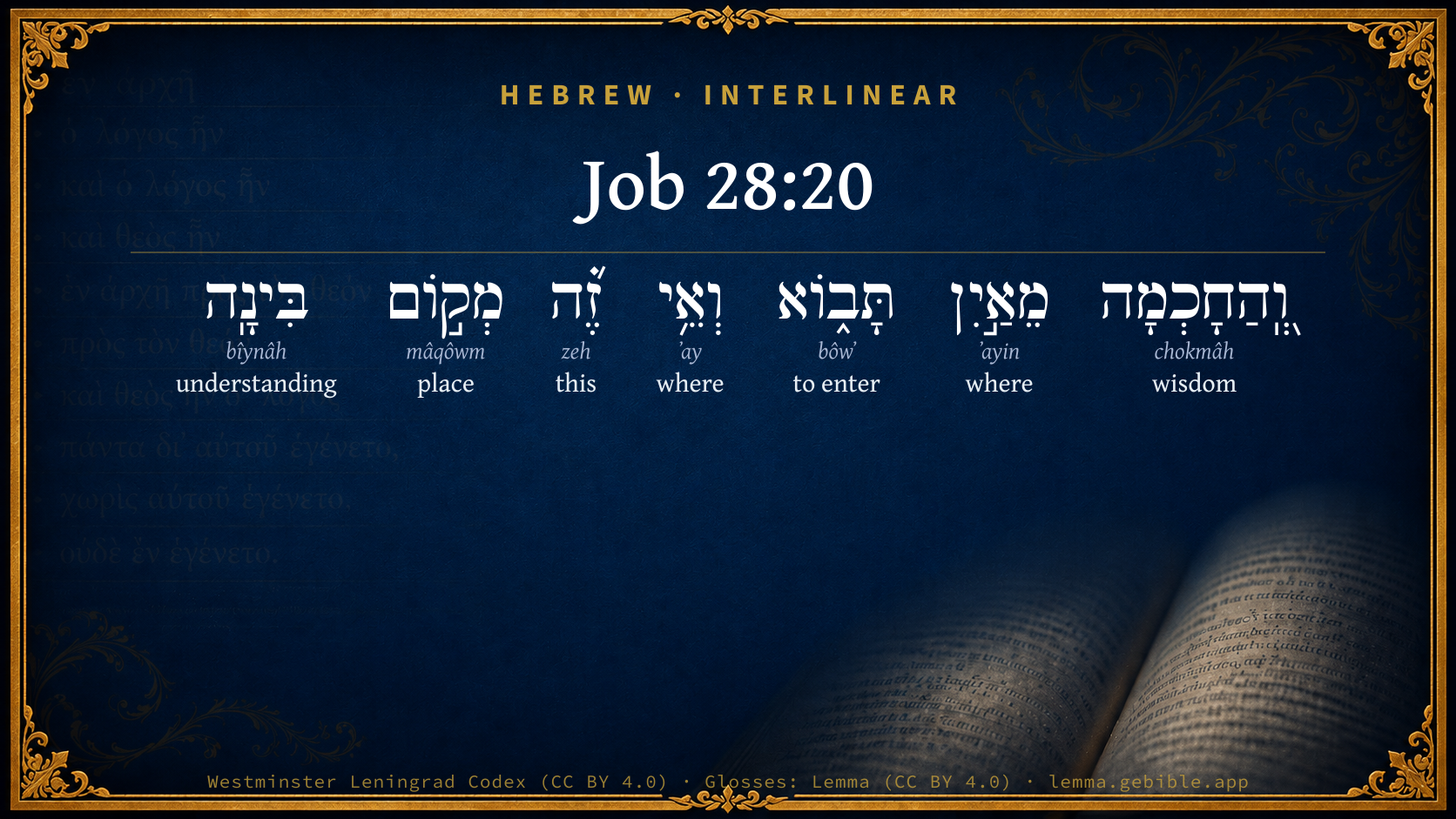
Hebrew (Westminster Leningrad Codex) Job 28:20 appears in the Hebrew Old Testament. The text above is from the Westminster Leningrad Codex. Each word links to its Strong’s number, a concise gloss, and parsing drawn from the Open Scriptures Hebrew Bible morphology. Click any word for its full Brown-Driver-Briggs (BDB) entry.
Download image
Cite this verse

Job 28:20 (World English Bible). Public Domain. Lemma interlinear Bible study tool, https://lemma.gebible.app/v/job/28/20.

Show BibTeX & RIS
BibTeX
RIS
English Translation
Whence then comes wisdom? Where is the place of understanding?
World English Bible · Public Domain
Download a study sheet

One document with this verse’s original text, its word-by-word gloss line, the meaning frame, cross-references with their text, attributed commentary, and full source and license credits — printable, and it pastes into notes with its structure intact.

This verse Autodidact and up

Study sheet (.html) Plain text (.txt)

A passage Seminary Student

Up to 50 verses in one chapter. A passage sheet keeps up to 6 commentary sources and 12 cross-references per verse, in the order this page ranks them, and says so on the sheet whenever that leaves anything out. Ask for a single verse and you get the Autodidact verse sheet above.

Everything on this page stays free to read, with no account — the sheet is a download of what is already on screen, not access to it.

Want to remove ads? Support Godless Engineer
Compare translations 3

The same verse in 3 English versions, stacked beneath the original-language interlinear above. Click any original word for its lexicon entry.

Each is an independent rendering of the whole verse — the interlinear is not word-aligned to these translations.

Highlighted words mark where these versions differ — a whole-verse word diff, not a word-by-word alignment.

  • World English Bible Public Domain
    Whence then comes wisdom? Where is the place of understanding?
  • King James Version Public Domain
    Whence then cometh wisdom? and where is the place of understanding?
  • unfoldingWord Literal Text CC BY-SA 4.0
    From whence, then, does wisdom come? And where that, the place of understanding?

unfoldingWord Literal Text — © unfoldingWord, licensed CC BY-SA 4.0. Word-aligned USFM3 via Door43 (git.door43.org/unfoldingWord/en_ult).

Versions to compare (up to 4)

3 of 4 selected

Show all 18 translations

Every available English version of this verse, each an independent rendering of the whole verse.

  • World English Bible Public Domain
    Whence then comes wisdom? Where is the place of understanding?
  • Berean Standard Bible Public Domain
    From where then does wisdom come, and where does understanding dwell?
  • Majority Standard Bible Public Domain
    From where, then, does wisdom come, and where does understanding dwell?
  • King James Version Public Domain
    Whence then cometh wisdom? and where is the place of understanding?
  • American Standard Version (1901) Public Domain
    Whence then cometh wisdom? And where is the place of understanding?
  • Revised Version (1885) Public Domain
    Whence then cometh wisdom? and where is the place of understanding?
  • Geneva Bible (1599) Public Domain
    Whence then commeth wisedome? and where is the place of vnderstanding,
  • Douay-Rheims (1899) Public Domain
    Whence then cometh wisdom? and where is the place of understanding?
  • Young's Literal Translation Public Domain
    And the wisdom -- whence doth it come? And where `is' this, the place of understanding?
  • Literal Standard Version CC BY-SA 4.0
    And the wisdom—from where does it come? And where [is] this, the place of understanding?
  • Unlocked Literal Bible CC BY-SA 4.0
    From where, then, comes wisdom? Where is the place of understanding?
  • unfoldingWord Literal Text CC BY-SA 4.0
    From whence, then, does wisdom come? And where that, the place of understanding?
  • Darby Bible Public Domain
    Whence then cometh wisdom? and where is the place of understanding?
  • World Messianic Bible Public Domain
    Where then does wisdom come from? Where is the place of understanding?
  • Webster's Bible Public Domain
    Whence then cometh wisdom? and where is the place of understanding?
  • Free Bible Version CC BY-SA 4.0
    So where does wisdom come from? Where is the place to gain understanding?
  • Bible in Basic English Public Domain
    From where then does wisdom come, and where is the resting-place of knowledge?
  • JPS Tanakh (1917) Public Domain
    Whence then cometh wisdom? And where is the place of understanding?

Literal Standard Version (2020), Covenant Press — licensed CC BY-SA 4.0. Text via the HelloAO Bible API (eBible.org). Unlocked Literal Bible (unfoldingWord) — licensed CC BY-SA 4.0. Text via the HelloAO Bible API (eBible.org). unfoldingWord Literal Text — © unfoldingWord, licensed CC BY-SA 4.0. Word-aligned USFM3 via Door43 (git.door43.org/unfoldingWord/en_ult). Free Bible Version, Dr. Jonathan Gallagher — licensed CC BY-SA 4.0. Text via the HelloAO Bible API (eBible.org).

Word by word

More ways to search: Search by grammar → Find every occurrence → Compare this word →

Practice this passage: Drill this verse → Learn its vocabulary →

About this verse

These counts appear in no published source. They are computed here, from the morphology-tagged text and Lemma’s own curated glosses. What Lemma adds →

7
words
7
distinct lemmas
Wisdom
section

Notable vocabulary

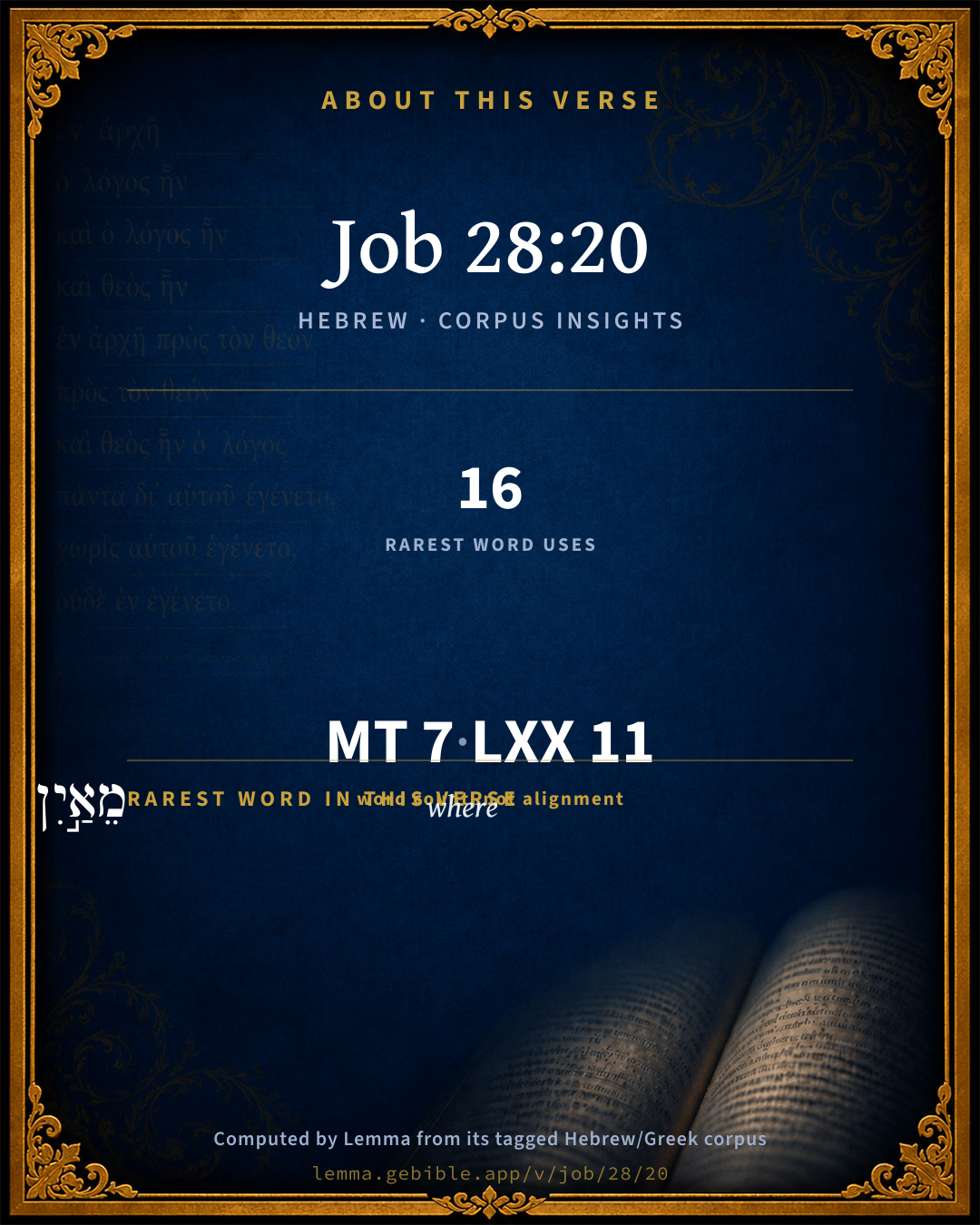
The rarest word here is מֵאַ֣יִן where H370 — appearing just 16 times in the whole Hebrew Bible.

Shared distinctive vocabulary

מֵאַ֣יִן where H370 occurs in 16 verses of the Hebrew Bible. Also found in:

Grammatical profile

  • 1 verb
  • 3 nouns
  • 1 pronoun
  • 2 particles

Verb forms

  • תָּב֑וֹא Qal · Imperfect

Hebrew & Septuagint length

In English translation the verse runs 10 words from the Hebrew and 14 from the Septuagint (LXX English) — the Septuagint runs noticeably longer here. See the side-by-side →

A rough comparison of the two English renderings, which tokenize alike — not a word-level alignment.

Word counts can differ between the Hebrew and the Greek without any difference in meaning — e.g. the Hebrew direct-object marker אֵת has no separate Greek word, and Greek often adds the article ὁ.

In the original languages it is 7 Hebrew tokens and 11 Greek tokens — but the two are counted differently (Hebrew bundles its prefixes and suffixes into one token; the Greek is in lemma form), so that isn’t a like-for-like length.

Cross-references

8

Topical passages linked to Job 28:20 in the Treasury of Scripture Knowledge — connected by theme and wording, ordered by reader-vote popularity; previews shown in the World English Bible.

  • Job 28:12 "But where shall wisdom be found? Where is the place of understanding?
  • Job 28:28 To man he said, 'Behold, the fear of the Lord, that is wisdom. To depart from evil is understanding.'"
  • James 1:5 But if any of you lacks wisdom, let him ask of God, who gives to all liberally and without reproach; and it will be given to him.
  • James 1:17 Every good gift and every perfect gift is from above, coming down from the Father of lights, with whom can be no variation, nor turning shadow.
  • Job 28:23 "God understands its way, And he knows its place.
  • Proverbs 2:6 For Yahweh gives wisdom. Out of his mouth comes knowledge and understanding.
  • Ecclesiastes 7:23–24 All this have I proved in wisdom. I said, "I will be wise;" but it was far from me.
  • 1 Corinthians 2:6–15 We speak wisdom, however, among those who are full grown; yet a wisdom not of this world, nor of the rulers of this world, who are coming to nothing.

Cross-references courtesy of OpenBible.info (CC BY 4.0).

Hebrew and Greek witnesses Masoretic Hebrew ↔ Greek Septuagint

The same verse in the two great witnesses to the Old Testament, shown verse-for-verse.

Here the Septuagint runs noticeably longer than the Hebrew — LXX2012 (modern English Septuagint) 14 words vs World English Bible 10. A rough length comparison of the two English translations, not a word-level alignment — read both below.

These are two independent witnesses, not word-aligned to each other, and the Septuagint is shown in lemma (dictionary) form.

Hebrew Job 28:20 Masoretic · Westminster Leningrad Codex

וְֽ֭הַחָכְמָה מֵאַ֣יִן תָּב֑וֹא וְאֵ֥י זֶ֝֗ה מְק֣וֹם בִּינָֽה

Whence then comes wisdom? Where is the place of understanding?

World English Bible · Public Domain

Greek LXX Job 28:20 Septuagint · lemma form

ὁ δέ σοφία πόθεν εὑρίσκω ποῖος δέ τόπος εἰμί ὁ σύνεσις

Whence then is wisdom found? and of what kind is the place of understanding?

LXX2012 (modern English Septuagint) · Public Domain

On this verse, John Gill's Exposition discusses the Septuagint’s reading. Read the note in Commentary ↓

Hebrew: Westminster Leningrad Codex (CC BY 4.0). Greek: Septuagint (public domain); English from LXX2012 (modern English Septuagint) (Public Domain). How the Septuagint differs from the Hebrew →

Commentary

Notes on Job 28:20 from classic Christian and Jewish commentators (each source and its license shown beneath its notes). The classic Christian expositions comment on the surrounding passage and are grouped to its opening verse, so a note may address several verses; the Jewish commentaries on the Tanakh (Rashi and others) are per-verse, so they appear only where the commentator wrote on this verse.

Lemma curates 59 commentaries, every one of them public domain or Creative Commons licensed, each selected and text-cleaned for this edition rather than reprinted as found. About our sources →

Jamieson, Fausset & Brown

Robert Jamieson, A. R. Fausset & David Brown

job 28:20Job 28:12 repeated with great force.

Jamieson, Fausset & Brown — Commentary Critical and Explanatory on the Whole Bible (1871) — public domain (CC PDM 1.0). Text via the HelloAO Bible API.

The Cambridge Bible for Schools and Colleges

gen. ed. J. J. S. Perowne

20–22. The preceding verses indicated that Wisdom cannot be acquired by man though he should bid for it the most precious things that he possesses, in other words that it is unattainable; these verses state that idea again explicitly. The question Job_28:20 implies a negative answer—nowhere by man.

The Cambridge Bible for Schools and Colleges (gen. ed. J. J. S. Perowne; Cambridge University Press, 1878–1918) — public domain. Text from a community e-Sword module.

Trapp's Complete Commentary

John Trapp

Job 28:20 Whence then cometh wisdom? and where [is] the place of understanding?

Ver. 20. Whence then cometh wisdom? &c.] {See Trapp on "Job 28:12"} q.d. Nowhere surely is she to be found but with God, the fountain of wisdom, Job 28:23. To seek her elsewhere is but laborious loss of time; witness the philosophers’ anxious, but bootless, disquisitions after the summum bonum, the true blessedness or chief good; about which there were eight various opinions, and yet all out.

John Trapp, A Commentary or Exposition upon All the Books of the Old and New Testament (1647–1656) — public domain. Text from a community e-Sword module.

The Biblical Illustrator

Joseph S. Exell

Job_28:20-21

Seeing it is hid from the eyes of all living.

Mystery and dogma

It is the dogmatism of science that stands in the way of the much-needed reconciliation, even more than the dogmatism of theology. Nothing is so hostile to mystery as dogmatism. The sense of mystery is the sense of vastness, indefiniteness, grandeur. The moment you come with your dogmas to measure and explain everything, that moment the mystery, the vastness, the grandeur, begin to vanish. Rightly understood, the facts of science and the facts of theology point us on to something infinitely greater and more mysterious than the dogmas by which we try to explain, and in explaining, too often imprison and dwarf them. Yet we must have dogmas both in theology and science. No progress, no tradition, is possible without them. We must learn to use them without abusing them. (D. I. Vaughan, M. D.)

The Biblical Illustrator, edited by Joseph S. Exell (c. 1880s–1900s) — public domain. Text from a community e-Sword module.

Joseph Benson's Commentary

Job 28:20-21. Whence then cometh wisdom, &c. — By what means, then, shall we get this precious treasure of wisdom, of which we are so desirous? Who can show us where it lies, that we may go and search for it? By a diligent prosecution of this inquiry he brings us at length to this issue: That there is a two-fold wisdom; one hid in God, which is secret, and belongs not to us; the other made known by him, and revealed to man, which belongs to us and to our children. It is hid from the eyes of all living — Of all men that live upon the earth. And kept close from the fowls of the air — Though they fly high, and can see far and clearly, they cannot discern this: men of the most exalted and comprehensive minds, of the most enlarged and elevated understanding, cannot discover it: however acute their discernment may be, and however high their thoughts may soar, yet they cannot rise to this height, they cannot comprehend this. The line and plummet of human reason can never fathom the abyss of the divine counsels. Who can account for the maxims, measures, and methods of God’s government? Let us then be content, not to know the future events of Providence, till time discovers them; and not to know the secret reasons of Providence, till eternity brings them to light.

Joseph Benson's Commentary on the Old and New Testaments (1811–1818) — public domain. Text from a community e-Sword module.

Matthew Henry's Commentary

The question which Job had asked (Job 28:12) he asks again here; for it is too worthy, too weighty, to be let fall, until we speed in the enquiry. Concerning this we must seek till we find, till we get some satisfactory account of it. By a diligent prosecution of this enquiry he brings it, at length, to this issue, that there is a twofold wisdom, one hidden in God, which is secret and belongs not to us, the other made known by him and revealed to man, which belongs to us and to our children.

I. The knowledge of God's secret will, the will of his providence, is out of our reach, and what God has reserved to himself. It belongs to the Lord our God. To know the particulars of what God will do hereafter, and the reasons of what he is doing now, is the knowledge Job first speaks of.

1. This knowledge is hidden from us. It is high, we cannot attain unto it (Job 28:21, Job 28:22): It is hid from the eyes of all living, even of philosophers, politicians, and saints; it is kept close from the fowls of the air; though they fly high and in the open firmament of heaven, though they seem somewhat nearer that upper world where the source of this wisdom is, though their eyes behold afar off (Job 39:29), yet they cannot penetrate into the counsels of God. No, man is wiser than the fowls of heaven, and yet comes short of this wisdom. Even those who, in their speculations, soar highest, and think themselves, like the fowls of the air, above the heads of other people, yet cannot pretend to this knowledge. Job and his friends had been arguing about the methods and reasons of the dispensations of Providence in the government of the world. "What fools are we" (says Job) "to fight in the dark thus, to dispute about that which we do not understand!" The line and plummet of human reason can never fathom the abyss of the divine counsels. Who can undertake to give the rationale of Providence, or account for the maxims, measure, and methods of God's government, those arcana imperii - cabinet counsels of divine wisdom? Let us then be content not to know the future events of the Providence until time discover them (Act 1:7) and not to know the secret reasons of Providence until eternity discover them. God is now a God that hideth himself (Isa 45:15); clouds and darkness are round about him. Though this wisdom be hidden from all living, yet destruction and death say, We have heard the fame of it. Though they cannot give an account of themselves (for there is no wisdom, nor device, nor knowledge at all in the grave, much less this), yet there is a world on the other side death and the grave, on which those dark regions border, and to which we must pass through them, and there we shall see clearly what we are now in the dark about. "Have a little patience," says Death to the inquisitive soul: "I will fetch thee shortly to a place where even this wisdom will be found." When the mystery of God shall be finished it will be laid open, and we shall know as we are known; when the veil of flesh is rent, and the interposing clouds are scattered, we shall know what God does, though we know not now, Joh 13:7.

2. This knowledge is hidden in God, as the apostle speaks, Eph 3:9. Known unto God are all his works, though they are not known to us, Act 15:18. There are good reasons for what he does, though we cannot assign them (Job 28:23): God understands the way thereof. Men sometimes do they know not what, but God never does. Men do what they did not design to do; new occurrences put them upon new counsels, and oblige them to take new measures. But God does all according to the purpose which he purposed in himself, and which he never alters. Men sometimes do that which they cannot give a good reason for, but in every will of God there is a counsel: he knows both what he does and why he does it, the whole series of events and the order and place of every occurrence. This knowledge he has in perfection, but keeps to himself. Two reasons are here given why God must needs understand his own way, and he only: -

(1.) Because all events are now directed by an all-seeing and almighty Providence, Job 28:24, Job 28:25. He that governs the world is, [1.] Omniscient; for he looks to the ends of the earth, both in place and time; distant ages, distant regions, are under his view. We do not understand our own way, much less can we understand God's way, because we are short-sighted. How little do we know of what is doing in the world, much less of what will be done? But the eyes of the Lord are in every place; nay, they run to and fro through the earth. Nothing is, or can be, hidden from him; and therefore the reasons why some wicked people prosper remarkably and others are remarkably punished in this world, which are secret to us, are known to him. One day's events, and one man's affairs, have such a reference to, and such a dependence upon, another's, that he only to whom all events and all affairs are naked and open, and who sees the whole at one entire and certain view, is a competent Judge of every part. [2.] He is omnipotent. He can do every thing, and is very exact in all he does. For proof of this Job mentions the winds and waters, Job 28:25. What is lighter than the wind? Yet God hath ways of poising it. He knows how to make the weight for the winds, which he brings out of his treasuries (Psa 135:7), keeping a very particular account of what he draws out, as men do of what they pay out of their treasuries, not at random, as men bring out their trash. Nothing sensible is to us more unaccountable than the wind. We hear the sound of it, yet cannot tell whence it comes, nor whither it goes; but God gives it out by weight, wisely ordering both from what point it shall blow and with what strength. The waters of the sea, and the rain-waters, he both weighs and measures, allotting the proportion of every tide and every shower. A great and constant communication there is between clouds and seas, the waters above the firmament and those under it. Vapours go up, rains come down, air is condensed into water, water rarefied into air; but the great God keeps an exact account of all the stock with which this trade is carried on for the public benefit and sees that none of it be lost. Now if, in these things, Providence be so exact, much more in dispensing frowns and favours, rewards and punishments, to the children of men, according to the rules of equity.

(2.) Because all events were from eternity designed and determined by an infallible prescience and immutable decree, Job 28:26, Job 28:27. When he settled the course of nature he foreordained all the operations of his government. [1.] He settled the course of nature. Job mentions particularly a decree for the rain and a way for the thunder and lightening. The general manner and method, and the particular uses and tendencies, of these strange performances, both their causes and their effects, were appointed by the divine purpose; hence God is said to prepare lightnings for the rain, Psa 135:7; Jer 10:13. [2.] When he did that he laid all the measures of his providence, and drew an exact scheme of the whole work from first to last. Then, from eternity, did he see in himself, and declare to himself, the plan of his proceedings. Then he prepared it, fixed it, and established it, set every thing in readiness for all his works, so that, when any thing was to be done, nothing was to seek, nor could any thing unforeseen occur, to put it either out of its method or out of its time; for all was ordered as exactly as if he had studied it and searched it out, so that, whatever he does, nothing can be put to it nor taken from it, and therefore it shall be for ever, Ecc 3:14. Some make Job to speak of wisdom here as a person, and translate it, Then he saw her and showed her, etc., and then it is parallel with that of Solomon concerning the essential wisdom of the Father, the eternal Word, Pro 8:22, etc. Before the earth was, then was I by him, Joh 1:1, Joh 1:2.

II. The knowledge of God's revealed will, the will of his precept, and this is within our reach; it is level to our capacity, and will do us good (Job 28:28): Unto man he said, Behold, the fear of the Lord that is wisdom. Let it not be said that when God concealed his counsels from man, and forbade him that tree of knowledge, it was because he grudged him any thing that would contribute to his real bliss and satisfaction; no, he let him know as much as he was concerned to know in order to his duty and happiness; he shall be entrusted with as much of his sovereign mind as is needful and fit for a subject, but he must not think himself fit to be a privy-counsellor. He said to Adam (so some), to the first man, in the day in which he was created; he told him plainly it was not for him to amuse himself with over-curious searches into the mysteries of creation, nor to pretend to solve all the phenomena of nature; he would find it neither possible nor profitable to do so. No less wisdom (says archbishop Tillotson) than that which made the world can thoroughly understand the philosophy of it. But let him look upon this as his wisdom, to fear the Lord and to depart from evil; let him learn that, and he is learned enough; let this knowledge serve his turn. When God forbade man the tree of knowledge he allowed him the tree of life, and this is that tree, Pro 3:18. We cannot attain true wisdom but by divine revelation. The Lord giveth wisdom, Pro 2:6. Now the matter of that is not found in the secrets of nature or providence, but in the rules for our own practice. Unto man he said, not, "Go up to heaven, to fetch happiness thence;" or, "Go down to the deep, to draw it up thence." No, the word is nigh thee, Deu 30:14. He hath shown thee, O man! not what is great, but what is good, not what the Lord thy God designs to do with thee, but what he requires of thee, Mic 6:8. Unto you, O men! I call, Pro 8:4. Lord, what is man that he should be thus minded, thus visited! Behold, mark, take notice of this; he that has ears let him hear what the God of heaven says to the children of men: The fear of the Lord, that is the wisdom. Here is, 1. The description of true religion, pure religion, and undefiled; it is to fear the Lord and depart from evil, which agrees with God's character of Job, Job 1:1. The fear of the Lord is the spring and summary of all religion. There is a slavish fear of God, springing from hard thoughts of him, which is contrary to religion, Mat 25:24. There is a selfish fear of God springing from dreadful thoughts of him, which may be a good step towards religion, Act 9:5. But there is a filial fear of God, springing from great and high thoughts of him, which is the life and soul of all religion. And, wherever this reigns in the heart, it will appear by a constant care to depart from evil, Pro 16:6. This is essential to religion. We must first cease to do evil, or we shall never learn to do well. Virtus est vitium fugere - Even in our flight from vice some virtue lies. 2. The commendation of religion: it is wisdom and understanding. To be truly religious is to be truly wise. As the wisdom of God appears in the institution of religion, so the wisdom of man appears in the institution of religion, so the wisdom of man appears in the practice and observance of it. It is understanding, for it is the best knowledge of truth; it is wisdom, for it is the best management of our affairs. Nothing more surely guides our way and gains our end than being religious.

Matthew Henry's Commentary on the Whole Bible (1708–1710) — public domain (CC PDM 1.0). Text via the HelloAO Bible API.

Adam Clarke's Commentary

Verse 20. Whence then cometh wisdom?] Nearly the same words as in Job 28:12, where see the note.

Adam Clarke's Commentary on the Bible (1810–1826) — public domain. Text from a community e-Sword/MySword module.

John Gill's Exposition

Whence then cometh wisdom? and where is the place of understanding? The same questions as in Job 28:12; repeated to set forth the superior excellency of wisdom, and to carry on the discourse, and lead on to other things concerning it. See Gill on Job 28:12.

.

Job 28:21

job 28:21

job 28:21

job 28:21Seeing it is hid from the eyes of all living,.... Meaning not the beasts of the field, as some interpret it; this makes the sentiment jejune and trifling; but rational creatures, men, so the Septuagint, Eve is said to be the mother of, Gen 3:20; wisdom, as a perfection in God, displayed in his works of creation and providence, is but imperfectly known by men; and the secret reasons of his providential dealings with men, good and bad, are hid from all at present; and as for spiritual wisdom or godliness, and the Gospel of Christ, and Christ himself, they are hid from the eyes of all natural and carnal men, though ever so wise and prudent in other things:

and kept close from the fowls of the air, or "heaven" (k); either the devils so called, because they dwell in the air, and are the posse or power of the air, Eph 2:2; and because of their ravenous and cruel disposition, and swiftness to do mischief; see Luk 8:5; or rather the holy angels, as Jarchi, whose habitation is in heaven, and who are swift to do the will of God, and are represented as having wings like fowls; though these know much, yet the wisdom of God in his providence, in the doctrines of the Gospel, and Christ himself, the Wisdom of God, are in a good measure hid from them; at least their knowledge is imperfect, and they are desirous of prying more into these things, Pe1 1:12, unless men of the most piercing and penetrating geniuses, that soar aloft in the things of nature, and make the greatest discoveries therein, and yet know nothing of divine and spiritual things, of the arcanas of Providence or of grace, should be meant.

(k) "caeli", Pagninus, Montanus, &c.

John Gill's Exposition of the Whole Bible (1746–1763) — public domain (CC PDM 1.0). Text via the HelloAO Bible API.

Albert Barnes' Notes on the Bible

Whence then cometh wisdom? - This question is now repeated from Job 28:12, in order to give it greater emphasis. It is designed to fix the attention on the inquiry as one which found no solution in the discoveries of science, and whose solution was hidden from the most penetrating human intellect.

Albert Barnes' Notes on the Bible (1834–1885) — public domain. Text from a community e-Sword/MySword module.

Matthew Poole's English Annotations

Where this precious treasure lies, and whence a man may fetch it.

Matthew Poole's English Annotations on the Holy Bible (1683–1685) — public domain. Text from a community e-Sword/MySword module.

Whedon's Commentary on the Bible

Daniel D. Whedon

20. Whence… cometh wisdom — Job repeats his question that he may, if possible, enforce a reply. The varied gems of beauty that adorn this subject may have been in the mind of Paul when he speaks of “the manifold,” πολυποικιλος, (literally, much variegated,) “wisdom of God.” Wisdom is pure, one in essence, “one in sublime unity of truth and purpose;” transmitted through the Church, it becomes “chromatic, so to speak, with the rainbow colours of that light which in itself is one and undivided.” — ALFORD on Eph_3:10.

Daniel D. Whedon (gen. ed.), Commentary on the Old and New Testaments (1874–1909) — public domain. Text from a community e-Sword module.

The Pulpit Commentary

Whence then cometh wisdom? and where is the place of understanding? This is a repetition of ver. 12, with a mere variant of the verb in the first line. Job"s elaborate inquiry of vers. 14-19 having thresh no light on the subject, the original question recurs Where does wisdom come from?

Vers 20-27. Wisdom hidden from man.

Skillful is the hand of man. His researches are profound. He has digged deep into the earth. He tracks the vein of the silver and the place for the gold. He taketh iron out of the earth, and brass he melteth from the stone. He searcheth amidst the stones of darkness and the very shadow of death. His eye seeth what escapes the eye of the vulture, and he knoweth the path which no fowl knoweth. His power is over the hills, for he putteth his hand upon the rock, and overturneth the mountains by the roots. Rocks and rivers and flood are under his power, and the hidden things he bringeth to light. But with all his powers of research he is baffled in the pursuit of wisdom, and he knows neither the place nor the price of understanding. The perfect knowledge of the nature of things, and the high wisdom to guide in the proper use of" things, is not within the human grasp. Such knowledge is too high for him. It belongs unto God. It cannot be gotten for gold, nor purchased with the price of silver. This reflection may

I PROFITABLY TURN AWAY OUR HOPES OF GAINING WISDOM FROM MAN. We cannot gain it there; for "it is hid from the eyes of all living.

II IT IS A BECOMING OCCASION FOR HUMILITY ON THE PART OF MAN. Vain man, who can do so much, is baffled here.

III IT IS A MOTIVE FOR THANKFULLY RECEIVING THE TEACHINGS OF THE WISE. There are men to whom God has discovered the hidden springs of wisdom. Happy they, and happy all who learn of them.

IV BUT ITS SUPREME LESSON IS TO DRIVE US IN OUR SEARCH FOR WISDOM TO GOD, to whom alone it appertains. "God understandeth the way thereof, and he knoweth the place thereof even the wisdom that is "hid from the eyes of all living, and kept close from the fowls of the air. R.G.

The Pulpit Commentary (1880–1919), ed. H.D.M. Spence-Jones & Joseph S. Exell — public domain. Text from a community e-Sword module.

John Wesley's Explanatory Notes

Whence, &c. - By a diligent inquiry, we find at length, that there is a twofold wisdom; one hid in God, which belongs not to us, the other revealed to man, which belongs to us and to our children.

John Wesley, Explanatory Notes Upon the Whole Bible (1754–1765) — public domain. Text via the GEBible commentary corpus.

unfoldingWord translationNotes

Door43 World Missions Community

From where, then, comes wisdom? Where is the place of understanding?

Job uses these questions to introduce how people get wisdom and understanding. AT: "I will tell you where wisdom comes from and where understanding is." or "I will tell you how to become wise and how to learn to understand things." (See: Rhetorical Question)

From where, then, comes wisdom

Wisdom is spoken of as if it were in a place and comes to people. Its coming represents people becoming wise. (See: Metaphor)

Where is the place of understanding

Understanding is spoken of as if it were in a place. (See: Metaphor)

Wisdom is hidden from the eyes of all living things

This means that living things are unable to see wisdom. It can be expressed in active form. AT: "No living thing can see wisdom" (See: Synecdoche and Active or Passive)

is kept hidden from the birds of the heavens

This means that the birds are unable to see wisdom. This can be expressed in active form. AT: "even the birds that fly in the skies cannot see wisdom" (See: Active or Passive)

Destruction and Death say

Here "Destruction" and "Death" are spoken of as if they are living things who can speak. (See: Personification)

translationWords

heaven

die

unfoldingWord translationNotes — © Distant Shores Media and the Door43 World Missions Community, licensed CC BY-SA 4.0. Source: git.door43.org/Door43/en_tn.

Lesson kit

Teaching starters — assembled from the data on this page, not authored interpretation. Every prompt links to the verse data it draws on. Edit before teaching.

Job, in the Wisdom, opens this verse with 7 words (7 distinct Hebrew lemmas). Its most distinctive word is ʼayin (“where”). The Greek Septuagint runs longer here. A historical commentator’s framing appears above. Read the whole chapter for the surrounding context.

Discussion questions

  1. How does “where” (ʼayin) shape what this verse is saying?
  2. How does Genesis 29:4, which shares the word «where», read alongside this verse?
  3. The Septuagint runs longer here than the Hebrew. What might account for the difference?
  4. These translations render this verse differently; the difference is in the English rendering, not the original. What questions does that raise?
  5. «תָּב֑וֹא» is a Qal Imperfect verb. How does that grammatical form shape the action described?
  6. Compare how Jamieson, Fausset & Brown and The Cambridge Bible for Schools and Colleges read this verse. Where do they agree or differ?

Things to notice

Reading settings

Reading text

Shown beneath each verse's original-language words.

Old Testament
Old Testament edition

Read the OT as the Masoretic Hebrew (MT) or the Greek Septuagint (LXX).

English shown for the Greek Septuagint (in the Hebrew ↔ Greek comparison).

Comparing translations? Open the Compare panel on any verse page to stack up to four side by side.