
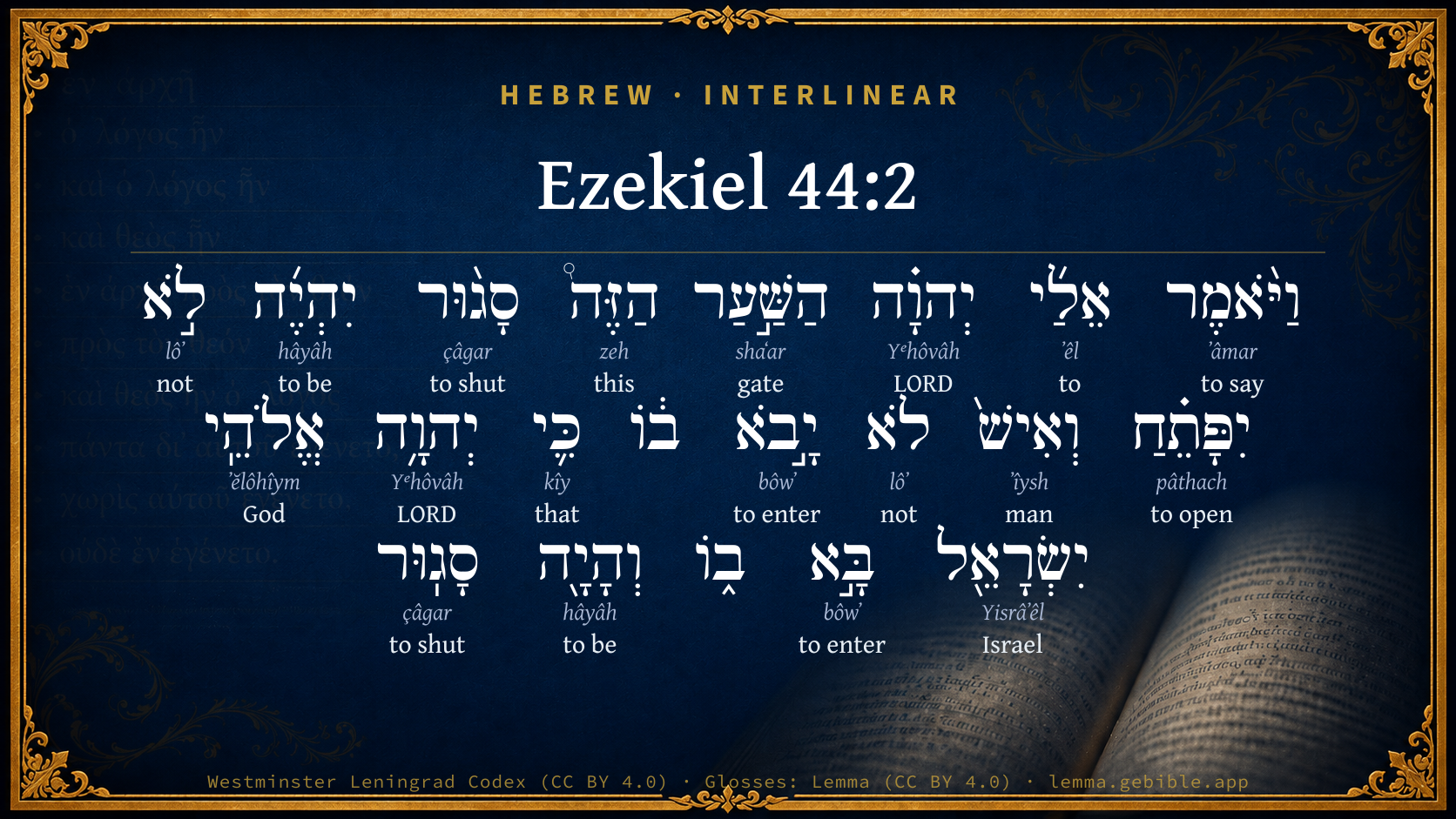
Ezekiel 44:2

Hebrew (Westminster Leningrad Codex) Ezekiel 44:2 appears in the Hebrew Old Testament. The text above is from the Westminster Leningrad Codex. Each word links to its Strong’s number, a concise gloss, and parsing drawn from the Open Scriptures Hebrew Bible morphology. Click any word for its full Brown-Driver-Briggs (BDB) entry.
Download image
Cite this verse

Ezekiel 44:2 (World English Bible). Public Domain. Lemma interlinear Bible study tool, https://lemma.gebible.app/v/ezekiel/44/2.

Show BibTeX & RIS
BibTeX
RIS
English Translation
Yahweh said to me, This gate shall be shut; it shall not be opened, neither shall any man enter in by it; for Yahweh, the God of Israel, has entered in by it; therefore it shall be shut.
World English Bible · Public Domain
Download a study sheet

One document with this verse’s original text, its word-by-word gloss line, the meaning frame, cross-references with their text, attributed commentary, and full source and license credits — printable, and it pastes into notes with its structure intact.

This verse Autodidact and up

Study sheet (.html) Plain text (.txt)

A passage Seminary Student

Up to 50 verses in one chapter. A passage sheet keeps up to 6 commentary sources and 12 cross-references per verse, in the order this page ranks them, and says so on the sheet whenever that leaves anything out. Ask for a single verse and you get the Autodidact verse sheet above.

Everything on this page stays free to read, with no account — the sheet is a download of what is already on screen, not access to it.

Want to remove ads? Support Godless Engineer
Compare translations 3

The same verse in 3 English versions, stacked beneath the original-language interlinear above. Click any original word for its lexicon entry.

Each is an independent rendering of the whole verse — the interlinear is not word-aligned to these translations.

Highlighted words mark where these versions differ — a whole-verse word diff, not a word-by-word alignment.

  • World English Bible Public Domain
    Yahweh said to me, This gate shall be shut; it shall not be opened, neither shall any man enter in by it; for Yahweh, the God of Israel, has entered in by it; therefore it shall be shut.
  • King James Version Public Domain
    Then said the LORD unto me; This gate shall be shut, it shall not be opened, and no man shall enter in by it; because the LORD, the God of Israel, hath entered in by it, therefore it shall be shut.
  • unfoldingWord Literal Text CC BY-SA 4.0
    Yahweh said to me, “This gate has been sealed shut; it will not be opened. No man will go through it, for Yahweh, the God of Israel, has come through it, so it has been closed tightly.

unfoldingWord Literal Text — © unfoldingWord, licensed CC BY-SA 4.0. Word-aligned USFM3 via Door43 (git.door43.org/unfoldingWord/en_ult).

Versions to compare (up to 4)

3 of 4 selected

Show all 18 translations

Every available English version of this verse, each an independent rendering of the whole verse.

  • World English Bible Public Domain
    Yahweh said to me, This gate shall be shut; it shall not be opened, neither shall any man enter in by it; for Yahweh, the God of Israel, has entered in by it; therefore it shall be shut.
  • Berean Standard Bible Public Domain
    And the LORD said to me, “This gate is to remain shut. It shall not be opened, and no man shall enter through it, because the LORD, the God of Israel, has entered through it. Therefore it will remain shut.
  • Majority Standard Bible Public Domain
    And the LORD said to me, “This gate is to remain shut. It shall not be opened, and no man shall enter through it, because the LORD, the God of Israel, has entered through it. Therefore it will remain shut.
  • King James Version Public Domain
    Then said the LORD unto me; This gate shall be shut, it shall not be opened, and no man shall enter in by it; because the LORD, the God of Israel, hath entered in by it, therefore it shall be shut.
  • American Standard Version (1901) Public Domain
    And Jehovah said unto me, This gate shall be shut; it shall not be opened, neither shall any man enter in by it; for Jehovah, the God of Israel, hath entered in by it; therefore it shall be shut.
  • Revised Version (1885) Public Domain
    And the LORD said unto me, This gate shall be shut, it shall not be opened, neither shall any man enter in by it, for the LORD, the God of Israel, hath entered in by it; therefore it shall be shut.
  • Geneva Bible (1599) Public Domain
    Then saide the Lord vnto me, This gate shalbe shut, and shall not bee opened, and no man shall enter by it, because the Lord God of Israel hath entred by it, and it shalbe shut.
  • Douay-Rheims (1899) Public Domain
    And the Lord said to me: This gate shall be shut, it shall not be opened, and no man shall pass through it: because the Lord the God of Israel hath entered in by it, and it shall be shut
  • Young's Literal Translation Public Domain
    And Jehovah saith unto me, `This gate is shut, it is not opened, and none doth go in by it, for Jehovah, God of Israel, hath come in by it, and it hath been shut.
  • Literal Standard Version CC BY-SA 4.0
    And YHWH says to me, “This gate is shut, it is not opened, and none go in by it, for YHWH, God of Israel, has come in by it, and it has been shut.
  • Unlocked Literal Bible CC BY-SA 4.0
    Yahweh said to me, “This gate has been sealed shut; it will not be opened. No man will go through it, for Yahweh, the God of Israel, has come through it, so it has been closed tightly.
  • unfoldingWord Literal Text CC BY-SA 4.0
    Yahweh said to me, “This gate has been sealed shut; it will not be opened. No man will go through it, for Yahweh, the God of Israel, has come through it, so it has been closed tightly.
  • Darby Bible Public Domain
    And Jehovah said unto me, This gate shall be shut; it shall not be opened, and no one shall enter in by it: for Jehovah, the God of Israel, hath entered in by it; and it shall be shut.
  • World Messianic Bible Public Domain
    The LORD said to me, “This gate shall be shut. It shall not be opened, no man shall enter in by it; for the LORD, the God of Israel, has entered in by it. Therefore it shall be shut.
  • Webster's Bible Public Domain
    Then said the LORD to me; This gate shall be shut, it shall not be opened, and no man shall enter in by it; because the LORD the God of Israel hath entered in by it, therefore it shall be shut.
  • Free Bible Version CC BY-SA 4.0
    The Lord told me, “This gate will stay shut. It is not to be opened. No one is allowed to come in through it, because the Lord, the God of Israel, has passed through it. So it will stay shut.
  • Bible in Basic English Public Domain
    And the Lord said to me, This doorway is to be shut, it is not to be open, and no man is to go in by it, because the Lord, the God of Israel, has gone in by it; and it is to be shut.
  • JPS Tanakh (1917) Public Domain
    And the LORD said unto me: 'This gate shall be shut, it shall not be opened, neither shall any man enter in by it, for the LORD, the God of Israel, hath entered in by it; therefore it shall be shut.

Literal Standard Version (2020), Covenant Press — licensed CC BY-SA 4.0. Text via the HelloAO Bible API (eBible.org). Unlocked Literal Bible (unfoldingWord) — licensed CC BY-SA 4.0. Text via the HelloAO Bible API (eBible.org). unfoldingWord Literal Text — © unfoldingWord, licensed CC BY-SA 4.0. Word-aligned USFM3 via Door43 (git.door43.org/unfoldingWord/en_ult). Free Bible Version, Dr. Jonathan Gallagher — licensed CC BY-SA 4.0. Text via the HelloAO Bible API (eBible.org).

Word by word

More ways to search: Search by grammar → Find every occurrence → Compare this word →

Practice this passage: Drill this verse → Learn its vocabulary →

סָג֨וּר
çâgar
H5462
“shut”
Verb, Qal, Participle Passive, Masculine, Singular, Absolute
Part of Speech
Verb
Stem
Qal
Form
Participle Passive
Gender
Masculine
Number
Singular
State
Absolute
Full BDB Definition

Origin: a primitive root

TWOT: 1462

to shut, close - (Qal) - to shut - to close, close up - closed up, closely joined, shut up - (Niphal) - to be shut up - to be shut or closed - (Piel) to shut up, deliver up - (Pual) to be shut up - (Hiphil) - to deliver up - to shut up, imprison
  1. וַיֹּ֨אמֶר ʼâmar H559 “and · to say” Conjunction + Verb, Qal, Sequential Imperfect, 3rd Person, Masculine, Singular
  2. אֵלַ֜י ʼêl H413 “to · me” Preposition + Suffix, Personal, 1st Person, Common, Singular
  3. יְהוָ֗ה Yᵉhôvâh H3068 “LORD” Noun, Proper
  4. הַשַּׁ֣עַר shaʻar H8179 “the · gate” Particle, Definite Article + Noun, Common, Masculine, Singular, Absolute
  5. הַזֶּה֩ zeh H2088 “the · this” Particle, Definite Article + Pronoun, Demonstrative, Masculine, Singular
  6. יִהְיֶ֜ה hâyâh H1961 “to be” Verb, Qal, Imperfect, 3rd Person, Masculine, Singular
  7. לֹ֣א lôʼ H3808 “not” Particle, Negative
  8. יִפָּתֵ֗חַ pâthach H6605 “to open” Verb, Niphal, Imperfect, 3rd Person, Masculine, Singular
  9. וְאִישׁ֙ ʼîysh H376 “and · man” Conjunction + Noun, Common, Masculine, Singular, Absolute
  10. לֹא lôʼ H3808 “not” Particle, Negative
  11. יָ֣בֹא bôwʼ H935 “to enter” Verb, Qal, Imperfect, 3rd Person, Masculine, Singular
  12. כִּ֛י kîy H3588 “that” Conjunction
  13. יְהוָ֥ה Yᵉhôvâh H3068 “LORD” Noun, Proper
  14. אֱלֹהֵֽי ʼĕlôhîym H430 “God(s) of” Noun, Common, Masculine, Plural, Construct
  15. יִשְׂרָאֵ֖ל Yisrâʼêl H3478 “Israel” Noun, Proper
  16. בָּ֣א bôwʼ H935 “to enter” Verb, Qal, Perfect, 3rd Person, Masculine, Singular
  17. וְהָיָ֖ה hâyâh H1961 “and · to be” Conjunction + Verb, Qal, Sequential Perfect, 3rd Person, Masculine, Singular
  18. סָגֽוּר çâgar H5462 “shut” Verb, Qal, Participle Passive, Masculine, Singular, Absolute

About this verse

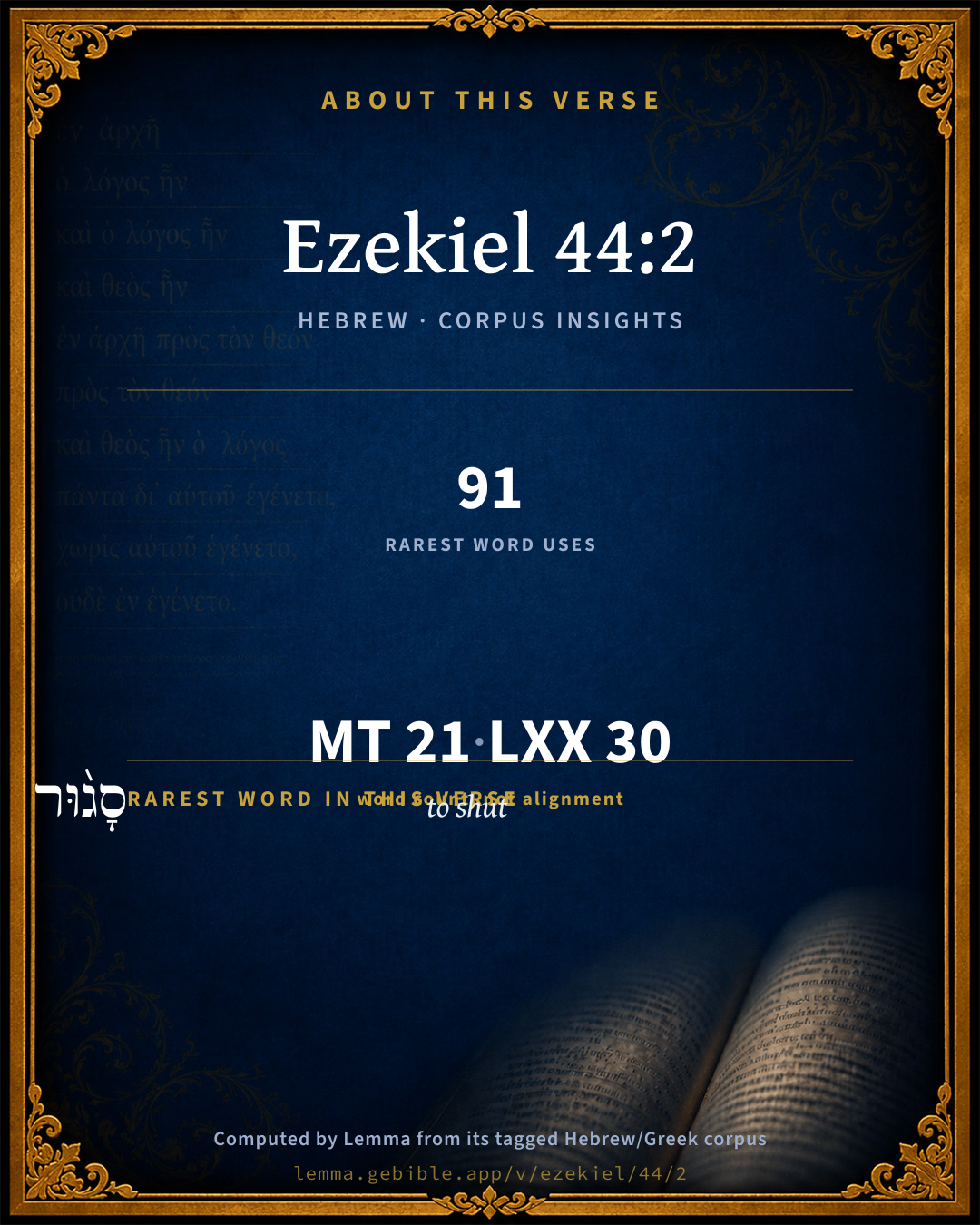
These counts appear in no published source. They are computed here, from the morphology-tagged text and Lemma’s own curated glosses. What Lemma adds →

21
words
14
distinct lemmas
Prophets
section

Grammatical profile

  • 8 verbs
  • 6 nouns
  • 1 pronoun
  • 3 prepositions
  • 1 conjunction
  • 2 particles

Verb forms

  • וַיֹּ֨אמֶר Qal · Sequential Imperfect
  • סָג֨וּר Qal · Participle Passive
  • יִהְיֶ֜ה Qal · Imperfect
  • יִפָּתֵ֗חַ Niphal · Imperfect
  • יָ֣בֹא Qal · Imperfect
  • בָּ֣א Qal · Perfect
  • וְהָיָ֖ה Qal · Sequential Perfect
  • סָגֽוּר Qal · Participle Passive

Repetition

Words recur within this verse — often emphatic in Hebrew:

  • יְהוָ֗ה LORD H3068 ×2
  • סָג֨וּר to shut H5462 ×2
  • יִהְיֶ֜ה to be H1961 ×2
  • יָ֣בֹא to enter H935 ×2
  • לֹ֣א not H3808 ×2

Hebrew & Septuagint length

In English translation the verse runs 38 words from the Hebrew and 38 from the Septuagint (LXX English) — the same length.

A rough comparison of the two English renderings, which tokenize alike — not a word-level alignment.

Word counts can differ between the Hebrew and the Greek without any difference in meaning — e.g. the Hebrew direct-object marker אֵת has no separate Greek word, and Greek often adds the article ὁ.

In the original languages it is 21 Hebrew tokens and 30 Greek tokens — but the two are counted differently (Hebrew bundles its prefixes and suffixes into one token; the Greek is in lemma form), so that isn’t a like-for-like length.

Cross-references

3

Topical passages linked to Ezekiel 44:2 in the Treasury of Scripture Knowledge — connected by theme and wording, ordered by reader-vote popularity; previews shown in the World English Bible.

  • Exodus 24:10 They saw the God of Israel. Under his feet was like a paved work of sapphire stone, like the skies for clearness.
  • Ezekiel 43:2–4 Behold, the glory of the God of Israel came from the way of the east: and his voice was like the sound of many waters; and the earth shined with his glory.
  • Isaiah 6:1–5 In the year that king Uzziah died, I saw the Lord sitting on a throne, high and lifted up; and his train filled the temple.

Cross-references courtesy of OpenBible.info (CC BY 4.0).

Hebrew and Greek witnesses Masoretic Hebrew ↔ Greek Septuagint

The same verse in the two great witnesses to the Old Testament, shown verse-for-verse.

These are two independent witnesses, not word-aligned to each other, and the Septuagint is shown in lemma (dictionary) form.

Hebrew Ezekiel 44:2 Masoretic · Westminster Leningrad Codex

וַיֹּ֨אמֶר אֵלַ֜י יְהוָ֗ה הַשַּׁ֣עַר הַזֶּה֩ סָג֨וּר יִהְיֶ֜ה לֹ֣א יִפָּתֵ֗חַ וְאִישׁ֙ לֹא יָ֣בֹא ב֔וֹ כִּ֛י יְהוָ֥ה אֱלֹהֵֽי יִשְׂרָאֵ֖ל בָּ֣א ב֑וֹ וְהָיָ֖ה סָגֽוּר

Yahweh said to me, This gate shall be shut; it shall not be opened, neither shall any man enter in by it; for Yahweh, the God of Israel, has entered in by it; therefore it shall be shut.

World English Bible · Public Domain

Greek LXX Ezekiel 44:2 Septuagint · lemma form

καί εἶπον κύριος πρός ἐγώ ὁ πύλη οὗτος κλείω εἰμί οὐ ἀναοἴγω καί οὐδείς μή διαἔρχομαι διά αὐτός ὅτι κύριος ὁ θεός ὁ ἰσραήλ εἰςἔρχομαι διά αὐτός καί εἰμί κλείω

And the Lord said to me, This gate shall be shut, it shall not be opened, and no one shall pass through it; for the Lord God of Israel shall enter by it, and it shall be shut.

LXX2012 (modern English Septuagint) · Public Domain

On this verse, The Pulpit Commentary discusses the Septuagint’s reading. Read the note in Commentary ↓

Hebrew: Westminster Leningrad Codex (CC BY 4.0). Greek: Septuagint (public domain); English from LXX2012 (modern English Septuagint) (Public Domain). How the Septuagint differs from the Hebrew →

Targum (Aramaic paraphrase)

1

The Targum is the ancient Jewish Aramaic paraphrase of the Hebrew Scriptures — an interpretive translation, not the Hebrew text itself. Onkelos (literal) and Pseudo-Jonathan (expansive) render the Torah, and Jonathan the Prophets. Coverage is partial: where no permissively-licensed English translation exists for a verse, only the Aramaic is shown. This is verse-level text, not a word-by-word alignment to the Hebrew.

  1. Targum Jonathan Prophets (Joshua–Malachi)
    וַאֲמַר יְיָ לִי תְּרַע הָדֵין אָחִיד יְהֵא וְלָא יִתְפְּתַח וֶאֱנַשׁ לָא יֵעוֹל בֵּיהּ אֲרֵי יְיָ אֱלָהָא דְיִשְׂרָאֵל אִתְגְלֵי עֲלוֹהִי וִיהֵי אָחִיד:

    (no public-domain English translation for this verse)

    Targum Jonathan — Aramaic: “Mikraot Gedolot” (public domain). English: “Sefaria Community Translation” (CC0 1.0 (public-domain dedication)); “London "Chaldee Paraphrase," 1871” (public domain). Text via Sefaria.

Commentary

Notes on Ezekiel 44:2 from classic Christian and Jewish commentators (each source and its license shown beneath its notes). The classic Christian expositions comment on the surrounding passage and are grouped to its opening verse, so a note may address several verses; the Jewish commentaries on the Tanakh (Rashi and others) are per-verse, so they appear only where the commentator wrote on this verse.

Lemma curates 59 commentaries, every one of them public domain or Creative Commons licensed, each selected and text-cleaned for this edition rather than reprinted as found. About our sources →

Trapp's Complete Commentary

John Trapp

Eze 44:2 Then said the LORD unto me; This gate shall be shut, it shall not be opened, and no man shall enter in by it; because the LORD, the God of Israel, hath entered in by it, therefore it shall be shut.

Ver. 2. This gate shall be shut.] Is, and shall be, save only to Messiah the Prince, and to whomsoever he, as having the keys of David, shall open it. "This gate of the Lord into which the righteous shall enter" {Psa 118:20} - sc., By that "new and living way," which Christ, their forerunner, {Heb 6:20} hath prepared and paved for them with his own blood. {Heb 10:20} See Heb 7:8-9; Heb 7:11-12; Heb 7:24; Heb 9:11-12.

And no man shall enter in it.] No mere man, [no man] unless it be Emmanuel. See Joh 3:13.

John Trapp, A Commentary or Exposition upon All the Books of the Old and New Testament (1647–1656) — public domain. Text from a community e-Sword module.

Tyndale Open Study Notes

Tyndale Open Resources

44:2 The outer east gate must remain perpetually closed because the Lord had now returned to his Temple and would never again leave it. He had also sanctified this gate by going through it, and no one else was ever to use it.

Tyndale Open Study Notes — © Tyndale Open Resources, licensed CC BY-SA 4.0. Text via the HelloAO Bible API.

Geneva Bible (1599)

Geneva Bible translators

Meaning, from the common people, but not from the Priests, nor the Prince, read Ezek. 46:8,9.

Geneva Bible (1599) marginal notes — public domain. Text via Bolls.life.

Adam Clarke's Commentary

Verse 2. This gate shall be shut] It was not to be opened on ordinary occasions, nor at all on the week days: but only on the Sabbaths and the new moons. See the account of the gates (4) in the explanation of the plan. See Clarke on Eze 48:35.

This verse has been adduced by the Roman Catholics to prove the perpetual virginity of the mother of our Lord; and it may be allowed to be as much to the purpose as any other that has been brought to prove this very precarious point, on which no stress should ever be laid by any man. Mary was a virgin when she brought forth Jesus.

Adam Clarke's Commentary on the Bible (1810–1826) — public domain. Text from a community e-Sword/MySword module.

Ellicott's Commentary for English Readers

(2) Hath entered in by it.—See Eze_43:1-2. The thought is, that the gate which had been sanctified by such a manifestation of the Divine presence, should not afterwards be used for the ordinary purposes of the entrance of the people.

A Bible Commentary for English Readers, edited by Charles John Ellicott (1878–1897) — public domain. Text from a community e-Sword module.

John Gill's Exposition

Then said the Lord unto me, this gate shall be shut,.... In time to come, as Jarchi interprets it, in the latter day; it was shut, and it should continue to be shut:

it shall not be opened; any more; though it has been, yet hereafter no more:

and no man shall enter in by it, into the house of the Lord,

because the Lord the God of Israel hath entered in by it; the same with the glory of the God of Israel, Eze 43:2,

therefore it shall be shut; no one being to enter after him. Various are the sentiments of expositors concerning this gate. Some of the ancients have interpreted it of the Virgin Mary, by whom Christ came into this world in human nature, being born of her, a virgin, who had never known man, and as is thought never did after the birth of Christ; nor were any afterwards born of her; no man might come into the world by her, by that self-same way the incarnate God did, and for that reason. This sense is approved of, not only by Papists, but by many Protestant writers. Others understand it of the Scriptures, the word of God, which as it is a sealed book to men learned and unlearned, so a gate shut up; it cannot be opened by a mere natural man, or be understood by the light of nature; none can open it but the Lion of the tribe of Judah; who gives the spiritual knowledge of it to whom he pleases, the perfect knowledge of which is reserved to a future state; and there are some things in it which will be always shut, and ever secrets; as the modus of the subsistence of the three Persons in the Godhead; the generation of the Son, the procession of the Spirit, and the union of the two natures in Christ; see Isa 29:11, others think that the gate of heaven, or the way to eternal glory and happiness, is meant; which was shut by the sin of man, and could never be opened again by any mere man; but Christ by his blood has opened the way into it; and has entered into it, not as a private, but public person, representing all his people; and none but those that belong to him, that are members of him, shall enter there; as none but Christ personal, so none but Christ mystical: but I am rather of opinion, since this whole fabric, as we have seen, is an emblem of the church of Christ on earth in the latter day, the way into that is designed here; and its being shut signifies, that, as the church is a garden enclosed, a spring shut up, and is only for the use of Christ, and should be a chaste virgin to him, he should have all her heart, affection, and faith; so it should not be pervious unto others; no natural or unregenerate man should enter into it; and when the Lord shall have taken up his residence in the church in the latter day, in a more spiritual and glorious manner than ever, there shall no more come into her the uncircumcised and the unclean, Isa 52:1, and especially in the New Jerusalem state nothing shall enter that defiles, or makes an abomination, or a lie, Rev 21:27 none but those that are Christ's, that are true members of his, and one with him; and this sense agrees with what follows in this chapter, and receives light and confirmation thereby; in which the Lord complains of the Israel and church of God in these its present declining times, that unregenerate persons were admitted into the sanctuary of the Lord, to communicate with the saints, and officiate there, Eze 44:7 and commends such who are faithful ministers and members, who are established therein, Eze 44:15.

John Gill's Exposition of the Whole Bible (1746–1763) — public domain (CC PDM 1.0). Text via the HelloAO Bible API.

Albert Barnes' Notes on the Bible

The Lord hath entered in - See Eze 43:2.

Albert Barnes' Notes on the Bible (1834–1885) — public domain. Text from a community e-Sword/MySword module.

Haydock's Catholic Bible Commentary

Opened. No man perfectly understands the Scriptures but the Son of God, Matthew xi. 27. (St. Jerome) --- This also insinuates, that Mary ever remained a pure virgin. (St. Augustine, &c.) (Worthington) --- Shut, even for the prince. Some (Haydock) kings of Juda claimed the privilege of entering by it at any time, and passed through a part of the court assigned to the priests, 2 Paralipomenon vi. 12., and 4 Kings xvi. 18. This shall be no longer tolerated. The gate might be opened in the week days if the prince wished to offer sacrifice, but not else, except on the sabbaths, chap. xlvi. 1, 12. --- Lord, in peace offerings and religious feasts. --- Porch. Each had two doors, chap. xlvi. 2. (Calmet)

George Leo Haydock (1774–1849), Haydock's Catholic Family Bible and Commentary, 1859 edition — public domain. Excludes Psalms (Douay-Rheims chapter numbering differs from Protestant) and Deuterocanonical books (Catholic canon only).

Matthew Poole's English Annotations

Likely the prophet was somewhat surprised, and wondered that the door should be shut; and while he museth on it the Lord speaks to him out of the temple, and informs him, and satisfieth him.

Shall not be opened, i.e. shall not ordinarily stand open, but be shut till occasion requires it should sometimes be opened.

No man; none of the common ordinary sort of people, or none but the prince, God’s vicegerent, and the ministering priests.

The God of Israel hath entered in: what was the glory of the God of Israel, Eze 43:2, is here

the Lord, the God of Israel, that glory was the visible sign of his presence. His glory is himself, and where that entered he entered, i.e. gave evidence of a more than ordinary presence there.

It shall be shut; either kept shut with bars, or, by a prohibition, be as if it were shut, that none should enter thereby.

Matthew Poole's English Annotations on the Holy Bible (1683–1685) — public domain. Text from a community e-Sword/MySword module.

The Pulpit Commentary

This gate shall be shut, The prophet must have noted this as an important difference between the new sanctuary and the old (whether temple or tabernacle), in which the east gate stood always open. That the gate of the new temple was to be closed only on the six working days Ewald mistakenly infers from Eze_46:1, where he reads, after the LXX, the outer instead of the inner court. But Eze_46:1 refers to the east gate of the inner court. Of the east gate of the outer court it is declared emphatically that it shall not be opened, neither shall any man enter in by it, meaning that it should be closed in perpetuity; and that not, as Abar-banel and Lightfoot have supposed, to express the idea that the glory of Jehovah should no more depart from the temple, but abide in it forever, but to inspire an exalted conception of the sanctity of the "house" and all its belongings, as Jehovah explained, Because the Lord, the God of Israel, hath entered in by it, therefore it shall be shut.

Vers. 2, 3The shut gate.

The "Golden Gate" at Jerusalem, on the eastern side of the temple area, looking towards the Mount of Olives, is now built up, so that it can only be traced by means of the form of the arches and carved work embedded in a line of wall. Tradition associates this now inaccessible archway with the gate which Ezekiel said should be shut till the Prince passed through it. There is a striking symbolism in Ezekiel"s description of the shut gate.

I THE GATE WAS SHUT.

1. The way to God was closed. Man once had free access to his Father. Sin barred the door and shut him out in the waste.

2. The way to life was closed. Cherubim with flaming swords, stood between Adam and the tree of life. (Gen_3:24) Fallen man cannot recover his spiritual life; he has forfeited eternal life, and it is beyond his power to regain it.

3. The way to happiness was closed. The tree of life stood in Eden, and Eden was shut against fallen man.

4. The way to heaven was closed. The door was shut against the foolish virgins. The bliss of futurity is denied to man in his sin.

II THE HOLINESS OF GOD BARS THE GATE. God had passed through the gate; therefore it was to be closed against man. This suggests a painful thought; where God is man may not be. The same idea was prominent at Horeb, when no man or beast was to come near the mount while God descended upon it. (Heb_12:20) There is a natural feeling of the supreme majesty of God that leads to a thought of utter separateness. No being approaches him in greatness or rank. The Sovereign of all is alone in his awful majesty. Yet we must not associate vulgar ideas of pomp and ceremony with God. He does not need the artificial dignity of separateness. He is necessarily apart from us in sheer greatness. But he desires to be near to his children. The real secret of the separateness is sin. Man cannot come where God is because man is sinful and God is holy.

III THE GATE IS OPENED FOR THE PRINCE. Christ, and Christ alone, realizes the Messianic vision of Hebrew prophecy. He is the Prince par excellence. Christ has a right of access to God by reason of his sinlessness, and by reason of his nature as "the Only Begotten of the Father." He has made a way to God by his intercession and his sacrifice. The door, long barred by sin, is now opened by grace. First our Prince goes through it, and himself realizes communion with God. But he does not keep this as a rare privilege for himself alone. He is the "Firstborn among many brethren," and he opens the door of access to God for all men. He leads all his people to the tree of life, for "he that hath the Son hath life". (1Jn_5:12) He gives true blessedness to his people. He unbars the golden gate of heaven. All who sleep in Jesus will awake in the glorious resurrection-life of which he is the Source and Center who could say, "I am the Resurrection and the Life". (Joh_11:25)

The Pulpit Commentary (1880–1919), ed. H.D.M. Spence-Jones & Joseph S. Exell — public domain. Text from a community e-Sword module.

John Wesley's Explanatory Notes

Shall not be opened - Shall not ordinarily stand open. No man - None of the common people. The Lord - That glory which was the visible sign of his presence.

John Wesley, Explanatory Notes Upon the Whole Bible (1754–1765) — public domain. Text via the GEBible commentary corpus.

Rashi

Rabbi Shlomo Yitzchaki (Rashi)

shall be closed Our Rabbis interpreted this verse as referring to the southern wicket, for the gate of the Heichal had a wicket, a small entrance. So we learned in Tractate Middoth (4:2): The Great Gate had two wickets, one in the south and one in the north. No one ever entered the one in the south, of which Ezekiel says, “This gate shall be closed.”

comes through it in the future.

Rashi on the Tanakh — English translations: “The Judaica Press complete Tanach with Rashi, translated by A. J. Rosenberg” (CC BY 4.0); “Pentateuch with Rashi's commentary by M. Rosenbaum and A.M. Silbermann, 1929-1934” (public domain); “The Metsudah Tanach series, Lakewood, N.J” (CC BY 4.0); and “The Book of Joshua, Metsudah Publications, 1997” (CC BY 4.0). Text via Sefaria.

Lesson kit

Teaching starters — assembled from the data on this page, not authored interpretation. Every prompt links to the verse data it draws on. Edit before teaching.

Ezekiel, in the Prophets, opens this verse with 21 words (14 distinct Hebrew lemmas). Its most distinctive word is çâgar (“to shut”). A historical commentator’s framing appears above. Read the whole chapter for the surrounding context.

Discussion questions

  1. What does “to shut” (çâgar) contribute to the verse as a whole?
  2. How does Exodus 24:10, which shares this passage’s theme, read alongside this verse?
  3. What does the repetition of “LORD” (2× in this one verse) do in this verse?
  4. These translations render this verse differently; the difference is in the English rendering, not the original. What questions does that raise?
  5. «וַיֹּ֨אמֶר» is a Qal Sequential Imperfect verb. How does that grammatical form shape the action described?
  6. Compare how Trapp's Complete Commentary and Tyndale Open Study Notes read this verse. Where do they agree or differ?

Things to notice

Reading settings

Reading text

Shown beneath each verse's original-language words.

Old Testament
Old Testament edition

Read the OT as the Masoretic Hebrew (MT) or the Greek Septuagint (LXX).

English shown for the Greek Septuagint (in the Hebrew ↔ Greek comparison).

Comparing translations? Open the Compare panel on any verse page to stack up to four side by side.