
Haggai 2:14

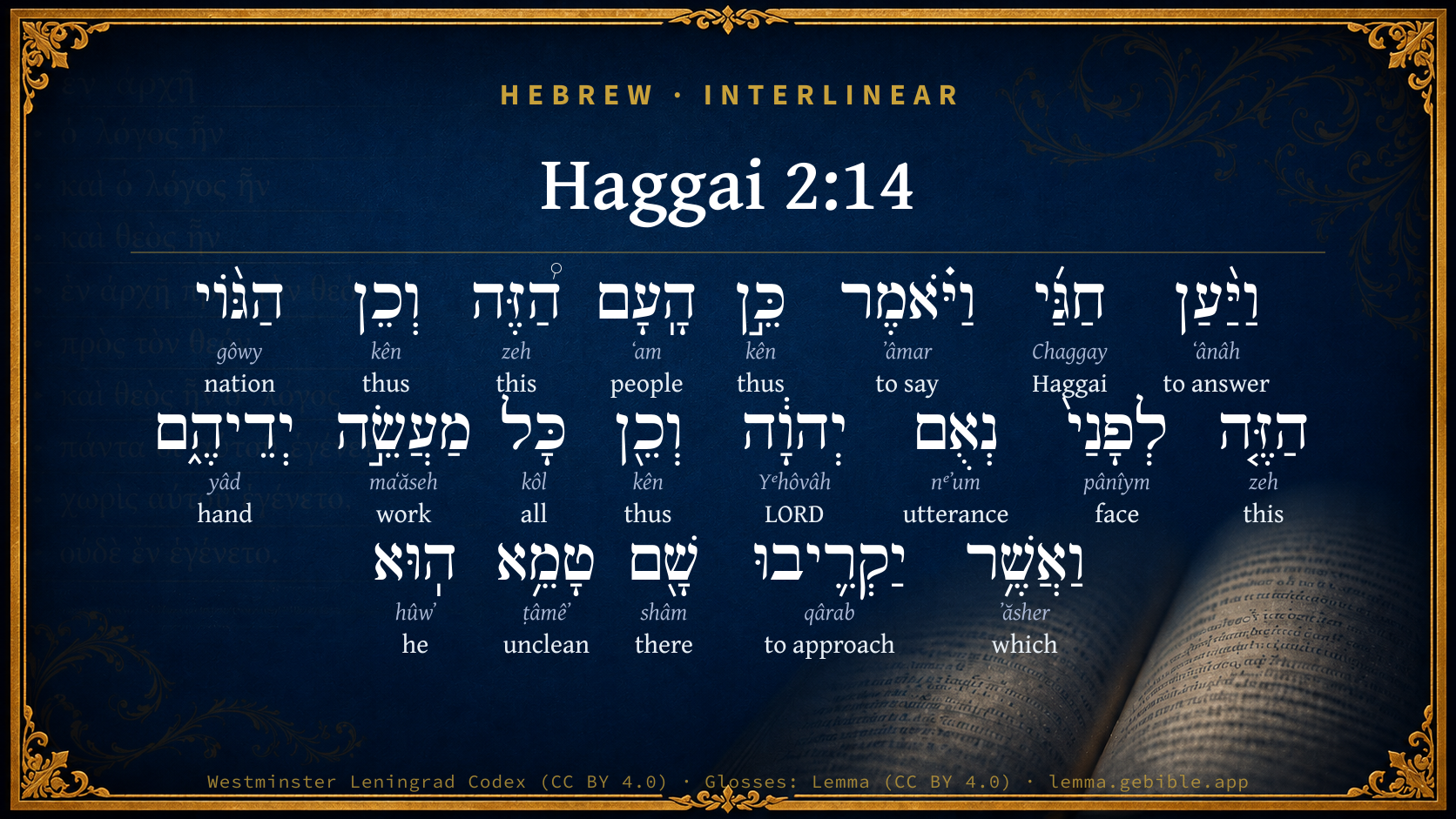
Hebrew (Westminster Leningrad Codex) Haggai 2:14 appears in the Hebrew Old Testament. The text above is from the Westminster Leningrad Codex. Each word links to its Strong’s number, a concise gloss, and parsing drawn from the Open Scriptures Hebrew Bible morphology. Click any word for its full Brown-Driver-Briggs (BDB) entry.
Download image
Cite this verse

Haggai 2:14 (World English Bible). Public Domain. Lemma interlinear Bible study tool, https://lemma.gebible.app/v/haggai/2/14.

Show BibTeX & RIS
BibTeX
RIS
English Translation
Then Haggai answered, "'So is this people, and so is this nation before me,' says Yahweh; 'and so is every work of their hands. That which they offer there is unclean.
World English Bible · Public Domain
Download a study sheet

One document with this verse’s original text, its word-by-word gloss line, the meaning frame, cross-references with their text, attributed commentary, and full source and license credits — printable, and it pastes into notes with its structure intact.

This verse Autodidact and up

Study sheet (.html) Plain text (.txt)

A passage Seminary Student

Up to 50 verses in one chapter. A passage sheet keeps up to 6 commentary sources and 12 cross-references per verse, in the order this page ranks them, and says so on the sheet whenever that leaves anything out. Ask for a single verse and you get the Autodidact verse sheet above.

Everything on this page stays free to read, with no account — the sheet is a download of what is already on screen, not access to it.

Want to remove ads? Support Godless Engineer
Compare translations 3

The same verse in 3 English versions, stacked beneath the original-language interlinear above. Click any original word for its lexicon entry.

Each is an independent rendering of the whole verse — the interlinear is not word-aligned to these translations.

Highlighted words mark where these versions differ — a whole-verse word diff, not a word-by-word alignment.

  • World English Bible Public Domain
    Then Haggai answered, "'So is this people, and so is this nation before me,' says Yahweh; 'and so is every work of their hands. That which they offer there is unclean.
  • King James Version Public Domain
    Then answered Haggai, and said, So is this people, and so is this nation before me, saith the LORD; and so is every work of their hands; and that which they offer there is unclean.
  • unfoldingWord Literal Text CC BY-SA 4.0
    And Haggai answered and said, “‘Thus this people and thus this nation to my face!’—the declaration of Yahweh—‘and thus every work of their hands, and what they offer there, it unclean!

unfoldingWord Literal Text — © unfoldingWord, licensed CC BY-SA 4.0. Word-aligned USFM3 via Door43 (git.door43.org/unfoldingWord/en_ult).

Versions to compare (up to 4)

3 of 4 selected

Show all 18 translations

Every available English version of this verse, each an independent rendering of the whole verse.

  • World English Bible Public Domain
    Then Haggai answered, "'So is this people, and so is this nation before me,' says Yahweh; 'and so is every work of their hands. That which they offer there is unclean.
  • Berean Standard Bible Public Domain
    Then Haggai replied, “So it is with this people and this nation before Me, declares the LORD, and so it is with every work of their hands; whatever they offer there is defiled.
  • Majority Standard Bible Public Domain
    Then Haggai replied, “So it is with this people and this nation before Me, declares the LORD, and so it is with every work of their hands; whatever they offer there is defiled.
  • King James Version Public Domain
    Then answered Haggai, and said, So is this people, and so is this nation before me, saith the LORD; and so is every work of their hands; and that which they offer there is unclean.
  • American Standard Version (1901) Public Domain
    Then answered Haggai and said, So is this people, and so is this nation before me, saith Jehovah; and so is every work of their hands; and that which they offer there is unclean.
  • Revised Version (1885) Public Domain
    Then answered Haggai and said, So is this people, and so is this nation before me, saith the LORD; and so is every work of their hands; and that which they offer there is unclean.
  • Geneva Bible (1599) Public Domain
    Then sayde Haggai, If a polluted person touch any of these, shall it be vncleane? And the Priests answered, and sayd, It shalbe vncleane.
  • Douay-Rheims (1899) Public Domain
    And Aggeus said: If one that is unclean by occasion of a soul touch any of all these things, shall it be defiled? And the priests answered, and said: It shall be defiled.
  • Young's Literal Translation Public Domain
    And Haggai answereth and saith, `So `is' this people, and so `is' this nation before Me -- an affirmation of Jehovah -- and so `is' every work of their hands, and that which they bring near there -- it is unclean.
  • Literal Standard Version CC BY-SA 4.0
    And Haggai answers and says, “So [is] this people, and so [is] this nation before Me,” a declaration of YHWH, “and so [is] every work of their hands, and that which they bring near there—it is unclean.
  • Unlocked Literal Bible CC BY-SA 4.0
    So Haggai answered and said, “So it is with this people and this nation before me!—this is Yahweh's declaration—and so it is with everything done by their hands. What they offer to me is unclean!
  • unfoldingWord Literal Text CC BY-SA 4.0
    And Haggai answered and said, “‘Thus this people and thus this nation to my face!’—the declaration of Yahweh—‘and thus every work of their hands, and what they offer there, it unclean!
  • Darby Bible Public Domain
    Then answered Haggai and said, So is this people, and so is this nation before me, saith Jehovah, and so is every work of their hands; and that which they offer there is unclean.
  • World Messianic Bible Public Domain
    Then Haggai answered, “‘So is this people, and so is this nation before me,’ says the LORD; ‘and so is every work of their hands. That which they offer there is unclean.
  • Webster's Bible Public Domain
    Then answered Haggai, and said, So is this people, and so is this nation before me, saith the LORD; and so is every work of their hands; and that which they offer there is unclean.
  • Free Bible Version CC BY-SA 4.0
    Then Haggai responded, “This is how it is with these people, and with the nation before me, says the Lord. All that they do, every offering they bring, is unclean.”
  • Bible in Basic English Public Domain
    Then Haggai said, So is this people and so is this nation before me, says the Lord; and so is every work of their hands; and the offering they give there is unclean.
  • JPS Tanakh (1917) Public Domain
    Then answered Haggai, and said: 'So is this people, and so is this nation before me, saith the LORD; and so is every work of their hands; and that which they offer there is unclean.

Literal Standard Version (2020), Covenant Press — licensed CC BY-SA 4.0. Text via the HelloAO Bible API (eBible.org). Unlocked Literal Bible (unfoldingWord) — licensed CC BY-SA 4.0. Text via the HelloAO Bible API (eBible.org). unfoldingWord Literal Text — © unfoldingWord, licensed CC BY-SA 4.0. Word-aligned USFM3 via Door43 (git.door43.org/unfoldingWord/en_ult). Free Bible Version, Dr. Jonathan Gallagher — licensed CC BY-SA 4.0. Text via the HelloAO Bible API (eBible.org).

Word by word

More ways to search: Search by grammar → Find every occurrence → Compare this word →

Practice this passage: Drill this verse → Learn its vocabulary →

חַגַּ֜י
Chaggay
H2292
“Haggai”
Noun, Proper
Part of Speech
Noun
Type
Proper
Full BDB Definition

Origin: from H2282

TWOT: None

Haggai = "festive" - 10th in order of the minor prophets; first prophet to prophecy after the captivity
  1. וַיַּ֨עַן ʻânâh H6030 “and · to answer” Conjunction + Verb, Qal, Sequential Imperfect, 3rd Person, Masculine, Singular
  2. וַיֹּ֗אמֶר ʼâmar H559 “and · to say” Conjunction + Verb, Qal, Sequential Imperfect, 3rd Person, Masculine, Singular
  3. כֵּ֣ן kên H3651 “thus” Particle, Demonstrative
  4. הָֽעָם ʻam H5971 “the · people” Particle, Definite Article + Noun, Common, Masculine, Singular, Absolute
  5. הַ֠זֶּה zeh H2088 “the · this” Particle, Definite Article + Pronoun, Demonstrative, Masculine, Singular
  6. וְכֵן kên H3651 “and · thus” Conjunction + Particle, Demonstrative
  7. הַגּ֨וֹי gôwy H1471 “the · nation” Particle, Definite Article + Noun, Common, Masculine, Singular, Absolute
  8. הַזֶּ֤ה zeh H2088 “the · this” Particle, Definite Article + Pronoun, Demonstrative, Masculine, Singular
  9. לְפָנַי֙ pânîym H6440 “to/for · face(s) · my” Preposition + Noun, Common, Both, Plural, Construct + Suffix, Personal, 1st Person, Common, Singular
  10. נְאֻם nᵉʼum H5002 “utterance of” Noun, Common, Masculine, Singular, Construct
  11. יְהוָ֔ה Yᵉhôvâh H3068 “LORD” Noun, Proper
  12. וְכֵ֖ן kên H3651 “and · thus” Conjunction + Particle, Demonstrative
  13. כָּל kôl H3605 “all of” Noun, Common, Masculine, Singular, Construct
  14. מַעֲשֵׂ֣ה maʻăseh H4639 “work of” Noun, Common, Masculine, Singular, Construct
  15. יְדֵיהֶ֑ם yâd H3027 “hands · their” Noun, Common, Both, Dual, Construct + Suffix, Personal, 3rd Person, Masculine, Plural
  16. וַאֲשֶׁ֥ר ʼăsher H834 “and · which” Conjunction + Particle, Relative
  17. יַקְרִ֛יבוּ qârab H7126 “to approach” Verb, Hiphil, Imperfect, 3rd Person, Masculine, Plural
  18. שָׁ֖ם shâm H8033 “there” Adverb
  19. טָמֵ֥א ṭâmêʼ H2931 “unclean” Adjective, Adjective, Masculine, Singular, Absolute
  20. הֽוּא hûwʼ H1931 “he” Pronoun, Personal, 3rd Person, Masculine, Singular

About this verse

These counts appear in no published source. They are computed here, from the morphology-tagged text and Lemma’s own curated glosses. What Lemma adds →

21
words
18
distinct lemmas
Prophets
section

Notable vocabulary

The rarest word here is חַגַּ֜י Haggai H2292 — appearing just 11 times in the whole Hebrew Bible.

Shared distinctive vocabulary

חַגַּ֜י Haggai H2292 occurs in 11 verses of the Hebrew Bible. Also found in:

Grammatical profile

  • 3 verbs
  • 9 nouns
  • 1 adjective
  • 3 pronouns
  • 1 adverb
  • 4 particles

Verb forms

  • וַיַּ֨עַן Qal · Sequential Imperfect
  • וַיֹּ֗אמֶר Qal · Sequential Imperfect
  • יַקְרִ֛יבוּ Hiphil · Imperfect

Repetition

Words recur within this verse — often emphatic in Hebrew:

  • כֵּ֣ן thus H3651 ×3
  • הַ֠זֶּה this H2088 ×2

Hebrew & Septuagint length

In English translation the verse runs 31 words from the Hebrew and 34 from the Septuagint (LXX English) — closely comparable.

A rough comparison of the two English renderings, which tokenize alike — not a word-level alignment.

Word counts can differ between the Hebrew and the Greek without any difference in meaning — e.g. the Hebrew direct-object marker אֵת has no separate Greek word, and Greek often adds the article ὁ.

Cross-references

9

Topical passages linked to Haggai 2:14 in the Treasury of Scripture Knowledge — connected by theme and wording, ordered by reader-vote popularity; previews shown in the World English Bible.

  • Proverbs 28:9 He who turns away his ear from hearing the law, Even his prayer is an abomination.
  • Titus 1:15 To the pure, all things are pure; but to those who are defiled and unbelieving, nothing is pure; but both their mind and their conscience are defiled.
  • Proverbs 15:8 The sacrifice made by the wicked is an abomination to Yahweh, But the prayer of the upright is his delight.
  • Isaiah 1:11–15 "What are the multitude of your sacrifices to me?," says Yahweh. "I have had enough of the burnt offerings of rams, And the fat of fed animals. I don't delight in the blood of bulls, Or of lambs, Or of male goats.
  • Haggai 1:4–11 "Is it a time for you yourselves to dwell in your paneled houses, while this house lies waste?
  • Ezra 3:2–3 Then stood up Jeshua the son of Jozadak, and his brothers the priests, and Zerubbabel the son of Shealtiel, and his brothers, and built the altar of the God of Israel, to offer burnt offerings thereon, as it is written in the law of Moses the man of God.
  • Proverbs 21:4 A high look, and a proud heart, The lamp of the wicked, is sin.
  • Proverbs 21:27 The sacrifice of the wicked is an abomination: How much more, when he brings it with a wicked mind!
  • Jude 1:23 and some save, snatching them out of the fire with fear, hating even the clothing stained by the flesh.

Cross-references courtesy of OpenBible.info (CC BY 4.0).

Hebrew and Greek witnesses Masoretic Hebrew ↔ Greek Septuagint

The same verse in the two great witnesses to the Old Testament, shown verse-for-verse.

These are two independent witnesses, not word-aligned to each other, and the Septuagint is shown in lemma (dictionary) form.

Hebrew Haggai 2:14 Masoretic · Westminster Leningrad Codex

וַיַּ֨עַן חַגַּ֜י וַיֹּ֗אמֶר כֵּ֣ן הָֽעָם הַ֠זֶּה וְכֵן הַגּ֨וֹי הַזֶּ֤ה לְפָנַי֙ נְאֻם יְהוָ֔ה וְכֵ֖ן כָּל מַעֲשֵׂ֣ה יְדֵיהֶ֑ם וַאֲשֶׁ֥ר יַקְרִ֛יבוּ שָׁ֖ם טָמֵ֥א הֽוּא

Then Haggai answered, "'So is this people, and so is this nation before me,' says Yahweh; 'and so is every work of their hands. That which they offer there is unclean.

World English Bible · Public Domain

Greek LXX Haggai 2:14 Septuagint · lemma form

καί ἀποκρίνω αγγαιος καί εἶπον οὕτως ὁ λαός οὗτος καί οὕτως ὁ ἔθνος οὗτος ἐνώπιον ἐγώ λέγω κύριος καί οὕτως πᾶς ὁ ἔργον ὁ χείρ αὐτός καί ὅς ἐάν ἐγγίζω ἐκεῖ μιαίνω ἕνεκεν ὁ λῆμμα αὐτός ὁ ὀρθρινός ὀδυνάω ἀπό πρόσωπον πόνος αὐτός καί μισέω ἐν πύλη ἐλέγχω

And Aggaeus said, If a defiled person who is unclean by reason of a dead body, touch any of these, shall it be defiled? And the priests answered and said, It shall be defiled.

LXX2012 (modern English Septuagint) · Public Domain

On this verse, The Pulpit Commentary discusses the Septuagint’s reading. Read the note in Commentary ↓

Hebrew: Westminster Leningrad Codex (CC BY 4.0). Greek: Septuagint (public domain); English from LXX2012 (modern English Septuagint) (Public Domain). How the Septuagint differs from the Hebrew →

Targum (Aramaic paraphrase)

1

The Targum is the ancient Jewish Aramaic paraphrase of the Hebrew Scriptures — an interpretive translation, not the Hebrew text itself. Onkelos (literal) and Pseudo-Jonathan (expansive) render the Torah, and Jonathan the Prophets. Coverage is partial: where no permissively-licensed English translation exists for a verse, only the Aramaic is shown. This is verse-level text, not a word-by-word alignment to the Hebrew.

  1. Targum Jonathan Prophets (Joshua–Malachi)
    וַאֲתִיב חַגַי וַאֲמַר כֵּן עַמָא הָדֵין וְכֵן כְּנִשְׁתָּא הָדָא קֳדָמַי אֲמַר יְיָ וְכֵן כָּל עוֹבָדֵי יְדֵיהוֹן וּדְיִקְרְבוּן תַּמָן מְסָאָב הוּא:

    (no public-domain English translation for this verse)

    Targum Jonathan — Aramaic: “Mikraot Gedolot” (public domain). English: “Sefaria Community Translation” (CC0 1.0 (public-domain dedication)); “London "Chaldee Paraphrase," 1871” (public domain). Text via Sefaria.

Commentary

Notes on Haggai 2:14 from classic Christian and Jewish commentators (each source and its license shown beneath its notes). The classic Christian expositions comment on the surrounding passage and are grouped to its opening verse, so a note may address several verses; the Jewish commentaries on the Tanakh (Rashi and others) are per-verse, so they appear only where the commentator wrote on this verse.

Lemma curates 59 commentaries, every one of them public domain or Creative Commons licensed, each selected and text-cleaned for this edition rather than reprinted as found. About our sources →

Trapp's Complete Commentary

John Trapp

Hag 2:14 Then answered Haggai, and said, So [is] this people, and so [is] this nation before me, saith the LORD; and so [is] every work of their hands; and that which they offer there [is] unclean.

Ver. 14. So is this people, and so is this nation before me] Though pure in their own eyes, Pro 30:12, and to the world-ward unrebukeable, as Paul the Pharisees, Php 2:14-15, and those self-justiciaries, Luk 16:14-15 "Ye are those that justify yourselves" (and have the world’s good word for you), "but God knoweth your hearts: for that which is highly esteemed among men is abomination in the sight of God." Sordet in conspectu iudicis quod fulget in conspectu operantis. Filthy in the sight of the judge who glisten in the sight of their works. Wicked men’s services are but glistering sins ( splendida peccata), they rejoice in a thing of nought, as Amos hath it, Amo 6:13, like as Leah rejoiced in that whereof she had cause to repent, and said, "God hath given me my hire," when she had more cause to say, God, I fear, will give me my hire, my payment, "because I have given my maiden to my husband," Gen 30:18. But she was in the common error of measuring and judging of things by the success; as if God were not many times angry with men, though they outwardly prosper; or as if there were not here one event to the clean and to the unclean, Ecc 9:2. Until the day that God shall separate the sheep from the goats, whom for the glory of his name and the good of his people he suffers for present to go one among another, to make his own to stick the faster together and to their principles. Shepherds say that it is wholesome for a flock of sheep to have some goats to feed among them; their bad scent being good medicine for the sheep, to keep them from the shakings. {a} Only let God’s sheep take heed that they contract no corruption by conversing with goats; which is soon done, for sin is catching, and ill company is contagious. Nemo errat sibi ipsi; sed dementiam spargit in proxiruos, saith Seneca, No man errs out of the right way alone, but draws others along. And multos sollicitat societas nefauda, saith Chrysostom, evil company soliciteth many to sin. Virtue is oft overcome by vice, saith Nazianzen, as a little wormwood sooner embittereth a great deal of honey than twice so much honey can sweeten a small deal of wormwood; or as one spoonful of vinegar will soon sour a great deal of sweet milk; but a great deal of milk will not so soon allay one spoonful of vinegar. Remove but one stone, and the whole river will rush downward; but you can hardly stop the stream again with a strong dam. Touch pitch and you shall presently be defiled, but touch soap and you shall not presently be made clean without much rubbing and rinsing. Mezentius the tyrant, Corpora a corporibus iungebat mortua vivis, tied living men to dead carcasses; but the dead did not revive the living, the living rather putrefied by reason of the dead. He that bore consecrated flesh in the skirt of his garment, and with his skirt touched bread, or pottage, or wine, or oil, or any food, he made it not thereby holy. But if an unclean person touched any of these he made it unclean. The Donatists abused this text, to prove that baptism was defiled and vacated if administrated by an unregenerate minister; but Augustine again, against Fulgentius the Donatist, vindicateth the text from their false glosses, and asserteth from it the contrary truth. May not clean grain be sowed with foul hands, and grow nevertheless? May not a trumpet be well sounded by an impure breath? And is not the water in baptism, that cleanseth the child, cast afterwards into the draught? saith Gregory, Aqua baptismatis baptizatos ad regnum caelestis mittit, et ipsa postea in cloacam descendit.

So is this people, and so is that nation before me, and so is every work of their hands, and that which they offer, &c.] Note the order of the induction. First, themselves were unclean, both people and nation; there was a general defection and defilement ran through all sorts and sexes, as the woof runs through the warp; so that they were all together but one continued web of wickedness, as it were, spun out and made up by the hands of the devil, and the flesh, an evil spinner, and a worse weaver; both root and fruit were nought, as Isa 5:4, both head, heart, and foot were out of order, Isa 1:5-6, and they are barely and boldly told of it by the prophets. Secondly, the works of their hands were unclean; for not only the praying, but "the plowing of the wicked, is sin," Pro 21:4, all their natural and civil actions also are abominable. Whether they plough, or play, or eat, or sleep: corruption is like copperas, {b} which will turn wine or milk into ink; or leaven, which turns a very passover into pollution; or as the sanies of a plague sore, which will render the richest robe infectious. Thirdly, that which they offer there, their sacrifices and all their religious performances, were likewise unclean; not in respect of God, who commanded them; nor of the matter, for they offered clean beasts; but of the manner of offering (which makes or mars the action), and of the men, who were unregenerate, and rested in the work done, and drew near to God with their lips, thinking to put God off with an external worship only; Ludenies cum Deo tanquam pueri cum suis puppis, as Calvin hath it, that is, playing with God, as children do with their babies. The poets declaimed against this foppery, as Persius; and another, Non bene caelestes impia dextra colit.

{a} A disease in sheep and swine. Also the ague. ŒD

{b} A name given from early times to the protosulphates of copper, iron, and zinc (distinguished as blue, green, and white copperas respectively). ŒD

John Trapp, A Commentary or Exposition upon All the Books of the Old and New Testament (1647–1656) — public domain. Text from a community e-Sword module.

The Biblical Illustrator

Joseph S. Exell

Hag_2:14

So is every work of their hands, and that which they offer there is unclean.

Works and pure hearts

They who have imbibed the true fear of God, do rightly serve Him though they may bring only a crumb of incense, and that others only profane the worship of God, though they bring many oxen; as a heathen poet says, An impious right hand does not rightly worship the celestials. The philosophers ever hold this principle--that no sacrifice is rightly offered to God except the mind be right and pure. But yet the philosophers, as well as the poets, adopted this false notion, by which Satan beguiled all men, that God is pacified by ceremonies: hence have proceeded so many expiations, in which foolish men trusted, and by which they thought that God would be propitious to them, though they obstinately continued daily to procure for themselves new punishments, and, as it were, avowedly to carry on war with God Himself. The prophet says that men not only lose all their labour, but also contract new pollution, when they seek to pacify God by their sacrifices, unaccompanied by inward purity. Works, however splendid they may appear before our eyes, are of no value or importance before God, except they flow from a pure heart. The fountain of works I consider to be integrity of heart, and the design and end is, when the object of men is to obey God, and to consecrate their life to Him. (John Calvin.)

The Biblical Illustrator, edited by Joseph S. Exell (c. 1880s–1900s) — public domain. Text from a community e-Sword module.

Tyndale Open Study Notes

Tyndale Open Resources

2:14 That is how it is with this people: Simply returning from exile to the land God promised Israel did not make the people of Judah holy. They were still unclean, since they were not obeying the instructions of God’s covenant with them. Their work and even their worship were contaminated by impurity; the ruins of the Lord’s Temple had symbolized the people’s disobedience. The rebuilding of the Temple was a tangible sign of changed hearts and renewed obedience to God’s covenant.

Tyndale Open Study Notes — © Tyndale Open Resources, licensed CC BY-SA 4.0. Text via the HelloAO Bible API.

Jamieson, Fausset & Brown

Robert Jamieson, A. R. Fausset & David Brown

Then answered Haggai--rather, "Then Haggai answered (in rejoinder to the priests' answer) and said" [MAURER].

so is this people--heretofore not in such an obedient state of mind as to deserve to be called My people (Tit 1:15). Here he applies the two cases just stated. By the first case, "this people" is not made "holy" by their offerings "there" (namely, on the altar built in the open air, under Cyrus, Ezr 3:3); though the ritual sacrifice can ordinarily sanctify outwardly so far as it reaches (Heb 9:13), as the "holy flesh" sanctified the "skirt," yet it cannot make the offerers in their persons and all their works acceptable to God, because lacking the spirit of obedience (Sa1 15:22) so long as they neglected to build the Lord's house. On the contrary, by the second case, they made "unclean" their very offerings by being unclean through "dead works" (disobedience), just as the person unclean by contact with a dead body imparted his uncleanness to all that he touched (compare Heb 9:14). This all applies to them as they had been, not as they are now that they have begun to obey; the design is to guard them against falling back again. The "there" points to the altar, probably in view of the audience which the prophet addressed.

Jamieson, Fausset & Brown — Commentary Critical and Explanatory on the Whole Bible (1871) — public domain (CC PDM 1.0). Text via the HelloAO Bible API.

Adam Clarke's Commentary

Verse 14. Then answered Haggai - So is this people] As an unclean man communicates his uncleanness to every thing he touches, so are ye unclean; and whatever ye have hitherto done is polluted in the sight of God. For your neglect of my temple has made you unclean, as if you had contracted legal pollution by touching a dead body.

Adam Clarke's Commentary on the Bible (1810–1826) — public domain. Text from a community e-Sword/MySword module.

Ellicott's Commentary for English Readers

(14) That which they offer there—i.e., probably, “on yon altar,” but the expression is singular. In Ezr_3:3 we read, “And they set the altar upon his bases. . . . and they offered burnt offerings thereon unto the Lord, even burnt offerings morning and evening.”

A Bible Commentary for English Readers, edited by Charles John Ellicott (1878–1897) — public domain. Text from a community e-Sword module.

The Cambridge Bible for Schools and Colleges

gen. ed. J. J. S. Perowne

14. This verse contains the application to the present case of the Jews of the principles brought out by the foregoing questions. The second principle, as to the transmission of uncleanness, is first applied in the former clauses of the verse, while the first principle, as to the non-transmission of holiness, is referred to in the last clause. “So,” resembling the case just described, “is this people and this nation, before Me, saith the Lord.” It is polluted in itself, like the man who is “unclean by a dead body,” through its disobedience, and neglect of my Temple. “And so,” defiled through this act of disobedience, just as whatever he touches is defiled by the touch of him who has had contact with the dead, “is every work of their hands.” The blight that rests on all their industry and labour, that mars and withers every work in which their hands are engaged, is the punishment and the proof of the moral uncleanness, which residing in themselves extends to all that they put their hand to. “And that which they offer there,” (on the altar which they have built to My Name in Jerusalem,) so far from sanctifying their works, as they vainly think, is itself through the pervading influence of their sin “unclean.” The sanctifying influence of the altar on which they pride themselves would at best but have reached a little way. The prevailing power of their disobedience vitiates all such sanctifying influence, and renders the very offerings on the altar itself unclean.

this people and so is this nation] See ch. Hag_1:2. The addition of the word “nation,” the word commonly used for the heathen nations of the world, as distinguished from the Jews who were the “people” of God, has been thought to be a further sign of contempt and rejection. But the two words are used together of Israel in Zep_2:9, where no such meaning can be intended.

there] On the altar built on their return from Babylon. Ezr_3:3.

The Cambridge Bible for Schools and Colleges (gen. ed. J. J. S. Perowne; Cambridge University Press, 1878–1918) — public domain. Text from a community e-Sword module.

John Gill's Exposition

And now, I pray you, consider from this day and upward,.... This being their case, and they so polluted with sin, particularly through their neglect of building the temple; they are most earnestly and importunately entreated to "lay" it "to their hearts", to ponder it in their minds, and thoroughly consider how it had fared with them from this twenty fourth day of the ninth month, in which the prophet was sent unto them to encourage them in their work, and upwards or backwards, for some years past: even

from before a stone was laid upon a stone in the temple of the Lord: the foundation of the temple was laid quickly after the Jews returned from Babylon, upon the proclamation of Cyrus, Ezr 3:10 but, through difficulties and discouragements they met with, they desisted from the work, and went no further; a stone was not laid upon it; or, as the Targum, a row, or course upon course, until this time: and now all the intermediate space of time between the first laying the foundation of the temple, and their present going to work upon it, the prophet would have them take particular notice of; how it had been with them, as to their outward circumstances; whereby it would appear, they had sinned, and the Lord had been offended with them.

John Gill's Exposition of the Whole Bible (1746–1763) — public domain (CC PDM 1.0). Text via the HelloAO Bible API.

Haydock's Catholic Bible Commentary

CHAPTER II.

By occasion of a soul. That is, by having touched the dead: in which case, according to the prescription of the law, (Numbers xix. 13, 22.) a person not only became unclean himself, but made everything that he touched unclean. The prophet applies all this to the people, whose souls remained unclean by neglecting the temple of God; and therefore were not sanctified by the flesh they offered in sacrifice, but rather defiled their sacrifices by approaching to them in the state of uncleanness. (Challoner)

George Leo Haydock (1774–1849), Haydock's Catholic Family Bible and Commentary, 1859 edition — public domain. Excludes Psalms (Douay-Rheims chapter numbering differs from Protestant) and Deuterocanonical books (Catholic canon only).

Matthew Poole's English Annotations

Now is the case applied. As common things touched by holy things are not sanctified, and as polluted persons touching what is clean pollute it; as holy things did not by touch and bodily application make him legally holy who was common, but a polluted person made all he touched and handled unclean; so unsanctified and polluted Jews polluted God’s ordinances, while the outward performing of legal and ceremonial duties, such as bringing, offering, eating, dragging about their legal sacrifices, left them as unholy in themselves and as unacceptable to God as they were before. Somewhat more then is to be done. The soul is first to be purified, that they and we may offer up a pure offering.

So is the people; the body of the Jews, or the most part of them.

So is this nation: this ingeminateth the same thing, to intimate to us how God resenteth it, and how we should be affected with it.

Before me; in God’s account, or in his sight, who seeth indeed what men are, and what their actions are.

So is every work of their hands; whatever they do in sacred or civil matters, they make a shift to pollute all by polluted hands, by leprous touches.

That which they offer there, what they do bring to the altar with impure hearts and hands, is more polluted by them than sanctified by the altar.

Is unclean; really impure; though it seem externally clean and holy, it is unsuitable to the purity of a holy God. In sanctified actions all is spoiled by unsanctified hearts. Thence it is that uncleanness is derived on their best works, and consecrated rites do not, cannot sanctify profane spirits.

Matthew Poole's English Annotations on the Holy Bible (1683–1685) — public domain. Text from a community e-Sword/MySword module.

The Pulpit Commentary

Then answered Haggai, and said; then Haggai continued and said. He applies the principles just enunciated to the ease of the Jews, taking the communication of uncleanness first. So is this people. Not, my people, because by their acts they had disowned God. (Hag_1:2) This people is defiled in my sight like one who has touched a corpse, and not only they themselves, but so is every work of their hands; all their labour, all that they put their hands to, is unclean, and can win no blessing. Their pollution was their disobedience in not building the house of God. They had calmly contemplated the lifeless symbol of the theocracy, the ruined temple, and made no determined effort to resuscitate it, so a blight had rested on all their work. That which they offer there (pointing to the altar which they had built when they first returned, (Ezr_3:2) is unclean. They had fancied that the sanctifying influence of the altar and its sacrifices would extend to all their works, and cover all their shortcomings; but so far from this, their very offerings were unclean, because the offerers were polluted. They who come before the Holy One should themselves be holy. Neither the altar nor the Holy Land imparted sanctity by any intrinsic virtue of their own, but entailed upon all an obligation to personal holiness (Wordsworth). The LXX has an addition at the end of the verse. Eneken twn lhmmatwn aujtwn twn ojrqrinwn ojdunhqhsontai ajpopou ponwn aujtwn kailaiv ejlegcontav "On account of their morning gains or, "burdens they shall be pained in the presence of their labours, and ye hated those who reproved in the gates." This is expounded by Theodoret thus: As soon as morning dawned ye employed yourselves in no good work, but sought only how to obtain sordid gain. And ye regarded with. hatred these who reproved, you, who sitting at the gate spake words of wisdom to all who passed by. The passage is found in no other version.

The Pulpit Commentary (1880–1919), ed. H.D.M. Spence-Jones & Joseph S. Exell — public domain. Text from a community e-Sword module.

John Wesley's Explanatory Notes

So - Polluted persons, touching what is clean, pollute it, so polluted Jews, polluted God's ordinances, while the outward performing of legal duties, left them as unholy in themselves, as they were before: somewhat more then is to be done. The soul is first to be purified, that they and we may offer up a pure offering. The people - The body of the Jews. Every work - Whatever they do, they pollute all by polluted hands. Offer - What they bring to the altar with impure hearts, is polluted by them.

John Wesley, Explanatory Notes Upon the Whole Bible (1754–1765) — public domain. Text via the GEBible commentary corpus.

Rashi

Rabbi Shlomo Yitzchaki (Rashi)

So is this people Just as you err in this, so do you err in many halachot.

and whatever they will sacrifice there if they do not put their hearts to learning.

Rashi on the Tanakh — English translations: “The Judaica Press complete Tanach with Rashi, translated by A. J. Rosenberg” (CC BY 4.0); “Pentateuch with Rashi's commentary by M. Rosenbaum and A.M. Silbermann, 1929-1934” (public domain); “The Metsudah Tanach series, Lakewood, N.J” (CC BY 4.0); and “The Book of Joshua, Metsudah Publications, 1997” (CC BY 4.0). Text via Sefaria.

Lesson kit

Teaching starters — assembled from the data on this page, not authored interpretation. Every prompt links to the verse data it draws on. Edit before teaching.

Haggai, in the Prophets, opens this verse with 21 words (18 distinct Hebrew lemmas). Its most distinctive word is Chaggay (“Haggai”). A historical commentator’s framing appears above. Read the whole chapter for the surrounding context.

Discussion questions

  1. What does “Haggai” (Chaggay) contribute to the verse as a whole?
  2. Ezra 5:1 shares the word «Haggai» with this verse. How do the two illuminate each other?
  3. “thus” occurs 3× in this one verse. What is the effect of the repetition?
  4. These translations render this verse differently; the difference is in the English rendering, not the original. What questions does that raise?
  5. The verb «וַיַּ֨עַן» is Qal Sequential Imperfect. How does its form color the action?
  6. Reading how Trapp's Complete Commentary and The Biblical Illustrator read this verse, where do the two commentators agree and where do they part?

Things to notice

Reading settings

Reading text

Shown beneath each verse's original-language words.

Old Testament
Old Testament edition

Read the OT as the Masoretic Hebrew (MT) or the Greek Septuagint (LXX).

English shown for the Greek Septuagint (in the Hebrew ↔ Greek comparison).

Comparing translations? Open the Compare panel on any verse page to stack up to four side by side.