
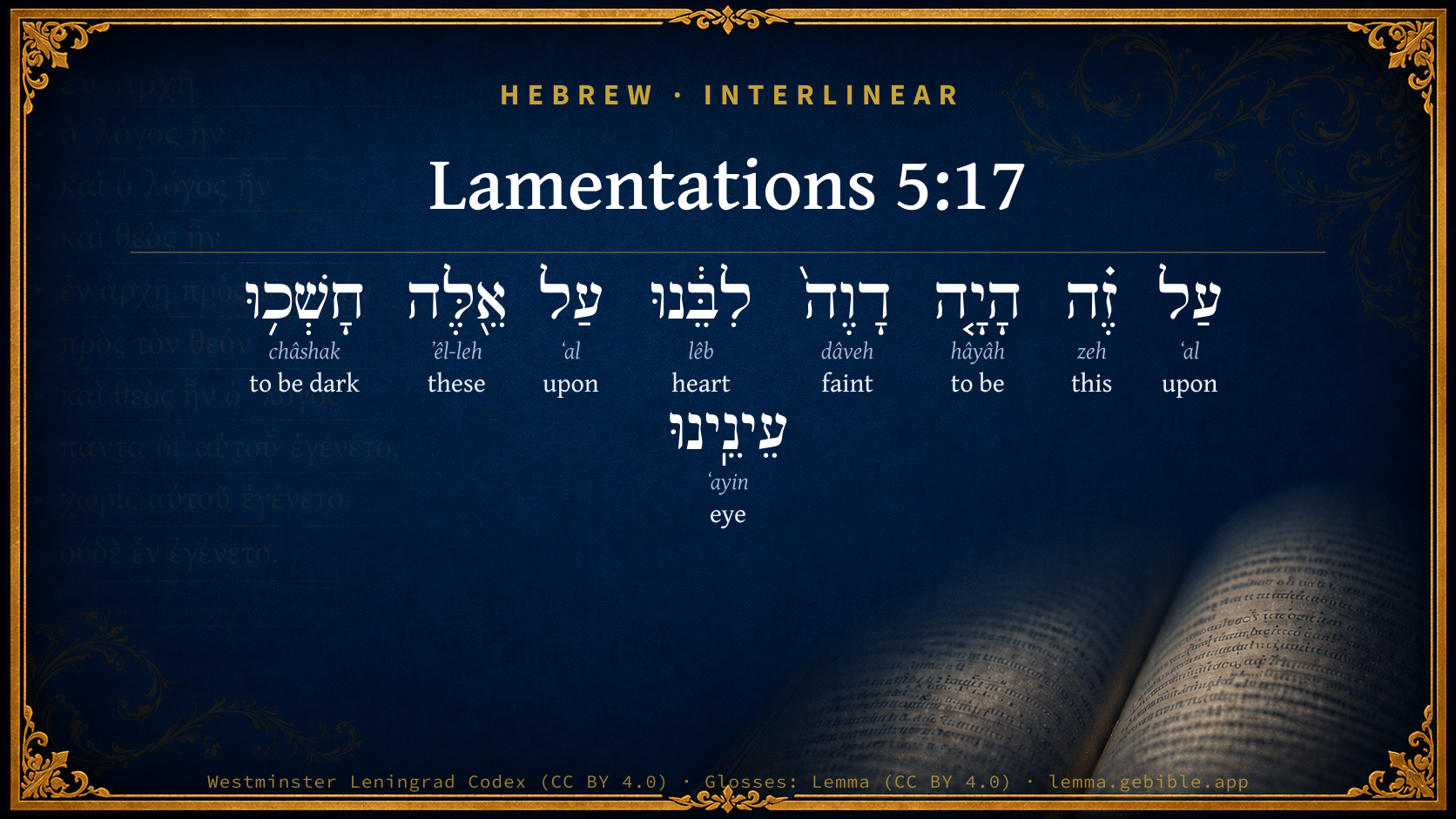
Lamentations 5:17

Hebrew (Westminster Leningrad Codex) Lamentations 5:17 appears in the Hebrew Old Testament. The text above is from the Westminster Leningrad Codex. Each word links to its Strong’s number, a concise gloss, and parsing drawn from the Open Scriptures Hebrew Bible morphology. Click any word for its full Brown-Driver-Briggs (BDB) entry.
Download image
Cite this verse

Lamentations 5:17 (World English Bible). Public Domain. Lemma interlinear Bible study tool, https://lemma.gebible.app/v/lamentations/5/17.

Show BibTeX & RIS
BibTeX
RIS
English Translation
For this our heart is faint; For these things our eyes are dim;
World English Bible · Public Domain
Download a study sheet

One document with this verse’s original text, its word-by-word gloss line, the meaning frame, cross-references with their text, attributed commentary, and full source and license credits — printable, and it pastes into notes with its structure intact.

This verse Autodidact and up

Study sheet (.html) Plain text (.txt)

A passage Seminary Student

Up to 50 verses in one chapter. A passage sheet keeps up to 6 commentary sources and 12 cross-references per verse, in the order this page ranks them, and says so on the sheet whenever that leaves anything out. Ask for a single verse and you get the Autodidact verse sheet above.

Everything on this page stays free to read, with no account — the sheet is a download of what is already on screen, not access to it.

Want to remove ads? Support Godless Engineer
Compare translations 3

The same verse in 3 English versions, stacked beneath the original-language interlinear above. Click any original word for its lexicon entry.

Each is an independent rendering of the whole verse — the interlinear is not word-aligned to these translations.

Highlighted words mark where these versions differ — a whole-verse word diff, not a word-by-word alignment.

  • World English Bible Public Domain
    For this our heart is faint; For these things our eyes are dim;
  • King James Version Public Domain
    For this our heart is faint; for these things our eyes are dim.
  • unfoldingWord Literal Text CC BY-SA 4.0
    On account of this, our heart has become sick; on account of these things, our eyes have grown dim.

unfoldingWord Literal Text — © unfoldingWord, licensed CC BY-SA 4.0. Word-aligned USFM3 via Door43 (git.door43.org/unfoldingWord/en_ult).

Versions to compare (up to 4)

3 of 4 selected

Show all 18 translations

Every available English version of this verse, each an independent rendering of the whole verse.

  • World English Bible Public Domain
    For this our heart is faint; For these things our eyes are dim;
  • Berean Standard Bible Public Domain
    Because of this, our hearts are faint; because of these, our eyes grow dim—
  • Majority Standard Bible Public Domain
    Because of this, our hearts are faint; because of these, our eyes grow dim—
  • King James Version Public Domain
    For this our heart is faint; for these things our eyes are dim.
  • American Standard Version (1901) Public Domain
    For this our heart is faint; For these things our eyes are dim;
  • Revised Version (1885) Public Domain
    For this our heart is faint; for these things our eyes are dim;
  • Geneva Bible (1599) Public Domain
    Therefore our heart is heauy for these things, our eyes are dimme,
  • Douay-Rheims (1899) Public Domain
    Therefore is our heart sorrowful, therefore are our eyes become dim,
  • Young's Literal Translation Public Domain
    For this hath our heart been sick, For these have our eyes been dim.
  • Literal Standard Version CC BY-SA 4.0
    Our heart has been sick for this, || Our eyes have been dim for these.
  • Unlocked Literal Bible CC BY-SA 4.0
    For this our heart has become sick, for these things our eyes grow dim
  • unfoldingWord Literal Text CC BY-SA 4.0
    On account of this, our heart has become sick; on account of these things, our eyes have grown dim.
  • Darby Bible Public Domain
    For this our heart is faint; for these things our eyes have grown dim,
  • World Messianic Bible Public Domain
    For this our heart is faint. For these things our eyes are dim:
  • Webster's Bible Public Domain
    For this our heart is faint; for these things our eyes are dim.
  • Free Bible Version CC BY-SA 4.0
    Because of all this, we're sick at heart; because of all these things, we can hardly look;
  • Bible in Basic English Public Domain
    Because of this our hearts are feeble; for these things our eyes are dark;
  • JPS Tanakh (1917) Public Domain
    For this our heart is faint, for these things our eyes are dim;

Literal Standard Version (2020), Covenant Press — licensed CC BY-SA 4.0. Text via the HelloAO Bible API (eBible.org). Unlocked Literal Bible (unfoldingWord) — licensed CC BY-SA 4.0. Text via the HelloAO Bible API (eBible.org). unfoldingWord Literal Text — © unfoldingWord, licensed CC BY-SA 4.0. Word-aligned USFM3 via Door43 (git.door43.org/unfoldingWord/en_ult). Free Bible Version, Dr. Jonathan Gallagher — licensed CC BY-SA 4.0. Text via the HelloAO Bible API (eBible.org).

Word by word

More ways to search: Search by grammar → Find every occurrence → Compare this word →

Practice this passage: Drill this verse → Learn its vocabulary →

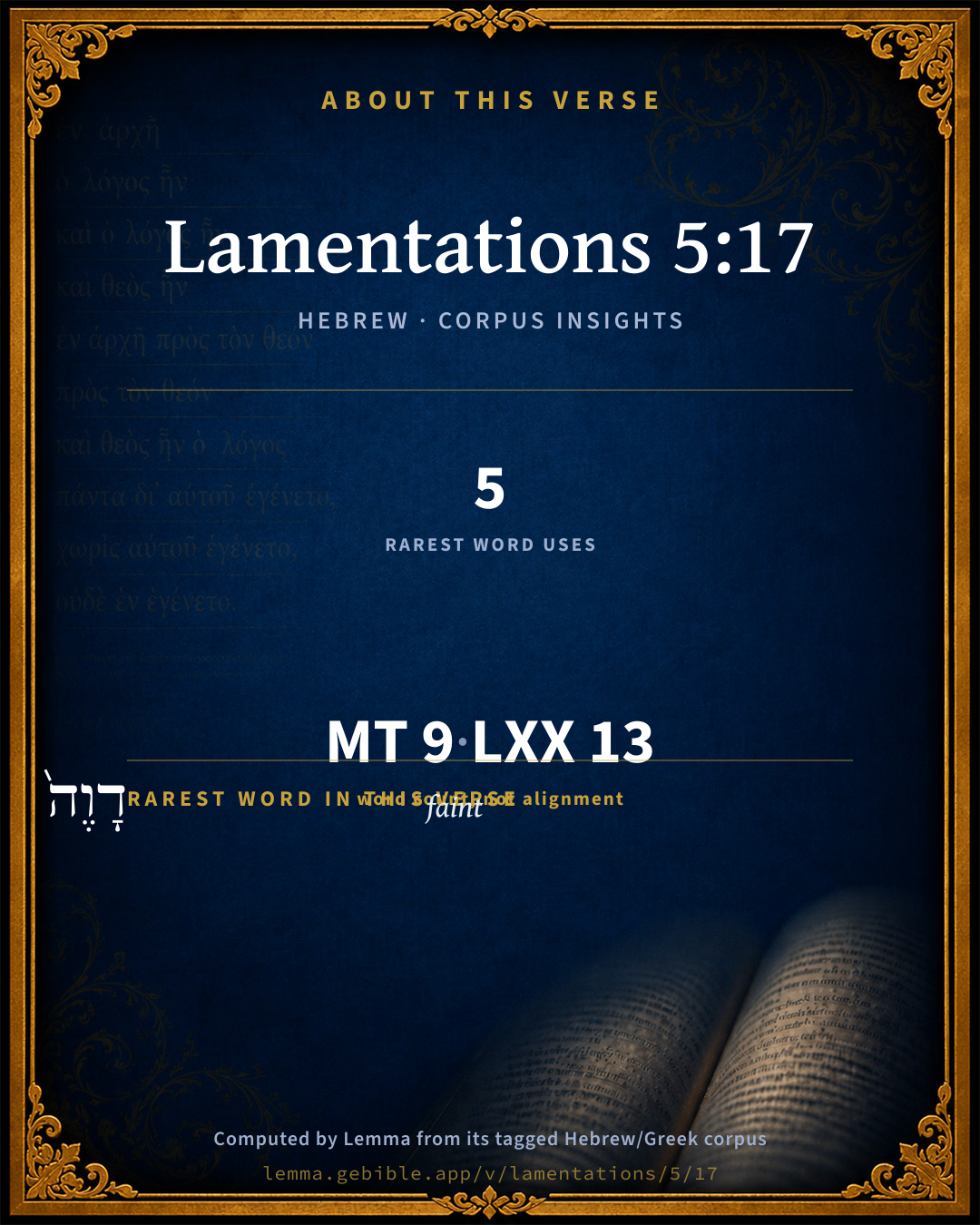
About this verse

These counts appear in no published source. They are computed here, from the morphology-tagged text and Lemma’s own curated glosses. What Lemma adds →

9
words
8
distinct lemmas
Prophets
section

Notable vocabulary

The rarest word here is דָוֶה֙ faint H1739 — appearing just 5 times in the whole Hebrew Bible.

Shared distinctive vocabulary

דָוֶה֙ faint H1739 occurs in 5 verses of the Hebrew Bible. Also found in:

Grammatical profile

  • 2 verbs
  • 2 nouns
  • 1 adjective
  • 2 pronouns
  • 2 prepositions

Verb forms

  • הָיָ֤ה Qal · Perfect
  • חָשְׁכ֥וּ Qal · Perfect

Repetition

A word recurs within this verse — often emphatic in Hebrew:

Hebrew & Septuagint length

In English translation the verse runs 13 words from the Hebrew and 15 from the Septuagint (LXX English) — closely comparable.

A rough comparison of the two English renderings, which tokenize alike — not a word-level alignment.

Word counts can differ between the Hebrew and the Greek without any difference in meaning — e.g. the Hebrew direct-object marker אֵת has no separate Greek word, and Greek often adds the article ὁ.

In the original languages it is 9 Hebrew tokens and 13 Greek tokens — but the two are counted differently (Hebrew bundles its prefixes and suffixes into one token; the Greek is in lemma form), so that isn’t a like-for-like length.

Cross-references

16

Topical passages linked to Lamentations 5:17 in the Treasury of Scripture Knowledge — connected by theme and wording, ordered by reader-vote popularity; previews shown in the World English Bible.

  • Psalms 6:7 My eye wastes away because of grief; It grows old because of all my adversaries.
  • Isaiah 1:5 Why should you be beaten more, That you revolt more and more? The whole head is sick, And the whole heart faint.
  • Job 17:7 My eye also is dim by reason of sorrow. All my members are as a shadow.
  • Lamentations 2:11 My eyes do fail with tears, my heart is troubled; My liver is poured on the earth, because of the destruction of the daughter of my people, Because the young children and the infants swoon in the streets of the city.
  • Isaiah 38:14 Like a swallow [or] a crane, so did I chatter; I did moan as a dove; my eyes fail [with looking] upward: Lord, I am oppressed, be my collateral.
  • Leviticus 26:36 "'As for those of you who are left, I will send a faintness into their hearts in the lands of their enemies: and the sound of a driven leaf will put them to flight; and they shall flee, as one flees from the sword; and they will fall when no one pursues.
  • Deuteronomy 28:65 Among these nations shall you find no ease, and there shall be no rest for the sole of your foot: but Yahweh will give you there a trembling heart, and failing of eyes, and pining of soul;
  • Psalms 31:9 Have mercy on me, Yahweh, for I am in distress. My eye, my soul, and my body waste away with grief.
  • Psalms 69:3 I am weary with my crying. My throat is dry. My eyes fail, looking for my God.
  • Jeremiah 8:18 Oh that I could comfort myself against sorrow! my heart is faint within me.
  • Jeremiah 46:5 Why have I seen it? they are dismayed and are turned backward; and their mighty ones are beaten down, and have fled apace, and don't look back: terror is on every side, says Yahweh.
  • Lamentations 1:13 From on high has he sent fire into my bones, and it prevails against them; He has spread a net for my feet, he has turned me back: He has made me desolate and faint all the day.
  • Lamentations 1:22 Let all their wickedness come before you; Do to them, as you have done to me for all my transgressions: For my sighs are many, and my heart is faint.
  • Ezekiel 21:7 It shall be, when they tell you, Why do you sigh? that you shall say, Because of the news, for it comes; and every heart shall melt, and all hands shall be feeble, and every spirit shall faint, and all knees shall be weak as water: behold, it comes, and it shall be done, says the Lord Yahweh.
  • Ezekiel 21:15 I have set the threatening sword against all their gates, that their heart may melt, and their stumblings be multiplied: ah! it is made as lightning, it is pointed for slaughter.
  • Micah 6:13 Therefore I also have struck you with a grievous wound. I have made you desolate because of your sins.

Cross-references courtesy of OpenBible.info (CC BY 4.0).

Hebrew and Greek witnesses Masoretic Hebrew ↔ Greek Septuagint

The same verse in the two great witnesses to the Old Testament, shown verse-for-verse.

These are two independent witnesses, not word-aligned to each other, and the Septuagint is shown in lemma (dictionary) form.

Hebrew Lamentations 5:17 Masoretic · Westminster Leningrad Codex

עַל זֶ֗ה הָיָ֤ה דָוֶה֙ לִבֵּ֔נוּ עַל אֵ֖לֶּה חָשְׁכ֥וּ עֵינֵֽינוּ

For this our heart is faint; For these things our eyes are dim;

World English Bible · Public Domain

Greek LXX Lamentations 5:17 Septuagint · lemma form

περί οὗτος γίγνομαι ὀδυνηρός ὁ καρδία ἐγώ περί οὗτος σκοτάζω ὁ ὀφθαλμός ἐγώ

For this has grief come; our heart is sorrowful: for this our eyes are darkened.

LXX2012 (modern English Septuagint) · Public Domain

Hebrew: Westminster Leningrad Codex (CC BY 4.0). Greek: Septuagint (public domain); English from LXX2012 (modern English Septuagint) (Public Domain). How the Septuagint differs from the Hebrew →

Commentary

Notes on Lamentations 5:17 from classic Christian and Jewish commentators (each source and its license shown beneath its notes). The classic Christian expositions comment on the surrounding passage and are grouped to its opening verse, so a note may address several verses; the Jewish commentaries on the Tanakh (Rashi and others) are per-verse, so they appear only where the commentator wrote on this verse.

Lemma curates 59 commentaries, every one of them public domain or Creative Commons licensed, each selected and text-cleaned for this edition rather than reprinted as found. About our sources →

Matthew Henry's Commentary

Here, I. The people of God express the deep concern they had for the ruins of the temple, more than for any other of their calamities; the interests of God's house lay nearer their hearts than those of their own (Lam 5:17, Lam 5:18): For this our heart is faint, and sinks under the load of its own heaviness; for these things our eyes are dim, and our sight is gone, as is usual in a deliquium, or fainting fit. "It is because of the mountain of Zion, which is desolate, the holy mountain, and the temple built upon that mountain. For other desolations our hearts grieve and our eyes weep; but for this our hearts faint and our eyes are dim." Note, Nothing lies so heavily upon the spirits of good people as that which threatens the ruin of religion or weakens its interests; and it is a comfort if we can appeal to God that that afflicts us more than any temporal affliction to ourselves. "The people have polluted the mountain of Zion with their sins, and therefore God has justly made it desolate, to such a degree that the foxes walk upon it as freely and commonly as they do in the woods." It is sad indeed when the mountain of Zion has become a portion for foxes (Psa 63:10); but sin had first made it so, Eze 13:4.

II. They comfort themselves with the doctrine of God's eternity, and the perpetuity of his government (Lam 5:19): But thou, O Lord! remainest for ever. This they are taught to do by that psalm which is entitled, A prayer of the afflicted, Psa 102:27, Psa 102:28. When all our creature-comforts are removed from us, and our hearts fail us, we may then encourage ourselves with the belief, 1. Of God's eternity: Thou remainest for ever. What shakes the world gives no disturbance to him who made it; whatever revolutions there are on earth there is no change in the Eternal Mind; God is still the same, and remains for ever infinitely wise and holy, just and good; with him there is no variableness nor shadow of turning. 2. Of the never-failing continuance of his dominion: Thy throne is from generation to generation; the throne of glory, the throne of grace, and the throne of government, are all unchangeable, immovable; and this is matter of comfort to us when the crown has fallen from our head. When the thrones of princes, that should be our protectors, are brought to the dust, and buried in it, God's throne continues still; he still rules the world, and rules it for the good of the church. The Lord reigns, reigns for ever, even thy God, O Zion!

III. They humbly expostulate with God concerning the low condition they were now in, and the frowns of heaven they were now under (Lam 5:20): "Wherefore dost thou forsake us so long time, as if we were quite deprived of the tokens of thy presence? Wherefore dost thou defer our deliverance, as if thou hadst utterly abandoned us? Thou art the same, and, though the throne of thy sanctuary is demolished, thy throne in heaven is unshaken. But wilt thou not be the same to us?" Not as if they thought God had forgotten and forsaken them, much less feared his forgetting and forsaking them for ever; but thus they express the value they had for his favour and presence, which they thought it long that they were deprived of the evidence and comfort of. The last verse may be read as such an expostulation, and so the margin reads it: "For wilt thou utterly reject us? Wilt thou be perpetually wroth with us, not only not smile upon us and remember us in mercy, but frown upon us and lay us under the tokens of thy wrath, not only not draw nigh to us, but cast us out of thy presence and forbid us to draw nigh unto thee? How ill this be reconciled with thy goodness and faithfulness, and the stability of thy covenant?" We read it, "But thou hast rejected us; thou hast given us cause to fear that thou hast. Lord, how long shall we be in this temptation?" Note, Thou we may not quarrel with God, yet we may plead with him; and, though we may not conclude that he has cast off, yet we may (with the prophet, Jer 12:1) humbly reason with him concerning his judgments, especially the continuance of the desolations of his sanctuary.

IV. They earnestly pray to God for mercy and grace: "Lord, do not reject us for ever, but turn thou us unto thee; renew our days," Lam 5:21. Though these words are not put last, yet the Rabbin, because they would not have the book to conclude with those melancholy words (Lam 5:22), repeat this prayer again, that the sun may not set under a cloud, and so make these the last words both in writing and reading this chapter. They here pray, 1. For converting grace to prepare and qualify them for mercy: Turn us to thee, O Lord! They had complained that God had forsaken and forgotten them, and then their prayer is not, Turn thou to us, but, Turn us to thee, which implies an acknowledgment that the cause of the distance was in themselves. God never leaves any till they first leave him, nor stands afar off from any longer than while they stand afar off from him; if therefore he turn them to him in a way of duty, no doubt but he will quickly return to them in a way of mercy. This agrees with that repeated prayer (Psa 80:3, Psa 80:7, Psa 80:19), Turn us again, and then cause thy face to shine. Turn us from our idols to thyself, by a sincere repentance and reformation, and then we shall be turned. This implies a further acknowledgment of their own weakness and inability to turn themselves. There is in our nature a proneness to backslide from God, but no disposition to return to him till his grace works in us both to will and to do. So necessary is that grace that we may truly say, Turn us or we shall not be turned, but shall wander endlessly; and so powerful and effectual is that grace that we may as truly say, Turn us, and we shall be turned; for it is a day of power, almighty power, in which God's people are made a willing people, Psa 110:3. 2. For restoring mercy: Turn us to thee, and then renew our days as of old, put us into the same happy state that our ancestors were in long ago and that they continued long in; let it be with us as it was at the first, and at the beginning, Isa 1:26. Note, If God by his grace renew our hearts, he will be his favour renew our days, so that we shall renew our youth as the eagle, Psa 103:5. Those that repent, and do their first works, shall rejoice, and recover their first comforts. God's mercies to his people have been ever of old (Psa 25:6); and therefore they may hope, even then when he seems to have forsaken and forgotten them, that the mercy which was from everlasting will be to everlasting.

Matthew Henry's Commentary on the Whole Bible (1708–1710) — public domain (CC PDM 1.0). Text via the HelloAO Bible API.

Trapp's Complete Commentary

John Trapp

Lam 5:17 For this our heart is faint; for these [things] our eyes are dim.

Ver. 17. For this our heart is faint.] Ponit symbolum vere contritionis, we are sin sick even at heart; our sins are as so many daggers at our hearts, or bearded arrows in our flesh.

For these things our eyes are dim.] We have well nigh wept them out; whereby, nevertheless, our minds have been enlightened. Lachrymae sunt succus cordis contriti, seu liquores animae patientis.

John Trapp, A Commentary or Exposition upon All the Books of the Old and New Testament (1647–1656) — public domain. Text from a community e-Sword module.

The Biblical Illustrator

Joseph S. Exell

Lam_5:17-18

For this our heart is faint, for these things our eyes are dim.

Zions sufferings

1. The best are exposed to sorrow. That the best are not out of the reach of misery, or that there is no outward calamity, but it may fall upon the godly as well as others (Ecc_9:1). Ahabs and Josiahs ends concur in their circumstances, and Saul and Jonathan, though different in their deportments yet in their deaths they were not divided (2Sa_1:23). No man knows either love or hatred by that, that is before them. The snow and hail of adversity lights upon the best gardens, as well as the barren wastes. The best of saints have the same nature with others (1Co_10:13). The most eminent Christians sometimes as well as others sin against their God. Here we are soldiers and must look for hot skirmishes, mariners and must not think to sail without tedious storms. Be not discouraged, O ye poor souls, though the world be a sea, a rough, a raging, and a dangerous sea unto yourselves, yea be not dejected and altogether cast down, though a heavy weight of grief by reason of sin and troubles, the effects of sin come to lie pressing upon your spirits; though your hearts be faint, let them not die.

(1) That there is transcendent mercy, mercy far greater to be hoped for from our God, than any misery we can endure.

(2) That there is a hand put down from heaven, when the saints are in danger, to keep up their heads from sinking.

(3) That great sorrows do but accelerate, do but hasten Divine compassions. It is not Gods opportunity, until your souls be in great extremity.

(4) Though God multiply His strokes upon you, it is not because He hates, but rather because He loves you, His design is not to destroy you, but to reform you.

(5) Light, shall spring out of your darkness, good shall come out of your evils, and joy out of the sorrow that is in your hearts (Rom_8:28). God hath ever had His fire in Zion, and His furnace in Jerusalem (Isa_31:9), and the choicest saints like the finest gold for trial must pass the flames.

2. Christians have bowels for others in afflictions. The Chaldee paraphrase will have these first words to relate to the ruins of Zion in the next verse, and therefore it renders them, for this house of the Sanctuary which is desolate our heart is faint, and indeed it shows us as the affections, so the Christians deportment in the Churchs troubles. Zions sufferings, like darts, penetrate the souls of Gods precious saints. And no marvel if they have been thus affected with the Churchs miseries.

(1) The downfall, the desolation of Zion is the wickeds triumph (Psa_13:3-4). Moab skipped for joy when Israel was distressed, she was to her a derision in the day of her affliction (Jer_48:27).

(2) When the Church suffers, God is dishonoured (Deu_9:28), and His honour hath ever been precious to gracious hearts (Exo_32:32; Rom_9:3).

(3) Zions prosperity is not only joy, but hath always been a chief joy to a Christians soul (Psa_137:6).

3. We must not stand at a distance each from other in the day of sorrow.

4. Sad sufferings cause sad, yea, fainting spirits.

5. Extremity of sorrow brings dimness into our eyes. That dimness of sight is the effect of sorrow. This was the condition of Job, when his face was foul with weeping, and on his eyelids was the shadow of death (Job_16:16). When his eye was dim by reason of grief, and all his thoughts as a very shadow (Job_17:7). And in the like case you may see the kingly prophet, having his heart panting, his strength failing, and the light of his eyes departing from him (Psa_38:9-11; Psa_6:7). (D. Swift.)

Because of the mountain of Zion, which is desolate.

Zions desolations contemplated and improved

I. A distressing experience. The spectacle which Mount Zion exhibited was necessarily fitted both to agitate and afflict pious and patriotic soul. God had visited His own holy habitation in anger. Because of the transgressions of His people, He had afflicted them; because of their forgetfulness of His mercies, He had forsaken them; because of their abuse of His ordinances, He had carried them away captive. If such a state of things occasioned to the prophet a feeling of the deepest distress, similar must be the experience of the Lords people, when any portion of the Church is visited with tokens of the Divine displeasure. Sins, by us unrepented of--sins, forgotten it may be by us, but not forgotten by God--these, undoubtedly, as affording cause of humiliation, grief, and bitterness, are to be considered in connection with the removal of the light of the Divine countenance; and if we cast our eyes abroad on any portion of the visible Church, if we look either at its past history or present condition, where can we take our station, and say that difficulties, or trials, or threatenings of judgment are being made manifest, without being constrained to acknowledge that there are sins to be accounted for, and for which a fearful reckoning may be demanded?

II. A reviving sentiment. The prophet, amidst the very tears that were shed by him over the fallen fortunes of Jerusalem, could fix his thoughts upon One who is ever the same; and his spirit was revived in consequence. And thus have Gods people in all ages been sustained. The Lord, as it regards His own cause, may hide His face; but it will only be for a season. He may remove His candle from one corner of the earth; but it will be to plant it in another--He will not suffer it to be extinguished. As His own existence and purposes are eternal and unchangeable, so is that provision which He has made for His Church, and for a continued succession of believers, who shall know His name, and rejoice in His salvation.

III. A holy expostulation. Animated with a holy zeal for the glory of God as associated with the prosperity of His Church, the prophet asks whether it could be that God would afford no sign of His returning favour, which might reanimate the hopes of His afflicted people, and keep them from fainting under the reproach of their enemies? It is more than prayer; it is expostulation. Yet the sentiments which he breathed were not those of unhallowed presumption; for he bowed with the deepest reverence before God when he addressed Him. It was that enlargement of soul, which they only know, who, in the strength of a living faith, have long walked with the Most High as their Father and their Friend. And similar, accordingly, at times has been the experience of the saints in after ages. Thus, for instance, it was with Luther in that most eventful of all passages in his history, when his enemies who had gathered around him on every side, thought they had swallowed him up; when the proudest of earths potentates sat in judgment over him; when the papacy had written out the sentence which doomed him to death, and which doomed the Reformation to destruction along with him. In these distressing circumstances, when to the eye of man, the cause of truth seemed on the eve of perishing, he was overheard in an agony of soul to exclaim, O God, Almighty God everlasting! if I am to depend on any strength of this world, all is over; the knell is struck; sentence is gone forth. O God! O God! O Thou my God, help me against the wisdom of this world: the work is not mine, but Thine. I have no business here. I would gladly spend my days in happiness and peace. But the cause is Thine; and it is righteous and everlasting. O Lord, help me. O faithful and unchangeable God, I lean not upon man. My God, my God, dost Thou not hear: my God, art Thou no longer living? Nay, Thou canst not die: Thou dost but hide Thyself. My God, where art Thou? The cause is holy; it is Thine own. I win not let Thee go; no, nor yet for all eternity. (T. Doig, M. A.)

The foxes walk upon it.--

Zions sufferings

1. The Churchs miseries make deep impressions in the hearts of saints. Time was when God chose this place, and desired it for His habitation (Psa_132:13), when it was a principal object of His affection (Psa_87:2); when the people from all quarters of Judea resorted to it for Divine instruction (Isa_2:3); when of all other places it was the most precious in the repute of the saints (Psa_137:1). But now this mountain, this stately mountain is divested of all her glory, her ordinances are polluted, her inhabitants are driven into exile, her princes are carried away captive, and all her ornaments, all her jewels, all her riches, are the spoils of Babylon, now she is as a desert, she sits solitary, she hath none to visit her but the foxes that walk about her, she is laid waste like a wilderness, and even brought to utter destruction. So that by this we are taught--That Zion may become like Shilo, the choicest places notwithstanding their more than ordinary privileges may come to ruin (Jer_7:12-14; Isa_64:10-11; Lam_1:17-18). But why must Zion become a desolation?

(1) The Jews rested more upon the holiness of this place than upon their God whose name was called upon in this place (Jer_7:4, etc.). It is the Lord, not created substances, not places, that must have the truth, the confidence of our souls. God is jealous of His glory, He cannot endure that His mercies should become our idols.

(2) The people estranged this place, and burnt incense in it to other gods, and therefore, as they fall by the sword, so their city, this Zion, must be desolate (Jer_19:4; Jer_19:7-9). If you pollute your temple, God will destroy your temple.

(3) The sins of the priests and prophets that belonged to this mountain were very grievous; witness their riot and excess (Isa_28:7), their base avarice (Isa_56:11), their wicked flatteries (Jer_6:13-14), their pernicious examples (Jer_23:14), and their horrid neglect of their duties (Eze_34:3-4). These the sins of her prophets, and the iniquities of her priests, have fetched wrath from heaven, caused God to accomplish His fury, and to kindle a fire in Zion (Lam_4:11; Lam_4:13).

(4) The people, the inhabitants were abusive to Gods messengers (Jer_11:21-22; Amo_7:10-12; Amo_7:16-17; 2Ch_36:16), and pitiless one towards another (Jer_2:34; Jer_15:5; Mic_3:2-3). Her sins that were more obvious to every eye, were idolatry (Isa_10:11-12), formality (Isa_29:13-14), hypocrisy (Isa_58:2-4), infertility (Isa_5:2; Isa_5:5-6), obstinacy (Jer_18:11-12; Jer_18:17), security (Amo_6:1).

2. The Assyrians like crafty foxes.

(1) The fox is looked upon as that which exceeds in subtilty; shall I say, that faction and sedition come short of these, no, their counsels and their consultations are very crafty against Gods precious ones (Psa_83:3).

(2) The fox is not only nimble and light of foot, but usually he shuns the common roads, choosing bushy and unbeaten places for his paths, that as himself may not be seen, so that with more safety he may take his prey. Mans locomotive faculty was bestowed upon him, not that fox-like he should run to mischief, but that he should be quick to walk in the way which is called holy.

(3) These have the foxs ears, the foxs eyes, and the foxs teeth as well as his nimble feet, as they are capable of hearing the least sound, that echoes detraction, and speak reproach unto the saints, lies, not truth being the delight of their hearts (Psa_62:4), so they look every way how to mischief you, how to get from you, how to get something to themselves, besides their teeth are as swords, they pierce where they enter (Pro_30:14).

(4) Whatsoever you do to the fox he still retains his nature, men may chain him, but they can never tame him; so these pestiferous wretches which annoy the Church, they resolve against conviction, against reformation (Jer_2:25), with Solomons fool, you may bray them in a mortar, but yet they will not leave their folly (Pro_27:22).

(5) Lastly, you know young cubs in time will prove both greedy and crafty foxes, if they be let alone; so it is with profane and schismatical persons, if they be not timely suppressed; the first will become atheists (Psa_14:1-3), and the other heretics (1Co_11:18-19). Here we see it adds much unto Zions sorrows, when she lies open to the rapine of subtle and cruel foxes, and well may it. For men like foxes are bloody, deceitful, and devouring creatures. No part of Gods worship can be advanced, where these have their dens in Zion. What is more destructive to shepherds flocks than foxes? (D. Swift.)

The Biblical Illustrator, edited by Joseph S. Exell (c. 1880s–1900s) — public domain. Text from a community e-Sword module.

Joseph Benson's Commentary

Lam 5:17-18. For this our heart is faint — And sinks under the load of its own heaviness. Our eyes are dim — See on Lam 2:11. Our spirits fail us, and we are almost blind with weeping. Because of the mountain of Zion — The holy mountain, and the temple built upon it. Nothing lies with so heavy a load upon the spirits of good people, as that which threatens the ruin of religion, or weakens the interest thereof: and it is a mark of our possessing saving grace, if we can appeal to God that we are more concerned for his cause than for any temporal interests of our own. The Jews had polluted the mountain of Zion with their sins, and therefore God justly made it desolate; which he did to such a degree that the foxes walked upon it, as freely and commonly as they did in the woods. It is lamentable indeed when the mountain of Zion is made a portion for foxes, Psa 63:10.

Joseph Benson's Commentary on the Old and New Testaments (1811–1818) — public domain. Text from a community e-Sword module.

The Preacher's Complete Homiletical Commentary

Joseph S. Exell (gen. ed.)

EXEGETICAL NOTES.—

Lam_5:17. How depressing is the conviction of personal sin. For this our heart has become faint. Many sorrows had surged over them and exhausted the faculty of external and mental vision. For these things our eyes are darkened.

Lam_5:18. The depression of heart meets its most striking symbol in that which, once the glory of the land, is now its reproach. As to Mount Zion—regarded as embracing both the dwelling-place of Jehovah and the precincts of the sacred city, which is desolate; jackals roam in it. These animals live in waste places, and avoid man’s presence, so their wandering upon Zion proves that it has become a ruinous area, without inhabitant. The place of the tabernacle of thy glory, the hill and the watch-tower, are turned into dens for wild beasts.

HOMILETICS

RELIGIOUS DECLENSION

(Lam_5:17-18)

I. Evident in the desolation of the sanctuary. “The mountain of Zion, which is desolate, the foxes walk upon it” (Lam_5:18). The foxes or jackals were very likely attracted to the ruinous site of Zion by the bodies of the slain, which they devoured for food and, finding how completely the place was deserted, they remained in undisturbed possession. How different from the time when the Temple services were in full swing and the city crowded with happy worshippers! Religion is at a low ebb when the house of God is neglected and its services disregarded; it is lower still when the sanctuary is closed and its mouldering stones are covered with mosses and lichens; but it has got to the lowest depth when the building is demolished and scattered in ruins. To this pass had all the pretentious religionism of Judah now come.

II. Is a reason for depression and sorrow. “For this our heart is faint; for these things our eyes are dim” (Lam_5:17). The Jews of all ranks and classes would lament the national disasters—the loss of national honour in the fall of their king, the loss of wealth and influence, the loss of independence and liberty; but the pious Jews would lament most of all the loss of religion. They sorrowed till their hearts became faint and their eyes grew dim with tears. We may well grieve over the loss of property and friends, of worldly comforts and necessities, but the devout heart sorrows most of all over the decline of religion and the cessation of the worship of God.

III. Should lead to much heart-searching as to its cause. “For this—for these things—because of Zion which is desolate” (Lam_5:17-18). To the Jewish mind the Temple was the residence and throne of Jehovah, the symbol of worship, the embodiment of the national religious life. The destruction of the Temple carried with it the doom of religion: no Temple, no religion. It is true that genuine religion is independent of temples and buildings, but as a matter of fact it does not exist long without them. Individual piety may flourish without a material temple, but collective and organised religion can be maintained only by continued association and intercourse, and the sanctuary becomes a necessity of associated religious life. Those who talk so grandiosely about worshipping God in the temple of Nature rarely worship Him at all anywhere. Where there is no recognised sanctuary there is no rally-point for worshippers, and religion is disorganised and depressed. The same result ensues when the house of God is habitually neglected.

LESSONS.—

1. Religious declension is at the root of national decay.

2. The people of God should be always deeply concerned in religious extension.

3. Religious declension is sincerely lamented by the good.

GERM NOTES ON THE VERSES

Lam_5:17-18. The disasters of the Church:

1. Create profound concern in the hearts of the good.

2. Should be deplored by every member of the commonwealth.

3. Mean that there has been gross unfaithfulness somewhere.

Lam_5:18. A deserted sanctuary:

1. A pathetic and suggestive sight.

2. An evidence of indifference and sin

3. A reproach that should be promptly wiped away.

ILLUSTRATIONS.—Religious declension. The consequences which Moses foretold (Deu_29:24-25) as the result of the religious defection of the people were such as no human wisdom could foresee or experience suggest. The practice of idolatry did not prevent the aggrandisement of ancient Rome, nor any mere statesman ensure the accomplishment of a prophecy that military success should always attend the worship of the one true God, and that military discomfiture should always follow idolatry. It is evident that Moses derived his accurate knowledge of futurity from immediate inspiration of God.

Religious sham. A religion that does not take hold of the life that now is, is like a cloud that does not rain. A cloud may roll in grandeur and be an object of admiration, but if it does not rain, it is of little account so far as utility is concerned. And a religion that consists in the observance of magnificent ceremonies, but does not touch the duties of daily life, is a religion of show and of sham.

Church-going not the end of religion. I fear there are some who imagine that church-going is in itself the aim and end of all religion. No mistake can be more deplorable or pernicious. It is a blunder as egregious as it would be for a visitor to a manufactory to suppose that the machinery was all set in motion merely to be gazed at, and to keep employed the people who are engaged in tending it. The manufacturer who lays out his capital in such costly apparatus would find but an unsatisfactory return at the end of the year if there had not been a given quantity of finished goods for profitable sale in the market. So it is with church-going. It is wretched work if the worship of the house of God begins and ends with the prayers uttered there.—Hooper.

Mercenary religion. One of the causes that led to the overthrow of religion in Ephesus was the growing wealth attached to the Temple of Diana. The priesthood established deposit banks. Kings and private individuals intrusted their money to the care of the goddess, and the priests reinvested this for a profit. But gradually the idea of religious sanctity gave place to that of commercial enterprise, and the temple became fair game for attack and robbery.

Decay of religion. The most curious phenomenon in all Venetian history is the vitality of religion in private life, and its deadness in public policy. Amidst the enthusiasm, chivalry, or fanaticism of the other States of Europe, Venice stands from first to last like a masked statue; her coldness impenetrable, her exertion only aroused by the touches of a secret spring. That spring was her commercial interests—this the one motive of all her important political acts or enduring national animosities. She could forgive insults to her honour, but never rivalship in her commerce. She calculated the glory of her conquests by their value, and estimated their justice by their facility. While all Europe around her was wasted by the fire of its devotion, she first calculated the highest price she could exact from its piety for the armament she furnished, and then, for the advancement of her own private interests, at once broke her faith and betrayed her religion.—Ruskin.

The Preacher's Complete Homiletical Commentary (gen. ed. Joseph S. Exell; Funk & Wagnalls, c. 1892) — public domain (pre-1929). A full-Bible homiletical/sermon-outline anthology covering 65 of 66 books (2 John is absent from the source module). Text from a community e-Sword module.

Keil & Delitzsch

C. F. Keil & F. Delitzsch

The request that the judgment of wrath may be averted, and that the former gracious condition may be restored. Lam 5:17 and Lam 5:18 form the transition to the request in Lam 5:19-22. "Because of this" and "because of these [things]" refer mainly to what precedes, yet not in such a way as that the former must be referred to the fact that sin has been committed, and the latter to the suffering. The two halves of the verse are unmistakeably parallel; the sickening of the heart is essentially similar to the dimness coming on the eyes, the former indicating the sorrow of the soul, while the latter is the expression of this sorrow in tears. "Because of this (viz., because of the misery hitherto complained of) the heart has become sick," and the grief of the heart finds vent in tears, in consequence of which the eyes have become dim; cf. Lam 2:11. But this sorrow culminates in the view taken of the desolation of Mount Zion, which receives consideration, not because of its splendid palaces (Thenius), but as the holy mountain on which the house of God stood, for "Zion" comprehended Moriah; see on Psa 2:6; Psa 9:12; Psa 76:3. The glory formerly attaching to Mount Zion (Psa 48:3; Psa 50:2) is departed; the mountain has been so much laid waste, that jackals roam on it. שׁוּעלים are not properly foxes, but jackals (as in Psa 63:11), which lodge among the ruins. הלּך is an intensive form, meaning to rove or roam about.

Keil & Delitzsch — Biblical Commentary on the Old Testament (1861–1891) — public domain (CC PDM 1.0). Text via the HelloAO Bible API. (Old Testament only.)

Geneva Bible (1599)

Geneva Bible translators

With weeping.

Geneva Bible (1599) marginal notes — public domain. Text via Bolls.life.

Jamieson, Fausset & Brown

Robert Jamieson, A. R. Fausset & David Brown

(Lam 1:22; Lam 2:11).

Jamieson, Fausset & Brown — Commentary Critical and Explanatory on the Whole Bible (1871) — public domain (CC PDM 1.0). Text via the HelloAO Bible API.

John Calvin's Commentaries

He connects sorrow here with the acknowledgment of sin, that the people under the pressure and agony of sorrow might apply their minds so as to consider their own sins. At the same time the Prophet, no doubt, includes here all that we have already observed, as though he had said that the people were not without reason wearied with sorrow, for they had ample and manifold reasons for their grief.

For this reason, he says, that is, we do not exceed a due measure in our sorrow, for our afflictions are not ordinary, so that our grief cannot be moderate; but as we are come to an extremity, it cannot then be but our minds should be overwhelmed with sorrow. As, then, the curse of God appeared everywhere, he says that this was the cause of the fainting heart; and he says also, Therefore were our eyes darkened. This is a common metaphor, that the eyes become dim through sorrow; for the senses through sorrow are blunted. Hence it is that the sight of the eyes is injured; and David especially makes use of this mode of speaking. Our Prophet then says that the eyes were darkened, because their grief was, as it were, deadly. It follows —

John Calvin's Commentaries (1540-1563) — public domain. Text from the Calvin Translation Society English edition (1840s-50s) via the Christian Classics Ethereal Library (ccel.org). Calvin's coverage is partial (roughly two-thirds of the Bible); uncommented books and verses are honest gaps, never fabricated. The 19th-century editor's footnotes and remarks are omitted so the notes are faithfully Calvin's own voice.

Ellicott's Commentary for English Readers

(17) For this . . . for these things.—The first clause refers to the loss of national honour indicated in Lam_5:16; the latter, to all the horrors named in Lam_5:8-15.

A Bible Commentary for English Readers, edited by Charles John Ellicott (1878–1897) — public domain. Text from a community e-Sword module.

John Gill's Exposition

For this our heart is faint,.... Our spirits sink; we are ready to swoon and die away; either for this, that we have sinned; because of our sins, they are so many, so great, and so aggravated; or for those distresses and calamities they have brought upon us before mentioned; or for the desolation of Zion, more especially, after expressed; and so the Targum,

"for this house of the sanctuary, which is desolate, our heart is weak:''

for these things our eyes are dim; or "darkened" (b) almost blinded with weeping; can scarcely see out of them; or as persons in a swoon; for dimness of sight usually attends faintness of spirit.

(b) "contenebrati sunt", V. L. "obtenebrati", Pagninus, Montanus, Calvin, Cocceius.

John Gill's Exposition of the Whole Bible (1746–1763) — public domain (CC PDM 1.0). Text via the HelloAO Bible API.

Albert Barnes' Notes on the Bible

Is faint ... - Or, has become “faint” - have become “dim.” “For this,” i. e. for the loss of our crown etc.

Albert Barnes' Notes on the Bible (1834–1885) — public domain. Text from a community e-Sword/MySword module.

Haydock's Catholic Bible Commentary

Dim, the natural consequence of extreme want, 1 Kings xiv. 27.

George Leo Haydock (1774–1849), Haydock's Catholic Family Bible and Commentary, 1859 edition — public domain. Excludes Psalms (Douay-Rheims chapter numbering differs from Protestant) and Deuterocanonical books (Catholic canon only).

Matthew Poole's English Annotations

Either for our sins these miseries are befallen us; or for these miseries our spirits fail us, and we are almost blinded with weeping.

Matthew Poole's English Annotations on the Holy Bible (1683–1685) — public domain. Text from a community e-Sword/MySword module.

The Pulpit Commentary

Vers. 17, 18. These verses form a transition to the final appeal. The thought of the desolation of Zion overwhelms the spirit of the poet. But he will soon be able to lift himself up again when he recalls the sublime truth of the inviolable security of Israel"s God. Foxes; rather, jackals.

The faint heart and the dim eyes.

I THE PENETRATING EFFECT OF THE DIVINE CHASTISEMENTS. Jerusalem had been satisfied with outward things. Wherever it turned, there had been enough to satisfy its pride and its pleasure. And now Jehovah, by efficient agents, had taken these outward things away. The difference that had been made in Jerusalem was perceptible to any eye. But another difference could only be known when it was confessed, namely, the difference made in the hearts of the people when their outward circumstances were so completely changed. Proud, resolute men, full of joy in their selfish purposes, found the interest of life completely gone, It would have availed nothing if all these chastisements had ended in leaving the people real Stoics, able to say that it was all the same whether they kept their temporal possessions or lost them. God did not desolate Jerusalem for any delight that he took in this; it was to find a way to humble hearts that were unsubdued after every prophetic appeal. When men are delightedly occupied with the things of sense, then it is a great end gained if, through losses and changes, their hearts become faint and their eyes dim. For then they may accept the ministry of Christ to put into their hearts an energy which will tend for righteousness and direct their eyes to look on the world in the right way,

II THE CAUSE HERE SPECIALLY MENTIONED. The hill of Zion has become a desolation; it has become again a mere height in the wilderness, such as doubtless it had been at some time before in the immemorial past. That Zion is here specified seems to point to the sorrow and despair caused by the overthrow of religious ordinances. The very fact that Jehovah had allowed the place devoted to him to become thus desolated made his displeasure with the people to become a much more vivid thing. It seemed as if he needed no more a habitation in their midst. Y.

The Pulpit Commentary (1880–1919), ed. H.D.M. Spence-Jones & Joseph S. Exell — public domain. Text from a community e-Sword module.

Kretzmann's Popular Commentary

Paul E. Kretzmann

Plea for the Renewal of Jehovah’s Love

v. 17. For this, on account of the great afflictions, well deserved as they were, our heart is faint, with the bitterness of the soul’s pain; for these things are our eyes dim, the sorrow of the heart finding its expression in tears.

v. 18. Because of the mountain of Zion, where the Temple had formerly stood, which is desolate, the foxes walk upon it, jackals making their dens in its ruins. In the midst of all this sorrow, however, the hearts of the believers turn to the true source of comfort and consolation.

v. 19. Thou, O Lord, remainest forever, sitting as the one true Monarch ruling the entire world; Thy throne from generation to generation, through all eternity.

v. 20. Wherefore dost Thou forget us forever and forsake us so long time? That Jehovah should be so inclined is beyond the conception of the inspired poet; he firmly believes that the Lord will yet remember His mercy.

v. 21. Turn Thou us unto Thee, O Lord, by a true conversion, which is the work of the Lord alone, and we shall be turned; renew our days as of old, restoring them to their position as His children, as His Church, as in former times.

v. 22. But, or "Unless," Thou hast utterly rejected us; Thou art very wroth against us. It is hardly plausible that God’s anger is so excessively great as to cause Him to shut out His repentant children forever. Thus the song of supplication, the prayer for mercy, ends with a statement of assurance, which hopes for a speedy fulfillment of its desire. Herein it is a model prayer for all times; for in the very midst of misery and affliction the believers are bound still to trust in the compassion of their heavenly Father.

Paul E. Kretzmann, Popular Commentary of the Bible (1921–1924) — public domain. Text from a community e-Sword module.

unfoldingWord translationNotes

Door43 World Missions Community

For this our heart has become sick

The "heart" represents a person's emotions. This speaks of a person being discouraged as if their emotions were sick. AT: "Because of this we are discouraged" (See: Metonymy and Metaphor)

for these things our eyes grow dim

This means that they have a hard time seeing because they are crying. AT: "and we can hardly see because our eyes are full of tears" (See: Assumed Knowledge and Implicit Information)

for Mount Zion lies desolate

Here "Mount Zion" refers to Jerusalem. The phrase "lies desolate" means that no one lives there.

jackals

These are fierce wild dogs. See how you translated this in Lamentations 4:3.

translationWords

heart

Zion

unfoldingWord translationNotes — © Distant Shores Media and the Door43 World Missions Community, licensed CC BY-SA 4.0. Source: git.door43.org/Door43/en_tn.

Rashi

Rabbi Shlomo Yitzchaki (Rashi)

For this our heart has become faint, etc. because of that which is delineated in the following verse: “For Mount Zion, which lies desolate, and foxes prowl over it.”

Rashi on the Tanakh — English translations: “The Judaica Press complete Tanach with Rashi, translated by A. J. Rosenberg” (CC BY 4.0); “Pentateuch with Rashi's commentary by M. Rosenbaum and A.M. Silbermann, 1929-1934” (public domain); “The Metsudah Tanach series, Lakewood, N.J” (CC BY 4.0); and “The Book of Joshua, Metsudah Publications, 1997” (CC BY 4.0). Text via Sefaria.

Lesson kit

Teaching starters — assembled from the data on this page, not authored interpretation. Every prompt links to the verse data it draws on. Edit before teaching.

Lamentations, in the Prophets, opens this verse with 9 words (8 distinct Hebrew lemmas). Its most distinctive word is dâveh (“faint”). A historical commentator’s framing appears above. Read the whole chapter for the surrounding context.

Discussion questions

  1. What does “faint” (dâveh) contribute to the verse as a whole?
  2. Leviticus 15:33 shares the word «faint» with this verse. How do the two illuminate each other?
  3. “upon” occurs 2× in this one verse. What is the effect of the repetition?
  4. The translations on this page render this verse differently — a whole-verse word diff, not a word-by-word alignment. What might account for the different wordings?
  5. The verb «הָיָ֤ה» is Qal Perfect. How does its form color the action?
  6. Reading how Matthew Henry's Commentary and Trapp's Complete Commentary read this verse, where do the two commentators agree and where do they part?

Things to notice

Reading settings

Reading text

Shown beneath each verse's original-language words.

Old Testament
Old Testament edition

Read the OT as the Masoretic Hebrew (MT) or the Greek Septuagint (LXX).

English shown for the Greek Septuagint (in the Hebrew ↔ Greek comparison).

Comparing translations? Open the Compare panel on any verse page to stack up to four side by side.