
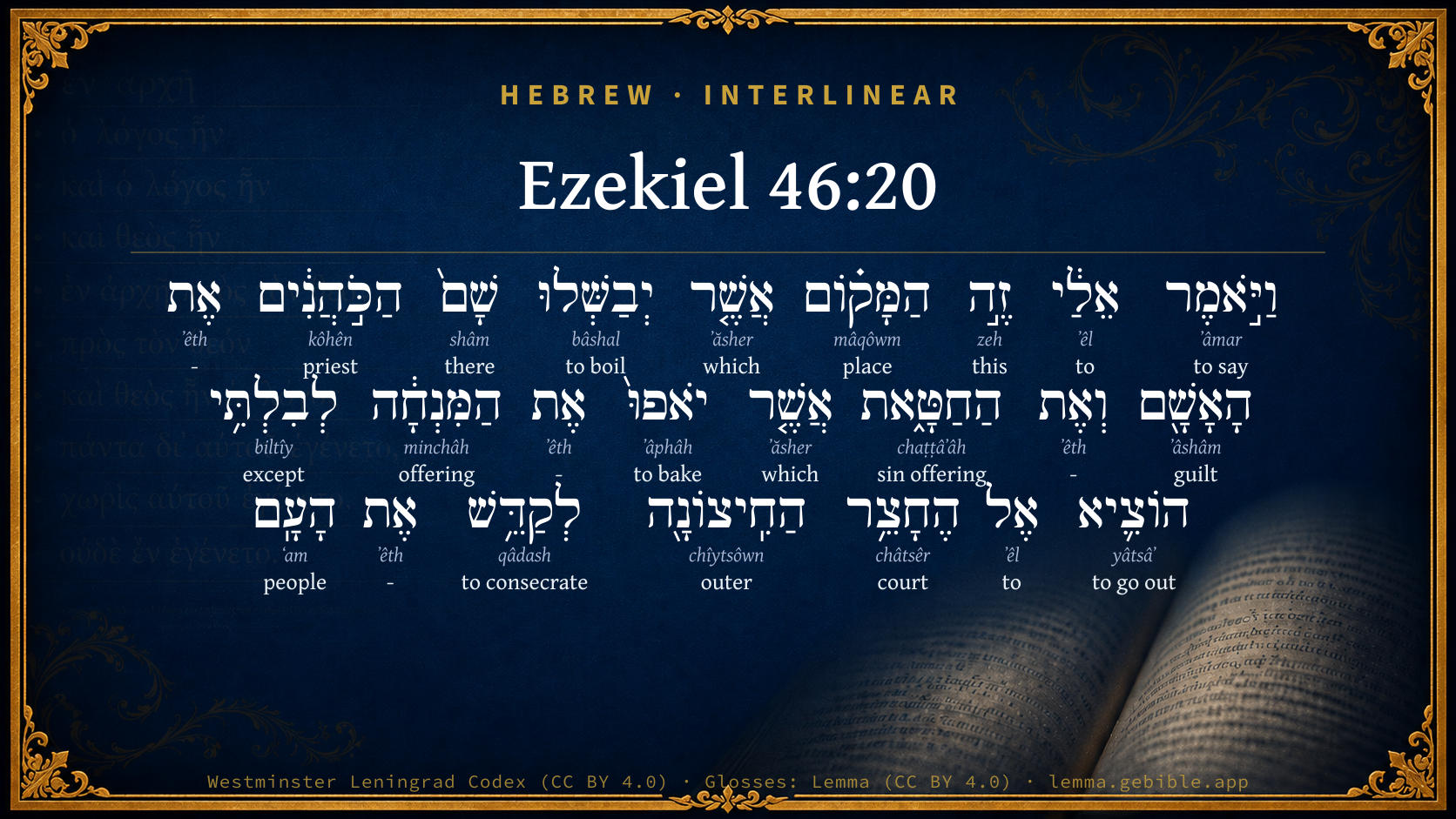
Ezekiel 46:20

Hebrew (Westminster Leningrad Codex) Ezekiel 46:20 appears in the Hebrew Old Testament. The text above is from the Westminster Leningrad Codex. Each word links to its Strong’s number, a concise gloss, and parsing drawn from the Open Scriptures Hebrew Bible morphology. Click any word for its full Brown-Driver-Briggs (BDB) entry.
Download image
Cite this verse

Ezekiel 46:20 (World English Bible). Public Domain. Lemma interlinear Bible study tool, https://lemma.gebible.app/v/ezekiel/46/20.

Show BibTeX & RIS
BibTeX
RIS
English Translation
He said to me, This is the place where the priests shall boil the trespass-offering and the sin-offering, [and] where they shall bake the meal-offering; that they not bring them forth into the outer court, to sanctify the people.
World English Bible · Public Domain
Download a study sheet

One document with this verse’s original text, its word-by-word gloss line, the meaning frame, cross-references with their text, attributed commentary, and full source and license credits — printable, and it pastes into notes with its structure intact.

This verse Autodidact and up

Study sheet (.html) Plain text (.txt)

A passage Seminary Student

Up to 50 verses in one chapter. A passage sheet keeps up to 6 commentary sources and 12 cross-references per verse, in the order this page ranks them, and says so on the sheet whenever that leaves anything out. Ask for a single verse and you get the Autodidact verse sheet above.

Everything on this page stays free to read, with no account — the sheet is a download of what is already on screen, not access to it.

Want to remove ads? Support Godless Engineer
Compare translations 3

The same verse in 3 English versions, stacked beneath the original-language interlinear above. Click any original word for its lexicon entry.

Each is an independent rendering of the whole verse — the interlinear is not word-aligned to these translations.

Highlighted words mark where these versions differ — a whole-verse word diff, not a word-by-word alignment.

  • World English Bible Public Domain
    He said to me, This is the place where the priests shall boil the trespass-offering and the sin-offering, [and] where they shall bake the meal-offering; that they not bring them forth into the outer court, to sanctify the people.
  • King James Version Public Domain
    Then said he unto me, This is the place where the priests shall boil the trespass offering and the sin offering, where they shall bake the meat offering; that they bear them not out into the utter court, to sanctify the people.
  • unfoldingWord Literal Text CC BY-SA 4.0
    He said to me, “This is the place where the priests must boil the guilt offering and the sin offering and where they must bake the grain offering. They must not bring the offerings into the outer courtyard, for then the people would be consecrated.”

unfoldingWord Literal Text — © unfoldingWord, licensed CC BY-SA 4.0. Word-aligned USFM3 via Door43 (git.door43.org/unfoldingWord/en_ult).

Versions to compare (up to 4)

3 of 4 selected

Show all 18 translations

Every available English version of this verse, each an independent rendering of the whole verse.

  • World English Bible Public Domain
    He said to me, This is the place where the priests shall boil the trespass-offering and the sin-offering, [and] where they shall bake the meal-offering; that they not bring them forth into the outer court, to sanctify the people.
  • Berean Standard Bible Public Domain
    and said to me, “This is the place where the priests shall boil the guilt offering and the sin offering, and where they shall bake the grain offering, so that they do not bring them into the outer court and transmit holiness to the people.”
  • Majority Standard Bible Public Domain
    and said to me, “This is the place where the priests shall boil the guilt offering and the sin offering, and where they shall bake the grain offering, so that they do not bring them into the outer court and transmit holiness to the people.”
  • King James Version Public Domain
    Then said he unto me, This is the place where the priests shall boil the trespass offering and the sin offering, where they shall bake the meat offering; that they bear them not out into the utter court, to sanctify the people.
  • American Standard Version (1901) Public Domain
    And he said unto me, This is the place where the priests shall boil the trespass-offering and the sin-offering, `and' where they shall bake the meal-offering; that they bring them not forth into the outer court, to sanctify the people.
  • Revised Version (1885) Public Domain
    And he said unto me, This is the place where the priests shall boil the guilt offering and the sin offering, where they shall bake the meal offering; that they bring them not forth into the outer court, to sanctify the people.
  • Geneva Bible (1599) Public Domain
    Then saide he vnto me, This is the place where the Priestes shall see the the trespasse offering and the sinne offering, where they shall bake the meat offring, that they should not beare them into the vtter court, to sanctifie ye people.
  • Douay-Rheims (1899) Public Domain
    And he said to me: This is the place where the priests shall boil the sin offering, and the trespass offering: where they shall dress the sacrifice, that they may not bring it out into the outward court, and the people be sanctified.
  • Young's Literal Translation Public Domain
    And he saith unto me, `This `is' the place where the priests do boil the guilt-offering and the sin-offering, where they bake the present, so as not to bring `it' out unto the outer court, to sanctify the people.'
  • Literal Standard Version CC BY-SA 4.0
    And he says to me, “This [is] the place where the priests boil the guilt-offering and the sin-offering, where they bake the present, so as not to bring [it] out to the outer court, to sanctify the people.”
  • Unlocked Literal Bible CC BY-SA 4.0
    He said to me, “This is the place where the priests must boil the guilt offering and the sin offering and where they must bake the grain offering. They must not bring the offerings into the outer courtyard, for then the people would be consecrated.”
  • unfoldingWord Literal Text CC BY-SA 4.0
    He said to me, “This is the place where the priests must boil the guilt offering and the sin offering and where they must bake the grain offering. They must not bring the offerings into the outer courtyard, for then the people would be consecrated.”
  • Darby Bible Public Domain
    And he said unto me, This is the place where the priests shall boil the trespass-offering, and the sin-offering, [and] where they shall bake the oblation, that they bring them not out into the outer court, so as to hallow the people.
  • World Messianic Bible Public Domain
    He said to me, “This is the place where the priests shall boil the trespass offering and the sin offering, and where they shall bake the meal offering, that they not bring them out into the outer court, to sanctify the people.”
  • Webster's Bible Public Domain
    Then said he to me, This is the place where the priests shall boil the trespass-offering and the sin-offering, where they shall bake the meat-offering; that they bear them not out into the outer court, to sanctify the people.
  • Free Bible Version CC BY-SA 4.0
    and told me, “This is where the priests cook guilt offerings and sin offerings, and where they bake the grain offering. This is so that they don't take them to the outer courtyard and carry holiness to the people.”
  • Bible in Basic English Public Domain
    And he said to me, This is the place where the offering for error and the sin-offering are to be cooked in water by the priests, and where the meal offering is to be cooked in the oven; so that they may not be taken out into the outer square to make the people holy.
  • JPS Tanakh (1917) Public Domain
    And he said unto me: 'This is the place where the priests shall boil the guilt-offering and the sin-offering, where they shall bake the meal-offering; that they bring them not forth into the outer court, to sanctify the people.'

Literal Standard Version (2020), Covenant Press — licensed CC BY-SA 4.0. Text via the HelloAO Bible API (eBible.org). Unlocked Literal Bible (unfoldingWord) — licensed CC BY-SA 4.0. Text via the HelloAO Bible API (eBible.org). unfoldingWord Literal Text — © unfoldingWord, licensed CC BY-SA 4.0. Word-aligned USFM3 via Door43 (git.door43.org/unfoldingWord/en_ult). Free Bible Version, Dr. Jonathan Gallagher — licensed CC BY-SA 4.0. Text via the HelloAO Bible API (eBible.org).

Word by word

More ways to search: Search by grammar → Find every occurrence → Compare this word →

Practice this passage: Drill this verse → Learn its vocabulary →

יֹאפוּ֙
ʼâphâh
H644
“to bake”
Verb, Qal, Imperfect, 3rd Person, Masculine, Plural
Part of Speech
Verb
Stem
Qal
Form
Imperfect
Person
3rd Person
Gender
Masculine
Number
Plural
Full BDB Definition

Origin: a primitive root

TWOT: 143

to bake - (Qal) - to bake - (substantive) baker - (Niphal) to be baked, baked
  1. וַיֹּ֣אמֶר ʼâmar H559 “and · to say” Conjunction + Verb, Qal, Sequential Imperfect, 3rd Person, Masculine, Singular
  2. אֵלַ֔י ʼêl H413 “to · me” Preposition + Suffix, Personal, 1st Person, Common, Singular
  3. זֶ֣ה zeh H2088 “this” Pronoun, Demonstrative, Masculine, Singular
  4. הַמָּק֗וֹם mâqôwm H4725 “the · place” Particle, Definite Article + Noun, Common, Masculine, Singular, Absolute
  5. אֲשֶׁ֤ר ʼăsher H834 “which” Particle, Relative
  6. יְבַשְּׁלוּ bâshal H1310 “to boil” Verb, Piel, Imperfect, 3rd Person, Masculine, Plural
  7. שָׁם֙ shâm H8033 “there” Adverb
  8. הַכֹּ֣הֲנִ֔ים kôhên H3548 “the · priests” Particle, Definite Article + Noun, Common, Masculine, Plural, Absolute
  9. אֶת ʼêth H853 “-” Particle, Direct Object
  10. הָאָשָׁ֖ם ʼâshâm H817 “the · guilt” Particle, Definite Article + Noun, Common, Masculine, Singular, Absolute
  11. וְאֶת ʼêth H853 “and · -” Conjunction + Particle, Direct Object
  12. הַחַטָּ֑את chaṭṭâʼâh H2403 “the · sin offering” Particle, Definite Article + Noun, Common, Feminine, Singular, Absolute
  13. אֲשֶׁ֤ר ʼăsher H834 “which” Particle, Relative
  14. אֶת ʼêth H853 “-” Particle, Direct Object
  15. הַמִּנְחָ֔ה minchâh H4503 “the · offering” Particle, Definite Article + Noun, Common, Feminine, Singular, Absolute
  16. לְבִלְתִּ֥י biltîy H1115 “to/for · except” Preposition + Conjunction
  17. הוֹצִ֛יא yâtsâʼ H3318 “to go out” Verb, Hiphil, Infinitive Construct
  18. אֶל ʼêl H413 “to” Preposition
  19. הֶחָצֵ֥ר châtsêr H2691 “the · court” Particle, Definite Article + Noun, Common, Both, Singular, Absolute
  20. הַחִֽיצוֹנָ֖ה chîytsôwn H2435 “the · outer” Particle, Definite Article + Adjective, Adjective, Feminine, Singular, Absolute
  21. לְקַדֵּ֥שׁ qâdash H6942 “to consecrate” Preposition + Verb, Piel, Infinitive Construct
  22. אֶת ʼêth H853 “-” Particle, Direct Object
  23. הָעָֽם ʻam H5971 “the · people” Particle, Definite Article + Noun, Common, Masculine, Singular, Absolute

About this verse

These counts appear in no published source. They are computed here, from the morphology-tagged text and Lemma’s own curated glosses. What Lemma adds →

24
words
19
distinct lemmas
Prophets
section

Notable vocabulary

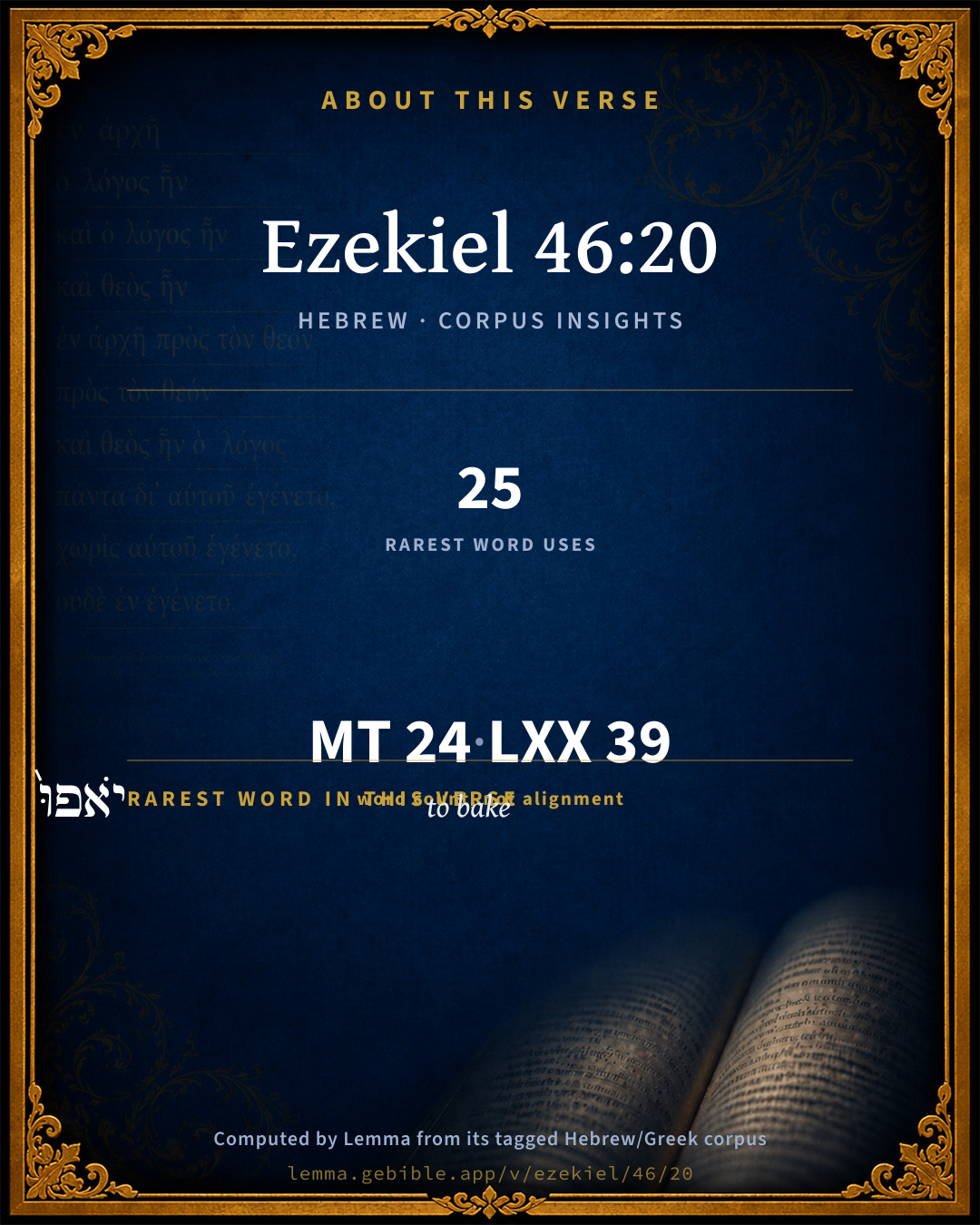
The rarest word here is יֹאפוּ֙ to bake H644 — appearing just 25 times in the whole Hebrew Bible.

Shared distinctive vocabulary

יֹאפוּ֙ to bake H644 occurs in 24 verses of the Hebrew Bible. Also found in:

Grammatical profile

  • 5 verbs
  • 7 nouns
  • 1 adjective
  • 1 pronoun
  • 2 prepositions
  • 1 conjunction
  • 1 adverb
  • 6 particles

Verb forms

  • וַיֹּ֣אמֶר Qal · Sequential Imperfect
  • יְבַשְּׁלוּ Piel · Imperfect
  • יֹאפוּ֙ Qal · Imperfect
  • הוֹצִ֛יא Hiphil · Infinitive Construct
  • לְקַדֵּ֥שׁ Piel · Infinitive Construct

Repetition

Words recur within this verse — often emphatic in Hebrew:

  • אֵלַ֔י to H413 ×2
  • אֲשֶׁ֤ר which H834 ×2

Hebrew & Septuagint length

In English translation the verse runs 39 words from the Hebrew and 42 from the Septuagint (LXX English) — closely comparable.

A rough comparison of the two English renderings, which tokenize alike — not a word-level alignment.

Word counts can differ between the Hebrew and the Greek without any difference in meaning — e.g. the Hebrew direct-object marker אֵת has no separate Greek word, and Greek often adds the article ὁ.

In the original languages it is 24 Hebrew tokens and 39 Greek tokens — but the two are counted differently (Hebrew bundles its prefixes and suffixes into one token; the Greek is in lemma form), so that isn’t a like-for-like length.

Cross-references

6

Topical passages linked to Ezekiel 46:20 in the Treasury of Scripture Knowledge — connected by theme and wording, ordered by reader-vote popularity; previews shown in the World English Bible.

  • 2 Chronicles 35:13 They roasted the Passover with fire according to the ordinance: and the holy offerings boiled they in pots, and in caldrons, and in pans, and carried them quickly to all the children of the people.
  • Leviticus 2:4–7 "'When you offer an offering of a meal offering baked in the oven, it shall be unleavened cakes of fine flour mixed with oil, or unleavened wafers anointed with oil.
  • Ezekiel 44:19 When they go forth into the outer court, even into the outer court to the people, they shall put off their garments in which they minister, and lay them in the holy chambers; and they shall put on other garments, that they not sanctify the people with their garments.
  • Ezekiel 44:29 They shall eat the meal-offering, and the sin-offering, and the trespass-offering; and every devoted thing in Israel shall be theirs.
  • Leviticus 7:1–38 "'This is the law of the trespass offering. It is most holy.
  • 1 Samuel 2:13–15 The custom of the priests with the people was that when any man offered sacrifice, the priest's servant came, while the flesh was boiling, with a flesh-hook of three teeth in his hand;

Cross-references courtesy of OpenBible.info (CC BY 4.0).

Hebrew and Greek witnesses Masoretic Hebrew ↔ Greek Septuagint

The same verse in the two great witnesses to the Old Testament, shown verse-for-verse.

These are two independent witnesses, not word-aligned to each other, and the Septuagint is shown in lemma (dictionary) form.

Hebrew Ezekiel 46:20 Masoretic · Westminster Leningrad Codex

וַיֹּ֣אמֶר אֵלַ֔י זֶ֣ה הַמָּק֗וֹם אֲשֶׁ֤ר יְבַשְּׁלוּ שָׁם֙ הַכֹּ֣הֲנִ֔ים אֶת הָאָשָׁ֖ם וְאֶת הַחַטָּ֑את אֲשֶׁ֤ר יֹאפוּ֙ אֶת הַמִּנְחָ֔ה לְבִלְתִּ֥י הוֹצִ֛יא אֶל הֶחָצֵ֥ר הַחִֽיצוֹנָ֖ה לְקַדֵּ֥שׁ אֶת הָעָֽם

He said to me, This is the place where the priests shall boil the trespass-offering and the sin-offering, [and] where they shall bake the meal-offering; that they not bring them forth into the outer court, to sanctify the people.

World English Bible · Public Domain

Greek LXX Ezekiel 46:20 Septuagint · lemma form

καί εἶπον πρός ἐγώ οὗτος ὁ τόπος εἰμί ὅς ἕψω ἐκεῖ ὁ ἱερεύς ὁ ὑπέρ ἄγνοια καί ὁ ὑπέρ ἁμαρτία καί ἐκεῖ πέσσω ὁ μαναα ὁ παράπαν ὁ μή ἐκφέρω εἰς ὁ αὐλή ὁ ἐξώτερος ὁ ἁγιάζω ὁ λαός

And he said to me, This is the place where the priests shall boil the trespass-offerings and the sin-offerings, and there shall they bake the meat-offering always; so as not to carry them out into the outer court, to sanctify the people.

LXX2012 (modern English Septuagint) · Public Domain

Hebrew: Westminster Leningrad Codex (CC BY 4.0). Greek: Septuagint (public domain); English from LXX2012 (modern English Septuagint) (Public Domain). How the Septuagint differs from the Hebrew →

Targum (Aramaic paraphrase)

1

The Targum is the ancient Jewish Aramaic paraphrase of the Hebrew Scriptures — an interpretive translation, not the Hebrew text itself. Onkelos (literal) and Pseudo-Jonathan (expansive) render the Torah, and Jonathan the Prophets. Coverage is partial: where no permissively-licensed English translation exists for a verse, only the Aramaic is shown. This is verse-level text, not a word-by-word alignment to the Hebrew.

  1. Targum Jonathan Prophets (Joshua–Malachi)
    וַאֲמַר לִי דֵין אַתְרָא דִיבַשְׁלוּן תַּמָן כַּהֲנַיָא יַת אֲשָׁמָא וְיַת חֲטָאתָא דִי יֵיפוּן יַת מִנְחָתָא בְּדִיל דְלָא לְאַפָקָא לְדַרְתָּא בְּרַיְתָא לְאִתְעֲרָבָא עִם עַמָא:

    (no public-domain English translation for this verse)

    Targum Jonathan — Aramaic: “Mikraot Gedolot” (public domain). English: “Sefaria Community Translation” (CC0 1.0 (public-domain dedication)); “London "Chaldee Paraphrase," 1871” (public domain). Text via Sefaria.

Commentary

Notes on Ezekiel 46:20 from classic Christian and Jewish commentators (each source and its license shown beneath its notes). The classic Christian expositions comment on the surrounding passage and are grouped to its opening verse, so a note may address several verses; the Jewish commentaries on the Tanakh (Rashi and others) are per-verse, so they appear only where the commentator wrote on this verse.

Lemma curates 59 commentaries, every one of them public domain or Creative Commons licensed, each selected and text-cleaned for this edition rather than reprinted as found. About our sources →

Trapp's Complete Commentary

John Trapp

Eze 46:20 Then said he unto me, This [is] the place where the priests shall boil the trespass offering and the sin offering, where they shall bake the meat offering; that they bear [them] not out into the utter court, to sanctify the people.

Ver. 20. Where they shall bake the meat offering,] i.e., The ministers shall indite or boil good matters in their hearts for the use of the people, and then their tongues shall be as the pen of a ready writer. {Psa 45:1} They shall not feed their hearers with crude and indigested stuff, but such as is well boiled and baked with the fire of the Holy Spirit, kindled on the hearth of their own hearts; that from the heart they may speak to the heart.

To sanctify the people.] As in promiscuous communions, where all are pell-mell admitted.

John Trapp, A Commentary or Exposition upon All the Books of the Old and New Testament (1647–1656) — public domain. Text from a community e-Sword module.

Geneva Bible (1599)

Geneva Bible translators

That the people should not have to do with those things which appertain to the Lord, and think it lawful for them to eat them.

Geneva Bible (1599) marginal notes — public domain. Text via Bolls.life.

Adam Clarke's Commentary

Verse 20. The trespass-offering] Part of this, and of the sin-offering, and the flour-offering was the portion of the priests. See Nu 18:9-10.

Adam Clarke's Commentary on the Bible (1810–1826) — public domain. Text from a community e-Sword/MySword module.

Ellicott's Commentary for English Readers

(20) Shall boil . . . shall bake.—The flesh of all sacrifices except the Passover was by the law required to be boiled, and the unbloody “meat offering,” when not already cooked, was to be baked.

Bear them not out into the utter court.—In one sense the priestly chambers and also these cooking rooms were themselves in the outer court; but as already remarked, these, with the walk that led to them, although within the enclosure of the outer, were considered as appurtenances of, and therefore belonging to, the inner court. The reason given for not bearing the flesh of the sin and trespass offering into the outer court is, lest they should thereby “sanctify the people,” and the same reason is given in Eze_44:19 for not allowing the priests’ garments to come into the outer court. Under the law all those offerings which it was the duty of the priests to consume are called “most holy,” and whoever touched them or the sacred vessels of the sanctuary became “holy” in the sense of set apart to God (Lev_6:18; also Exo_29:37; Exo_30:29). The object of the command is therefore to prevent that ceremonial sanctification of the people which would interfere with their ordinary life.

A Bible Commentary for English Readers, edited by Charles John Ellicott (1878–1897) — public domain. Text from a community e-Sword module.

John Gill's Exposition

Then he brought me forth into the utter court,.... From the holy chambers of the priests, and from viewing the place where they boiled the sacrifices, and baked the meat offering:

and caused me to pass by the four corners of the court; in each of the four corners of the outward court there was another court; signifying that there will be courts or churches in the several parts of the world in the latter day.

John Gill's Exposition of the Whole Bible (1746–1763) — public domain (CC PDM 1.0). Text via the HelloAO Bible API.

Matthew Poole's English Annotations

Where the priests shall boil the trespass-offering; those that were brought sacrifices for sin were in part for the sacrificing priest, and he was to eat thereof; but it was to be dressed in the verge of holy ground, and so kitchens, boilers, ovens, and other utensils were prepared to do it, and these kitchens are here described,

That they bear them not; the priests, or the attending Levites.

Into the utter court, where the people were, and many times in great numbers, that this holy flesh must needs be very near many of them, if it were carried out.

To sanctify the people: see Eze 44:19.

Matthew Poole's English Annotations on the Holy Bible (1683–1685) — public domain. Text from a community e-Sword/MySword module.

The Pulpit Commentary

The "place" was designed as a kitchen where the priests should boil the trespass and the sin offerings and bake the meat (or, meal) offering, i.e. cook the portions of the sacrifices they should eat in their official capacity. (see Eze_42:13) The Law of Moses (Lev_8:31) required the flesh to be boiled (and probably also the flour to be baked) at the tabernacle door. The last clause, that they, i.e. the priests, bear them, i.e. the offerings, not out into the utter (or, outer) court, to sanctify the people, is by most interpreters understood in the sense of Eze_44:19 (which see). To this, however, Kliefoth objects that the conception of deriving ceremonial sanctity from contact with such offerings is completely strange to the Old Testament, (see Hag_2:12) and accordingly he connects the words. "to sanctify the people," with the "baking" and "boiling" of the preceding clause.

The Pulpit Commentary (1880–1919), ed. H.D.M. Spence-Jones & Joseph S. Exell — public domain. Text from a community e-Sword module.

John Wesley's Explanatory Notes

The outer court - Where the people were.

John Wesley, Explanatory Notes Upon the Whole Bible (1754–1765) — public domain. Text via the GEBible commentary corpus.

Rashi

Rabbi Shlomo Yitzchaki (Rashi)

so as not to bring [them] out [Heb. הוֹצִיא,] like לְהוֹצִיא, for the “most holy sacrifices” become disqualified by being taken out.

to mingle with the people [Heb. לְקַדֵשׁ אֶתהָעָם lit. to sanctify the people.] Jonathan renders: to mingle with the people.

Rashi on the Tanakh — English translations: “The Judaica Press complete Tanach with Rashi, translated by A. J. Rosenberg” (CC BY 4.0); “Pentateuch with Rashi's commentary by M. Rosenbaum and A.M. Silbermann, 1929-1934” (public domain); “The Metsudah Tanach series, Lakewood, N.J” (CC BY 4.0); and “The Book of Joshua, Metsudah Publications, 1997” (CC BY 4.0). Text via Sefaria.

Lesson kit

Teaching starters — assembled from the data on this page, not authored interpretation. Every prompt links to the verse data it draws on. Edit before teaching.

Ezekiel, in the Prophets, opens this verse with 24 words (19 distinct Hebrew lemmas). Its most distinctive word is ʼâphâh (“to bake”). A historical commentator’s framing appears above. Read the whole chapter for the surrounding context.

Discussion questions

  1. How does “to bake” (ʼâphâh) shape what this verse is saying?
  2. How does Genesis 19:3, which shares the word «to bake», read alongside this verse?
  3. What does the repetition of “to” (2× in this one verse) do in this verse?
  4. These translations render this verse differently; the difference is in the English rendering, not the original. What questions does that raise?
  5. «וַיֹּ֣אמֶר» is a Qal Sequential Imperfect verb. How does that grammatical form shape the action described?
  6. Compare how Trapp's Complete Commentary and Geneva Bible (1599) read this verse. Where do they agree or differ?

Things to notice

Reading settings

Reading text

Shown beneath each verse's original-language words.

Old Testament
Old Testament edition

Read the OT as the Masoretic Hebrew (MT) or the Greek Septuagint (LXX).

English shown for the Greek Septuagint (in the Hebrew ↔ Greek comparison).

Comparing translations? Open the Compare panel on any verse page to stack up to four side by side.