Ezekiel 24:2

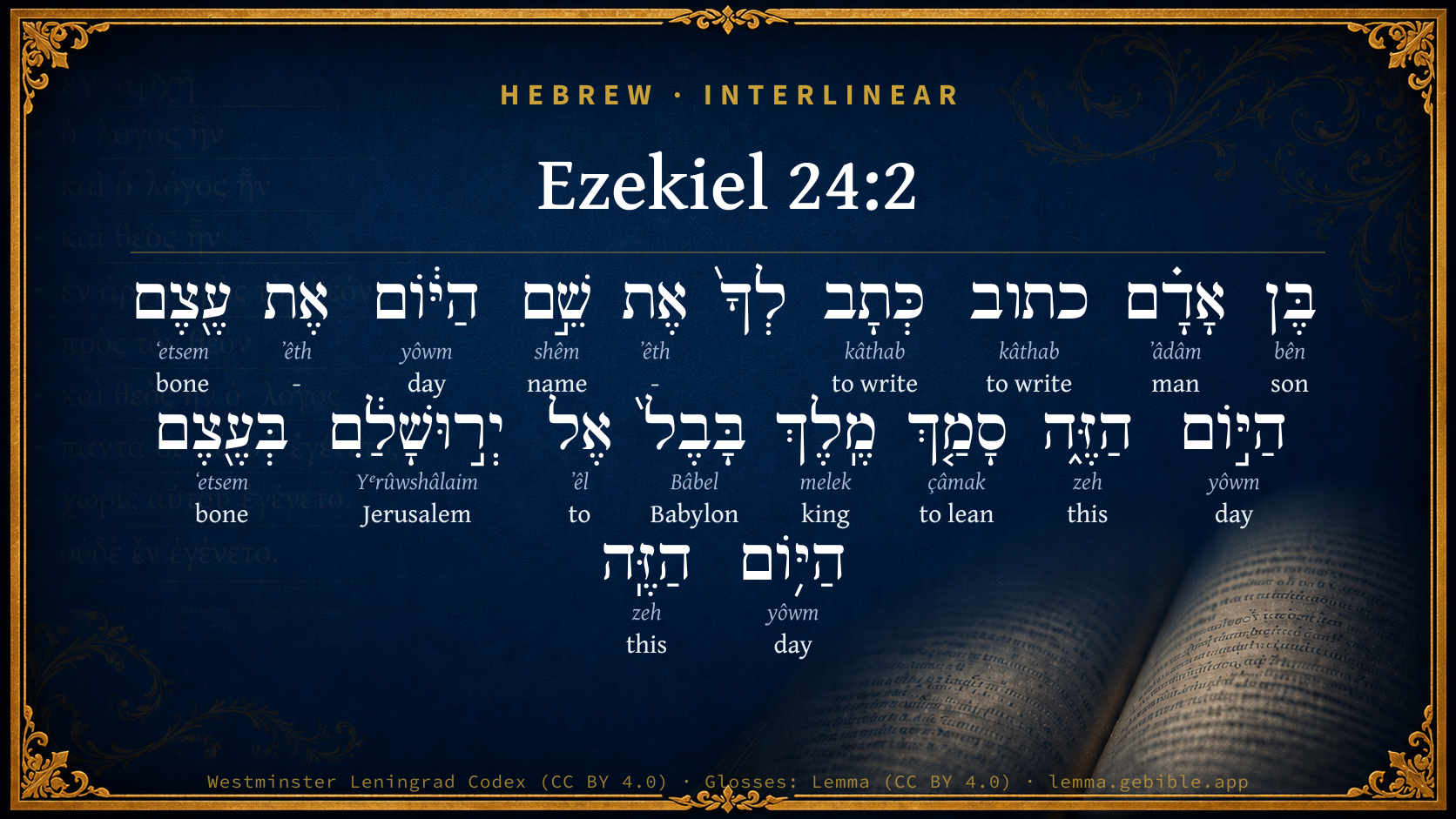
Hebrew (Westminster Leningrad Codex) Ezekiel 24:2 appears in the Hebrew Old Testament. The text above is from the Westminster Leningrad Codex. Each word links to its Strong’s number, a concise gloss, and parsing drawn from the Open Scriptures Hebrew Bible morphology. Click any word for its full Brown-Driver-Briggs (BDB) entry.
Download image
Cite this verse

Ezekiel 24:2 (World English Bible). Public Domain. Lemma interlinear Bible study tool, https://lemma.gebible.app/v/ezekiel/24/2.

Show BibTeX & RIS
BibTeX
RIS
English Translation
Son of man, write you the name of the day, [even] of this same day: the king of Babylon drew close to Jerusalem this same day.
World English Bible · Public Domain
Download a study sheet

One document with this verse’s original text, its word-by-word gloss line, the meaning frame, cross-references with their text, attributed commentary, and full source and license credits — printable, and it pastes into notes with its structure intact.

This verse Autodidact and up

Study sheet (.html) Plain text (.txt)

A passage Seminary Student

Up to 50 verses in one chapter. A passage sheet keeps up to 6 commentary sources and 12 cross-references per verse, in the order this page ranks them, and says so on the sheet whenever that leaves anything out. Ask for a single verse and you get the Autodidact verse sheet above.

Everything on this page stays free to read, with no account — the sheet is a download of what is already on screen, not access to it.

Want to remove ads? Support Godless Engineer
Compare translations 3

The same verse in 3 English versions, stacked beneath the original-language interlinear above. Click any original word for its lexicon entry.

Each is an independent rendering of the whole verse — the interlinear is not word-aligned to these translations.

Highlighted words mark where these versions differ — a whole-verse word diff, not a word-by-word alignment.

  • World English Bible Public Domain
    Son of man, write you the name of the day, [even] of this same day: the king of Babylon drew close to Jerusalem this same day.
  • King James Version Public Domain
    Son of man, write thee the name of the day, even of this same day: the king of Babylon set himself against Jerusalem this same day.
  • unfoldingWord Literal Text CC BY-SA 4.0
    “Son of man, write for yourself the name of this day, this exact day, for this exact day the king of Babylon has besieged Jerusalem.

unfoldingWord Literal Text — © unfoldingWord, licensed CC BY-SA 4.0. Word-aligned USFM3 via Door43 (git.door43.org/unfoldingWord/en_ult).

Versions to compare (up to 4)

3 of 4 selected

Show all 18 translations

Every available English version of this verse, each an independent rendering of the whole verse.

  • World English Bible Public Domain
    Son of man, write you the name of the day, [even] of this same day: the king of Babylon drew close to Jerusalem this same day.
  • Berean Standard Bible Public Domain
    “Son of man, write down today’s date, for on this very day the king of Babylon has laid siege to Jerusalem.
  • Majority Standard Bible Public Domain
    “Son of man, write down today’s date, for on this very day the king of Babylon has laid siege to Jerusalem.
  • King James Version Public Domain
    Son of man, write thee the name of the day, even of this same day: the king of Babylon set himself against Jerusalem this same day.
  • American Standard Version (1901) Public Domain
    Son of man, write thee the name of the day, `even' of this selfsame day: the king of Babylon drew close unto Jerusalem this selfsame day.
  • Revised Version (1885) Public Domain
    Son of man, write thee the name of the day, even of this selfsame day: the king of Babylon drew close unto Jerusalem this selfsame day.
  • Geneva Bible (1599) Public Domain
    Sonne of man, write thee the name of the day, euen of this same day: for the King of Babel set himselfe against Ierusalem this same day.
  • Douay-Rheims (1899) Public Domain
    Son of man, write thee the name of this day, on which the king of Babylon hath set himself against Jerusalem to day.
  • Young's Literal Translation Public Domain
    `Son of man, write for thee the name of the day -- this self-same day leaned hath the king of Babylon toward Jerusalem in this self-same day --
  • Literal Standard Version CC BY-SA 4.0
    “Son of man, write! Write the name of the day for yourself, this very day; the king of Babylon has leaned toward Jerusalem in this very day.
  • Unlocked Literal Bible CC BY-SA 4.0
    “Son of man, write for yourself the name of this day, this exact day, for this exact day the king of Babylon has besieged Jerusalem.
  • unfoldingWord Literal Text CC BY-SA 4.0
    “Son of man, write for yourself the name of this day, this exact day, for this exact day the king of Babylon has besieged Jerusalem.
  • Darby Bible Public Domain
    Son of man, write thee the name of the day, of this selfsame day: on this selfsame day the king of Babylon draws near to Jerusalem.
  • World Messianic Bible Public Domain
    “Son of man, write the name of the day, this same day. The king of Babylon drew close to Jerusalem this same day.
  • Webster's Bible Public Domain
    Son of man, Write for thee the name of the day, even of this same day: the king of Babylon set himself against Jerusalem this same day.
  • Free Bible Version CC BY-SA 4.0
    “Son of man, write down today's date, because this is the day that the king of Babylon started his siege of Jerusalem.
  • Bible in Basic English Public Domain
    Son of man, put down in writing this very day: The king of Babylon let loose the weight of his attack against Jerusalem on this very day.
  • JPS Tanakh (1917) Public Domain
    'Son of man, write thee the name of the day, even of this selfsame day; this selfsame day the king of Babylon hath invested Jerusalem.

Literal Standard Version (2020), Covenant Press — licensed CC BY-SA 4.0. Text via the HelloAO Bible API (eBible.org). Unlocked Literal Bible (unfoldingWord) — licensed CC BY-SA 4.0. Text via the HelloAO Bible API (eBible.org). unfoldingWord Literal Text — © unfoldingWord, licensed CC BY-SA 4.0. Word-aligned USFM3 via Door43 (git.door43.org/unfoldingWord/en_ult). Free Bible Version, Dr. Jonathan Gallagher — licensed CC BY-SA 4.0. Text via the HelloAO Bible API (eBible.org).

Word by word

More ways to search: Search by grammar → Find every occurrence → Compare this word →

Practice this passage: Drill this verse → Learn its vocabulary →

סָמַ֤ךְ
çâmak
H5564
“to lean”
Verb, Qal, Perfect, 3rd Person, Masculine, Singular
Part of Speech
Verb
Stem
Qal
Form
Perfect
Person
3rd Person
Gender
Masculine
Number
Singular
Full BDB Definition

Origin: a primitive root

TWOT: 1514

to lean, lay, rest, support, put, uphold, lean upon - (Qal) - to lean or lay upon, rest upon, lean against - to support, uphold, sustain - (Niphal) to support or brace oneself - (Piel) to sustain, refresh, revive
  1. בֶּן bên H1121 “son of” Noun, Common, Masculine, Singular, Construct
  2. אָדָ֗ם ʼâdâm H120 “man” Noun, Common, Masculine, Singular, Absolute
  3. כתוב kâthab H3789 “to write” Verb, Qal, Infinitive Absolute
  4. כְּתָב kâthab H3789 “write” Verb, Qal, Imperative, 2nd Person, Masculine, Singular
  5. אֶת ʼêth H853 “-” Particle, Direct Object
  6. שֵׁ֣ם shêm H8034 “name of” Noun, Common, Masculine, Singular, Construct
  7. הַיּ֔וֹם yôwm H3117 “the · day” Particle, Definite Article + Noun, Common, Masculine, Singular, Absolute
  8. אֶת ʼêth H853 “-” Particle, Direct Object
  9. עֶ֖צֶם ʻetsem H6106 “bone of” Noun, Common, Feminine, Singular, Construct
  10. הַיּ֣וֹם yôwm H3117 “the · day” Particle, Definite Article + Noun, Common, Masculine, Singular, Absolute
  11. הַזֶּ֑ה zeh H2088 “the · this” Particle, Definite Article + Pronoun, Demonstrative, Masculine, Singular
  12. מֶֽלֶךְ melek H4428 “king of” Noun, Common, Masculine, Singular, Construct
  13. בָּבֶל֙ Bâbel H894 “Babylon” Noun, Proper
  14. אֶל ʼêl H413 “to” Preposition
  15. יְר֣וּשָׁלִַ֔ם Yᵉrûwshâlaim H3389 “Jerusalem” Noun, Proper
  16. בְּעֶ֖צֶם ʻetsem H6106 “in/at · bone of” Preposition + Noun, Common, Feminine, Singular, Construct
  17. הַיּ֥וֹם yôwm H3117 “the · day” Particle, Definite Article + Noun, Common, Masculine, Singular, Absolute
  18. הַזֶּֽה zeh H2088 “the · this” Particle, Definite Article + Pronoun, Demonstrative, Masculine, Singular

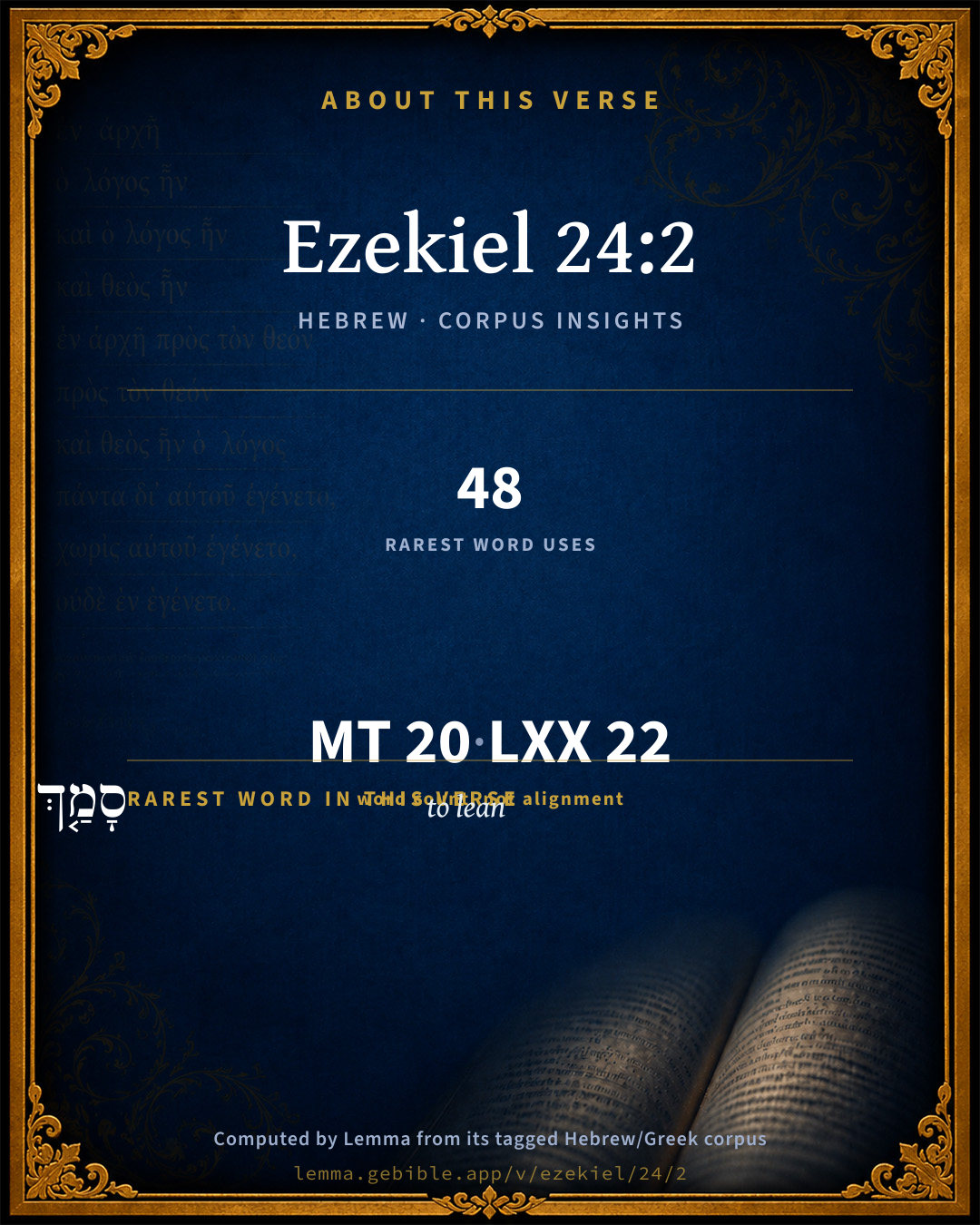
About this verse

These counts appear in no published source. They are computed here, from the morphology-tagged text and Lemma’s own curated glosses. What Lemma adds →

20
words
13
distinct lemmas
Prophets
section

Shared distinctive vocabulary

סָמַ֤ךְ to lean H5564 occurs in 47 verses of the Hebrew Bible. Also found in:

Grammatical profile

  • 3 verbs
  • 11 nouns
  • 2 pronouns
  • 2 prepositions
  • 2 particles

Verb forms

  • כתוב Qal · Infinitive Absolute
  • כְּתָב Qal · Imperative
  • סָמַ֤ךְ Qal · Perfect

Repetition

Words recur within this verse — often emphatic in Hebrew:

  • הַיּ֔וֹם day H3117 ×3
  • כתוב to write H3789 ×2
  • עֶ֖צֶם bone H6106 ×2
  • הַזֶּ֑ה this H2088 ×2

Hebrew & Septuagint length

In English translation the verse runs 26 words from the Hebrew and 24 from the Septuagint (LXX English) — closely comparable.

A rough comparison of the two English renderings, which tokenize alike — not a word-level alignment.

Word counts can differ between the Hebrew and the Greek without any difference in meaning — e.g. the Hebrew direct-object marker אֵת has no separate Greek word, and Greek often adds the article ὁ.

In the original languages it is 20 Hebrew tokens and 22 Greek tokens — but the two are counted differently (Hebrew bundles its prefixes and suffixes into one token; the Greek is in lemma form), so that isn’t a like-for-like length.

Cross-references

6

Topical passages linked to Ezekiel 24:2 in the Treasury of Scripture Knowledge — connected by theme and wording, ordered by reader-vote popularity; previews shown in the World English Bible.

  • 2 Kings 25:1 It happened in the ninth year of his reign, in the tenth month, in the tenth day of the month, that Nebuchadnezzar king of Babylon came, he and all his army, against Jerusalem, and encamped against it; and they built forts against it round about.
  • Jeremiah 39:1 It happened when Jerusalem was taken, (in the ninth year of Zedekiah king of Judah, in the tenth month, came Nebuchadrezzar king of Babylon and all his army against Jerusalem, and besieged it;
  • Jeremiah 52:4 It happened in the ninth year of his reign, in the tenth month, in the tenth day of the month, that Nebuchadrezzar king of Babylon came, he and all his army, against Jerusalem, and encamped against it; and they built forts against it round about.
  • Isaiah 8:1 Yahweh said to me, "Take a large tablet, and write on it with a man's pen, 'For Maher Shalal Hash Baz;'
  • Isaiah 30:8–9 Now go, write it before them on a tablet, and inscribe it in a book, that it may be for the time to come forever and ever.
  • Habakkuk 2:2–3 Yahweh answered me, "Write the vision, and make it plain on tablets, that he may run who reads it.

Cross-references courtesy of OpenBible.info (CC BY 4.0).

Hebrew and Greek witnesses Masoretic Hebrew ↔ Greek Septuagint

The same verse in the two great witnesses to the Old Testament, shown verse-for-verse.

These are two independent witnesses, not word-aligned to each other, and the Septuagint is shown in lemma (dictionary) form.

Hebrew Ezekiel 24:2 Masoretic · Westminster Leningrad Codex

בֶּן אָדָ֗ם כתוב כְּתָב לְךָ֙ אֶת שֵׁ֣ם הַיּ֔וֹם אֶת עֶ֖צֶם הַיּ֣וֹם הַזֶּ֑ה סָמַ֤ךְ מֶֽלֶךְ בָּבֶל֙ אֶל יְר֣וּשָׁלִַ֔ם בְּעֶ֖צֶם הַיּ֥וֹם הַזֶּֽה

Son of man, write you the name of the day, [even] of this same day: the king of Babylon drew close to Jerusalem this same day.

World English Bible · Public Domain

Greek LXX Ezekiel 24:2 Septuagint · lemma form

υἱός ἄνθρωπος γράφω σεαυτοῦ εἰς ἡμέρα ἀπό ὁ ἡμέρα οὗτος ἀπό ὅς ἀποἐρείδομαι βασιλεύς βαβυλών ἐπί ἰερουσαλήμ ἀπό ὁ ἡμέρα ὁ σήμερον

Son of man, write for yourself daily from this day, on which the king of Babylon set himself against Jerusalem, even from this day.

LXX2012 (modern English Septuagint) · Public Domain

Hebrew: Westminster Leningrad Codex (CC BY 4.0). Greek: Septuagint (public domain); English from LXX2012 (modern English Septuagint) (Public Domain). How the Septuagint differs from the Hebrew →

Targum (Aramaic paraphrase)

1

The Targum is the ancient Jewish Aramaic paraphrase of the Hebrew Scriptures — an interpretive translation, not the Hebrew text itself. Onkelos (literal) and Pseudo-Jonathan (expansive) render the Torah, and Jonathan the Prophets. Coverage is partial: where no permissively-licensed English translation exists for a verse, only the Aramaic is shown. This is verse-level text, not a word-by-word alignment to the Hebrew.

  1. Targum Jonathan Prophets (Joshua–Malachi)
    בַּר אָדָם כְּתַב לָךְ יַת שׁוּם יוֹמָא יַת כְּרַן יוֹמָא הָדֵין סְמַךְ מַלְכָּא דְבָבֶל עַל יְרוּשְׁלֵם בִּכְרַן יוֹמָא הָדֵין:

    (no public-domain English translation for this verse)

    Targum Jonathan — Aramaic: “Mikraot Gedolot” (public domain). English: “Sefaria Community Translation” (CC0 1.0 (public-domain dedication)); “London "Chaldee Paraphrase," 1871” (public domain). Text via Sefaria.

Commentary

Notes on Ezekiel 24:2 from classic Christian and Jewish commentators (each source and its license shown beneath its notes). The classic Christian expositions comment on the surrounding passage and are grouped to its opening verse, so a note may address several verses; the Jewish commentaries on the Tanakh (Rashi and others) are per-verse, so they appear only where the commentator wrote on this verse.

Lemma curates 59 commentaries, every one of them public domain or Creative Commons licensed, each selected and text-cleaned for this edition rather than reprinted as found. About our sources →

Trapp's Complete Commentary

John Trapp

Eze 24:2 Son of man, write thee the name of the day, [even] of this same day: the king of Babylon set himself against Jerusalem this same day.

Ver. 2. This same day.] Ezekiel in Mesopotamia is told by God, and telleth others the very day that Nebuchadnezzar laid siege to Jerusalem. {2Ki 25:1 Jer 39:1; Jer 52:4} Heathen historians all us of Apollonius Tyanaeus, that in the self-same day and hour wherein Domitian the emperor was slain at Rome, he got up into a high place at Ephesus in Asia, and calling together a great multitude of men, he spake these words, Kαλως Sτεφανε, ειγε Sτεφανε - Well done, Stephen, strike the murderer home, pay him soundly; thou hast struck him, thou hast wounded him to the heart, thou hast slain him outright; {a} I commend thee for it. This, if it were so, was brought to him by the devil doubtless. Our prophet had a better intelligencer.

{a} παιε τον μιαιφονον, επλεξας, ετρωσας, απεκτεινας. - Dio Domit.

John Trapp, A Commentary or Exposition upon All the Books of the Old and New Testament (1647–1656) — public domain. Text from a community e-Sword module.

Tyndale Open Study Notes

Tyndale Open Resources

24:2 Ezekiel had been warning the people of this event, and it had now finally arrived (see also 2 Kgs 25:1-2). • is beginning his attack against (literally is leaning on): The same terminology was used when a worshiper pressed his hands on the animal he had brought to be sacrificed (Lev 1:4; 3:2). Jerusalem was thus identified as the sacrificial lamb to be slaughtered to the glory of God.

Tyndale Open Study Notes — © Tyndale Open Resources, licensed CC BY-SA 4.0. Text via the HelloAO Bible API.

Jamieson, Fausset & Brown

Robert Jamieson, A. R. Fausset & David Brown

set himself--laid siege; "lay against."

Jamieson, Fausset & Brown — Commentary Critical and Explanatory on the Whole Bible (1871) — public domain (CC PDM 1.0). Text via the HelloAO Bible API.

Ellicott's Commentary for English Readers

(2) Write thee the name.—It is evident that especial attention was to be called to the exact date, and a note made of it at the time. The words “has set himself against” would be more accurately rendered has fallen upon. The supposition that the reference is to some point on his march from which Nebuchadnezzar advanced to the attack upon Jerusalem, and that tidings of this were brought to the prophet in the ordinary way, is quite inconsistent with the whole verse. It is plain that the prophet means to say, with especial emphasis and distinctness, that he was informed of what was taking place at Jerusalem on the same day in which it happened.

A Bible Commentary for English Readers, edited by Charles John Ellicott (1878–1897) — public domain. Text from a community e-Sword module.

John Gill's Exposition

Son of man, write thee the name of the day,.... That is, what day of the week it was, as well as what day of the month; as whether the first, or second, or third, &c.: for the Jews had no other names for their days, as we have:

even of this same day; according to Bishop Usher (r), it was the 30th of January, and the fifth day of the week (Thursday); A.M. 3414, or 590 before Christ. Mr. Whiston (s) places it at 3413 A.M. or 591 before Christ. The prophet is bid to observe it punctually, and write it exactly, that there might be no mistake; to set it down in his pocket book; or it may be in some public register, that it might not only be remembered by him, but known by the people; that so when they should hear the fact afterwards related, and exactly agreeing with this prediction, they would acknowledge him to be a true prophet; since this would be a confirmation of the word of the Lord coming to him:

the king of Babylon set himself against Jerusalem this same day; or "drew nigh" (t); brought up his army to it, and laid siege against it, and prepared everything to carry it on; which he very probably did in person, though he afterwards retired, and left the command of his army with his generals; and this was exactly the day before mentioned; see Kg2 25:1. The Prophet Ezekiel was now in Chaldea, many miles from Judea, and yet had this account the very selfsame day, even from the Lord himself, who is omniscient and omnipresent.

(r) Annales Vet. Test. A. M. 3414. (s) Chronological Tables, cent. 10. (t) "appropinquavit", Pagninus, Vatablus; so R. Sol. Urbin. Ohel Moed, fol. 84. 2. "adjunxit se", Montanus.

John Gill's Exposition of the Whole Bible (1746–1763) — public domain (CC PDM 1.0). Text via the HelloAO Bible API.

Haydock's Catholic Bible Commentary

Pot, to denote Jerusalem: the flesh boiled and consumed in the fire with the bones, would shew the future dismal condition of its chiefs and inhabitants. (Haydock) --- The hardened Jews turned such things to ridicule, chap. xi. 3.

George Leo Haydock (1774–1849), Haydock's Catholic Family Bible and Commentary, 1859 edition — public domain. Excludes Psalms (Douay-Rheims chapter numbering differs from Protestant) and Deuterocanonical books (Catholic canon only).

Matthew Poole's English Annotations

Write; set it down, and in such manner, with such witness, that it may be proved. The name of the day, most punctually, set it down.

The king of Babylon; Nebuchadnezzar, who in person it is like was there at first to encourage, direct, and settle the siege, though he withdrew from it for his delights when he perceived it would be a long siege, as on Eze 11:11, the issue whereof he expected at Antioch on the banks of Orontes.

Set himself against; sat down to besiege.

Matthew Poole's English Annotations on the Holy Bible (1683–1685) — public domain. Text from a community e-Sword/MySword module.

The Pulpit Commentary

Memorable days.

Ezekiel was to take note of the day on which he received a message concerning the approaching ruin of Jerusalem, as it was to be on the anniversary of that day that the King of Babylon would besiege Jerusalem. Thus it would be seen that the prediction was strikingly fulfilled. This is one instance of the marking of memorable days.

I THE OCCURRENCE OF MEMORABLE DAYS. In themselves all days may be equally sacred. (Rom_14:5) Nevertheless, a difference of character, history, and associations will divide our days out into very various classes, and will mark some for especial interest. There are days that stand out in history like great promontories along the coast. We must all have lived through days the memory of which is burnt into our souls. There are the red-letter days, days of honor and gladness; and there are the black-letter days of calamity. Note some of the kinds of memorable days.

1. Days of warning. Such was the day of our text. We cannot afford to forget such days. They may occur but rarely; yet their influence should be permanent.

2. Days of blessing. If we have had times of exceptional prosperity, or occasions when we have been surprised with new and unexpected good, surely such happy seasons deserves to be chronicled. It is ungrateful to leave a blank in our diaries for those days.

3. Days of sorrow. These, too, may be days of blessing, though of blessing in disguise. It is not easy to forget such days, nor is it altogether desirable. The softened memory of past grief has a wholesome, subduing influence over the soul.

4. Days of revelation. The day to be noted by Ezekiel was of this character. We have no prophetic visions. But there may be days when God has seemed to draw especially near to us. Truth has then been most clear and faith most strong. The memory of such days is a help for the darker seasons of doubt and dreary solitude.

II THE USE OF MEMORABLE DAYS.

1. To chronicle them. A diary of sentiments is not always a wholesome production; but a journal of events should be full of instruction. An almanac marked with anniversary dates is a constant reminder of the lessons of the past.

2. To study them. Dates are but sign-pests. They indicate events which require separate consideration. It is good sometimes to turn aside from the noisy scenes of the present and walk in the dim cloisters of the sweet, sad past, communing with bygone days and musing over the deeds of olden times. Our own rushing, heedless age would be the better for such meditations among the tombs, not to grow melancholy in the thought of death, but to learn wisdom in the lessons of the ages.

3. To avoid their errors. There are bad past days. Antiquity does not consecrate sin and folly.

4. To follow their good example. We have the whole roll of the world"s history from which to select instances of inspiring lives. The Christian year is sacred to the memory of a holy past, and its anniversaries revive the lessons of good examples; chiefly it repeatedly reminds us of the great events in the life of our Lord.

5. To be prepared for their recurrence. The day of prophecy was anticipatory of the Day of Judgment. Past days of judgment point to the future judgment. "Of that day and of that hour knoweth no one," but the fulfillment of prophecy in the destruction of Jerusalem is a solemn warning of the sure fulfillment of predictions concerning the judgment on the whole world.

The Pulpit Commentary (1880–1919), ed. H.D.M. Spence-Jones & Joseph S. Exell — public domain. Text from a community e-Sword module.

John Wesley's Explanatory Notes

Set himself - Sat down to besiege.

John Wesley, Explanatory Notes Upon the Whole Bible (1754–1765) — public domain. Text via the GEBible commentary corpus.

Rashi

Rabbi Shlomo Yitzchaki (Rashi)

the king of Babylon has besieged Today he besieged it.

Rashi on the Tanakh — English translations: “The Judaica Press complete Tanach with Rashi, translated by A. J. Rosenberg” (CC BY 4.0); “Pentateuch with Rashi's commentary by M. Rosenbaum and A.M. Silbermann, 1929-1934” (public domain); “The Metsudah Tanach series, Lakewood, N.J” (CC BY 4.0); and “The Book of Joshua, Metsudah Publications, 1997” (CC BY 4.0). Text via Sefaria.

Lesson kit

Teaching starters — assembled from the data on this page, not authored interpretation. Every prompt links to the verse data it draws on. Edit before teaching.

Ezekiel, in the Prophets, opens this verse with 20 words (13 distinct Hebrew lemmas). Its most distinctive word is çâmak (“to lean”). A historical commentator’s framing appears above. Read the whole chapter for the surrounding context.

Discussion questions

  1. How does “to lean” (çâmak) shape what this verse is saying?
  2. How does Genesis 27:37, which shares the word «to lean», read alongside this verse?
  3. What does the repetition of “day” (3× in this one verse) do in this verse?
  4. These translations render this verse differently. What is at stake in choosing one wording over another?
  5. «כתוב» is a Qal Infinitive Absolute verb. How does that grammatical form shape the action described?
  6. Compare how Trapp's Complete Commentary and Tyndale Open Study Notes read this verse. Where do they agree or differ?

Things to notice

Reading settings

Reading text

Shown beneath each verse's original-language words.

Old Testament
Old Testament edition

Read the OT as the Masoretic Hebrew (MT) or the Greek Septuagint (LXX).

English shown for the Greek Septuagint (in the Hebrew ↔ Greek comparison).

Comparing translations? Open the Compare panel on any verse page to stack up to four side by side.