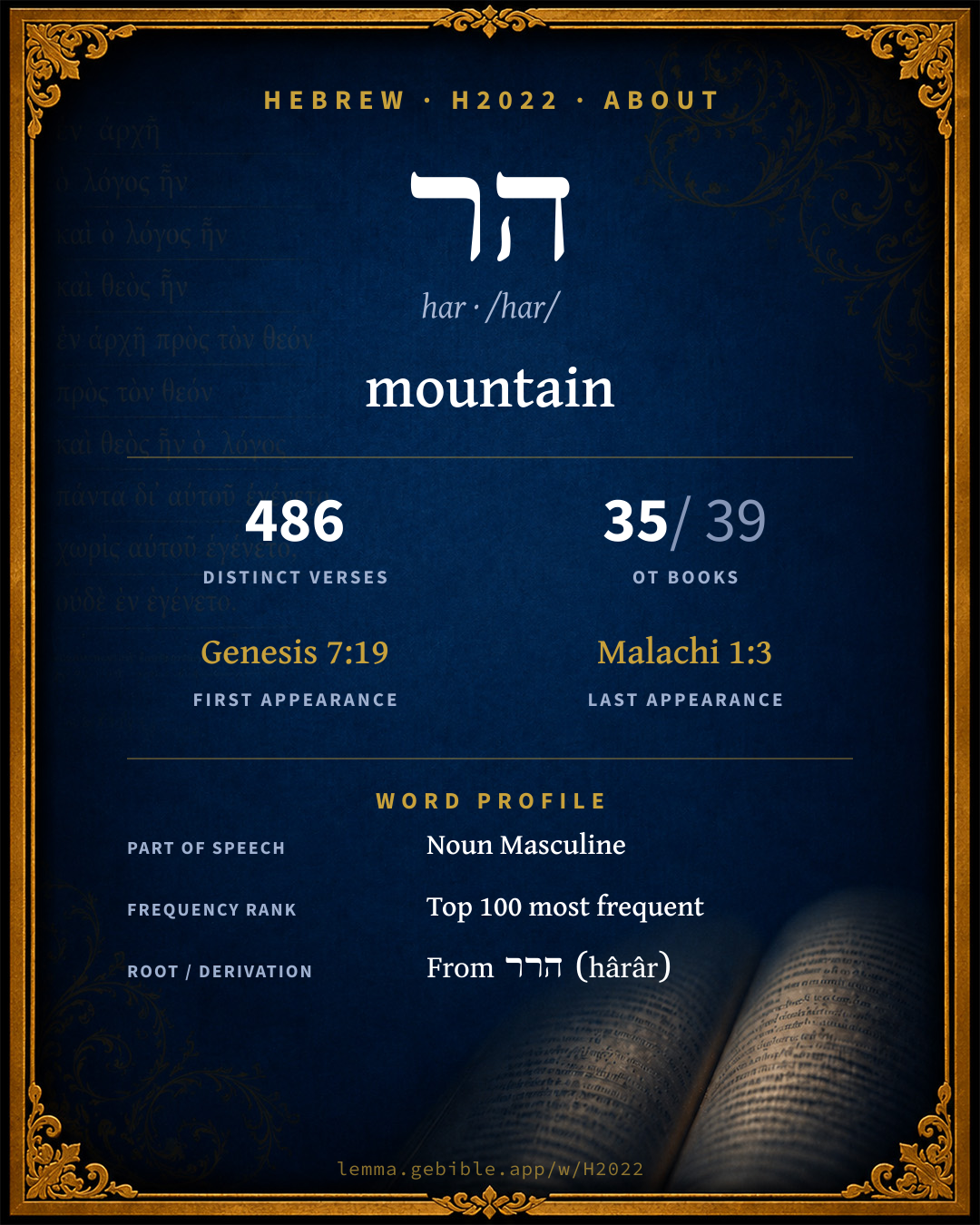
הַר
mountain
Full lexicon entry — Brown-Driver-Briggs (BDB)
From Brown-Driver-Briggs (BDB)
Where this word appears
See every Absolute-state word in the Hebrew Bible →
Grammar key — what these labels mean
Part of speech
- Noun
- A naming word — a person, place, thing, or idea.
Noun type
- Common
- A common noun — a general class of person, place, or thing (“king,” “city,” “water”), not a specific name.
State
- Construct
- A noun bound to a following noun in a possessive / “of” relationship (the construct chain).
- Absolute
- The independent form of a noun, not bound to a following word.
Gender
- Masculine
- Grammatically masculine.
Number
- Singular
- One.
- Plural
- More than one (in Hebrew, generally three or more).
16 verses where H2022 appears in the Construct state in the Book of Exodus. Filtered view — show all forms. Click any verse to open its interlinear word-by-word view. Verse text shown in the World English Bible for context — . Each verse’s Hebrew form is shown with its reference; the English is not keyword-highlighted, since the data carries no word-level English alignment. Use “Compare translations” on any verse to read it across multiple English versions. This concordance covers the Hebrew Bible; Septuagint (Greek Old Testament) occurrences are not indexed here.
Exodus
- Exodus 3:1 הַ֥ר n c ms cs Now Moses was keeping the flock of Jethro, his father-in-law, the priest of Midian, and he led the flock to the back of the wilderness, and came to God's mountain, to Horeb.
- Exodus 4:27 בְּ/הַ֥ר prep + n c ms cs Yahweh said to Aaron, "Go into the wilderness to meet Moses." He went, and met him on God's mountain, and kissed him.
- Exodus 15:17 בְּ/הַ֣ר prep + n c ms cs You shall bring them in, and plant them in the mountain of your inheritance, The place, Yahweh, which you have made for yourself to dwell in; The sanctuary, Lord, which your hands have established.
- Exodus 18:5 הַ֥ר n c ms cs Jethro, Moses' father-in-law, came with his sons and his wife to Moses into the wilderness where he was encamped, at the Mountain of God.
- Exodus 19:11 הַ֥ר n c ms cs and be ready against the third day; for on the third day Yahweh will come down in the sight of all the people on Mount Sinai.
- Exodus 19:18 וְ/הַ֤ר הָ/הָ֖ר conj + n c ms cs ptcl def.art + n c ms Mount Sinai, the whole of it, smoked, because Yahweh descended on it in fire; and its smoke ascended like the smoke of a furnace, and the whole mountain quaked greatly.
- Exodus 19:20 הַ֥ר הָ/הָ֑ר הָ/הָ֖ר n c ms cs ptcl def.art + n c ms ptcl def.art + n c ms Yahweh came down on Mount Sinai, to the top of the mountain. Yahweh called Moses to the top of the mountain, and Moses went up.
- Exodus 19:23 הַ֣ר הָ/הָ֖ר n c ms cs ptcl def.art + n c ms Moses said to Yahweh, "The people can't come up to Mount Sinai, for you charged us, saying, 'Set bounds around the mountain, and sanctify it.'"
- Exodus 24:13 הַ֥ר n c ms cs Moses rose up with Joshua, his servant, and Moses went up onto God's Mountain.
- Exodus 24:16 הַ֣ר n c ms cs The glory of Yahweh settled on Mount Sinai, and the cloud covered it six days. The seventh day he called to Moses out of the midst of the cloud.
- Exodus 31:18 בְּ/הַ֣ר prep + n c ms cs He gave to Moses, when he finished speaking with him on Mount Sinai, the two tablets of the testimony, stone tablets, written with God's finger.
- Exodus 33:6 מֵ/הַ֥ר prep + n c ms cs The children of Israel stripped themselves of their jewelry from Mount Horeb onward.
- Exodus 34:2 הַ֣ר הָ/הָֽר n c ms cs ptcl def.art + n c ms Be ready by the morning, and come up in the morning to Mount Sinai, and present yourself there to me on the top of the mountain.
- Exodus 34:4 הַ֣ר n c ms cs He chiseled two tablets of stone like the first; and Moses rose up early in the morning, and went up to Mount Sinai, as Yahweh had commanded him, and took in his hand two stone tablets.
- Exodus 34:29 מֵ/הַ֣ר הָ/הָ֑ר prep + n c ms cs ptcl def.art + n c ms It happened, when Moses came down from Mount Sinai with the two tablets of the testimony in Moses' hand, when he came down from the mountain, that Moses didn't know that the skin of his face shone by reason of his speaking with him.
- Exodus 34:32 בְּ/הַ֥ר prep + n c ms cs Afterward all the children of Israel came near, and he gave them all of the commandments that Yahweh had spoken with him on Mount Sinai.
About this entry
At a glance — auto-summarized from this page’s data, not written by a person. Every figure links to its source below. This summary describes the numbers; it doesn’t interpret them.
הר (har) is a Hebrew noun most often rendered “mountain.” Debuting at Genesis 7:19, it then recurs through the corpus. The Hebrew Bible uses it across 486 verses — common. Related forms include הרר, הראל and יהיר. The sections below give every sense, occurrence, and version rendering.
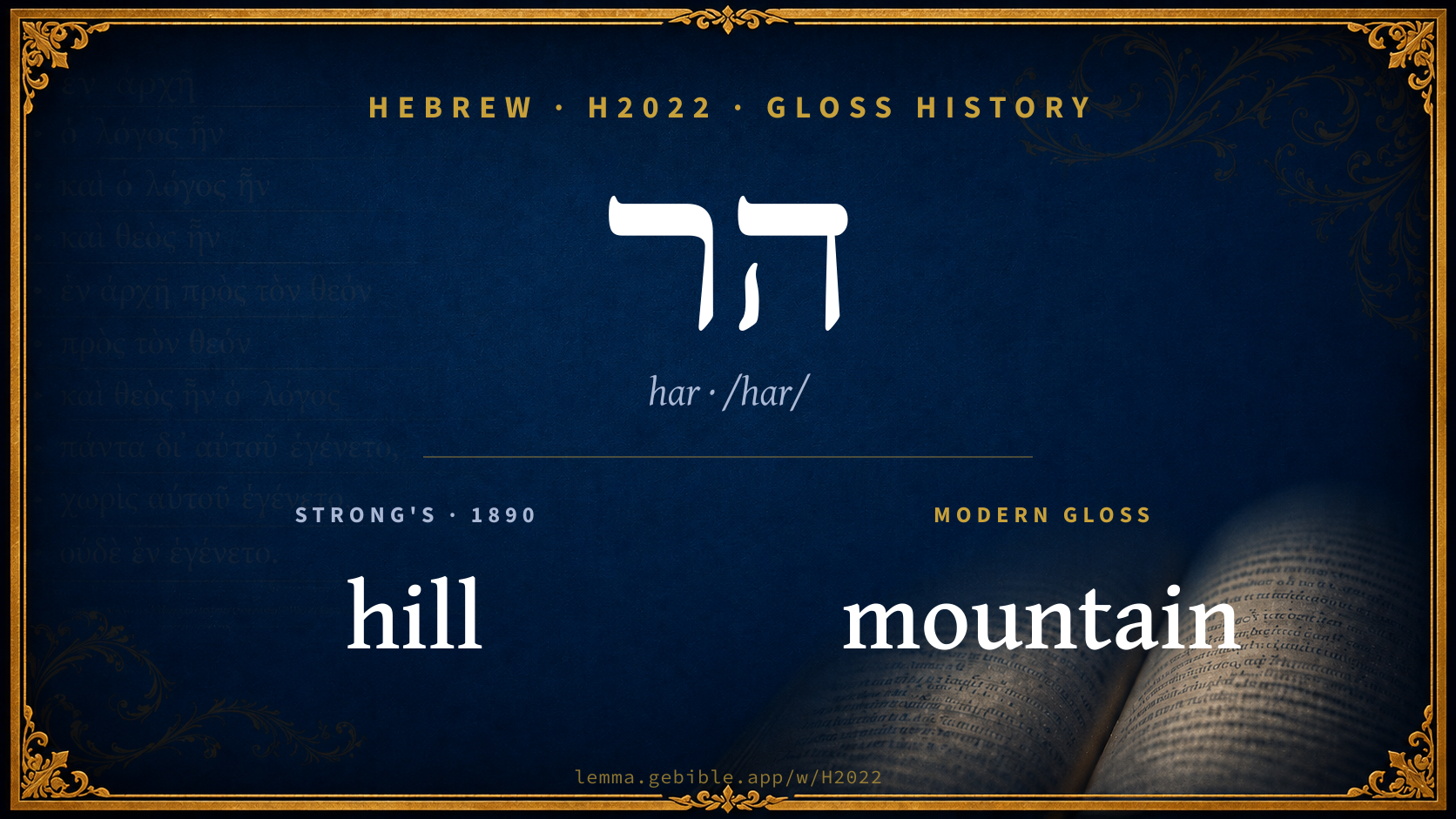
Gloss history
Strong's 1890 vs modern scholarship
About this word
Strong's H2022 catalogs a Hebrew word from the Hebrew Old Testament.
These counts are not copied from any lexicon or concordance. They are computed here, from the morphology-tagged Hebrew Old Testament. What Lemma adds →
- 486
- distinct verses
- The word appears in 486 distinct verses.
- 35 / 39
- OT books
- The word appears in 35 of 39 Old Testament books.
- #92
- by frequency
- Top 100 most frequent Hebrew words (rank 92 of 8,640 Hebrew words by occurrence).
View all 486 occurrences in the concordance →
Most concentrated in
- Isaiah 56 verses 12%
- Deuteronomy 44 verses 9%
- Psalms 43 verses 9%
By section of the Old Testament
By traditional corpus
Conventional, traditional groupings — biblical authorship is debated, so this is a traditional corpus grouping, not an authorship claim. Each share is this word’s portion of its verses in that division of the Hebrew canon. Each figure is a share of the word’s 486 distinct verses.
- Prophets (Nevi'im) 272 verses · 56%
- Torah (Pentateuch) 130 verses · 27%
- Writings (Ketuvim) 84 verses · 17%
How translations render this word
Counts come from each version’s own published word-to-Strong’s tagging or interlinear alignment — an approximate guide to how each version renders this word, not a word-level alignment the data otherwise carries. Because each total is that version’s own tagged count, the per-version totals vary from one another and need not match the appearance or distinct-verse counts above. These counts may also differ from a printed concordance because Lemma counts each distinctly tagged rendering and does not collapse phrase taggings into a single head-word total. This is a fixed set of word-tagged versions (KJV, ASV, BSB, ULT) and does not change with the reading translation you choose elsewhere. Each version’s license is shown beside its name below (and on Sources).
BDB lists this Strong’s number as 2 distinct words (homographs). Each count above pools all of them and is not split by sense — see the Senses section below. A low-frequency rendering may belong to a different one of those words, not the primary meaning.
- King James Version†: Mount 191×, Mountains 127×, Mountain 96×
- American Standard Version†: Mount 143×, Mountains 120×, Mountain 99×
- Berean Standard Bible†: Mountains 136×, Mountain 129×, Mount 124×
- unfoldingWord Literal Text†: Mountains 126×, Mount 107×, Mountain 100×
King James Version Public Domain
Renders H2022 across 545† tagged occurrences — most commonly:
Plus other, less common renderings. Plus 54 renderings that appear only once — usually multi-word phrases or single function words the recovered tagging swept in, not distinct renderings. Not rendered by a distinct English word in 1 further occurrence.
American Standard Version Public Domain
Renders H2022 across 541† tagged occurrences — most commonly:
Plus other, less common renderings. Plus 75 renderings that appear only once — usually multi-word phrases or single function words the recovered tagging swept in, not distinct renderings.
Berean Standard Bible Public Domain
Renders H2022 across 527† tagged occurrences — most commonly:
Plus 18 renderings that appear only once — usually multi-word phrases or single function words the recovered tagging swept in, not distinct renderings. Not rendered by a distinct English word in 20 further occurrences.
unfoldingWord Literal Text CC BY-SA 4.0
Renders H2022 across 567† tagged occurrences — most commonly:
Plus other, less common renderings. Plus 22 renderings that appear only once — usually multi-word phrases or single function words the recovered tagging swept in, not distinct renderings.
14 senses and sub-senses in the full BDB
What do BDB’s symbols mean?
BDB uses these scholarly abbreviations:
| Symbol | Meaning |
|---|---|
| 𝔊 | the Septuagint (the ancient Greek translation, LXX) |
| 𝔙 | the Vulgate (the Latin translation) |
| 𝔖 | the Syriac version (the Peshitta) |
| 𝔗 | the Targum (the Aramaic translation) |
| ψ | the Psalms |
| √ | root (the underlying root or stem) |
| ‖ | parallel passage (a synonymous or contrasted parallel) |
| † | the dagger: every passage where the word occurs is cited |
The 14 senses and sub-senses the full Brown-Driver-Briggs lexicon distinguishes for this word, in lexicon order (not ranked by frequency), with BDB’s own verbatim wording and sub-sense lettering. Shown in Hebrew script with BDB’s own scholarly abbreviations. The condensed entry is in the Lexicon Entry tab. See also the Forms in the corpus table below.
- 1. mountain, hill (these often not sharply distinguished, but):
- a. specif. mountain, high elevation, often in all the literature;—e.g. הַר סִינַי Mount Sinai (properly, the Mount of Sinai; so always) †Ex 19:11, 18, 20, 23; 24:16; 31:18; 34:2, 4, 29, 32 Lv 7:38; 25:1; 26:46; 27:34 Nu 3:1; 28:6 Ne 9:13 (v. סִינַי); also הָהָר = id., Ex 19:2 + 10 times Ex 19 (v 18 read הָעָם, so Codd. 𝔊 Di) 20:18; 24:4 + 6 times Ex 24; 25:40; 26:30; 27:8; 32:1, 15, 19; 34:2, 3(×2), 29; = הַר חוֹרֵב †Ex 33:6 (v. חֹרֵב), also אֶל־הַר הָאֱלֹהִים חֹרֵ֑בָה Ex 3:1, עַד הַר הָאֱלֹהִים חֹרֵב 1 K 19:8; further הָהָר = id., Dt 4:11(×2); 5:4, 5, 19, 20; 9:9 + 10 times Dt 9.10, 1 K 19:11; = הַר הָאֱלֹהִים Ex 4:27; 18:5; 24:13 (all JE) = הַר יהוה Nu 10:33 (cf. Di); v. further הֹר הָהָר Hor the mount (so always) Nu 20:22 + 10 times Nu; Dt 32:50; = הָהָר Nu 20:28(×2); הַר נְבוֹ Dt 32:49; 34:1 = הָהָר 32:50; = הַר הָעֲבָרִים הַזֶּה Nu 27:12 Dt 32:49, cf. (לִפְנֵי נְבוֹ) הָרֵי הָעֲבָרִים Nu 33:47, 48; הַר גְּרִזִּים Mt. Gerizim †Dt 11:29; 27:12 Jos 8:33; רֹאשׁ הַר־גְּרִזִּים Ju 9:7; הַר עֵיבָ֑ל Mt. Ebal †Dt 11:29; 27:4, 13 Jos 8:30, 33; also הַר חֶרְמוֹן Mt. Hermon Dt 3:8 Jos 11:17; 12:1, 5; 13:5, 11 1 Ch 5:23; cf. Dt 4:48 הַר שִׂראֹן הוּא חֶרְמוֹן (v. חֶרְמוֹן), & הַר בַּעַל חֶרְמוֹן (v. id., & בעל חרמון sub בעל); הַר הַלְּבָנוֹן Mt. Lebanon Ju 3:3, cf. מְרוֹם הָרִים יַרְכְּתֵי לְבָנוֹן 2 K 19:23 = Is 37:24 (v. לבנון); הַר הַכַּרְמֶ֑ל Mt. Carmel 1 K 18:19, 20 2 K 2:25; 4:25 (v. כרמל); הָהָר = id., 4:27, appar. also 1:9; הַר תָּבוֹר Mt. Tabor, Ju 4:6, 12, 14, cf. Je 46:18 תָּבוֹר בֶּהָרִים (opp. כַּרְמֶל בַּיָּם); הַר הַגִּלְבֹּעַ 1 S 31:1, 8 2 S 1:6, also (poet.) הָרֵי בַּגּ׳ v 21 (cf. Dr); הַר־חֶרֶס Ju 1:35 (Stu עָר חֶרֶס) cf. חֶרֶס; הַר הַזֵּיתִים Zc 14:4(×2) Mount of Olives, (opp. גֵּיא) cf. הָהָר אֲשֶׁר מִקֶּדֶם לָעִיר Ez 11:23; also בָּהָר אֲשֶׁר עַל־פְּנֵי יְרוּשָׁלִַם 1 K 11:7 (place of Sol.’s idolary) = הַר־הַמַּשְׁחִית 2 K 23:13 mt. of the destroyer (same combin. in another, fig. sense Je 51:25), others der. הַמ׳ here from משׁח anoint, and render as = Mt. of Olives (cited as הר המשׁחה Talm, Shabb. 56 b), cf. HoffmZAW 1882, 175; אַחַד הֶהָרִים in land of Moriah Gn 22:2; mts. about Jerus. in gen., יְרוּשָׁלִַם הָרִים סָבִיב לָהּ ψ 125:2; cf. also ψ 121:1 (‖ יהוה); הָהָר of citadel of Jerus. Is 22:5; of temple hill הַר הַבַּיִת Mi 3:12 = Je 26:18; הַר בֵּית־י׳ Is 2:2 = Mi 4:1, 2 Ch 33:15; also הֲרָרִי בַּשָּׂדֶה Je 17:3; further הַר צִיּוֹן Mt. Zion Is 4:5; 8:18; 10:12; 18:7; 24:23; 29:8; 31:4; 37:32 Mi 4:7 La 5:18 Ob 17 Jo 3:5 ψ 48:3, 12; 74:2; 78:68; 125:1 (v. also צִיּוֹן); comp. הַר בַּ֯ית־צִיּוֹן Is 10:32, הַר בַּת צ׳ 16:1; הַר־י׳ Is 2:3 = Mi 4:2, Is 30:29 ψ 24:3; (id. of Horeb Nu 10:33 JE); הַר־י׳ צְבָאוֹת הַר הַקֹּדֶשׁ Zc 8:3, הַר־קָדְשִׁי Zp 3:11 Ob 16 Ez 20:40 Is 11:9 = 65:25, cf. 56:7; 57:13; 65:11 Jo 2:1 (‖ צִיּוֹן) 4:17 (‖ id.) ψ 2:6 (‖ id.) 3:5; 15:1; 43:3; 48:2; v. further הַר־קָדְשִׁי יְרוּשָׁלִַם Is 66:20 cf. Dn 9:16 & הַר הַקֹּדֶשׁ יְרוּשָׁלִַם Is 27:13; also הַר צְבִי־קֹדֶשׁ Dn 11:45; הַר־הַקֹּדֶשׁ Je 31:23; even הַר קֹדֶשׁ אֱלֹהַי Dn 9:20; other designations of temple-hill are הָהָר חָמַד א׳ לְשִׁבְתּוֹ ψ 68:17, & הַר מְרוֹם יִשְׂרָאֵל Ez 17:23; 20:40 (‖ הַר־קָדְשִׁי); הַר קֹדֶשׁ אֱלֹהִים Ez 28:14 of the distant abode of God (or gods?) so הַר אֱלֹהִים v 16 (הַר־אֱלֹהִים ψ 68:16 is general, a God’s mountain, i.e. a majestic mt., likewise in simile מִשְׁפָּטֶיךָ כְּהַרֲרֵי־אֵל ψ 36:7);—הַר הָאֱלֹהִים elsewhere of Horeb (Sinai) Ex 4:27; 18:5; 24:13 1 K 19:8 (v. supr.). Note partic. †הַר־מוֹעֵד Is 14:13 mountain of meeting or of assembly, i.e. the dwelling-place of the gods, according to Babylonian conception, here represented as in the far north, v. especially Che De Di, DlPa 117 ff. COT ad loc. Jr 57 ff. Jen Kosmologie 23. Upon the mt. is עָל־הָהָר cf. וַתֵּבְךְּ עַל־בְּתוּלֶיהָ עַל־הֶהָרִים Ju 11:38, & the peculiar phr. וְאֵלְכָה וְיָרַדְתִּי עַל־הֶהָרִים v 37; go up upon עָלָה אֶל־ Ex 19:23; 24:13; 34:4 (all JE); cf. acc. in הַעַל אֹתָם הֹר הָהָר Nu 20:25; speak with one upon is דבר בהר Ex 31:18; 34:32 Nu 3:1 (all P), Lv 25:1 (H), cf. command, give commands, law, etc., בהר Lv 7:38; 26:46; 27:34 (all P or H); other phrases with בְּ upon (lit. in, i.e. in the midst of a group of mts.) Ex 34:3 בְּכָל (JE) 25:40; 26:30; 27:8 Nu 28:6 (all P), Is 13:4; but בְּחֹרֵב ψ 106:19 = at Horeb, בְּהֹר הָהָר Nu 33:37 at Mt. Hor; go down from the mt. is יָרַד מִן־הָהָר Ex 32:1, 15 (both JE) 34:29(×2) (both P), cf. Ju 9:36 etc. e.g. Exodus 19:11
- b. mountain-range הַר־בָּשָׁן ψ 68:16(×2) = הַר־אֱלֹהִים v 16; = הַר־גַּבְנֻנִּים v 16, הָרִים גַּבְנֻנִּים v 17 (of the Jebel Hauran: v. בשׁן). e.g. Psalms 68:16
- c. mountain, indef., Jb 14:18 (‖ צוּר); usually pl. mountains, in general, or the mountains, especially in poet. & the higher style; often fig.; הָרִים, הֶהָרִים, covered by flood Gn 7:20 cf. v 19; 8:5; covered by waters & freed therefrom by word of God (at creation) ψ 104:6; a chief work of God (in creation) Am 4:13 ψ 65:7; 90:2 Pr 8:25 (‖ גְּבָעוֹת); weighed by God Is 40:12; removed and overturned in anger of God Jb 9:5 cf. ψ 46:3, 4; devastated by God Is 42:15 (‖ גְּבָעוֹת) cf. Je 9:9; smoking at God’s touch ψ 104:32; 144:5; melting at presence of י׳ Ju 5:5 Mi 1:4 ψ 97:5 Is 63:19; 64:2; trembling Is 5:25 cf. Je 4:24 (‖ גְּבָעוֹת), Na 1:5 (‖ id.), Hb 3:10; called to witness Yahweh’s dealings with his people Mi 6:2 (‖ הָאֵתָנִים מֹסְדֵי אָ֑רֶץ) cf. v 1 (‖ הַגְּבָעוֹת), entreated to cover the guilty Ho 10:8 (‖ גְּבָעוֹת); addressed by י׳ also Ez 6:3 (‖ גְּבָעוֹת, opp. אֲפִיקִים, גֵּאָוֹת); specif., mts. of Israel summoned to hear י׳ and addressed by him Ez 36:1(×2), 4, 8; 37:22; 38:8; 39:2, 4; summoned to praise י׳ ψ 148:9 (‖ גְּבָעוֹת) cf. Is 44:23; 49:13; 55:12 (‖ גְּבָעוֹת); leaping in praise of י׳ ψ 114:4, 6 (both ‖ גְּבָעוֹת); הַרֲרֵי־קֶדֶם Dt 33:15 (‖ גִּבְעוֹת עוֹלָם); הַרֲרֵי־עַד Hb 3:6 (‖ id.); הַרֲרֵי־עַד also ψ 76:5 (according to 𝔊 Bi Che; MT has טֶרֶף for עַד), and prob. Gn 49:26 for MT הוֹרַי עַד (‖ גִּבְעֹת עוֹלָם) cf. Di e.g. Job 14:18
- d. high mt. הַר גָּבֹהַּ Is 30:25 (‖ גִּבְעָה נִשָּׂאָה) cf. 40:9; 52:7; הַר גָּבֹהַּ מְאֹד Ez 40:2; הַר גָּבֹהַּ וְתָלוּל Ez 17:22; pl. הֶהָרִים הַגְּבֹהִים Gn 7:19 ψ 104:18 (‖ סְלָעִים), הֶה׳ הָרָמִים Is 2:14 as symbol of strength and pride (‖ הַגְּבָעוֹת הַנִּשָּׂאוֹת), cf. הֶהָרִים Ez 38:20 (‖ מַדְרֵגוֹת, חוֹמָה). e.g. Isaiah 30:25
- e. opp. valley or plain Jos 12:8 (D; opp. מִדְּבָּר, אֲשֵׁדוֹת, עֲרָבָה, שְׁפֵלָה), cf. Dt 1:7, also Je 17:26 (opp. שְׁפֵלָה); Gn 19:17 (J; opp. כִּכָּר); often opp. גַּיְא 2 K 2:16 Ez 31:12 (fig.) 32:5 (id.) 35:8 (‖ גִּבְעָה), 36:4 (‖ id.), Is 40:4 (‖ id.), opp. בִּקְעָה Dt 8:7; 11:11 ψ 104:8; opp. מִדְבָּר La 4:19 (cf. Jos 12:8 supr.); בֵּין הָרִים ψ 104:10 is ‖ בַּנְּחָלִים; see also אֱלֹהֵי הָרִים י׳ וְלֹא־אֱלֹהֵי עֲמָקִים 1 K 20:28, cf. v 23 (opp. מִישׁוֹר); note also הַר הָעֵמֶק Jos 13:19 (P), & גֵּיא־הָרַי, גֵּי־הָרִים Zc 14:5(×2); further מִדְבַּר הָרִים ψ 75:7 mountainous desert Vrss. & most mod. (Baer מִדְבָּר but cf. De); mountain-ward is הֶ֫רָה Gn 14:10. e.g. Joshua 12:8
- f. mts. as hiding-places:—הַמִּנְהָרוֹת אֲשֶׁר בֶּהָרִים Ju 6:2 the burrows (Stanley, VB) which are in the mts.; cf. ψ 11:1 Je 16:16 (‖ גִּבְעָה); הָפַךְ מִשֹּׁרֶשׁ הָרִים Jb 28:9 (of mining), v. also Dt 8:9. e.g. Judges 6:2
- g. mts. as running-place of gazelles 1 Ch 12:8; of leopards הַרֲרֵי נְמֵרִים Ct 4:8; hunting-ground for partridges 1 S 26:20; עוֹף הָרִים ψ 50:11 cf. 11:1 (fig.); wandering-place of lost sheep (fig.) Na 3:18 1 K 22:17 Je 50:6 cf. v 6 (‖ גִּבְעָה), Ez 34:6 (‖ כָּל־גִּבְעָה רָמָה) 2 Ch 18:16. e.g. 1 Chronicles 12:8
- h. grazing-places for cattle בְּהֵמוֹת בְּהַרֲרֵי־אָ֑לֶף ψ 50:10 (read אֵל for אלף Ol Bi Che), cf. וְתוּר הָרִים Jb 39:8 of pasture of wild ass; also (si vera l.) בּוּל הָרִים Jb 40:20, i.e. mts. as furnishing food for hippopot.; v. further Ct 4:6; 8:14 Pr 27:25. e.g. Psalms 50:10
- i. as place of field and vineyards 2 Ch 26:10 (opp. שְׁפֵלָה, מִישׁוֹר) Is 7:25; v. also הַמַּצְמִיחַ הָרִים חָצִיר ψ 147:8 cf., Hg 1:11; fig. ψ 72:3 (‖ גְּבָעוֹת); in promise יִטְּפוּ הֶהָרִים עָסִיס וְהַגְּבָעוֹתּ תֵּלַכְּנָה חָלָב Jo 4:18 cf. Am 9:13; e.g. 2 Chronicles 26:10
- j. as kindled into flame (i.e. their forests; in sim.) ψ 83:15. k. as scene of massacre, (fig.) Is 34:3 melting with blood; as place of battle array, height 1 S 17:3(×2). l. as places of illicit worship Is 65:7 (‖ גְּבָעוֹת) cf. Je 3:6 & appar. v 25 (‖ id.) so הַר־גָּבֹהַּ וְנִשָּׂא Is 57:7, הֶהָרִים הָרָמִים Dt 12:2 (‖ הַגְּבָעוֹת); but Ez 18:6, 15 read perhaps הַדָּם for הרים cf. RSK 310 & 33:25. m. in various combinations צַד הָהָר 1 S 23:26(×2) 2 S 13:34 side of the mt., צֵלַע הָהָר 16:13 id.; מֹץ הָרִים Is 17:13 chaff of mts.; זֶרֶם הָרִים Jb 24:8 mountain-shower; צֵל הֶהָרִים Ju 9:36 shadow of the mts.; מִבֵּין שְׁנֵי הָרִים וְהֶהָרִים הָרֵי נְחשֶׁת Zc 6:1; top of mt. usually רֹאשׁ הָהָר Nu 14:40, 44 1 S 26:13 2 K 1:9; as place for beacon Is 30:17 (‖ גִּבְעָה), (cf. הַר־נִשְׁפֶּה 13:2 & נְשֹׂא־נֵס הָרִים Is 18:3), רֹאשׁ הֶהָרִים Is 2:2 = Mi 4:1, רֹאשׁ הָרִים Is 42:11 (‖ סֶלַע as dwelling-place) v. also ψ 72:16; רָאשֵׁי הֶהָרִים Gn 8:5; as lurking-places for ambuscade Ju 9:25, 36, places for altars Ez 6:13 (‖ גִּבְעָה רָמָה), for sacrifice Ho 4:13 (‖ הַגְּבָעוֹת); רֹאשׁ הָהָר Jos 15:8 = mt.-ridge, cf. v 9 Ju 16:3; תּוֹעֲפוֹת הָרִים ψ 95:4; foundations of mts. מוֹסְדֵי הָרִים Dt 32:22 ψ 18:8 (‖ מוֹסְדוֹת הַשָּׁמַיִם 2 S 22:8); cf. לְקִצְבֵי הָרִים יָרַדְתִּי Jon 2:7. n. in fig. uses: תָּדוּשׁ הָרִים וְתָדֹק וּגְבָעוֹת כַּמֹּץ תָּשִׂים Is 41:15 fig. of Isr.’s overcoming its foes; יִתְנַגְּפוּ רַגְלֵיכֶם עַל־הָרֵי נָ֑שֶׁף Je 13:16 of encountering hopeless calamities; הֶהָרִים Is 54:10 as less permanent & changeless than Yahweh’s kindness (‖ גְּבָעוֹת); הַר הַמַּשְׁחִית Je 51:25 & הַר שְׂרֵפָה v 25 fig. of Babylon. e.g. Psalms 83:15
- 2. hill-country, mountain-region,
- a. opp. plain, etc.:—dwelling-place of Canaanites, הָהָר Nu 13:17, 29 (of promised land; opp. אֶרֶץ הַנֶּגֶב, הַיָּם & יַד־הַיַּרְדֵּן); בָּֽעֲרָבָה בָּהָר וּבַשְּׁפֵלָה וּבַנֶּגֶב וּבְחוֹף הַיָּם Dt 1:7; בָּהָר וּבָֽעֲרָבָה נֶגֶב כִּנֲּרוֹת וּבַשְּׁפֵלָה וּבְנָפוֹת דּוֹר מִיָּם Jos 11:2; בָּהָר וּבַשְּׁפֵלָה וּבָֽעֲרָבָה וּבָֽאֲשֵׁדוֹת וּבַמִּדְבָּר וּבַנֶּגֶב 12:8; cf. 9:1; 10:40 Ju 1:9; הָהָר indef. (the hill-country, the mountains, in gen.) 2 Ch 2:1 (place for hewing wood) so v 17; Ne 8:15 (place for cutting boughs), etc. e.g. Numbers 13:17
- b. of a particular mountain-region, hill-country: הַר הָאֱמֹרִי Dt 1:7 (cf. v 7) v 19 (cf. v 24), also Jos 10:6; of Amalekites Ju 12:15; of Ephraim Jos 17:15; 19:50; 20:7; 21:21; 24:30, 33 Ju 3:27; 4:5; 7:24; 9:48; 17:1 + 6 times Ju 17, 1 S 1:1; 9:4; 14:22 2 S 20:21 1 K 4:8; 12:25 2 K 5:22 1 Ch 6:52 2 Ch 13:4; 15:8; 19:4 Je 4:15; 31:6; Ephraim and Gilead 50:19 (cf. also (ה)הר Jos 17:16, 18 Ju 3:27); of Israel Jos 11:16, 21, cf. הָרֵי יִשְׂרָאֵל Ez 6:2; 19:9; 33:28; 34:13; 35:12; הָרֵי מְרוֹם יִשְׂרָאֵל Ez 17:23; 20:40 (‖ הַר־קָדְשִׁי) 34:14; עָרֵי הָהָר i.e. in mountain-country Dt 2:37 (of Ammonites), Je 32:44; 33:13; hill-country of Judah Jos 11:21; 15:48; 18:12; 20:7; 21:11; 2 Ch 21:11 (הָרֵי יהודה) 27:4; abode of Jebusites Jos 11:3. e.g. Deuteronomy 1:7
Senses from the full Brown-Driver-Briggs lexicon (Brown, Driver, Briggs; Oxford 1906 — public domain), digitized via Sefaria, supplemented by the OpenScriptures HebrewLexicon (CC BY 4.0). Full attribution on Sources.
Word origin
n.m. Gn 7:19 mountain, hill, hill-country (NH id., pl. הָרִים, הֲרָרִים; Ph. הר †CIS i. 3, 17; Sab. sf. הרתהמו DHMZMG 1876, 673);—ה׳ abs. Jos 17:18 +; c. art. הָהָר Ex 3:12 +; c. ָה loc. הֶ֫רָה Gn 14:10, הָהָ֫רָה Gn 12:8 + 12 times; cstr. הַר Gn 10:30 +; sf. הַרֲרִי ψ 30:8, הֲרָרִי Je 17:3; הַרְכֶם ψ 11:1; הַרֲרָם Gn 14:6; pl. הָרִים Dt 11:11 +; c. art. הֶהָרִים Gn 7:19 +; cstr. הָרֵי Gn 8:4 + 27 times; הַרֲרֵי Dt 33:15 + 8 times (all poet.); sf. הָרַי Is 14:25; 49:11 Zc 14:5 + Ez 38:21 (B Co חרדה), הָרָ֑י Is 65:9; הָרָיו Ez 35:8 Mal 1:3; הֲרָרֶיהָ Dt 8:9;—
— Brown-Driver-Briggs (Oxford 1906, public domain), digitized via Sefaria, supplemented by the OpenScriptures HebrewLexicon (CC BY 4.0). See Sources.
Derived from הרר (hârâr) (H2042) — mountain.
Jastrow Dictionary
A second Hebrew/Aramaic lexicon for comparison, covering Aramaic and post-biblical (Talmudic, Targumic, Midrashic) usage that the biblical-Hebrew BDB does not. Matched by lemma rather than by Strong’s number, so a lemma may carry more than one Jastrow headword (shown separately below), and the entries cover usage well beyond the Bible.
הַר
- mound, mountain; trnsf. eminent person. Midd. II, 1, a. fr. הַר הבית the Temple mount. Yeb. 17ᵃ (play on ה̇ר̇פ̇נ̇יא) ה̇ר̇ שהכל פ̇ונ̇ין בו a hill to which all turn (whose spurious descent prevents them from getting wives elsewhere); a. v. fr.—Ḥull. 39ᵇ (in Chald. diction) רישיך והר here is thy head and here the mountain (a colloquial phrase for compelling one to give up a bargain).—Ex. R. s. 28 (ref. to Ex. XIX, 3) בזכות הה׳ for the merit of the distinguished one (Abraham), ואין הה׳ אלא אבות har means the patriarchs (ref. to Mic. VI, 2). Snh. 107ᵃ ה׳ שבכם the most prominent of you; a. fr.—[For proper nouns composed with הר, v. respective determinants.]—Pl. הָרִים, הֲרָרִים. Tam. 32ᵃ, a. e. הָרֵי חושך, v. חו̇שֶׁךְ.—Snh. 24ᵃ עוקר הרי הרים uprooting the highest mountains (a figure for dialectical ingenuity). Y. Yeb. I, 3ᵃ bot. בין שני הֶהָ׳ וכ׳ between the two high mountains (great scholars). Ex. R. s. 15 ואין ה׳ אלא אבות, v. supra.—Ḥag. I, 8 כה׳ תלויין בשערה like mountains suspended on a hair (a slender Bible text for numerous Talmudic laws); a. v. fr. e.g. Exodus 19:3
A Dictionary of the Targumim, the Talmud Babli and Yerushalmi, and the Midrashic Literature (Marcus Jastrow; London, Luzac, 1903) — Public Domain. Digitized via Sefaria. Digitized via Sefaria. Full attribution on Sources.
Forms in the corpus
The 144 distinct written forms H2022 takes in the Hebrew Bible, most frequent first — each parse links to that state’s occurrences in the concordance. Hebrew forms include their vowel points and cantillation, so a single lemma takes many written forms.
The 60 most common forms are shown; 84 rarer forms follow in the full concordance.
Same root — word family
Other BDB entries built from the same root as H2022, grouped by Strong’s listed origin. These share a root / origin per the lexicon — not necessarily a shared meaning. Each links to that word’s own entry.
Derives from
Derived from this word
Proper names from this root
People and places named from this root — a name, not an additional meaning of the word.
- הררי Hărârîy H2043 Hararite
- Αρμαγεδδων Armageddṓn G717 Armageddon
- הר Hôr H2023 Hor
- הרא Hârâʼ H2024 Hara
- הרן Hârân H2039 Haran
Compare all same-root words → Showing 4 of 9 — not the complete family. 5 of the same-root words are proper names (people or places). They share a root, not necessarily a meaning.
Septuagint verse parallels
This word appears in 467 verses that also exist in the Greek Old Testament (Septuagint), out of the 486 Hebrew verses it occurs in. You can read those verses in Greek by switching the Old Testament edition to the Septuagint.
Read these verses in the Septuagint
- Genesis 7:19
- Exodus 3:1
- Leviticus 7:38
- Numbers 3:1
- Deuteronomy 1:2
- Joshua 2:16
- Judges 1:9
- 1 Samuel 1:1
- 2 Samuel 1:6
- 1 Kings 4:8
- 2 Kings 1:9
- 1 Chronicles 4:42
This is a verse-level parallel only — the same verses exist in both the Hebrew and Greek Old Testaments. No word-level Hebrew↔Greek correspondence is claimed: the data carries no such alignment, so no Greek word is shown as this Hebrew word’s translation. Coverage is not total — the Septuagint omits the deuterocanon and renumbers the Psalms, so some Hebrew verses have no direct Greek parallel.