
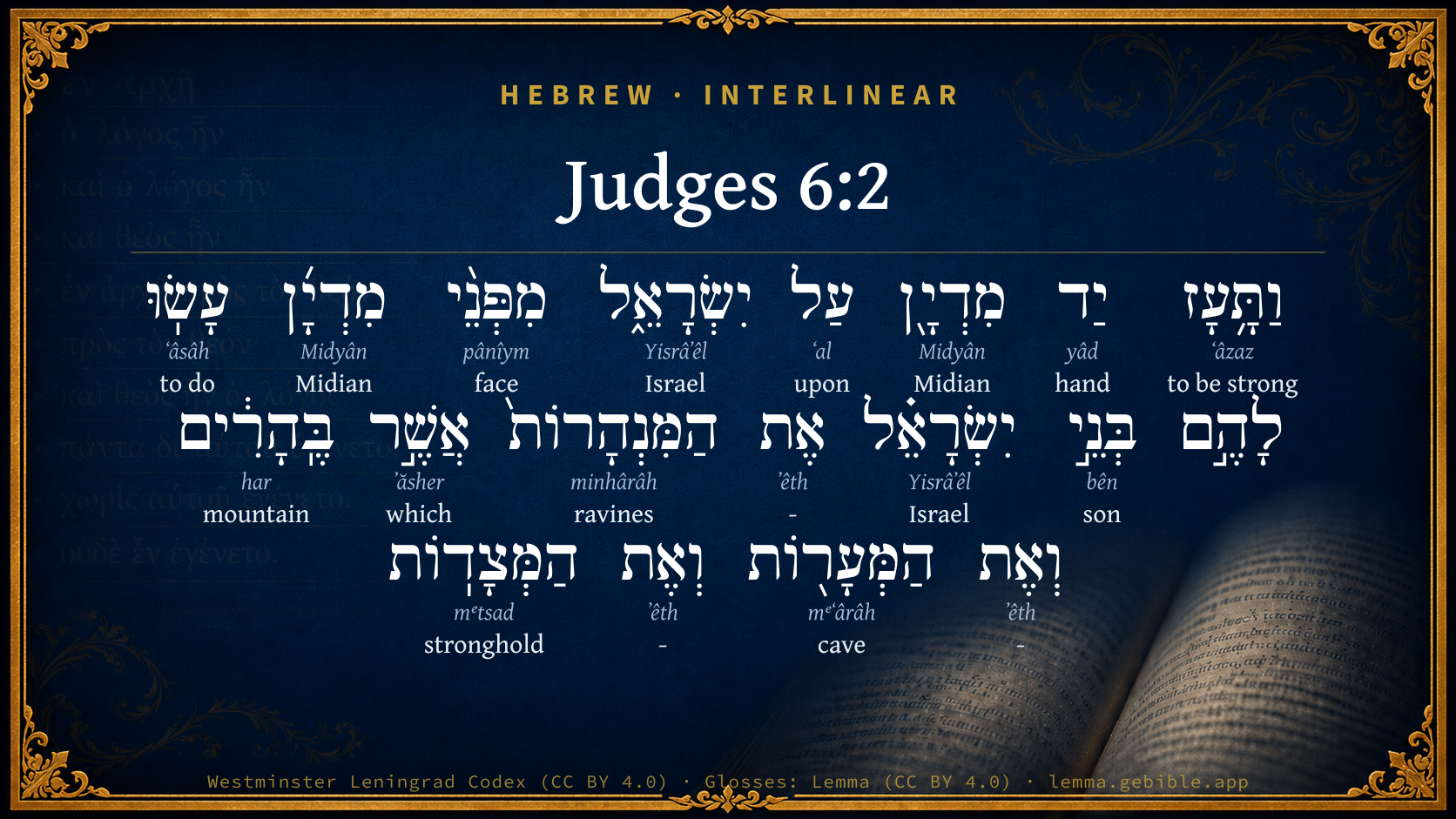
Judges 6:2

Hebrew (Westminster Leningrad Codex) Judges 6:2 appears in the Hebrew Old Testament. The text above is from the Westminster Leningrad Codex. Each word links to its Strong’s number, a concise gloss, and parsing drawn from the Open Scriptures Hebrew Bible morphology. Click any word for its full Brown-Driver-Briggs (BDB) entry.
Download image
Cite this verse

Judges 6:2 (World English Bible). Public Domain. Lemma interlinear Bible study tool, https://lemma.gebible.app/v/judges/6/2.

Show BibTeX & RIS
BibTeX
RIS
English Translation
The hand of Midian prevailed against Israel; and because of Midian the children of Israel made them the dens which are in the mountains, and the caves, and the strongholds.
World English Bible · Public Domain
Highlights
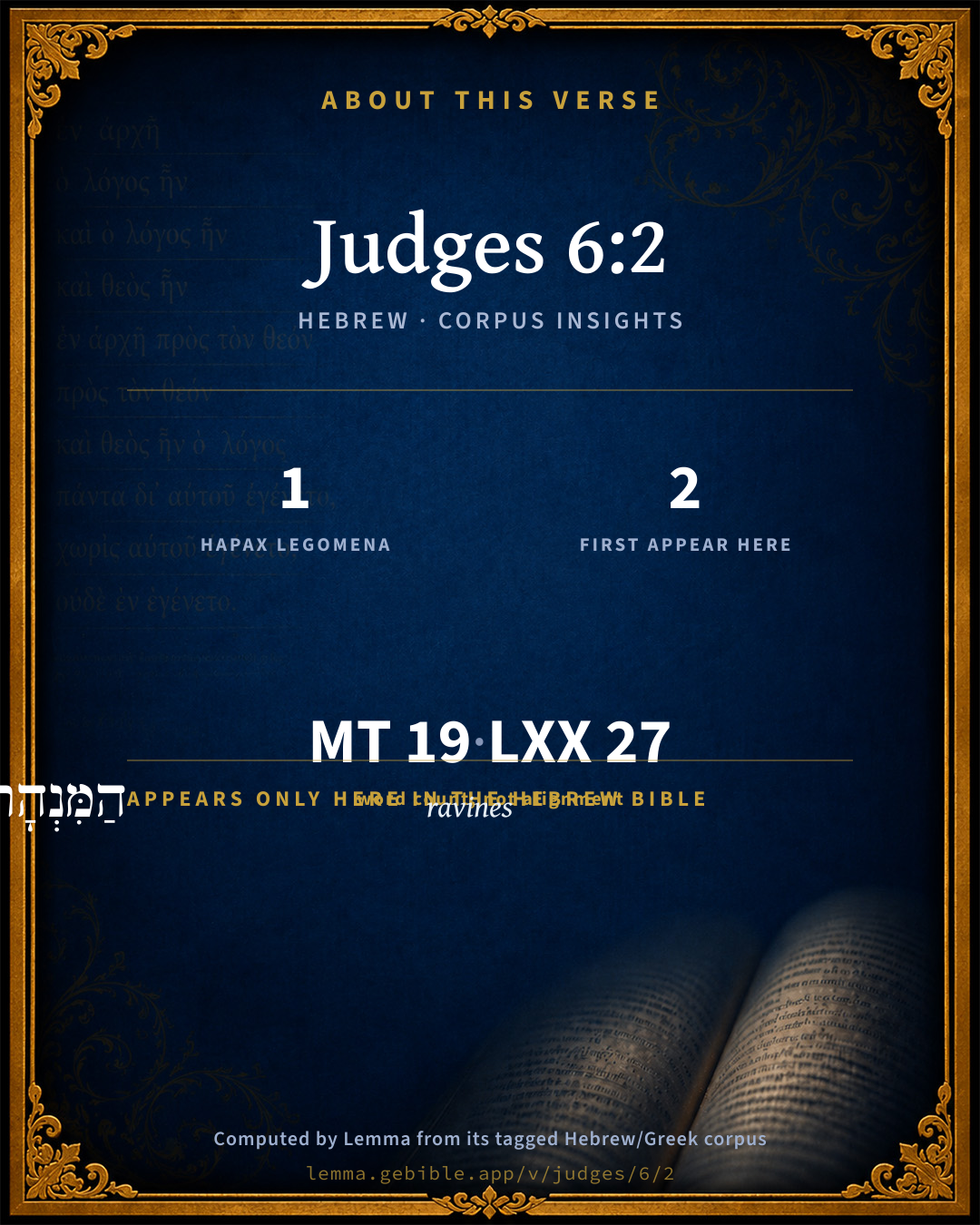
  • 1 hapax legomenon — only here in the Hebrew Bible
  • 2 first appearances in the Hebrew Bible
Full analysis ↓
Download a study sheet

One document with this verse’s original text, its word-by-word gloss line, the meaning frame, cross-references with their text, attributed commentary, and full source and license credits — printable, and it pastes into notes with its structure intact.

This verse Autodidact and up

Study sheet (.html) Plain text (.txt)

A passage Seminary Student

Up to 50 verses in one chapter. A passage sheet keeps up to 6 commentary sources and 12 cross-references per verse, in the order this page ranks them, and says so on the sheet whenever that leaves anything out. Ask for a single verse and you get the Autodidact verse sheet above.

Everything on this page stays free to read, with no account — the sheet is a download of what is already on screen, not access to it.

Want to remove ads? Support Godless Engineer
Compare translations 3

The same verse in 3 English versions, stacked beneath the original-language interlinear above. Click any original word for its lexicon entry.

Each is an independent rendering of the whole verse — the interlinear is not word-aligned to these translations.

Highlighted words mark where these versions differ — a whole-verse word diff, not a word-by-word alignment.

  • World English Bible Public Domain
    The hand of Midian prevailed against Israel; and because of Midian the children of Israel made them the dens which are in the mountains, and the caves, and the strongholds.
  • King James Version Public Domain
    And the hand of Midian prevailed against Israel: and because of the Midianites the children of Israel made them the dens which are in the mountains, and caves, and strong holds.
  • unfoldingWord Literal Text CC BY-SA 4.0
    So the hand of Midian prevailed over Israel. From the face of Midian, the sons of Israel made for themselves dens, which in the mountains, and caves and strongholds.

unfoldingWord Literal Text — © unfoldingWord, licensed CC BY-SA 4.0. Word-aligned USFM3 via Door43 (git.door43.org/unfoldingWord/en_ult).

Versions to compare (up to 4)

3 of 4 selected

Show all 17 translations

Every available English version of this verse, each an independent rendering of the whole verse.

  • World English Bible Public Domain
    The hand of Midian prevailed against Israel; and because of Midian the children of Israel made them the dens which are in the mountains, and the caves, and the strongholds.
  • Berean Standard Bible Public Domain
    and the hand of Midian prevailed against Israel. Because of the Midianites, the Israelites prepared shelters for themselves in the mountains, caves, and strongholds.
  • Majority Standard Bible Public Domain
    and the hand of Midian prevailed against Israel. Because of the Midianites, the Israelites prepared shelters for themselves in the mountains, caves, and strongholds.
  • King James Version Public Domain
    And the hand of Midian prevailed against Israel: and because of the Midianites the children of Israel made them the dens which are in the mountains, and caves, and strong holds.
  • American Standard Version (1901) Public Domain
    And the hand of Midian prevailed against Israel; and because of Midian the children of Israel made them the dens which are in the mountains, and the caves, and the strongholds.
  • Revised Version (1885) Public Domain
    And the hand of Midian prevailed against Israel: and because of Midian the children of Israel made them the dens which are in the mountains, and the caves, and the strong holds.
  • Geneva Bible (1599) Public Domain
    And the hand of Midian preuayled against Israel, and because of the Midianites the children of Israel made them dennes in the mountaines, and caues, and strong holdes.
  • Young's Literal Translation Public Domain
    and the hand of Midian is strong against Israel, from the presence of Midian have the sons of Israel made for themselves the flowings which `are' in the mountains, and the caves, and the strongholds.
  • Literal Standard Version CC BY-SA 4.0
    and the hand of Midian is strong against Israel, [so] the sons of Israel have made for themselves the nooks which [are] in the mountains, and the caves, and the strongholds [to hide] from the presence of Midian.
  • Unlocked Literal Bible CC BY-SA 4.0
    The power of Midian oppressed Israel. Because of Midian, the people of Israel made shelters for themselves from the dens in the hills, the caves, and the strongholds.
  • unfoldingWord Literal Text CC BY-SA 4.0
    So the hand of Midian prevailed over Israel. From the face of Midian, the sons of Israel made for themselves dens, which in the mountains, and caves and strongholds.
  • Darby Bible Public Domain
    And the hand of Mid'ian prevailed over Israel; and because of Mid'ian the people of Israel made for themselves the dens which are in the mountains, and the caves and the strongholds.
  • World Messianic Bible Public Domain
    The hand of Midian prevailed against Israel; and because of Midian the children of Israel made themselves the dens which are in the mountains, the caves, and the strongholds.
  • Webster's Bible Public Domain
    And the hand of Midian prevailed against Israel: and because of the Midianites the children of Israel made them the dens which are in the mountains, and caves, and strong holds.
  • Free Bible Version CC BY-SA 4.0
    The Midianite oppression was so great that because of them the Israelites made themselves hiding places in mountains, caves, and fortifications.
  • Bible in Basic English Public Domain
    And Midian was stronger than Israel; and because of the Midianites, the children of Israel made holes for themselves in the mountains, and hollows in the rocks, and strong places.
  • JPS Tanakh (1917) Public Domain
    And the hand of Midian prevailed against Israel; and because of Midian the children of Israel made them the dens which are in the mountains, and the caves, and the strongholds.

Literal Standard Version (2020), Covenant Press — licensed CC BY-SA 4.0. Text via the HelloAO Bible API (eBible.org). Unlocked Literal Bible (unfoldingWord) — licensed CC BY-SA 4.0. Text via the HelloAO Bible API (eBible.org). unfoldingWord Literal Text — © unfoldingWord, licensed CC BY-SA 4.0. Word-aligned USFM3 via Door43 (git.door43.org/unfoldingWord/en_ult). Free Bible Version, Dr. Jonathan Gallagher — licensed CC BY-SA 4.0. Text via the HelloAO Bible API (eBible.org).

Word by word

More ways to search: Search by grammar → Find every occurrence → Compare this word →

Practice this passage: Drill this verse → Learn its vocabulary →

הַמִּנְהָרוֹת֙
minhârâh
H4492
“the · ravines”
Particle, Definite Article + Noun, Common, Feminine, Plural, Absolute
Part of Speech
Particle + Noun
Type
Common
Gender
Feminine
Number
Plural
State
Absolute
Full BDB Definition

Origin: from H5102

TWOT: 1316b

crevices, ravines, mountain clefts, den, dugout holes - meaning dubious
  1. וַתָּ֥עָז ʻâzaz H5810 “and · to be strong” Conjunction + Verb, Qal, Sequential Imperfect, 3rd Person, Feminine, Singular
  2. יַד yâd H3027 “hand of” Noun, Common, Both, Singular, Construct
  3. מִדְיָ֖ן Midyân H4080 “Midian” Noun, Proper
  4. עַל ʻal H5921 “upon” Preposition
  5. יִשְׂרָאֵ֑ל Yisrâʼêl H3478 “Israel” Noun, Proper
  6. מִפְּנֵ֨י pânîym H6440 “from · face(s) of” Preposition + Noun, Common, Both, Plural, Construct
  7. מִדְיָ֜ן Midyân H4080 “Midian” Noun, Proper
  8. עָשֽׂוּ ʻâsâh H6213 “to do” Verb, Qal, Perfect, 3rd Person, Common, Plural
  9. בְּנֵ֣י bên H1121 “sons of” Noun, Common, Masculine, Plural, Construct
  10. יִשְׂרָאֵ֗ל Yisrâʼêl H3478 “Israel” Noun, Proper
  11. אֶת ʼêth H853 “-” Particle, Direct Object
  12. אֲשֶׁ֣ר ʼăsher H834 “which” Particle, Relative
  13. בֶּֽהָרִ֔ים har H2022 “in/at the · mountains” Preposition, Determined + Noun, Common, Masculine, Plural, Absolute
  14. וְאֶת ʼêth H853 “and · -” Conjunction + Particle, Direct Object
  15. הַמְּעָר֖וֹת mᵉʻârâh H4631 “the · caves” Particle, Definite Article + Noun, Common, Feminine, Plural, Absolute
  16. וְאֶת ʼêth H853 “and · -” Conjunction + Particle, Direct Object
  17. הַמְּצָדֽוֹת mᵉtsad H4679 “the · strongholds” Particle, Definite Article + Noun, Common, Feminine, Plural, Absolute

About this verse

These counts appear in no published source. They are computed here, from the morphology-tagged text and Lemma’s own curated glosses. What Lemma adds →

19
words
14
distinct lemmas
Historical
section

Notable vocabulary

1 hapax legomenon — a word that appears only here in the entire Hebrew Bible:

  • הַמִּנְהָרוֹת֙ ravines H4492

First appearance in Scripture

These words make their first canonical appearance in the Hebrew Bible here:

  • הַמִּנְהָרוֹת֙ ravines H4492
  • הַמְּצָדֽוֹת stronghold H4679

Shared distinctive vocabulary

הַמְּצָדֽוֹת stronghold H4679 occurs in 10 verses of the Hebrew Bible. Also found in:

Grammatical profile

  • 2 verbs
  • 11 nouns
  • 2 prepositions
  • 4 particles

Verb forms

  • וַתָּ֥עָז Qal · Sequential Imperfect
  • עָשֽׂוּ Qal · Perfect

Repetition

Words recur within this verse — often emphatic in Hebrew:

  • מִדְיָ֖ן Midian H4080 ×2
  • יִשְׂרָאֵ֑ל Israel H3478 ×2

Hebrew & Septuagint length

In English translation the verse runs 30 words from the Hebrew and 33 from the Septuagint (LXX English) — closely comparable.

A rough comparison of the two English renderings, which tokenize alike — not a word-level alignment.

Word counts can differ between the Hebrew and the Greek without any difference in meaning — e.g. the Hebrew direct-object marker אֵת has no separate Greek word, and Greek often adds the article ὁ.

In the original languages it is 19 Hebrew tokens and 27 Greek tokens — but the two are counted differently (Hebrew bundles its prefixes and suffixes into one token; the Greek is in lemma form), so that isn’t a like-for-like length.

Cross-references

6

Topical passages linked to Judges 6:2 in the Treasury of Scripture Knowledge — connected by theme and wording, ordered by reader-vote popularity; previews shown in the World English Bible.

  • 1 Samuel 13:6 When the men of Israel saw that they were in a strait (for the people were distressed), then the people did hide themselves in caves, and in thickets, and in rocks, and in coverts, and in pits.
  • Hebrews 11:38 (of whom the world was not worthy), wandering in deserts, mountains, caves, and the holes of the earth.
  • Leviticus 26:17 I will set my face against you, and you will be struck before your enemies. Those who hate you will rule over you; and you will flee when no one pursues you.
  • 1 Samuel 14:11 Both of them disclosed themselves to the garrison of the Philistines: and the Philistines said, Behold, the Hebrews come forth out of the holes where they had hid themselves.
  • Deuteronomy 28:47–48 Because you didn't serve Yahweh your God with joyfulness, and with gladness of heart, by reason of the abundance of all things;
  • Revelation 6:15 The kings of the earth, the princes, the commanding officers, the rich, the strong, and every slave and free person, hid themselves in the caves and in the rocks of the mountains.

Cross-references courtesy of OpenBible.info (CC BY 4.0).

Hebrew and Greek witnesses Masoretic Hebrew ↔ Greek Septuagint

The same verse in the two great witnesses to the Old Testament, shown verse-for-verse.

These are two independent witnesses, not word-aligned to each other, and the Septuagint is shown in lemma (dictionary) form.

Hebrew Judges 6:2 Masoretic · Westminster Leningrad Codex

וַתָּ֥עָז יַד מִדְיָ֖ן עַל יִשְׂרָאֵ֑ל מִפְּנֵ֨י מִדְיָ֜ן עָשֽׂוּ לָהֶ֣ם בְּנֵ֣י יִשְׂרָאֵ֗ל אֶת הַמִּנְהָרוֹת֙ אֲשֶׁ֣ר בֶּֽהָרִ֔ים וְאֶת הַמְּעָר֖וֹת וְאֶת הַמְּצָדֽוֹת

The hand of Midian prevailed against Israel; and because of Midian the children of Israel made them the dens which are in the mountains, and the caves, and the strongholds.

World English Bible · Public Domain

Greek LXX Judges 6:2 Septuagint · lemma form

καί ἰσχύω χείρ μαδιαμ ἐπί ἰσραήλ καί ποιέω ἑαυτοῦ ὁ υἱός ἰσραήλ ἀπό πρόσωπον μαδιαμ ὁ τρυμαλιά ὁ ἐν ὁ ὄρος καί ὁ σπήλαιον καί ὁ κρεμαστός

And the hand of Madiam prevailed against Israel: and the children of Israel made for themselves because of Madiam the caves in the mountains, and the dens, and the holes in the rocks.

LXX2012 (modern English Septuagint) · Public Domain

On this verse, Ellicott's Commentary for English Readers discusses the Septuagint’s reading. Read the note in Commentary ↓

Hebrew: Westminster Leningrad Codex (CC BY 4.0). Greek: Septuagint (public domain); English from LXX2012 (modern English Septuagint) (Public Domain). How the Septuagint differs from the Hebrew →

Targum (Aramaic paraphrase)

1

The Targum is the ancient Jewish Aramaic paraphrase of the Hebrew Scriptures — an interpretive translation, not the Hebrew text itself. Onkelos (literal) and Pseudo-Jonathan (expansive) render the Torah, and Jonathan the Prophets. Coverage is partial: where no permissively-licensed English translation exists for a verse, only the Aramaic is shown. This is verse-level text, not a word-by-word alignment to the Hebrew.

  1. Targum Jonathan Prophets (Joshua–Malachi)
    וּתְקֵיפַת יַד מִדְיָנָאֵי עַל יִשְׂרָאל מִן קֳדָם מִדְיָנָאֵי עֲבָדוּ לְהוֹן בְּנֵי יִשְׂרָאֵל יַת מַטְמוֹרִיתָא דִבְטוּרַיָא וְיַת מְעָרָתָא וְיַת מְצוֹדָתָא:

    (no public-domain English translation for this verse)

    Targum Jonathan — Aramaic: “Mikraot Gedolot” (public domain). English: “Sefaria Community Translation” (CC0 1.0 (public-domain dedication)); “London "Chaldee Paraphrase," 1871” (public domain). Text via Sefaria.

Commentary

Notes on Judges 6:2 from classic Christian and Jewish commentators (each source and its license shown beneath its notes). The classic Christian expositions comment on the surrounding passage and are grouped to its opening verse, so a note may address several verses; the Jewish commentaries on the Tanakh (Rashi and others) are per-verse, so they appear only where the commentator wrote on this verse.

Lemma curates 59 commentaries, every one of them public domain or Creative Commons licensed, each selected and text-cleaned for this edition rather than reprinted as found. About our sources →

Trapp's Complete Commentary

John Trapp

Jdg 6:2 And the hand of Midian prevailed against Israel: [and] because of the Midianites the children of Israel made them the dens which [are] in the mountains, and caves, and strong holds.

Ver. 2. Made them the dens which are in the mountains.] These served for shelters, places of refuge and strength, until the last desolation of the Jews. See 1Sa 13:6.

And caves, and strongholds.] They sought not to God till needs must; till these coverings were too short. {Jdg 6:6}

John Trapp, A Commentary or Exposition upon All the Books of the Old and New Testament (1647–1656) — public domain. Text from a community e-Sword module.

Geneva Bible (1599)

Geneva Bible translators

For fear of the Midianites, they fled into the dens of the mountains.

Geneva Bible (1599) marginal notes — public domain. Text via Bolls.life.

Jamieson, Fausset & Brown

Robert Jamieson, A. R. Fausset & David Brown

made . . . dens . . . in the mountains and caves--not, of course, excavating them, for they were already, but making them fit for habitation.

Jamieson, Fausset & Brown — Commentary Critical and Explanatory on the Whole Bible (1871) — public domain (CC PDM 1.0). Text via the HelloAO Bible API.

Adam Clarke's Commentary

Verse 2. Made them the dens which are in the mountains] Nothing can give a more distressing description of the state of the Israelites than what is here related. They durst not reside in the plain country, but were obliged to betake themselves to dens and caves of the mountains, and live like wild beasts, and were hunted like them by their adversaries.

Adam Clarke's Commentary on the Bible (1810–1826) — public domain. Text from a community e-Sword/MySword module.

Ellicott's Commentary for English Readers

(2) The hand of Midian prevailed.—See Jdg_3:10. This oppression is wholly different from that with which we have been dealing in the last chapter. That was the last great attempt of the old inhabitants to recover their lost country; this is a foreign invasion.

The dens which are in the mountains.—The word mineharoth, rendered dens (LXX., mandrai), occurs here only. Rashi and Kimchi render it, “caves lighted from above,” deriving it from neharah, “light” (Job_3:4). They were probably thinking of the subterranean galleries like those found by Wetzstein in the Hauran (p. 45). R. Tanchum and others take it to mean fire-signals. But the more probable derivation is nahar, “a river,” and then the meaning is “torrent-gullies,” which they easily converted into places of concealment, since the limestone hills of Palestine abound in caves. Josephus understood it to mean mines and caverns (Antt. v. 6. § 1). (Comp. 1Sa_13:6 : “When the men of Israel saw that they were in a strait, then the people did hide themselves in caves, and in thickets, and in rocks, and in high places, and in pits.” Heb_11:38 : “in dens and caves of the earth.”) Three places of hiding are mentioned: (1) The mineharoth, perhaps catacombs and galleries in the rocks, which, as the article shows, were pointed out long afterwards. (2) Craggy peaks, like Rimmon, Magada, &c. (3) “Limestone caves, here first mentioned, and afterwards often used, like the Corycian cave in Greece during the Persian invasion, and the caves of the Asturias in Spain during the occupation of the Moors. It was returning to the old troglodyte habits of the Horites and Phoenicians” (Stanley, i. 340). These caves were used, long afterwards, by the brigands whom Herod and the Romans found it so hard to extirpate.

A Bible Commentary for English Readers, edited by Charles John Ellicott (1878–1897) — public domain. Text from a community e-Sword module.

The Cambridge Bible for Schools and Colleges

gen. ed. J. J. S. Perowne

2. the hand … prevailed] A formula of Rd; cf. Jdg_3:10.

dens] This translation is a guess from the context. The mention of caves prepares the way for 11b; for strong holds cf. 1Sa_23:14; 1Sa_23:19; 1Sa_23:29 etc. Under pressure from the Philistines at a later time similar refuges were used, 1Sa_13:6.

The Cambridge Bible for Schools and Colleges (gen. ed. J. J. S. Perowne; Cambridge University Press, 1878–1918) — public domain. Text from a community e-Sword module.

John Gill's Exposition

And the hand of Midian prevailed against Israel,.... They were too strong for them, and overcame them, and brought them into subjection to them, and no wonder, when the Lord delivered them into their hand:

and because of the Midianites; because of their usage of them, their manner of coming upon them yearly, and pillaging and plundering their substance, as after related:

the children of Israel made them dens which are in the mountains; the word for "dens" has the signification of light in it, and are so called either by an antiphrasis, because they were dark, or, as Kimchi thinks, because they had a window at the top of them, which let in the light (a) but Ben Gersom conjectures they were torches, which gave a great light, and when they that held them saw from the mountains the Midianites, by these torches they made a signal to the Israelites to take care and hide themselves and their substance:

and caves, and strong holds; the caves were for the poorer sort, and the strong holds for the richer to retire to with their goods; though, according to Jarchi, the latter were no other than fences they made in woods, by cutting down trees, and setting them round about them, perhaps much the same as the thickets, Sa1 13:6.

(a) So David de Pomis Lexic. fol. 90. 3. or "because men flowed and flocked to them for safety"; so Buxtorf.

John Gill's Exposition of the Whole Bible (1746–1763) — public domain (CC PDM 1.0). Text via the HelloAO Bible API.

Albert Barnes' Notes on the Bible

The word rendered “dens” is only found in this passage. It is best explained of ravines hollowed out by torrents, which the Israelites made into hiding-places.

Albert Barnes' Notes on the Bible (1834–1885) — public domain. Text from a community e-Sword/MySword module.

Haydock's Catholic Bible Commentary

Resist is not expressed in Hebrew; neither did Israel dare to encounter the enemy. They retreated into the strongest holds, to rescue their goods and persons from the depredations of the Madianites. (Haydock)

George Leo Haydock (1774–1849), Haydock's Catholic Family Bible and Commentary, 1859 edition — public domain. Excludes Psalms (Douay-Rheims chapter numbering differs from Protestant) and Deuterocanonical books (Catholic canon only).

Matthew Poole's English Annotations

In which they might secure their persons and provisions from the hands of the Midianites.

Matthew Poole's English Annotations on the Holy Bible (1683–1685) — public domain. Text from a community e-Sword/MySword module.

Whedon's Commentary on the Bible

Daniel D. Whedon

2. The dens which are in the mountains — The recesses, fissures, and hollow places which had been worn by the water-courses in the mountain sides.

Caves — Such as abound all through the hill country of Palestine.

Strong holds — Mountain fastnesses not easily accessible to the foe. It seems that the Midianites cared not to exterminate the Israelites, but to occupy their rich pastures.

Daniel D. Whedon (gen. ed.), Commentary on the Old and New Testaments (1874–1909) — public domain. Text from a community e-Sword module.

The Pulpit Commentary

The dens... and caves. In the writer"s time certain hiding-places called by the above names were traditionally known as the places where the Israelites took refuge during the terrible Midianite invasion. The limestone hills of Palestine abounded in such caves.

The Pulpit Commentary (1880–1919), ed. H.D.M. Spence-Jones & Joseph S. Exell — public domain. Text from a community e-Sword module.

Rashi

Rabbi Shlomo Yitzchaki (Rashi)

Retreats. Hidden places. In old French, "voutes". Because a slight bit of illumination is positioned in them in some inconspicuous spot, they are referred to as מִנְהׇרוֹת, lit. "glimmerings", "lucerno" in old French.

Caves. "Grotte" in old French

Stockades. "Palliser" in old French, "pales", as it is constructed in the forest by felling trees around its perimeter.

Rashi on the Tanakh — English translations: “The Judaica Press complete Tanach with Rashi, translated by A. J. Rosenberg” (CC BY 4.0); “Pentateuch with Rashi's commentary by M. Rosenbaum and A.M. Silbermann, 1929-1934” (public domain); “The Metsudah Tanach series, Lakewood, N.J” (CC BY 4.0); and “The Book of Joshua, Metsudah Publications, 1997” (CC BY 4.0). Text via Sefaria.

Lesson kit

Teaching starters — assembled from the data on this page, not authored interpretation. Every prompt links to the verse data it draws on. Edit before teaching.

Judges, in the Historical, opens this verse with 19 words (14 distinct Hebrew lemmas). Its most distinctive word is minhârâh (“ravines”). A historical commentator’s framing appears above. Read the whole chapter for the surrounding context.

Discussion questions

  1. What does “ravines” (minhârâh) contribute to the verse as a whole?
  2. This verse holds 1 word here found nowhere else in the Hebrew Bible. What might the rare word draw attention to?
  3. 2 words here appear for the first time in Scripture. What is being introduced at this debut?
  4. 1 Samuel 23:14 shares the word «stronghold» with this verse. How do the two illuminate each other?
  5. “Midian” occurs 2× in this one verse. What is the effect of the repetition?
  6. The translations on this page render this verse differently — a whole-verse word diff, not a word-by-word alignment. What might account for the different wordings?
  7. The verb «וַתָּ֥עָז» is Qal Sequential Imperfect. How does its form color the action?
  8. Reading how Trapp's Complete Commentary and Geneva Bible (1599) read this verse, where do the two commentators agree and where do they part?

Things to notice

  • 1 word in this verse appears nowhere else in the Hebrew Bible.
  • 2 words make their first canonical appearance in Scripture here.
  • This verse counts 19 Hebrew ↔ 27 Greek words.
  • These translations choose different wording for 11 words in this verse.
  • “Midian” occurs 2× in this single verse.

Reading settings

Reading text

Shown beneath each verse's original-language words.

Old Testament
Old Testament edition

Read the OT as the Masoretic Hebrew (MT) or the Greek Septuagint (LXX).

English shown for the Greek Septuagint (in the Hebrew ↔ Greek comparison).

Comparing translations? Open the Compare panel on any verse page to stack up to four side by side.