Isaiah 30:25

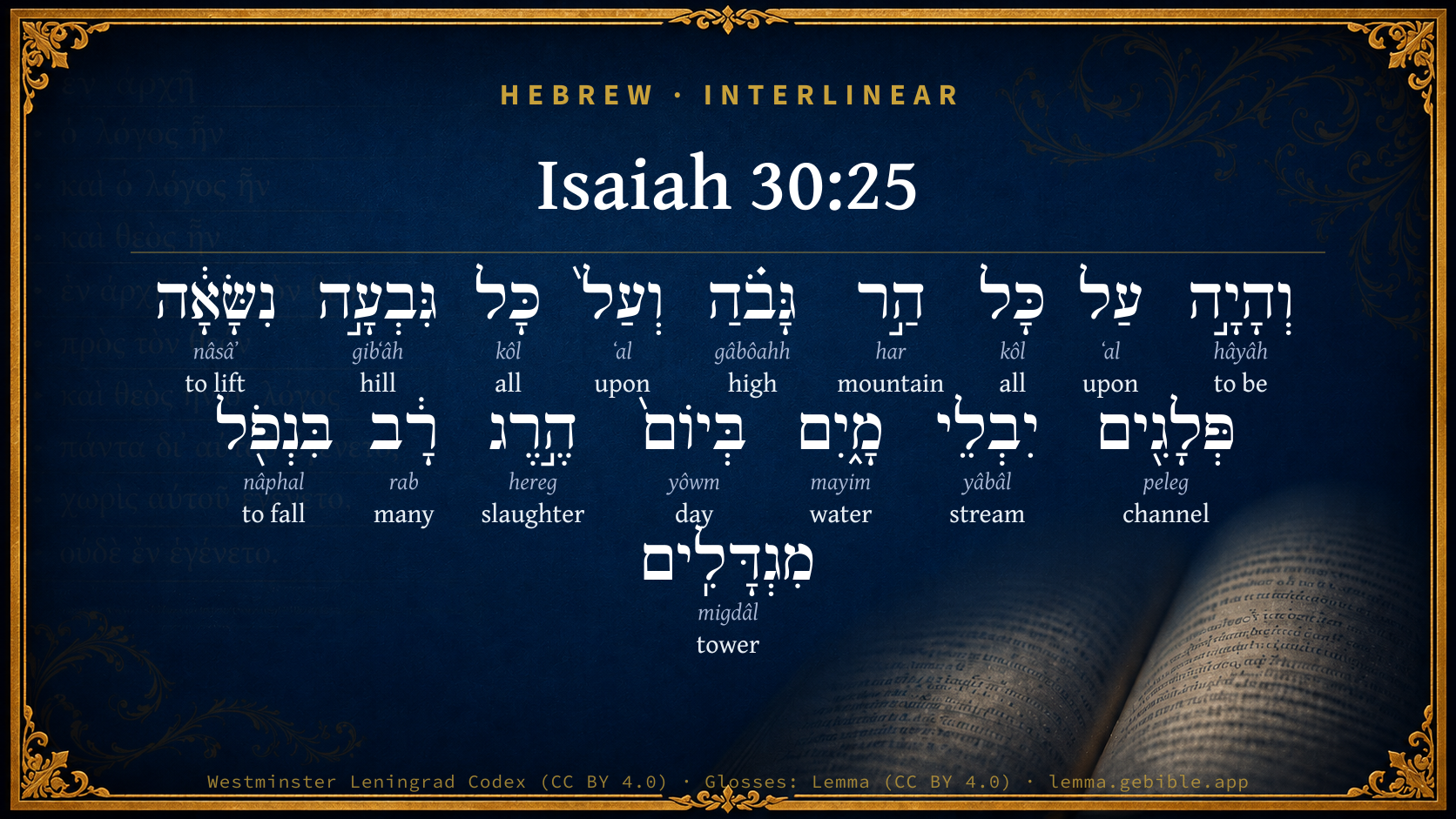
Hebrew (Westminster Leningrad Codex) Isaiah 30:25 appears in the Hebrew Old Testament. The text above is from the Westminster Leningrad Codex. Each word links to its Strong’s number, a concise gloss, and parsing drawn from the Open Scriptures Hebrew Bible morphology. Click any word for its full Brown-Driver-Briggs (BDB) entry.
Download image
Cite this verse

Isaiah 30:25 (World English Bible). Public Domain. Lemma interlinear Bible study tool, https://lemma.gebible.app/v/isaiah/30/25.

Show BibTeX & RIS
BibTeX
RIS
English Translation
There shall be on every lofty mountain, and on every high hill, brooks [and] streams of waters, in the day of the great slaughter, when the towers fall.
World English Bible · Public Domain
Highlights
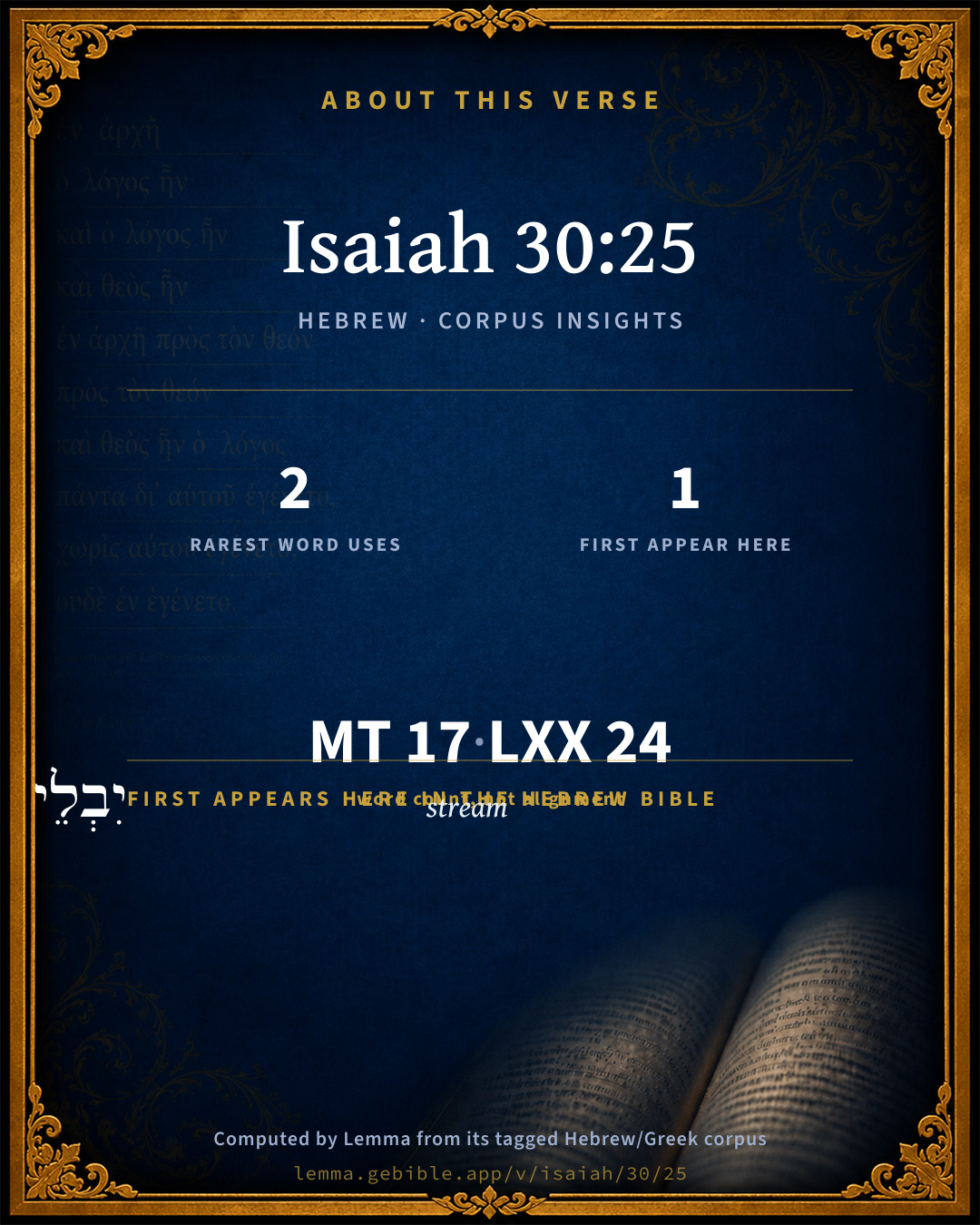
  • 1 first appearance in the Hebrew Bible
Full analysis ↓
Download a study sheet

One document with this verse’s original text, its word-by-word gloss line, the meaning frame, cross-references with their text, attributed commentary, and full source and license credits — printable, and it pastes into notes with its structure intact.

This verse Autodidact and up

Study sheet (.html) Plain text (.txt)

A passage Seminary Student

Up to 50 verses in one chapter. A passage sheet keeps up to 6 commentary sources and 12 cross-references per verse, in the order this page ranks them, and says so on the sheet whenever that leaves anything out. Ask for a single verse and you get the Autodidact verse sheet above.

Everything on this page stays free to read, with no account — the sheet is a download of what is already on screen, not access to it.

Want to remove ads? Support Godless Engineer
Compare translations 3

The same verse in 3 English versions, stacked beneath the original-language interlinear above. Click any original word for its lexicon entry.

Each is an independent rendering of the whole verse — the interlinear is not word-aligned to these translations.

Highlighted words mark where these versions differ — a whole-verse word diff, not a word-by-word alignment.

  • World English Bible Public Domain
    There shall be on every lofty mountain, and on every high hill, brooks [and] streams of waters, in the day of the great slaughter, when the towers fall.
  • King James Version Public Domain
    And there shall be upon every high mountain, and upon every high hill, rivers and streams of waters in the day of the great slaughter, when the towers fall.
  • unfoldingWord Literal Text CC BY-SA 4.0
    And on every high mountain and on every uplifted hill will be streams, courses of waters, in the day of great slaughter, when towers fall.

unfoldingWord Literal Text — © unfoldingWord, licensed CC BY-SA 4.0. Word-aligned USFM3 via Door43 (git.door43.org/unfoldingWord/en_ult).

Versions to compare (up to 4)

3 of 4 selected

Show all 18 translations

Every available English version of this verse, each an independent rendering of the whole verse.

  • World English Bible Public Domain
    There shall be on every lofty mountain, and on every high hill, brooks [and] streams of waters, in the day of the great slaughter, when the towers fall.
  • Berean Standard Bible Public Domain
    And from every high mountain and every raised hill, streams of water will flow in the day of great slaughter, when the towers fall.
  • Majority Standard Bible Public Domain
    And from every high mountain and every raised hill, streams of water will flow in the day of great slaughter, when the towers fall.
  • King James Version Public Domain
    And there shall be upon every high mountain, and upon every high hill, rivers and streams of waters in the day of the great slaughter, when the towers fall.
  • American Standard Version (1901) Public Domain
    And there shall be upon every lofty mountain, and upon every high hill, brooks `and' streams of waters, in the day of the great slaughter, when the towers fall.
  • Revised Version (1885) Public Domain
    And there shall be upon every lofty mountain, and upon every high hill, rivers and streams of waters, in the day of the great slaughter, when the towers fall.
  • Geneva Bible (1599) Public Domain
    And vpon euery hie mountaine, and vpon euery hie hill shall there be riuers and streames of waters, in the day of the great slaughter, when the towers shall fall.
  • Douay-Rheims (1899) Public Domain
    And there shall be upon every high mountain, and upon every elevated hill rivers of running waters in the day of the slaughter of many, when the tower shall fall.
  • Young's Literal Translation Public Domain
    And there hath been on every high mount, And on every exalted hill, Rivulets -- streams of waters, In a day of much slaughter, in the falling of towers.
  • Literal Standard Version CC BY-SA 4.0
    And there has been on every high mountain, || And on every exalted hill, || Streams—conduits of waters, || In a day of much slaughter, in the falling of towers.
  • Unlocked Literal Bible CC BY-SA 4.0
    On every high mountain and on every high hill, there will be flowing brooks and streams of waters, in the day of the great slaughter when the towers fall.
  • unfoldingWord Literal Text CC BY-SA 4.0
    And on every high mountain and on every uplifted hill will be streams, courses of waters, in the day of great slaughter, when towers fall.
  • Darby Bible Public Domain
    And there shall be upon every high mountain and upon every hill that is lifted up, brooks [and] water-courses, in the day of the great slaughter, when the towers fall.
  • World Messianic Bible Public Domain
    There will be brooks and streams of water on every lofty mountain and on every high hill in the day of the great slaughter, when the towers fall.
  • Webster's Bible Public Domain
    And there shall be upon every high mountain, and upon every high hill, rivers and streams of waters in the day of the great slaughter, when the towers fall.
  • Free Bible Version CC BY-SA 4.0
    At that time when your enemies are killed and the fortresses fall, streams of water will flow down every mountain and hill.
  • Bible in Basic English Public Domain
    And there will be rivers and streams of water on every tall mountain and on every high hill, in the day when great numbers are put to the sword, when the towers come down.
  • JPS Tanakh (1917) Public Domain
    And there shall be upon every lofty mountain, and upon every high hill streams and watercourses, in the day of the great slaughter, when the towers fall.

Literal Standard Version (2020), Covenant Press — licensed CC BY-SA 4.0. Text via the HelloAO Bible API (eBible.org). Unlocked Literal Bible (unfoldingWord) — licensed CC BY-SA 4.0. Text via the HelloAO Bible API (eBible.org). unfoldingWord Literal Text — © unfoldingWord, licensed CC BY-SA 4.0. Word-aligned USFM3 via Door43 (git.door43.org/unfoldingWord/en_ult). Free Bible Version, Dr. Jonathan Gallagher — licensed CC BY-SA 4.0. Text via the HelloAO Bible API (eBible.org).

Word by word

More ways to search: Search by grammar → Find every occurrence → Compare this word →

Practice this passage: Drill this verse → Learn its vocabulary →

יִבְלֵי
yâbâl
H2988
“streams of”
Noun, Common, Masculine, Plural, Construct
Part of Speech
Noun
Type
Common
Gender
Masculine
Number
Plural
State
Construct
Full BDB Definition

Origin: from H2986

TWOT: 835a

a stream, watercourse - as irrigating
  1. וְהָיָ֣ה hâyâh H1961 “and · to be” Conjunction + Verb, Qal, Sequential Perfect, 3rd Person, Masculine, Singular
  2. עַל ʻal H5921 “upon” Preposition
  3. כָּל kôl H3605 “all of” Noun, Common, Masculine, Singular, Construct
  4. הַ֣ר har H2022 “mountain” Noun, Common, Masculine, Singular, Absolute
  5. גָּבֹ֗הַ gâbôahh H1364 “high” Adjective, Adjective, Masculine, Singular, Absolute
  6. וְעַל֙ ʻal H5921 “and · upon” Conjunction + Preposition
  7. כָּל kôl H3605 “all of” Noun, Common, Masculine, Singular, Construct
  8. גִּבְעָ֣ה gibʻâh H1389 “hill” Noun, Common, Feminine, Singular, Absolute
  9. נִשָּׂאָ֔ה nâsâʼ H5375 “lifting” Verb, Niphal, Participle Active, Feminine, Singular, Absolute
  10. פְּלָגִ֖ים peleg H6388 “channels” Noun, Common, Masculine, Plural, Absolute
  11. מָ֑יִם mayim H4325 “water(s)” Noun, Common, Masculine, Plural, Absolute
  12. בְּיוֹם֙ yôwm H3117 “in/at · day of” Preposition + Noun, Common, Masculine, Singular, Construct
  13. הֶ֣רֶג hereg H2027 “slaughter” Noun, Common, Masculine, Singular, Absolute
  14. רָ֔ב rab H7227 “many” Adjective, Adjective, Masculine, Singular, Absolute
  15. בִּנְפֹ֖ל nâphal H5307 “in/at · to fall” Preposition + Verb, Qal, Infinitive Construct
  16. מִגְדָּלִֽים migdâl H4026 “towers” Noun, Common, Both, Plural, Absolute

About this verse

These counts appear in no published source. They are computed here, from the morphology-tagged text and Lemma’s own curated glosses. What Lemma adds →

17
words
15
distinct lemmas
Prophets
section

Notable vocabulary

The rarest word here is יִבְלֵי stream H2988 — appearing just 2 times in the whole Hebrew Bible.

First appearance in Scripture

This word makes its first canonical appearance in the Hebrew Bible here:

  • יִבְלֵי stream H2988

Shared distinctive vocabulary

יִבְלֵי stream H2988 occurs in 2 verses of the Hebrew Bible. Also found in:

Grammatical profile

  • 3 verbs
  • 10 nouns
  • 2 adjectives
  • 2 prepositions

Verb forms

  • וְהָיָ֣ה Qal · Sequential Perfect
  • נִשָּׂאָ֔ה Niphal · Participle Active
  • בִּנְפֹ֖ל Qal · Infinitive Construct

Repetition

Words recur within this verse — often emphatic in Hebrew:

Hebrew & Septuagint length

In English translation the verse runs 28 words from the Hebrew and 28 from the Septuagint (LXX English) — the same length.

A rough comparison of the two English renderings, which tokenize alike — not a word-level alignment.

Word counts can differ between the Hebrew and the Greek without any difference in meaning — e.g. the Hebrew direct-object marker אֵת has no separate Greek word, and Greek often adds the article ὁ.

In the original languages it is 17 Hebrew tokens and 24 Greek tokens — but the two are counted differently (Hebrew bundles its prefixes and suffixes into one token; the Greek is in lemma form), so that isn’t a like-for-like length.

Cross-references

18

Topical passages linked to Isaiah 30:25 in the Treasury of Scripture Knowledge — connected by theme and wording, ordered by reader-vote popularity; previews shown in the World English Bible.

  • Isaiah 2:14–15 For all the high mountains, For all the hills that are lifted up,
  • Isaiah 35:6–7 Then shall the lame man leap as a hart, and the tongue of the mute shall sing; for in the wilderness shall waters break out, and streams in the desert.
  • Isaiah 43:19–20 Behold, I will do a new thing; now shall it spring forth; shall you not know it? I will even make a way in the wilderness, and rivers in the desert.
  • Isaiah 32:14 For the palace shall be forsaken; the populous city shall be deserted; the hill and the watch-tower shall be for dens forever, a joy of wild donkeys, a pasture of flocks;
  • Isaiah 34:2–10 For Yahweh has indignation against all the nations, and wrath against all their host: he has utterly destroyed them, he has delivered them to the slaughter.
  • Isaiah 37:36 The angel of Yahweh went forth, and struck in the camp of the Assyrians one hundred and eighty-five thousand; and when men arose early in the morning, behold, these were all dead bodies.
  • Isaiah 41:18–19 I will open rivers on the bare heights, and springs in the midst of the valleys; I will make the wilderness a pool of water, and the dry land springs of water.
  • Isaiah 44:3–4 For I will pour water on him who is thirsty, and streams on the dry ground; I will pour my Spirit on your seed, and my blessing on your offspring:
  • Isaiah 63:1–6 Who is this who comes from Edom, with dyed garments from Bozrah? this who is glorious in his clothing, marching in the greatness of his strength? I who speak in righteousness, mighty to save.
  • Ezekiel 17:22 Thus says the Lord Yahweh: I will also take of the lofty top of the cedar, and will set it; I will crop off from the topmost of its young twigs a tender one, and I will plant it on a high and lofty mountain:
  • Ezekiel 34:13 I will bring them out from the peoples, and gather them from the countries, and will bring them into their own land; and I will feed them on the mountains of Israel, by the watercourses, and in all the inhabited places of the country.
  • Ezekiel 34:26 I will make them and the places round about my hill a blessing; and I will cause the shower to come down in its season; there shall be showers of blessing.
  • Ezekiel 39:17–20 You, son of man, thus says the Lord Yahweh: Speak to the birds of every sort, and to every animal of the field, Assemble yourselves, and come; gather yourselves on every side to my sacrifice that I do sacrifice for you, even a great sacrifice on the mountains of Israel, that you may eat flesh and drink blood.
  • Nahum 3:12 All your fortresses will be like fig trees with the first-ripe figs: if they are shaken, they fall into the mouth of the eater.
  • John 7:38 He who believes in me, as the Scripture has said, from within him will flow rivers of living water."
  • 2 Corinthians 10:4 for the weapons of our warfare are not of the flesh, but mighty before God to the throwing down of strongholds,
  • Revelation 16:1–19 I heard a loud voice out of the temple, saying to the seven angels, "Go and pour out the seven bowls of the wrath of God on the earth!"
  • Revelation 22:1 He showed me a river of water of life, clear as crystal, proceeding out of the throne of God and of the Lamb,

Cross-references courtesy of OpenBible.info (CC BY 4.0).

Hebrew and Greek witnesses Masoretic Hebrew ↔ Greek Septuagint

The same verse in the two great witnesses to the Old Testament, shown verse-for-verse.

These are two independent witnesses, not word-aligned to each other, and the Septuagint is shown in lemma (dictionary) form.

Hebrew Isaiah 30:25 Masoretic · Westminster Leningrad Codex

וְהָיָ֣ה עַל כָּל הַ֣ר גָּבֹ֗הַ וְעַל֙ כָּל גִּבְעָ֣ה נִשָּׂאָ֔ה פְּלָגִ֖ים יִבְלֵי מָ֑יִם בְּיוֹם֙ הֶ֣רֶג רָ֔ב בִּנְפֹ֖ל מִגְדָּלִֽים

There shall be on every lofty mountain, and on every high hill, brooks [and] streams of waters, in the day of the great slaughter, when the towers fall.

World English Bible · Public Domain

Greek LXX Isaiah 30:25 Septuagint · lemma form

καί εἰμί ἐπί πᾶς ὄρος ὑψηλός καί ἐπί πᾶς βουνός μετέωρος ὕδωρ διαπορεύομαι ἐν ὁ ἡμέρα ἐκεῖνος ὅταν ἀποὀλλύω πολύς καί ὅταν πίπτω πύργος

And there shall be upon every lofty mountain and upon every high hill, water running in that day, when many shall perish, and when the towers shall fall.

LXX2012 (modern English Septuagint) · Public Domain

Hebrew: Westminster Leningrad Codex (CC BY 4.0). Greek: Septuagint (public domain); English from LXX2012 (modern English Septuagint) (Public Domain). How the Septuagint differs from the Hebrew →

Targum (Aramaic paraphrase)

1

The Targum is the ancient Jewish Aramaic paraphrase of the Hebrew Scriptures — an interpretive translation, not the Hebrew text itself. Onkelos (literal) and Pseudo-Jonathan (expansive) render the Torah, and Jonathan the Prophets. Coverage is partial: where no permissively-licensed English translation exists for a verse, only the Aramaic is shown. This is verse-level text, not a word-by-word alignment to the Hebrew.

  1. Targum Jonathan Prophets (Joshua–Malachi)
    וִיהֵי עַל כָּל טוּר רָם וְעַל כָּל רָמָא מְנַטְלָא פַצִידִין נָגְדִין מַיִין תַּקָלָא לְמַלְכִין וּלְמַשִׁרְיַתְהוֹן בְּיוֹם קְטוּל רַב בְּמַפַּל רַבְרְבִין:

    And there shall be upon every high mountain, and upon every high and lofty hill, rivers flowing with water at the time of the ruin of the kings and their armies, in the day of the great slaughter, at the falling of the princes.

    Targum Jonathan — Aramaic: “Mikraot Gedolot” (public domain). English: “Sefaria Community Translation” (CC0 1.0 (public-domain dedication)); “London "Chaldee Paraphrase," 1871” (public domain). Text via Sefaria.

Commentary

Notes on Isaiah 30:25 from classic Christian and Jewish commentators (each source and its license shown beneath its notes). The classic Christian expositions comment on the surrounding passage and are grouped to its opening verse, so a note may address several verses; the Jewish commentaries on the Tanakh (Rashi and others) are per-verse, so they appear only where the commentator wrote on this verse.

Lemma curates 59 commentaries, every one of them public domain or Creative Commons licensed, each selected and text-cleaned for this edition rather than reprinted as found. About our sources →

Trapp's Complete Commentary

John Trapp

Isa 30:25 And there shall be upon every high mountain, and upon every high hill, rivers [and] streams of waters in the day of the great slaughter, when the towers fall.

Ver. 25. Rivers and streams of waters.] To moisten them and make them fertile.

When the towers fall] i.e., Sennacherib’s great princes, who were as towers and bulwarks.

John Trapp, A Commentary or Exposition upon All the Books of the Old and New Testament (1647–1656) — public domain. Text from a community e-Sword module.

Joseph Benson's Commentary

Isa 30:25. On every high mountain, and every high hill — Which are commonly dry and barren; shall be rivers and streams of water — Fertilizing and refreshing blessings, showered down by God upon his church and people. This verse certainly cannot be understood literally, and the mystical meaning, according to Vitringa and some others, is, “that in all the more celebrated places, whether of kingdoms or cities, there should be synagogues, public schools, or oratories, in which the word of God, and the doctrine of pure religion, should be copiously taught, and the waters of sound instruction poured out,” so that the lovers of true wisdom, piety, and virtue, might there quench their thirst. The time in which these benefits should be conferred upon the church is denoted by this character, namely, in the day of the great slaughter, when the towers shall fall — That is, when God should take severe vengeance upon the enemies of his people. Perhaps the destruction of Jerusalem and of the temple, with the subversion of the Jewish state, and the slaughter of immense multitudes of Jews, events connected with the calling of the Gentiles, and the extensive propagation of the gospel, might be first in the prophet’s view. The words may further refer to the overthrow of the pagan, persecuting Roman empire, and the great slaughter that preceded or accompanied it. But, undoubtedly, the words ultimately refer to the destruction of all the antichristian powers, the subversion of the fortresses and towers of Satan’s kingdom, making way for the universal diffusion of divine truth and spread of true religion. “This shall be remarkably fulfilled,” says Lowth, “at the time when there shall be a terrible destruction of God’s enemies, (Rev 14:20; Rev 19:21,) and when the great ones of the earth shall fall, denoted here by high towers, or the fortifications of mystical Babylon.”

Joseph Benson's Commentary on the Old and New Testaments (1811–1818) — public domain. Text from a community e-Sword module.

The Preacher's Complete Homiletical Commentary

Joseph S. Exell (gen. ed.)

RIVERS OF WATERS

Isa_30:25-26. And there shall be upon every high mountain, &c.

These are symbols of the blessings God will confer upon His people when He returns to them in mercy. These are vivid presentations of two characteristics of these blessings, their copiousness and their universality.

1. To express their COPIOUSNESS the prophet speaks not of streams merely, but of rivers; “rivers and streams of water;” and declares that they shall be poured forth, not merely as the light from the sun, but as if the light of seven days were concentrated in one [1138]

2. To express at once their copiousness and their UNIVERSALITY, He declares that the rivers and streams shall run on the hills and mountains, yea, upon every hill and mountain [1141] The idea of universality is involved also in the figure of sunlight [1144]

[1138] We can conceive of nothing more bright, pervading, and universal than the light of the sun. At its rising the whole face of nature is displayed, every object in brought out to view; the grandest or loveliest features of the scene are presented to us in all their extent and magnificence, while the most delicate tints of the smallest flower are seen in all their softest shades and richest hues. Still this glorious object in its full splendour, the sun itself is too dim, too dull, too feeble to represent the grace and love of our God; it must be multiplied sevenfold. And even then it but indistinctly shadows forth the unspeakable mercy of the everlasting God.—Packer.

[1141] “Rivers and streams of waters.” But where is their current? Upon every high mountain and upon every high hill. Now, there can be no rivers and streams on the summit of the mountain range, nor upon the high hill-top. Rivers and streams are fed from these lofty elevations; they take their rise amid these towering heights, but they do not find a channel there. Thus you see that to typify the effluence of the Holy Spirit, these flowing waters of the text are described as being in unusual localities, to intimate that the blessings will be in such abundance and profusion as to outrun expectation and surpass all experience. And this not in some highly favoured regions only, but the blessing shall be universal, even upon every high mountain and upon every high hill.—Packer.

[1144] This, like the air, cannot be excluded; it penetrates the gloomiest caverns, can enter even through a cranny. So there is no soul out of reach of the all-pervading Spirit. Those that are inaccessible to man can be reached, and enriched, and blessed by the mighty energy of the Holy Ghost.—Packer.

Have these promises been fulfilled? Yes.

1. When the Gospel was given to the world. Its messengers were sent forth into every land, and it is a small thing to say that the light it gave was sevenfold that which the most enlightened of the heathen had possessed.

2. In the experience of every believing soul. The Gospel reaches many who seem utterly beyond any saving influence; and when it does really reach a man, is received into his heart. It gives him a light of more than sevenfold brightness and value as compared with the best of the lights he before possessed—reason and conscience [1147]

3. It is fulfilled in our own day in the wide diffusion of the Gospel and the remarkable increase of religious knowledge. God’s Word is being carried into every land, and the children in our daily and Sabbath schools have a fuller acquaintance with Scripture than many men and women of the last generation. There is to be a yet more complete fulfilment of these promises in that glorious era of which we speak as the Millennium [1150]

[1147] When we attempt to compare the boasted light of natural reason with the light which the Spirit alone can impart, it is not simply that the former is as the light of the moon, and the latter as the light of the sun; but the one is as Egyptian darkness, and the other as the splendour of the meridian sun, without even one small fleecy cloud intervening. Jesus Christ is the light of life (2Co_4:6). All that we can know of God, of His attributes and perfections, of His plans and purposes, He has revealed unto us by His Son. To those who are in Christ all is light, and harmony, and peace; to those who are without Christ all is gloom, and confusion, and terror. By faith in Him we see that all God’s dealings wear an aspect of mercy, love, and wisdom. Corrections are inflicted for our profit; disappointments are sent to wean us from the unsatisfying, perishing things of time and sense. Surely, in this respect, the promise in the text is made good to the believer; he enjoys sevenfold light in his soul compared to that which he had in the days when he knew not the true God and Jesus Christ, whom He had sent.—Packer.

[1150] But these mercies will be preceded by the convulsions of the moral earthquake. The very terms in which the promise is couched convey the idea of trial and suffering. There is a breach which the Lord binds up, and there is the stroke of a wound to he healed, implying previous violence.—Packer.

It rests with ourselves to determine whether the fulfilment of these promises shall be to us a blessing [1153]John Packer: Warnings and Consolations. pp. 256–271.

[1153] What shall the universality and copiousness of the “rivers and streams of water” profit us, if we will not drink of them? In the natural world a man would be nothing benefited, though the light of the sun was augmented sevenfold, if he studiously closed and sealed every opening by which it entered his dwelling, or if he placed an impervious bandage tightly over his eyes whenever he went abroad (Joh_12:36).—Packer.

[See also Outlines, RIVERS OF WATER IN A DRY PLACE, Isa_32:2, and ENRICHING RIVERS, Isa_33:21.]

The Preacher's Complete Homiletical Commentary (gen. ed. Joseph S. Exell; Funk & Wagnalls, c. 1892) — public domain (pre-1929). A full-Bible homiletical/sermon-outline anthology covering 65 of 66 books (2 John is absent from the source module). Text from a community e-Sword module.

Geneva Bible (1599)

Geneva Bible translators

By these divers manners of speech he showeth that the felicity of the Church shall be so great, that none is able sufficiently to express it.

Geneva Bible (1599) marginal notes — public domain. Text via Bolls.life.

Jamieson, Fausset & Brown

Robert Jamieson, A. R. Fausset & David Brown

Even the otherwise barren hills shall then be well-watered (Isa 44:3).

the day, &c.--when the disobedient among the Jews shall have been slain, as foretold in Isa 30:16 : "towers," that is, mighty men (Isa 2:15). Or else, the towers of the Assyrian Sennacherib, or of Babylon, types of all enemies of God's people.

Jamieson, Fausset & Brown — Commentary Critical and Explanatory on the Whole Bible (1871) — public domain (CC PDM 1.0). Text via the HelloAO Bible API.

Adam Clarke's Commentary

Verse 25. When the towers fall - "When the mighty fall."] מגדלים migdalim, μεγαλους, Sym.; μεγαλυνομενους, Aquila; רברבין rabrebin, Chald.; all signifying mighty sizes.

Adam Clarke's Commentary on the Bible (1810–1826) — public domain. Text from a community e-Sword/MySword module.

Ellicott's Commentary for English Readers

(25) There shall be upon every high mountain . . .—The picture of a golden age is continued. The mountains and hills, often so dry and barren, should flow down with rivers of waters, and irrigate the valleys. And this should coincide with the day of a “great slaughter,” perhaps of the enemies of Israel, perhaps also of the people themselves (judgment coming before the blessing), and of the fall of the “towers” in which they had put their trust. (Comp. Isa_40:4.) As before, man’s extremity was to be God’s opportunity. Possibly, however, the “towers” are those of the besiegers of the city.

A Bible Commentary for English Readers, edited by Charles John Ellicott (1878–1897) — public domain. Text from a community e-Sword module.

The Cambridge Bible for Schools and Colleges

gen. ed. J. J. S. Perowne

25. Even the arid slopes of the hills of Palestine shall then flow with water.

slaughter, when the towers fall] cf. ch. Isa_2:12 ff. It is a vague poetic allusion to the day of the Lord, when all His enemies are destroyed.

The Cambridge Bible for Schools and Colleges (gen. ed. J. J. S. Perowne; Cambridge University Press, 1878–1918) — public domain. Text from a community e-Sword module.

John Gill's Exposition

And there shall be upon every high mountain, and upon every high hill,.... Which were round about Jerusalem, and in other parts of Judea:

rivers and streams of water; such abundance of rain, that it should flow in streams like rivers, from the higher to the lower lands, and water them. This may in a spiritual sense be understood of the great plenty of the ministry of the Gospel, in all the kingdoms of the world, great and small, signified by mountains and hills; and which may also intimate the open and public ministrations of it in them, Zac 14:8 or of the blessings of grace, and the graces of the Spirit, communicated everywhere; see Isa 41:18, Joh 7:38. This is applied to the times of the Messiah by the Jews (g) themselves, and respects the latter part of those times:

in the day of the great slaughter; not of Sennacherib's army by the angel, as many Jewish and Christian interpreters understand it; nor of the Babylonians, at the taking of Babylon by Cyrus; but of the antichristian kings, and their armies, Rev 19:17. So the Targum paraphrases it,

"for the ruin of kings and their armies, in the day of the great slaughter;''

and a great slaughter it will be indeed:

when the towers fall; not the batteries and fortifications raised in the Assyrian camp, at the siege of Jerusalem, which fell when they were destroyed by the angel; or the great men and princes in that army, which then fell; though towers sometimes signify great persons, such as princes; see Isa 2:15 and so the Targum interprets it here; and may be true of the antichristian princes; for of the fall of the great city of Rome, and of other cities of the nations, with the towers thereof, is this to be understood, even of mystical, and not of literal Babylon; see Rev 11:13.

(g) Bemidbar Rabba, fol. 212. 3.

John Gill's Exposition of the Whole Bible (1746–1763) — public domain (CC PDM 1.0). Text via the HelloAO Bible API.

Albert Barnes' Notes on the Bible

In the day of the great slaughter - When the enemies of the people of God shall have been destroyed - probably in a time subsequent to the slaughter of the army of the Assyrians.

When the towers fall - The towers of the enemy; perhaps referring here to the towers of Babylon. After they should fall, the Jews would be favored with the time of prosperity to which the prophet here refers.

Albert Barnes' Notes on the Bible (1834–1885) — public domain. Text from a community e-Sword/MySword module.

Haydock's Catholic Bible Commentary

Towers, or chief officers of Sennacherib. All shall be luxuriant.

George Leo Haydock (1774–1849), Haydock's Catholic Family Bible and Commentary, 1859 edition — public domain. Excludes Psalms (Douay-Rheims chapter numbering differs from Protestant) and Deuterocanonical books (Catholic canon only).

Matthew Poole's English Annotations

Upon every high mountain, and upon every high hill; which are commonly dry and barren, and destitute of rivers.

In the day of the great slaughter; when God shall destroy the enemies of his people, he will shower down his blessings upon his church.

The towers; either properly, the towers of Babylon, for which she was famous; or metaphorically, the high and mighty potentates, which fought against God’s people, as Isa 2:15.

Matthew Poole's English Annotations on the Holy Bible (1683–1685) — public domain. Text from a community e-Sword/MySword module.

The Pulpit Commentary

Rivers and streams of water; rather, rivulets, courses of water. Channels, along which water was conveyed for the purpose of irrigation, are intended. (comp. Eze_47:1-12Jo Eze_3:18) No doubt there is a secondary allegorical meaning running through the whole description of Judah"s prosperity (vers. 23-26). In this allegorical intention the waters stand for the streams of God"s grace. In the day of the great slaughter. Equivalent to "the day of vengeance" (Isa_34:8) the day when God shall tread down his enemies. The prophet passes from the immediate effect of Judah"s repentance to a broader view of what shall happen when God"s kingdom is established upon the earth. When the towers fall; i.e. when there shall be a general "pulling down of strong holds," and a "casting down of every high thing that exalts itself against. (2Co_10:4, 2Co_10:5)

The Pulpit Commentary (1880–1919), ed. H.D.M. Spence-Jones & Joseph S. Exell — public domain. Text from a community e-Sword module.

John Wesley's Explanatory Notes

Hill - Which is commonly dry and barren. In the day - When God shall destroy the enemies of his people. The towers - The mighty potentates, who fought against God's people.

John Wesley, Explanatory Notes Upon the Whole Bible (1754–1765) — public domain. Text via the GEBible commentary corpus.

J. A. Alexander on Isaiah

Joseph Addison Alexander

“And there shall be, on every high mountain, and on every elevated hill, channels, streams of water, in the day of great slaughter, in the falling of towers (or when towers fall).” The meaning seems to be, that water shall flow where it never flowed before, a common figure in the Prophets for a great change, and especially a change for the better. The same sense is no doubt to be attached to the previous descriptions of abundance and fertility. There are no sufficient data in the text itself for any specific and exclusive application. All that can certainly be gathered from the words is, that a period of war and carnage should be followed by one of abundance and prosperity.

Joseph Addison Alexander, The Prophecies of Isaiah (1846–1847; New York: Scribner, 1870–1878) — public domain. Text from a community e-Sword module.

unfoldingWord translationNotes

Door43 World Missions Community

General Information:

Isaiah continues speaking to the people of Judah.

On every high mountain ... sunlight of seven days

Isaiah describes what will be an ideal situation after Yahweh rescues his people. Although the language may be exaggerated, you should translate this just as Isaiah described it.

in the day of the great slaughter when the towers fall

"when Yahweh slaughters your enemies and causes their strong towers to fall"

in the day

"at the time"

the light of the sun will be seven times brighter, like the sunlight of seven days

"the sun will shine as bright as seven suns" or "the sun will give as much light in one day as it normally does in seven days"

Yahweh will bind up the breaking of his people and heal the bruises of his wounding them

Yahweh comforting his people and causing their suffering to end is spoken of as if he would put bandages on their wounds. (See: Metaphor)

translationWords

slaughter

watchtower

Yahweh

people of God

unfoldingWord translationNotes — © Distant Shores Media and the Door43 World Missions Community, licensed CC BY-SA 4.0. Source: git.door43.org/Door43/en_tn.

Rashi

Rabbi Shlomo Yitzchaki (Rashi)

rivulets of water (יִבְלֵי מָיִם), rivers of water. Comp. (Jer. 17:8) “And upon the river (יוּבַל) he sends forth his roots.”

on the day of the great slaying when there will be a great slaughter (in the land of Assyria), and Jonathan renders: On the day of the great slaying, when the great ones will fall.

Rashi on the Tanakh — English translations: “The Judaica Press complete Tanach with Rashi, translated by A. J. Rosenberg” (CC BY 4.0); “Pentateuch with Rashi's commentary by M. Rosenbaum and A.M. Silbermann, 1929-1934” (public domain); “The Metsudah Tanach series, Lakewood, N.J” (CC BY 4.0); and “The Book of Joshua, Metsudah Publications, 1997” (CC BY 4.0). Text via Sefaria.

Ibn Ezra

Rabbi Abraham ibn Ezra

יבלי Rivers. Comp. יובל river (Jer. 17:8). And there shall be upon every high mountain, etc. The rain will come in such quantity, that the water will remain upon the mountains.

In the day of great slaughter, etc. When people will die through the fall of towers. It is a kind of consolation to learn, that when ten die, myriads are kept alive: for although the wall might fall upon the widow through the rain, the Lord will not keep it back from coming down and giving life to many; the rain has no knowledge that it should come down upon one place and not at the same time upon the neighbouring ones.

Ibn Ezra on the Tanakh — English translations: “Sefaria Community Translation” (CC0 1.0 (public-domain dedication)); “Yalkut, Sifsei Chachomim Chumash, Metsudah Publications, 2009” (CC BY 4.0); and “Commentary of Ibn Ezra on Isaiah - trans. by M. Friedlander, 1873” (public domain). Text via Sefaria.

Lesson kit

Teaching starters — assembled from the data on this page, not authored interpretation. Every prompt links to the verse data it draws on. Edit before teaching.

Isaiah, in the Prophets, opens this verse with 17 words (15 distinct Hebrew lemmas). Its most distinctive word is yâbâl (“stream”). A historical commentator’s framing appears above. Read the whole chapter for the surrounding context.

Discussion questions

  1. How does “stream” (yâbâl) shape what this verse is saying?
  2. This is the first place “stream” appears in Scripture (first appears here). What does its debut here establish?
  3. How does Isaiah 44:4, which shares the word «stream», read alongside this verse?
  4. What does the repetition of “upon” (2× in this one verse) do in this verse?
  5. These translations render this verse differently; the difference is in the English rendering, not the original. What questions does that raise?
  6. «וְהָיָ֣ה» is a Qal Sequential Perfect verb. How does that grammatical form shape the action described?
  7. Compare how Trapp's Complete Commentary and Joseph Benson's Commentary read this verse. Where do they agree or differ?

Things to notice

Reading settings

Reading text

Shown beneath each verse's original-language words.

Old Testament
Old Testament edition

Read the OT as the Masoretic Hebrew (MT) or the Greek Septuagint (LXX).

English shown for the Greek Septuagint (in the Hebrew ↔ Greek comparison).

Comparing translations? Open the Compare panel on any verse page to stack up to four side by side.