
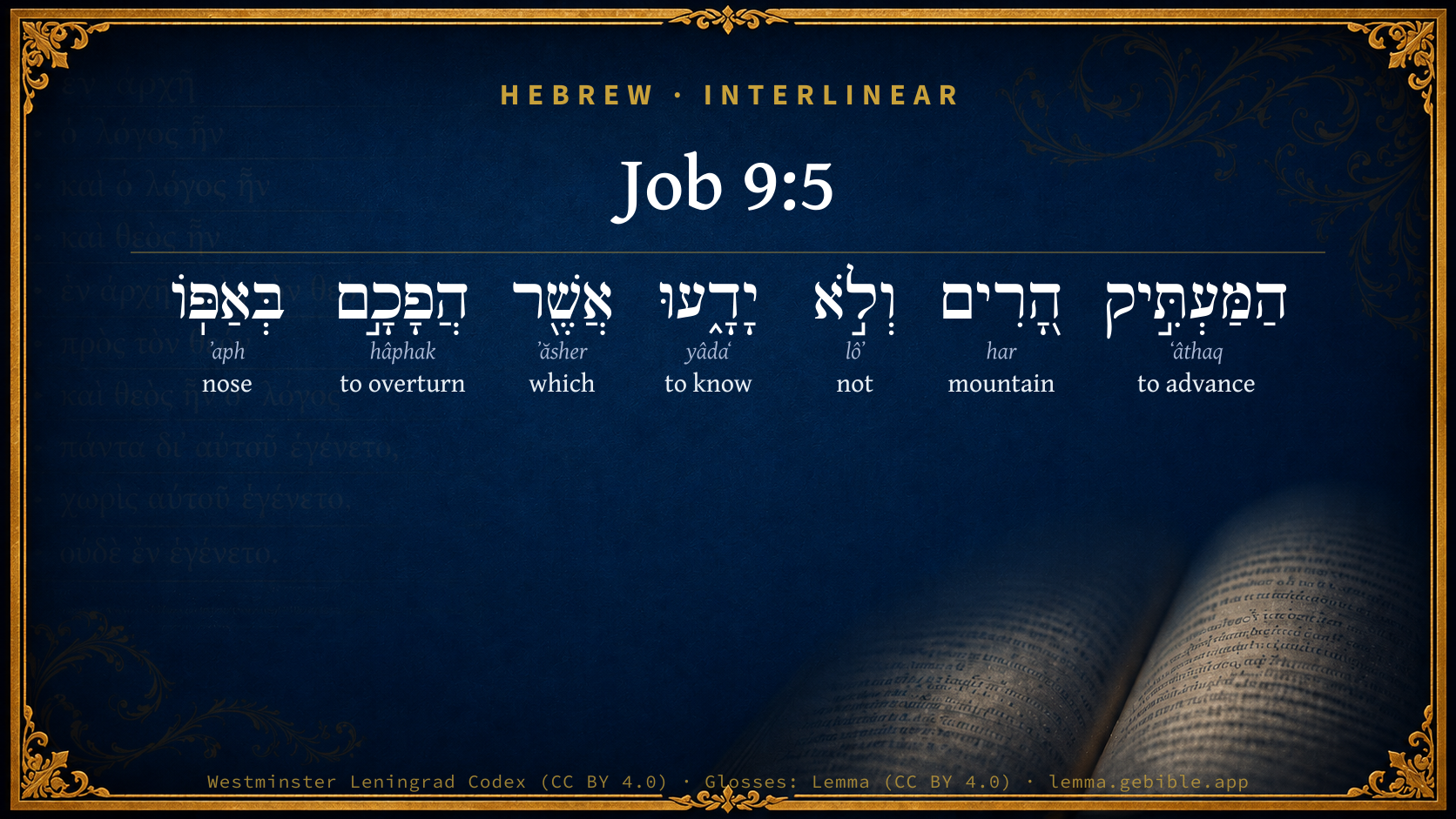
Job 9:5

Hebrew (Westminster Leningrad Codex) Job 9:5 appears in the Hebrew Old Testament. The text above is from the Westminster Leningrad Codex. Each word links to its Strong’s number, a concise gloss, and parsing drawn from the Open Scriptures Hebrew Bible morphology. Click any word for its full Brown-Driver-Briggs (BDB) entry.
Download image
Cite this verse

Job 9:5 (World English Bible). Public Domain. Lemma interlinear Bible study tool, https://lemma.gebible.app/v/job/9/5.

Show BibTeX & RIS
BibTeX
RIS
English Translation
Who removes the mountains, and they don't know it, When he overturns them in his anger
World English Bible · Public Domain
Download a study sheet

One document with this verse’s original text, its word-by-word gloss line, the meaning frame, cross-references with their text, attributed commentary, and full source and license credits — printable, and it pastes into notes with its structure intact.

This verse Autodidact and up

Study sheet (.html) Plain text (.txt)

A passage Seminary Student

Up to 50 verses in one chapter. A passage sheet keeps up to 6 commentary sources and 12 cross-references per verse, in the order this page ranks them, and says so on the sheet whenever that leaves anything out. Ask for a single verse and you get the Autodidact verse sheet above.

Everything on this page stays free to read, with no account — the sheet is a download of what is already on screen, not access to it.

Want to remove ads? Support Godless Engineer
Compare translations 3

The same verse in 3 English versions, stacked beneath the original-language interlinear above. Click any original word for its lexicon entry.

Each is an independent rendering of the whole verse — the interlinear is not word-aligned to these translations.

Highlighted words mark where these versions differ — a whole-verse word diff, not a word-by-word alignment.

  • World English Bible Public Domain
    Who removes the mountains, and they don't know it, When he overturns them in his anger
  • King James Version Public Domain
    Which removeth the mountains, and they know not: which overturneth them in his anger.
  • unfoldingWord Literal Text CC BY-SA 4.0
    the one removing mountains and they do not know, who in his nose overturns them;

unfoldingWord Literal Text — © unfoldingWord, licensed CC BY-SA 4.0. Word-aligned USFM3 via Door43 (git.door43.org/unfoldingWord/en_ult).

Versions to compare (up to 4)

3 of 4 selected

Show all 18 translations

Every available English version of this verse, each an independent rendering of the whole verse.

  • World English Bible Public Domain
    Who removes the mountains, and they don't know it, When he overturns them in his anger
  • Berean Standard Bible Public Domain
    He moves mountains without their knowledge and overturns them in His anger.
  • Majority Standard Bible Public Domain
    He moves mountains without their knowledge and overturns them in His anger.
  • King James Version Public Domain
    Which removeth the mountains, and they know not: which overturneth them in his anger.
  • American Standard Version (1901) Public Domain
    `Him' that removeth the mountains, and they know it not, When he overturneth them in his anger;
  • Revised Version (1885) Public Domain
    Which removeth the mountains, and they know it not, when he overturneth them in his anger.
  • Geneva Bible (1599) Public Domain
    He remoueth the mountaines, and they feele not when he ouerthroweth them in his wrath.
  • Douay-Rheims (1899) Public Domain
    Who hath removed mountains, and they whom he overthrew in his wrath, knew it not.
  • Young's Literal Translation Public Domain
    Who is removing mountains, And they have not known, Who hath overturned them in His anger.
  • Literal Standard Version CC BY-SA 4.0
    Who is removing mountains, || And they have not known, || Who has overturned them in His anger.
  • Unlocked Literal Bible CC BY-SA 4.0
    he who removes the mountains without warning anyone when he overturns them in his anger—
  • unfoldingWord Literal Text CC BY-SA 4.0
    the one removing mountains and they do not know, who in his nose overturns them;
  • Darby Bible Public Domain
    Who removeth mountains, and they know it not, when he overturneth them in his anger;
  • World Messianic Bible Public Domain
    He removes the mountains, and they don’t know it, when he overturns them in his anger.
  • Webster's Bible Public Domain
    Who removeth the mountains, and they know not: who overturneth them in his anger.
  • Free Bible Version CC BY-SA 4.0
    God moves the mountains suddenly; he overturns them in his anger.
  • Bible in Basic English Public Domain
    It is he who takes away the mountains without their knowledge, overturning them in his wrath:
  • JPS Tanakh (1917) Public Domain
    Who removeth the mountains, and they know it not, when He overturneth them in His anger.

Literal Standard Version (2020), Covenant Press — licensed CC BY-SA 4.0. Text via the HelloAO Bible API (eBible.org). Unlocked Literal Bible (unfoldingWord) — licensed CC BY-SA 4.0. Text via the HelloAO Bible API (eBible.org). unfoldingWord Literal Text — © unfoldingWord, licensed CC BY-SA 4.0. Word-aligned USFM3 via Door43 (git.door43.org/unfoldingWord/en_ult). Free Bible Version, Dr. Jonathan Gallagher — licensed CC BY-SA 4.0. Text via the HelloAO Bible API (eBible.org).

Word by word

More ways to search: Search by grammar → Find every occurrence → Compare this word →

Practice this passage: Drill this verse → Learn its vocabulary →

הַמַּעְתִּ֣יק
ʻâthaq
H6275
“the · advancing”
Particle, Definite Article + Verb, Hiphil, Participle Active, Masculine, Singular, Absolute
Part of Speech
Particle + Verb
Stem
Hiphil
Form
Participle Active
Gender
Masculine
Number
Singular
State
Absolute
Full BDB Definition

Origin: a primitive root

TWOT: 1721

to move, proceed, advance, move on, become old, be removed - (Qal) - to move - to advance (in years), grow old and weak - (Hiphil) - to move forward, proceed, move on - to remove - to transcribe
  1. הָ֭רִים har H2022 “mountains” Noun, Common, Masculine, Plural, Absolute
  2. וְלֹ֣א lôʼ H3808 “and · not” Conjunction + Particle, Negative
  3. יָדָ֑עוּ yâdaʻ H3045 “to know” Verb, Qal, Perfect, 3rd Person, Common, Plural
  4. אֲשֶׁ֖ר ʼăsher H834 “which” Particle, Relative
  5. הֲפָכָ֣ם hâphak H2015 “to overturn · them” Verb, Qal, Perfect, 3rd Person, Masculine, Singular + Suffix, Personal, 3rd Person, Masculine, Plural
  6. בְּאַפּֽוֹ ʼaph H639 “in/at · nose · his” Preposition + Noun, Common, Masculine, Singular, Construct + Suffix, Personal, 3rd Person, Masculine, Singular

About this verse

These counts appear in no published source. They are computed here, from the morphology-tagged text and Lemma’s own curated glosses. What Lemma adds →

7
words
7
distinct lemmas
Wisdom
section

Notable vocabulary

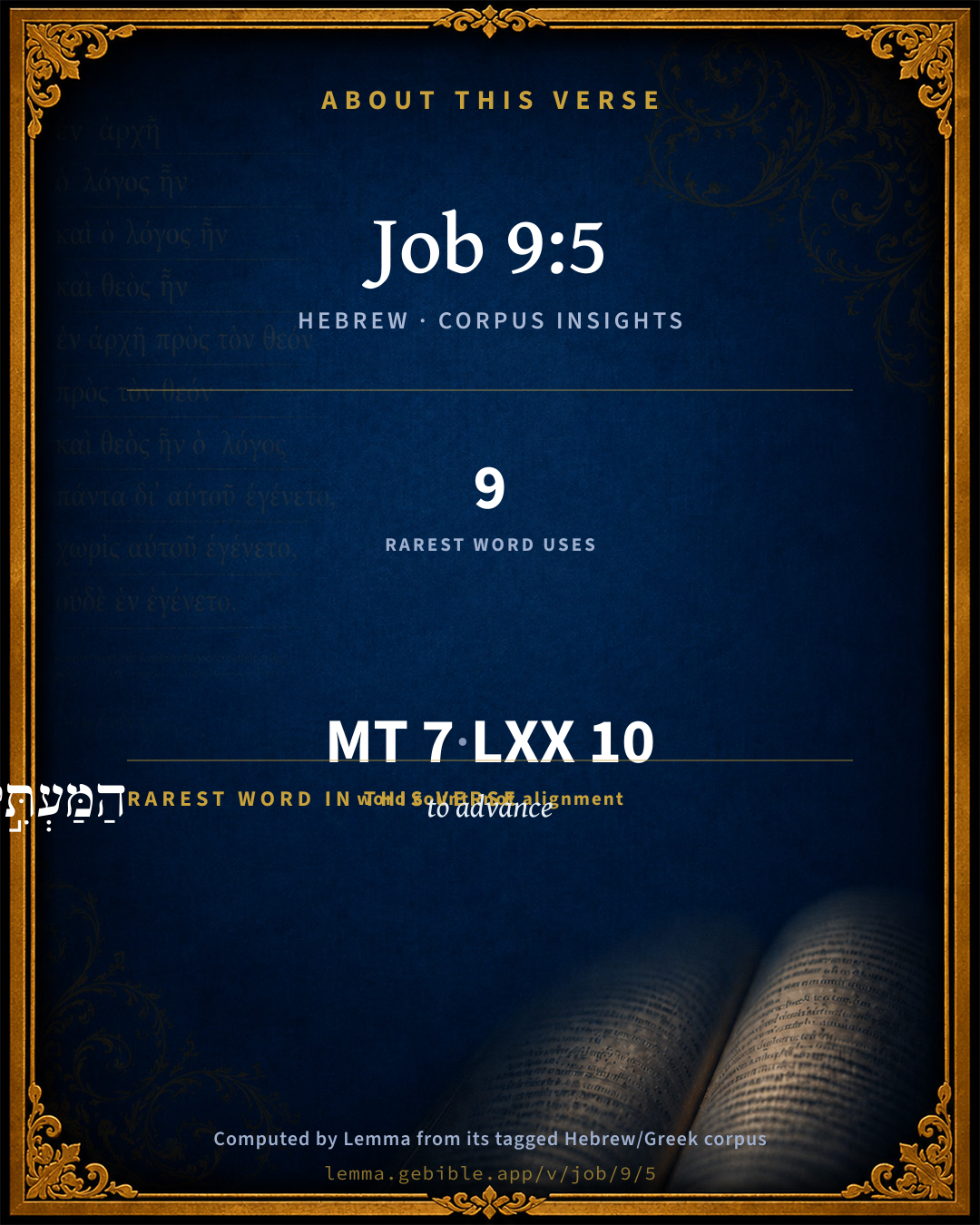
The rarest word here is הַמַּעְתִּ֣יק to advance H6275 — appearing just 9 times in the whole Hebrew Bible.

Shared distinctive vocabulary

הַמַּעְתִּ֣יק to advance H6275 occurs in 9 verses of the Hebrew Bible. Also found in:

Grammatical profile

  • 3 verbs
  • 2 nouns
  • 2 particles

Verb forms

  • הַמַּעְתִּ֣יק Hiphil · Participle Active
  • יָדָ֑עוּ Qal · Perfect
  • הֲפָכָ֣ם Qal · Perfect

Hebrew & Septuagint length

In English translation the verse runs 16 words from the Hebrew and 15 from the Septuagint (LXX English) — closely comparable.

A rough comparison of the two English renderings, which tokenize alike — not a word-level alignment.

Word counts can differ between the Hebrew and the Greek without any difference in meaning — e.g. the Hebrew direct-object marker אֵת has no separate Greek word, and Greek often adds the article ὁ.

In the original languages it is 7 Hebrew tokens and 10 Greek tokens — but the two are counted differently (Hebrew bundles its prefixes and suffixes into one token; the Greek is in lemma form), so that isn’t a like-for-like length.

Cross-references

17

Topical passages linked to Job 9:5 in the Treasury of Scripture Knowledge — connected by theme and wording, ordered by reader-vote popularity; previews shown in the World English Bible.

  • Matthew 27:51 Behold, the veil of the temple was torn in two from the top to the bottom. The earth quaked and the rocks were split.
  • Luke 21:11 There will be great earthquakes, famines, and plagues in various places. There will be terrors and great signs from heaven.
  • Habakkuk 3:10 The mountains saw you, and were afraid. The tempest of waters passed by. The deep roared and lifted up its hands on high.
  • Revelation 11:13 In that day there was a great earthquake, and a tenth of the city fell. Seven thousand people were killed in the earthquake, and the rest were terrified, and gave glory to the God of heaven.
  • Revelation 16:18–20 There were lightnings, sounds, and thunders; and there was a great earthquake, such as was not since there were men on the earth, so great an earthquake, so mighty.
  • Job 28:9 He puts forth his hand on the flinty rock, And he overturns the mountains by the roots.
  • Psalms 46:2 Therefore we won't be afraid, though the earth changes, Though the mountains are shaken into the heart of the seas;
  • Psalms 68:8 The earth trembled. The sky also poured down rain at the presence of the God of Sinai-- At the presence of God, the God of Israel.
  • Psalms 114:6 You mountains, that you skipped like rams; You little hills, like lambs?
  • Isaiah 40:12 Who has measured the waters in the hollow of his hand, and meted out the sky with the span, and comprehended the dust of the earth in a measure, and weighed the mountains in scales, and the hills in a balance?
  • Habakkuk 3:6 He stood, and shook the earth. He looked, and made the nations tremble. The ancient mountains were crumbled. The age-old hills collapsed. His ways are eternal.
  • Zechariah 4:7 Who are you, great mountain? Before Zerubbabel you are a plain; and he will bring out the capstone with shouts of 'Grace, grace, to it!'"
  • Zechariah 14:4–5 His feet will stand in that day on the Mount of Olives, which is before Jerusalem on the east; and the Mount of Olives will be split in two, from east to west, making a very great valley. Half of the mountain will move toward the north, and half of it toward the south.
  • Matthew 21:21 Jesus answered them, "Most assuredly I tell you, if you have faith, and don't doubt, you will not only do what is done to the fig tree, but even if you told this mountain, 'Be taken up and cast into the sea,' it would be done.
  • 1 Corinthians 13:2 If I have the gift of prophecy, and know all mysteries and all knowledge; and if I have all faith, so as to remove mountains, but don't have love, I am nothing.
  • Revelation 6:14 The sky was removed like a scroll when it is rolled up. Every mountain and island were moved out of their places.
  • Numbers 1:5–6 These are the names of the men who shall stand with you: Of Reuben: Elizur the son of Shedeur.

Cross-references courtesy of OpenBible.info (CC BY 4.0).

Hebrew and Greek witnesses Masoretic Hebrew ↔ Greek Septuagint

The same verse in the two great witnesses to the Old Testament, shown verse-for-verse.

These are two independent witnesses, not word-aligned to each other, and the Septuagint is shown in lemma (dictionary) form.

Hebrew Job 9:5 Masoretic · Westminster Leningrad Codex

הַמַּעְתִּ֣יק הָ֭רִים וְלֹ֣א יָדָ֑עוּ אֲשֶׁ֖ר הֲפָכָ֣ם בְּאַפּֽוֹ

Who removes the mountains, and they don't know it, When he overturns them in his anger

World English Bible · Public Domain

Greek LXX Job 9:5 Septuagint · lemma form

ὁ παλαιόω ὄρος καί οὐ οἶδα ὁ καταστρέφω αὐτός ὀργή

Who wears out the mountains, and men know it not: who overturns them in anger.

LXX2012 (modern English Septuagint) · Public Domain

On this verse, Haydock's Catholic Bible Commentary discusses the Septuagint’s reading. Read the note in Commentary ↓

Hebrew: Westminster Leningrad Codex (CC BY 4.0). Greek: Septuagint (public domain); English from LXX2012 (modern English Septuagint) (Public Domain). How the Septuagint differs from the Hebrew →

Commentary

Notes on Job 9:5 from classic Christian and Jewish commentators (each source and its license shown beneath its notes). The classic Christian expositions comment on the surrounding passage and are grouped to its opening verse, so a note may address several verses; the Jewish commentaries on the Tanakh (Rashi and others) are per-verse, so they appear only where the commentator wrote on this verse.

Lemma curates 59 commentaries, every one of them public domain or Creative Commons licensed, each selected and text-cleaned for this edition rather than reprinted as found. About our sources →

Trapp's Complete Commentary

John Trapp

Job 9:5 Which removeth the mountains, and they know not: which overturneth them in his anger.

Ver. 5. Which removeth the mountains, and they know not] For further proof of God’s power first (and then afterwards of his wisdom) Job produceth divers particular acts of his upon the creatures, both unreasonable and reasonable. Eliphaz had said somewhat to this purpose, Job 4:1-21, sed hic admirandus est Iob, saith Mercer, Job doth it admirably; his tongue, like a silver trumpet, sets forth the high praises of God far more plainly, plentifully, and magnificently than any of his friends, who yet have done it very well too. God, to show his power, removeth the mountains, saith Job, sc. by stupendous earthquakes, and otherwise, at his pleasure, Nah 1:5 Psa 97:4-5 Isa 40:15, he taketh up the isles as a very little thing, he can remove mountains with a wet finger, as we say, though so mighty in bulk, and strongly founded. Dionysius thinketh, that in thus speaking, Job aimeth at that which was done in the time of Noah’s flood, when the waters with their mighty force galled and bare down many great mountains, but that is uncertain. Great things God will do by the fire of the last day, when mountains shall melt, rocks rend, and the earth, with the works therein, shall be all burnt up, 2Pe 3:10. And what desolations he hath made in sundry parts of the earth by terrible earthquakes, as at Antioch often (which was therehence called Yεοπολις, because so visited by God), in divers places of Italy, Sicily, Burgundy, Helvetia, and here in Herefordshire, mention is made in Pliny, Stumpfius, Jovius, and other historians, all making good this of Job, and that of the psalmist, The mountains will skip like rams, and the little hills like lambs, when the Lord is displeased, Psa 114:4.

And they know it not] Dicto citius, it is done with a trice, speedily and secretly, before the mountains (if they could at all know) could know what is done to them; or before the mountaineers or the neighbourhood could foresee and avoid the danger of being overwhelmed and buried alive.

Which overturneth them in his anger] Or, that he overturneth them in his anger. Men are not sensible of God’s anger for sin, no, not in the greatest commotions, such is their stupidity; but will needs swelter and pine away in their iniquities, as if nothing could awake them, Lev 26:39.

John Trapp, A Commentary or Exposition upon All the Books of the Old and New Testament (1647–1656) — public domain. Text from a community e-Sword module.

The Biblical Illustrator

Joseph S. Exell

Job_9:5-9

Which removeth the mountains.

God in nature

I. Its almightiness is overwhelmingly grand in its manifestations. Removeth the mountains, etc. The whole passage impresses one with the unbounded energy of God.

1. His almightiness should impress all with a sense of their utter insignificance.

2. His almightiness should impress the sinner with his impious hardihood.

II. Its almightiness is co-extensive with the universe. Job here touches every part of material nature--the earth, the sea, the heavens--and sees God working in all.

1. His universal agency explains all material phenomena.

2. His universal agency binds men practically to recognise Him in every part of nature. He is the Force of all forces, the Pulse of all life, the Spirit of all forms. (Homilist.)

Religious interest in nature

There are some who feel no interest in nature, others feel a mere commercial interest in it, others feel an artistic or scientific interest in it, but how few feel a religious interest in it--regard it as the product, the mirror, the organ, of the Infinite Mind. If I fear an artist, I care not for his pictures; if I fear an author, I feel no interest in his work. If men loved, instead of feared God, how beautiful nature would appear to them. The painting and poem of a father, how interesting to his child! (R. Venting.)

The Biblical Illustrator, edited by Joseph S. Exell (c. 1880s–1900s) — public domain. Text from a community e-Sword module.

Joseph Benson's Commentary

Job 9:5-6. Which removeth the mountains — He proceeds to give particular evidences of the divine power and wisdom, which he mentioned Job 9:4. And they — That is, the mountains, to which he figuratively ascribes sense and knowledge; know not — He removes them suddenly and unexpectedly ere they are aware of it. Which overturneth them in his anger — In token of his displeasure with men, that lived upon or near them. Which shaketh the earth — Great portions of it by earthquakes, or by removing islands. And the pillars thereof tremble — The deep and inward parts of it, which, like pillars, support those parts which appear to our view.

Joseph Benson's Commentary on the Old and New Testaments (1811–1818) — public domain. Text from a community e-Sword module.

Whedon's Commentary on the Bible

Daniel D. Whedon

Strophes b and c, three verses each — Job, having once conceived the power of God, becomes fascinated by the very tremendousness of it; the invincible might of his and man’s adversary charms his eye, and compels him to gaze and shudder, and run over it, feature after feature, unable to withdraw his look from it, (Davidson,) Job_9:5-10.

5. And they know not — A Hebraism for suddenly, in a moment. Tyndale thus renders it: “He translate the the mountaynes or ever they be aware.” The unjustifiable translation of the Targum, “They know not that He hath overturned them in his wrath,” is adopted by the Vulgate, Ewald, etc. Chalmers pronounces this description of God’s power one of the finest sketches of natural theology to be found in Scripture, and, of course, far excelling all that any uninspired writer of antiquity has left behind him.

Daniel D. Whedon (gen. ed.), Commentary on the Old and New Testaments (1874–1909) — public domain. Text from a community e-Sword module.

Keil & Delitzsch

C. F. Keil & F. Delitzsch

5 Who removeth mountains without their knowing,

That He hath overturned them in His wrath;

6 Who causeth the earth to shake out of its place,

And its pillars to tremble;

7 Who commandeth the sun, and it riseth not,

And sealeth up the stars.

ידעוּ ולא (Job 9:5) may also be translated: without one's perceiving it or knowing why; but it is more natural to take the mountains as the subject. אשׁר, quod, that (not "as," Ewald, 333, a), after ידע, as Eze 20:26; Ecc 8:12. Even the lofty mountains are quite unconscious of the change which He effects on them in a moment. Before they are aware that it is being done, it is over, as the praet. implies; the destructive power of His anger is irresistible, and effects its purpose suddenly. He causes the earth to start up from its place (comp. Isa 13:13) which it occupies in space (Job 26:7); and by being thus set in motion by Him, its pillars tremble, i.e., its internal foundations (Psa 104:5), which are removed from human perception (Job 38:6). It is not the highest mountains, which are rather called the pillars, as it were the supports, of heaven (Job 26:11), that are meant. By the same almighty will He disposes of the sun and stars. The sun is here called חרס (as in Jdg 14:18 חרסה with unaccented ah, and as Isa 19:18 ‛Ir ha-Heres is a play upon החרס עיר, Ἡλιούπολις), perhaps from the same root as חרוּץ, one of the poetical names of gold. At His command the sun rises not, and He seals up the stars, i.e., conceals them behind thick clouds, so that the day becomes dark, and the night is not made bright. One may with Schultens think of the Flood, or with Warburton of the Egyptian darkness, and the standing still of the sun at the word of Joshua; but these are only single historical instances of a fact here affirmed as a universal experience of the divine power.

Keil & Delitzsch — Biblical Commentary on the Old Testament (1861–1891) — public domain (CC PDM 1.0). Text via the HelloAO Bible API. (Old Testament only.)

Tyndale Open Study Notes

Tyndale Open Resources

9:5-6 When God moves the mountains and when the foundations of the earth tremble, it is a sign of his presence as lawgiver (Exod 19:18), judge (Jer 4:24), or rescuer (Ps 18:7; Isa 13:13; 29:6).

Tyndale Open Study Notes — © Tyndale Open Resources, licensed CC BY-SA 4.0. Text via the HelloAO Bible API.

Jamieson, Fausset & Brown

Robert Jamieson, A. R. Fausset & David Brown

and they know not--Hebrew for "suddenly, unexpectedly, before they are aware of it" (Psa 35:8); "at unawares"; Hebrew, which "he knoweth not of" (Joe 2:14; Pro 5:6).

Jamieson, Fausset & Brown — Commentary Critical and Explanatory on the Whole Bible (1871) — public domain (CC PDM 1.0). Text via the HelloAO Bible API.

Adam Clarke's Commentary

Verse 5. Removeth the mountains, and they know not] This seems to refer to earthquakes. By those strong convulsions, mountains, valleys, hills, even whole islands, are removed in an instant; and to this latter circumstance the words, they know not, most probably refer. The work is done in the twinkling of an eye; no warning is given; the mountain, that seemed to be as firm as the earth on which it rested, was in the same moment both visible and invisible; so suddenly was it swallowed up.

Adam Clarke's Commentary on the Bible (1810–1826) — public domain. Text from a community e-Sword/MySword module.

The Cambridge Bible for Schools and Colleges

gen. ed. J. J. S. Perowne

5–10. Description of God’s omnipotent power as it displays itself in the material world.

they know not] Suddenly and unexpectedly, Psa_35:8; Jer_50:24.

The Cambridge Bible for Schools and Colleges (gen. ed. J. J. S. Perowne; Cambridge University Press, 1878–1918) — public domain. Text from a community e-Sword module.

John Gill's Exposition

Which shaketh the earth out of her place,.... Can do it, and will do it at the last day, when it shall be utterly broken down, clean dissolved, and reel to and fro like a drunkard, and be removed as a cottage, and which John in a vision saw flee away from the presence of him that sat upon the throne, Isa 24:19; for this cannot be understood of earthquakes in common, which are only partial, and do not remove the earth out of its place, only shake some parts of it; and this may also refer to the time of the flood, when the earth received some change and alteration in its situation, as Mr. Burnet in his Theory of the Earth observes; and the Apostle Peter suggests something of this kind, when he distinguishes the present earth from the former, which he says stood out of the water and in it, but the present earth not so, but is reserved for fire, Pe2 3:5,

and the pillars thereof tremble; the centre or lower parts of it, see Psa 75:3.

John Gill's Exposition of the Whole Bible (1746–1763) — public domain (CC PDM 1.0). Text via the HelloAO Bible API.

Albert Barnes' Notes on the Bible

Which removeth the mountains - In order to show how vain it was to contend with God, Job refers to some exhibitions of his power and greatness. The “removal of the mountains” here denotes the changes which occur in earthquakes and other violent convulsions of nature. This illustration of the power of God is often referred to in the Scriptures; compare Jdg 5:5; 1Ki 19:11; Psa 65:6; Psa 114:4; Psa 144:5; Isa 40:12; Jer 4:24.

And they know not - This is evidently a Hebraism, meaning suddenly, or unexpectedly. He does it, as it were, before they are aware of it. A similar expression occurs in the Koran, “God overturns them, and they do not know it;” that is, he does it without their suspecting any such thing; compare Psa 35:8. “Let destruction come upon him at unawares,” or, as it is in the Hebrew and in the margin, “which he knoweth not of.” Tindal renders this, “He translatethe the mountaynes or ever they be aware.”

Which overturneth them in his anger - As if he were enraged. There could scarcely be any more terrific exhibition of the wrath of God than the sudden and tremendous violence of an earthquake.

Albert Barnes' Notes on the Bible (1834–1885) — public domain. Text from a community e-Sword/MySword module.

Haydock's Catholic Bible Commentary

Removed, by earthquakes. (Pliny, [Natural History?] ii. 83.) (Calmet) --- In Calabria, 5th February, &c., 1783, during the most destructive and dreadful earthquake, a level valley was removed entire about a mile, and a hill, with the trees still growing, was projected down a declivity half a mile, and another above four miles. (Sir W. Hamilton) --- Septuagint, "who makes the mountains grown old, and they know not who overturns them in his wrath." (Haydock) --- Kings and empires fall to ruin at his command. (Calmet)

George Leo Haydock (1774–1849), Haydock's Catholic Family Bible and Commentary, 1859 edition — public domain. Excludes Psalms (Douay-Rheims chapter numbering differs from Protestant) and Deuterocanonical books (Catholic canon only).

Matthew Poole's English Annotations

He proccedeth to give particular evidences of the Divine power and wisdom, which he mentioned Job 9:4.

And they know not, i.e. suddenly and unexpectedly, ere they were aware of it. They, i.e. the mountains, to which he ascribes sense and knowledge figuratively, as hath been oft noted. In his anger; in token of his displeasure with men that lived upon them, or near them.

Matthew Poole's English Annotations on the Holy Bible (1683–1685) — public domain. Text from a community e-Sword/MySword module.

The Pulpit Commentary

Vers. 5-13. A magnificent description of the might and majesty of God, transcending anything in the Psalms, and comparable to the grandest passages of Isaiah. (see especially Isa_40:21-24 Isa_43:15-20)

Which removeth the mountains, and they know not; which overturneth them in his anger. Earthquakes are common in all the countries adjoining Syria and Palestine, and must always have been among the most striking manifestations of God"s power. There are several allusions to them in the Psalms. (Psa_8:8, Psa_104:32) and historical mention of them in Num_16:32 1Ki_19:1 Amo_1:1 Zec_14:4, 5 Mat_24:7. Josephus speaks of one which desolated Judaea in the reign of Herod the Great, and destroyed ten thousand people. ("Ant. Jud:," 15:5. There was another in 1181, which was felt over the whole of the Hauran, and did great damage. A still more violent convulsion occurred in 1837, when the area affected extended five hundred miles from north to south, and from eighty to a hundred miles east and west. Tiberias and Safed were overthrown. The earth gaped in various places, and closed again. Fearful oscillations were felt. The hot springs of Tiberias mounted up to a temperature that ordinary thermometers could not mark, and the loss of life was considerable (see the account given by Dr. Cunningham Geikie, in "The Holy Land and the Bible," vol. 2. pp. 317, 318). The phrases used by Job are, of course, poetical. Earthquakes do not literally "remove" mountains, nor "overturn" them. They produce fissures, elevations, depressions, and the like; but they rarely much alter local features or the general configuration of a district.

Vers. 5-10. Job to Bildad: 2. The majesty of God depicted.

I IN TERRESTRIAL PHENOMENA.

1. Overturning mountains. "Which removeth," i.e. uprooteth or overtumeth, "the mountains, and they know not: which overturneth them in his anger" (ver. 5). Whatever be the allusion intended, whether to the convulsions of nature which occurred at the Flood, or to those usually associated with earthquakes, the language suggests the absoluteness of God"s control over nature, and in particular:

(1) The greatness of his power, which, being able to uproot and overthrow mighty hills through its resistless force, must be competent to do the most stupendous works must, in fact, be an agency to which there can be no impossibilities. The only power resembling it on earth is that of faith, (Mar_9:23) to which also is ascribed the ability to remove mountains. (Mar_11:23)

(2) The suddenness of his power, the mountains being represented as overturned unexpectedly, in a moment, "without their knowing," which again reflects upon the vastness of that power which can effect so gigantic a feat without effort and without labour, so easily and naturally ("He toucheth the hills, and they smoker Psa_104:32) that it is done instantaneously.

(3) The fierceness of his power, especially when it is put forth in judgment, the uprooting of the mountains being depicted as a terrible manifestation of the Almighty"s wrath, concerning which the overturned hills seem to say, "Who can stand before his indignation? and who can abide in the fierceness of his anger? his fury is poured out like fire, and the rocks are thrown down by him". (Nah_1:6; cf. Hab_3:6)

2. Convulsing the earth. "Which shaketh the earth out of her place, and the pillars," i.e. the internal foundations, "thereof tremble" (ver. 6). Nothing is more seemingly stable than the solid globe. (Psa_119:90) Its original establishment was a sublime witness to the power and wisdom of its Creator. (1Sa_2:8 Psa_24:1, 2 Psa_136:6 Jer_51:15) Yet, by the mysterious forces treasured up within its dark retreats, the Almighty can make it tremble as if about to be dissolved, (Psa_104:32 Psa_114:7) as he did at Sinai, (Exo_19:18 Psa_68:8) and as once again he will do at the end of time. (Heb_1:10 2Pe_3:10) The shaking of the earth is an emblem of Divine judgments. (Isa_13:13)

II IN THE WONDERS OF THE SKY.

1. Obscuring the sun. "Who commandeth the sun, and it riseth or, "shineth not" (ver. 7). Alluding to both natural and supernatural obscurations of the solar light, of the former of which ordinary eclipses may be taken as illustrations, while the Egyptian darkness will constitute a sample of the latter.

(1) The sun is the most resplendent object in heaven. Here styled cherem, probably from its brilliant appearance (Delitzsch), or perhaps from its heat-giving properties (Gesenius). As such it is a silent witness to the great power of God. (Gen_1:16 Psa_74:16 Psa_136:7, 8 Jer_31:35)

(2) The sun is ever obedient to the will of its Creator. There is no part of God"s universe that is not under law. The greatest suns as well as the smallest atoms continually recognize his authority. The orb of day is equally obedient in rising and in setting. (Ecc_1:5) As such, it is an eloquent teacher of obedience to man. (Psa_148:8)

(3) The sun is never wearied of its beneficent mission to shine. And it always shines, except when commanded not. As such, it is a preacher of diligence to the Christian, who is commanded to let his light shine. (Mat_5:16)

(4) When the sun is obscured or commanded not to shine, it is in judgment on the sins of man, (Joe_2:31 Amo_8:9 Luk_21:25 Act_2:20) as during the Egyptian darkness (Exo_10:22) and at the time of the Crucifixion. (Mat_27:45) The darkened sun is an impressive and instructive emblem of the judgments God sends upon men and nations who neither value nor improve the light of truth and salvation they possess.

2. Concealing the stars. "And sealeth up the stars" (ver. 7). The stars also are God"s creatures, (Gen_1:16) and as such are obedient to his control. The vast number, immense magnitudes, and incredible velocities of the heavenly bodies, as unfolded by modern astronomy, impart to us loftier conceptions of the Creators power than were possessed by devout Hebrews. The Divine wisdom also is significantly displayed in the regularity of their movements, which secures that they never fail to swim out into the blue sea of the celestial firmament when the light of day has departed. Yet the ease with which the splendor of the midnight sky can be extinguished, by pouring over it the brilliance of day, or drawing round it the thick gloom of clouds, is no less striking as a visible display of almighty wisdom and power, and one which must have appeared to an Oriental, looking up into a Syrian sky, infinitely more solemnizing than it does to an Occidental, who only sees the stars shining with a dimmer lustre.

3. Bringing down the clouds. "Which alone spreadeth out the heavens" (ver. 8). The reference is probably not to the original creation of the firmament, (Gen_1:6) but to the visible descent of storm-clouds upon the sea. (Psa_18:9-11) The poet represents the striking phenomena of cloud-land as another exhibition of almighty power. The modern scientist imagines, when he has predicted the advent and measured the velocity of the tempest, he has effectually disposed of the Hebrew poet"s notion of supernaturalism in connection with the marvels of the sky. But the laws by which storm-clouds are built up and let down, swept along and finally dispersed, have not been spontaneously developed, or inherently possessed by, but externally imposed on, nature by him whose strength is in the clouds, (Psa_68:34) who employs them as his chariot, (Psa_104:3) and who when he pleases draws them across the face of heaven. (Psa_147:8)

4. Walking on the billows. "And treadeth upon the waves literally, "the heights of the sea" (ver. 8); i.e. upon the fierce mountainous billows. The two clauses are descriptive of a storm at sea, in which sea and sky appear to intermingle. (Psa_107:25, Psa_107:26) As the wind, so the water; as the sky, so the sea; as the cloud, so the wave, recognizes the authority of God. The Divine power is usually exhibited as calming the troubled billows. (Psa_65:7 Psa_89:9, Psa_89:13) Here Jehovah is portrayed as exciting a tempest, bringing down his clouds, sending forth his hurricanes, raising the still waters into gigantic billows, lashing the quiet sea into a wild and tumultuous commotion, and then going forth in sublime sovereignty amidst the hurricane he has produced, walking calmly upon the crested heights of the ocean, causing his voice to be heard above the loudest roar of the storm, and at length saying, "Peace, be still!" So Christ visibly walked upon the Sea of Galilee. (Mat_14:26) Another picture of God"s sovereignty over creation, another lesson of God"s ability to be the confidence of them that are afar off upon the sea. (Psa_65:8)

III IN THE CREATION OF THE STELLAR WORLD.

1. The constellations of the northern hemisphere. "Which maketh Arcturus, Orion, and the Pleiades literally, "who made.

(1) "Ash; identified with Ursa Major, the Wain, the Bear, an exceedingly bright constellation in the northern sky, the Hebrew term signifying (according to some) "the Nightly Watcher" because of its never setting (Schultens), or perhaps with greater probability being contracted from an Arabic root nash"meaning "bier," the three stars in the tail being designated "Daughters of the Bier" (Gesenius); cf. Job_38:32.

(2) Chesil; literally, "Fool," regarded by the Assyrians as the famous hunter Nimrod, styled by the Arabs "the Hero," and by the Chaldeans, "the Giant;" commonly allowed to be the splendid constellation Orion, which "stands like a great giant in the heavens south of Taurus and Gemini" (Carey).

(3) Chimah; literally, "Heap;" the well-known cluster of stars named "the Pleiades," a sparkling group compared by Persian poets to s bouquet formed of jewels (Delitzsch).

2. The constellations of the southern hemisphere. "And the chambers of the south;" i.e. the regions of the southern sky, which are completely veiled from view to us, and only occasionally discovered to Arabian spectators.

IV IN THE PROVIDENTIAL GOVERNMENT OF THE UNIVERSE. The sentiment of ver. 10, which almost verbatim repeats the utterance of Eliphaz, (Job_5:10) may be viewed as a general description of the mighty power of God in upholding, as well as creating, the stupendous fabric he has summoned into being. Regarded in this light, it describes the operations of Divine energy as:

1. Great. He doeth great things" (ver. 10). Everything that God does (in creation and providence) may be characterized as great, (Psa_92:5 Psa_111:2) as being the production of infinite power. The distinction between great and little, when applied to Divine acts, exists only in the human understanding. The creation of a solar system is as easy to Omnipotence as the construction of an atom, and the formation of the latter as much dependent on Divine power as the production of the former.

2. Wonderful. "He doeth wondrous things." The wisdom displayed in the Divine works is conspicuous to every intelligent observer. (Psa_104:24) The marvels of creation are fully equalled by the wonders of providence. The formation of a crystal, the structure of a flower, the organization of an animal, are examples of the former; the Deluge, the Exodus from Egypt, the Babylonish exile, the incarnation and death of Christ, illustrations of the latter.

3. Unsearchable. He doeth things "past finding out." Much as modern science has discovered of the secrets of Nature, there are vast realms lying unexplored around and beyond her, into some of which it is doubtful if she will ever be able to penetrate. Her ascertained results also make it probable that there are works of God into which she cannot sink the plummet of her finite understanding; as e.g. the nature of electricity and magnetism, the mystery of life in all its forms and gradations, the mode in which matter and mind act and react upon one another.

4. Numerous. He doeth "wonders without number." The exquisite variety and the apparently limitless number of God"s works are impressive testimonies to the infinite power and matchless wisdom of the Creator.

Learn:

1. There is no God like unto the God of the Christian. (Exo_15:11 Deu_33:26)

2. Nothing can transcend the power of God. (Gen_18:14 Jer_32:17)

3. God is infinitely worthy of the reverence, confidence, affection, and obedience of his intelligent creatures. (Psa_89:7 Rev_4:11)

4. It cannot but be dangerous to resist God"s will. (Nah_1:6 Isa_40:24 Heb_12:29)

5. "If God be for us, who can be against us?". (Psa_27:1 Rom_8:31)

The Pulpit Commentary (1880–1919), ed. H.D.M. Spence-Jones & Joseph S. Exell — public domain. Text from a community e-Sword module.

John Wesley's Explanatory Notes

Who - He proceeds to give evidence of the Divine power and wisdom. Removeth - Suddenly and unexpectedly. They - The mountains, to which he ascribes sense and knowledge figuratively. In anger - In token of his displeasure with the men that live upon them.

John Wesley, Explanatory Notes Upon the Whole Bible (1754–1765) — public domain. Text via the GEBible commentary corpus.

Rashi

Rabbi Shlomo Yitzchaki (Rashi)

He Who moved mountains He moved them away when He overturned Sodom.

and they knew not until He turned them over.

Rashi on the Tanakh — English translations: “The Judaica Press complete Tanach with Rashi, translated by A. J. Rosenberg” (CC BY 4.0); “Pentateuch with Rashi's commentary by M. Rosenbaum and A.M. Silbermann, 1929-1934” (public domain); “The Metsudah Tanach series, Lakewood, N.J” (CC BY 4.0); and “The Book of Joshua, Metsudah Publications, 1997” (CC BY 4.0). Text via Sefaria.

Lesson kit

Teaching starters — assembled from the data on this page, not authored interpretation. Every prompt links to the verse data it draws on. Edit before teaching.

Job, in the Wisdom, opens this verse with 7 words (7 distinct Hebrew lemmas). Its most distinctive word is ʻâthaq (“to advance”). A historical commentator’s framing appears above. Read the whole chapter for the surrounding context.

Discussion questions

  1. The word ʻâthaq carries the sense “to advance.” How does it shape the verse?
  2. How does Genesis 12:8, which shares the word «to advance», read alongside this verse?
  3. These translations render this verse differently; the difference is in the English rendering, not the original. What questions does that raise?
  4. «הַמַּעְתִּ֣יק» is a Hiphil Participle Active verb. How does that grammatical form shape the action described?
  5. Compare how Trapp's Complete Commentary and The Biblical Illustrator read this verse. Where do they agree or differ?

Things to notice

Reading settings

Reading text

Shown beneath each verse's original-language words.

Old Testament
Old Testament edition

Read the OT as the Masoretic Hebrew (MT) or the Greek Septuagint (LXX).

English shown for the Greek Septuagint (in the Hebrew ↔ Greek comparison).

Comparing translations? Open the Compare panel on any verse page to stack up to four side by side.