
Ezekiel 37:22

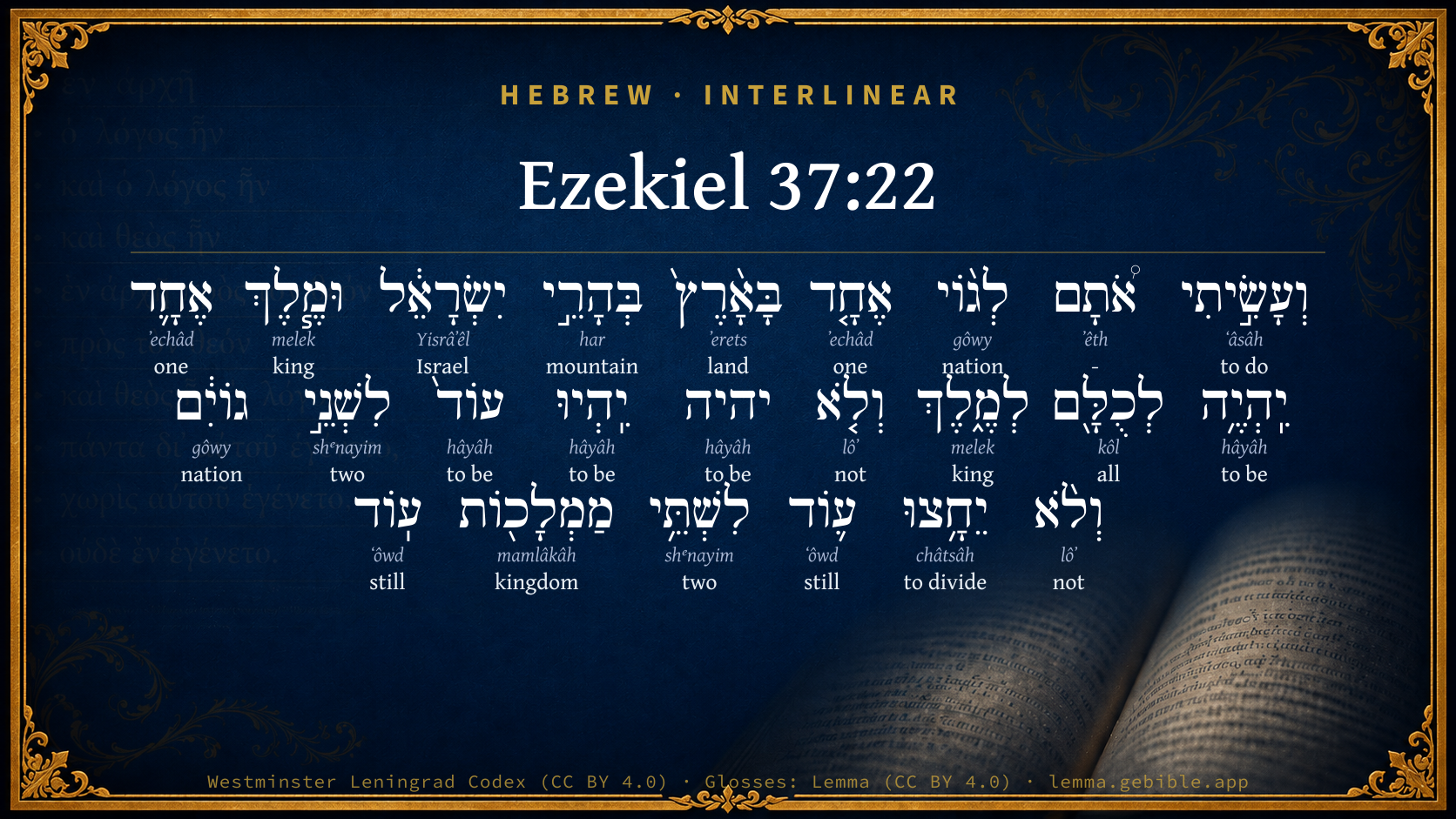
Hebrew (Westminster Leningrad Codex) Ezekiel 37:22 appears in the Hebrew Old Testament. The text above is from the Westminster Leningrad Codex. Each word links to its Strong’s number, a concise gloss, and parsing drawn from the Open Scriptures Hebrew Bible morphology. Click any word for its full Brown-Driver-Briggs (BDB) entry.
Download image
Cite this verse

Ezekiel 37:22 (World English Bible). Public Domain. Lemma interlinear Bible study tool, https://lemma.gebible.app/v/ezekiel/37/22.

Show BibTeX & RIS
BibTeX
RIS
English Translation
and I will make them one nation in the land, on the mountains of Israel; and one king shall be king to them all; and they shall be no more two nations, neither shall they be divided into two kingdoms any more at all;
World English Bible · Public Domain
Download a study sheet

One document with this verse’s original text, its word-by-word gloss line, the meaning frame, cross-references with their text, attributed commentary, and full source and license credits — printable, and it pastes into notes with its structure intact.

This verse Autodidact and up

Study sheet (.html) Plain text (.txt)

A passage Seminary Student

Up to 50 verses in one chapter. A passage sheet keeps up to 6 commentary sources and 12 cross-references per verse, in the order this page ranks them, and says so on the sheet whenever that leaves anything out. Ask for a single verse and you get the Autodidact verse sheet above.

Everything on this page stays free to read, with no account — the sheet is a download of what is already on screen, not access to it.

Want to remove ads? Support Godless Engineer
Compare translations 3

The same verse in 3 English versions, stacked beneath the original-language interlinear above. Click any original word for its lexicon entry.

Each is an independent rendering of the whole verse — the interlinear is not word-aligned to these translations.

Highlighted words mark where these versions differ — a whole-verse word diff, not a word-by-word alignment.

  • World English Bible Public Domain
    and I will make them one nation in the land, on the mountains of Israel; and one king shall be king to them all; and they shall be no more two nations, neither shall they be divided into two kingdoms any more at all;
  • King James Version Public Domain
    And I will make them one nation in the land upon the mountains of Israel; and one king shall be king to them all: and they shall be no more two nations, neither shall they be divided into two kingdoms any more at all.
  • unfoldingWord Literal Text CC BY-SA 4.0
    I will make them one nation in the land, on the mountains of Israel, and there will be one king as king over all of them, and they will no longer be two nations. They will no longer be divided into two kingdoms.

unfoldingWord Literal Text — © unfoldingWord, licensed CC BY-SA 4.0. Word-aligned USFM3 via Door43 (git.door43.org/unfoldingWord/en_ult).

Versions to compare (up to 4)

3 of 4 selected

Show all 18 translations

Every available English version of this verse, each an independent rendering of the whole verse.

  • World English Bible Public Domain
    and I will make them one nation in the land, on the mountains of Israel; and one king shall be king to them all; and they shall be no more two nations, neither shall they be divided into two kingdoms any more at all;
  • Berean Standard Bible Public Domain
    I will make them one nation in the land, on the mountains of Israel, and one king will rule over all of them. Then they will no longer be two nations and will never again be divided into two kingdoms.
  • Majority Standard Bible Public Domain
    I will make them one nation in the land, on the mountains of Israel, and one king will rule over all of them. Then they will no longer be two nations and will never again be divided into two kingdoms.
  • King James Version Public Domain
    And I will make them one nation in the land upon the mountains of Israel; and one king shall be king to them all: and they shall be no more two nations, neither shall they be divided into two kingdoms any more at all.
  • American Standard Version (1901) Public Domain
    and I will make them one nation in the land, upon the mountains of Israel; and one king shall be king to them all; and they shall be no more two nations, neither shall they be divided into two kingdoms any more at all;
  • Revised Version (1885) Public Domain
    and I will make them one nation in the land, upon the mountains of Israel; and one king shall be king to them all: and they shall be no more two nations, neither shall they be divided into two kingdoms any more at all:
  • Geneva Bible (1599) Public Domain
    And I will make them one people in the lande, vpon the mountaines of Israel, and one king shalbe king to them all: and they shalbe no more two peoples, neither bee deuided any more henceforth into two kingdomes.
  • Douay-Rheims (1899) Public Domain
    And I will make them one nation in the land on the mountains of Israel, and one king shall be king over them all: and they shall no more be two nations, neither shall they be divided any more into two kingdoms.
  • Young's Literal Translation Public Domain
    And I have made them become one nation in the land, on mountains of Israel, And one king is to them all for king, And they are no more as two nations, Nor are they divided any more into two kingdoms again.
  • Literal Standard Version CC BY-SA 4.0
    And I have made them become one nation in the land, on mountains of Israel, || And one king is to them all for king, || And they are no longer as two nations, || Nor are they divided anymore into two kingdoms again.
  • Unlocked Literal Bible CC BY-SA 4.0
    I will make them one nation in the land, on the mountains of Israel, and there will be one king as king over all of them, and they will no longer be two nations. They will no longer be divided into two kingdoms.
  • unfoldingWord Literal Text CC BY-SA 4.0
    I will make them one nation in the land, on the mountains of Israel, and there will be one king as king over all of them, and they will no longer be two nations. They will no longer be divided into two kingdoms.
  • Darby Bible Public Domain
    and I will make them one nation in the land upon the mountains of Israel; and one king shall be king to them all: and they shall be no more two nations, neither shall they be divided into two kingdoms any more at all.
  • World Messianic Bible Public Domain
    I will make them one nation in the land, on the mountains of Israel. One king will be king to them all. They will no longer be two nations. They won’t be divided into two kingdoms any more at all.
  • Webster's Bible Public Domain
    And I will make them one nation in the land upon the mountains of Israel; and one king shall be king to them all: and they shall be no more two nations, neither shall they be divided into two kingdoms any more at all:
  • Free Bible Version CC BY-SA 4.0
    I will make them one nation in the country, living in the mountains of Israel, and one king will rule them all. They won't be two nations any longer; never again will they be divided into two kingdoms.
  • Bible in Basic English Public Domain
    And I will make them one nation in the land, on the mountains of Israel; and one king will be king over them all: and they will no longer be two nations, and will no longer be parted into two kingdoms:
  • JPS Tanakh (1917) Public Domain
    and I will make them one nation in the land, upon the mountains of Israel, and one king shall be king to them all; and they shall be no more two nations, neither shall they be divided into two kingdoms any more at all;

Literal Standard Version (2020), Covenant Press — licensed CC BY-SA 4.0. Text via the HelloAO Bible API (eBible.org). Unlocked Literal Bible (unfoldingWord) — licensed CC BY-SA 4.0. Text via the HelloAO Bible API (eBible.org). unfoldingWord Literal Text — © unfoldingWord, licensed CC BY-SA 4.0. Word-aligned USFM3 via Door43 (git.door43.org/unfoldingWord/en_ult). Free Bible Version, Dr. Jonathan Gallagher — licensed CC BY-SA 4.0. Text via the HelloAO Bible API (eBible.org).

Word by word

More ways to search: Search by grammar → Find every occurrence → Compare this word →

Practice this passage: Drill this verse → Learn its vocabulary →

יֵחָ֥צוּ
châtsâh
H2673
“to divide”
Verb, Niphal, Imperfect, 3rd Person, Masculine, Plural
Part of Speech
Verb
Stem
Niphal
Form
Imperfect
Person
3rd Person
Gender
Masculine
Number
Plural
Full BDB Definition

Origin: a primitive root [compare H2686 ])

TWOT: 719

to divide, cut in two, cut short, live half (of one's life) - (Qal) - to divide - to half, cut in two - (Niphal) to be divided
  1. וְעָשִׂ֣יתִי ʻâsâh H6213 “and · to do” Conjunction + Verb, Qal, Sequential Perfect, 1st Person, Common, Singular
  2. אֹ֠תָם ʼêth H853 “- · them” Particle, Direct Object + Suffix, Personal, 3rd Person, Masculine, Plural
  3. לְג֨וֹי gôwy H1471 “to/for · nation” Preposition + Noun, Common, Masculine, Singular, Absolute
  4. אֶחָ֤ד ʼechâd H259 “one” Adjective, Cardinal number, Masculine, Singular, Absolute
  5. בָּאָ֨רֶץ֙ ʼerets H776 “in/at the · land” Preposition, Determined + Noun, Common, Both, Singular, Absolute
  6. בְּהָרֵ֣י har H2022 “in/at · mountains of” Preposition + Noun, Common, Masculine, Plural, Construct
  7. יִשְׂרָאֵ֔ל Yisrâʼêl H3478 “Israel” Noun, Proper
  8. וּמֶ֧לֶךְ melek H4428 “and · king” Conjunction + Noun, Common, Masculine, Singular, Absolute
  9. אֶחָ֛ד ʼechâd H259 “one” Adjective, Cardinal number, Masculine, Singular, Absolute
  10. יִֽהְיֶ֥ה hâyâh H1961 “to be” Verb, Qal, Imperfect, 3rd Person, Masculine, Singular
  11. לְכֻלָּ֖ם kôl H3605 “to/for · all · their” Preposition + Noun, Common, Masculine, Singular, Construct + Suffix, Personal, 3rd Person, Masculine, Plural
  12. לְמֶ֑לֶךְ melek H4428 “to/for · king” Preposition + Noun, Common, Masculine, Singular, Absolute
  13. וְלֹ֤א lôʼ H3808 “and · not” Conjunction + Particle, Negative
  14. יהיה hâyâh H1961 “to be” Verb, Qal, Imperfect, 3rd Person, Masculine, Singular
  15. יִֽהְיוּ hâyâh H1961 “to be” Verb, Qal, Imperfect, 3rd Person, Masculine, Plural
  16. עוֹד֙ hâyâh H1961 “to be” Adverb
  17. לִשְׁנֵ֣י shᵉnayim H8147 “to/for · two” Preposition + Adjective, Cardinal number, Masculine, Dual, Construct
  18. גוֹיִ֔ם gôwy H1471 “nations” Noun, Common, Masculine, Plural, Absolute
  19. וְלֹ֨א lôʼ H3808 “and · not” Conjunction + Particle, Negative
  20. ע֛וֹד ʻôwd H5750 “still” Adverb
  21. לִשְׁתֵּ֥י shᵉnayim H8147 “to/for · two” Preposition + Adjective, Cardinal number, Feminine, Dual, Construct
  22. מַמְלָכ֖וֹת mamlâkâh H4467 “kingdoms” Noun, Common, Feminine, Plural, Absolute
  23. עֽוֹד ʻôwd H5750 “still” Adverb

About this verse

These counts appear in no published source. They are computed here, from the morphology-tagged text and Lemma’s own curated glosses. What Lemma adds →

24
words
15
distinct lemmas
Prophets
section

Notable vocabulary

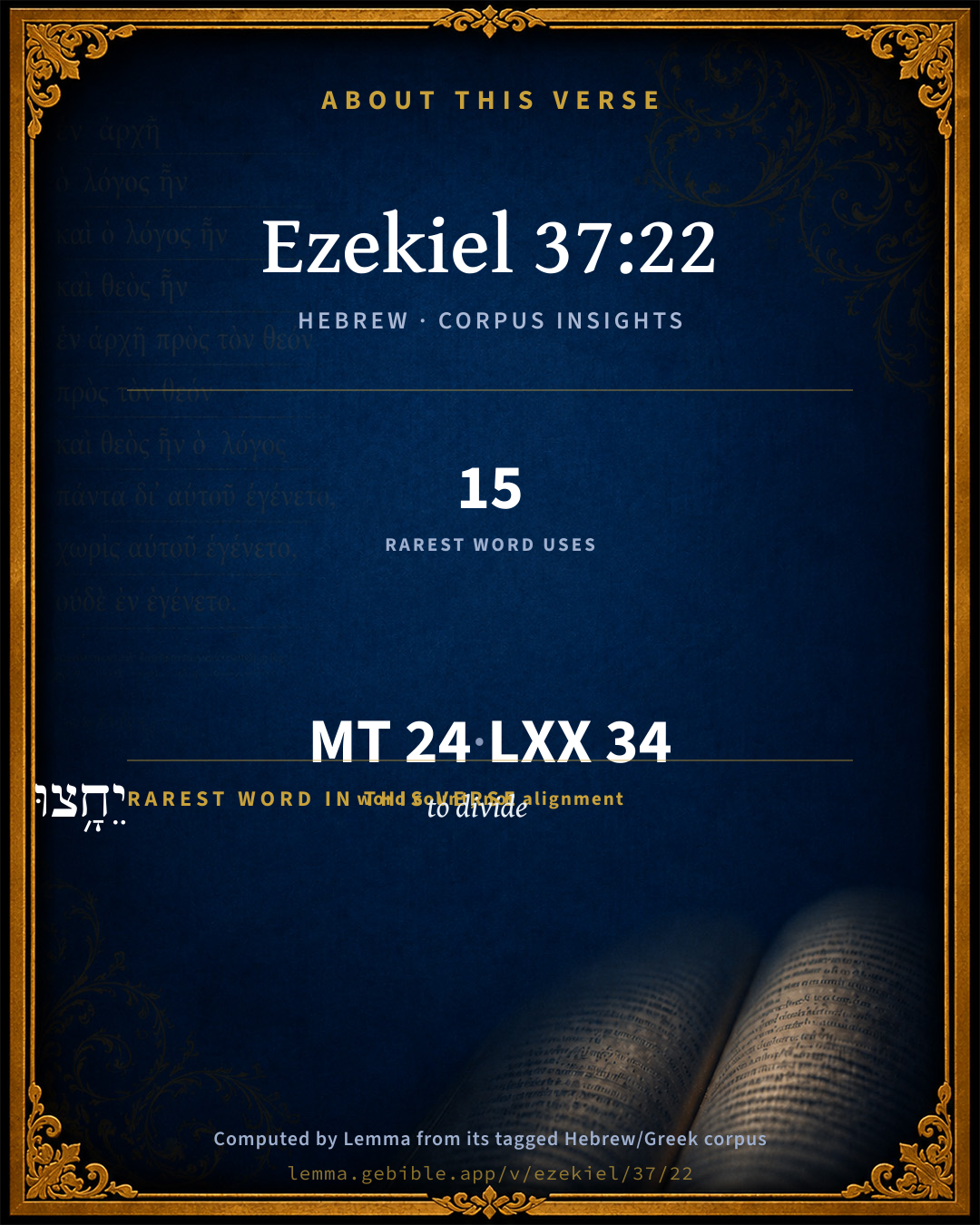
The rarest word here is יֵחָ֥צוּ to divide H2673 — appearing just 15 times in the whole Hebrew Bible.

Shared distinctive vocabulary

יֵחָ֥צוּ to divide H2673 occurs in 14 verses of the Hebrew Bible. Also found in:

Grammatical profile

  • 5 verbs
  • 9 nouns
  • 4 adjectives
  • 3 adverbs
  • 3 particles

Verb forms

  • וְעָשִׂ֣יתִי Qal · Sequential Perfect
  • יִֽהְיֶ֥ה Qal · Imperfect
  • יהיה Qal · Imperfect
  • יִֽהְיוּ Qal · Imperfect
  • יֵחָ֥צוּ Niphal · Imperfect

Repetition

Words recur within this verse — often emphatic in Hebrew:

  • יִֽהְיֶ֥ה to be H1961 ×4
  • לְג֨וֹי nation H1471 ×2
  • אֶחָ֤ד one H259 ×2
  • וּמֶ֧לֶךְ king H4428 ×2
  • לִשְׁנֵ֣י two H8147 ×2
  • ע֛וֹד still H5750 ×2
  • וְלֹ֤א not H3808 ×2

Hebrew & Septuagint length

In English translation the verse runs 44 words from the Hebrew and 42 from the Septuagint (LXX English) — closely comparable.

A rough comparison of the two English renderings, which tokenize alike — not a word-level alignment.

Word counts can differ between the Hebrew and the Greek without any difference in meaning — e.g. the Hebrew direct-object marker אֵת has no separate Greek word, and Greek often adds the article ὁ.

In the original languages it is 24 Hebrew tokens and 34 Greek tokens — but the two are counted differently (Hebrew bundles its prefixes and suffixes into one token; the Greek is in lemma form), so that isn’t a like-for-like length.

Cross-references

21

Topical passages linked to Ezekiel 37:22 in the Treasury of Scripture Knowledge — connected by theme and wording, ordered by reader-vote popularity; previews shown in the World English Bible.

  • Ezekiel 37:24 My servant David shall be king over them; and they all shall have one shepherd: they shall also walk in my ordinances, and observe my statutes, and do them.
  • Ezekiel 34:23–24 I will set up one shepherd over them, and he shall feed them, even my servant David; he shall feed them, and he shall be their shepherd.
  • Jeremiah 3:18 In those days the house of Judah shall walk with the house of Israel, and they shall come together out of the land of the north to the land that I gave for an inheritance to your fathers.
  • Jeremiah 50:4 In those days, and in that time, says Yahweh, the children of Israel shall come, they and the children of Judah together; they shall go on their way weeping, and shall seek Yahweh their God.
  • Genesis 49:10 The scepter will not depart from Judah, Nor the ruler's staff from between his feet, Until he comes to whom it belongs. To him will the obedience of the peoples be.
  • Isaiah 9:6–7 For to us a child is born, to us a son is given; and the government shall be on his shoulder: and his name shall be called Wonderful, Counselor, Mighty God, Everlasting Father, Prince of Peace.
  • Isaiah 11:12–13 He will set up an ensign for the nations, and will assemble the outcasts of Israel, and gather together the dispersed of Judah from the four corners of the earth.
  • Jeremiah 23:5–6 Behold, the days come, says Yahweh, that I will raise to David a righteous Branch, and he shall reign as king and deal wisely, and shall execute justice and righteousness in the land.
  • Hosea 1:11 The children of Judah and the children of Israel will be gathered together, and they will appoint themselves one head, and will go up from the land; for great will be the day of Jezreel.
  • Hosea 3:4–5 For the children of Israel shall abide many days without king, and without prince, and without sacrifice, and without sacred stone, and without ephod or idols.
  • Luke 1:32–33 He will be great, and will be called the Son of the Most High. The Lord God will give him the throne of his father, David,
  • John 10:16 I have other sheep, which are not of this fold. I must bring them also, and they will hear my voice. They will become one flock with one shepherd.
  • Psalms 2:6 "Yet I have set my king on my holy hill of Zion."
  • Psalms 2:12 Kiss the son, lest he be angry, and you perish in the way, For his wrath will soon be kindled. Blessed are all those who take refuge in him.
  • Psalms 72:1 God, give the king your justice; Your righteousness to the royal son.
  • Psalms 72:8 He shall have dominion also from sea to sea, From the River to the ends of the earth.
  • Jeremiah 32:39 and I will give them one heart and one way, that they may fear me forever, for the good of them, and of their children after them:
  • Jeremiah 33:14–17 Behold, the days come, says Yahweh, that I will perform that good word which I have spoken concerning the house of Israel and concerning the house of Judah.
  • Jeremiah 33:26 then will I also cast away the seed of Jacob, and of David my servant, so that I will not take of his seed to be rulers over the seed of Abraham, Isaac, and Jacob: for I will cause their captivity to return, and will have mercy on them.
  • Revelation 11:15 The seventh angel sounded, and great voices in heaven followed, saying, "The kingdom of the world has become the Kingdom of our Lord, and of his Christ. He will reign forever and ever!"
  • Ephesians 2:19–22 So then you are no longer strangers and foreigners, but you are fellow citizens with the saints, and of the household of God,

Cross-references courtesy of OpenBible.info (CC BY 4.0).

Hebrew and Greek witnesses Masoretic Hebrew ↔ Greek Septuagint

The same verse in the two great witnesses to the Old Testament, shown verse-for-verse.

These are two independent witnesses, not word-aligned to each other, and the Septuagint is shown in lemma (dictionary) form.

Hebrew Ezekiel 37:22 Masoretic · Westminster Leningrad Codex

וְעָשִׂ֣יתִי אֹ֠תָם לְג֨וֹי אֶחָ֤ד בָּאָ֨רֶץ֙ בְּהָרֵ֣י יִשְׂרָאֵ֔ל וּמֶ֧לֶךְ אֶחָ֛ד יִֽהְיֶ֥ה לְכֻלָּ֖ם לְמֶ֑לֶךְ וְלֹ֤א יהיה יִֽהְיוּ עוֹד֙ לִשְׁנֵ֣י גוֹיִ֔ם וְלֹ֨א יֵחָ֥צוּ ע֛וֹד לִשְׁתֵּ֥י מַמְלָכ֖וֹת עֽוֹד

and I will make them one nation in the land, on the mountains of Israel; and one king shall be king to them all; and they shall be no more two nations, neither shall they be divided into two kingdoms any more at all;

World English Bible · Public Domain

Greek LXX Ezekiel 37:22 Septuagint · lemma form

καί δίδωμι αὐτός εἰς ἔθνος εἷς ἐν ὁ γῆ ἐγώ καί ἐν ὁ ὄρος ἰσραήλ καί ἄρχων εἷς εἰμί αὐτός καί οὐ εἰμί ἔτι εἰς δύο ἔθνος οὐδέ μή διααἱρέω οὐκέτι εἰς δύο βασιλεία

And I will make them a nation in my land, even on the mountains of Israel; and they shall have one prince: and they shall be no more two nations, neither shall they be divided any more at all into two kingdoms:

LXX2012 (modern English Septuagint) · Public Domain

Hebrew: Westminster Leningrad Codex (CC BY 4.0). Greek: Septuagint (public domain); English from LXX2012 (modern English Septuagint) (Public Domain). How the Septuagint differs from the Hebrew →

Targum (Aramaic paraphrase)

1

The Targum is the ancient Jewish Aramaic paraphrase of the Hebrew Scriptures — an interpretive translation, not the Hebrew text itself. Onkelos (literal) and Pseudo-Jonathan (expansive) render the Torah, and Jonathan the Prophets. Coverage is partial: where no permissively-licensed English translation exists for a verse, only the Aramaic is shown. This is verse-level text, not a word-by-word alignment to the Hebrew.

  1. Targum Jonathan Prophets (Joshua–Malachi)
    וְאַעְבֵּיד יַתְהוֹן לְעַמָא חָד בְּאַרְעָא בְּטוּר קוּדְשָׁא דְיִשְׂרָאֵל דְיִשְׂרָאֵל וּמַלְכָּא חַד יְהֵי לְכוּלְהוֹן לְמֶהֱוֵי מַלְכָּא וְלָא יְהוֹן עוֹד לִתְרֵין עַמְמִין וְלָא יִתְפַּלְגוּן עוֹד לְתַרְתֵּין מַלְכְּוָן עוֹד:

    (no public-domain English translation for this verse)

    Targum Jonathan — Aramaic: “Mikraot Gedolot” (public domain). English: “Sefaria Community Translation” (CC0 1.0 (public-domain dedication)); “London "Chaldee Paraphrase," 1871” (public domain). Text via Sefaria.

Commentary

Notes on Ezekiel 37:22 from classic Christian and Jewish commentators (each source and its license shown beneath its notes). The classic Christian expositions comment on the surrounding passage and are grouped to its opening verse, so a note may address several verses; the Jewish commentaries on the Tanakh (Rashi and others) are per-verse, so they appear only where the commentator wrote on this verse.

Lemma curates 59 commentaries, every one of them public domain or Creative Commons licensed, each selected and text-cleaned for this edition rather than reprinted as found. About our sources →

Trapp's Complete Commentary

John Trapp

Eze 37:22 And I will make them one nation in the land upon the mountains of Israel; and one king shall be king to them all: and they shall be no more two nations, neither shall they be divided into two kingdoms any more at all:

Ver. 22. And I will make them one nation.] Who were before at deadly feud, and fought many bloody battles. Solemur et nos hac promissione contra schismata, Let us also comfort ourselves with this promise against schisms, saith Oecolampadius. Christ will cause the false prophets and the unclean spirit to pass out of the land; {Zec 13:2} he will also so work in the hearts of his people, that they shall, "with one mind and one mouth, glorify God, even the Father of our Lord Jesus Christ." {Rom 15:6}

John Trapp, A Commentary or Exposition upon All the Books of the Old and New Testament (1647–1656) — public domain. Text from a community e-Sword module.

Jamieson, Fausset & Brown

Robert Jamieson, A. R. Fausset & David Brown

one nation-- (Isa 11:13; Jer 3:18; Hos 1:11).

one king--not Zerubbabel, who was not a king either in fact or name, and who ruled over but a few Jews, and that only for a few years; whereas the King here reigns for ever. MESSIAH is meant (Eze 34:23-24). The union of Judah and Israel under King Messiah symbolizes the union of Jews and Gentiles under Him, partly now, perfectly hereafter (Eze 37:24; Joh 10:16).

Jamieson, Fausset & Brown — Commentary Critical and Explanatory on the Whole Bible (1871) — public domain (CC PDM 1.0). Text via the HelloAO Bible API.

Adam Clarke's Commentary

Verse 22. I will make them one nation] There was no distinction after the return from Babylon.

And one king shall be king to them all] Politically speaking they never had a king from that day to this; and the grand junction and government spoken of here must refer to another time - to that in which they shall be brought into the Christian Church with the fulness of the Gentiles; when JESUS, the King of kings and Lord of lords, shall rule over all.

Adam Clarke's Commentary on the Bible (1810–1826) — public domain. Text from a community e-Sword/MySword module.

The Cambridge Bible for Schools and Colleges

gen. ed. J. J. S. Perowne

22. This promise runs throughout all prophecy. The disruption of the state was felt even by Hosea, a native of the north, to have introduced a schism into the one kingdom of Jehovah, and to have broken the unity of the consciousness of the community, to which the consciousness of the one God corresponded. Hos_1:11; Hos_8:3-4; Isa_11:13; Jer_3:18. The one God, the husband of the community, required that the community should also be one, with a single affection and service. Cf. Eze_34:23-24.

The Cambridge Bible for Schools and Colleges (gen. ed. J. J. S. Perowne; Cambridge University Press, 1878–1918) — public domain. Text from a community e-Sword module.

John Gill's Exposition

And I will make them one nation in the land upon the mountains of Israel, As they were in the times of David and Solomon, who were both types of the Messiah; and to whose times is referred this prophecy by the ancient Jews (e), as then to have its accomplishment:

and one king shall be king to them all, not Zerubbabel, nor Nehemiah, nor Judas Maccabaeus; for these were neither of them kings; and much less such as reigned for ever, as it is said this king shall, Eze 37:25, besides, he is expressly said to be David, that is, the Messiah the son of David; and this clause is by a modern Jewish (f) writer applied to him:

and they shall be no more two nations, neither shall they be divided into two kingdoms any more at all; which is the very thing the two sticks made one were an emblem of.

(e) Zohar in Gen. fol. 85. 4. (f) R. Abendana, Not. in Miclol Yophi in 1 Kings xi. 39.

John Gill's Exposition of the Whole Bible (1746–1763) — public domain (CC PDM 1.0). Text via the HelloAO Bible API.

Haydock's Catholic Bible Commentary

King. The Jews were long without kings, after the captivity; then they were not of the tribe of Juda, and all did not return. Christ fulfils the prediction.

George Leo Haydock (1774–1849), Haydock's Catholic Family Bible and Commentary, 1859 edition — public domain. Excludes Psalms (Douay-Rheims chapter numbering differs from Protestant) and Deuterocanonical books (Catholic canon only).

Matthew Poole's English Annotations

I will make them one nation: they were one in David’s time, who was type of the Messiah, and continued so to the end of Solomon’s time, whose name includes peace. So when the Beloved, the Peace-maker, the Messiah shall be King, and on his throne exercising his kingly power, they shall be once more one again.

In the land of Canaan, called here, as elsewhere,

the mountains of Israel. One king; Messiah; the most and best, if not the learnedest, interpreters understand not Zerubbabel, nor Nehemiah, nor Judas Maccabeus.

No more two nations; the union under the Messiah’s visible and actual exercise of his regal power shall be perpetual. From this place, so full and express for a firm, lasting union between the two nations Ephraim and Judah, and their being of two kingdoms made one in the land whence they were scattered, some take occasion to inquire whether it be fulfilled already, or remaineth yet to be accomplished; the discussion whereof, as it would be very alien to a literal paraphrase, and too prolix, I pass over, saying no more of it in the affirmative or negative.

Matthew Poole's English Annotations on the Holy Bible (1683–1685) — public domain. Text from a community e-Sword/MySword module.

John Wesley's Explanatory Notes

One nation - They were one in David's time, who was a type of the Messiah, and continued so to the end of Solomon's time, whose name includes peace. So when the Beloved, the Peace- maker, the Messiah shall be king, they shall be one again. And one king - The Messiah.

John Wesley, Explanatory Notes Upon the Whole Bible (1754–1765) — public domain. Text via the GEBible commentary corpus.

Lesson kit

Teaching starters — assembled from the data on this page, not authored interpretation. Every prompt links to the verse data it draws on. Edit before teaching.

Ezekiel, in the Prophets, opens this verse with 24 words (15 distinct Hebrew lemmas). Its most distinctive word is châtsâh (“to divide”). A historical commentator’s framing appears above. Read the whole chapter for the surrounding context.

Discussion questions

  1. The word châtsâh carries the sense “to divide.” How does it shape the verse?
  2. How does Genesis 32:7, which shares the word «to divide», read alongside this verse?
  3. What does the repetition of “to be” (4× in this one verse) do in this verse?
  4. These translations render this verse differently; the difference is in the English rendering, not the original. What questions does that raise?
  5. «וְעָשִׂ֣יתִי» is a Qal Sequential Perfect verb. How does that grammatical form shape the action described?
  6. Compare how Trapp's Complete Commentary and Jamieson, Fausset & Brown read this verse. Where do they agree or differ?

Things to notice

Reading settings

Reading text

Shown beneath each verse's original-language words.

Old Testament
Old Testament edition

Read the OT as the Masoretic Hebrew (MT) or the Greek Septuagint (LXX).

English shown for the Greek Septuagint (in the Hebrew ↔ Greek comparison).

Comparing translations? Open the Compare panel on any verse page to stack up to four side by side.