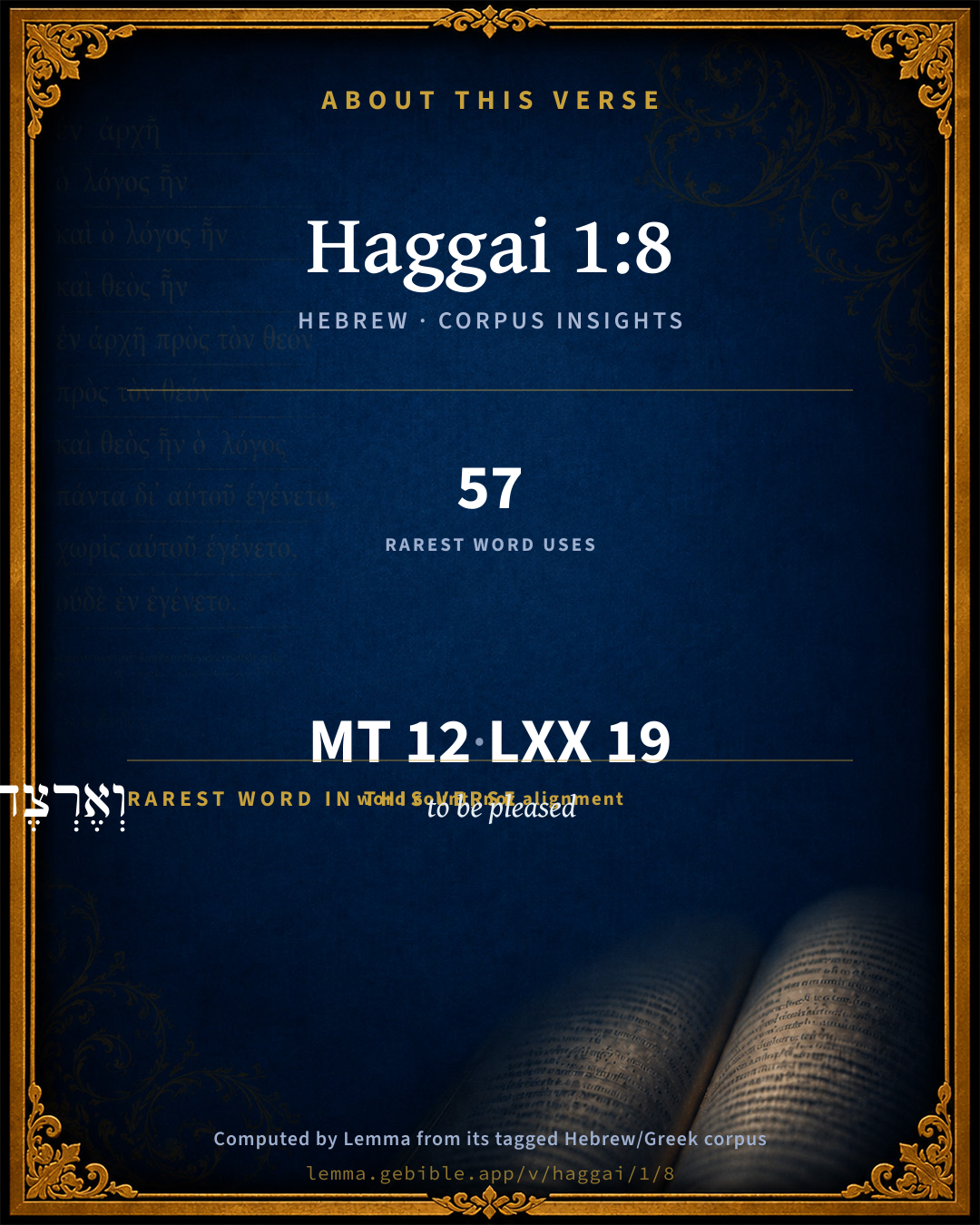
Haggai 1:8

Hebrew (Westminster Leningrad Codex) Haggai 1:8 appears in the Hebrew Old Testament. The text above is from the Westminster Leningrad Codex. Each word links to its Strong’s number, a concise gloss, and parsing drawn from the Open Scriptures Hebrew Bible morphology. Click any word for its full Brown-Driver-Briggs (BDB) entry.
Download image
Cite this verse

Haggai 1:8 (World English Bible). Public Domain. Lemma interlinear Bible study tool, https://lemma.gebible.app/v/haggai/1/8.

Show BibTeX & RIS
BibTeX
RIS
English Translation
Go up to the mountain, bring wood, and build the house. I will take pleasure in it, and I will be glorified," says Yahweh.
World English Bible · Public Domain
Download a study sheet

One document with this verse’s original text, its word-by-word gloss line, the meaning frame, cross-references with their text, attributed commentary, and full source and license credits — printable, and it pastes into notes with its structure intact.

This verse Autodidact and up

Study sheet (.html) Plain text (.txt)

A passage Seminary Student

Up to 50 verses in one chapter. A passage sheet keeps up to 6 commentary sources and 12 cross-references per verse, in the order this page ranks them, and says so on the sheet whenever that leaves anything out. Ask for a single verse and you get the Autodidact verse sheet above.

Everything on this page stays free to read, with no account — the sheet is a download of what is already on screen, not access to it.

Want to remove ads? Support Godless Engineer
Compare translations 3

The same verse in 3 English versions, stacked beneath the original-language interlinear above. Click any original word for its lexicon entry.

Each is an independent rendering of the whole verse — the interlinear is not word-aligned to these translations.

Highlighted words mark where these versions differ — a whole-verse word diff, not a word-by-word alignment.

  • World English Bible Public Domain
    Go up to the mountain, bring wood, and build the house. I will take pleasure in it, and I will be glorified," says Yahweh.
  • King James Version Public Domain
    Go up to the mountain, and bring wood, and build the house; and I will take pleasure in it, and I will be glorified, saith the LORD.
  • unfoldingWord Literal Text CC BY-SA 4.0
    Go up the mountain and bring timber and build the house, and I will take pleasure in it, and I will be glorified,’ says Yahweh.

unfoldingWord Literal Text — © unfoldingWord, licensed CC BY-SA 4.0. Word-aligned USFM3 via Door43 (git.door43.org/unfoldingWord/en_ult).

Versions to compare (up to 4)

3 of 4 selected

Show all 18 translations

Every available English version of this verse, each an independent rendering of the whole verse.

  • World English Bible Public Domain
    Go up to the mountain, bring wood, and build the house. I will take pleasure in it, and I will be glorified," says Yahweh.
  • Berean Standard Bible Public Domain
    Go up into the hills, bring down lumber, and build the house, so that I may take pleasure in it and be glorified, says the LORD.
  • Majority Standard Bible Public Domain
    Go up into the hills, bring down lumber, and build the house, so that I may take pleasure in it and be glorified, says the LORD.
  • King James Version Public Domain
    Go up to the mountain, and bring wood, and build the house; and I will take pleasure in it, and I will be glorified, saith the LORD.
  • American Standard Version (1901) Public Domain
    Go up to the mountain, and bring wood, and build the house; and I will take pleasure in it, and I will be glorified, saith Jehovah.
  • Revised Version (1885) Public Domain
    Go up to the mountain, and bring wood, and build the house; and I will take pleasure in it, and I will be glorified, saith the LORD.
  • Geneva Bible (1599) Public Domain
    Goe vp to the mountaine, and bring wood, and build this House, and I wil be fauourable in it, and I will be glorified, sayth the Lord.
  • Douay-Rheims (1899) Public Domain
    Go up to the mountain, bring timber, and build the house: and it shall be acceptable to me, and I shall be glorified, saith the Lord.
  • Young's Literal Translation Public Domain
    Go up the mountain, and ye have brought in wood, And build the house, and I am pleased with it. And I am honoured, said Jehovah.
  • Literal Standard Version CC BY-SA 4.0
    Go up the mountain, and you have brought in wood, || And build the house, and I am pleased with it. And I am honored,” said YHWH.
  • Unlocked Literal Bible CC BY-SA 4.0
    Go up to the mountain, bring timber, and build my house; then I will take pleasure in it, and I will be glorified!—says Yahweh.”
  • unfoldingWord Literal Text CC BY-SA 4.0
    Go up the mountain and bring timber and build the house, and I will take pleasure in it, and I will be glorified,’ says Yahweh.
  • Darby Bible Public Domain
    Go up to the mountain and bring wood, and build the house, and I will take pleasure in it, and I will be glorified, saith Jehovah.
  • World Messianic Bible Public Domain
    Go up to the mountain, bring wood, and build the house. I will take pleasure in it, and I will be glorified,” says the LORD.
  • Webster's Bible Public Domain
    Go up to the mountain, and bring wood, and build the house; and I will take pleasure in it, and I will be glorified, saith the LORD.
  • Free Bible Version CC BY-SA 4.0
    Go into the hills and bring wood to build the house. This will please me and honor me, says the Lord.
  • Bible in Basic English Public Domain
    Go up to the hills and get wood and put up the house; and I will take pleasure in it and be honoured, says the Lord.
  • JPS Tanakh (1917) Public Domain
    Go up to the hill-country, and bring wood, and build the house; and I will take pleasure in it, and I will be glorified, saith the LORD.

Literal Standard Version (2020), Covenant Press — licensed CC BY-SA 4.0. Text via the HelloAO Bible API (eBible.org). Unlocked Literal Bible (unfoldingWord) — licensed CC BY-SA 4.0. Text via the HelloAO Bible API (eBible.org). unfoldingWord Literal Text — © unfoldingWord, licensed CC BY-SA 4.0. Word-aligned USFM3 via Door43 (git.door43.org/unfoldingWord/en_ult). Free Bible Version, Dr. Jonathan Gallagher — licensed CC BY-SA 4.0. Text via the HelloAO Bible API (eBible.org).

Word by word

More ways to search: Search by grammar → Find every occurrence → Compare this word →

Practice this passage: Drill this verse → Learn its vocabulary →

וְאֶרְצֶה
râtsâh
H7521
“and · to be pleased”
Conjunction + Verb, Qal, Imperfect, 1st Person, Common, Singular
Part of Speech
Conjunction + Verb
Stem
Qal
Form
Imperfect
Person
1st Person
Gender
Common
Number
Singular
Full BDB Definition

Origin: a primitive root

TWOT: 2207

to be pleased with, be favourable to, accept favourably - (Qal) - to be pleased with, be favourable to - to accept - to be pleased, be determined - to make acceptable, satisfy - to please - (Niphal) to be accepted, be pleased with - (Piel) to seek favour of - (Hiphil) to please, pay off - (Hithpael) to make oneself acceptable or pleasing
  1. עֲל֥וּ ʻâlâh H5927 “go up” Verb, Qal, Imperative, 2nd Person, Masculine, Plural
  2. הָהָ֛ר har H2022 “the · mountain” Particle, Definite Article + Noun, Common, Masculine, Singular, Absolute
  3. וַהֲבֵאתֶ֥ם bôwʼ H935 “and · to enter” Conjunction + Verb, Hiphil, Sequential Perfect, 2nd Person, Masculine, Plural
  4. עֵ֖ץ ʻêts H6086 “tree” Noun, Common, Masculine, Singular, Absolute
  5. וּבְנ֣וּ bânâh H1129 “and · build” Conjunction + Verb, Qal, Imperative, 2nd Person, Masculine, Plural
  6. הַבָּ֑יִת bayith H1004 “the · house” Particle, Definite Article + Noun, Common, Masculine, Singular, Absolute
  7. ואכבד kâbad H3513 “and · to be heavy” Conjunction + Verb, Niphal, Imperfect, 1st Person, Common, Singular
  8. וְאֶכָּבְדָ֖ה kâbad H3513 “and · to be heavy” Conjunction + Verb, Niphal, Cohortative, 1st Person, Common, Singular
  9. אָמַ֥ר ʼâmar H559 “to say” Verb, Qal, Perfect, 3rd Person, Masculine, Singular
  10. יְהוָֽה Yᵉhôvâh H3068 “LORD” Noun, Proper

About this verse

These counts appear in no published source. They are computed here, from the morphology-tagged text and Lemma’s own curated glosses. What Lemma adds →

12
words
10
distinct lemmas
Prophets
section

Shared distinctive vocabulary

וְאֶרְצֶה to be pleased H7521 occurs in 55 verses of the Hebrew Bible. Also found in:

Grammatical profile

  • 7 verbs
  • 4 nouns
  • 1 preposition

Verb forms

  • עֲל֥וּ Qal · Imperative
  • וַהֲבֵאתֶ֥ם Hiphil · Sequential Perfect
  • וּבְנ֣וּ Qal · Imperative
  • וְאֶרְצֶה Qal · Imperfect
  • ואכבד Niphal · Imperfect
  • וְאֶכָּבְדָ֖ה Niphal · Cohortative
  • אָמַ֥ר Qal · Perfect

Repetition

A word recurs within this verse — often emphatic in Hebrew:

  • ואכבד to be heavy H3513 ×2

Hebrew & Septuagint length

In English translation the verse runs 24 words from the Hebrew and 24 from the Septuagint (LXX English) — the same length.

A rough comparison of the two English renderings, which tokenize alike — not a word-level alignment.

Word counts can differ between the Hebrew and the Greek without any difference in meaning — e.g. the Hebrew direct-object marker אֵת has no separate Greek word, and Greek often adds the article ὁ.

In the original languages it is 12 Hebrew tokens and 19 Greek tokens — but the two are counted differently (Hebrew bundles its prefixes and suffixes into one token; the Greek is in lemma form), so that isn’t a like-for-like length.

Cross-references

18

Topical passages linked to Haggai 1:8 in the Treasury of Scripture Knowledge — connected by theme and wording, ordered by reader-vote popularity; previews shown in the World English Bible.

  • Psalms 132:13–14 For Yahweh has chosen Zion. He has desired it for his habitation.
  • 2 Chronicles 7:16 For now have I chosen and made this house holy, that my name may be there forever; and my eyes and my heart shall be there perpetually.
  • 2 Chronicles 2:8–10 Send me also cedar trees, fir trees, and algum trees, out of Lebanon; for I know that your servants know how to cut timber in Lebanon: and, behold, my servants shall be with your servants,
  • Haggai 2:7 and I will shake all nations. The precious things of all nations will come, and I will fill this house with glory, says Yahweh of Hosts.
  • Exodus 29:43 There I will meet with the children of Israel; and the place shall be sanctified by my glory.
  • 1 Kings 9:3 Yahweh said to him, I have heard your prayer and your supplication, that you have made before me: I have made this house holy, which you have built, to put my name there forever; and my eyes and my heart shall be there perpetually.
  • Ezra 3:7 They gave money also to the masons, and to the carpenters; and food, and drink, and oil, to them of Sidon, and to them of Tyre, to bring cedar trees from Lebanon to the sea, to Joppa, according to the grant that they had of Cyrus king of Persia.
  • Jonah 3:1–2 The word of Yahweh came to Jonah the second time, saying,
  • Haggai 1:2–4 "This is what Yahweh of Hosts says: These people say, 'The time hasn't yet come, the time for Yahweh's house to be built.'"
  • Ezra 6:4 with three courses of great stones, and a course of new timber: and let the expenses be given out of the king's house.
  • Psalms 87:2–3 Yahweh loves the gates of Zion more than all the dwellings of Jacob.
  • Isaiah 60:7 All the flocks of Kedar shall be gathered together to you, the rams of Nebaioth shall minister to you; they shall come up with acceptance on my altar; and I will glorify the house of my glory.
  • Isaiah 60:13 The glory of Lebanon shall come to you, the fir tree, the pine, and the box tree together, to beautify the place of my sanctuary; and I will make the place of my feet glorious.
  • Isaiah 66:11 that you may suck and be satisfied with the breasts of her consolations; that you may milk out, and be delighted with the abundance of her glory.
  • Haggai 2:9 'The latter glory of this house will be greater than the former,' says Yahweh of Hosts; 'and in this place will I give peace,' says Yahweh of Hosts."
  • Zechariah 11:1–2 Open your doors, Lebanon, That the fire may devour your cedars.
  • Matthew 3:8–9 Therefore bring forth fruit worthy of repentance!
  • John 13:31–32 When he had gone out, Jesus said, "Now the Son of Man has been glorified, and God has been glorified in him.

Cross-references courtesy of OpenBible.info (CC BY 4.0).

Hebrew and Greek witnesses Masoretic Hebrew ↔ Greek Septuagint

The same verse in the two great witnesses to the Old Testament, shown verse-for-verse.

These are two independent witnesses, not word-aligned to each other, and the Septuagint is shown in lemma (dictionary) form.

Hebrew Haggai 1:8 Masoretic · Westminster Leningrad Codex

עֲל֥וּ הָהָ֛ר וַהֲבֵאתֶ֥ם עֵ֖ץ וּבְנ֣וּ הַבָּ֑יִת וְאֶרְצֶה בּ֥וֹ ואכבד וְאֶכָּבְדָ֖ה אָמַ֥ר יְהוָֽה

Go up to the mountain, bring wood, and build the house. I will take pleasure in it, and I will be glorified," says Yahweh.

World English Bible · Public Domain

Greek LXX Haggai 1:8 Septuagint · lemma form

ἀναβαίνω ἐπί ὁ ὄρος καί κόπτω ξύλον καί οἰκοδομέω ὁ οἶκος καί εὐδοκέω ἐν αὐτός καί ἐνδοξάζομαι εἶπον κύριος

Go up to the mountain, and cut timber; build the house, and I will take pleasure in it, and be glorified, says the Lord.

LXX2012 (modern English Septuagint) · Public Domain

Hebrew: Westminster Leningrad Codex (CC BY 4.0). Greek: Septuagint (public domain); English from LXX2012 (modern English Septuagint) (Public Domain). How the Septuagint differs from the Hebrew →

Targum (Aramaic paraphrase)

1

The Targum is the ancient Jewish Aramaic paraphrase of the Hebrew Scriptures — an interpretive translation, not the Hebrew text itself. Onkelos (literal) and Pseudo-Jonathan (expansive) render the Torah, and Jonathan the Prophets. Coverage is partial: where no permissively-licensed English translation exists for a verse, only the Aramaic is shown. This is verse-level text, not a word-by-word alignment to the Hebrew.

  1. Targum Jonathan Prophets (Joshua–Malachi)
    סַקוּ לְטוּרַיָא וְאַיְתוּ אָעִין וּבְנוֹ בַיְתָא וְאִתְרְעִי לְאַשְׁרָאָה שְׁכִנְתִּי בֵּיהּ בִּיקָר אֲמַר יְיָ:

    (no public-domain English translation for this verse)

    Targum Jonathan — Aramaic: “Mikraot Gedolot” (public domain). English: “Sefaria Community Translation” (CC0 1.0 (public-domain dedication)); “London "Chaldee Paraphrase," 1871” (public domain). Text via Sefaria.

Commentary

Notes on Haggai 1:8 from classic Christian and Jewish commentators (each source and its license shown beneath its notes). The classic Christian expositions comment on the surrounding passage and are grouped to its opening verse, so a note may address several verses; the Jewish commentaries on the Tanakh (Rashi and others) are per-verse, so they appear only where the commentator wrote on this verse.

Lemma curates 59 commentaries, every one of them public domain or Creative Commons licensed, each selected and text-cleaned for this edition rather than reprinted as found. About our sources →

Trapp's Complete Commentary

John Trapp

Hag 1:8 Go up to the mountain, and bring wood, and build the house; and I will take pleasure in it, and I will be glorified, saith the LORD.

Ver. 8. Go up to the mountain, and bring wood, &c.] Set upon the work, and be serious; build the temple with like zeal as Baruch repaired the wall, Neh 3:20, accendit seipsum, he burst out into a heat, being angry with his own and others’ sloth; and so finished his task in a short time. It must be an earnest, upright, and constant endeavour of reformation that must follow upon our sense of sin and fear of wrath; or else all will be but motus aliquis evanidus (as Calvin on the text hath it), a very flash; it will be but as prints made on water; as soon as finger is off all is out. It was certainly, therefore, an excellent saying of Luther (though condemned for heretical by Pope Leo X), Optima et aptissima poenitentia est nova vita. Amendment of life is the best repentance; neither is there any wiser way to break off our sins than to practise the contrary duties. He that repents with a contradiction (saith Tertullian), God will pardon him with a contradiction. Thou repentest and yet continuest in thy sin. God will pardon thee and yet send thee to hell. Those that will have God to take pleasure in them, as in his temple, to love them and come unto them, and make his abode with them, Joh 14:23, to dwell in them, and walk in them, 2Co 6:16 (as they did in Solomon’s porch, and other walks and galleries about the temple, Zec 3:7), to be glorified in them (accounting himself to receive, as it were, a new being, by those inward conceptions of his glory, and those outward honours we do to his name), they must go up to the mountain, not of Lebanon (though that was a pleasant and plentiful place, Deu 3:25), but of heaven, that hill from whence comes their help, and bring wood (growing wood, Son 1:17, living stones, 1Pe 2:5), and build the house, 1Co 3:9 Eph 2:22, laying faith for a foundation, love for a covering, having hope for a pinnacle, humility for a pavement, washing it with tears, sweeping it by repentance, beautifying it with holiness, perfuming it with prayers, hanging it with sincerity. So shall Christ the King be held in the galleries, Son 7:5, he shall covet their beauty, Psa 45:12, and be held fast bound to them in the bands of pure affection and spiritual wedlock. He will take pleasure in them, as he did in those that prayed in or toward the temple, Deu 12:11 1Ki 8:29, as he did in Daniel, that man of desires, Dan 9:23, in David, God’s corculum, or darling, 1Sa 13:14, in his Hephzibah, or sweetheart, the Church, Isa 62:4, called elsewhere the beloved of his soul, or his beloved soul: and he will be glorified in them by their spiritual sacrifices, 1Pe 2:5, reasonable services, Rom 12:1, performed in spirit and in truth, Joh 4:24, by some one of which God is more glorified than by all the actions of unreasonable or unregenerate creatures.

John Trapp, A Commentary or Exposition upon All the Books of the Old and New Testament (1647–1656) — public domain. Text from a community e-Sword module.

The Biblical Illustrator

Joseph S. Exell

Hag_1:8

Bring wood, and build the house.

The building rising

I. An important operation engaged in. Building the house.

1. Its actual nature. The building of the temple of God on Mount Zion. Solomons temple had been dismantled and razed to the ground. The first act of the restored captives was to rebuild the temple, so that they might once more perform Divine worship. The spiritual import of it was the formation and the gradual perfecting through successive generations of time, of the spiritual Church of God, under the dispensation of the Gospel of His Son, which in Scripture is known by the similitude of a house or a temple.

2. Its attendant difficulties. External adversaries around them. Powerful obstacles arose from the Jews themselves. Their numbers were scanty, and their resources were feeble; some were depressed and fearful, and some were indifferent and apathetic. Subtle objections against undertaking the work just then were started. Difficulties which common agency and common exertion might well despair of removing. These facts suggest the circumstances attendant on the erection of the spiritual temple of Divine grace, under the Gospel of our Lord Jesus Christ. The work has to progress amidst immense difficulty and opposition. External enmity has abounded, arising from the radical depravity and alienation of the human heart against God, and employing against His truth all the weapons of tact and force: heathen imposture, antichristian superstition, Mohammedan fanaticism, infidel impiety, worldly contempt and neglect. And the professed friends of the Gospel have themselves interposed serious difficulties in the path of progress and success. What injuries have come through the corruptions of the Church; by the divisions of the Church; and by the indolence of the Church. The inertness of some among us has been a most serious injury to the progress of truth and righteousness. It has contracted the resources of the Church; it has given to the Church a false aspect, and a false reputation in the eyes of the world. It has damped the zeal and paralysed the energies of pious, active, and devoted men; and it has prevented the announcement of saving principles to multitudes, who thus have lived in ignorance, have died in darkness, and have gone down in despair.

II. An agency in connection with which this operation is to be conducted.

1. It is instrumental and secondary. The personal exertions of the Jews themselves were demanded, and were enlisted under the guidance of certain men who had been specially appointed by God for that purpose. The instrumental and secondary agency, appointed for the purpose of promoting the designs of Divine mercy, under the Gospel of our Redeemer, consists in the devoted labours of men who have been themselves redeemed. When the Saviour had completed His own personal mission among the sons of men, He consigned the instrumentality we have noticed, mainly to those whom He had constituted His ministers: some amongst them to labour in temporary offices, and others again to be raised up in long succession, and in such succession to labour until the end of time.

2. It is an agency efficient and supreme. The Divine agency, connected with the instrumentality of men, was to direct them in their counsels, and to give efficiency and success to their movements. It is the agency of the Lord Jesus Christ, and the agency of the Holy Spirit. Zechariah presents Christ as the foundation-stone of the building, and as the architect of the building. The Spirit is presented under the figure of the seven eyes. Obstacles would remain undiminished, the great mountain would always frown upon us in equal and unmitigated power, were it not for the agency asserted and vindicated here. The best instrumentality devised and employed by man, and operating with whatever of industry and skill, would not advance one solitary step, were it not for the agency asserted and vindicated here.

III. A result, in which this operation, so conducted, shall terminate. The operation shall be triumphantly completed. The head-stone of the temple was brought on. And we can securely anticipate the certain and appointed consummation of the efforts, which in the cause of God we are now, although inadequately, assisting to promote. There is to be the completion of the structure of Divine grace. Nothing can injure the progress and the advancement of our religion. And being triumphantly completed, it will eminently redound to the Divine glory. And the final triumph will be hailed with ecstasy and rapture by all holy created beings. Application--

1. What encouragement to those already engaged and labouring for God!

2. What rebuke to those, professing the religion of Jesus, who are yet indolent and inactive!

3. What warning to those who are avowedly hostile to God and to His truth! (James Parsons.)

The sanctuary built

It is vain to contend that there exists an exact correspondence between the Jewish and the Christian Church. Yet, as they were constituted and ruled by the same authority, and for the same great ends, the history of the former cannot be otherwise than pregnant with instructions suited to the condition and wants of the latter. The principles of truth and righteousness are immutable. These remarks are applicable to the present portion of Jewish history. The returned captives let the house of God lie waste until they had made ample provision for themselves and their families. With this course God was displeased, and He punished them in a manner exactly corresponding with the offence. They wanted to accumulate more of the world for themselves and families. But God rendered abortive every labour of their hands. By drought and famine He dried up the sources of their gains, and withered their hopes. There is nothing to render this case inapplicable to the Christian Church. The great law of Gods providence, in this respect, is maintained even down to the present day.

1. God has, from the beginning, been worshipped in temples made With hands. While the Jews were passing through the wilderness, they built a portable tabernacle for Gods worship. When their migrations were ended, they built a costly and magnificent temple to the honour of Jehovah. Thus it has been in all time where Jehovah has been known. Even heathen nations have everywhere had public edifices devoted to the rites of their idolatrous worship. There never was a community that did not consecrate to the object of its worship some structure,

2. As respects the true religion, these edifices have been built by command of God. See injunctions given to Moses and to Solomon. History records not one instance of the pervading and sanctifying power of religion in any community where the regular and stated convocations of the people for the worship of God had been abolished.

3. A house of worship, where the people may convene to make a public recognition of God, and offer to Him their homage, is indispensably necessary to a diffusion of the blessings of religion, and a perpetuation of its institutions. The advantages resulting from a convocation of the people at stated periods for religious instruction are perfectly obvious. Let the house of God go to decay, let the sanctuary be demolished, and the strongest bonds of the social state will be dissolved, and all combinations of effort or sympathy to sustain the ordinances, or propagate the doctrines of religion, come to an end. Religion could, under these circumstances, have no organised existence. The solemn convocations of the Church of Christ constitute the heart, whose pulsations send the vital fluid through all the ramifications of the system. Let its Sabbath assemblies be given up, and its existence would speedily come to an end.

4. The ministrations of the house of God have a powerful influence upon the intelligence and good order of the community. There are susceptibilities to religious influence which belong to mans nature. They must either be developed and trained under scriptural instruction, or they must take on a character from some superstitious and inadequate culture. The objects presented before the mind in the sanctuary, by an able and scriptural ministry, are of the most exalted and commanding character. How is it possible that the constant exhibition of themes like these should fail of producing an elevation and expansion of intellect through all the grades of society that no other agency is capable of producing? How great must be the moral power of the pulpit. The principles of the Gospel are all holy. Whence come the perpetrators of crimes? I have no recollection of even one individual who was an habitual worshipper in the sanctuary being convicted of a States prison offence. There are still higher interests to be secured by this agency--the interests of the soul. In the house of prayer there are peculiar manifestations of the Divine glory. Here souls are trained for heaven.

5. The building destined to this high purpose should, in some sense, correspond to the great design of its erection.

(1) It should be a true exponent of the estimation in which the people hold the institutions of religion.

(2) It ought to be rendered as attractive, by its architectural beauty without, and by its well-appointed arrangements within, as is consistent with the sacred and holy purposes which it is designed to subserve.

(3) When it becomes necessary to erect a house for the worship of God, the people should well consider the character of the Being to whom it is to be consecrated, and take care that the structure be such a one as they will not be ashamed to present to Him as an expression of their gratitude and love. Closing remarks--

1. We owe primarily to the sanctuary the intelligence, refinement, good order which prevail in Christian communities, and the security of life and property which we enjoy.

2. We do not recommend extravagant expenditures in building a house for the worship of our God. We would have everything simple and chaste, but, if the ability of the people permitted, rich and commodious.

3. To accomplish a work of such magnitude, the utmost harmony is demanded; a perfect union of views and efforts. Divided counsels always tend to weakness and ruin.

4. Nothing but the spirit of an enlightened and enlarged liberality will be equal to the demands of such an emergency, as the erection of a house to be consecrated to the worship of Jehovah.

5. The condescension of God, in recording His name in temples made with hands, and in permitting Himself there to be sought and worshipped by His sinful creatures, ought to excite our highest wonder, and gratitude, and love for ever. (J. W. Adams, D. D.)

The encouragement to build the Lords house

In the Word of God warnings and threats are always accompanied with exhortations and promises. Were it not so, the threats would profit us little. It is true that only in the Gospel is the love of God made manifest in its fulness. Only in the Gospel do the promises prevail mightily over the threatenings. As God bids the Jews go up to the mountain and fetch the wood to build His house, so does He command us likewise to go up to the mountain for the same purpose. To what mountain? To the mountain of faith; to the mountain of duty. Faith is a hard mountain to climb for all, above all for those who have been living in unbelief. Duty too is a hard mountain to climb for all, above all for those who have been living in self-indulgence. This is the reward He promises us, if we will climb the steep mountain of faith and duty to seek the graces with which we are to build Gods house. He assures us He will take pleasure in that house, and will be glorified in it. What a mighty motive is this! It ought to have great sway over every one of us. If God takes pleasure in our work, that work must be blessed upon ourselves also. God is infinitely more merciful and bountiful than man can believe or conceive. He sees the very first stirrings of an obedient spirit in the heart; and when He sees them, He blesses them, and strengthens them, and helps them forward. No sooner had Zerubbabel and the remnant of the people begun to obey the voice of the Lord, than the prophet Haggai was sent to say, I am with you, saith the Lord. He had been with them long before. He had shown forth His wonderful loving-kindness in a number of ways. Yet He sent them this comforting assurance. Nor is He less kind, less gracious, less bountiful, less merciful to us who have become His children in Christ Jesus. He comes to us from the very first by His Spirit. He has been with us, as our Guide, Teacher, and Director, during the whole of our journey through the wilderness of the world, from our childhood upward. It is through Him that we have been brought, whenever we have been brought, into the assembly of His people upon His holy hill of Zion. He has ever and anon sent His prophets to Us. Yet when we do begin to turn our hearts towards Him, as soon as we earnestly desire to obey Him, and serve Him, He comes to us more plainly, more openly, more manifestly, and sends us a message to cheer us with the assurance that He is and will be with us. This blessed assurance is vouchsafed to all who sincerely desire and strive to obey God. They feel that they have a wisdom above their own to guide them, that they have a strength beyond their own to support them. May we all be brought to that state in which God will take pleasure and be glorified in us! (Julius C. Hare, M. A.)

God glorified in the building of Churches.

What are the walls which we raise, unless God take pleasure in them? Just what a body is without a soul, hopeless, spiritless, unprofitable. Will God indeed he glorified of men? There is one thing more strange, it is that God should be so little glorified of men. It would be profane and impious to speak of those as glorifying God, who live with no fear of God before their eyes. When is God glorified?

1. When any are converted to Him who, heretofore, either in accordance with bad principles, or in contradiction to better principles, have been alienated from Him, or transgressing against Him.

2. When men accept the way of salvation which He has prepared. When the Gospel offer is accepted, and men thank God for His unspeakable gift, God is glorified.

3. When they who have repented do works meet for repentance, live righteously, soberly, and godly, and wait for His heavenly kingdom. God is dishonoured when any who profess to take His yoke upon them walk unworthily of the vocation wherewith they are called; when any, who pretend to be His friends, are really enemies of the Cross of Christ.

4. When men are saved. This is the crown of all; and truly is it the glory of God. Whoever is made meet for the heavenly inheritance, will ascribe it to God alone. He that glorieth will glory in the Lord; will acknowledge that His Spirit influenced him, His wisdom guided him, His goodness converted him, His power defended him, and that with anything less than that all-sufficient hand, he must have sunk under the dangers with which he was assailed. (T. B. Summer, D. D.)

The duty of building the spiritual house of God

Gods material temple at Jerusalem was typical of the spiritual temple to be erected in the hearts of the people. The words of text are applicable--

I. To the spiritual house to be raised in every individuals heart. St. Paul, writing to the Corinthians, says, Ye are the temple of God; and the Spirit of God dwelleth in you. Yet what minister can look over his congregation and not see manifest proof that in the case of too many this temple is altogether in ruins. Even where there is good reason to believe that the rubbish of sinful habits has been cleared away, the foundation been rightly laid, and the building is making progress, will not most allow that the lets and hindrances perpetually occurring, render the exhortations of the prophets both salutary and expedient? Some may say, What can we do in this matter? Is not the building of this spiritual house the work of God? Yes, it is. But because Gods material temple was to be raised, not by human power, but by Gods Spirit, therefore the people were urged to persevere and fear no obstacle: and it is because God worketh in us both to will and do, therefore we are exhorted to work out our own salvation with fear and trembling. Man can do nothing in spiritual things without God, and God seldom acts without being pleased to use the co-operation of man. We are to be active in the carrying on of t-hies spiritual building, that the Lord may take pleasure in it, and that He may be glorified thereby.

II. To the Church of Christ in our own land. But there are many living in our land without Christian ordinances, and in a state of heathenism. Then there is a call to build this house.

III. To the Church of Christ throughout the world. Our charity should indeed begin at home, but it should not stay there. Missionary exertion has a reflex effect. If ever there was a Church, or nation, to which God, by His providential dispensations, might be supposed in an especial manner to say, Go ye into all the world, and preach the Gospel, that Church and that nation is our own. (T. Grantham, B. D.)

The Biblical Illustrator, edited by Joseph S. Exell (c. 1880s–1900s) — public domain. Text from a community e-Sword module.

Joseph Benson's Commentary

Hag 1:8-11. Go up to the mountain — Go to any of the forests upon the mountains: see Neh 2:8 : and cut down timber to carry on the building; or go to the mountain of Moriah, which I have chosen to build my temple upon it; and I will take pleasure in it — I will accept your offerings, and hear your prayers. And I will be glorified — Will show my majesty, and account myself glorified by you also. Ye looked for much and lo, it came to little — It did not answer the expectation you had formed. When ye brought it home, I did blow upon it — I blasted it; or, blowed it away: when you brought your gains home, I caused them to be soon scattered again, or expended. The dearth with which God punished them for their neglect of rebuilding the temple, made all the necessaries of life so dear, that whatever gains they got were quickly expended. Why? saith the Lord, &c. — For what reason have ye been visited with this calamity? Because of my house that is waste — All this evil is come upon you for your ungodly neglect of my house, leaving it waste. And ye run every man to his own house — You with eagerness carry on your own particular buildings, and mind only your own private affairs, and you take no manner of care about those things which concern my worship. Therefore the heaven over you is stayed from dew — I have punished you with great drought, wherein the dew itself has ceased to fall: see 1Ki 17:1. And the earth is stayed from her fruit — From bringing forth those fruits which otherwise it would have produced. And I called for a drought — I caused a dearth of every thing in the land, or a general barrenness to take place. And upon the mountains — Upon the hills, where your cattle and flocks used to feed, and to find sufficient nourishment; upon the new wine, and upon the oil —

Upon your vineyards and olive-yards; and upon men, and upon cattle — I made both men and cattle unfruitful. Or the meaning is, their very constitutions were changed, and many diseases afflicted them.

Joseph Benson's Commentary on the Old and New Testaments (1811–1818) — public domain. Text from a community e-Sword module.

Tyndale Open Study Notes

Tyndale Open Resources

1:8 Now go up into the hills: The stands of trees around Jerusalem were insufficient to meet the demands of the Temple project. Such supplies would have been imported from Lebanon and Syria to the north. • The challenge to rebuild my house underscores the importance of worship in the life of the community and the need for a proper sanctuary so worship of the Lord might take place according to the law. The land would experience blessing and prosperity when the Lord’s Temple—his dwelling place—was rebuilt (2:4).

Tyndale Open Study Notes — © Tyndale Open Resources, licensed CC BY-SA 4.0. Text via the HelloAO Bible API.

Geneva Bible (1599)

Geneva Bible translators

That is, my glory shall be set forth by you.

Meaning, that they should leave off their own commodities, and go forward in the building of God’s Temple, and in the setting forth of his religion.

That is, I will hear your prayers according to my promise, 1 Kings 8:21, 29.

Geneva Bible (1599) marginal notes — public domain. Text via Bolls.life.

Jamieson, Fausset & Brown

Robert Jamieson, A. R. Fausset & David Brown

Go up to the mountain--Moriah [ROSENMULLER]; Lebanon [HENDERSON]. Rather, generally, the mountains around, now covered with wood, the growth of the long period of the captivity. So Neh 8:15, "Go forth unto the mount," that is, the neighboring hills [MAURER].

wood--Haggai specifies this as being the first necessary; not to the exclusion of other materials. Stones also were doubtless needed. That the old walls were not standing, as the Hebrew interpreters quoted by JEROME state, or the new walls partly built, appears from Hag 2:18, where express mention is made of laying the foundations.

I will take pleasure in it, and I will be glorified--I will be propitious to suppliants in it (Kg1 8:30), and shall receive the honor due to Me which has been withheld. In neglecting the temple, which is the mirror of My presence, ye dishonor Me [CALVIN]; in its being built, ye shall glorify Me.

Jamieson, Fausset & Brown — Commentary Critical and Explanatory on the Whole Bible (1871) — public domain (CC PDM 1.0). Text via the HelloAO Bible API.

Adam Clarke's Commentary

Verse 8. Go up to the mountain, and bring wood] Go to Lebanon, and get timber. In the second year of the return from the captivity, they had procured cedar trees from Lebanon, and brought them to Joppa, and had hired masons and carpenters from the Tyrians and Sidonians; but that labour had been nearly lost by the long suspension of the building. Ezr 3:7.

Adam Clarke's Commentary on the Bible (1810–1826) — public domain. Text from a community e-Sword/MySword module.

Ellicott's Commentary for English Readers

(8) The mountain.—No one mountain is thought of. The term implies the high lands generally, as growing the most suitable timber for building purposes.

A Bible Commentary for English Readers, edited by Charles John Ellicott (1878–1897) — public domain. Text from a community e-Sword module.

The Cambridge Bible for Schools and Colleges

gen. ed. J. J. S. Perowne

8. Go up to the mountain] The consideration to which they have twice been called is to lead to action and amendment. They are not only to repent, but to bring forth fruits meet for repentance.

the mountain] This is clearly not, as some have thought, the mountain on which the Temple stood, “the mountain of the Lord’s house,” but the mountain from which the timber for building was to be fetched. It might possibly mean Lebanon, from which they were to cause wood to be brought, qui facit per alium facit per se, but the words sound more like a call to immediate personal effort, and then the mountain would be the mountainous neighbourhood generally (hill country, R. V. margin), to which they were themselves to go and bring wood. See Neh_2:8, where “the king’s forest” would seem to have been in the neighbourhood of Jerusalem; and Neh_8:15, where possibly “the mount” means the Mount of Olives.

I will be glorified] “The meaning may be either, ‘I will accept it as done for My glory’; or, ‘I will display My glory in it’ (see ch. Hag_2:9).” Annotated Paragraph Bible, Rel. Tract. Soc.

The Cambridge Bible for Schools and Colleges (gen. ed. J. J. S. Perowne; Cambridge University Press, 1878–1918) — public domain. Text from a community e-Sword module.

Albert Barnes' Notes on the Bible

Go up into the mountain - Not Mount Lebanon, from where the cedars had been brought for the first temple; from where also Zerubbabel and Joshua had procured some out of Cyrus’ grant Ezr 3:7, at the first return from the captivity. They were not required to buy, expend, but simply to give their own labor. They were themselves to “go up to the mountain,” i. e., the mountainous country where the trees grew, “and bring” them. So, in order to keep the Feast of Tabernacles, Ezra made a proclamation Neh 8:15 “in all their cities and in Jerusalem, go ye up to the mountain and bring leafy branches of vines, olives, myrtles, palms.” The palms, anyhow, were timber. God required not goodly stones, such as had been already used, and such as hereafter, in the temple which was built, were the admiration even of disciples of Jesus Mat 24:1, but which were, for the wickedness of those who rejected their Saviour, “not to be left, one stone upon another.” He required not costly gifts, but the heart. The neglect to build the temple was neglect of Himself, who ought to be worshiped there. His worship sanctified the offering; offerings were acceptable, only if made with a free heart.

And I will have pleasure in it - God, who has declared that He has no Mic 6:7 “pleasure in thousands of rams, ten thousands of rivers of oil,” had delight in Psa 147:11 “them that feared Him,” that are “upright in their way,” Pro 11:20 that “deal truly” Pro 12:22 in the “prayer” of the “upright” Pro 15:8, and so in the temple too, when it should be built to His glory.

And will be glorified - o God is glorified in man, when man serves Him; in Himself, when He manifests aught of His greatness; in His great doings to His people Isa 26:15; Isa 44:23; Isa 60:21; Isa 61:3, as also in the chastisement of those who disobey Him Exo 14:4; Eze 28:22. God allows that glory, which shines ineffably throughout His creation, to be obscured here through man’s disobedience, to shine forth anew on his renewed obedience. The glory of God, as it is the end of the creation, so is it His creature’s supreme bliss. When God is really glorified, then can He show forth His glory, by His grace and acceptance. (Augustine, Serm. 380, n. 6.) “The glory of God is our glory. The more sweetly God is glorified, the more it profits us:” yet not our profit, but the glory of God is itself our end; so the prophet closes in that which is our end, “God will be glorified.”

“Good then and well-pleasing to God is zeal in fulfilling whatever may appear necessary for the good condition of the Church and its building-up, collecting the most useful materials, the spiritual principles in inspired Scripture, whereby he may secure and ground the conception of God, and may shew that the way of the Incarnation was well-ordered, and may collect what pertains to accurate knowledge of spiritual erudition and moral goodness. Nay, each of us may be thought of, as the temple and house of God. For Christ “dwelleth in us” by the Spirit, and we are “temples of the living God,” according to the Scripture 2Co 6:16. Let each then build up his own heart by right faith, having the Saviour as the “precious foundation.” And let him add thereto other materials, obedience, readiness for anything, courage, endurance, continence. “So being framed together by that which every joint supplieth, shall we become a holy temple, a habitation of God through the Spirit” Eph 4:16; Eph 2:21-22. But those who are slow to faith, or who believe but are sluggish in shaking off passions and sins and worldly pleasure, thereby cry out in a manner, The time is not come to build the house of the Lord.”

Albert Barnes' Notes on the Bible (1834–1885) — public domain. Text from a community e-Sword/MySword module.

Haydock's Catholic Bible Commentary

The mountain Libanus. Wood had been purchased before, but had been used for other purposes, 1 Esdras iii. 7. Now the people went to procure more. The following year Darius confirmed the decree of Cyrus, which was a change plainly effected by Providence. (Calmet)

George Leo Haydock (1774–1849), Haydock's Catholic Family Bible and Commentary, 1859 edition — public domain. Excludes Psalms (Douay-Rheims chapter numbering differs from Protestant) and Deuterocanonical books (Catholic canon only).

Matthew Poole's English Annotations

Go up, delay no longer, speed ye up to the mountain; Moriah, or Zion, better Lebanon, where best and greatest store of cedars were to be had, whence came the goodly cedars which built Solomon’s temple, 1Ki 5:14,15, and where they had (before the building was forbidden) furnished themselves, Ezr 3:7.

Bring wood; provide all sorts of lumber for this future edifice.

Build; go on with the work, the foundation whereof hath been laid some years, but the superstructure omitted.

The house of God, the holy temple.

I will take pleasure in it: this a very gracious promise revived, an assurance that God will dwell in it, and afford his presence there; I will meet you there, and there I will bless you, there I will accept your offerings, hear your prayers, forgive your sins, and satisfy you with the fatness of my house: much the same promise with that, 1Ki 8:29; 9:3.

I will be glorified; show my majesty, and account myself glorified by you also.

Matthew Poole's English Annotations on the Holy Bible (1683–1685) — public domain. Text from a community e-Sword/MySword module.

The Pulpit Commentary

Go up to the mountain. The hill country in the neighbourhood of Jerusalem, whence by their own personal exertions they might procure material for the building. The temple mount is certainly not meant, as if they were to bring wood from it. Nor can Lebanon be intended, as in Ezr_3:7; for the injunction looks to an immediate actual result, and in their depressed circumstances they were scarcely likely to interest the Sidonians and Tyrians to provide cedar for them. There was abundance of wood close at hand, and the "kings forest" (Neh_2:8) was in the immediate neighbourhood of Jerusalem. There is no mention of stone, probably because the foundations had long been laid, and the ruins of the old temple supplied material for the new one; and, indeed, stone was to be had in abundance everywhere; or it may be that the prophet names merely one opening for their renewed activity, as a specimen of the work required from them. Not costly offerings were desired, but a willing mind. I will be glorified; I will glorify myself by showering blessings on the house and the people, so that the Hebrews themselves and their neighbours may own that I am among them. (comp. Exo_14:4; Lev_10:3; Isa_66:5)

The Pulpit Commentary (1880–1919), ed. H.D.M. Spence-Jones & Joseph S. Exell — public domain. Text from a community e-Sword module.

John Wesley's Explanatory Notes

Take pleasure - I will accept your offerings, and hear your prayers. Glorified - Shew my majesty and account myself glorified by you also.

John Wesley, Explanatory Notes Upon the Whole Bible (1754–1765) — public domain. Text via the GEBible commentary corpus.

Rashi

Rabbi Shlomo Yitzchaki (Rashi)

and I will be honored The “heh” [whose numerical value is five] missing from the Masoretic text corresponds to the five items in the First Temple that were not in the Second Temple: 1) the Holy Ark, 2) the Urim and Tummim, 3) the fire that descended from heaven, 4) the Shechinah, and 5) the Holy Spirit, as is stated in Tractate Yoma (21b).

Rashi on the Tanakh — English translations: “The Judaica Press complete Tanach with Rashi, translated by A. J. Rosenberg” (CC BY 4.0); “Pentateuch with Rashi's commentary by M. Rosenbaum and A.M. Silbermann, 1929-1934” (public domain); “The Metsudah Tanach series, Lakewood, N.J” (CC BY 4.0); and “The Book of Joshua, Metsudah Publications, 1997” (CC BY 4.0). Text via Sefaria.

Lesson kit

Teaching starters — assembled from the data on this page, not authored interpretation. Every prompt links to the verse data it draws on. Edit before teaching.

Haggai, in the Prophets, opens this verse with 12 words (10 distinct Hebrew lemmas). Its most distinctive word is râtsâh (“to be pleased”). A historical commentator’s framing appears above. Read the whole chapter for the surrounding context.

Discussion questions

  1. What does “to be pleased” (râtsâh) contribute to the verse as a whole?
  2. Genesis 33:10 shares the word «to be pleased» with this verse. How do the two illuminate each other?
  3. “to be heavy” occurs 2× in this one verse. What is the effect of the repetition?
  4. These translations render this verse differently. What is at stake in choosing one wording over another?
  5. The verb «עֲל֥וּ» is Qal Imperative. How does its form color the action?
  6. Reading how Trapp's Complete Commentary and The Biblical Illustrator read this verse, where do the two commentators agree and where do they part?

Things to notice

Reading settings

Reading text

Shown beneath each verse's original-language words.

Old Testament
Old Testament edition

Read the OT as the Masoretic Hebrew (MT) or the Greek Septuagint (LXX).

English shown for the Greek Septuagint (in the Hebrew ↔ Greek comparison).

Comparing translations? Open the Compare panel on any verse page to stack up to four side by side.