
Ezekiel 19:9

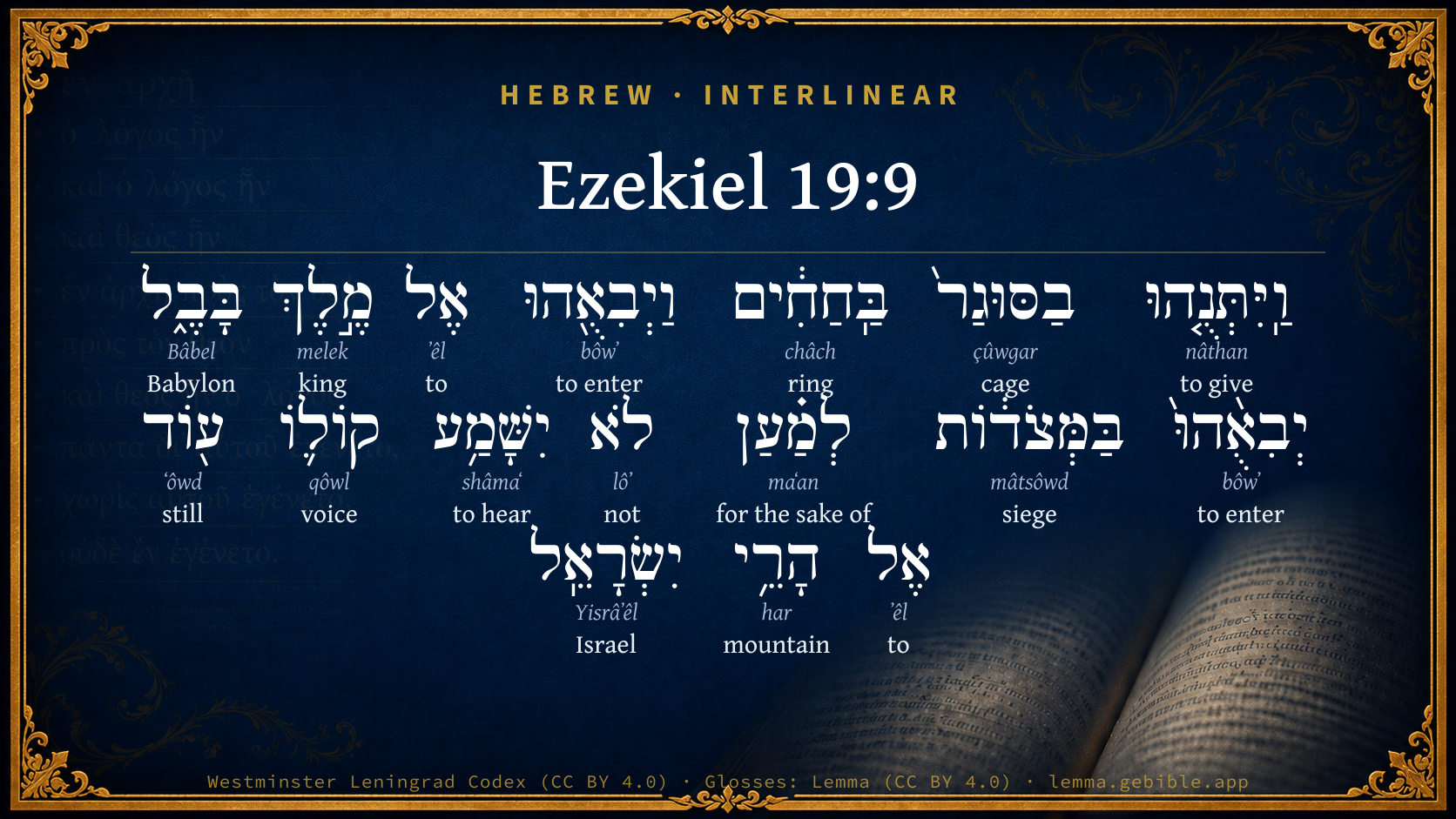
Hebrew (Westminster Leningrad Codex) Ezekiel 19:9 appears in the Hebrew Old Testament. The text above is from the Westminster Leningrad Codex. Each word links to its Strong’s number, a concise gloss, and parsing drawn from the Open Scriptures Hebrew Bible morphology. Click any word for its full Brown-Driver-Briggs (BDB) entry.
Download image
Cite this verse

Ezekiel 19:9 (World English Bible). Public Domain. Lemma interlinear Bible study tool, https://lemma.gebible.app/v/ezekiel/19/9.

Show BibTeX & RIS
BibTeX
RIS
English Translation
They put him in a cage with hooks, and brought him to the king of Babylon; they brought him into strongholds, that his voice should no more be heard on the mountains of Israel.
World English Bible · Public Domain
Highlights
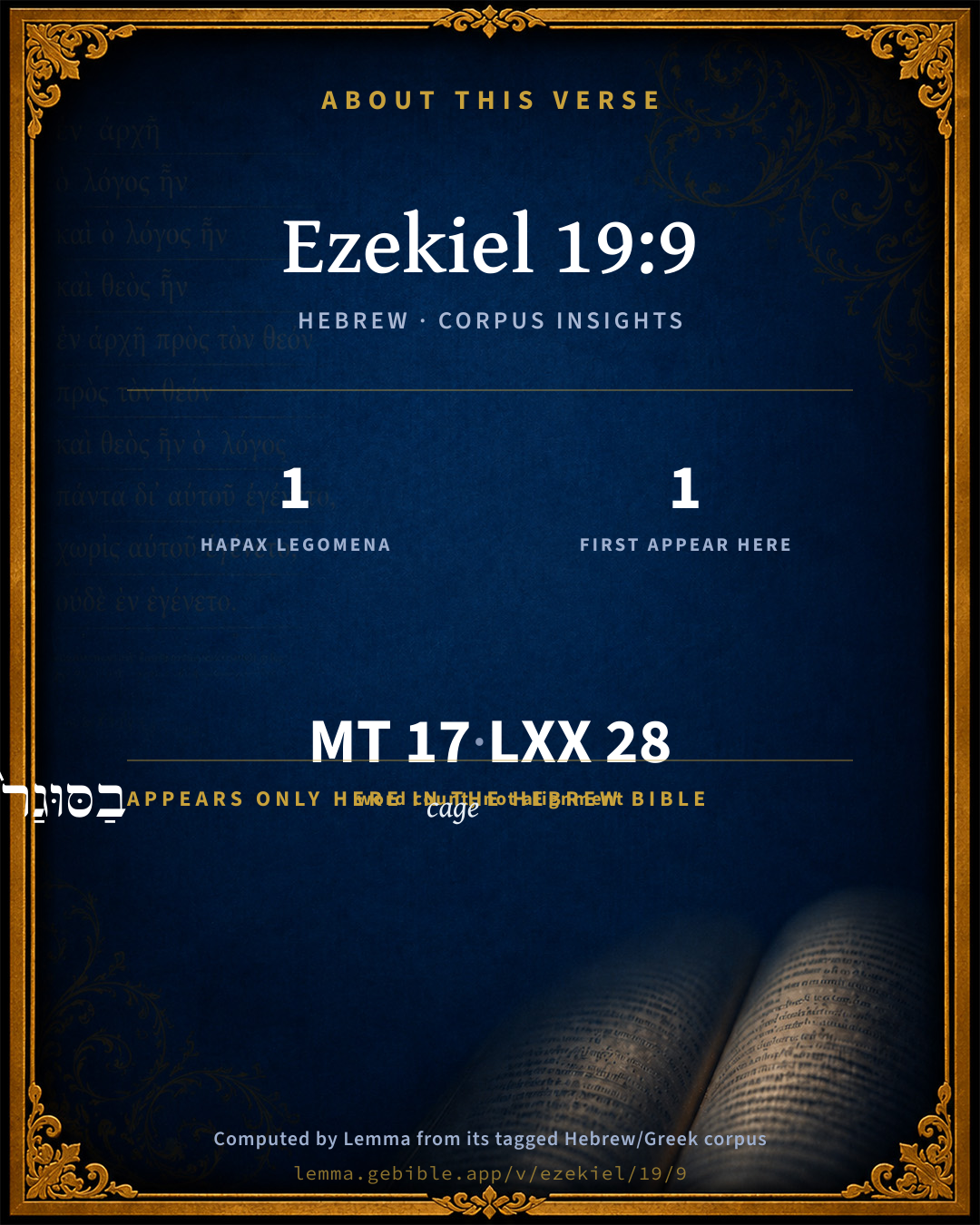
  • 1 hapax legomenon — only here in the Hebrew Bible
  • 1 first appearance in the Hebrew Bible
Full analysis ↓
Download a study sheet

One document with this verse’s original text, its word-by-word gloss line, the meaning frame, cross-references with their text, attributed commentary, and full source and license credits — printable, and it pastes into notes with its structure intact.

This verse Autodidact and up

Study sheet (.html) Plain text (.txt)

A passage Seminary Student

Up to 50 verses in one chapter. A passage sheet keeps up to 6 commentary sources and 12 cross-references per verse, in the order this page ranks them, and says so on the sheet whenever that leaves anything out. Ask for a single verse and you get the Autodidact verse sheet above.

Everything on this page stays free to read, with no account — the sheet is a download of what is already on screen, not access to it.

Want to remove ads? Support Godless Engineer
Compare translations 3

The same verse in 3 English versions, stacked beneath the original-language interlinear above. Click any original word for its lexicon entry.

Each is an independent rendering of the whole verse — the interlinear is not word-aligned to these translations.

Highlighted words mark where these versions differ — a whole-verse word diff, not a word-by-word alignment.

  • World English Bible Public Domain
    They put him in a cage with hooks, and brought him to the king of Babylon; they brought him into strongholds, that his voice should no more be heard on the mountains of Israel.
  • King James Version Public Domain
    And they put him in ward in chains, and brought him to the king of Babylon: they brought him into holds, that his voice should no more be heard upon the mountains of Israel.
  • unfoldingWord Literal Text CC BY-SA 4.0
    With hooks they put him in a cage and then they brought him to the king of Babylon. They brought him to the strongholds so that his voice would no longer be heard on the mountains of Israel.

unfoldingWord Literal Text — © unfoldingWord, licensed CC BY-SA 4.0. Word-aligned USFM3 via Door43 (git.door43.org/unfoldingWord/en_ult).

Versions to compare (up to 4)

3 of 4 selected

Show all 18 translations

Every available English version of this verse, each an independent rendering of the whole verse.

  • World English Bible Public Domain
    They put him in a cage with hooks, and brought him to the king of Babylon; they brought him into strongholds, that his voice should no more be heard on the mountains of Israel.
  • Berean Standard Bible Public Domain
    With hooks they caged him and brought him to the king of Babylon. They brought him into captivity so that his roar was heard no longer on the mountains of Israel.
  • Majority Standard Bible Public Domain
    With hooks they caged him and brought him to the king of Babylon. They brought him into captivity so that his roar was heard no longer on the mountains of Israel.
  • King James Version Public Domain
    And they put him in ward in chains, and brought him to the king of Babylon: they brought him into holds, that his voice should no more be heard upon the mountains of Israel.
  • American Standard Version (1901) Public Domain
    And they put him in a cage with hooks, and brought him to the king of Babylon; they brought him into strongholds, that his voice should no more be heard upon the mountains of Israel.
  • Revised Version (1885) Public Domain
    And they put him in a cage with hooks, and brought him to the king of Babylon; they brought him into strong holds, that his voice should no more be heard upon the mountains of Israel.
  • Geneva Bible (1599) Public Domain
    And they put him in prison and in chaines, and brought him to the King of Babel, and they put him in holdes, that his voyce should no more be heard vpon the mountaines of Israel.
  • Douay-Rheims (1899) Public Domain
    And they put him into a cage, they brought him in chains to the king of Babylon: and they cast him into prison, that his voice should no more be heard upon the mountains of Israel.
  • Young's Literal Translation Public Domain
    And they put it in prison -- in chains, And they bring it unto the king of Babylon, They bring it in unto bulwarks, So that its voice is not heard any more On mountains of Israel.
  • Literal Standard Version CC BY-SA 4.0
    And they put him in prison—in chains, || And they bring him to the king of Babylon, || They bring him into bulwarks, || So that his voice is not heard || On mountains of Israel anymore.
  • Unlocked Literal Bible CC BY-SA 4.0
    With hooks they put him in a cage and then they brought him to the king of Babylon. They brought him to the strongholds so that his voice would no longer be heard on the mountains of Israel.
  • unfoldingWord Literal Text CC BY-SA 4.0
    With hooks they put him in a cage and then they brought him to the king of Babylon. They brought him to the strongholds so that his voice would no longer be heard on the mountains of Israel.
  • Darby Bible Public Domain
    And they put him in a cage with nose-rings, and brought him to the king of Babylon; they brought him into strongholds, that his voice should no more be heard upon the mountains of Israel.
  • World Messianic Bible Public Domain
    They put him in a cage with hooks, and brought him to the king of Babylon. They brought him into strongholds, so that his voice should no more be heard on the mountains of Israel.
  • Webster's Bible Public Domain
    And they put him in custody in chains, and brought him to the king of Babylon: they brought him into holds, that his voice should no more be heard upon the mountains of Israel.
  • Free Bible Version CC BY-SA 4.0
    They used hooks to put him in a cage and took him to the king of Babylon. They led him away and imprisoned him so his roar wasn't heard any more in Israel's mountains.
  • Bible in Basic English Public Domain
    They made him a prisoner with hooks, and took him to the king of Babylon; they put him in the strong place so that his voice might be sounding no longer on the mountains of Israel.
  • JPS Tanakh (1917) Public Domain
    And they put him in a cage with hooks, and brought him to the king of Babylon; that they might bring him into strongholds, so that his voice should no more be heard upon the mountains of Israel.

Literal Standard Version (2020), Covenant Press — licensed CC BY-SA 4.0. Text via the HelloAO Bible API (eBible.org). Unlocked Literal Bible (unfoldingWord) — licensed CC BY-SA 4.0. Text via the HelloAO Bible API (eBible.org). unfoldingWord Literal Text — © unfoldingWord, licensed CC BY-SA 4.0. Word-aligned USFM3 via Door43 (git.door43.org/unfoldingWord/en_ult). Free Bible Version, Dr. Jonathan Gallagher — licensed CC BY-SA 4.0. Text via the HelloAO Bible API (eBible.org).

Word by word

More ways to search: Search by grammar → Find every occurrence → Compare this word →

Practice this passage: Drill this verse → Learn its vocabulary →

בַסּוּגַר֙
çûwgar
H5474
“in/at the · cage”
Preposition, Determined + Noun, Common, Masculine, Singular, Absolute
Part of Speech
Preposition + Noun
Type
Common
Gender
Masculine
Number
Singular
State
Absolute
Full BDB Definition

Origin: from H5462

TWOT: 1462b

cage, prison, cage with hooks
  1. וַֽיִּתְּנֻ֤הוּ nâthan H5414 “and · to give · him” Conjunction + Verb, Qal, Sequential Imperfect, 3rd Person, Masculine, Plural + Suffix, Personal, 3rd Person, Masculine, Singular
  2. בַּֽחַחִ֔ים châch H2397 “in/at the · rings” Preposition, Determined + Noun, Common, Masculine, Plural, Absolute
  3. וַיְבִאֻ֖הוּ bôwʼ H935 “and · to enter · him” Conjunction + Verb, Hiphil, Sequential Imperfect, 3rd Person, Masculine, Plural + Suffix, Personal, 3rd Person, Masculine, Singular
  4. אֶל ʼêl H413 “to” Preposition
  5. מֶ֣לֶךְ melek H4428 “king of” Noun, Common, Masculine, Singular, Construct
  6. בָּבֶ֑ל Bâbel H894 “Babylon” Noun, Proper
  7. יְבִאֻ֨הוּ֙ bôwʼ H935 “to enter · him” Verb, Hiphil, Imperfect, 3rd Person, Masculine, Plural + Suffix, Personal, 3rd Person, Masculine, Singular
  8. בַּמְּצֹד֔וֹת mâtsôwd H4685 “in/at the · sieges” Preposition, Determined + Noun, Common, Feminine, Plural, Absolute
  9. לְמַ֗עַן maʻan H4616 “for the sake of” Preposition
  10. לֹא lôʼ H3808 “not” Particle, Negative
  11. יִשָּׁמַ֥ע shâmaʻ H8085 “to hear” Verb, Niphal, Imperfect, 3rd Person, Masculine, Singular
  12. קוֹל֛וֹ qôwl H6963 “voice · his” Noun, Common, Masculine, Singular, Construct + Suffix, Personal, 3rd Person, Masculine, Singular
  13. ע֖וֹד ʻôwd H5750 “still” Adverb
  14. אֶל ʼêl H413 “to” Preposition
  15. הָרֵ֥י har H2022 “mountains of” Noun, Common, Masculine, Plural, Construct
  16. יִשְׂרָאֵֽל Yisrâʼêl H3478 “Israel” Noun, Proper

About this verse

These counts appear in no published source. They are computed here, from the morphology-tagged text and Lemma’s own curated glosses. What Lemma adds →

17
words
15
distinct lemmas
Prophets
section

Notable vocabulary

1 hapax legomenon — a word that appears only here in the entire Hebrew Bible:

  • בַסּוּגַר֙ cage H5474

First appearance in Scripture

This word makes its first canonical appearance in the Hebrew Bible here:

  • בַסּוּגַר֙ cage H5474

Shared distinctive vocabulary

בַּמְּצֹד֔וֹת siege H4685 occurs in 6 verses of the Hebrew Bible. Also found in:

Grammatical profile

  • 4 verbs
  • 8 nouns
  • 3 prepositions
  • 1 adverb
  • 1 particle

Verb forms

  • וַֽיִּתְּנֻ֤הוּ Qal · Sequential Imperfect
  • וַיְבִאֻ֖הוּ Hiphil · Sequential Imperfect
  • יְבִאֻ֨הוּ֙ Hiphil · Imperfect
  • יִשָּׁמַ֥ע Niphal · Imperfect

Repetition

Words recur within this verse — often emphatic in Hebrew:

  • וַיְבִאֻ֖הוּ to enter H935 ×2
  • אֶל to H413 ×2

Hebrew & Septuagint length

In English translation the verse runs 34 words from the Hebrew and 36 from the Septuagint (LXX English) — closely comparable.

A rough comparison of the two English renderings, which tokenize alike — not a word-level alignment.

Word counts can differ between the Hebrew and the Greek without any difference in meaning — e.g. the Hebrew direct-object marker אֵת has no separate Greek word, and Greek often adds the article ὁ.

In the original languages it is 17 Hebrew tokens and 28 Greek tokens — but the two are counted differently (Hebrew bundles its prefixes and suffixes into one token; the Greek is in lemma form), so that isn’t a like-for-like length.

Cross-references

7

Topical passages linked to Ezekiel 19:9 in the Treasury of Scripture Knowledge — connected by theme and wording, ordered by reader-vote popularity; previews shown in the World English Bible.

  • 2 Chronicles 36:6 Against him came up Nebuchadnezzar king of Babylon, and bound him in fetters, to carry him to Babylon.
  • Ezekiel 6:2 Son of man, set your face toward the mountains of Israel, and prophesy to them,
  • 2 Kings 24:15 He carried away Jehoiachin to Babylon; and the king's mother, and the king's wives, and his officers, and the chief men of the land, carried he into captivity from Jerusalem to Babylon.
  • Jeremiah 22:18–19 Therefore thus says Yahweh concerning Jehoiakim the son of Josiah, king of Judah: they shall not lament for him, [saying], Ah my brother! or, Ah sister! They shall not lament for him, [saying] Ah lord! or, Ah his glory!
  • Jeremiah 36:30–31 Therefore thus says Yahweh concerning Jehoiakim king of Judah: He shall have none to sit on the throne of David; and his dead body shall be cast out in the day to the heat, and in the night to the frost.
  • Ezekiel 19:7 He knew their palaces, and laid waste their cities; and the land was desolate, and the fullness of it, because of the noise of his roaring.
  • Ezekiel 36:1 You, son of man, prophesy to the mountains of Israel, and say, You mountains of Israel, hear the word of Yahweh.

Cross-references courtesy of OpenBible.info (CC BY 4.0).

Hebrew and Greek witnesses Masoretic Hebrew ↔ Greek Septuagint

The same verse in the two great witnesses to the Old Testament, shown verse-for-verse.

These are two independent witnesses, not word-aligned to each other, and the Septuagint is shown in lemma (dictionary) form.

Hebrew Ezekiel 19:9 Masoretic · Westminster Leningrad Codex

וַֽיִּתְּנֻ֤הוּ בַסּוּגַר֙ בַּֽחַחִ֔ים וַיְבִאֻ֖הוּ אֶל מֶ֣לֶךְ בָּבֶ֑ל יְבִאֻ֨הוּ֙ בַּמְּצֹד֔וֹת לְמַ֗עַן לֹא יִשָּׁמַ֥ע קוֹל֛וֹ ע֖וֹד אֶל הָרֵ֥י יִשְׂרָאֵֽל

They put him in a cage with hooks, and brought him to the king of Babylon; they brought him into strongholds, that his voice should no more be heard on the mountains of Israel.

World English Bible · Public Domain

Greek LXX Ezekiel 19:9 Septuagint · lemma form

καί τίθημι αὐτός ἐν κημός καί ἐν γαλεάγρα ἔρχομαι πρός βασιλεύς βαβυλών καί εἰςἄγω αὐτός εἰς φυλακή ὅπως μή ἀκούω ὁ φωνή αὐτός ἐπί ὁ ὄρος ὁ ἰσραήλ

And they put him in chains and in a cage, and he came to the king of Babylon; and he cast him into prison, that his voice should not be heard on the mountains of Israel.

LXX2012 (modern English Septuagint) · Public Domain

Hebrew: Westminster Leningrad Codex (CC BY 4.0). Greek: Septuagint (public domain); English from LXX2012 (modern English Septuagint) (Public Domain). How the Septuagint differs from the Hebrew →

Targum (Aramaic paraphrase)

1

The Targum is the ancient Jewish Aramaic paraphrase of the Hebrew Scriptures — an interpretive translation, not the Hebrew text itself. Onkelos (literal) and Pseudo-Jonathan (expansive) render the Torah, and Jonathan the Prophets. Coverage is partial: where no permissively-licensed English translation exists for a verse, only the Aramaic is shown. This is verse-level text, not a word-by-word alignment to the Hebrew.

  1. Targum Jonathan Prophets (Joshua–Malachi)
    וְיַהֲבוּהִי בְּקוֹלָרִין בְּשִׁלְשְׁלָן וְאַיְתִיאוּהוּ לְוַת מַלְכָּא דְבָבֶל אַיְתִיאוּהוּ בִּמְצַדְיָא בְּדִיל דְלָא יִשְׁתְּמַע קָלֵיהּ עַד עַל טוּרֵי יִשְׂרָאֵל:

    (no public-domain English translation for this verse)

    Targum Jonathan — Aramaic: “Mikraot Gedolot” (public domain). English: “Sefaria Community Translation” (CC0 1.0 (public-domain dedication)); “London "Chaldee Paraphrase," 1871” (public domain). Text via Sefaria.

Commentary

Notes on Ezekiel 19:9 from classic Christian and Jewish commentators (each source and its license shown beneath its notes). The classic Christian expositions comment on the surrounding passage and are grouped to its opening verse, so a note may address several verses; the Jewish commentaries on the Tanakh (Rashi and others) are per-verse, so they appear only where the commentator wrote on this verse.

Lemma curates 59 commentaries, every one of them public domain or Creative Commons licensed, each selected and text-cleaned for this edition rather than reprinted as found. About our sources →

Trapp's Complete Commentary

John Trapp

Eze 19:9 And they put him in ward in chains, and brought him to the king of Babylon: they brought him into holds, that his voice should no more be heard upon the mountains of Israel.

Ver. 9. And they put him in ward in chains.] Or, Hooks. As lions are not looked upon, but through a grate. In claustrum. God knows how to hamper the most truculent tyrants, as he did also Bajazet.

They brought him into holds.] Into some strong tower, or rock, where he died; and his body was afterwards thrown out upon a dunghill. {Jer 22:18}

John Trapp, A Commentary or Exposition upon All the Books of the Old and New Testament (1647–1656) — public domain. Text from a community e-Sword module.

Jamieson, Fausset & Brown

Robert Jamieson, A. R. Fausset & David Brown

in chains-- (Ch2 36:6; Jer 22:18). Margin, "hooks"; perhaps referring to the hook often passed through the nose of beasts; so, too, through that of captives, as seen in the Assyrian sculptures (see on Eze 19:4).

voice--that is, his roaring.

no more be heard upon the mountains--carrying on the metaphor of the lion, whose roaring on the mountains frightens all the other beasts. The insolence of the prince, not at all abated though his kingdom was impaired, was now to cease.

Jamieson, Fausset & Brown — Commentary Critical and Explanatory on the Whole Bible (1871) — public domain (CC PDM 1.0). Text via the HelloAO Bible API.

Adam Clarke's Commentary

Verse 9. That his voice should no more be heard] He continued in prison many years, till the reign of Evil-merodach, who set him at liberty, but never suffered him to return to the mountains of Israel. "The unhappy fate of these princes, mentioned Eze 19:4; Eze 19:8- 9, is a just subject of lamentation." - Newcome.

Adam Clarke's Commentary on the Bible (1810–1826) — public domain. Text from a community e-Sword/MySword module.

John Calvin's Commentaries

He pursues the same subject, saying that King Jehoiakim, after being taken captive, was bound with fetters and chains, adding, that he was brought to the king of Babylon; and thirdly, was cast into prison. He shows, therefore, how severely God punished the vicious obstinacy of that nation: for when King Jehoiakim was chastised, it thought to have been enough to correct then; but since the people were not improved by this, the severity was doubled; and here Ezekiel says, that King Jehoiakim was cast into a fortified dungeon. He adds, that his voice, that is, his roaring, should be no longer heard in the mountains of Israel. For although he was reduced to straits, through a great part of his kingdom being cut off, yet he did not desist from his ferocity. The Prophet, therefore, sharply derides his insolence, since he did not cease to cry out, and to roar even in the mountains of Israel. It follows —

John Calvin's Commentaries (1540-1563) — public domain. Text from the Calvin Translation Society English edition (1840s-50s) via the Christian Classics Ethereal Library (ccel.org). Calvin's coverage is partial (roughly two-thirds of the Bible); uncommented books and verses are honest gaps, never fabricated. The 19th-century editor's footnotes and remarks are omitted so the notes are faithfully Calvin's own voice.

Ellicott's Commentary for English Readers

(9) Brought him to the king of Babylon.—2Ki_24:8-17. Jehoiachin reigned only three months when Jerusalem was conquered by Nebuchadnezzar. He “went out to the king of Babylon,” but only because he could not help doing so, and was carried to Babylon and put in prison, where he was still living at the time of this prophecy. It was not till many years later that he was released (Jer_52:31-32).

A Bible Commentary for English Readers, edited by Charles John Ellicott (1878–1897) — public domain. Text from a community e-Sword module.

The Cambridge Bible for Schools and Colleges

gen. ed. J. J. S. Perowne

9. in chains] See Eze_19:4. The elegiac measure is not maintained in this verse. Possibly the original form of the verse has not been preserved. If the words “they brought him into holds” were omitted, an elegiac verse, though less regular, would be restored.

The Cambridge Bible for Schools and Colleges (gen. ed. J. J. S. Perowne; Cambridge University Press, 1878–1918) — public domain. Text from a community e-Sword module.

John Gill's Exposition

And they put him in ward in chains,.... Or "in an enclosure"; or "in a collar with hooks" (b); put a collar of iron, as is said, about his neck, which had hooks in it, and to those hooks chains were put, in which he was led a prisoner; and it is certain that he was bound in fetters, in order to be carried to Babylon though it is thought he never reached thither, but died by the way Ch2 36:6;

and brought him to the king of Babylon; to Nebuchadnezzar, who came up against him with his army of many nations, he having rebelled against him; and, being taken by his soldiers, was brought to him in chains, wherever he was, whether without the gates of Jerusalem, or at any other place; for it is not certain where he was: however,

they brought him into holes; places of confinement, one after another, in his way to Babylon; where, it seems, before he came thither, he died, and was cast out on a dunghill, and had no burial, as Jeremiah foretold, Eze 22:18;

that his voice should no more be heard in the mountains of Israel; in the kingdom of Israel, to the terror of its inhabitants, threatening them with death, if they did not answer his exorbitant demands; nor was it ever heard any more: the allusion still is to a lion traversing the mountains, and roaring after its prey, to the terror of other creatures.

(b) "in claustro uncis adhibitis", Junius & Tremellius, Polanus; "in claustrum in hamis", Montanus; "in claustro in hamis", Starckius; "in cavea hamis", Cocceius.

John Gill's Exposition of the Whole Bible (1746–1763) — public domain (CC PDM 1.0). Text via the HelloAO Bible API.

Matthew Poole's English Annotations

They, the armies of the several nations, or the chief commanders of those armies,

put him in ward, in grates, or a great cage, as wild beasts are conveyed.

In chains; it is reported they put an iron collar on his neck, and fastened an iron chain to it.

And brought him; he was carried that long journey in chains, enough to change his roaring lion-like into the roarings of a desperate, miserable captive.

To the king of Babylon, wherever he was, for some dispute it whether now in Babylon, or elsewhere with some of his armies; however, this unhappy king was carried to Nebuchadnezzar, or died on the way perhaps, by command of Nebuchadnezzar so used that hard usage killed him, and then they cast him out unburied, as Jer 22:18,19, foretold.

Brought him into holds; kept him safe that he should not escape, or brought him to Babylon, which, though one city, yet so large, and had so great and many forts about it, that it seemed to be made up of many strong holds.

That his voice should no more be heard; that he might never more either affright, or kill, or devour any of his people and subjects in the land of Israel.

On the mountains of Israel: in a comely observance of the parable the kingdom is the mountains, when the king is the lion that rangeth and roareth on them. Two more lions of the same temper, and alike miserable in their end, I doubt not, are included in this emblem; and by these the Jews might know what would become of Jeconiah, called also Jehoiachin, and of Zedekiah, who was called Mattaniah.

Matthew Poole's English Annotations on the Holy Bible (1683–1685) — public domain. Text from a community e-Sword/MySword module.

Rashi

Rabbi Shlomo Yitzchaki (Rashi)

into a collar Heb. בַּסוּגַר. Jonathan rendered: into a collar.

into strongholds to be imprisoned there.

Rashi on the Tanakh — English translations: “The Judaica Press complete Tanach with Rashi, translated by A. J. Rosenberg” (CC BY 4.0); “Pentateuch with Rashi's commentary by M. Rosenbaum and A.M. Silbermann, 1929-1934” (public domain); “The Metsudah Tanach series, Lakewood, N.J” (CC BY 4.0); and “The Book of Joshua, Metsudah Publications, 1997” (CC BY 4.0). Text via Sefaria.

Lesson kit

Teaching starters — assembled from the data on this page, not authored interpretation. Every prompt links to the verse data it draws on. Edit before teaching.

Ezekiel, in the Prophets, opens this verse with 17 words (15 distinct Hebrew lemmas). Its most distinctive word is çûwgar (“cage”). A historical commentator’s framing appears above. Read the whole chapter for the surrounding context.

Discussion questions

  1. The word çûwgar carries the sense “cage.” How does it shape the verse?
  2. This verse holds 1 word here found nowhere else in the Hebrew Bible. What might the rare word draw attention to?
  3. The word “cage” first appears here in Scripture. What is being introduced at this debut?
  4. Proverbs 12:12 shares the word «siege» with this verse. How do the two illuminate each other?
  5. “to enter” occurs 2× in this one verse. What is the effect of the repetition?
  6. These translations render this verse differently; the difference is in the English rendering, not the original. What questions does that raise?
  7. The verb «וַֽיִּתְּנֻ֤הוּ» is Qal Sequential Imperfect. How does its form color the action?
  8. Reading how Trapp's Complete Commentary and Jamieson, Fausset & Brown read this verse, where do the two commentators agree and where do they part?

Things to notice

  • 1 word in this verse appears nowhere else in the Hebrew Bible.
  • 1 word makes its first canonical appearance in Scripture here.
  • This verse counts 17 Hebrew ↔ 28 Greek words.
  • These translations choose different wording for 12 words in this verse.
  • “to enter” occurs 2× in this single verse.

Reading settings

Reading text

Shown beneath each verse's original-language words.

Old Testament
Old Testament edition

Read the OT as the Masoretic Hebrew (MT) or the Greek Septuagint (LXX).

English shown for the Greek Septuagint (in the Hebrew ↔ Greek comparison).

Comparing translations? Open the Compare panel on any verse page to stack up to four side by side.