
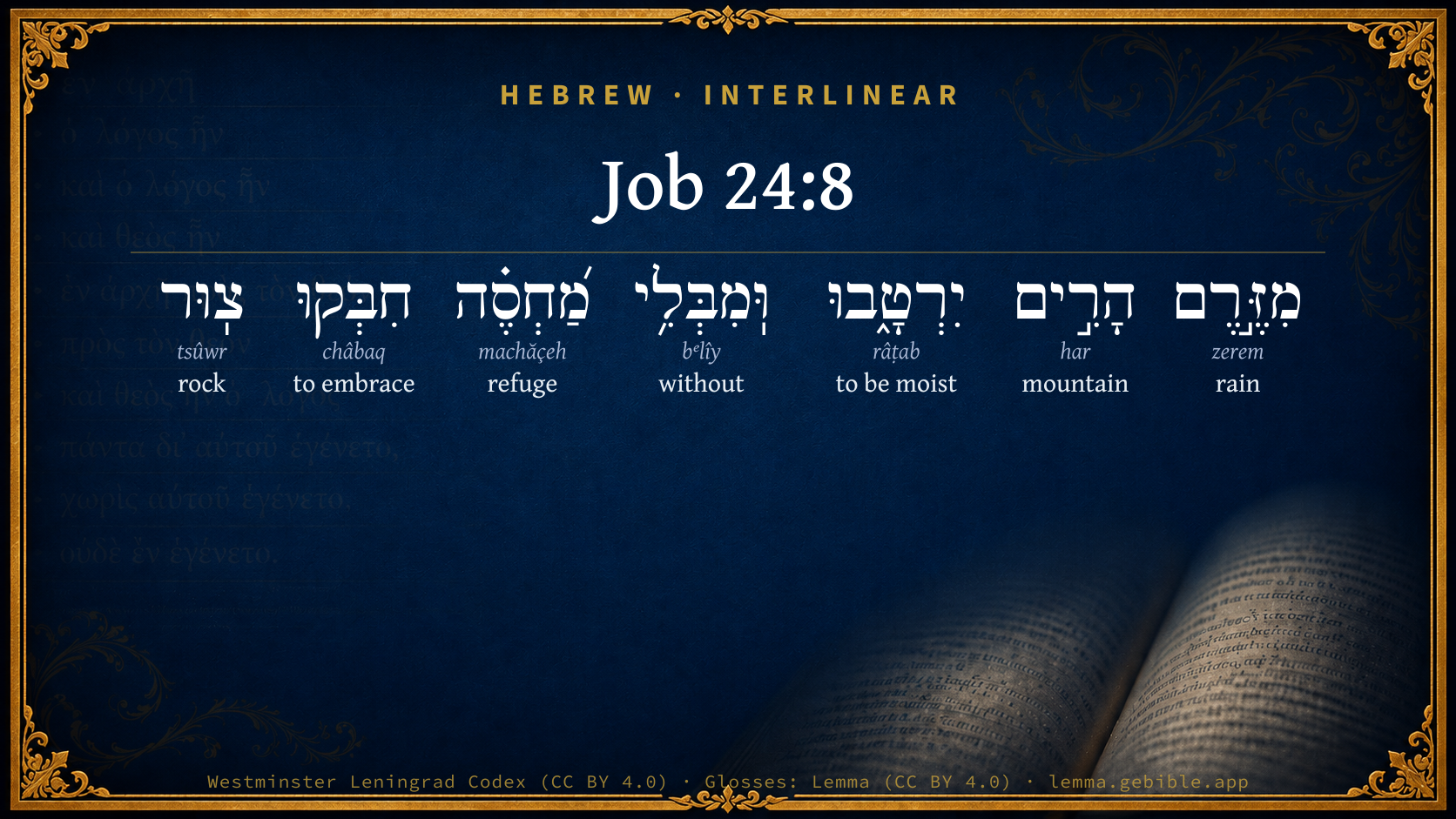
Job 24:8

Hebrew (Westminster Leningrad Codex) Job 24:8 appears in the Hebrew Old Testament. The text above is from the Westminster Leningrad Codex. Each word links to its Strong’s number, a concise gloss, and parsing drawn from the Open Scriptures Hebrew Bible morphology. Click any word for its full Brown-Driver-Briggs (BDB) entry.
Download image
Cite this verse

Job 24:8 (World English Bible). Public Domain. Lemma interlinear Bible study tool, https://lemma.gebible.app/v/job/24/8.

Show BibTeX & RIS
BibTeX
RIS
English Translation
They are wet with the showers of the mountains, And embrace the rock for lack of a shelter.
World English Bible · Public Domain
Highlights
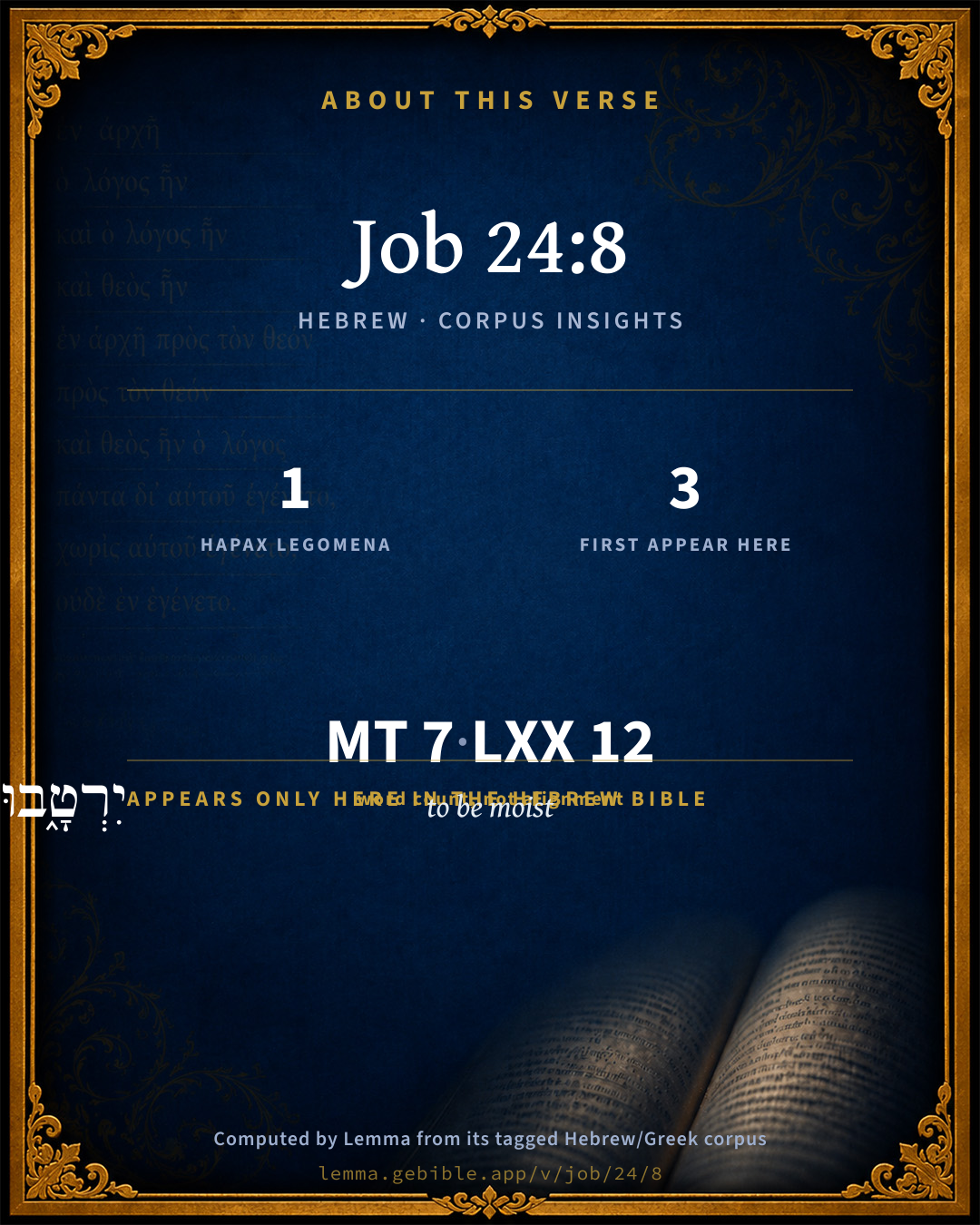
  • 1 hapax legomenon — only here in the Hebrew Bible
  • 3 first appearances in the Hebrew Bible
Full analysis ↓
Download a study sheet

One document with this verse’s original text, its word-by-word gloss line, the meaning frame, cross-references with their text, attributed commentary, and full source and license credits — printable, and it pastes into notes with its structure intact.

This verse Autodidact and up

Study sheet (.html) Plain text (.txt)

A passage Seminary Student

Up to 50 verses in one chapter. A passage sheet keeps up to 6 commentary sources and 12 cross-references per verse, in the order this page ranks them, and says so on the sheet whenever that leaves anything out. Ask for a single verse and you get the Autodidact verse sheet above.

Everything on this page stays free to read, with no account — the sheet is a download of what is already on screen, not access to it.

Want to remove ads? Support Godless Engineer
Compare translations 3

The same verse in 3 English versions, stacked beneath the original-language interlinear above. Click any original word for its lexicon entry.

Each is an independent rendering of the whole verse — the interlinear is not word-aligned to these translations.

Highlighted words mark where these versions differ — a whole-verse word diff, not a word-by-word alignment.

  • World English Bible Public Domain
    They are wet with the showers of the mountains, And embrace the rock for lack of a shelter.
  • King James Version Public Domain
    They are wet with the showers of the mountains, and embrace the rock for want of a shelter.
  • unfoldingWord Literal Text CC BY-SA 4.0
    They are wet with the showers of the mountains, and from without shelter, they hug the rock.

unfoldingWord Literal Text — © unfoldingWord, licensed CC BY-SA 4.0. Word-aligned USFM3 via Door43 (git.door43.org/unfoldingWord/en_ult).

Versions to compare (up to 4)

3 of 4 selected

Show all 18 translations

Every available English version of this verse, each an independent rendering of the whole verse.

  • World English Bible Public Domain
    They are wet with the showers of the mountains, And embrace the rock for lack of a shelter.
  • Berean Standard Bible Public Domain
    Drenched by mountain rains, they huddle against the rocks for want of shelter.
  • Majority Standard Bible Public Domain
    Drenched by mountain rains, they huddle against the rocks for want of shelter.
  • King James Version Public Domain
    They are wet with the showers of the mountains, and embrace the rock for want of a shelter.
  • American Standard Version (1901) Public Domain
    They are wet with the showers of the mountains, And embrace the rock for want of a shelter.
  • Revised Version (1885) Public Domain
    They are wet with the showers of the mountains, and embrace the rock for want of a shelter.
  • Geneva Bible (1599) Public Domain
    They are wet with the showres of the moutaines, and they imbrace the rocke for want of a couering.
  • Douay-Rheims (1899) Public Domain
    Who are wet, with the showers of the mountains, and having no covering embrace the stones.
  • Young's Literal Translation Public Domain
    From the inundation of hills they are wet, And without a refuge -- have embraced a rock.
  • Literal Standard Version CC BY-SA 4.0
    From the inundation of hills they are wet, || And without a refuge—have embraced a rock.
  • Unlocked Literal Bible CC BY-SA 4.0
    They are wet with the showers of the mountains; they lie next to large rocks because they have no shelter.
  • unfoldingWord Literal Text CC BY-SA 4.0
    They are wet with the showers of the mountains, and from without shelter, they hug the rock.
  • Darby Bible Public Domain
    They are wet with the showers of the mountains, and for want of a shelter embrace the rock...
  • World Messianic Bible Public Domain
    They are wet with the showers of the mountains, and embrace the rock for lack of a shelter.
  • Webster's Bible Public Domain
    They are wet with the showers of the mountains, and embrace the rock for want of a shelter.
  • Free Bible Version CC BY-SA 4.0
    They are soaked by the cold mountain storms, and huddle beside the rocks for shelter.
  • Bible in Basic English Public Domain
    They are wet with the rain of the mountains, and get into the cracks of the rock for cover.
  • JPS Tanakh (1917) Public Domain
    They are wet with the showers of the mountains, and embrace the rock for want of a shelter.

Literal Standard Version (2020), Covenant Press — licensed CC BY-SA 4.0. Text via the HelloAO Bible API (eBible.org). Unlocked Literal Bible (unfoldingWord) — licensed CC BY-SA 4.0. Text via the HelloAO Bible API (eBible.org). unfoldingWord Literal Text — © unfoldingWord, licensed CC BY-SA 4.0. Word-aligned USFM3 via Door43 (git.door43.org/unfoldingWord/en_ult). Free Bible Version, Dr. Jonathan Gallagher — licensed CC BY-SA 4.0. Text via the HelloAO Bible API (eBible.org).

Word by word

More ways to search: Search by grammar → Find every occurrence → Compare this word →

Practice this passage: Drill this verse → Learn its vocabulary →

About this verse

These counts appear in no published source. They are computed here, from the morphology-tagged text and Lemma’s own curated glosses. What Lemma adds →

7
words
7
distinct lemmas
Wisdom
section

Notable vocabulary

1 hapax legomenon — a word that appears only here in the entire Hebrew Bible:

  • יִרְטָ֑בוּ to be moist H7372

First appearance in Scripture

These words make their first canonical appearance in the Hebrew Bible here:

  • מִזֶּ֣רֶם rain H2230
  • יִרְטָ֑בוּ to be moist H7372
  • מַ֝חְסֶ֗ה refuge H4268

Shared distinctive vocabulary

מִזֶּ֣רֶם rain H2230 occurs in 7 verses of the Hebrew Bible. Also found in:

Grammatical profile

  • 2 verbs
  • 4 nouns
  • 1 particle

Verb forms

  • יִרְטָ֑בוּ Qal · Imperfect
  • חִבְּקוּ Piel · Perfect

Hebrew & Septuagint length

In English translation the verse runs 18 words from the Hebrew and 19 from the Septuagint (LXX English) — closely comparable.

A rough comparison of the two English renderings, which tokenize alike — not a word-level alignment.

Word counts can differ between the Hebrew and the Greek without any difference in meaning — e.g. the Hebrew direct-object marker אֵת has no separate Greek word, and Greek often adds the article ὁ.

In the original languages it is 7 Hebrew tokens and 12 Greek tokens — but the two are counted differently (Hebrew bundles its prefixes and suffixes into one token; the Greek is in lemma form), so that isn’t a like-for-like length.

Cross-references

3

Topical passages linked to Job 24:8 in the Treasury of Scripture Knowledge — connected by theme and wording, ordered by reader-vote popularity; previews shown in the World English Bible.

  • Lamentations 4:5 Those who did feed delicately are desolate in the streets: Those who were brought up in scarlet embrace dunghills.
  • Song of Solomon 5:2 I was asleep, but my heart was awake. It is the voice of my beloved who knocks: Open to me, my sister, my love, my dove, my undefiled; For my head is filled with dew, My hair with the dampness of the night.
  • Hebrews 11:38 (of whom the world was not worthy), wandering in deserts, mountains, caves, and the holes of the earth.

Cross-references courtesy of OpenBible.info (CC BY 4.0).

Hebrew and Greek witnesses Masoretic Hebrew ↔ Greek Septuagint

The same verse in the two great witnesses to the Old Testament, shown verse-for-verse.

These are two independent witnesses, not word-aligned to each other, and the Septuagint is shown in lemma (dictionary) form.

Hebrew Job 24:8 Masoretic · Westminster Leningrad Codex

מִזֶּ֣רֶם הָרִ֣ים יִרְטָ֑בוּ וּֽמִבְּלִ֥י מַ֝חְסֶ֗ה חִבְּקוּ צֽוּר

They are wet with the showers of the mountains, And embrace the rock for lack of a shelter.

World English Bible · Public Domain

Greek LXX Job 24:8 Septuagint · lemma form

ἀπό ψεκάς ὄρος ὑγραίνω παρά ὁ μή ἔχω αὐτός σκέπη πέτρα περιβάλλω

They are wet with the drops of the mountains: they have embraced the rock, because they had no shelter.

LXX2012 (modern English Septuagint) · Public Domain

Hebrew: Westminster Leningrad Codex (CC BY 4.0). Greek: Septuagint (public domain); English from LXX2012 (modern English Septuagint) (Public Domain). How the Septuagint differs from the Hebrew →

Commentary

Notes on Job 24:8 from classic Christian and Jewish commentators (each source and its license shown beneath its notes). The classic Christian expositions comment on the surrounding passage and are grouped to its opening verse, so a note may address several verses; the Jewish commentaries on the Tanakh (Rashi and others) are per-verse, so they appear only where the commentator wrote on this verse.

Lemma curates 59 commentaries, every one of them public domain or Creative Commons licensed, each selected and text-cleaned for this edition rather than reprinted as found. About our sources →

Trapp's Complete Commentary

John Trapp

Job 24:8 They are wet with the showers of the mountains, and embrace the rock for want of a shelter.

Ver. 8. They are wet with the showers of the mountains] Wet they are, but not at all refreshed, as this word (here only found in the Bible) signifieth sometimes among the Rabbis. Cold comfort they find abroad; and at home they dare not abide, lest rich men should oppress them and draw them before the judgment seats, Jas 2:6, or drag them to prison for refusing their drudgery. Hence they are forced to live in the mountains and desert places, in extreme misery.

And embrace the rock for want of a shelter] Like conies or wild beasts, glad of any lurking place that may keep them out of the hands of unreasonable and wicked men. What hardship have many worthy men in all ages suffered from persecutors and oppressors (in Dioclesian’s days especially), driven out of house and harbour, and glad to take up in any hole, there to lie on the cold stone instead of a warm bed (as that good duchess of Suffolk, with that noble gentleman her husband, did in the Low Countries, whither they fled from the Marian persecution), till, as Elijah once under the juniper, they wish themselves out of the world? Iterum hic disce gratias Deo agere, saith Lavater. Here again learn to give thanks to God for this great benefit, if thou mayest stay at home, and not be forced to flee for thy life, or for conscience’ sake; for home is home, as we say, and very desirable; and the apostle reckons it for a piece of his sufferings that he was ανεστιος, and had no settled station, no certain dwelling place, αστατουμεν, 1Co 4:11.

John Trapp, A Commentary or Exposition upon All the Books of the Old and New Testament (1647–1656) — public domain. Text from a community e-Sword module.

Joseph Benson's Commentary

Job 24:8. They are wet — That is, the poor, being stripped of their raiment, and forced away from their houses; with the showers of the mountains — With the rain-water, which, in great showers, runs down from the rocks or mountains into the caves or holes in the sides of them, to which they have fled for shelter. And embrace the rock — That is, are glad when they can find a cavern, or cleft of a rock, in which they may have some protection against the injuries of the weather, and a hiding-place from the fury of their oppressors.

Joseph Benson's Commentary on the Old and New Testaments (1811–1818) — public domain. Text from a community e-Sword module.

Geneva Bible (1599)

Geneva Bible translators

The poor are driven by the wicked into the rocks and holes where they cannot lie dry for the rain.

Geneva Bible (1599) marginal notes — public domain. Text via Bolls.life.

Jamieson, Fausset & Brown

Robert Jamieson, A. R. Fausset & David Brown

They--the plundered travellers.

embrace the rock--take refuge under it (Lam 4:5).

Jamieson, Fausset & Brown — Commentary Critical and Explanatory on the Whole Bible (1871) — public domain (CC PDM 1.0). Text via the HelloAO Bible API.

Adam Clarke's Commentary

Verse 8. They are wet with the showers of the mountains] Mr. Good thinks that torrents, not showers, is the proper translation of the original זרם zerem; but I think showers of the mountain strictly proper. I have seen many of these in mountainous countries, where the tails of water-spouts have been intercepted and broken, and the outpouring of them would be incredible to those who have never witnessed similar phenomena. The rain fell in torrents, and produced torrents on the land, carrying away earth and stones and every thing before them, scooping out great gullies in the sides of the mountains. Mountain torrents are not produced but by such extraordinary outpourings of rain, formed either by water-spouts, or by vast masses of clouds intercepted and broken to pieces by the mountain tops.

And embrace the rock for want of a shelter.] In such cases as that related above, the firm rock is the only shelter which can be found, or safely trusted.

Adam Clarke's Commentary on the Bible (1810–1826) — public domain. Text from a community e-Sword/MySword module.

The Cambridge Bible for Schools and Colleges

gen. ed. J. J. S. Perowne

8. The mountain rains, more violent than even those in the plain, drench these thinly-clad outcasts; and they “embrace the rock,” i. e. huddle in closely under its ledge.

The Cambridge Bible for Schools and Colleges (gen. ed. J. J. S. Perowne; Cambridge University Press, 1878–1918) — public domain. Text from a community e-Sword module.

John Gill's Exposition

They are wet with the showers of the mountains,.... They that are without any clothes to cover them, lying down at the bottom of a hill or mountain, where the clouds often gather, and there break, or the snow at the top of them melts through the heat of the day; and whether by the one or by the other, large streams of water run down the mountains, and the naked poor, or such who are thinly clothed, are all over wet therewith, as Nebuchadnezzar's body was with the dew of heaven, when he was driven from men, and lived among beasts, Dan 4:33,

and embrace the rock for want of a shelter; or habitation, as the Targum; having no house to dwell in, nor any raiment to cover them, they were glad to get into the hole of a rock, in a cave or den there, and where some good men in former times were obliged to wander, Heb 11:38; and whither mean persons, in the time and country in which Job lived, were driven to dwell in, see Job 30:6.

John Gill's Exposition of the Whole Bible (1746–1763) — public domain (CC PDM 1.0). Text via the HelloAO Bible API.

Albert Barnes' Notes on the Bible

They are wet with the showers of the mountains - That is, the poor persons, or the travelers whom they have robbed. Hills collect the clouds, and showers seem to pour down from the mountains. These showers often collect and pour down so suddenly that there is scarcely time to seek a shelter.

And embrace the rock for want of a shelter - Take refuge beneath a projecting rock. The robbers drive them away from their homes, or plunder them of their tents, and leave them to find a shelter from the storm, or at night, beneath a rock. This agrees exactly with what Niebuhr says of the wandering Arabs near mount Sinai: “Those who cannot afford a tent, spread out a cloth upon four or six stakes; and others spread their cloth near a tree, or endeavor to shelter themselves from the heat and the rain in the cavities of the rocks. Reisebeschreib. i. Thes s. 233.

Albert Barnes' Notes on the Bible (1834–1885) — public domain. Text from a community e-Sword/MySword module.

Haydock's Catholic Bible Commentary

Stones, for their bed, though they be so wet. (Haydock)

George Leo Haydock (1774–1849), Haydock's Catholic Family Bible and Commentary, 1859 edition — public domain. Excludes Psalms (Douay-Rheims chapter numbering differs from Protestant) and Deuterocanonical books (Catholic canon only).

Matthew Poole's English Annotations

They, i.e. the poor, being stripped of their raiment, and forced away from their houses.

With the showers of the mountains; with the rain water, which in great showers run down from the rocks or mountains into the caves or holes in the sides of them, to which they fled for shelter.

Embrace the rock, i.e. are glad when they can find a cavern or cleft of a rock in which they may have some protection against the injuries of the weather, and a hiding-place from the fury of their oppressors. Compare Lam 4:5.

Matthew Poole's English Annotations on the Holy Bible (1683–1685) — public domain. Text from a community e-Sword/MySword module.

Whedon's Commentary on the Bible

Daniel D. Whedon

8. Showers — Better, Storms.

Embrace the rock — In order to cover at least some part of the body. This closely agrees with what Niebuhr says of the modern wandering Arabs near Mount Sinai: “Those who cannot afford a tent spread out a cloth upon four or six stakes; and others spread their cloth near a tree, or endeavour to shelter themselves from the heat and the rain in the cavities of the rocks.”

Daniel D. Whedon (gen. ed.), Commentary on the Old and New Testaments (1874–1909) — public domain. Text from a community e-Sword module.

The Pulpit Commentary

They are wet with the showers of the mountains, and embrace the rock for want of a shelter. Further unpleasant consequences of marauding, hut endured without complaint by the wild robber-tribes.

A threefold religious emblem; of the shelter of the rock.

I AN EMBLEM OF THE SINNER"S MISERABLE CONDITION.

1. Exposed to a storm. Like the unhappy victims of tyrannical oppression, men, in their unconverted state, are liable to be overtaken by the tempest of God"s righteous wrath and indignation against sin, (Psa_11:6 Rom_1:18 Col_3:6 1Th_1:10 Rev_6:16, Rev_6:17) which will not assail the body merely, but destroy both soul and body in hell, (Luk_12:5) and that for ever.

2. Destitute of shelter. Like the houseless and homeless wanderers among the mountains, unpardoned souls are without a refuge to which they can betake themselves in the day of their calamity. Driven forth from the place of safety in which they originally stood, they have now "no covering in the cold," no garment of righteousness in which they can wrap their trembling spirits. Nor can they by any wisdom, wealth, or labour of their own construct or discover for themselves a habitation and defence against the storm.

II AN EMBLEM OF THE GREAT SALVATION OFFERED IN THE GOSPEL. As the shivering outcasts crept into the rocky caves on the mountain-side, so Christ has been set forth as a Rock and a Hiding-place. (Isa_32:2)

1. Accessible by all; the approach to him being hindered by no formidable barriers, and no stupendous effort being required to reach his side, (Rom_10:6) nothing beyond a simple exercise of faith which is within the ability of even a child.

2. Sufficient for all; there being room enough in Christ for all who come to him in faith, (Luk_14:22) yea, for the entire world of mankind, (Isa_45:22Jo Isa_3:16) if only they sincerely come to him; and perfect safety and protection for all who gain its shelter, complete defence against the charges of the Law, the accusations of conscience, the penalties of sin, the terrors of death, and of the wrath to come. (Rom_5:1)

3. Free to all; every one who seeks his presence and assistance being accorded a welcome, without money and without price. "All the fitness he requireth Is to feel our need of him.

III AN EMBLEM OF THE ACT OF SAVING FAITH. As the miserable victims of the strong man"s oppression embraced the rock for a shelter, so must needy sinners embrace Christ the Rock.

1. With personal application; Christ being of no more use to a sinner without individual appropriation than the mountain rock would have been to those who did not cling to it. Faith is the hand that lays hold of and embraces Christ as he is exhibited in the gospel.

2. With fervent gratitude; giving thanks to God for his abundant mercy in providing such a shelter for the soul, as no doubt the poor creatures whom the mountain-storms drenched were grateful for even the protection of a cave.

3. With immediate action; allowing no delay to prevent the soul from fleeing from the storm of impending wrath to the hope set before it in the gospel.

The Pulpit Commentary (1880–1919), ed. H.D.M. Spence-Jones & Joseph S. Exell — public domain. Text from a community e-Sword module.

John Wesley's Explanatory Notes

Wet - With the rain-water, which runs down the rocks or mountains into the caves, to which they fled for shelter. Rock - Are glad when they can find a cleft of a rock in which they may have some protection against the weather.

John Wesley, Explanatory Notes Upon the Whole Bible (1754–1765) — public domain. Text via the GEBible commentary corpus.

unfoldingWord translationNotes

Door43 World Missions Community

Connecting Statement:

Job continues speaking.

They are wet with the showers of the mountains

"They become wet when it rains in the mountains"

orphans from their mothers' breast

Here "breast" refers to the mother. This implies that these orphans are still very young. This can be made explicit. AT: "young orphans out of their mothers' arms" or "fatherless infants from their mothers" (See: Synecdoche and Assumed Knowledge and Implicit Information)

orphans

This generally refers to children without parents. Here, however, it is used for children who have mothers but do not have fathers.

take children as security from poor people

"take poor people's children to guarantee that the poor people will pay back money that they borrowed from the wicked people"

as security

A lender would take something from a borrower to ensure that the borrower pays him back. See how you translated this in Job 24:3.

go about

"walk around"

naked without clothing

The words "without clothing" mean the same thing as "naked." AT: "completely naked" or "naked because they have no clothing" (See: Doublet)

they carry bundles of grain belonging to other people

This means their work will provide food for others but not for themselves.

translationWords

refuge

grain

unfoldingWord translationNotes — © Distant Shores Media and the Door43 World Missions Community, licensed CC BY-SA 4.0. Source: git.door43.org/Door43/en_tn.

Rashi

Rabbi Shlomo Yitzchaki (Rashi)

From the stream that flows from the mountains, these naked people became wet and damp because they have no cover. They have no refuge under which to shelter themselves.

they embrace the rocks They hide in the crevices in the rocks, and even there the stream flows down and sprays on them, soaking them. רָטוֹב is the Aramaic for לַח wet, and whoever is not dried is called לַח.

moist (moite in Old French).

Rashi on the Tanakh — English translations: “The Judaica Press complete Tanach with Rashi, translated by A. J. Rosenberg” (CC BY 4.0); “Pentateuch with Rashi's commentary by M. Rosenbaum and A.M. Silbermann, 1929-1934” (public domain); “The Metsudah Tanach series, Lakewood, N.J” (CC BY 4.0); and “The Book of Joshua, Metsudah Publications, 1997” (CC BY 4.0). Text via Sefaria.

Lesson kit

Teaching starters — assembled from the data on this page, not authored interpretation. Every prompt links to the verse data it draws on. Edit before teaching.

Job, in the Wisdom, opens this verse with 7 words (7 distinct Hebrew lemmas). Its most distinctive word is râṭab (“to be moist”). A historical commentator’s framing appears above. Read the whole chapter for the surrounding context.

Discussion questions

  1. The word râṭab carries the sense “to be moist.” How does it shape the verse?
  2. 1 word here appears nowhere else in the Hebrew Bible. Why might the author reach for such rare wording?
  3. 3 words make their first appearance in Scripture here. What does this debut establish?
  4. How does Isaiah 4:6, which shares the word «rain», read alongside this verse?
  5. These translations render this verse differently. What is at stake in choosing one wording over another?
  6. «יִרְטָ֑בוּ» is a Qal Imperfect verb. How does that grammatical form shape the action described?
  7. Compare how Trapp's Complete Commentary and Joseph Benson's Commentary read this verse. Where do they agree or differ?

Things to notice

Reading settings

Reading text

Shown beneath each verse's original-language words.

Old Testament
Old Testament edition

Read the OT as the Masoretic Hebrew (MT) or the Greek Septuagint (LXX).

English shown for the Greek Septuagint (in the Hebrew ↔ Greek comparison).

Comparing translations? Open the Compare panel on any verse page to stack up to four side by side.