

Job 14:18

Hebrew (Westminster Leningrad Codex) Job 14:18 appears in the Hebrew Old Testament. The text above is from the Westminster Leningrad Codex. Each word links to its Strong’s number, a concise gloss, and parsing drawn from the Open Scriptures Hebrew Bible morphology. Click any word for its full Brown-Driver-Briggs (BDB) entry.
Download image
Cite this verse

Job 14:18 (World English Bible). Public Domain. Lemma interlinear Bible study tool, https://lemma.gebible.app/v/job/14/18.

Show BibTeX & RIS
BibTeX
RIS
English Translation
"But the mountain falling comes to nothing; The rock is removed out of its place;
World English Bible · Public Domain
Download a study sheet

One document with this verse’s original text, its word-by-word gloss line, the meaning frame, cross-references with their text, attributed commentary, and full source and license credits — printable, and it pastes into notes with its structure intact.

This verse Autodidact and up

Study sheet (.html) Plain text (.txt)

A passage Seminary Student

Up to 50 verses in one chapter. A passage sheet keeps up to 6 commentary sources and 12 cross-references per verse, in the order this page ranks them, and says so on the sheet whenever that leaves anything out. Ask for a single verse and you get the Autodidact verse sheet above.

Everything on this page stays free to read, with no account — the sheet is a download of what is already on screen, not access to it.

Want to remove ads? Support Godless Engineer
Compare translations 3

The same verse in 3 English versions, stacked beneath the original-language interlinear above. Click any original word for its lexicon entry.

Each is an independent rendering of the whole verse — the interlinear is not word-aligned to these translations.

Highlighted words mark where these versions differ — a whole-verse word diff, not a word-by-word alignment.

  • World English Bible Public Domain
    "But the mountain falling comes to nothing; The rock is removed out of its place;
  • King James Version Public Domain
    And surely the mountains falling cometh to nought, and the rock is removed out of his place.
  • unfoldingWord Literal Text CC BY-SA 4.0
    However, a falling mountain crumbles, and a rock moves from its place,

unfoldingWord Literal Text — © unfoldingWord, licensed CC BY-SA 4.0. Word-aligned USFM3 via Door43 (git.door43.org/unfoldingWord/en_ult).

Versions to compare (up to 4)

3 of 4 selected

Show all 18 translations

Every available English version of this verse, each an independent rendering of the whole verse.

  • World English Bible Public Domain
    "But the mountain falling comes to nothing; The rock is removed out of its place;
  • Berean Standard Bible Public Domain
    But as a mountain erodes and crumbles and a rock is dislodged from its place,
  • Majority Standard Bible Public Domain
    But as a mountain erodes and crumbles and a rock is dislodged from its place,
  • King James Version Public Domain
    And surely the mountains falling cometh to nought, and the rock is removed out of his place.
  • American Standard Version (1901) Public Domain
    But the mountain falling cometh to nought; And the rock is removed out of its place;
  • Revised Version (1885) Public Domain
    And surely the mountain falling cometh to nought, and the rock is removed out of its place;
  • Geneva Bible (1599) Public Domain
    And surely as the mountaine that falleth, commeth to nought, and the rocke that is remooued from his place:
  • Douay-Rheims (1899) Public Domain
    A mountain falling cometh to nought, and a rock is removed out of its place.
  • Young's Literal Translation Public Domain
    And yet, a falling mountain wasteth away, And a rock is removed from its place.
  • Literal Standard Version CC BY-SA 4.0
    And yet, a falling mountain wastes away, and a rock is removed from its place.
  • Unlocked Literal Bible CC BY-SA 4.0
    But even mountains fall and come to nothing; even rocks are moved out of their place;
  • unfoldingWord Literal Text CC BY-SA 4.0
    However, a falling mountain crumbles, and a rock moves from its place,
  • Darby Bible Public Domain
    And indeed a mountain falling cometh to nought, and the rock is removed out of its place;
  • World Messianic Bible Public Domain
    “But the mountain falling comes to nothing. The rock is removed out of its place.
  • Webster's Bible Public Domain
    And surely the mountain falling cometh to naught, and the rock is removed out of its place.
  • Free Bible Version CC BY-SA 4.0
    But just as the mountains crumble and fall, and the rocks tumble down;
  • Bible in Basic English Public Domain
    But truly a mountain falling comes to dust, and a rock is moved from its place;
  • JPS Tanakh (1917) Public Domain
    And surely the mountain falling crumbleth away, and the rock is removed out of its place;

Literal Standard Version (2020), Covenant Press — licensed CC BY-SA 4.0. Text via the HelloAO Bible API (eBible.org). Unlocked Literal Bible (unfoldingWord) — licensed CC BY-SA 4.0. Text via the HelloAO Bible API (eBible.org). unfoldingWord Literal Text — © unfoldingWord, licensed CC BY-SA 4.0. Word-aligned USFM3 via Door43 (git.door43.org/unfoldingWord/en_ult). Free Bible Version, Dr. Jonathan Gallagher — licensed CC BY-SA 4.0. Text via the HelloAO Bible API (eBible.org).

Word by word

More ways to search: Search by grammar → Find every occurrence → Compare this word →

Practice this passage: Drill this verse → Learn its vocabulary →

About this verse

These counts appear in no published source. They are computed here, from the morphology-tagged text and Lemma’s own curated glosses. What Lemma adds →

7
words
7
distinct lemmas
Wisdom
section

Notable vocabulary

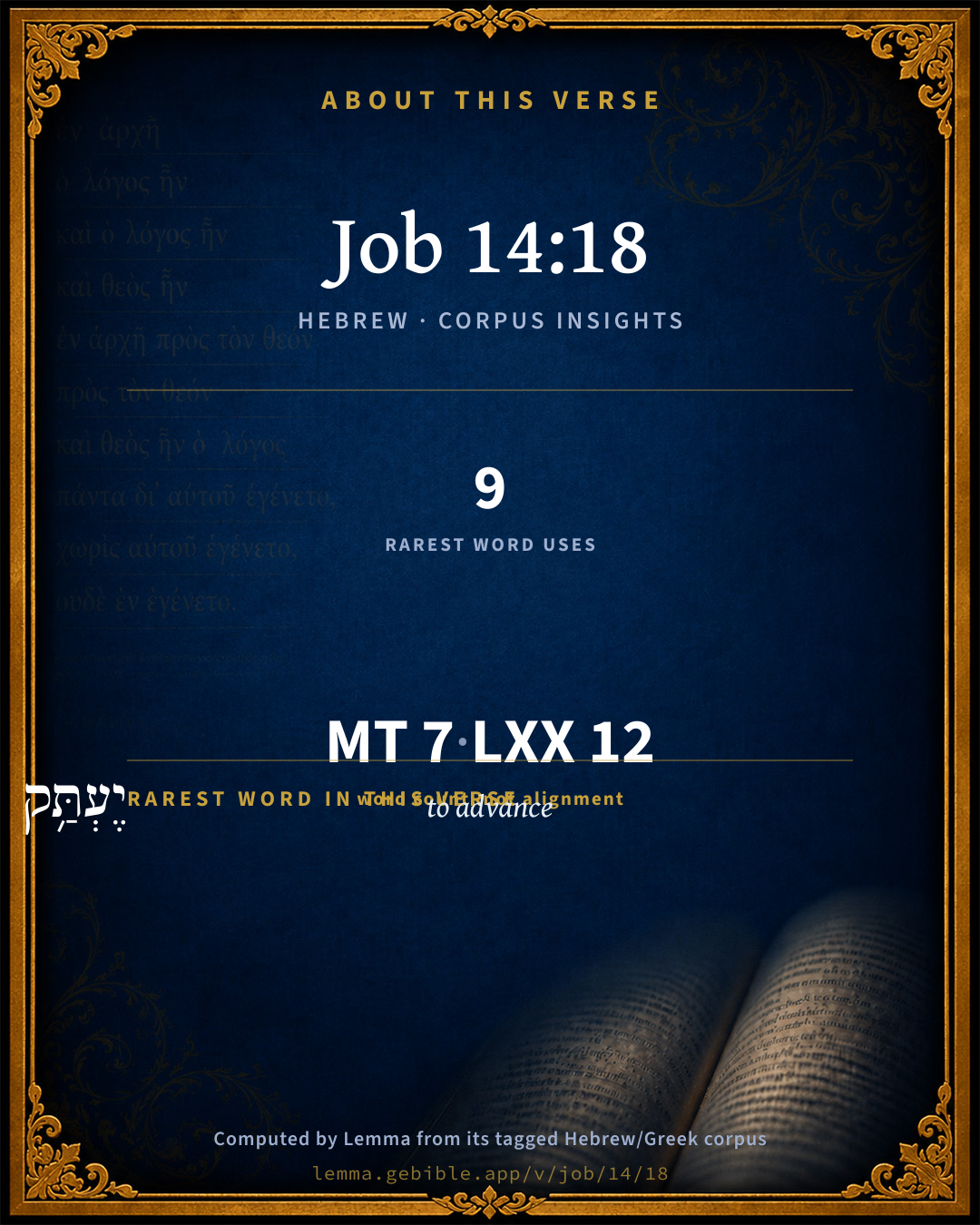
The rarest word here is יֶעְתַּ֥ק to advance H6275 — appearing just 9 times in the whole Hebrew Bible.

Shared distinctive vocabulary

יֶעְתַּ֥ק to advance H6275 occurs in 9 verses of the Hebrew Bible. Also found in:

Grammatical profile

  • 3 verbs
  • 3 nouns
  • 1 adverb

Verb forms

  • נוֹפֵ֣ל Qal · Participle Active
  • יִבּ֑וֹל Qal · Imperfect
  • יֶעְתַּ֥ק Qal · Imperfect

Hebrew & Septuagint length

In English translation the verse runs 15 words from the Hebrew and 19 from the Septuagint (LXX English) — closely comparable.

A rough comparison of the two English renderings, which tokenize alike — not a word-level alignment.

Word counts can differ between the Hebrew and the Greek without any difference in meaning — e.g. the Hebrew direct-object marker אֵת has no separate Greek word, and Greek often adds the article ὁ.

In the original languages it is 7 Hebrew tokens and 12 Greek tokens — but the two are counted differently (Hebrew bundles its prefixes and suffixes into one token; the Greek is in lemma form), so that isn’t a like-for-like length.

Cross-references

11

Topical passages linked to Job 14:18 in the Treasury of Scripture Knowledge — connected by theme and wording, ordered by reader-vote popularity; previews shown in the World English Bible.

  • Revelation 6:14 The sky was removed like a scroll when it is rolled up. Every mountain and island were moved out of their places.
  • Job 18:4 You who tear yourself in your anger, Shall the earth be forsaken for you? Or shall the rock be removed out of its place?
  • Jeremiah 4:24 I saw the mountains, and, behold, they trembled, and all the hills moved back and forth.
  • Psalms 102:25–26 Of old, you laid the foundation of the earth. The heavens are the work of your hands.
  • Isaiah 40:12 Who has measured the waters in the hollow of his hand, and meted out the sky with the span, and comprehended the dust of the earth in a measure, and weighed the mountains in scales, and the hills in a balance?
  • Isaiah 41:15–16 Behold, I have made you [to be] a new sharp threshing instrument having teeth; you shall thresh the mountains, and beat them small, and shall make the hills as chaff.
  • Isaiah 54:10 For the mountains may depart, and the hills be removed; but my loving kindness shall not depart from you, neither shall my covenant of peace be removed, says Yahweh who has mercy on you.
  • Isaiah 64:1 Oh that you would tear the heavens, that you would come down, that the mountains might quake at your presence,
  • Matthew 27:51 Behold, the veil of the temple was torn in two from the top to the bottom. The earth quaked and the rocks were split.
  • Revelation 8:8 The second angel sounded, and something like a great burning mountain was thrown into the sea. One third of the sea became blood,
  • Revelation 20:11 I saw a great white throne, and him who sat on it, from whose face the earth and the heaven fled away. There was found no place for them.

Cross-references courtesy of OpenBible.info (CC BY 4.0).

Hebrew and Greek witnesses Masoretic Hebrew ↔ Greek Septuagint

The same verse in the two great witnesses to the Old Testament, shown verse-for-verse.

These are two independent witnesses, not word-aligned to each other, and the Septuagint is shown in lemma (dictionary) form.

Hebrew Job 14:18 Masoretic · Westminster Leningrad Codex

וְ֭אוּלָם הַר נוֹפֵ֣ל יִבּ֑וֹל וְ֝צ֗וּר יֶעְתַּ֥ק מִמְּקֹמֽוֹ

"But the mountain falling comes to nothing; The rock is removed out of its place;

World English Bible · Public Domain

Greek LXX Job 14:18 Septuagint · lemma form

καί πλήν ὄρος πίπτω διαπίπτω καί πέτρα παλαιόω ἐκ ὁ τόπος αὐτός

And verily a mountain falling will utterly be destroyed, and a rock shall be worn out of its place.

LXX2012 (modern English Septuagint) · Public Domain

Hebrew: Westminster Leningrad Codex (CC BY 4.0). Greek: Septuagint (public domain); English from LXX2012 (modern English Septuagint) (Public Domain). How the Septuagint differs from the Hebrew →

Commentary

Notes on Job 14:18 from classic Christian and Jewish commentators (each source and its license shown beneath its notes). The classic Christian expositions comment on the surrounding passage and are grouped to its opening verse, so a note may address several verses; the Jewish commentaries on the Tanakh (Rashi and others) are per-verse, so they appear only where the commentator wrote on this verse.

Lemma curates 59 commentaries, every one of them public domain or Creative Commons licensed, each selected and text-cleaned for this edition rather than reprinted as found. About our sources →

Trapp's Complete Commentary

John Trapp

Job 14:18 And surely the mountain falling cometh to nought, and the rock is removed out of his place.

Ver. 18. And surely the mountain falling cometh to nought] q.d. If thou, Lord, proceed to deal thus rigidly with me, viz. to number or cipher up my steps, to watch over my sins, to seal them up in a bag, &c., and all this in fierce wrath, that thou mayest lay load upon me; what mountain, what rock, what other creature is ever able to abide it? Job had said before, "Is my strength the strength of stones?" Job 6:12; "Am I a sea, or a whale?" Job 7:12 : were I these, or any the like robust creatures, yet could not I expect to stand before the displeased Omnipotency, who taketh the hills like tennis balls, and cracketh the rocks like a nut shell. See Hab 1:4-6. {See Trapp on "Hab 1:4"} {See Trapp on "Hab 1:5"} {See Trapp on "Hab 1:6"}

And the rock is removed out of his place] As in earthquakes it sometimes happens. See Job 19:5. Or by reason of the sea underlaking, it decayeth in time, and waxeth old, as the Hebrew word signifieth.

John Trapp, A Commentary or Exposition upon All the Books of the Old and New Testament (1647–1656) — public domain. Text from a community e-Sword module.

The Biblical Illustrator

Joseph S. Exell

Job_14:18-19

And surely the mountain falling cometh to nought.

The law of nature and of life

If the patriarch of Uz could listen to all the criticism of his commentators, his patience would be more severely tried than by his contemporaries.

1. Job intentionally uttered a solemn truth. He speaks of the changes to which human life is subjected--great and sudden revolutions and changes--and the changes that result from the slow and silent operation of trivial causes.

(1) Many things in life are fixed and stable as the mountains, but are nevertheless suddenly removed. The only abiding and permanent objects are spiritual.

(2) Many things in life receive their impress and derive their character from the operation of trivial causes. There is a power in the slow, uniform operation of little things. The present is the result of the past.

(3) Many things in life that are most precious, and singularly frail, are nevertheless swept away by some flood. Changes are constantly taking place before our eyes.

2. Job unconsciously stated a great fact. There are laws by which all changes and convulsions in nature are regulated. There is in nature a provision against the waste which appears to follow change. The things which grow out of the dust owe their beauty or fruitfulness to the soil, which is constantly being renewed. There is no soil so miraculously prolific as sorrow,--the seed sown there will bring forth the peaceable fruits of righteousness. Life seems to have its birth in death. There is one great change produced directly by Divine agency. It is indispensable that we should experience this.

3. Our days have a definite end. If life is so brief, make the most of it, use all its opportunities, seek to be prepared for death. (H. J. Bevis.)

The Biblical Illustrator, edited by Joseph S. Exell (c. 1880s–1900s) — public domain. Text from a community e-Sword module.

Joseph Benson's Commentary

Job 14:18-19. As the mountain falling cometh to naught, &c. — As when a great mountain falls, by an earthquake or inundation, it moulders away like a fading leaf, (as the Hebrew ward signifies,) and as the rock, when, by the violence of winds or earthquakes, it is removed out of its place, and thrown down, is never re-advanced; and as the waters, by continual droppings, wear away the stones, so that they can never be made whole again; and as thou wastest away, by a great and violent inundation, the things which grow out of the dust of the earth, herbs, and fruits, and plants, which once washed away are irrecoverably lost; in like manner thou destroyest the hope of man: when man dies, all hope of his living again in this world is lost. Thus, as before he declared the hopelessness of man’s restoration from death to this animal life, by way of opposition to such things as did, in a manner, rise from death to life, Job 14:7-10; so now he declares the same thing, by way of similitude to such things as, being once lost and gone, are past all hopes of recovery.

Joseph Benson's Commentary on the Old and New Testaments (1811–1818) — public domain. Text from a community e-Sword module.

Geneva Bible (1599)

Geneva Bible translators

He murmureth through the impatience of the flesh against God, as though he used as great severity against him as against the hard rocks, or waters that overflow, so that hereby all the occasion of his hope is taken away.

Geneva Bible (1599) marginal notes — public domain. Text via Bolls.life.

Jamieson, Fausset & Brown

Robert Jamieson, A. R. Fausset & David Brown

cometh to naught--literally, "fadeth"; a poetical image from a leaf (Isa 34:4). Here Job falls back into his gloomy bodings as to the grave. Instead of "and surely," translate "yet"; marking the transition from his brighter hopes. Even the solid mountain falls and crumbles away; man therefore cannot "hope" to escape decay or to live again in the present world (Job 14:19).

out of his place--so man (Psa 103:16).

Jamieson, Fausset & Brown — Commentary Critical and Explanatory on the Whole Bible (1871) — public domain (CC PDM 1.0). Text via the HelloAO Bible API.

Adam Clarke's Commentary

Verse 18. The mountain falling cometh to naught] Every thing in nature is exposed to mutability and decay:-even mountains themselves may fall from their bases, and be dashed to pieces; or be suddenly swallowed up by an earthquake; and, by the same means, the strongest and most massive rocks may be removed.

Adam Clarke's Commentary on the Bible (1810–1826) — public domain. Text from a community e-Sword/MySword module.

The Cambridge Bible for Schools and Colleges

gen. ed. J. J. S. Perowne

18. And surely] Rather, but; cf. ch. Job_13:3-4.

The “mountain falling” is the mountain from which great forces detach pieces—as man is subjected to the shattering strokes of God. The second clause shews this to be the meaning.

18–22. Under this severe treatment man must perish. For even the greatest and the firmest things in nature, and those most capable of resistance, are worn down by the influence of constant forces, and how much more man’s life under God’s continued severity.

The Cambridge Bible for Schools and Colleges (gen. ed. J. J. S. Perowne; Cambridge University Press, 1878–1918) — public domain. Text from a community e-Sword module.

John Gill's Exposition

And surely the mountain falling cometh to nought,.... Job here returns to his former subject of the irreparable state of man at death, which he illustrates by various other similes, as before; and first by a "mountain falling", which may be supposed, and has been fact, and when it does, it "comes to nought"; it crumbles into dust, and where it falls there it lies, and never rises up to a mountain, or to the height it had, any more; or it "withers" (n), as some render it, the plants, herbs, and trees that grow upon it, wither away, see Nah 1:4; or "it is dissolved", or "flows" (o), and spreads itself over the face of the green earth it covers, and destroys with its dust and sand, which is never more gathered up to form a mountain again; so man, like unto a mountain, as kingdoms and states, and kings and princes, and great men are; the Targum instances in Lot; as a man may be said to be, that is in good health of body, and in prosperous circumstances in his family; when he falls, as he does by death, which is expressed by falling, Sa2 3:38; he comes to nought, he is not any more in the land of the living, nor in the place and circumstances in which he was before:

and the rock is removed out of his place; from the mountain, of which it was a part; or elsewhere, by earthquakes, by force of winds, or strength of waters; and which, when once removed, is never returned to its place any more; so man, who in his full strength seems like a rock immovable, when death comes, it shakes and moves him out of his place, and that never knows him any more.

(n) "marceseit", Tigurine version, Mercerus; "emarcescit", Schultens. (o) "Diffluit", Cocceius, Schmidt, Michaelis.

John Gill's Exposition of the Whole Bible (1746–1763) — public domain (CC PDM 1.0). Text via the HelloAO Bible API.

Albert Barnes' Notes on the Bible

And surely the mountain falling - Margin, “Fadeth.” The sense of this is, that the hope of man in regard to living again, must certainly fail - as a mountain falls and does not rise again; as the rock is removed, and is not replaced; or as the waters wear away the stones, and they disappear. The hope of dying man was not like the tree that would spring up again Job 14:7-9; it was like the falling mountain, the wasting waters Job 14:11, the rock that was removed. The reference in the phrase before us is, probably, to a mountain that settles down and disappears - as is sometimes the case in violent convulsions of nature. It does not rise again, but is gone to reappear no more. So Job says it was of man.

And the rock is removed - An earthquake shakes it, and removes it from its foundation, and it is not replaced.

Albert Barnes' Notes on the Bible (1834–1885) — public domain. Text from a community e-Sword/MySword module.

Matthew Poole's English Annotations

As when a great mountain falls, either by an earthquake or inundation of waters, or from any other cause, it moulders away like a fading leaf, (as the Hebrew word signifies,) and never recovers its former height and stability; and as the rock, when by the violence of winds or earthquake, &c.

it is removed out of its place, and thrown down, is never readvanced; and as the waters by continual droppings, or violent and frequent assaults, wear away, or break the stones to pieces, so as they can never be made whole again; and as thou washest away, to wit, by a great and violent inundation which thou sendest, the things which grow out of the dust of the earth, to wit, herbs, and fruits, and plants, which once washed away are irrecoverably lost, and, or so, (as this particle is oft used, i.e. in like manner, to wit, irrecoverably,) thou destroyest the hope of man; i.e. so when man dies, all hope of living again in this world is utterly lost: and this seems to be the plain meaning of these two verses. And as before he declared the hopelessness of man’s restoration from death to this animal life, by way of opposition to such things as did rise in a manner from death to life, Job 14:7, &c.; so now he declares it by way of similitude or resemblance to such things, as being once lost and gone are past all hopes of recovery.

Matthew Poole's English Annotations on the Holy Bible (1683–1685) — public domain. Text from a community e-Sword/MySword module.

Whedon's Commentary on the Bible

Daniel D. Whedon

18. And surely — But. He now proceeds to sum up.

Cometh to nought — Decayeth. Literally, withereth like a leaf. A bold metaphor. Zophar had promised Job, if he would repent, enduring prosperity, (Job_11:15-20.) In a world, Job tacitly replies, where there is nothing substantial — where things most stable are overwhelmed with destruction — there is nothing for man to hope. Nature is at war with itself, and God with man. Instability characterizes every conceivable work of God’s creative power. AElian says, that it was the general opinion in his time that mounts Parnassus, Olympus, and Etna had much diminished in size.

Daniel D. Whedon (gen. ed.), Commentary on the Old and New Testaments (1874–1909) — public domain. Text from a community e-Sword module.

The Pulpit Commentary

And surely the mountain falling cometh to nought. Job here resumes the lament "over human infirmity, with which the chapter opens (vers. 1-12); but he has, perhaps, in this passage, his own case mote distinctly presented to his consciousness. With the wealth of metaphor which characterizes his utterances, he compares the ruin of a prosperous man

(1) to the sudden collapse of a mountain;

(2) to the removal of a rock out of its place;

(3) to the wearing away of stones by the constant flow of streams; and

(4) to the destruction of alluvial tracts by floods.

Mountains collapse, either by volcanic agency, which is quite as much shown in the subsidence as in the elevation of the soil, or by landslips, which are most usually the results of heavy rains. And the rock is removed out of his place. Rocks are sometimes split by frost, and topple over when a thaw comes; at other times, heavy floods remove them from their accustomed place; occasionally earthquakes overturn them, and cause them to fall with a crash. There is also a removal of rocks to much greeter distances, by means of glaciers and icebergs; but of these Job is not likely to have known.

The Pulpit Commentary (1880–1919), ed. H.D.M. Spence-Jones & Joseph S. Exell — public domain. Text from a community e-Sword module.

John Wesley's Explanatory Notes

And - As when a great mountain falls, by an earthquake or inundation, it moulders away like a fading leaf, (as the Hebrew word signifies) and as the rock, when by the violence of winds or earthquakes it is removed out of its place, and thrown down, is never re-advanced: and as the waters by continual droppings, wear away the stones, so that they can never be made whole again: and as thou wastest away, by a great and violent inundation, the things which grow out of the dust of the earth, herbs, and fruits, and plants, which once washed away are irrecoverably lost; in like manner, thou destroyest the hope of man: when man dies, all hope of his living again in this world is lost.

John Wesley, Explanatory Notes Upon the Whole Bible (1754–1765) — public domain. Text via the GEBible commentary corpus.

unfoldingWord translationNotes

Door43 World Missions Community

General Information:

Job continues speaking to God.

mountains fall and come to nothing

"Come to nothing" here is an idiom meaning be completely destroyed. This phrase expands on the word "fall" and emphasizes complete destruction. AT: "mountains completely fall apart" (See: Doublet)

rocks are moved out of their place

This can be expressed in active form. AT: "rocks tumble down from their place" (See: Active or Passive)

Like this, you destroy the hope of man

If it is easier in your language, you can put this phrase at the beginning of verse 18 and adjust the text accordingly. AT: "You destroy the hope of man, just like ... dust of the earth" (See: Simile)

you destroy the hope of man

Destroying hope represents causing the things people hope for not to happen. AT: "You prevent the hope of man from happening" (See: Metaphor)

the hope of man

The abstract noun "hopes" can be expressed with the verb "hope." AT: "the things that man hopes for" (See: Abstract Nouns)

translationWords

earth

hope

unfoldingWord translationNotes — © Distant Shores Media and the Door43 World Missions Community, licensed CC BY-SA 4.0. Source: git.door43.org/Door43/en_tn.

Rashi

Rabbi Shlomo Yitzchaki (Rashi)

And surely the falling mountain gives forth produce The height of a falling mountain will give forth produce. It will produce dust, and there will be hope of deriving benefit from it. and the rock that moves from its place will also give forth produce. This is an expression of grain.

Rashi on the Tanakh — English translations: “The Judaica Press complete Tanach with Rashi, translated by A. J. Rosenberg” (CC BY 4.0); “Pentateuch with Rashi's commentary by M. Rosenbaum and A.M. Silbermann, 1929-1934” (public domain); “The Metsudah Tanach series, Lakewood, N.J” (CC BY 4.0); and “The Book of Joshua, Metsudah Publications, 1997” (CC BY 4.0). Text via Sefaria.

Lesson kit

Teaching starters — assembled from the data on this page, not authored interpretation. Every prompt links to the verse data it draws on. Edit before teaching.

Job, in the Wisdom, opens this verse with 7 words (7 distinct Hebrew lemmas). Its most distinctive word is ʻâthaq (“to advance”). A historical commentator’s framing appears above. Read the whole chapter for the surrounding context.

Discussion questions

  1. What does “to advance” (ʻâthaq) contribute to the verse as a whole?
  2. How does Genesis 12:8, which shares the word «to advance», read alongside this verse?
  3. These translations render this verse differently; the difference is in the English rendering, not the original. What questions does that raise?
  4. «נוֹפֵ֣ל» is a Qal Participle Active verb. How does that grammatical form shape the action described?
  5. Compare how Trapp's Complete Commentary and The Biblical Illustrator read this verse. Where do they agree or differ?

Things to notice

Reading settings

Reading text

Shown beneath each verse's original-language words.

Old Testament
Old Testament edition

Read the OT as the Masoretic Hebrew (MT) or the Greek Septuagint (LXX).

English shown for the Greek Septuagint (in the Hebrew ↔ Greek comparison).

Comparing translations? Open the Compare panel on any verse page to stack up to four side by side.