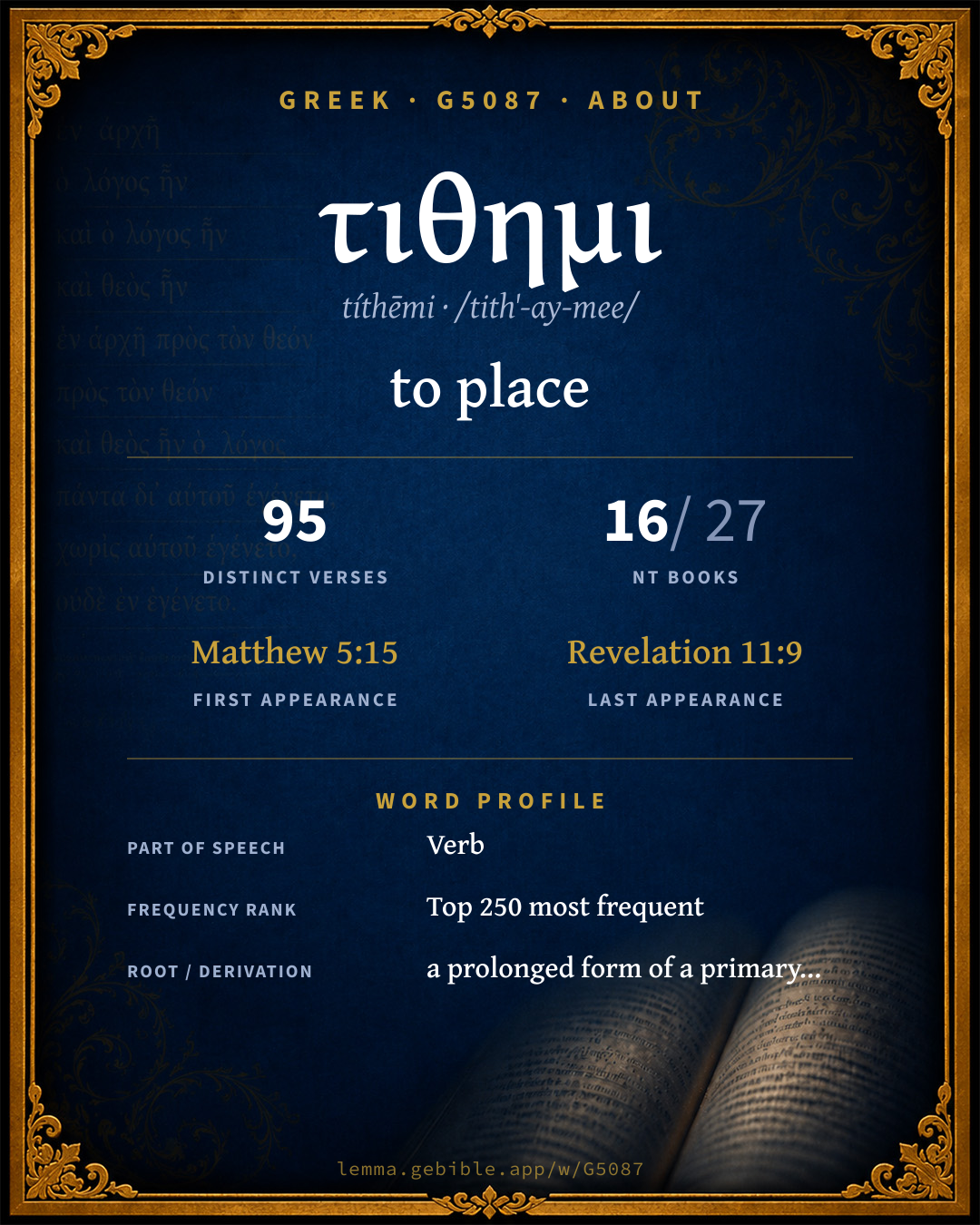
τίθημι
to place
‘to place’ is one of 7 main senses fuller range ↓
Full lexicon entry — Thayer's Greek Lexicon
From Thayer's Greek Lexicon
Where this word appears
Grammar key — what these labels mean
Part of speech
- Verb
- An action or state-of-being word.
Tense
- Aorist
- Action viewed as a simple whole, without regard to duration — often past (perfective aspect).
- Present
- Ongoing or general action in present time (imperfective aspect).
- Imperfect
- Continuous or repeated action in past time (“was writing”).
- Future
- Action expected in future time.
- Perfect
- A completed past action with continuing present results.
Voice
- Active
- The subject performs the action.
- Middle
- The subject acts on or for itself, or with special interest in the action.
- Passive
- The subject receives the action.
Mood
- Indicative
- States a fact or asks a factual question (the mood of reality).
- Subjunctive
- Expresses probability, purpose, or possibility (the mood of contingency).
- Infinitive
- A verbal noun (“to write”), unmarked for person or number.
- Participle
- A verbal adjective (“writing,” “having written”).
- Imperative
- Expresses a command or request.
Case
- Nominative
- The case of the subject (and the predicate nominative).
- Genitive
- The case of source, possession, or “of” — answers “whose / from what.”
Person
- 3rd person
- The one spoken about (“he / she / it / they”).
- 1st person
- The speaker (“I / we”).
- 2nd person
- The one addressed (“you”).
Gender
- Masculine
- Grammatically masculine.
Number
- Singular
- One.
- Plural
- More than one.
Every verse where G5087 appears in the Book of 2 Peter — 1 distinct verse. Click any verse to open its interlinear word-by-word view. Verse text shown in the World English Bible for context — . Each verse’s Greek form is shown with its reference; the English is not keyword-highlighted, since the data carries no word-level English alignment. Use “Compare translations” on any verse to read it across multiple English versions. This concordance covers the Greek New Testament; Septuagint (Greek Old Testament) occurrences of this word are not indexed here.
2 Peter
About this entry
At a glance — auto-summarized from this page’s data, not written by a person. Every figure links to its source below. This summary describes the numbers; it doesn’t interpret them.
τιθημι — transliterated títhēmi — is a Greek verb carrying the sense “to place.” Translators differ — “laid” in the King James Version, then “placed” (Berean Standard Bible), as the renderings breakdown shows. The Greek New Testament uses it across 95 verses — moderately common. First canonically at Matthew 5:15, it enters the text early. Catalogued under 7 senses, its meaning is not single-sense. Dig into 95-verse concordance and the renderings breakdown below.
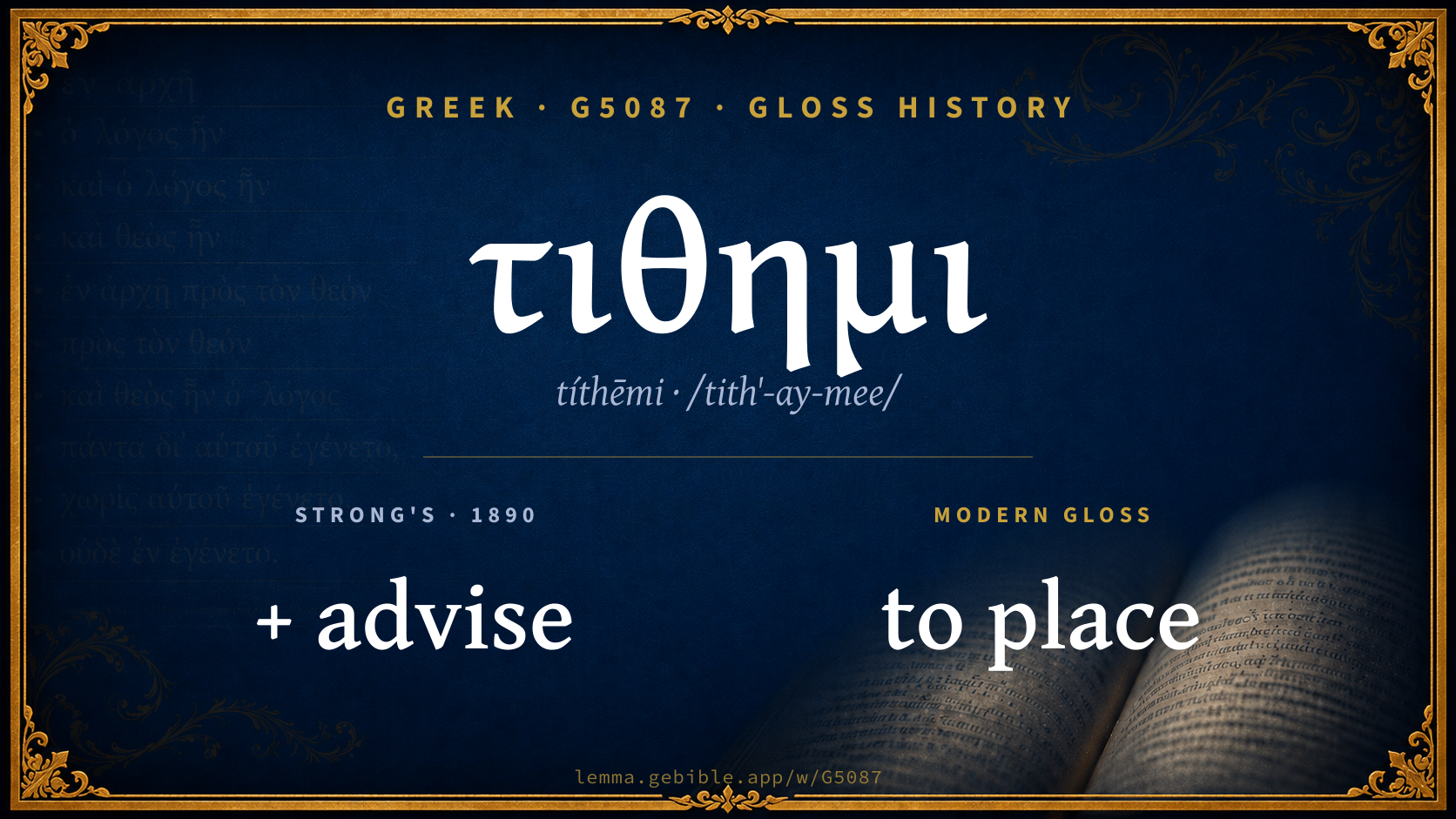
Gloss history
Strong's 1890 vs modern scholarship
About this word
Strong's G5087 catalogs a Greek word from the Greek New Testament.
These counts are not copied from any lexicon or concordance. They are computed here, from the morphology-tagged Greek New Testament. What Lemma adds →
- 95
- distinct verses
- The word appears in 95 distinct verses.
- 16 / 27
- NT books
- The word appears in 16 of 27 New Testament books.
- #171
- by frequency
- Top 250 most frequent Greek words (rank 171 of 5,347 Greek words by occurrence).
View all 95 occurrences in the concordance →
By section of the New Testament
By traditional corpus
Conventional, traditional groupings — biblical authorship is debated, so this is a traditional corpus grouping, not an authorship claim. Some books belong to more than one corpus (Luke is in both the Gospels and the Lukan corpus, and so on), so these shares overlap and need not total 100%. Each figure is a share of the word’s 95 distinct verses.
- Gospels 46 verses · 48%
- Lukan (Luke–Acts) 38 verses · 40%
- Johannine 21 verses · 22%
- Pauline corpus 16 verses · 17%
- General (Catholic) Epistles 4 verses · 4%
- Hebrews 3 verses · 3%
- Revelation 3 verses · 3%
How translations render this word
Counts come from each version’s own published word-to-Strong’s tagging or interlinear alignment — an approximate guide to how each version renders this word, not a word-level alignment the data otherwise carries. Because each total is that version’s own tagged count, the per-version totals vary from one another and need not match the appearance or distinct-verse counts above. These counts may also differ from a printed concordance because Lemma counts each distinctly tagged rendering and does not collapse phrase taggings into a single head-word total. This is a fixed set of word-tagged versions (KJV, ASV, BSB, ULT) and does not change with the reading translation you choose elsewhere. Each version’s license is shown beside its name below (and on Sources).
- King James Version: Laid 10×, Put 8×, Down 5×
- American Standard Version: Laid 12×, Put 8×, Lay 5×
- Berean Standard Bible: Placed 7×, Laid 6×, Put 5×
- unfoldingWord Literal Text: Put 8×, Having put down 4×, Appoint 3×
King James Version Public Domain
Renders G5087 across 101 tagged occurrences — most commonly:
Plus other, less common renderings. Plus 50 renderings that appear only once — usually multi-word phrases or single function words the recovered tagging swept in, not distinct renderings. Not rendered by a distinct English word in 3 further occurrences.
American Standard Version Public Domain
Renders G5087 across 101 tagged occurrences — most commonly:
Plus other, less common renderings. Plus 47 renderings that appear only once — usually multi-word phrases or single function words the recovered tagging swept in, not distinct renderings.
Berean Standard Bible Public Domain
Renders G5087 across 98 tagged occurrences — most commonly:
Plus other, less common renderings. Plus 51 renderings that appear only once — usually multi-word phrases or single function words the recovered tagging swept in, not distinct renderings. Not rendered by a distinct English word in 1 further occurrence.
unfoldingWord Literal Text CC BY-SA 4.0
Renders G5087 across 115 tagged occurrences — most commonly:
Plus other, less common renderings. Plus 66 renderings that appear only once — usually multi-word phrases or single function words the recovered tagging swept in, not distinct renderings.
7 senses in Thayer's, in lexicon order
The 7 senses Thayer's distinguishes for this word, in lexicon order (not ranked by frequency or importance). The full entry — with sub-senses — is in the Lexicon Entry tab.
- to place or lay
- to put down, lay down
- to set on (serve) something to eat or drink
- to set forth, something to be explained by discourse
- to make (or set) for one's self or for one's use
- to set forth
- to establish, ordain
Word origin
Origin: a prolonged form of a primary theo theh'-o (which is used only as alternate in certain tenses)
A prolonged form of a primary word θέω theō (which is used only as an alternate in certain tenses); to place (in the widest application literally and figuratively; properly in a passive or horizontal posture and thus different from G2476 which properly denotes an upright and active position while G2749 is properly reflexive and utterly prostrate): - + advise appoint bow commit conceive give X kneel down lay (aside down up) make ordain purpose put set (forth) settle sink down.
— Strong’s Exhaustive Concordance (1890), public domain.
Forms in the corpus
The 41 distinct written forms G5087 takes in the Greek New Testament, most frequent first — each parse links to that tense’s occurrences in the concordance.
Same root — word family
Other Thayer's entries built from the same root as G5087, grouped by Strong’s listed origin. These share a root / origin per the lexicon — not necessarily a shared meaning. Each links to that word’s own entry.
Derived from this word
Compare all same-root words → They share a root, not necessarily a meaning.
Septuagint usage
The same Greek word τιθημι appears 467 times in the Greek Old Testament (Septuagint), across 447 verses in 37 books.
- 467
- LXX occurrences
- Tagged occurrences of this Greek word in the Septuagint.
- 447
- verses
- Distinct Septuagint verses containing this word.
- 37 / 39
- OT books
- The word appears in 37 of the 39 Old Testament books.
Sample Septuagint occurrences
- Genesis 1:17 τίθημι
- Exodus 2:3 τίθημι
- Leviticus 26:1 τίθημι
- Numbers 17:19 τίθημι
- Deuteronomy 14:28 τίθημι
- Joshua 2:18 τίθημι
- Judges 4:21 τίθημι
- Ruth 4:16 τίθημι
- 1 Samuel 6:8 τίθημι
- 2 Samuel 7:10 τίθημι
- 1 Kings 2:15 τίθημι
- 2 Kings 2:20 τίθημι
Septuagint occurrences (same lexeme)
Every verse where the same Strong’s number (G5087) appears in the Greek Septuagint — showing the first 50 of 447. Verse text shown in the World English Bible for context; the Greek form is the matched word — the English is not keyword-highlighted.
- Genesis 1:17 τίθημι God set them in the expanse of sky to give light to the earth,
- Genesis 2:8 τίθημι Yahweh God planted a garden eastward, in Eden, and there he put the man whom he had formed.
- Genesis 2:15 τίθημι Yahweh God took the man, and put him into the garden of Eden to dress it and to keep it.
- Genesis 3:15 τίθημι I will put enmity between you and the woman, and between your offspring and her offspring. He will bruise your head, and you will bruise his heel."
- Genesis 4:15 τίθημι Yahweh said to him, "Therefore whoever slays Cain, vengeance will be taken on him sevenfold." Yahweh appointed a sign for Cain, lest any finding him should strike him.
- Genesis 9:13 τίθημι I set my rainbow in the cloud, and it will be for a sign of a covenant between me and the earth.
- Genesis 15:10 τίθημι He took him all these, and divided them in the middle, and laid each half opposite the other; but he didn't divide the birds.
- Genesis 17:2 τίθημι I will make my covenant between me and you, and will multiply you exceedingly."
- Genesis 17:5 τίθημι Neither will your name any more be called Abram, but your name will be Abraham; for the father of a multitude of nations have I made you.
- Genesis 17:6 τίθημι I will make you exceeding fruitful, and I will make nations of you. Kings will come out of you.
- Genesis 24:2 τίθημι Abraham said to his servant, the elder of his house, who ruled over all that he had, "Please put your hand under my thigh.
- Genesis 24:9 τίθημι The servant put his hand under the thigh of Abraham his master, and swore to him concerning this matter.
- Genesis 28:11 τίθημι He came to a certain place, and stayed there all night, because the sun had set. He took one of the stones of the place, and put it under his head, and lay down in that place to sleep.
- Genesis 30:41 τίθημι It happened, whenever the stronger of the flock conceived, that Jacob laid the rods before the eyes of the flock in the gutters, that they might conceive among the rods;
- Genesis 30:42 τίθημι but when the flock were feeble, he didn't put them in. So the feebler were Laban's, and the stronger Jacob's.
- Genesis 31:37 τίθημι Now that you have felt around in all my stuff, what have you found of all your household stuff? Set it here before my relatives and your relatives, that they may judge between us two.
- Genesis 32:13 τίθημι He lodged there that night, and took from that which he had with him, a present for Esau, his brother:
- Genesis 40:3 τίθημι He put them in custody in the house of the captain of the guard, into the prison, the place where Joseph was bound.
- Genesis 41:10 τίθημι Pharaoh was angry with his servants, and put me in custody in the house of the captain of the guard, me and the chief baker.
- Genesis 41:48 τίθημι He gathered up all the food of the seven years which were in the land of Egypt, and laid up the food in the cities: the food of the field, which was round about every city, he laid up in the same.
- Genesis 42:17 τίθημι He put them all together into custody three days.
- Genesis 42:30 τίθημι "The man, the lord of the land, spoke roughly with us, and took us for spies of the country.
- Genesis 47:26 τίθημι Joseph made it a statute concerning the land of Egypt to this day, that Pharaoh should have the fifth. Only the land of the priests alone didn't become Pharaoh's.
- Genesis 48:20 τίθημι He blessed them that day, saying, "In you will Israel bless, saying, 'God make you as Ephraim and as Manasseh'" He set Ephraim before Manasseh.
- Genesis 50:26 τίθημι So Joseph died, being one hundred ten years old, and they embalmed him, and he was put in a coffin in Egypt.
- Exodus 2:3 τίθημι When she could no longer hide him, she took a papyrus basket for him, and coated it with tar and with pitch. She put the child in it, and laid it in the reeds by the river's bank.
- Exodus 12:7 τίθημι They shall take some of the blood, and put it on the two side-posts and on the lintel, on the houses in which they shall eat it.
- Exodus 15:25 τίθημι Then he cried to Yahweh. Yahweh shown him a tree, and he threw it into the waters, and the waters were made sweet. There he made a statute and an ordinance for them, and there he tested them;
- Exodus 23:31 τίθημι I will set your border from the Red Sea even to the sea of the Philistines, and from the wilderness to the River; for I will deliver the inhabitants of the land into your hand, and you shall drive them out before you.
- Exodus 26:33 τίθημι You shall hang up the veil under the clasps, and shall bring the ark of the testimony in there within the veil: and the veil shall separate the holy place from the most holy for you.
- Exodus 26:35 τίθημι You shall set the table outside the veil, and the lampstand over against the table on the side of the tent toward the south: and you shall put the table on the north side.
- Exodus 28:12 τίθημι You shall put the two stones on the shoulder-pieces of the ephod, to be stones of memorial for the children of Israel: and Aaron shall bear their names before Yahweh on his two shoulders for a memorial.
- Exodus 28:29 τίθημι Aaron shall bear the names of the children of Israel in the breastplate of judgment on his heart, when he goes in to the holy place, for a memorial before Yahweh continually.
- Exodus 29:12 τίθημι You shall take of the blood of the bull, and put it on the horns of the altar with your finger; and you shall pour out all the blood at the base of the altar.
- Exodus 30:6 τίθημι You shall put it before the veil that is by the ark of the testimony, before the mercy seat that is over the testimony, where I will meet with you.
- Exodus 30:18 τίθημι "You shall also make a basin of brass, and the base of it of brass, in which to wash. You shall put it between the tent of meeting and the altar, and you shall put water in it.
- Exodus 30:36 τίθημι and you shall beat some of it very small, and put some of it before the testimony in the tent of meeting, where I will meet with you. It shall be to you most holy.
- Exodus 32:27 τίθημι He said to them, "Thus says Yahweh, the God of Israel, 'Every man put his sword on his thigh, and go back and forth from gate to gate throughout the camp, and every man kill his brother, and every man his companion, and every man his neighbor."
- Exodus 33:22 τίθημι It will happen, while my glory passes by, that I will put you in a cleft of the rock, and will cover you with my hand until I have passed by;
- Exodus 34:10 τίθημι He said, "Behold, I make a covenant: before all your people I will do marvels, such as have not been worked in all the earth, nor in any nation; and all the people among which you are shall see the work of Yahweh; for it is an awesome thing that I do with you.
- Exodus 34:12 τίθημι Be careful, lest you make a covenant with the inhabitants of the land where you are going, lest it be for a snare in the midst of you:
- Exodus 34:15 τίθημι Don't make a covenant with the inhabitants of the land, lest they play the prostitute after their gods, and sacrifice to their gods, and one call you and you eat of his sacrifice;
- Exodus 34:26 τίθημι You shall bring the first of the first fruits of your ground to the house of Yahweh your God. You shall not boil a young goat in its mother's milk."
- Exodus 34:27 τίθημι Yahweh said to Moses, "Write you these words: for in accordance with these words I have made a covenant with you and with Israel."
- Exodus 40:3 τίθημι You shall put the ark of the testimony in it, and you shall screen the ark with the veil.
- Exodus 40:5 τίθημι You shall set the golden altar for incense before the ark of the testimony, and put the screen of the door to the tent.
- Exodus 40:6 τίθημι You shall set the altar of burnt offering before the door of the tent of the tent of meeting.
- Exodus 40:22 τίθημι He put the table in the tent of meeting, on the side of the tent northward, outside of the veil.
- Exodus 40:24 τίθημι He put the lampstand in the tent of meeting, opposite the table, on the side of the tent southward.
- Exodus 40:26 τίθημι He put the golden altar in the tent of meeting before the veil;
These are occurrences of the same Greek lexeme (G5087) in the Septuagint — not a translation of any one Hebrew word. The store carries no word-level Hebrew↔Greek alignment, so no Hebrew original is asserted here. Counts come from the recovered LXX Strong's tagging — high-frequency vocabulary is well covered, while rare or late forms may be untagged — so they reflect tagged occurrences and may slightly undercount.