2 Peter 2:6

Greek (Tischendorf 8th ed.) 2 Peter 2:6 appears in the Greek New Testament. The text above is from the Tischendorf 8th edition. Each word links to its Strong’s number and a concise gloss. Click any word for its full Thayer’s Greek Lexicon entry.
Download image
Cite this verse

2 Peter 2:6 (World English Bible). Public Domain. Lemma interlinear Bible study tool, https://lemma.gebible.app/v/2-peter/2/6.

Show BibTeX & RIS
BibTeX
RIS
English Translation
and turning the cities of Sodom and Gomorrah into ashes, condemned them to destruction, having made them an example to those who would live ungodly;
World English Bible · Public Domain
Highlights
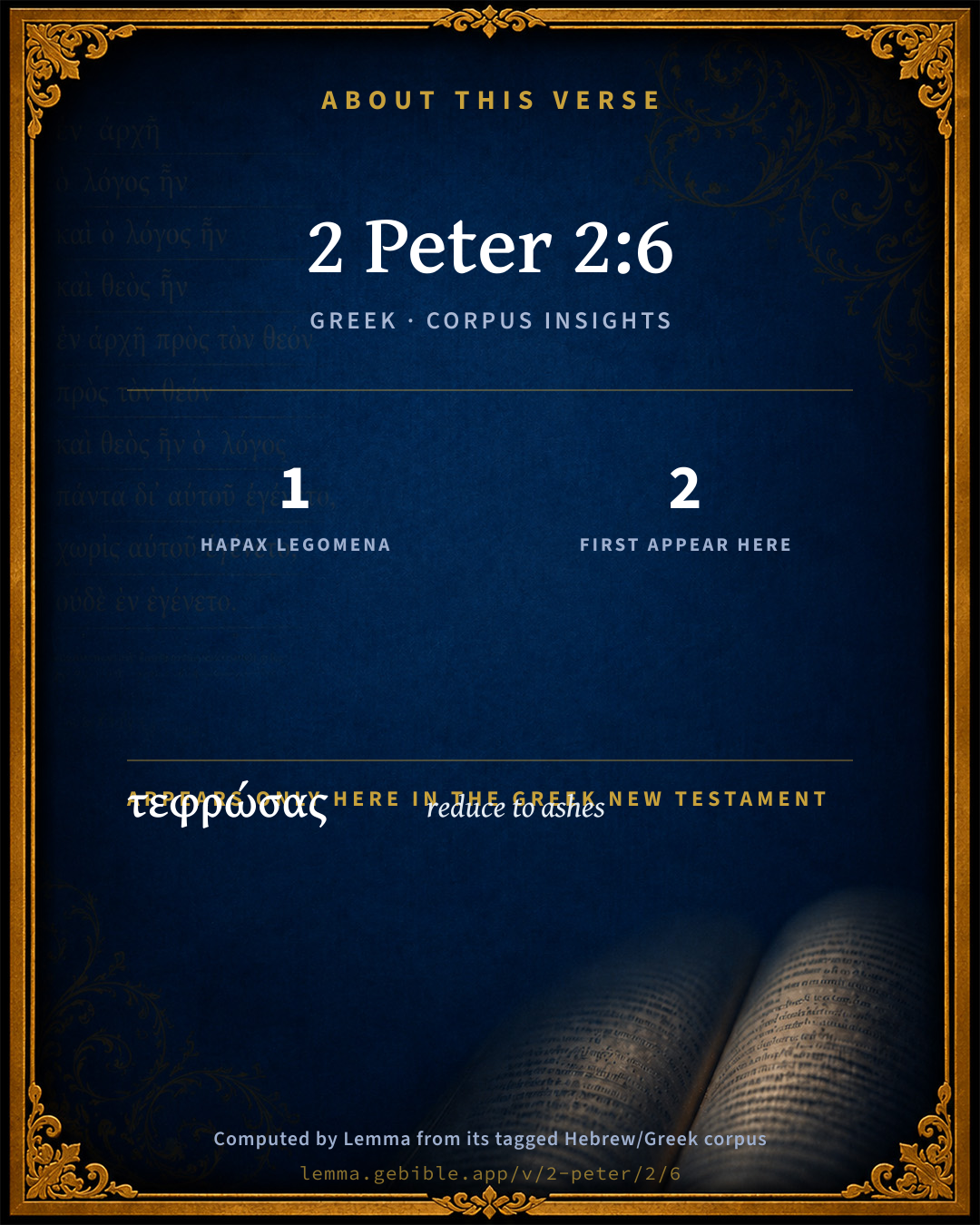
  • 1 hapax legomenon — only here in the Greek New Testament
  • 2 first appearances in the Greek New Testament
Full analysis ↓
Download a study sheet

One document with this verse’s original text, its word-by-word gloss line, the meaning frame, cross-references with their text, attributed commentary, and full source and license credits — printable, and it pastes into notes with its structure intact.

This verse Autodidact and up

Study sheet (.html) Plain text (.txt)

A passage Seminary Student

Up to 50 verses in one chapter. A passage sheet keeps up to 6 commentary sources and 12 cross-references per verse, in the order this page ranks them, and says so on the sheet whenever that leaves anything out. Ask for a single verse and you get the Autodidact verse sheet above.

Everything on this page stays free to read, with no account — the sheet is a download of what is already on screen, not access to it.

Want to remove ads? Support Godless Engineer
Compare translations 3

The same verse in 3 English versions, stacked beneath the original-language interlinear above. Click any original word for its lexicon entry.

Each is an independent rendering of the whole verse — the interlinear is not word-aligned to these translations.

Highlighted words mark where these versions differ — a whole-verse word diff, not a word-by-word alignment.

  • World English Bible Public Domain
    and turning the cities of Sodom and Gomorrah into ashes, condemned them to destruction, having made them an example to those who would live ungodly;
  • King James Version Public Domain
    And turning the cities of Sodom and Gomorrha into ashes condemned them with an overthrow, making them an ensample unto those that after should live ungodly;
  • unfoldingWord Literal Text CC BY-SA 4.0
    and the cities of Sodom and Gomorrah, having reduced to ashes, he condemned to destruction, having set an example are going to happen to the ungodly ones;

unfoldingWord Literal Text — © unfoldingWord, licensed CC BY-SA 4.0. Word-aligned USFM3 via Door43 (git.door43.org/unfoldingWord/en_ult).

Versions to compare (up to 4)

3 of 4 selected

Show all 19 translations

Every available English version of this verse, each an independent rendering of the whole verse.

  • World English Bible Public Domain
    and turning the cities of Sodom and Gomorrah into ashes, condemned them to destruction, having made them an example to those who would live ungodly;
  • Berean Standard Bible Public Domain
    if He condemned the cities of Sodom and Gomorrah to destruction, reducing them to ashes as an example of what is coming on the ungodly;
  • Majority Standard Bible Public Domain
    if He condemned the cities of Sodom and Gomorrah to destruction, reducing them to ashes as an example of what is coming on the ungodly;
  • King James Version Public Domain
    And turning the cities of Sodom and Gomorrha into ashes condemned them with an overthrow, making them an ensample unto those that after should live ungodly;
  • American Standard Version (1901) Public Domain
    and turning the cities of Sodom and Gomorrah into ashes condemned them with an overthrow, having made them an example unto those that should live ungodly;
  • Revised Version (1885) Public Domain
    and turning the cities of Sodom and Gomorrah into ashes condemned them with an overthrow, having made them an example unto those that should live ungodly;
  • Geneva Bible (1599) Public Domain
    And turned the cities of Sodom and Gomorrhe into ashes, condemned them and ouerthrewe them, and made them an ensample vnto them that after should liue vngodly,
  • Douay-Rheims (1899) Public Domain
    And reducing the cities of the Sodomites, and of the Gomorrhites, into ashes, condemned them to be overthrown, making them an example to those that should after act wickedly.
  • Young's Literal Translation Public Domain
    and the cities of Sodom and Gomorrah having turned to ashes, with an overthrow did condemn, an example to those about to be impious having set `them';
  • Literal Standard Version CC BY-SA 4.0
    and having turned the cities of Sodom and Gomorrah to ashes, condemned with an overthrow, having set [them as] an example to those about to be impious,
  • Unlocked Literal Bible CC BY-SA 4.0
    God also reduced the cities of Sodom and Gomorrah to ashes and condemned them to destruction, as an example of what is to happen to the ungodly.
  • unfoldingWord Literal Text CC BY-SA 4.0
    and the cities of Sodom and Gomorrah, having reduced to ashes, he condemned to destruction, having set an example are going to happen to the ungodly ones;
  • Darby Bible Public Domain
    and having reduced [the] cities of Sodom and Gomorrha to ashes, condemned [them] with an overthrow, setting [them as] an example to those that should [afterwards] live an ungodly life;
  • World Messianic Bible Public Domain
    and turning the cities of Sodom and Gomorrah into ashes, condemned them to destruction, having made them an example to those who would live in an ungodly way,
  • Webster's Bible Public Domain
    And turning the cities of Sodom and Gomorrah into ashes, condemned them with an overthrow, making them an example to those that afterwards should live ungodly lives.
  • Free Bible Version CC BY-SA 4.0
    God condemned the cities of Sodom and Gomorrah to total destruction, burning them to ash, as an example of what will happen to those who live evil lives.
  • Bible in Basic English Public Domain
    And sent destruction on Sodom and Gomorrah, burning them up with fire as an example to those whose way of life might in the future be unpleasing to him;
  • Text-Critical English NT CC BY 4.0
    and if he condemned the cities of Sodom and Gomorrah to destruction by reducing them to ashes and made them an example to those who would live in an ungodly way;
  • Tyndale New Testament (1534) Public Domain
    and turned the cities of zodom and Gomor into asshes: overthrewe them damned them and made on them an ensample vnto all that after shuld live vngodly.

Literal Standard Version (2020), Covenant Press — licensed CC BY-SA 4.0. Text via the HelloAO Bible API (eBible.org). Unlocked Literal Bible (unfoldingWord) — licensed CC BY-SA 4.0. Text via the HelloAO Bible API (eBible.org). unfoldingWord Literal Text — © unfoldingWord, licensed CC BY-SA 4.0. Word-aligned USFM3 via Door43 (git.door43.org/unfoldingWord/en_ult). Free Bible Version, Dr. Jonathan Gallagher — licensed CC BY-SA 4.0. Text via the HelloAO Bible API (eBible.org).

Word by word

More ways to search: Search by grammar → Find every occurrence → Compare this word →

Practice this passage: Drill this verse → Learn its vocabulary →

τεφρώσας
tephróō
G5077
“reduce to ashes”
Verb, Aorist, Active, Participle, Nominative, Singular, Masculine
Part of Speech
Verb
Tense
Aorist
Voice
Active
Mood
Participle
Case
Nominative
Number
Singular
Gender
Masculine
Full Thayer's Definition

Origin: from tephra (ashes)

TDNT: None

1. reduce to ashes
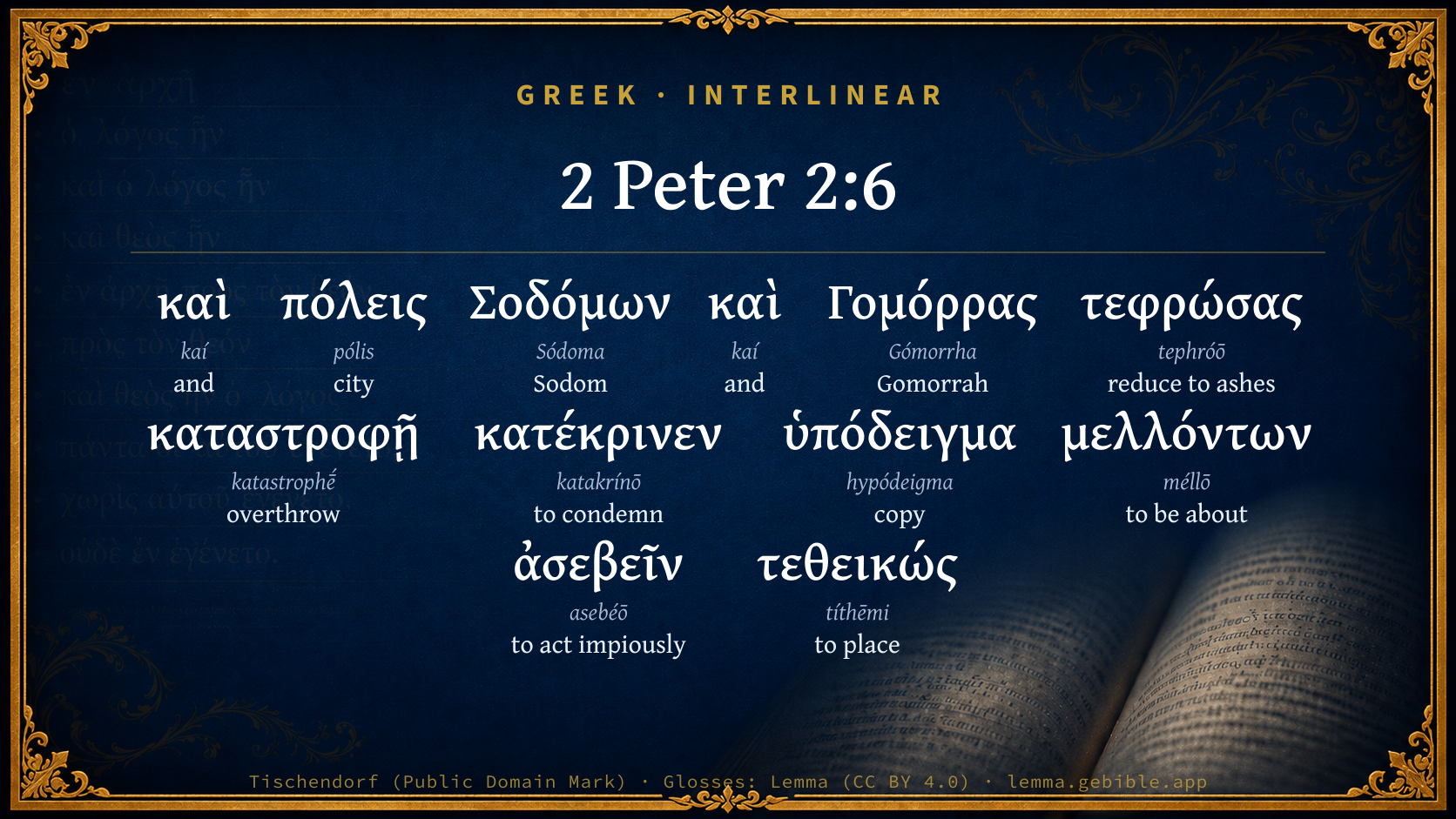
  1. καὶ kaí G2532 “and” Conjunction
  2. πόλεις pólis G4172 “city” Noun, Accusative, Plural, Feminine
  3. Σοδόμων Sódoma G4670 “Sodom” Noun, Genitive, Plural, Neuter
  4. καὶ kaí G2532 “and” Conjunction
  5. Γομόρρας Gómorrha G1116 “Gomorrah” Noun, Genitive, Singular, Feminine
  6. καταστροφῇ katastrophḗ G2692 “overthrow” Noun, Dative, Singular, Feminine
  7. κατέκρινεν katakrínō G2632 “to condemn” Verb, Aorist, Active, Indicative, 3rd person, Singular
  8. ὑπόδειγμα hypódeigma G5262 “copy” Noun, Accusative, Singular, Neuter
  9. μελλόντων méllō G3195 “to be about” Verb, Present, Active, Participle, Genitive, Plural, Masculine
  10. ἀσεβεῖν asebéō G764 “to act impiously” Verb, Present, Active, Infinitive
  11. τεθεικώς títhēmi G5087 “to place” Verb, Perfect, Active, Participle, Nominative, Singular, Masculine

About this verse

These counts appear in no published source. They are computed here, from the morphology-tagged text and Lemma’s own curated glosses. What Lemma adds →

12
words
11
distinct lemmas
General Epistles
section

Notable vocabulary

1 hapax legomenon — a word that appears only here in the entire Greek New Testament:

  • τεφρώσας reduce to ashes G5077

First appearance in Scripture

These words make their first canonical appearance in the Greek New Testament here:

  • τεφρώσας reduce to ashes G5077
  • ἀσεβεῖν to act impiously G764

Shared distinctive vocabulary

καταστροφῇ overthrow G2692 occurs in 2 verses of the Greek New Testament. Also found in:

Repetition

A word recurs within this verse:

Cross-references

14

Topical passages linked to 2 Peter 2:6 in the Treasury of Scripture Knowledge — connected by theme and wording, ordered by reader-vote popularity; previews shown in the World English Bible.

  • Jude 1:7 Even as Sodom and Gomorrah, and the cities around them, having, in the same way as these, given themselves over to sexual immorality and gone after strange flesh, are set forth as an example, suffering the punishment of eternal fire.
  • Luke 17:28–30 Likewise, even as it happened in the days of Lot: they ate, they drank, they bought, they sold, they planted, they built;
  • Deuteronomy 29:23 [and that] the whole land of it is sulfur, and salt, [and] a burning, [that] it is not sown, nor bears, nor any grass grows therein, like the overthrow of Sodom and Gomorrah, Admah and Zeboiim, which Yahweh overthrew in his anger, and in his wrath:
  • Genesis 19:24–25 Then Yahweh rained on Sodom and on Gomorrah sulfur and fire from Yahweh out of the sky.
  • Numbers 26:10 and the earth opened its mouth, and swallowed them up together with Korah, when that company died; what time the fire devoured two hundred fifty men, and they became a sign.
  • Isaiah 13:19 Babylon, the glory of kingdoms, the beauty of the Chaldeans' pride, shall be as when God overthrew Sodom and Gomorrah.
  • Jeremiah 50:40 As when God overthrew Sodom and Gomorrah and the neighbor cities of it, says Yahweh, so shall no man dwell there, neither shall any son of man sojourn therein.
  • Zephaniah 2:9 Therefore as I live, says Yahweh of Hosts, the God of Israel, surely Moab will be as Sodom, and the children of Ammon as Gomorrah, a possession of nettles, and salt pits, and a perpetual desolation. The remnant of my people will plunder them, and the survivors of my nation will inherit them.
  • 1 Corinthians 10:11 Now all these things happened to them by way of example, and they were written for our admonition, on whom the ends of the ages have come.
  • Genesis 19:28 He looked toward Sodom and Gomorrah, and toward all the land of the plain, and looked, and saw that the smoke of the land went up as the smoke of a furnace.
  • Ezekiel 16:49–56 Behold, this was the iniquity of your sister Sodom: pride, fullness of bread, and prosperous ease was in her and in her daughters; neither did she strengthen the hand of the poor and needy.
  • Hosea 11:8 "How can I give you up, Ephraim? How can I hand you over, Israel? How can I make you like Admah? How can I make you like Zeboiim? My heart is turned within me, My compassion is aroused.
  • Amos 4:11 "I have overthrown some of you, As when God overthrew Sodom and Gomorrah, And you were like a burning stick plucked out of the fire; Yet you haven't returned to me," says Yahweh.
  • Jude 1:15 to execute judgment on all, and to convict all the ungodly of all their works of ungodliness which they have done in an ungodly way, and of all the hard things which ungodly sinners have spoken against him."

Cross-references courtesy of OpenBible.info (CC BY 4.0).

Commentary

Notes on 2 Peter 2:6 from classic Christian and Jewish commentators (each source and its license shown beneath its notes). The classic Christian expositions comment on the surrounding passage and are grouped to its opening verse, so a note may address several verses; the Jewish commentaries on the Tanakh (Rashi and others) are per-verse, so they appear only where the commentator wrote on this verse.

Lemma curates 59 commentaries, every one of them public domain or Creative Commons licensed, each selected and text-cleaned for this edition rather than reprinted as found. About our sources →

Joseph Benson's Commentary

2Pe 2:6-8. And turning the cities of Sodom, &c., into ashes — When the inhabitants of those places were sunk into the lowest degeneracy; and condemned them with an overthrow — Punished them with utter destruction, both of their persons and habitations; making them an ensample — Not an example to be imitated, but an example to be avoided, as the word υποδειγμα, here used, signifies. Hence Jude, to express the same idea, uses the word δειγμα. And delivered just Lot — By the miraculous interposition of his providence; vexed with the filthy conversation of the wicked — Exceedingly grieved by the lewd behaviour of the lawless Sodomites. For that righteous man, dwelling among them — Lot appears to have dwelt sixteen years in Sodom, after he parted from Abraham; a long space to abide in one of the lewdest and most outrageously wicked cities in the world, and not be tainted with their vices. Doubtless, as he was so exceedingly grieved with their lewd conduct from day to day, he often earnestly desired to leave the place, but he was directed, it seems, by God, to remain, that he might be an example of the divine goodness and power in delivering the godly from temptation, sin, and punishment. In seeing their base actions, and in hearing their lewd speeches, he vexed — Εβασανιζεν, tormented; his righteous soul from day to day — For their wickedness was incessant; with their unlawful deeds — The cry of which came up at length to heaven, and brought down upon them flaming destruction.

Joseph Benson's Commentary on the Old and New Testaments (1811–1818) — public domain. Text from a community e-Sword module.

Tyndale Open Study Notes

Tyndale Open Resources

2:6 The third example of judgment is that God condemned the cities of Sodom and Gomorrah. The people of these cities were so immoral that God rained down sulfur from heaven to destroy them (Gen 19:24). Peter focuses on the result of this action: The cities were turned into heaps of ashes.

Tyndale Open Study Notes — © Tyndale Open Resources, licensed CC BY-SA 4.0. Text via the HelloAO Bible API.

Bengel's Gnomon

Johann Albrecht Bengel

2Pe 2:6. Πόλεις, cities) There were therefore sins of the same description in the neighbourhood of Sodom, Gomorrha, etc.—τεφρώσας καταστροφῇ, turning them into ashes with an overthrow) The words καταστρέφειν and καταστροφὴ are thus used, Gen 19:25; Gen 19:29, Septuagint.—τεθεικὼς, placing) [rendering them]. It was an imperishable memorial of God and of the Divine judgment.

Bengel's Gnomon of the New Testament — English translation (T&T Clark, Edinburgh, 1860) — public domain. Text from a community e-Sword module.

Meyer's Critical & Exegetical Commentary

Heinrich August Wilhelm Meyer

2Pe_2:6. Third example: The overthrow of Sodom and Gomorrah; cf. Jud_1:7.

This verse also is still dependent on εἰ. Schott, without any adequate reason, asserts that the author has even here forgotten the construction of his expression in the protasis with εἰ.

πόλεις Σοδόμων καὶ Γομόῤῥας] The gen. as apposition.

τεφρώσας] Suidas: equivalent to ἐμπρήσας, σποδώσας: by burning them to ashes, by reducing them to ashes.

καταστροφῇ κατέκρινεν] not equal to eversione s. subversione damnavit i. e. unditus evertendo punivit (Gerhard, Dietlein, Schott), but καταστροφῇ is the dative of reference; see Buttmann, p. 144; cf. κατακρ. θανάτῳ, Mat_20:18; Pott correctly: in cineres redigens damnavit ad eversionem; thus also Wahl, de Wette, Wiesinger, Steinfass, Fronmüller, Hofmann; only it must be here remarked that κατακρίνειν includes within it the punishment, the putting into execution of the judgment of condemnationwhich Hofmann, without reason, denies, cf. Rom_8:3.

It is incorrect to connect καταστροφῇ with τεφρώσας (Bengel).

καταστροφή, in the N. T. besides here, only in 2Ti_2:14; there, however, in a figurative sense; the same word occurs in the narrative of the destruction of the cities of the plain, Gen_19:29, LXX.

ὑπόδειγμα μελλόντων ἀσεβεῖν τεθεικώς] Jud_1:7; with ὑπόδειγμα, not equal to example, but to type, cf. Jam_5:10; Heb_4:11, etc. The perf. τεθεικώς corresponds with the πρόκεινται, Jud_1:7; Hofmann correctly: God has made them, as the perf. shows, a lasting type of those who ever afterwards should live a godless life.[68]

[68] Hofmann attaches particular importance to the circumstance, that the judgment which was effected by water was followed by another, which was effected by fire.

Meyer — Critical and Exegetical Commentary on the New Testament — English translation by Peter Christie, edited by Frederick Crombie (T&T Clark, 1880) — public domain. Text from a community e-Sword module.

Expositor's Greek Testament

ed. W. Robertson Nicoll

2Pe 2:6 . πόλεις Σοδ . καὶ Γομορρ . Not genitive of apposition, but cities of the district, where Sodom and Gomorrah were situated. cf. Jud 1:7 . Σ . καὶ Γ . καὶ αἱ περὶ αὐτὰς πόλεις καταστροφῇ κατέκρινεν . καταστροφῇ is dative of instrument, “condemned them by overthrow”. Gen 19:24-25 seems to imply some further destruction after the fire. Perhaps an earthquake is meant, a common accompanying phenomenon of volcanic disturbance. ὑπόδειγμα … τεθεικώς , “constituting them an example to ungodly persons of things in store for them.” With μελλ . cf. Heb 11:20 , Col 2:17 . τεφρώσας = “cover up with ashes” (not “reduce to ashes”) found in a description of the eruption of Vesuvius. (Dio. Cass. lxvi. p. 1094).

The Expositor's Greek Testament, edited by W. Robertson Nicoll (1897–1910) — public domain. Text from a community e-Sword module.

Jamieson, Fausset & Brown

Robert Jamieson, A. R. Fausset & David Brown

with, &c.--"TO overthrow" [ALFORD].

ensample--"of (the fate that should befall) those who in after-time should live ungodly." Compare Jde 1:7, "set forth for an example."

Jamieson, Fausset & Brown — Commentary Critical and Explanatory on the Whole Bible (1871) — public domain (CC PDM 1.0). Text via the HelloAO Bible API.

Adam Clarke's Commentary

Verse 6. The cities of Sodom and Gomorrha] See the notes on Gen. 19, for an account of the sin and punishment of these cities.

Making them an ensample] These three words, υποδειγμα παραδειγμα, and δειγμα, are used to express the same idea; though the former may signify an example to be shunned, the second an example to be followed, and the third a simple exhibition. But these differences are not always observed.

Adam Clarke's Commentary on the Bible (1810–1826) — public domain. Text from a community e-Sword/MySword module.

John Calvin's Commentaries

6 The cities of Sodom. This was so memorable an example of Divine vengeance, that when the Scripture speaks of the universal destruction of the ungodly, it alludes commonly to this as the type. Hence Peter says, that these cities were made an example. This may, indeed, be truly said of others; but Peter points out something singular, because it was the chief and a lively image; yea, rather, because the Lord designed that his wrath against the ungodly should be made known to all ages; as when he redeemed his people from Egypt, he has set forth to us by that one favor the perpetual safety of his Church. Jude has also expressed the same thing, calling it the punishment of eternal fire. [Jude 1:7.]

John Calvin's Commentaries (1540-1563) — public domain. Text from the Calvin Translation Society English edition (1840s-50s) via the Christian Classics Ethereal Library (ccel.org). Calvin's coverage is partial (roughly two-thirds of the Bible); uncommented books and verses are honest gaps, never fabricated. The 19th-century editor's footnotes and remarks are omitted so the notes are faithfully Calvin's own voice.

Ellicott's Commentary for English Readers

(6) And turning. . . .—The construction still depends upon the “if” in 2Pe_2:4. (See Note on Jud_1:7.)

Condemned them with an overthrow.—Or, perhaps, to an overthrow, like “condemn to death” in Mat_20:18. The very word here used for “overthrow”—catastrophe—is used by the LXX. of the overthrow of these cities (Gen_19:29); in the New Testament it occurs in 2Ti_2:4 only.

An ensample unto those.—Literally, an ensample of those—i.e., of the punishment which such sinners must expect. (Comp. “Are set forth for an example,” Jud_1:7.)

A Bible Commentary for English Readers, edited by Charles John Ellicott (1878–1897) — public domain. Text from a community e-Sword module.

The Cambridge Bible for Schools and Colleges

gen. ed. J. J. S. Perowne

6. and turning the cities of Sodom and Gomorrha into ashes …] The parallelism with Luk_17:26-29 continues and here runs on side by side with Jude (2Pe_2:7), who omits, however, any reference to the deluge, and does not dwell on the deliverance of Lot.

making them an ensample …] St Peter does not see in the supernatural destruction of the cities of the plain an exception to the normal order of the Divine government. It was rather a pattern instance of the judgment sure to fall, sooner or later, on all who were guilty of like sins. It may be noted that that destruction had been used as an illustration by the older prophets (Isa_1:9-10; Eze_16:48-56) as well as by our Lord.

The Cambridge Bible for Schools and Colleges (gen. ed. J. J. S. Perowne; Cambridge University Press, 1878–1918) — public domain. Text from a community e-Sword module.

John Gill's Exposition

And turning the cities of Sodom and Gomorrha into ashes,.... By raining brimstone and fire upon them from heaven, Gen 19:24 which soon reduced them to ashes, with Admah and Zeboiim, Deu 29:25, cities delightfully situated, which were as the garden of God, and the land of Egypt, together with the inhabitants of them; and after they had received a signal mercy, in being rescued by Abraham from the kings who had carried them captive; and though Abraham, the friend of God, interceded for them, and righteous Lot dwelt among them. The first of these cities is in the Hebrew language called Sedom; Philo the Jew (w) calls it Sodoma, as in Rom 9:29 and in the Septuagint on Gen 13:10 here it is said to be a city, and Josephus (x) always calls it the city of the Sodomites, but in Mat 10:15 we read of the land of Sodom; and so Philo (y) the Jew speaks of the region or country of the Sodomites; here the word is of the plural number, as in Mat 10:15 as it is also in the Septuagint in Gen 10:19 and in Philo the Jew (z), and so is Gomorrah in some copies of this, place, as in Mat 10:15. Solinus, the historian, gives an account of these cities, in agreement with this;

"a good way off of Jerusalem (he says (a)) is opened a sorrowful gulf, which the black ground, "in cinerem soluta", "reduced to ashes", shows it to be touched by heaven; there were two towns, or cities, the one called Sodom, and the other Gomorrah; where an apple is produced, which, although it has an appearance of ripeness, cannot be eaten; for the outward skin that encompasses it only contains a sort of soot, or embers within, which, ever so lightly squeezed, evaporates into smoke and dust;''

and so the author of the book of Wisdom 10:7 speaking of the five cities, on which fire fell, says,

"of whose wickedness, even to this day, the waste land that smoketh is a testimony; and plants bearing fruit, that never come to ripeness.''

Philo the Jew (b) says, that

"there are showed to this day in Syria monuments of this unspeakable destruction that happened; as ruins, ashes, sulphur, smoke, and a weak flame, breaking forth as of a fire burning:''

condemned them with an overthrow; by this sad "catastrophe" God condemned the sins of those men of Sodom and Gomorrah, and condemned their persons to everlasting damnation; of which their temporal punishment was an emblem and figure; see Jde 1:7, the word "overthrow" is generally used when this destruction is spoken of, Deu 29:23 and therefore retained by the apostle here:

making them ensamples unto those who after should live ungodly; in the commission of any sins, and be open, bold, and impudent in them, and declare them as they did; and especially that should live in the commission of the same sins, those unnatural lusts and uncleannesses, which to this day go by the name of "sodomy", and "sodomitical" practices; now the punishment of the inhabitants of these cities was an ensample to such wicked conduct, showing what they must expect, and was a representation of those everlasting burnings, which such sinners, as a righteous retaliation for their burning lusts, shall be cast into. The Jews say (c) the same of the men of Sodom and Gomorrah as of the old world;

"the men of Sodom have no part in the world to come, as is said Gen 13:13 "but the men of Sodom were wicked, and sinners before the Lord exceedingly"; wicked in this world, and sinners in the world to come;''

See Gill on .

(w) De Temulentia, p. 272. (x) Antiqu. l. 1. c. 8. sect. 3. c. 11. sect. 3. (y) De Abrahamo, p. 381. (z) De Temulentia, p. 272. (a) Polyhistor. c. 48. (b) De Vifa Mosis, l. 2. p. 662. (c) Misn. Sanhedrin, c. 11. sect. 3. Vajikra Rabba, sect. 4. fol. 149. 1.

John Gill's Exposition of the Whole Bible (1746–1763) — public domain (CC PDM 1.0). Text via the HelloAO Bible API.

Trapp's Complete Commentary

John Trapp

6 And turning the cities of Sodom and Gomorrha into ashes condemned them with an overthrow, making them an ensample unto those that after should live ungodly;

Ver. 6. And turning the cities] Burying them likewise in the Dead Sea, after that he had rained down hell from heaven upon them. {See Trapp on "Gen 19:24"} {See Trapp on "Gen 19:25"}

Making them an ensample] Hanging them up in gibbets, as it were, that others might hear and fear.

John Trapp, A Commentary or Exposition upon All the Books of the Old and New Testament (1647–1656) — public domain. Text from a community e-Sword module.

Albert Barnes' Notes on the Bible

And turning the cities of Sodom and Gomorrha into ashes - Gen 19:24-25. This is a third example to demonstrate that God will punish the wicked. Compare the notes at Jud 1:7. The word here rendered “turning into ashes” τεφρωσας tephrōsas, occurs nowhere else in the New Testament. It is from τέφρα tefra, ashes, and means to reduce to ashes, and then to consume or destroy.

Condemned them with an overthrow - By the fact of their being overthrown, he showed that they were to be condemned, or that he disapproved their conduct. Their calamity came expressly on account of their enormous sins; as it is frequently the case now that the awful judgments that come upon the licentious and the intemperate, are as plain a proof of the divine disapprobation as were the calamities that came upon Sodom and Gomorrah.

Making them an ensample ... - That is, they were a demonstration that God disapproved of the crimes for which they were punished, and would disapprove of the same crimes in every age and in every land. The punishment of one wicked man or people always becomes a warning to all others.

Albert Barnes' Notes on the Bible (1834–1885) — public domain. Text from a community e-Sword/MySword module.

Matthew Poole's English Annotations

The cities of Sodom and Gomorrha; which being the chief of the five, include Admah and Zeboim, Zoar, the fifth, being spared for Lot’s sake, Gen 14:18, compared with Gen 19:25.

Condemned them with an overthrow; i.e. punished them with a total subversion, or brought that destruction upon them to which he had condemned them.

Making them an ensample unto those that after should live ungodly; of his wrath and vengeance ready to be poured out upon others that should live ungodly, to deter them from the imitation of the sins of those that had so miserably perished. The word may be rendered a type, (as it is, Heb 8:5, and Heb 9:23), viz. of hell-fire, which is to be the punishment of wicked men at the last day: Jud 1:7 implies as much. As the deliverance of the Israelites out of Egypt was a kind of type of the deliverance of all God’s people to the end of the world; so the subversion of these cities was so memorable an instance of Divine vengeance, that the Scripture frequently alludes to it, as a type or pattern, when it speaks of the general destruction of the wicked of the world.

Matthew Poole's English Annotations on the Holy Bible (1683–1685) — public domain. Text from a community e-Sword/MySword module.

Whedon's Commentary on the Bible

Daniel D. Whedon

c. Third case—The cities of the plain.

6. Sodom—Interceded for by Abraham, but lacking its needed ten righteous men to save it. Gen_18:32. The occasion and the manner of the destruction of these cities is narrated in Genesis 19. They are a standing ensample for ungodly men in all after time, warning them of the doom to which they are exposed. There are a full score of references to it in Scripture.

Daniel D. Whedon (gen. ed.), Commentary on the Old and New Testaments (1874–1909) — public domain. Text from a community e-Sword module.

The Pulpit Commentary

And turning the cities of Sodom and Gomorrah into ashes condemned them with an overthrow. The striking word tefrwsav, turning into ashes, occurs nowhere else in the New Testament; and the word for "overthrow" (katastrofh) only in 2Ti_2:14. It is used in the Septuagint Version of Gen_19:29 of this same judgment. Perhaps "to an overthrow" is a better translation. comp. Luk_17:26. (Jud_1:7) Making them an ensample unto those that after should live ungodly; rather, having made. The example is to be a lasting warning; literally, an example of those that should live ungodly; i.e., an example of their punishment, their end. In this verse the Vatican Manuscript omits "with an overthrow," and reads "an example of things to come unto the ungodly."

The Pulpit Commentary (1880–1919), ed. H.D.M. Spence-Jones & Joseph S. Exell — public domain. Text from a community e-Sword module.

The People's New Testament

B. W. Johnson

6. Turning the cities of Sodom and Gomorrha into ashes. The third example of judgment on sin. See Gen. 19:29.

B. W. Johnson's The People's New Testament with Notes (1889–1891) — public domain. Electronic text from the Christian Classics Ethereal Library (CCEL) ThML edition.

Cambridge Greek Testament for Schools and Colleges

6. πόλεις Σοδόμων. The genitive, as in urbs Romae, is of apposition.

τεφρώσας. Examples are quoted from Dion Cassius describing an eruption of Vesuvius, and from Lycophron (who in his so-called play the Alexandra or Cassandra heaps together all the obscure words he can find): l. 227 τεφρώσας γυῖα Λημναίῳ πυρί. This means “reduce to ashes.” The passage in Dion Cass. means “covered with ashes.”

καταστροφῇ κατέκρινεν is the reading of the large mass of authorities, BC alone omitting καταστροφῇ, and P reading κατέστρεψεν. The meaning would be either “condemned by overthrowing” or “condemned to overthrow” (the latter unclassical, but paralleled by Mat 20:18 κατακρίνουσιν αὐτὸν θανάτῳ). I think the word should be restored to the text.

ὑπόδειγμα μελλόντων ἀσεβέσιν τεθεικώς = Jude πρόκεινται δεῖγμα πυρὸς αἰωνίου. For ἀσεβέσιν (BP) the bulk of authorities read ἀσεβεῖν, induced probably by the presence of μελλόντων, with which an infinitive is expected. A good parallel to these verses is in 3Ma 2:4-5 (in a prayer of the high-priest Simon):

Σὺ τοὺς ἔμπροσθεν ἀδικίαν ποιήσαντας ἐν οἷς καὶ γίγαντες ἦσαν ῥώμῃ καὶ θράσει πεποιθότες διέφθειρας, ἐπαγαγὼν (cf. ἐπάξας) αὐτοῖς ἀμέτρητον ύδωρ. Σὺ τοὺς ὑπερηφανίαν ἐργαζομένους Σοδομίτας … πυρὶ καὶ θείῳ κατέφλεξας, παράδειγμα τοῖς ἐπιγενομένοις καταστήσας.

The date of 3 Macc. is uncertain, but it is a Jewish book, probably written about the Christian era.

Cambridge Greek Testament for Schools and Colleges (Cambridge University Press, 1896; 21 vols, various authors incl. Carr, Maclear, Plummer, Farrar, Lumby, Moule, M. R. James, Simcox) — public domain. Text from a community e-Sword module.

Alford’s Greek Testament

Henry Alford

6.] Third historical proof: the destruction of Sodom and Gomorrha, Jud 1:7Jud 1:7. And burning to ashes (Suidas, τεφρώσας, ἐμπρήσας, σποδώσας. The aor. part. is contemporary with the aor. following) the cities of (gen. of apposition) Sodom and Gomorrha, condemned (them) (κατέκρινεν, not imperf., but first aor. as παρέδωκεν and ἐφύλαξεν in the co-ordinate verses above) to (better than “with:” see reff.: not “eversione damnavit,” “funditus evertendo punivit,” as Gerh.: but “in cineres redigens damnavit ad eversionem,” as Pott, Wahl, Winer, De Wette, Huther) overthrow (καταστροφή is the word used (ref. Gen.) in the history), laying down an example (cf. πρόκεινται δεῖγμα, Jud 1:7) of (i. e. that which might shew forth the fate of) those that should in after time live ungodly (so the E. V. well, but with “after”):

Henry Alford, The Greek Testament (1849–1861) — public domain. Text from a community e-Sword module.

Vincent's Word Studies in the New Testament

Marvin R. Vincent

Turning into ashes [τεφρωσας] . Only here in New Testament.

Having made them an example [υποδειγμα τεθεικως] . Compare 1Pe 2:21. The word for example is condemned as unclassical by the Attic grammarians, and paradeigma is substituted, which means, properly, a sculptor's or a painter's model, or an architect's plan.

Marvin R. Vincent, Word Studies in the New Testament (1887–1900) — public domain. Text from a community e-Sword/MySword module.

Lesson kit

Teaching starters — assembled from the data on this page, not authored interpretation. Every prompt links to the verse data it draws on. Edit before teaching.

2 Peter, in the General Epistles, opens this verse with 12 words (11 distinct Greek lemmas). Its most distinctive word is tephróō (“reduce to ashes”). A historical commentator’s framing appears above. Read the whole chapter for the surrounding context.

Discussion questions

  1. The word tephróō carries the sense “reduce to ashes.” How does it shape the verse?
  2. This verse holds 1 word here found nowhere else in the Greek New Testament. What might the rare word draw attention to?
  3. 2 words here appear for the first time in Scripture. What is being introduced at this debut?
  4. 2 Timothy 2:14 shares the word «overthrow» with this verse. How do the two illuminate each other?
  5. “and” occurs 2× in this one verse. What is the effect of the repetition?
  6. These translations render this verse differently; the difference is in the English rendering, not the original. What questions does that raise?
  7. Reading how Joseph Benson's Commentary and Tyndale Open Study Notes read this verse, where do the two commentators agree and where do they part?

Things to notice

  • 1 word in this verse appears nowhere else in the Greek New Testament.
  • 2 words make their first canonical appearance in Scripture here.
  • These translations choose different wording for 21 words in this verse.
  • “and” occurs 2× in this single verse.
  • 11 distinct Greek lemmas span 12 words in this verse.

Reading settings

Reading text

Shown beneath each verse's original-language words.

Old Testament
Old Testament edition

Read the OT as the Masoretic Hebrew (MT) or the Greek Septuagint (LXX).

English shown for the Greek Septuagint (in the Hebrew ↔ Greek comparison).

Comparing translations? Open the Compare panel on any verse page to stack up to four side by side.