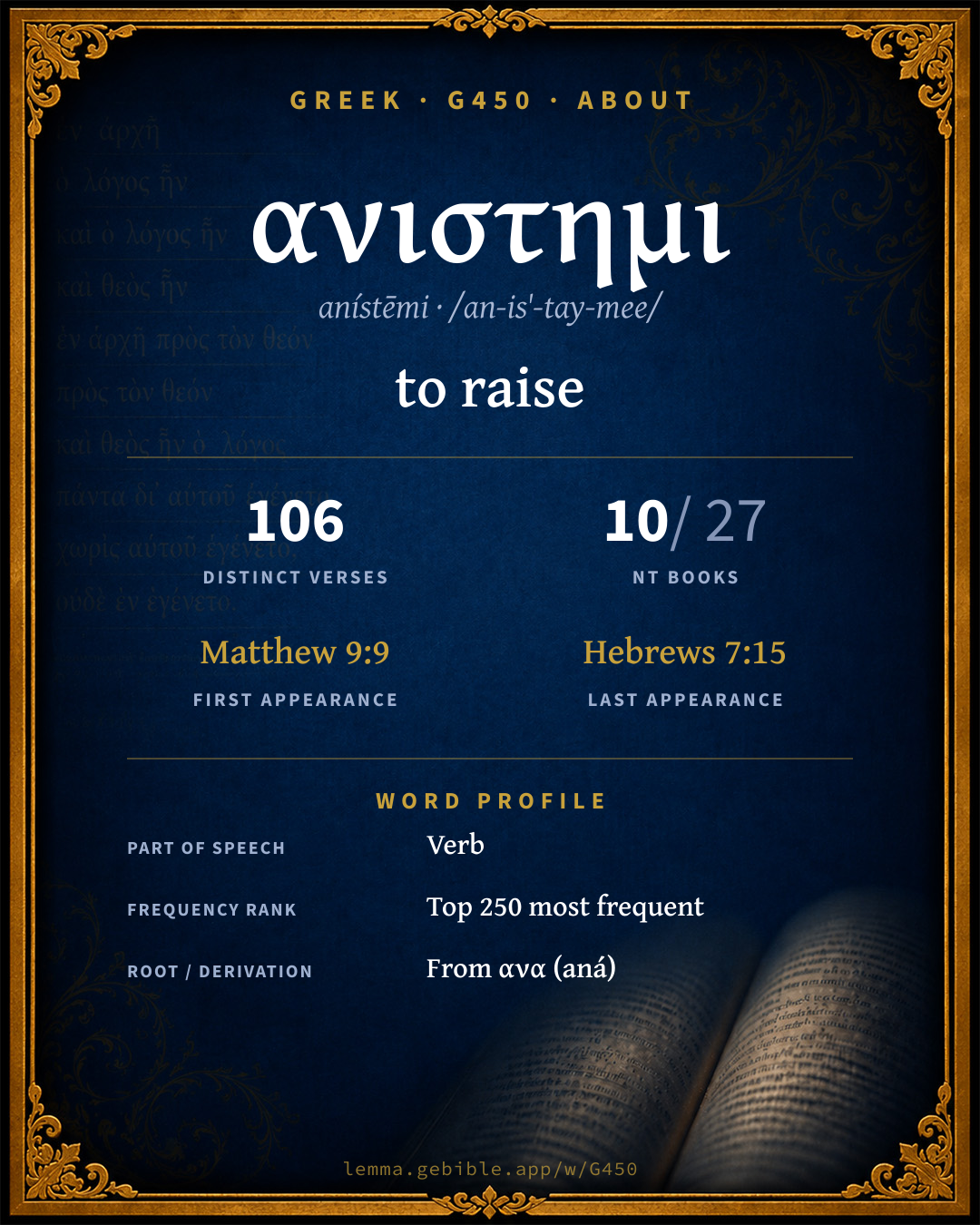
ἀνίστημι
to raise
‘to raise’ is one of 6 main senses fuller range ↓
Full lexicon entry — Thayer's Greek Lexicon
From Thayer's Greek Lexicon
Where this word appears
See every Aorist-tense verb in the Greek New Testament →
Grammar key — what these labels mean
Part of speech
- Verb
- An action or state-of-being word.
Tense
- Aorist
- Action viewed as a simple whole, without regard to duration — often past (perfective aspect).
- Future
- Action expected in future time.
- Present
- Ongoing or general action in present time (imperfective aspect).
Voice
- Active
- The subject performs the action.
- Middle
- The subject acts on or for itself, or with special interest in the action.
Mood
- Participle
- A verbal adjective (“writing,” “having written”).
- Indicative
- States a fact or asks a factual question (the mood of reality).
- Imperative
- Expresses a command or request.
- Infinitive
- A verbal noun (“to write”), unmarked for person or number.
- Subjunctive
- Expresses probability, purpose, or possibility (the mood of contingency).
Case
- Nominative
- The case of the subject (and the predicate nominative).
Person
- 3rd person
- The one spoken about (“he / she / it / they”).
- 2nd person
- The one addressed (“you”).
- 1st person
- The speaker (“I / we”).
Gender
- Masculine
- Grammatically masculine.
- Feminine
- Grammatically feminine.
- Neuter
- Grammatically neuter.
Number
- Singular
- One.
- Plural
- More than one.
Every verse where G450 appears in the Book of Luke — 26 distinct verses. Click any verse to open its interlinear word-by-word view. Verse text shown in the World English Bible for context — . Each verse’s Greek form is shown with its reference; the English is not keyword-highlighted, since the data carries no word-level English alignment. Use “Compare translations” on any verse to read it across multiple English versions. This concordance covers the Greek New Testament; Septuagint (Greek Old Testament) occurrences of this word are not indexed here.
Luke
- Luke 1:39 Ἀναστᾶσα aor act ptcp nom sg fem Mary arose in those days and went into the hill country with haste, into a city of Judah,
- Luke 4:16 ἀνέστη aor act ind 3sg He came to Nazareth, where he had been brought up. He entered, as was his custom, into the synagogue on the Sabbath day, and stood up to read.
- Luke 4:29 ἀναστάντες aor act ptcp nom pl masc They rose up, threw him out of the city, and led him to the brow of the hill that their city was built on, that they might throw him off the cliff.
- Luke 4:38 Ἀναστὰς aor act ptcp nom sg masc He rose up from the synagogue, and entered into Simon's house. Simon's mother-in-law was afflicted with a great fever, and they begged him for her.
- Luke 4:39 ἀναστᾶσα aor act ptcp nom sg fem He stood over her, and rebuked the fever; and it left her. Immediately she rose up and served them.
- Luke 5:25 ἀναστὰς aor act ptcp nom sg masc Immediately he rose up before them, and took up that which he was laying on, and departed to his house, glorifying God.
- Luke 5:28 ἀναστὰς aor act ptcp nom sg masc He left everything, and rose up and followed him.
- Luke 6:8 ἀναστὰς aor act ptcp nom sg masc But he knew their thoughts; and he said to the man who had the withered hand, "Rise up, and stand in the middle." He arose and stood.
- Luke 8:55 ἀνέστη aor act ind 3sg Her spirit returned, and she rose up immediately. He commanded that something be given to her to eat.
- Luke 9:8 ἀνέστη aor act ind 3sg and by some that Elijah had appeared, and by others that one of the old prophets had risen again.
- Luke 9:19 ἀνέστη aor act ind 3sg They answered, "'John the Baptizer,' but others say, 'Elijah,' and others, that one of the old prophets is risen again."
- Luke 10:25 ἀνέστη aor act ind 3sg Behold, a certain lawyer stood up and tested him, saying, "Teacher, what shall I do to inherit eternal life?"
- Luke 11:7 ἀναστὰς aor act ptcp nom sg masc and he from within will answer and say, 'Don't bother me. The door is now shut, and my children are with me in bed. I can't get up and give it to you'?
- Luke 11:8 ἀναστὰς aor act ptcp nom sg masc I tell you, although he will not rise and give it to him because he is his friend, yet because of his persistence, he will get up and give him as many as he needs.
- Luke 11:32 ἀναστήσονται fut mid ind 3pl The men of Nineveh will stand up in the judgment with this generation, and will condemn it: for they repented at the preaching of Jonah, and behold, one greater than Jonah is here.
- Luke 15:18 ἀναστὰς aor act ptcp nom sg masc I will get up and go to my father, and will tell him, "Father, I have sinned against heaven, and in your sight.
- Luke 15:20 ἀναστὰς aor act ptcp nom sg masc "He arose, and came to his father. But while he was still far off, his father saw him, and was moved with compassion, and ran, and fell on his neck, and kissed him.
- Luke 16:31 ἀναστῇ aor act subj 3sg "He said to him, 'If they don't listen to Moses and the prophets, neither will they be persuaded if one rises from the dead.'"
- Luke 17:19 ἀναστὰς aor act ptcp nom sg masc Then he said to him, "Get up, and go your way. Your faith has healed you."
- Luke 18:33 ἀναστήσεται fut mid ind 3sg They will scourge and kill him. On the third day, he will rise again."
- Luke 22:45 ἀναστὰς aor act ptcp nom sg masc When he rose up from his prayer, he came to the disciples, and found them sleeping because of grief,
- Luke 22:46 ἀναστάντες aor act ptcp nom pl masc and said to them, "Why do you sleep? Rise and pray that you may not enter into temptation."
- Luke 23:1 ἀναστὰν aor act ptcp nom sg neut The whole company of them rose up and brought him before Pilate.
- Luke 24:7 ἀναστῆναι aor act inf saying that the Son of Man must be delivered up into the hands of sinful men, and be crucified, and the third day rise again?"
- Luke 24:33 ἀναστάντες aor act ptcp nom pl masc They rose up that very hour, returned to Jerusalem, and found the eleven gathered together, and those who were with them,
- Luke 24:46 ἀναστῆναι aor act inf He said to them, "Thus it is written, and thus it was necessary for the Christ to suffer and to rise from the dead the third day,
About this entry
At a glance — auto-summarized from this page’s data, not written by a person. Every figure links to its source below. This summary describes the numbers; it doesn’t interpret them.
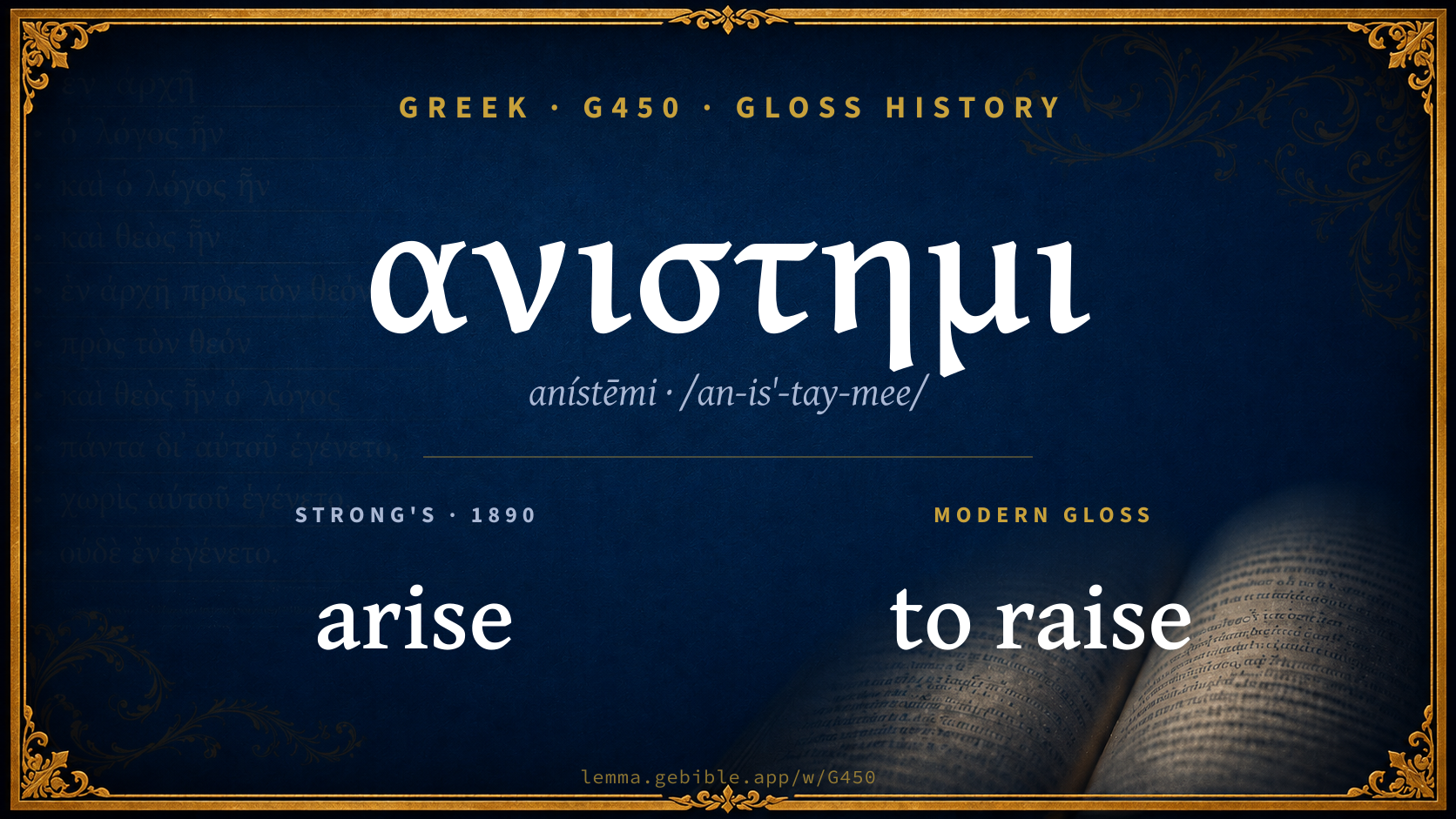
“to raise” is the headline sense of the Greek verb ανιστημι (anístēmi). Where the King James Version says “arise,” newer translations reach for “get up” (Berean Standard Bible) and “arising” (unfoldingWord Literal Text); the renderings breakdown has the detail. It appears 106 verses across 10 books of the Greek New Testament, among its common vocabulary. More than a third of its appearances fall in Acts. Lexicons map it across 6 senses. See the sense tree, 106-verse concordance, and the renderings breakdown below.
Gloss history
Strong's 1890 vs modern scholarship
About this word
Strong's G450 catalogs a Greek word from the Greek New Testament.
These counts are not copied from any lexicon or concordance. They are computed here, from the morphology-tagged Greek New Testament. What Lemma adds →
- 106
- distinct verses
- The word appears in 106 distinct verses.
- 10 / 27
- NT books
- The word appears in 10 of 27 New Testament books.
- #155
- by frequency
- Top 250 most frequent Greek words (rank 155 of 5,347 Greek words by occurrence).
View all 106 occurrences in the concordance →
By section of the New Testament
By traditional corpus
Conventional, traditional groupings — biblical authorship is debated, so this is a traditional corpus grouping, not an authorship claim. Some books belong to more than one corpus (Luke is in both the Gospels and the Lukan corpus, and so on), so these shares overlap and need not total 100%. Each figure is a share of the word’s 106 distinct verses.
- Lukan (Luke–Acts) 70 verses · 66%
- Gospels 55 verses · 52%
- Johannine 8 verses · 8%
- Pauline corpus 5 verses · 5%
- Hebrews 2 verses · 2%
How translations render this word
Counts come from each version’s own published word-to-Strong’s tagging or interlinear alignment — an approximate guide to how each version renders this word, not a word-level alignment the data otherwise carries. Because each total is that version’s own tagged count, the per-version totals vary from one another and need not match the appearance or distinct-verse counts above. These counts may also differ from a printed concordance because Lemma counts each distinctly tagged rendering and does not collapse phrase taggings into a single head-word total. This is a fixed set of word-tagged versions (KJV, ASV, BSB, ULT) and does not change with the reading translation you choose elsewhere. Each version’s license is shown beside its name below (and on Sources).
- King James Version: Arise 12×, Arose 12×, He arose 10×
- American Standard Version: Arise 11×, Stood up 10×, He arose 9×
- Berean Standard Bible: Get up 14×, Got up 12×, Stood up 9×
- unfoldingWord Literal Text: Arising 14×, Having gotten up 8×, Arise 6×
King James Version Public Domain
Renders G450 across 123 tagged occurrences — most commonly:
Plus other, less common renderings. Plus 36 renderings that appear only once — usually multi-word phrases or single function words the recovered tagging swept in, not distinct renderings.
American Standard Version Public Domain
Renders G450 across 120 tagged occurrences — most commonly:
Plus other, less common renderings. Plus 37 renderings that appear only once — usually multi-word phrases or single function words the recovered tagging swept in, not distinct renderings. Not rendered by a distinct English word in 1 further occurrence.
Berean Standard Bible Public Domain
Renders G450 across 107 tagged occurrences — most commonly:
Plus other, less common renderings. Plus 40 renderings that appear only once — usually multi-word phrases or single function words the recovered tagging swept in, not distinct renderings. Not rendered by a distinct English word in 1 further occurrence.
unfoldingWord Literal Text CC BY-SA 4.0
Renders G450 across 117 tagged occurrences — most commonly:
Plus other, less common renderings. Plus 25 renderings that appear only once — usually multi-word phrases or single function words the recovered tagging swept in, not distinct renderings.
Senses in Thayer's
The 6 senses Thayer's distinguishes for this word, in lexicon order (not ranked by frequency or importance). The full entry — with sub-senses — is in the Lexicon Entry tab.
- to cause to rise up, raise up
- of persons lying down, of persons lying on the ground
- of persons seated
- of those who leave a place to go elsewhere
- of the dead
- at arise, appear, stand forth
Word origin
Derived from ανα (aná) (G303) — among.
Forms in the corpus
The 23 distinct written forms G450 takes in the Greek New Testament, most frequent first — each parse links to that tense’s occurrences in the concordance.
Same root — word family
Other Thayer's entries built from the same root as G450, grouped by Strong’s listed origin. These share a root / origin per the lexicon — not necessarily a shared meaning. Each links to that word’s own entry.
Derives from
Shares the same root
- αναβαινω anabaínō G305 to ascend
- αναβαλλομαι anabállomai G306 to delay
- αναβιβαζω anabibázō G307 to draw up
- αναβλεπω anablépō G308 to look up
- αναβοαω anaboáō G310 to cry out
- αναγγελλω anangéllō G312 to announce
- αναγενναω anagennáō G313 to be born again
- αναγινωσκω anaginṓskō G314 to recognize
- αναγκη anánkē G318 necessity
- αναγνωριζομαι anagnōrízomai G319 to recognize
- αναγω anágō G321 to lead up
- αναδεικνυμι anadeíknymi G322 to proclaim
- αναδεχομαι anadéchomai G324 to take up
- αναδιδωμι anadídōmi G325 to give forth
- αναζαω anazáō G326 to live again
- αναζητεω anazētéō G327 to search out
- αναζωννυμι anazṓnnymi G328 to gird up
- αναζωπυρεω anazōpyréō G329 to inflame
- αναθαλλω anathállō G330 to sprout up
- αναθεωρεω anatheōréō G333 to observe
- αναιρεω anairéō G337 to take away
- ανακαθιζω anakathízō G339 to sit up
- ανακαινιζω anakainízō G340 to renew
- ανακαινοω anakainóō G341 to make new
+51 more words share this root (not shown).
Derived from this word
Compare all same-root words → Showing 4 of 79 — not the complete family. They share a root, not necessarily a meaning.
Septuagint usage
The same Greek word ανιστημι appears 485 times in the Greek Old Testament (Septuagint), across 465 verses in 33 books.
- 485
- LXX occurrences
- Tagged occurrences of this Greek word in the Septuagint.
- 465
- verses
- Distinct Septuagint verses containing this word.
- 33 / 39
- OT books
- The word appears in 33 of the 39 Old Testament books.
Sample Septuagint occurrences
- Genesis 4:8 ἀναἵστημι
- Exodus 1:8 ἀναἵστημι
- Leviticus 19:32 ἀνἵστημι
- Numbers 1:51 ἀναἵστημι
- Deuteronomy 2:13 ἀναἵστημι
- Joshua 1:2 ἀναἵστημι
- Judges 2:10 ἀναἵστημι
- Ruth 1:6 ἀναἵστημι
- 1 Samuel 1:9 ἀναἵστημι
- 2 Samuel 2:14 ἀναἵστημι
- 1 Kings 1:49 ἀναἵστημι
- 2 Kings 1:3 ἀναἵστημι
Septuagint occurrences (same lexeme)
Every verse where the same Strong’s number (G450) appears in the Greek Septuagint — showing the first 50 of 465. Verse text shown in the World English Bible for context; the Greek form is the matched word — the English is not keyword-highlighted.
- Genesis 4:8 ἀναἵστημι Cain said to Abel, his brother, "Let's go into the field." It happened, when they were in the field, that Cain rose up against Abel, his brother, and killed him.
- Genesis 4:25 ἀναἵστημι Adam knew his wife again. She gave birth to a son, and named him Seth. For, she said, "God has appointed me another child instead of Abel, for Cain killed him."
- Genesis 9:9 ἀναἵστημι "As for me, behold, I establish my covenant with you, and with your offspring after you,
- Genesis 13:17 ἀναἵστημι Arise, walk through the land in the length of it and in the breadth of it; for I will give it to you."
- Genesis 18:16 ἀναἵστημι The men rose up from there, and looked toward Sodom. Abraham went with them to see them on their way.
- Genesis 19:1 ἀναἵστημι The two angels came to Sodom at evening. Lot sat in the gate of Sodom. Lot saw them, and rose up to meet them. He bowed himself with his face to the earth,
- Genesis 19:14 ἀναἵστημι Lot went out, and spoke to his sons-in-law, who were pledged to marry his daughters, and said, "Get up! Get out of this place, for Yahweh will destroy the city." But he seemed to his sons-in-law to be joking.
- Genesis 19:15 ἀναἵστημι When the morning arose, then the angels hurried Lot, saying, "Arise, take your wife, and your two daughters who are here, lest you be consumed in the iniquity of the city."
- Genesis 19:32 ἀναἵστημι Come, let's make our father drink wine, and we will lie with him, that we may preserve our father's seed."
- Genesis 19:33 ἀναἵστημι They made their father drink wine that night: and the firstborn went in, and lay with her father. He didn't know when she lay down, nor when she arose.
- Genesis 19:34 ἀναἵστημι It came to pass on the next day, that the firstborn said to the younger, "Behold, I lay last night with my father. Let us make him drink wine again, tonight. You go in, and lie with him, that we may preserve our father's seed."
- Genesis 19:35 ἀναἵστημι They made their father drink wine that night also. The younger arose, and lay with him. He didn't know when she lay down, nor when she arose.
- Genesis 21:14 ἀναἵστημι Abraham rose up early in the morning, and took bread and a bottle of water, and gave it to Hagar, putting it on her shoulder, and gave her the child, and sent her away. She departed, and wandered in the wilderness of Beersheba.
- Genesis 21:18 ἀναἵστημι Get up, lift up the boy, and hold him in your hand. For I will make him a great nation."
- Genesis 21:32 ἀναἵστημι So they made a covenant at Beersheba. Abimelech rose up with Phicol, the captain of his host, and they returned into the land of the Philistines.
- Genesis 22:3 ἀναἵστημι Abraham rose early in the morning, and saddled his donkey, and took two of his young men with him, and Isaac his son. He split the wood for the burnt offering, and rose up, and went to the place of which God had told him.
- Genesis 22:19 ἀναἵστημι So Abraham returned to his young men, and they rose up and went together to Beersheba. Abraham lived at Beersheba.
- Genesis 23:3 ἀναἵστημι Abraham rose up from before his dead, and spoke to the children of Heth, saying,
- Genesis 23:7 ἀναἵστημι Abraham rose up, and bowed himself to the people of the land, even to the children of Heth.
- Genesis 24:10 ἀναἵστημι The servant took ten camels, of his master's camels, and departed, having all goodly things of his master's in his hand. He arose, and went to Mesopotamia, to the city of Nahor.
- Genesis 24:54 ἀναἵστημι They ate and drank, he and the men who were with him, and stayed all night. They rose up in the morning, and he said, "Send me away to my master."
- Genesis 24:61 ἀναἵστημι Rebekah arose with her ladies. They rode on the camels, and followed the man. The servant took Rebekah, and went his way.
- Genesis 25:34 ἀναἵστημι Jacob gave Esau bread and stew of lentils. He ate and drank, rose up, and went his way. So Esau despised his birthright.
- Genesis 26:31 ἀναἵστημι They rose up some time in the morning, and swore one to another. Isaac sent them away, and they departed from him in peace.
- Genesis 27:19 ἀναἵστημι Jacob said to his father, "I am Esau your firstborn. I have done what you asked me to do. Please arise, sit and eat of my venison, that your soul may bless me."
- Genesis 27:31 ἀναἵστημι He also made savory food, and brought it to his father. He said to his father, "Let my father arise, and eat of his son's venison, that your soul may bless me."
- Genesis 27:43 ἀναἵστημι Now therefore, my son, obey my voice. Arise, flee to Laban, my brother, in Haran.
- Genesis 28:2 ἀναἵστημι Arise, go to Paddan Aram, to the house of Bethuel your mother's father. Take a wife from there from the daughters of Laban, your mother's brother.
- Genesis 28:18 ἀναἵστημι Jacob rose up early in the morning, and took the stone that he had put under his head, and set it up for a pillar, and poured oil on the top of it.
- Genesis 31:13 ἀναἵστημι I am the God of Bethel, where you anointed a pillar, where you vowed a vow to me. Now arise, get out from this land, and return to the land of your birth."
- Genesis 31:17 ἀναἵστημι Then Jacob rose up, and set his sons and his wives on the camels,
- Genesis 31:35 ἀναἵστημι She said to her father, "Don't let my lord be angry that I can't rise up before you; for the manner of women is on me." He searched, but didn't find the teraphim.
- Genesis 32:1 ἀναἵστημι Jacob went on his way, and the angels of God met him.
- Genesis 32:23 ἀναἵστημι He took them, and sent them over the stream, and sent over that which he had.
- Genesis 35:1 ἀναἵστημι God said to Jacob, "Arise, go up to Bethel, and live there. Make there an altar to God, who appeared to you when you fled from the face of Esau your brother."
- Genesis 35:3 ἀναἵστημι Let us arise, and go up to Bethel. I will make there an altar to God, who answered me in the day of my distress, and was with me in the way which I went."
- Genesis 37:7 ἀναἵστημι for, behold, we were binding sheaves in the field, and behold, my sheaf arose and also stood upright; and behold, your sheaves came around, and bowed down to my sheaf."
- Genesis 38:8 ἀναἵστημι Judah said to Onan, "Go in to your brother's wife, and perform the duty of a husband's brother to her, and raise up seed to your brother."
- Genesis 38:19 ἀναἵστημι She arose, and went away, and put off her veil from her, and put on the garments of her widowhood.
- Genesis 43:8 ἀναἵστημι Judah said to Israel, his father, "Send the boy with me, and we will arise and go, so that we may live, and not die, both we, and you, and also our little ones.
- Genesis 43:13 ἀναἵστημι Take also your brother, and arise, go again to the man.
- Genesis 43:15 ἀναἵστημι The men took that present, and they took double money in their hand, and Benjamin; and rose up, went down to Egypt, and stood before Joseph.
- Genesis 44:4 ἀναἵστημι When they had gone out of the city, and were not yet far off, Joseph said to his steward, "Up, follow after the men. When you overtake them, ask them, 'Why have you rewarded evil for good?
- Genesis 46:5 ἀναἵστημι Jacob rose up from Beersheba, and the sons of Israel carried Jacob, their father, their little ones, and their wives, in the wagons which Pharaoh had sent to carry him.
- Exodus 1:8 ἀναἵστημι Now there arose a new king over Egypt, who didn't know Joseph.
- Exodus 2:17 ἀναἵστημι The shepherds came and drove them away; but Moses stood up and helped them, and watered their flock.
- Exodus 10:23 ἀναἵστημι They didn't see one another, neither did anyone rise from his place for three days; but all the children of Israel had light in their dwellings.
- Exodus 12:30 ἀναἵστημι Pharaoh rose up in the night, he, and all his servants, and all the Egyptians; and there was a great cry in Egypt, for there was not a house where there was not one dead.
- Exodus 12:31 ἀναἵστημι He called for Moses and Aaron by night, and said, "Rise up, get out from among my people, both you and the children of Israel; and go, serve Yahweh, as you have said!
- Exodus 21:19 ἀναἵστημι if he rises again and walks around with his staff, then he who struck him shall be cleared: only he shall pay for the loss of his time, and shall provide for his healing until he is thoroughly healed.
These are occurrences of the same Greek lexeme (G450) in the Septuagint — not a translation of any one Hebrew word. The store carries no word-level Hebrew↔Greek alignment, so no Hebrew original is asserted here. Counts come from the recovered LXX Strong's tagging — high-frequency vocabulary is well covered, while rare or late forms may be untagged — so they reflect tagged occurrences and may slightly undercount.