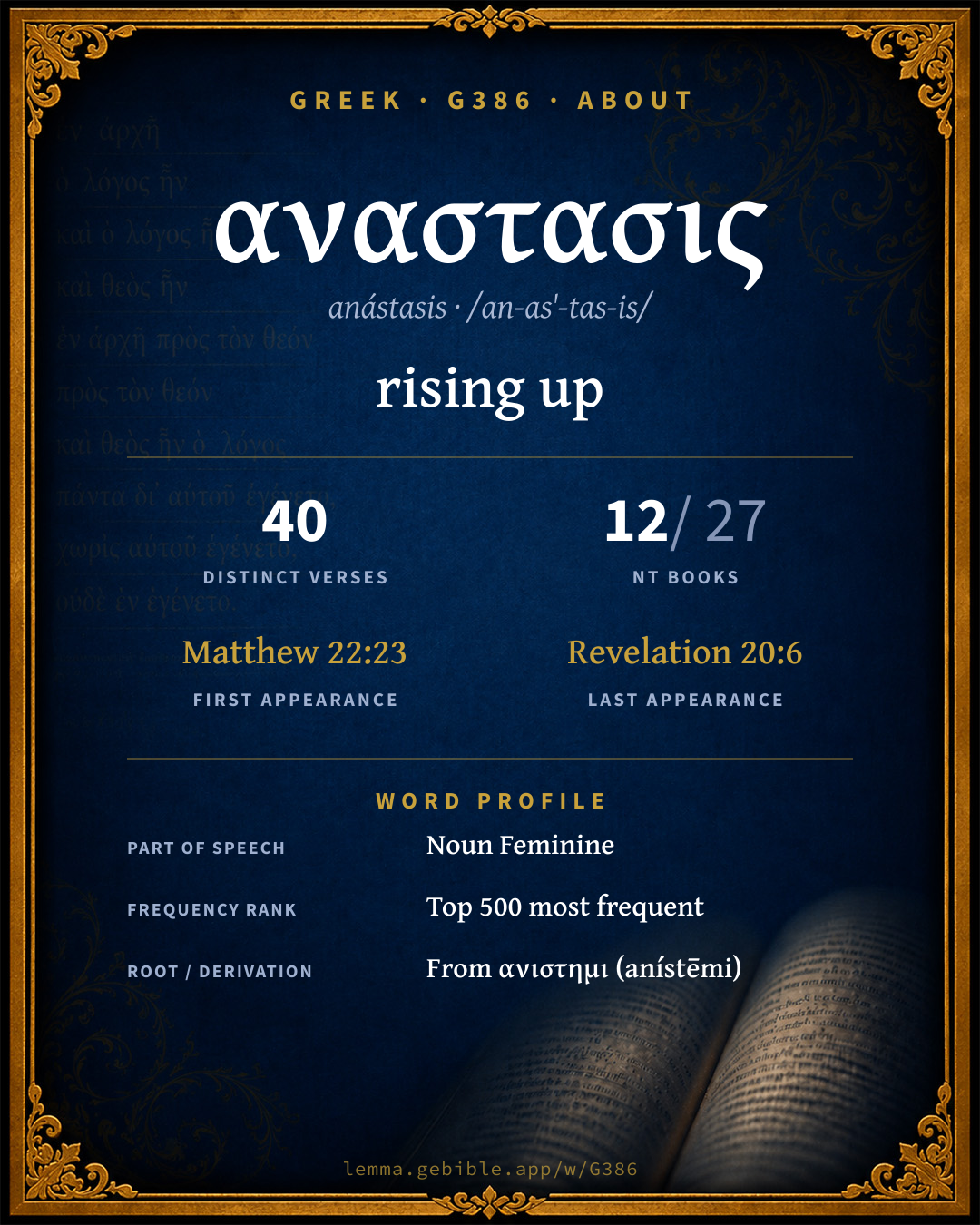
ἀνάστασις
rising up
‘rising up’ is one of 4 main senses fuller range ↓
Full lexicon entry — Thayer's Greek Lexicon
From Thayer's Greek Lexicon
Where this word appears
See every Genitive-case word in the Greek New Testament →
Grammar key — what these labels mean
Part of speech
- Noun
- A naming word — a person, place, thing, or idea.
Case
- Genitive
- The case of source, possession, or “of” — answers “whose / from what.”
- Accusative
- The case of the direct object and of extent.
- Dative
- The case of the indirect object, means, or location — “to / for / with / in.”
- Nominative
- The case of the subject (and the predicate nominative).
Gender
- Feminine
- Grammatically feminine.
Number
- Singular
- One.
Grammatical forms
- Noun, Genitive, Singular, Feminine 17 times (40%)
- Noun, Accusative, Singular, Feminine 12 times (29%)
- Noun, Dative, Singular, Feminine 7 times (17%)
- Noun, Nominative, Singular, Feminine 6 times (14%)
Parsed forms decoded from the imported morphology (Robinson–Tischendorf, public domain), counted across 42 parsed occurrences — not distinct verses.
Every verse where G386 appears — 40 distinct verses across 12 books. Click any verse to open its interlinear word-by-word view. Verse text shown in the World English Bible for context — . Each verse’s Greek form is shown with its reference; the English is not keyword-highlighted, since the data carries no word-level English alignment. Use “Compare translations” on any verse to read it across multiple English versions. This concordance covers the Greek New Testament; Septuagint (Greek Old Testament) occurrences of this word are not indexed here.
Matthew 4 verses
- Matthew 22:23 ἀνάστασιν n acc sg fem On that day Sadducees (those who say that there is no resurrection) came to him. They asked him,
- Matthew 22:28 ἀναστάσει n dat sg fem In the resurrection therefore, whose wife will she be of the seven? For they all had her."
- Matthew 22:30 ἀναστάσει n dat sg fem For in the resurrection they neither marry, nor are given in marriage, but are like God's angels in heaven.
- Matthew 22:31 ἀναστάσεως n gen sg fem But concerning the resurrection of the dead, haven't you read that which was spoken to you by God, saying,
Mark 2 verses
Luke 6 verses
- Luke 2:34 ἀνάστασιν n acc sg fem and Simeon blessed them, and said to Mary, his mother, "Behold, this child is set for the falling and the rising of many in Israel, and for a sign which is spoken against.
- Luke 14:14 ἀναστάσει n dat sg fem and you will be blessed, because they don't have the resources to repay you. For you will be repaid in the resurrection of the righteous."
- Luke 20:27 ἀνάστασιν n acc sg fem Some of the Sadducees came to him, those who deny that there is a resurrection.
- Luke 20:33 ἀναστάσει n dat sg fem Therefore in the resurrection whose wife of them will she be? For the seven had her as a wife."
- Luke 20:35 ἀναστάσεως n gen sg fem But those who are considered worthy to attain to that age and the resurrection from the dead, neither marry, nor are given in marriage.
- Luke 20:36 ἀναστάσεως n gen sg fem For they can't die any more, for they are like the angels, and are children of God, being children of the resurrection.
John 3 verses
- John 5:29 ἀνάστασιν ἀνάστασιν n acc sg fem n acc sg fem and will come out; those who have done good, to the resurrection of life; and those who have done evil, to the resurrection of judgment.
- John 11:24 ἀναστάσει n dat sg fem Martha said to him, "I know that he will rise again in the resurrection at the last day."
- John 11:25 ἀνάστασις n nom sg fem Jesus said to her, "I am the resurrection and the life. He who believes in me, though he die, yet will he live.
Acts 11 verses
- Acts 1:22 ἀναστάσεως n gen sg fem beginning from the baptism of John, to the day that he was received up from us, of these one must become a witness with us of his resurrection."
- Acts 2:31 ἀναστάσεως n gen sg fem he foreseeing this spoke about the resurrection of the Christ, that neither was his soul left in Hades, nor did his flesh see decay.
- Acts 4:2 ἀνάστασιν n acc sg fem being upset because they taught the people and proclaimed in Jesus the resurrection from the dead.
- Acts 4:33 ἀναστάσεως n gen sg fem With great power, the apostles gave their testimony of the resurrection of the Lord Jesus. Great grace was on them all.
- Acts 17:18 ἀνάστασιν n acc sg fem Some of the Epicurean and Stoic philosophers also were conversing with him. Some said, "What does this babbler want to say?" Others said, "He seems to be advocating foreign deities," because he preached Jesus and the resurrection.
- Acts 17:32 ἀνάστασιν n acc sg fem Now when they heard of the resurrection of the dead, some mocked; but others said, "We want to hear you again concerning this."
- Acts 23:6 ἀναστάσεως n gen sg fem But when Paul perceived that the one part were Sadducees and the other Pharisees, he cried out in the council, "Men and brothers, I am a Pharisee, a son of Pharisees. Concerning the hope and resurrection of the dead I am being judged!"
- Acts 23:8 ἀνάστασιν n acc sg fem For the Sadducees say that there is no resurrection, nor angel, nor spirit; but the Pharisees confess all of these.
- Acts 24:15 ἀνάστασιν n acc sg fem having hope toward God, which these also themselves look for, that there will be a resurrection of the dead, both of the just and unjust.
- Acts 24:21 ἀναστάσεως n gen sg fem unless it is for this one thing that I cried standing among them, 'Concerning the resurrection of the dead I am being judged before you today!'"
- Acts 26:23 ἀναστάσεως n gen sg fem how the Christ must suffer, and how, by the resurrection of the dead, he would be first to proclaim light both to these people and to the Gentiles."
Romans 2 verses
- Romans 1:4 ἀναστάσεως n gen sg fem who was declared to be the Son of God with power, according to the Spirit of holiness, by the resurrection from the dead, Jesus Christ our Lord,
- Romans 6:5 ἀναστάσεως n gen sg fem For if we have become united with him in the likeness of his death, we will also be part of his resurrection;
1 Corinthians 4 verses
- 1 Corinthians 15:12 ἀνάστασις n nom sg fem Now if Christ is preached, that he has been raised from the dead, how do some among you say that there is no resurrection of the dead?
- 1 Corinthians 15:13 ἀνάστασις n nom sg fem But if there is no resurrection of the dead, neither has Christ been raised.
- 1 Corinthians 15:21 ἀνάστασις n nom sg fem For since death came by man, the resurrection of the dead also came by man.
- 1 Corinthians 15:42 ἀνάστασις n nom sg fem So also is the resurrection of the dead. It is sown in corruption; it is raised in incorruption.
Philippians 1 verse
2 Timothy 1 verse
Hebrews 2 verses
- Hebrews 6:2 ἀναστάσεώς n gen sg fem of the teaching of baptisms, of laying on of hands, of resurrection of the dead, and of eternal judgment.
- Hebrews 11:35 ἀναστάσεως ἀναστάσεως n gen sg fem n gen sg fem Women received their dead by resurrection. Others were tortured, not accepting their deliverance, that they might obtain a better resurrection.
1 Peter 2 verses
- 1 Peter 1:3 ἀναστάσεως n gen sg fem Blessed be the God and Father of our Lord Jesus Christ, who according to his great mercy became our father again to a living hope through the resurrection of Jesus Christ from the dead,
- 1 Peter 3:21 ἀναστάσεως n gen sg fem This is a symbol of baptism, which now saves you-- not the putting away of the filth of the flesh, but the answer of a good conscience toward God, through the resurrection of Jesus Christ,
Revelation 2 verses
- Revelation 20:5 ἀνάστασις n nom sg fem The rest of the dead didn't live until the thousand years were finished. This is the first resurrection.
- Revelation 20:6 ἀναστάσει n dat sg fem Blessed and holy is he who has part in the first resurrection. Over these, the second death has no power, but they will be priests of God and of Christ, and will reign with him one thousand years.
About this entry
At a glance — auto-summarized from this page’s data, not written by a person. Every figure links to its source below. This summary describes the numbers; it doesn’t interpret them.
αναστασις (anástasis) is a Greek noun most often rendered “rising up.” Ranging over 4 senses, it is not a single-sense word. The Greek New Testament uses it across 40 verses — moderately common. Acts dominates its distribution — 11 of 40 verses. It first appears in Matthew 22:23. For the data behind this summary, explore the sense tree and the renderings breakdown below.
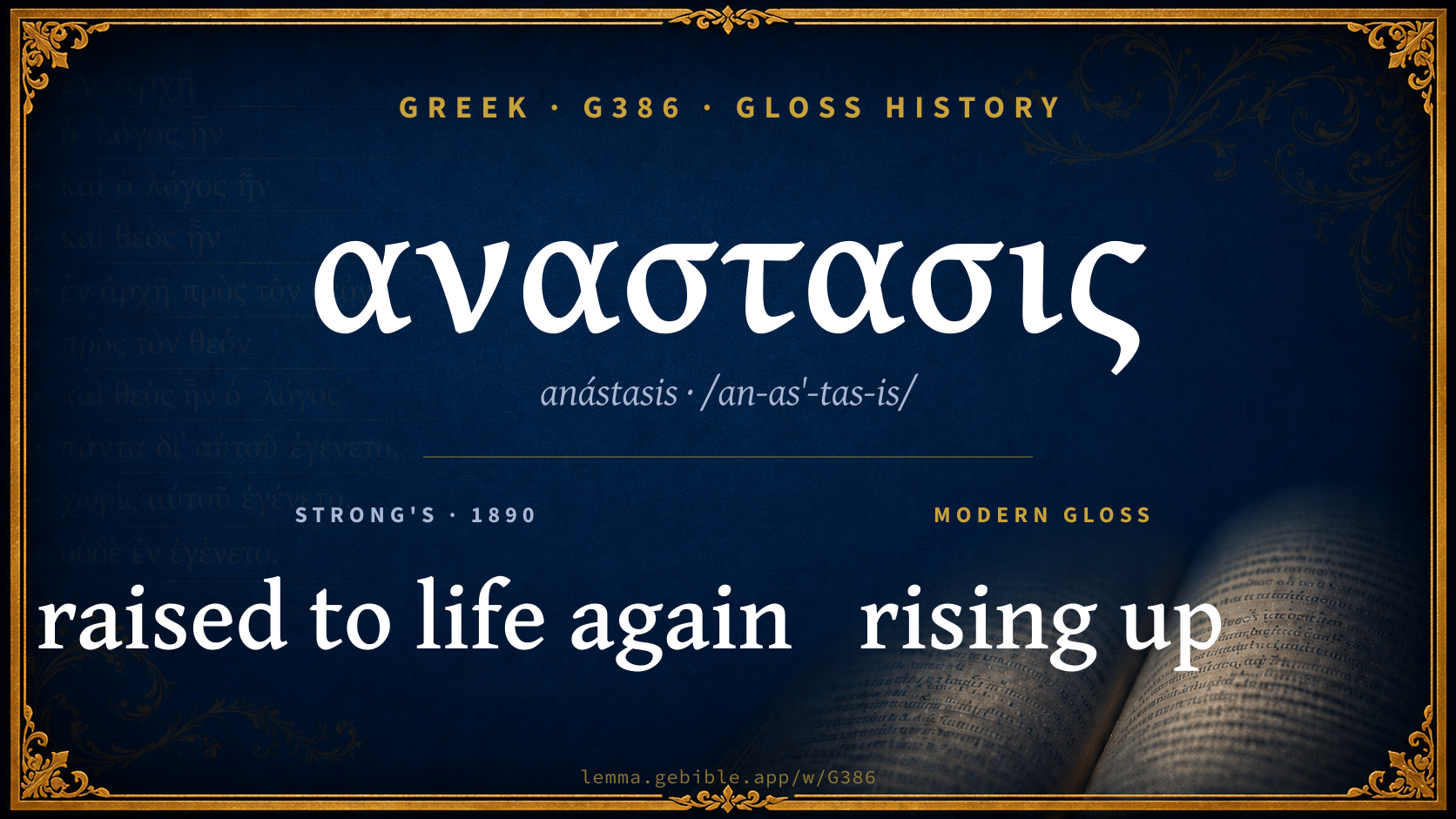
Gloss history
Strong's 1890 vs modern scholarship
About this word
Strong's G386 catalogs a Greek word from the Greek New Testament.
These counts are not copied from any lexicon or concordance. They are computed here, from the morphology-tagged Greek New Testament. What Lemma adds →
- 40
- distinct verses
- The word appears in 40 distinct verses.
- 12 / 27
- NT books
- The word appears in 12 of 27 New Testament books.
- #356
- by frequency
- Top 500 most frequent Greek words (rank 356 of 5,347 Greek words by occurrence).
View all 40 occurrences in the concordance →
By section of the New Testament
By traditional corpus
Conventional, traditional groupings — biblical authorship is debated, so this is a traditional corpus grouping, not an authorship claim. Some books belong to more than one corpus (Luke is in both the Gospels and the Lukan corpus, and so on), so these shares overlap and need not total 100%. Each figure is a share of the word’s 40 distinct verses.
- Lukan (Luke–Acts) 17 verses · 43%
- Gospels 15 verses · 38%
- Pauline corpus 8 verses · 20%
- Johannine 5 verses · 13%
- Hebrews 2 verses · 5%
- General (Catholic) Epistles 2 verses · 5%
- Revelation 2 verses · 5%
How translations render this word
Counts come from each version’s own published word-to-Strong’s tagging or interlinear alignment — an approximate guide to how each version renders this word, not a word-level alignment the data otherwise carries. Because each total is that version’s own tagged count, the per-version totals vary from one another and need not match the appearance or distinct-verse counts above. These counts may also differ from a printed concordance because Lemma counts each distinctly tagged rendering and does not collapse phrase taggings into a single head-word total. This is a fixed set of word-tagged versions (KJV, ASV, BSB, ULT) and does not change with the reading translation you choose elsewhere. Each version’s license is shown beside its name below (and on Sources).
- King James Version: Resurrection 37×
- American Standard Version: Resurrection 37×
- Berean Standard Bible: Resurrection 39×, Rise 2×
- unfoldingWord Literal Text: Resurrection 41×, Of 2×
King James Version Public Domain
Renders G386 across 41 tagged occurrences — most commonly:
Plus 4 renderings that appear only once — usually multi-word phrases or single function words the recovered tagging swept in, not distinct renderings. Not rendered by a distinct English word in 1 further occurrence.
American Standard Version Public Domain
Renders G386 across 41 tagged occurrences — most commonly:
Plus 4 renderings that appear only once — usually multi-word phrases or single function words the recovered tagging swept in, not distinct renderings.
Berean Standard Bible Public Domain
Renders G386 across 42 tagged occurrences — most commonly:
Plus 1 rendering that appears only once — usually multi-word phrases or single function words the recovered tagging swept in, not distinct renderings.
unfoldingWord Literal Text CC BY-SA 4.0
Renders G386 across 45 tagged occurrences — most commonly:
Plus 2 renderings that appear only once — usually multi-word phrases or single function words the recovered tagging swept in, not distinct renderings.
Senses in Thayer's
The 4 senses Thayer's distinguishes for this word, in lexicon order (not ranked by frequency or importance). The full entry — with sub-senses — is in the Lexicon Entry tab.
- a raising up, rising (e.g. from a seat)
- that of Christ
- that of all men at the end of this present age
- the resurrection of certain ones history who were restored to life ( Heb. 11:35 )
Word origin
Derived from ανιστημι (anístēmi) (G450) — to raise.
From G450 ; a standing up again that is (literally) a resurrection from death (individual general or by implication (its author)) or (figuratively) a (moral) recovery (of spiritual truth): - raised to life again resurrection rise from the dead that should rise rising again.
— Strong’s Exhaustive Concordance (1890), public domain.
Forms in the corpus
The 5 distinct written forms G386 takes in the Greek New Testament, most frequent first — each parse links to that case’s occurrences in the concordance.
| Form | Parsing | Example | Uses |
|---|---|---|---|
| ἀναστάσεως anastáseōs | Noun, Genitive, Singular, Feminine | Matthew 22:31 | 16 |
| ἀνάστασιν anástasin | Noun, Accusative, Singular, Feminine | Matthew 22:23 | 12 |
| ἀναστάσει anastásei | Noun, Dative, Singular, Feminine | Matthew 22:28 | 7 |
| ἀνάστασις anástasis | Noun, Nominative, Singular, Feminine | John 11:25 | 6 |
| ἀναστάσεώς anastáseṓs | Noun, Genitive, Singular, Feminine | Hebrews 6:2 | 1 |
Same root — word family
Other Thayer's entries built from the same root as G386, grouped by Strong’s listed origin. These share a root / origin per the lexicon — not necessarily a shared meaning. Each links to that word’s own entry.
Derives from
Shares the same root
Compare all same-root words → They share a root, not necessarily a meaning.
Septuagint usage
The same Greek word αναστασις appears 4 times in the Greek Old Testament (Septuagint), across 4 verses in 4 books.
- 4
- LXX occurrences
- Tagged occurrences of this Greek word in the Septuagint.
- 4
- verses
- Distinct Septuagint verses containing this word.
- 4 / 39
- OT books
- The word appears in 4 of the 39 Old Testament books.
Sample Septuagint occurrences
- Psalms 65:1 ἀνάστασις
- Lamentations 3:63 ἀνάστασις
- Daniel 11:20 ἀνάστασις
- Zephaniah 3:8 ἀνάστασις
Septuagint occurrences (same lexeme)
Every verse where the same Strong’s number (G386) appears in the Greek Septuagint. Verse text shown in the World English Bible for context; the Greek form is the matched word — the English is not keyword-highlighted.
- Psalms 65:1 ἀνάστασις Praise waits for you, God, in Zion. To you shall vows be performed.
- Lamentations 3:63 ἀνάστασις See you their sitting down, and their rising up; I am their song.
- Daniel 11:20 ἀνάστασις Then shall stand up in his place one who shall cause a tax collector to pass through the kingdom to maintain its glory; but within few days he shall be destroyed, neither in anger, nor in battle.
- Zephaniah 3:8 ἀνάστασις "Therefore wait for me," says Yahweh, "until the day that I rise up to the prey, for my determination is to gather the nations, that I may assemble the kingdoms, to pour on them my indignation, even all my fierce anger, for all the earth will be devoured with the fire of my jealousy.
These are occurrences of the same Greek lexeme (G386) in the Septuagint — not a translation of any one Hebrew word. The store carries no word-level Hebrew↔Greek alignment, so no Hebrew original is asserted here. Counts come from the recovered LXX Strong's tagging — high-frequency vocabulary is well covered, while rare or late forms may be untagged — so they reflect tagged occurrences and may slightly undercount.