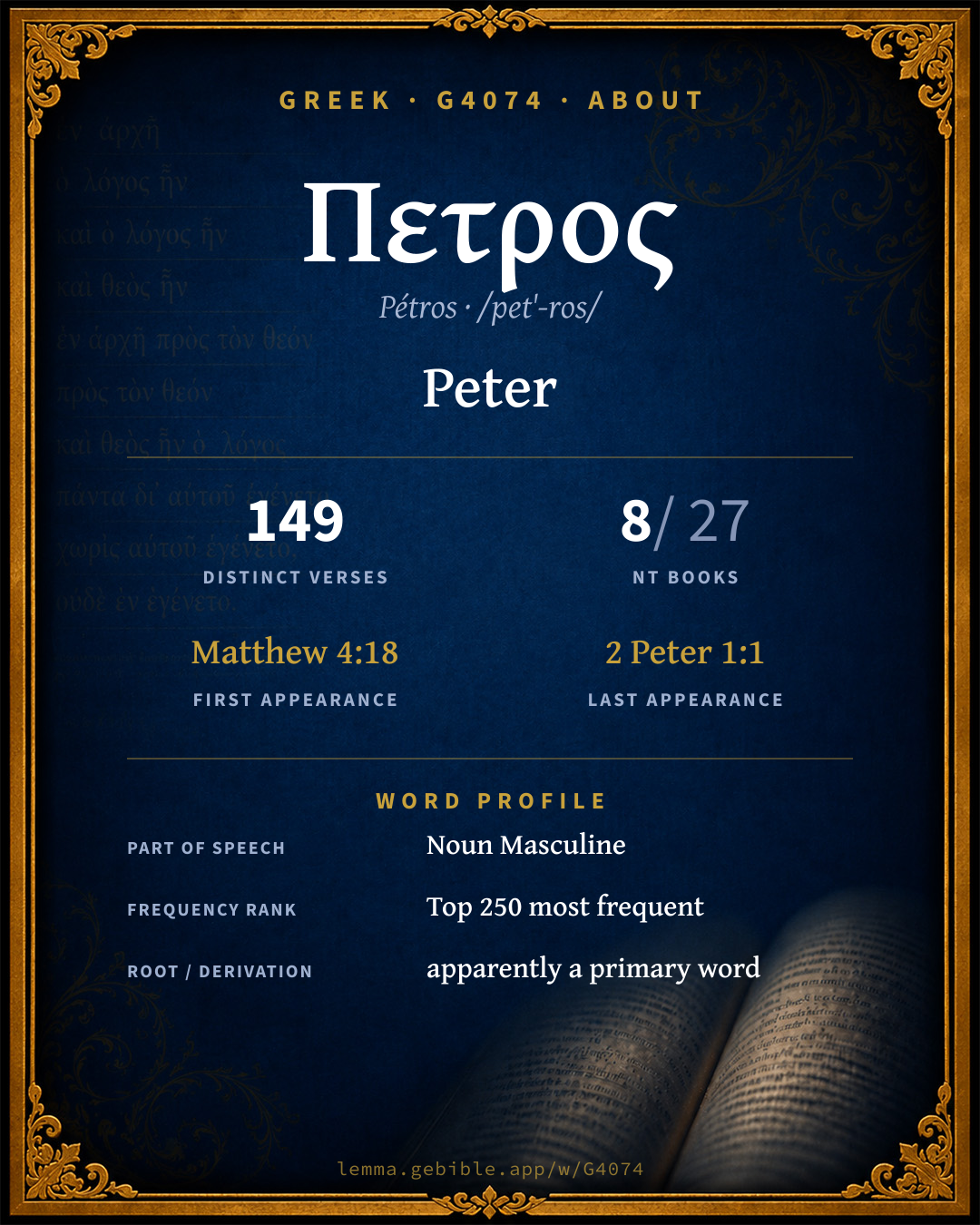
Πέτρος
Peter
Thayer's lists 2 entries for ‘Peter’ fuller range ↓
Full lexicon entry — Thayer's Greek Lexicon
From Thayer's Greek Lexicon
Where this word appears
See every Nominative-case word in the Greek New Testament →
Grammar key — what these labels mean
Part of speech
- Noun
- A naming word — a person, place, thing, or idea.
Case
- Nominative
- The case of the subject (and the predicate nominative).
- Accusative
- The case of the direct object and of extent.
- Dative
- The case of the indirect object, means, or location — “to / for / with / in.”
- Genitive
- The case of source, possession, or “of” — answers “whose / from what.”
- Vocative
- The case of direct address (“O Lord”).
Gender
- Masculine
- Grammatically masculine.
Number
- Singular
- One.
Grammatical forms
- Noun, Nominative, Singular, Masculine 99 times (64%)
- Noun, Accusative, Singular, Masculine 25 times (16%)
- Noun, Dative, Singular, Masculine 15 times (10%)
- Noun, Genitive, Singular, Masculine 12 times (8%)
- Noun, Vocative, Singular, Masculine 3 times (2%)
Parsed forms decoded from the imported morphology (Robinson–Tischendorf, public domain), counted across 154 parsed occurrences — not distinct verses.
Every verse where G4074 appears — 149 distinct verses across 8 books. Click any verse to open its interlinear word-by-word view. Verse text shown in the World English Bible for context — . Each verse’s Greek form is shown with its reference; the English is not keyword-highlighted, since the data carries no word-level English alignment. Use “Compare translations” on any verse to read it across multiple English versions. This concordance covers the Greek New Testament; Septuagint (Greek Old Testament) occurrences of this word are not indexed here.
Matthew 23 verses
- Matthew 4:18 Πέτρον n acc sg masc Walking by the sea of Galilee, he saw two brothers: Simon, who is called Peter, and Andrew, his brother, casting a net into the sea; for they were fishermen.
- Matthew 8:14 Πέτρου n gen sg masc When Jesus came into Peter's house, he saw his wife's mother lying sick with a fever.
- Matthew 10:2 Πέτρος n nom sg masc Now the names of the twelve apostles are these. The first, Simon, who is called Peter; Andrew, his brother; James the son of Zebedee; John, his brother;
- Matthew 14:28 Πέτρος n nom sg masc Peter answered him and said, "Lord, if it is you, command me to come to you on the waters."
- Matthew 14:29 Πέτρος n nom sg masc He said, "Come!" Peter stepped down from the boat, and walked on the waters to come to Jesus.
- Matthew 15:15 Πέτρος n nom sg masc Peter answered him, "Explain the parable to us."
- Matthew 16:16 Πέτρος n nom sg masc Simon Peter answered, "You are the Christ, the Son of the living God."
- Matthew 16:18 Πέτρος n nom sg masc I also tell you that you are Peter, and on this rock I will build my assembly, and the gates of Hades will not prevail against it.
- Matthew 16:22 Πέτρος n nom sg masc Peter took him aside, and began to rebuke him, saying, "Far be it from you, Lord! This will never be done to you."
- Matthew 16:23 Πέτρῳ n dat sg masc But he turned, and said to Peter, "Get behind me, Satan! You are a stumbling-block to me, for you are not setting your mind on the things of God, but on the things of men."
- Matthew 17:1 Πέτρον n acc sg masc After six days, Jesus took with him Peter, James, and John his brother, and brought them up into a high mountain by themselves.
- Matthew 17:4 Πέτρος n nom sg masc Peter answered, and said to Jesus, "Lord, it is good for us to be here. If you want, let's make three tents here: one for you, one for Moses, and one for Elijah."
- Matthew 17:24 Πέτρῳ n dat sg masc When they had come to Capernaum, those who collected the didrachma coins came to Peter, and said, "Doesn't your teacher pay the didrachma?"
- Matthew 18:21 Πέτρος n nom sg masc Then Peter came and said to him, "Lord, how often shall my brother sin against me, and I forgive him? Until seven times?"
- Matthew 19:27 Πέτρος n nom sg masc Then Peter answered, "Behold, we have left everything, and followed you. What then will we have?"
- Matthew 26:33 Πέτρος n nom sg masc But Peter answered him, "Even if all will be made to stumble because of you, I will never be made to stumble."
- Matthew 26:35 Πέτρος n nom sg masc Peter said to him, "Even if I must die with you, I will not deny you." All of the disciples also said likewise.
- Matthew 26:37 Πέτρον n acc sg masc He took with him Peter and the two sons of Zebedee, and began to be sorrowful and severely troubled.
- Matthew 26:40 Πέτρῳ n dat sg masc He came to the disciples, and found them sleeping, and said to Peter, "What, couldn't you watch with me for one hour?
- Matthew 26:58 Πέτρος n nom sg masc But Peter followed him from a distance, to the court of the high priest, and entered in and sat with the officers, to see the end.
- Matthew 26:69 Πέτρος n nom sg masc Now Peter was sitting outside in the court, and a maid came to him, saying, "You were also with Jesus, the Galilean!"
- Matthew 26:73 Πέτρῳ n dat sg masc After a little while those who stood by came and said to Peter, "Surely you are also one of them, for your speech makes you known."
- Matthew 26:75 Πέτρος n nom sg masc Peter remembered the word which Jesus had said to him, "Before the rooster crows, you will deny me three times." He went out and wept bitterly.
Mark 19 verses
- Mark 3:16 Πέτρον n acc sg masc Simon, to whom he gave the name Peter;
- Mark 5:37 Πέτρον n acc sg masc He allowed no one to follow him, except Peter, James, and John the brother of James.
- Mark 8:29 Πέτρος n nom sg masc He said to them, "But who do you say that I am?" Peter answered, "You are the Christ."
- Mark 8:32 Πέτρος n nom sg masc He spoke to them openly. Peter took him, and began to rebuke him.
- Mark 8:33 Πέτρῳ n dat sg masc But he, turning around, and seeing his disciples, rebuked Peter, and said, "Get behind me, Satan! For you have in mind not the things of God, but the things of men."
- Mark 9:2 Πέτρον n acc sg masc After six days Jesus took with him Peter, James, and John, and brought them up onto a high mountain privately by themselves, and he was changed into another form in front of them.
- Mark 9:5 Πέτρος n nom sg masc Peter answered Jesus, "Rabbi, it is good for us to be here. Let's make three tents: one for you, one for Moses, and one for Elijah."
- Mark 10:28 Πέτρος n nom sg masc Peter began to tell him, "Behold, we have left all, and have followed you."
- Mark 11:21 Πέτρος n nom sg masc Peter, remembering, said to him, "Rabbi, look! The fig tree which you cursed has withered away."
- Mark 13:3 Πέτρος n nom sg masc As he sat on the Mount of Olives opposite the temple, Peter, James, John, and Andrew asked him privately,
- Mark 14:29 Πέτρος n nom sg masc But Peter said to him, "Although all will be offended, yet I will not."
- Mark 14:33 Πέτρον n acc sg masc He took with him Peter, James, and John, and began to be greatly troubled and distressed.
- Mark 14:37 Πέτρῳ n dat sg masc He came and found them sleeping, and said to Peter, "Simon, are you sleeping? Couldn't you watch one hour?
- Mark 14:54 Πέτρος n nom sg masc Peter had followed him from a distance, until he came into the court of the high priest. He was sitting with the officers, and warming himself in the light of the fire.
- Mark 14:66 Πέτρου n gen sg masc As Peter was in the courtyard below, one of the maids of the high priest came,
- Mark 14:67 Πέτρον n acc sg masc and seeing Peter warming himself, she looked at him, and said, "You were also with the Nazarene, Jesus!"
- Mark 14:70 Πέτρῳ n dat sg masc But he again denied it. After a little while again those who stood by said to Peter, "You truly are one of them, for you are a Galilean, and your speech shows it."
- Mark 14:72 Πέτρος n nom sg masc The rooster crowed the second time. Peter remembered the word, how that Jesus said to him, "Before the rooster crows twice, you will deny me three times." When he thought about that, he wept.
- Mark 16:7 Πέτρῳ n dat sg masc But go, tell his disciples and Peter, 'He goes before you into Galilee. There you will see him, as he said to you.'"
Luke 17 verses
- Luke 5:8 Πέτρος n nom sg masc But Simon Peter, when he saw it, fell down at Jesus' knees, saying, "Depart from me, for I am a sinful man, Lord."
- Luke 6:14 Πέτρον n acc sg masc Simon, whom he also named Peter; Andrew, his brother; James; John; Philip; Bartholomew;
- Luke 8:45 Πέτρος n nom sg masc Jesus said, "Who touched me?" When all denied it, Peter and those with him said, "Master, the multitudes press and jostle you, and you say, 'Who touched me?'"
- Luke 8:51 Πέτρον n acc sg masc When he came to the house, he didn't allow anyone to enter in, except Peter, John, James, the father of the child, and her mother.
- Luke 9:20 Πέτρος n nom sg masc He said to them, "But who do you say that I am?" Peter answered, "The Christ of God."
- Luke 9:28 Πέτρον n acc sg masc It happened about eight days after these sayings, that he took with him Peter, John, and James, and went up onto the mountain to pray.
- Luke 9:32 Πέτρος n nom sg masc Now Peter and those who were with him were heavy with sleep, but when they were fully awake, they saw his glory, and the two men who stood with him.
- Luke 9:33 Πέτρος n nom sg masc It happened, as they were parting from him, that Peter said to Jesus, "Master, it is good for us to be here. Let's make three tents: one for you, and one for Moses, and one for Elijah," not knowing what he said.
- Luke 12:41 Πέτρος n nom sg masc Peter said to him, "Lord, are you telling this parable to us, or to everybody?"
- Luke 18:28 Πέτρος n nom sg masc Peter said, "Look, we have left everything, and followed you."
- Luke 22:8 Πέτρον n acc sg masc He sent Peter and John, saying, "Go and prepare the Passover for us, that we may eat."
- Luke 22:34 Πέτρε n voc sg masc He said, "I tell you, Peter, the rooster will by no means crow today until you deny that you know me three times."
- Luke 22:54 Πέτρος n nom sg masc They seized him, and led him away, and brought him into the high priest's house. But Peter followed from a distance.
- Luke 22:55 Πέτρος n nom sg masc When they had kindled a fire in the middle of the courtyard, and had sat down together, Peter sat among them.
- Luke 22:58 Πέτρος n nom sg masc After a little while someone else saw him, and said, "You also are one of them!" But Peter answered, "Man, I am not!"
- Luke 22:60 Πέτρος n nom sg masc But Peter said, "Man, I don't know what you are talking about!" Immediately, while he was still speaking, a rooster crowed.
- Luke 22:61 Πέτρῳ Πέτρος n dat sg masc n nom sg masc The Lord turned, and looked at Peter. Then Peter remembered the Lord's word, how he said to him, "Before the rooster crows you will deny me three times."
John 32 verses
- John 1:41 Πέτρου n gen sg masc He first found his own brother, Simon, and said to him, "We have found the Messiah!" (which is, being interpreted, Christ).
- John 1:43 Πέτρος n nom sg masc On the next day, he was determined to go out into Galilee, and he found Philip. Jesus said to him, "Follow me."
- John 1:45 Πέτρου n gen sg masc Philip found Nathanael, and said to him, "We have found him, of whom Moses in the law, and the prophets, wrote: Jesus of Nazareth, the son of Joseph."
- John 6:8 Πέτρου n gen sg masc One of his disciples, Andrew, Simon Peter's brother, said to him,
- John 6:68 Πέτρος n nom sg masc Simon Peter answered him, "Lord, to whom would we go? You have the words of eternal life.
- John 13:6 Πέτρον n acc sg masc Then he came to Simon Peter. He said to him, "Lord, do you wash my feet?"
- John 13:8 Πέτρος n nom sg masc Peter said to him, "You will never wash my feet!" Jesus answered him, "If I don't wash you, you have no part with me."
- John 13:9 Πέτρος n nom sg masc Simon Peter said to him, "Lord, not my feet only, but also my hands and my head!"
- John 13:24 Πέτρος n nom sg masc Simon Peter therefore beckoned to him, and said to him, "Tell us who it is of whom he speaks."
- John 13:36 Πέτρος n nom sg masc Simon Peter said to him, "Lord, where are you going?" Jesus answered, "Where I am going, you can't follow now, but you will follow afterwards."
- John 13:37 Πέτρος n nom sg masc Peter said to him, "Lord, why can't I follow you now? I will lay down my life for you."
- John 18:10 Πέτρος n nom sg masc Simon Peter therefore, having a sword, drew it, and struck the high priest's servant, and cut off his right ear. The servant's name was Malchus.
- John 18:11 Πέτρῳ n dat sg masc Jesus therefore said to Peter, "Put the sword into its sheath. The cup which the Father has given me, shall I not surely drink it?"
- John 18:15 Πέτρος n nom sg masc Simon Peter followed Jesus, as did another disciple. Now that disciple was known to the high priest, and entered in with Jesus into the court of the high priest;
- John 18:16 Πέτρος Πέτρον n nom sg masc n acc sg masc but Peter was standing at the door outside. So the other disciple, who was known to the high priest, went out and spoke to her who kept the door, and brought in Peter.
- John 18:17 Πέτρῳ n dat sg masc Then the maid who kept the door said to Peter, "Are you also one of this man's disciples?" He said, "I am not."
- John 18:18 Πέτρος n nom sg masc Now the servants and the officers were standing there, having made a fire of coals, for it was cold. They were warming themselves. Peter was with them, standing and warming himself.
- John 18:25 Πέτρος n nom sg masc Now Simon Peter was standing and warming himself. They said therefore to him, "You aren't also one of his disciples, are you?" He denied it, and said, "I am not."
- John 18:26 Πέτρος n nom sg masc One of the servants of the high priest, being a relative of him whose ear Peter had cut off, said, "Didn't I see you in the garden with him?"
- John 18:27 Πέτρος n nom sg masc Peter therefore denied it again, and immediately the rooster crowed.
- John 20:2 Πέτρον n acc sg masc Therefore she ran and came to Simon Peter, and to the other disciple whom Jesus loved, and said to them, "They have taken away the Lord out of the tomb, and we don't know where they have laid him!"
- John 20:3 Πέτρος n nom sg masc Therefore Peter and the other disciple went out, and they went toward the tomb.
- John 20:4 Πέτρου n gen sg masc They both ran together. The other disciple outran Peter, and came to the tomb first.
- John 20:6 Πέτρος n nom sg masc Then Simon Peter came, following him, and entered into the tomb. He saw the linen cloths lying,
- John 21:2 Πέτρος n nom sg masc Simon Peter, Thomas called Didymus, Nathanael of Cana in Galilee, and the sons of Zebedee, and two others of his disciples were together.
- John 21:3 Πέτρος n nom sg masc Simon Peter said to them, "I'm going fishing." They told him, "We are also coming with you." They immediately went out, and entered into the boat. That night, they caught nothing.
- John 21:7 Πέτρῳ Πέτρος n dat sg masc n nom sg masc That disciple therefore whom Jesus loved said to Peter, "It's the Lord!" So when Simon Peter heard that it was the Lord, he wrapped his coat around him (for he was naked), and threw himself into the sea.
- John 21:11 Πέτρος n nom sg masc Simon Peter went up, and drew the net to land, full of great fish, one hundred fifty-three; and even though there were so many, the net wasn't torn.
- John 21:15 Πέτρῳ n dat sg masc So when they had eaten their breakfast, Jesus said to Simon Peter, "Simon, son of Jonah, do you love me more than these?" He said to him, "Yes, Lord; you know that I have affection for you." He said to him, "Feed my lambs."
- John 21:17 Πέτρος n nom sg masc He said to him the third time, "Simon, son of Jonah, do you have affection for me?" Peter was grieved because he asked him the third time, "Do you have affection for me?" He said to him, "Lord, you know everything. You know that I have affection for you." Jesus said to him, "Feed my sheep.
- John 21:20 Πέτρος n nom sg masc Then Peter, turning around, saw a disciple following. This was the disciple whom Jesus sincerely loved, the one who had also leaned on Jesus' breast at the supper and asked, "Lord, who is going to betray You?"
- John 21:21 Πέτρος n nom sg masc Peter seeing him, said to Jesus, "Lord, what about this man?"
Acts 54 verses
- Acts 1:13 Πέτρος n nom sg masc When they had come in, they went up into the upper room, where they were staying; that is Peter, John, James, Andrew, Philip, Thomas, Bartholomew, Matthew, James the son of Alphaeus, Simon the Zealot, and Judas the son of James.
- Acts 1:15 Πέτρος n nom sg masc In these days, Peter stood up in the midst of the disciples (and the number of names was about one hundred twenty), and said,
- Acts 2:14 Πέτρος n nom sg masc But Peter, standing up with the eleven, lifted up his voice, and spoke out to them, "You men of Judea, and all you who dwell at Jerusalem, let this be known to you, and listen to my words.
- Acts 2:37 Πέτρον n acc sg masc Now when they heard this, they were cut to the heart, and said to Peter and the rest of the apostles, "Brothers, what shall we do?"
- Acts 2:38 Πέτρος n nom sg masc Peter said to them, "Repent, and be baptized, everyone of you, in the name of Jesus Christ for the forgiveness of sins, and you will receive the gift of the Holy Spirit.
- Acts 3:1 Πέτρος n nom sg masc Peter and John were going up into the temple at the hour of prayer, the ninth hour.
- Acts 3:3 Πέτρον n acc sg masc Seeing Peter and John about to go into the temple, he asked to receive gifts for the needy.
- Acts 3:4 Πέτρος n nom sg masc Peter, fastening his eyes on him, with John, said, "Look at us."
- Acts 3:6 Πέτρος n nom sg masc But Peter said, "Silver and gold have I none, but what I have, that I give you. In the name of Jesus Christ of Nazareth, get up and walk!"
- Acts 3:11 Πέτρον n acc sg masc As the lame man who was healed held on to Peter and John, all the people ran together to them in the porch that is called Solomon's, greatly wondering.
- Acts 3:12 Πέτρος n nom sg masc When Peter saw it, he responded to the people, "You men of Israel, why do you marvel at this man? Why do you fasten your eyes on us, as though by our own power or godliness we had made him walk?
- Acts 4:8 Πέτρος n nom sg masc Then Peter, filled with the Holy Spirit, said to them, "You rulers of the people, and elders of Israel,
- Acts 4:13 Πέτρου n gen sg masc Now when they saw the boldness of Peter and John, and had perceived that they were unlearned and ignorant men, they marveled. They recognized that they had been with Jesus.
- Acts 4:19 Πέτρος n nom sg masc But Peter and John answered them, "Whether it is right in the sight of God to listen to you rather than to God, judge for yourselves,
- Acts 5:3 Πέτρος n nom sg masc But Peter said, "Ananias, why has Satan filled your heart to lie to the Holy Spirit, and to keep back part of the price of the land?
- Acts 5:8 Πέτρος n nom sg masc Peter answered her, "Tell me whether you sold the land for so much." She said, "Yes, for so much."
- Acts 5:9 Πέτρος n nom sg masc But Peter asked her, "How is it that you have agreed together to tempt the Spirit of the Lord? Behold, the feet of those who have buried your husband are at the door, and they will carry you out."
- Acts 5:15 Πέτρου n gen sg masc They even carried out the sick into the streets, and laid them on cots and mattresses, so that as Peter came by, at the least his shadow might overshadow some of them.
- Acts 5:29 Πέτρος n nom sg masc But Peter and the apostles answered, "We must obey God rather than men.
- Acts 8:14 Πέτρον n acc sg masc Now when the apostles who were at Jerusalem heard that Samaria had received the word of God, they sent Peter and John to them,
- Acts 8:20 Πέτρος n nom sg masc But Peter said to him, "May your silver perish with you, because you thought you could obtain the gift of God with money!
- Acts 9:32 Πέτρον n acc sg masc It happened, as Peter went throughout all those parts, he came down also to the saints who lived at Lydda.
- Acts 9:34 Πέτρος n nom sg masc Peter said to him, "Aeneas, Jesus Christ heals you. Get up and make your bed!" Immediately he arose.
- Acts 9:38 Πέτρος n nom sg masc As Lydda was near Joppa, the disciples, hearing that Peter was there, sent two men to him, imploring him not to delay in coming to them.
- Acts 9:39 Πέτρος n nom sg masc Peter got up and went with them. When he had come, they brought him into the upper chamber. All the widows stood by him weeping, and showing the coats and garments which Dorcas had made while she was with them.
- Acts 9:40 Πέτρος Πέτρον n nom sg masc n acc sg masc Peter put them all out, and kneeled down and prayed. Turning to the body, he said, "Tabitha, get up!" She opened her eyes, and when she saw Peter, she sat up.
- Acts 10:5 Πέτρος n nom sg masc Now send men to Joppa, and get Simon, who is surnamed Peter.
- Acts 10:9 Πέτρος n nom sg masc Now on the next day as they were on their journey, and got close to the city, Peter went up on the housetop to pray at about noon.
- Acts 10:13 Πέτρε n voc sg masc A voice came to him, "Rise, Peter, kill and eat!"
- Acts 10:14 Πέτρος n nom sg masc But Peter said, "Not so, Lord; for I have never eaten anything that is common or unclean."
- Acts 10:17 Πέτρος n nom sg masc Now while Peter was very perplexed in himself what the vision which he had seen might mean, behold, the men who were sent by Cornelius, having made inquiry for Simon's house, stood before the gate,
- Acts 10:18 Πέτρος n nom sg masc and called and asked whether Simon, who was surnamed Peter, was lodging there.
- Acts 10:19 Πέτρου n gen sg masc While Peter was pondering the vision, the Spirit said to him, "Behold, three men seek you.
- Acts 10:21 Πέτρος n nom sg masc Peter went down to the men, and said, "Behold, I am he whom you seek. Why have you come?"
- Acts 10:25 Πέτρον n acc sg masc When it happened that Peter entered, Cornelius met him, fell down at his feet, and worshiped him.
- Acts 10:26 Πέτρος n nom sg masc But Peter raised him up, saying, "Stand up! I myself am also a man."
- Acts 10:32 Πέτρος n nom sg masc Send therefore to Joppa, and summon Simon, who is surnamed Peter. He lodges in the house of Simon a tanner, by the seaside. When he comes, he will speak to you.'
- Acts 10:34 Πέτρος n nom sg masc Peter opened his mouth and said, "Truly I perceive that God doesn't show favoritism;
- Acts 10:44 Πέτρου n gen sg masc While Peter was still speaking these words, the Holy Spirit fell on all those who heard the word.
- Acts 10:45 Πέτρῳ n dat sg masc They of the circumcision who believed were amazed, as many as came with Peter, because the gift of the Holy Spirit was also poured out on the Gentiles.
- Acts 10:46 Πέτρος n nom sg masc For they heard them speaking in other languages and magnifying God. Then Peter answered,
- Acts 11:2 Πέτρος n nom sg masc When Peter had come up to Jerusalem, those who were of the circumcision contended with him,
- Acts 11:4 Πέτρος n nom sg masc But Peter began, and explained to them in order, saying,
- Acts 11:7 Πέτρε n voc sg masc I also heard a voice saying to me, 'Rise, Peter, kill and eat!'
- Acts 11:13 Πέτρον n acc sg masc He told us how he had seen the angel standing in his house, and saying to him, 'Send to Joppa, and get Simon, whose surname is Peter,
- Acts 12:3 Πέτρον n acc sg masc When he saw that it pleased the Jews, he proceeded to seize Peter also. This was during the days of unleavened bread.
- Acts 12:5 Πέτρος n nom sg masc Peter therefore was kept in the prison, but constant prayer was made by the assembly to God for him.
- Acts 12:6 Πέτρος n nom sg masc The same night when Herod was about to bring him out, Peter was sleeping between two soldiers, bound with two chains. Guards in front of the door kept the prison.
- Acts 12:7 Πέτρου n gen sg masc And behold, an angel of the Lord stood by him, and a light shone in the cell. He struck Peter on the side, and woke him up, saying, "Stand up quickly!" His chains fell off from his hands.
- Acts 12:11 Πέτρος n nom sg masc When Peter had come to himself, he said, "Now I truly know that the Lord has sent out his angel and delivered me out of the hand of Herod, and from everything the Jewish people were expecting."
- Acts 12:14 Πέτρου Πέτρον n gen sg masc n acc sg masc When she recognized Peter's voice, she didn't open the gate for joy, but ran in, and reported that Peter was standing in front of the gate.
- Acts 12:16 Πέτρος n nom sg masc But Peter continued knocking. When they had opened, they saw him, and were amazed.
- Acts 12:18 Πέτρος n nom sg masc Now as soon as it was day, there was no small stir among the soldiers about what had become of Peter.
- Acts 15:7 Πέτρος n nom sg masc When there had been much discussion, Peter rose up and said to them, "Brothers, you know that a good while ago God made choice among you, that by my mouth the Gentiles should hear the word of the Gospel, and believe.
Galatians 2 verses
- Galatians 2:7 Πέτρος n nom sg masc but to the contrary, when they saw that I had been entrusted with the Gospel for the uncircumcision, even as Peter with the Gospel for the circumcision
- Galatians 2:8 Πέτρῳ n dat sg masc (for he who appointed Peter to the apostleship of the circumcision appointed me also to the Gentiles);
1 Peter 1 verse
2 Peter 1 verse
About this entry
At a glance — auto-summarized from this page’s data, not written by a person. Every figure links to its source below. This summary describes the numbers; it doesn’t interpret them.
The Greek name Πετρος centers on the idea of “Peter.” Its earliest occurrence is Matthew 4:18. It turns up in 149 verses across 8 books, a common footprint. The word gravitates to Acts (36%), then John and Matthew. For the data behind this summary, explore 149-verse concordance and the renderings breakdown below.
Gloss history
Strong's 1890 vs modern scholarship
About this word
Strong's G4074 catalogs a Greek word from the Greek New Testament.
These counts are not copied from any lexicon or concordance. They are computed here, from the morphology-tagged Greek New Testament. What Lemma adds →
- 149
- distinct verses
- The word appears in 149 distinct verses.
- 8 / 27
- NT books
- The word appears in 8 of 27 New Testament books.
- #104
- by frequency
- Top 250 most frequent Greek words (rank 104 of 5,347 Greek words by occurrence).
View all 149 occurrences in the concordance →
By section of the New Testament
By traditional corpus
Conventional, traditional groupings — biblical authorship is debated, so this is a traditional corpus grouping, not an authorship claim. Some books belong to more than one corpus (Luke is in both the Gospels and the Lukan corpus, and so on), so these shares overlap and need not total 100%. Each figure is a share of the word’s 149 distinct verses.
- Gospels 91 verses · 61%
- Lukan (Luke–Acts) 71 verses · 48%
- Johannine 32 verses · 21%
- Pauline corpus 2 verses · 1%
- General (Catholic) Epistles 2 verses · 1%
How translations render this word
Counts come from each version’s own published word-to-Strong’s tagging or interlinear alignment — an approximate guide to how each version renders this word, not a word-level alignment the data otherwise carries. Because each total is that version’s own tagged count, the per-version totals vary from one another and need not match the appearance or distinct-verse counts above. These counts may also differ from a printed concordance because Lemma counts each distinctly tagged rendering and does not collapse phrase taggings into a single head-word total. This is a fixed set of word-tagged versions (KJV, ASV, BSB, ULT) and does not change with the reading translation you choose elsewhere. Each version’s license is shown beside its name below (and on Sources).
- King James Version: Peter 156×, Peter's 4×
- American Standard Version: Peter 147×, Cephas 3×, He 3×
- Berean Standard Bible: Peter 146×, Peter’s 6×
- unfoldingWord Literal Text: Peter 155×
King James Version Public Domain
Renders G4074 across 162 tagged occurrences — most commonly:
Plus 2 renderings that appear only once — usually multi-word phrases or single function words the recovered tagging swept in, not distinct renderings.
American Standard Version Public Domain
Renders G4074 across 158 tagged occurrences — most commonly:
Plus 3 renderings that appear only once — usually multi-word phrases or single function words the recovered tagging swept in, not distinct renderings.
Berean Standard Bible Public Domain
Renders G4074 across 152 tagged occurrences — most commonly:
Not rendered by a distinct English word in 3 further occurrences.
unfoldingWord Literal Text CC BY-SA 4.0
Renders G4074 across 155 tagged occurrences — most commonly:
Senses in Thayer's
The 2 senses Thayer's distinguishes for this word, in lexicon order (not ranked by frequency or importance). The full entry — with sub-senses — is in the Lexicon Entry tab.
- Peter = "a rock or a stone"
- one of the twelve disciples of Jesus
Word origin
Origin: apparently a primary word
Forms in the corpus
The 5 distinct written forms G4074 takes in the Greek New Testament, most frequent first — each parse links to that case’s occurrences in the concordance.
| Form | Parsing | Example | Uses |
|---|---|---|---|
| Πέτρος Pétros | Noun, Nominative, Singular, Masculine | Matthew 10:2 | 99 |
| Πέτρον Pétron | Noun, Accusative, Singular, Masculine | Matthew 4:18 | 25 |
| Πέτρῳ Pétrō | Noun, Dative, Singular, Masculine | Matthew 16:23 | 15 |
| Πέτρου Pétrou | Noun, Genitive, Singular, Masculine | Matthew 8:14 | 12 |
| Πέτρε Pétre | Noun, Vocative, Singular, Masculine | Luke 22:34 | 3 |
Same root — word family
Other Thayer's entries built from the same root as G4074, grouped by Strong’s listed origin. These share a root / origin per the lexicon — not necessarily a shared meaning. Each links to that word’s own entry.
Derived from this word
Proper names from this root
People and places named from this root — a name, not an additional meaning of the word.
Compare all same-root words → 1 of the same-root words is a proper name (a person or place). They share a root, not necessarily a meaning.
Bible dictionary
Public-domain dictionary articles matched to this entry by name (Peter). A biblical name can be shared by more than one person or place, so an article may treat several.
Easton's Bible Dictionary · M. G. Easton, 1897
Originally called Simon (=Simeon, i.e., "hearing"), a very common Jewish name in the New Testament. He was the son of Jona (Matt. 16:17). His mother is nowhere named in Scripture. He had a younger brother called Andrew, who first brought him to Jesus (John 1:40-42). His native town was Bethsaida, on the western coast of the Sea of Galilee, to which also Philip belonged. Here he was brought up by the shores of the Sea of Galilee, and was trained to the occupation of a fisher. His father had probably died while he was still young, and he and his brother were brought up under the care of Zebedee and his wife Salome (Matt. 27:56; Mark 15:40; 16:1). There the four youths, Simon, Andrew, James, and John, spent their boyhood and early manhood in constant fellowship. Simon and his brother doubtless enjoyed all the advantages of a religious training, and were early instructed in an acquaintance with the Scriptures and with the great prophecies regarding the coming of the Messiah. They did not probably enjoy, however, any special training in the study of the law under any of the rabbis. When Peter appeared before the Sanhedrin, he looked like an "unlearned man" (Acts 4:13).
"Simon was a Galilean, and he was that out and out...The Galileans had a marked character of their own. They had a reputation for an independence and energy which often ran out into turbulence. They were at the same time of a franker and more transparent disposition than their brethren in the south. In all these respects, in bluntness, impetuosity, headiness, and simplicity, Simon was a genuine Galilean. They spoke a peculiar dialect. They had a difficulty with the guttural sounds and some others, and their pronunciation was reckoned harsh in Judea. The Galilean accent stuck to Simon all through his career. It betrayed him as a follower of Christ when he stood within the judgment-hall (Mark 14:70). It betrayed his own nationality and that of those conjoined with him on the day of Pentecost (Acts 2:7)." It would seem that Simon was married before he became an apostle. His wife's mother is referred to (Matt. 8:14; Mark 1:30; Luke 4:38). He was in all probability accompanied by his wife on his missionary journeys (1 Cor. 9:5; comp. 1 Pet. 5:13).
He appears to have been settled at Capernaum when Christ entered on his public ministry, and may have reached beyond the age of thirty. His house was large enough to give a home to his brother Andrew, his wife's mother, and also to Christ, who seems to have lived with him (Mark 1:29, 36; 2:1), as well as to his own family. It was apparently two stories high (2:4).
At Bethabara (R.V., John 1:28, "Bethany"), beyond Jordan, John the Baptist had borne testimony concerning Jesus as the "Lamb of God" (John 1:29-36). Andrew and John hearing it, followed Jesus, and abode with him where he was. They were convinced, by his gracious words and by the authority with which he spoke, that he was the Messiah (Luke 4:22; Matt. 7:29); and Andrew went forth and found Simon and brought him to Jesus (John 1:41).
Jesus at once recognized Simon, and declared that hereafter he would be called Cephas, an Aramaic name corresponding to the Greek Petros, which means "a mass of rock detached from the living rock." The Aramaic name does not occur again, but the name Peter gradually displaces the old name Simon, though our Lord himself always uses the name Simon when addressing him (Matt. 17:25; Mark 14:37; Luke 22:31, comp. 21:15-17). We are not told what impression the first interview with Jesus produced on the mind of Simon. When we next meet him it is by the Sea of Galilee (Matt. 4:18-22). There the four (Simon and Andrew, James and John) had had an unsuccessful night's fishing. Jesus appeared suddenly, and entering into Simon's boat, bade him launch forth and let down the nets. He did so, and enclosed a great multitude of fishes. This was plainly a miracle wrought before Simon's eyes. The awe-stricken disciple cast himself at the feet of Jesus, crying, "Depart from me; for I am a sinful man, O Lord" (Luke 5:8). Jesus addressed him with the assuring words, "Fear not," and announced to him his life's work. Simon responded at once to the call to become a disciple, and after this we find him in constant attendance on our Lord.
He is next called into the rank of the apostleship, and becomes a "fisher of men" (Matt. 4:19) in the stormy seas of the world of human life (Matt. 10:2-4; Mark 3:13-19; Luke 6:13-16), and takes a more and more prominent part in all the leading events of our Lord's life. It is he who utters that notable profession of faith at Capernaum (John 6:66-69), and again at Caesarea Philippi (Matt. 16:13-20; Mark 8:27-30; Luke 9:18-20). This profession at Caesarea was one of supreme importance, and our Lord in response used these memorable words: "Thou art Peter, and upon this rock I will build my church."
"From that time forth" Jesus began to speak of his sufferings. For this Peter rebuked him. But our Lord in return rebuked Peter, speaking to him in sterner words than he ever used to any other of his disciples (Matt. 16:21-23; Mark 8:31-33). At the close of his brief sojourn at Caesarea our Lord took Peter and James and John with him into "an high mountain apart," and was transfigured before them. Peter on that occasion, under the impression the scene produced on his mind, exclaimed, "Lord, it is good for us to be here: let us make three tabernacles" (Matt. 17:1-9).
On his return to Capernaum the collectors of the temple tax (a didrachma, half a sacred shekel), which every Israelite of twenty years old and upwards had to pay (Ex. 30:15), came to Peter and reminded him that Jesus had not paid it (Matt. 17:24-27). Our Lord instructed Peter to go and catch a fish in the lake and take from its mouth the exact amount needed for the tax, viz., a stater, or two half-shekels. "That take," said our Lord, "and give unto them for me and thee."
As the end was drawing nigh, our Lord sent Peter and John (Luke 22:7-13) into the city to prepare a place where he should keep the feast with his disciples. There he was forewarned of the fearful sin into which he afterwards fell (22:31-34). He accompanied our Lord from the guest-chamber to the garden of Gethsemane (Luke 22:39-46), which he and the other two who had been witnesses of the transfiguration were permitted to enter with our Lord, while the rest were left without. Here he passed through a strange experience. Under a sudden impulse he cut off the ear of Malchus (47-51), one of the band that had come forth to take Jesus. Then follow the scenes of the judgment-hall (54-61) and his bitter grief (62).
He is found in John's company early on the morning of the resurrection. He boldly entered into the empty grave (John 20:1-10), and saw the "linen clothes laid by themselves" (Luke 24:9-12). To him, the first of the apostles, our risen Lord revealed himself, thus conferring on him a signal honour, and showing how fully he was restored to his favour (Luke 24:34; 1 Cor. 15:5). We next read of our Lord's singular interview with Peter on the shores of the Sea of Galilee, where he thrice asked him, "Simon, son of Jonas, lovest thou me?" (John 21:1-19). (See LOVE.)
After this scene at the lake we hear nothing of Peter till he again appears with the others at the ascension (Acts 1:15-26). It was he who proposed that the vacancy caused by the apostasy of Judas should be filled up. He is prominent on the day of Pentecost (2:14-40). The events of that day "completed the change in Peter himself which the painful discipline of his fall and all the lengthened process of previous training had been slowly making. He is now no more the unreliable, changeful, self-confident man, ever swaying between rash courage and weak timidity, but the stead-fast, trusted guide and director of the fellowship of believers, the intrepid preacher of Christ in Jerusalem and abroad. And now that he is become Cephas indeed, we hear almost nothing of the name Simon (only in Acts 10:5, 32; 15:14), and he is known to us finally as Peter."
After the miracle at the temple gate (Acts 3) persecution arose against the Christians, and Peter was cast into prison. He boldly defended himself and his companions at the bar of the council (4:19, 20). A fresh outburst of violence against the Christians (5:17-21) led to the whole body of the apostles being cast into prison; but during the night they were wonderfully delivered, and were found in the morning teaching in the temple. A second time Peter defended them before the council (Acts 5:29-32), who, "when they had called the apostles and beaten them, let them go."
The time had come for Peter to leave Jerusalem. After labouring for some time in Samaria, he returned to Jerusalem, and reported to the church there the results of his work (Acts 8:14-25). Here he remained for a period, during which he met Paul for the first time since his conversion (9:26-30; Gal. 1:18). Leaving Jerusalem again, he went forth on a missionary journey to Lydda and Joppa (Acts 9:32-43). He is next called on to open the door of the Christian church to the Gentiles by the admission of Cornelius of Caesarea (ch. 10).
After remaining for some time at Caesarea, he returned to Jerusalem (Acts 11:1-18), where he defended his conduct with reference to the Gentiles. Next we hear of his being cast into prison by Herod Agrippa (12:1-19); but in the night an angel of the Lord opened the prison gates, and he went forth and found refuge in the house of Mary.
He took part in the deliberations of the council in Jerusalem (Acts 15:1-31; Gal. 2:1-10) regarding the relation of the Gentiles to the church. This subject had awakened new interest at Antioch, and for its settlement was referred to the council of the apostles and elders at Jerusalem. Here Paul and Peter met again.
We have no further mention of Peter in the Acts of the Apostles. He seems to have gone down to Antioch after the council at Jerusalem, and there to have been guilty of dissembling, for which he was severely reprimanded by Paul (Gal. 2:11-16), who "rebuked him to his face."
After this he appears to have carried the gospel to the east, and to have laboured for a while at Babylon, on the Euphrates (1 Pet. 5:13). There is no satisfactory evidence that he was ever at Rome. Where or when he died is not certainly known. Probably he died between A.D. 64 and 67.
Smith's Bible Dictionary · William Smith, 1863
(a rock or stone). The original name of this disciple was Simon, i.e. "hearer." He was the son of a man named Jonas, (Matthew 16:17; John 1:42; 21:16) and was brought up in his father's occupation, that of a fisherman. He and his brother Andrew were partners of John end James, the sons of Zebedee, who had hired servants. Peter did not live, as a mere laboring man, in a hut by the seaside, but first at Bethsaida, and afterward in a house at Capernaum belonging to himself or his mother-in-law, which must have been rather a large one, since he received in it not only our Lord and his fellow disciples, but multitudes who were attracted by the miracles and preaching of Jesus. Peter was probably between thirty and forty pears of age at the date of his call. That call was preceded by a special preparation. Peter and his brother Andrew, together with their partners James and John, the sons of Zebedee, were disciples of John the Baptist when he was first called by our Lord. The particulars of this are related with graphic minuteness by St. John. It was upon this occasion that Jesus gave Peter the name Cephas, a Syriac word answering to the Greek Peter, and signifying a stone or rock. (John 1:35-42) This first call led to no immediate change in Peter's external position. He and his fellow disciples looked henceforth upon our Lord as their teacher, but were not commanded to follow him as regular disciples. They returned to Capernaum, where they pursued their usual business, waiting for a further intimation of his will. The second call is recorded by the other three evangelists; the narrative of Luke being apparently supplementary to the brief and, so to speak official accounts given by Matthew and Mark. It took place on the Sea of Galilee near Capernaum, where the four disciples Peter and Andrew, James and John were fishing. Some time was passed afterward in attendance upon our Lord's public ministrations in Galilee, Decapolis, Peraea and Judea. The special designation of Peter and his eleven fellow disciples took place some time afterward, when they were set apart as our Lord's immediate attendants. See (Matthew 10:2-4; Mark 3:13-19) (the most detailed account); Luke 6:13 They appear to have then first received formally the name of apostles, and from that time Simon bore publicly, and as it would seem all but exclusively, the name Peter, which had hitherto been used rather as a characteristic appellation than as a proper name. From this time there can be no doubt that Peter held the first place among the apostles, to whatever cause his precedence is to be attributed. He is named first in every list of the apostles; he is generally addressed by our Lord as their representative; and on the most solemn occasions he speaks in their name. The distinction which he received, and it may be his consciousness of ability, energy, zeal and absolute devotion to Christ's person, seem to have developed a natural tendency to rashness and forwardness bordering upon resumption. In his affection and self-confidence Peter ventured to reject as impossible the announcement of the sufferings and humiliation which Jesus predicted, and heard the sharp words, "Get thee behind me, Satan; thou art an offence unto me, for thou savorest not the things that be of God but those that be of men." It is remarkable that on other occasions when St. Peter signalized his faith and devotion, he displayed at the time, or immediately afterward, a more than usual deficiency in spiritual discernment and consistency. Toward the close of our Lord's ministry Peter's characteristics become especially prominent. At the last supper Peter seems to have been particularly earnest in the request that the traitor might be pointed out. After the supper his words drew out the meaning of the significant act of our Lord in washing his disciples' feet. Then too it was that he made those repeated protestations of unalterable fidelity, so soon to be falsified by his miserable fall. On the morning of the resurrection we have proof that Peter, though humbled, was not crushed by his fall. He and John were the first to visit the sepulchre; he was the first who entered it. We are told by Luke and by Paul that Christ appeared to him first among the apostles. It is observable; however, that on that occasion he is called by his original name, Simon not Peter; the higher designation was not restored until he had been publicly reinstituted, so to speak, by his Master. That reinstitution--an event of the very highest import-took place at the Sea of Galilee. John 21. The first part of the Acts of the Apostles is occupied by the record of transactions in nearly all forth as the recognized leader of the apostles. He is the most prominent person in the greatest event after the resurrection, when on the day of Pentecost the Church was first invested with the plenitude of gifts and power. When the gospel was first preached beyond the precincts of Judea, he and John were at once sent by the apostles to confirm the converts at Samaria. Henceforth he remains prominent, but not exclusively prominent, among the propagators of the gospel. We have two accounts of the first meeting of Peter and Paul-- (Acts 9:26; Galatians 1:17,18) This interview was followed by another event marking Peter's position--a general apostolical tour of visitation to the churches hitherto established. (Acts 9:32) The most signal transaction after the day of Pentecost was the baptism of Cornelius. That was the crown and consummation of Peter's ministry. The establishment of a church in great part of Gentile origin at Antioch and the mission of Barnabas between whose family and Peter there were the bonds of near intimacy, set the seal upon the work thus inaugurated by Peter. This transaction was soon followed by the imprisonment of our apostle. His miraculous deliverance marks the close of this second great period of his ministry. The special work assigned to him was completed. From that time we have no continuous history of him. Peter was probably employed for the most part in building up and completing the organization of Christian communities in Palestine and the adjoining districts. There is, however strong reason to believe that he visited Corinth at an early period. The name of Peter as founder or joint founder is not associated with any local church save the churches of Corinth, Antioch or Rome, by early ecclesiastical tradition. It may be considered as a settled point that he did not visit Rome before the last year of his life; but there is satisfactory evidence that he and Paul were the founders of the church at Rome, and suffered death in that city. The time and manner of the apostle's martyrdom are less certain. According to the early writers, he suffered at or about the same time with Paul, and in the Neronian persecution, A.D. 67,68. All agree that he was crucified. Origen says that Peter felt himself to be unworthy to be put to death in the same manner as his Master, and was therefore, at his own request, crucified with his head downward. The apostle is said to have employed interpreters. Of far more importance is the statement that Mark wrote his Gospel under the teaching of Peter, or that he embodied in that Gospel the substance of our apostle's oral instructions. [Mark, Gospel Of] The only written documents which Peter has left are the First Epistle-- about which no doubt has ever been entertained in the Church-- and the Second, which has been a subject of earnest controversy.
Hitchcock's Bible Names Dictionary · Roswell D. Hitchcock, 1869
a rock or stone
Classic public-domain reference works; full attribution on Sources.
Septuagint usage
The same Greek word Πετρος appears 10 times in the Greek Old Testament (Septuagint), across 10 verses in 5 books.
- 10
- LXX occurrences
- Tagged occurrences of this Greek word in the Septuagint.
- 10
- verses
- Distinct Septuagint verses containing this word.
- 5 / 39
- OT books
- The word appears in 5 of the 39 Old Testament books.
Sample Septuagint occurrences
- Job 30:6 πέτρος
- Psalms 103:12 πέτρος
- Isaiah 2:19 πέτρος
- Jeremiah 16:16 πέτρος
- Obadiah 1:3 πέτρος
Septuagint occurrences (same lexeme)
Every verse where the same Strong’s number (G4074) appears in the Greek Septuagint. Verse text shown in the World English Bible for context; the Greek form is the matched word — the English is not keyword-highlighted.
- Job 30:6 πέτρος So that they dwell in frightful valleys, And in holes of the earth and of the rocks.
- Psalms 103:12 πέτρος As far as the east is from the west, So far has he removed our transgressions from us.
- Isaiah 2:19 πέτρος Men shall go into the caves of the rocks, And into the holes of the earth, From before the terror of Yahweh, And from the glory of his majesty, When he arises to shake the earth mightily.
- Isaiah 2:21 πέτρος To go into the caverns of the rocks, And into the clefts of the ragged rocks, From before the terror of Yahweh, And from the glory of his majesty, When he arises to shake the earth mightily.
- Isaiah 7:19 πέτρος They shall come, and shall all rest in the desolate valleys, in the clefts of the rocks, on all thorn-hedges, and on all pastures.
- Isaiah 57:5 πέτρος you who inflame yourselves among the oaks, under every green tree; who kill the children in the valleys, under the clefts of the rocks?
- Jeremiah 16:16 πέτρος Behold, I will send for many fishermen, says Yahweh, and they shall fish them up; and afterward I will send for many hunters, and they shall hunt them from every mountain, and from every hill, and out of the clefts of the rocks.
- Jeremiah 28:25 πέτρος
- Jeremiah 30:10 πέτρος Therefore don't you be afraid, O Jacob my servant, says Yahweh; neither be dismayed, Israel: for, behold, I will save you from afar, and your seed from the land of their captivity; and Jacob shall return, and shall be quiet and at ease, and none shall make him afraid.
- Obadiah 1:3 πέτρος The pride of your heart has deceived you, you who dwell in the clefts of the rock, whose habitation is high, who says in his heart, 'Who will bring me down to the ground?'
These are occurrences of the same Greek lexeme (G4074) in the Septuagint — not a translation of any one Hebrew word. The store carries no word-level Hebrew↔Greek alignment, so no Hebrew original is asserted here. Counts come from the recovered LXX Strong's tagging — high-frequency vocabulary is well covered, while rare or late forms may be untagged — so they reflect tagged occurrences and may slightly undercount.