Acts 11:4

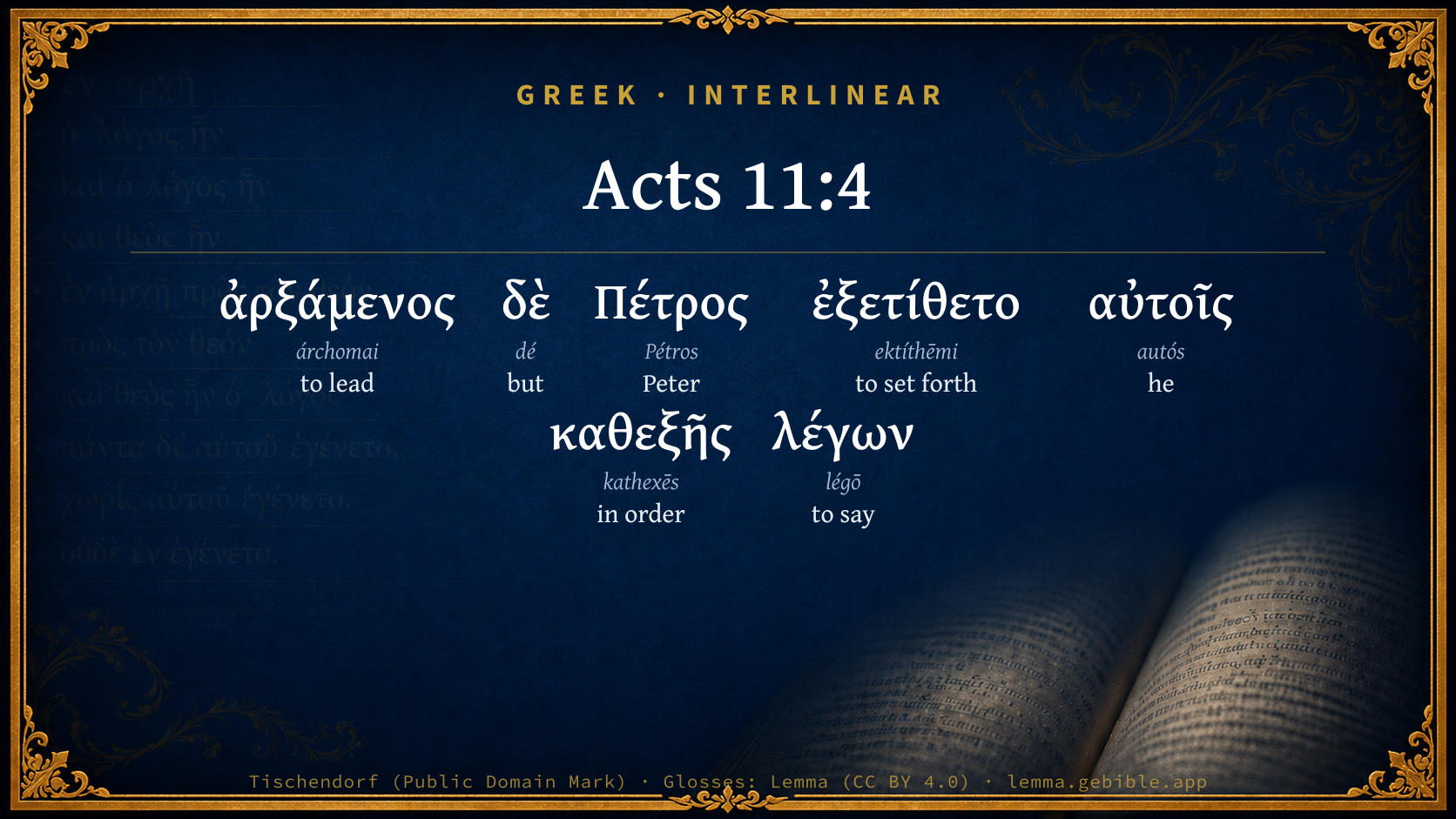
Greek (Tischendorf 8th ed.) Acts 11:4 appears in the Greek New Testament. The text above is from the Tischendorf 8th edition. Each word links to its Strong’s number and a concise gloss. Click any word for its full Thayer’s Greek Lexicon entry.
Download image
Cite this verse

Acts 11:4 (World English Bible). Public Domain. Lemma interlinear Bible study tool, https://lemma.gebible.app/v/acts/11/4.

Show BibTeX & RIS
BibTeX
RIS
English Translation
But Peter began, and explained to them in order, saying,
World English Bible · Public Domain
Download a study sheet

One document with this verse’s original text, its word-by-word gloss line, the meaning frame, cross-references with their text, attributed commentary, and full source and license credits — printable, and it pastes into notes with its structure intact.

This verse Autodidact and up

Study sheet (.html) Plain text (.txt)

A passage Seminary Student

Up to 50 verses in one chapter. A passage sheet keeps up to 6 commentary sources and 12 cross-references per verse, in the order this page ranks them, and says so on the sheet whenever that leaves anything out. Ask for a single verse and you get the Autodidact verse sheet above.

Everything on this page stays free to read, with no account — the sheet is a download of what is already on screen, not access to it.

Want to remove ads? Support Godless Engineer
Compare translations 3

The same verse in 3 English versions, stacked beneath the original-language interlinear above. Click any original word for its lexicon entry.

Each is an independent rendering of the whole verse — the interlinear is not word-aligned to these translations.

Highlighted words mark where these versions differ — a whole-verse word diff, not a word-by-word alignment.

  • World English Bible Public Domain
    But Peter began, and explained to them in order, saying,
  • King James Version Public Domain
    But Peter rehearsed the matter from the beginning, and expounded it by order unto them, saying,
  • unfoldingWord Literal Text CC BY-SA 4.0
    But Peter, beginning, was explaining to them in order, saying,

unfoldingWord Literal Text — © unfoldingWord, licensed CC BY-SA 4.0. Word-aligned USFM3 via Door43 (git.door43.org/unfoldingWord/en_ult).

Versions to compare (up to 4)

3 of 4 selected

Show all 19 translations

Every available English version of this verse, each an independent rendering of the whole verse.

  • World English Bible Public Domain
    But Peter began, and explained to them in order, saying,
  • Berean Standard Bible Public Domain
    But Peter began and explained to them the whole sequence of events:
  • Majority Standard Bible Public Domain
    But Peter began and explained to them the whole sequence of events:
  • King James Version Public Domain
    But Peter rehearsed the matter from the beginning, and expounded it by order unto them, saying,
  • American Standard Version (1901) Public Domain
    But Peter began, and expounded `the matter' unto them in order, saying,
  • Revised Version (1885) Public Domain
    But Peter began, and expounded the matter unto them in order, saying,
  • Geneva Bible (1599) Public Domain
    Then Peter beganne, and expounded the thing in order to them, saying,
  • Douay-Rheims (1899) Public Domain
    But Peter began and declared to them the matter in order, saying:
  • Young's Literal Translation Public Domain
    And Peter having begun, did expound to them in order saying,
  • Literal Standard Version CC BY-SA 4.0
    And Peter having begun, set [it] forth to them in order, saying,
  • Unlocked Literal Bible CC BY-SA 4.0
    But Peter started to explain the matter to them in detail; he said,
  • unfoldingWord Literal Text CC BY-SA 4.0
    But Peter, beginning, was explaining to them in order, saying,
  • Darby Bible Public Domain
    But Peter began and set forth [the matter] to them in order, saying,
  • World Messianic Bible Public Domain
    But Peter began, and explained to them in order, saying,
  • Webster's Bible Public Domain
    But Peter rehearsed the matter from the beginning, and expounded it by order to them, saying,
  • Free Bible Version CC BY-SA 4.0
    Peter began to explain to them everything that had happened.
  • Bible in Basic English Public Domain
    But Peter gave them an account of it all in order, saying to them,
  • Text-Critical English NT CC BY 4.0
    But Peter began to explain the situation to them, step by step, saying,
  • Tyndale New Testament (1534) Public Domain
    Then Peter began and expounded the thinge in order to the sayinge:

Literal Standard Version (2020), Covenant Press — licensed CC BY-SA 4.0. Text via the HelloAO Bible API (eBible.org). Unlocked Literal Bible (unfoldingWord) — licensed CC BY-SA 4.0. Text via the HelloAO Bible API (eBible.org). unfoldingWord Literal Text — © unfoldingWord, licensed CC BY-SA 4.0. Word-aligned USFM3 via Door43 (git.door43.org/unfoldingWord/en_ult). Free Bible Version, Dr. Jonathan Gallagher — licensed CC BY-SA 4.0. Text via the HelloAO Bible API (eBible.org).

Word by word

More ways to search: Search by grammar → Find every occurrence → Compare this word →

Practice this passage: Drill this verse → Learn its vocabulary →

About this verse

These counts appear in no published source. They are computed here, from the morphology-tagged text and Lemma’s own curated glosses. What Lemma adds →

7
words
7
distinct lemmas
Acts
section

Notable vocabulary

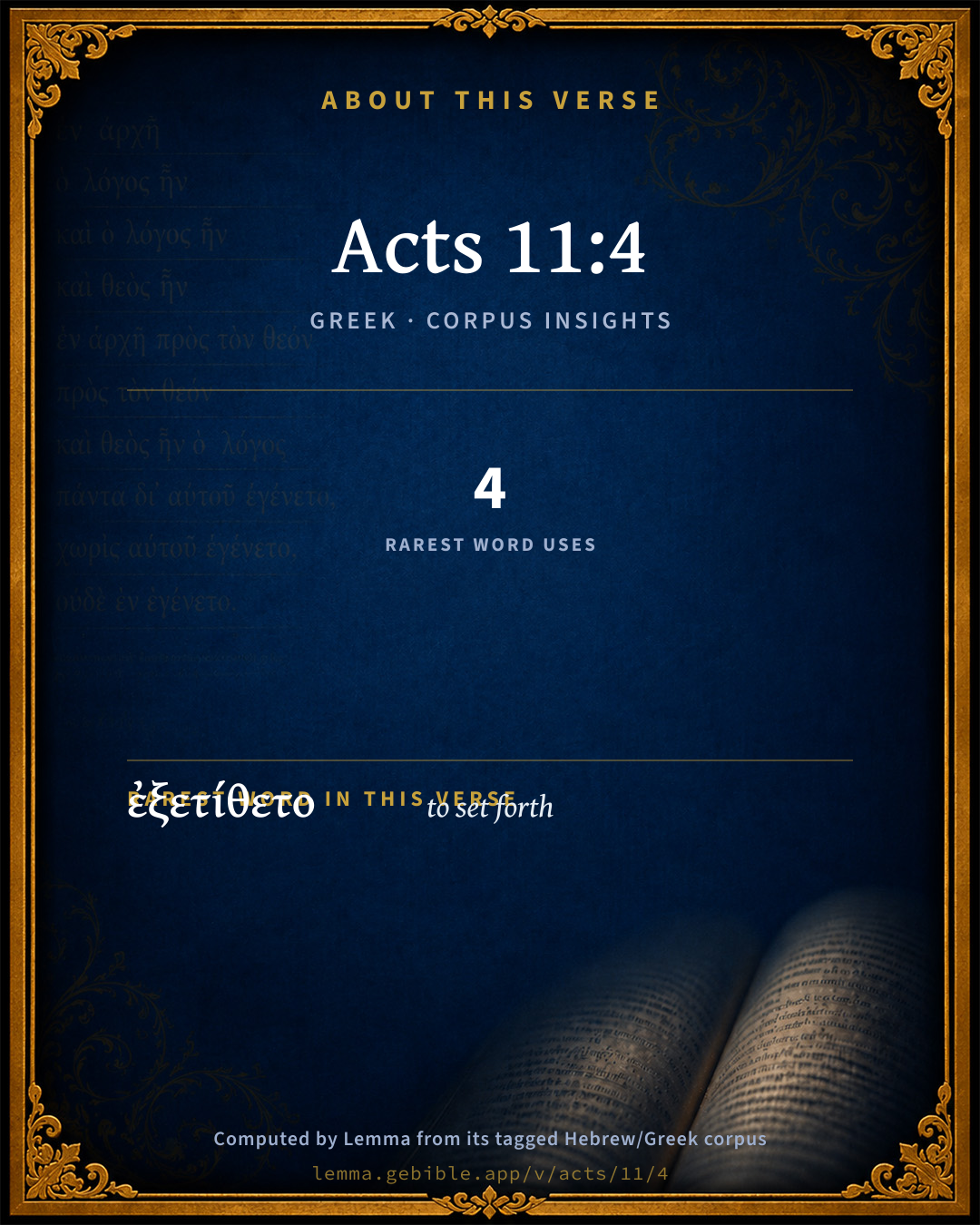
The rarest word here is ἐξετίθετο to set forth G1620 — appearing just 4 times in the whole Greek New Testament.

Shared distinctive vocabulary

ἐξετίθετο to set forth G1620 occurs in 4 verses of the Greek New Testament. Also found in:

Cross-references

4

Topical passages linked to Acts 11:4 in the Treasury of Scripture Knowledge — connected by theme and wording, ordered by reader-vote popularity; previews shown in the World English Bible.

  • Luke 1:3 it seemed good to me also, having traced the course of all things accurately from the first, to write to you in order, most excellent Theophilus;
  • Joshua 22:21–31 Then the children of Reuben and the children of Gad and the half-tribe of Manasseh answered, and spoke to the heads of the thousands of Israel,
  • Proverbs 15:1 A gentle answer turns away wrath, But a harsh word stirs up anger.
  • Acts 14:27 When they had arrived, and had gathered the assembly together, they reported all the things that God had done with them, and that he had opened a door of faith to the Gentiles.

Cross-references courtesy of OpenBible.info (CC BY 4.0).

Commentary

Notes on Acts 11:4 from classic Christian and Jewish commentators (each source and its license shown beneath its notes). The classic Christian expositions comment on the surrounding passage and are grouped to its opening verse, so a note may address several verses; the Jewish commentaries on the Tanakh (Rashi and others) are per-verse, so they appear only where the commentator wrote on this verse.

Lemma curates 59 commentaries, every one of them public domain or Creative Commons licensed, each selected and text-cleaned for this edition rather than reprinted as found. About our sources →

Joseph Benson's Commentary

Act 11:4-15. But Peter rehearsed — Εξετιθετο, laid open; the matter from the beginning — Of the vision which he had seen, which was evidently designed to dispose him to such condescension, and gave them a full detail of all the particulars, with the exactest truth and simplicity. So far was he from taking it ill to be questioned, or desiring to be treated as infallible. And he answers the more mildly, because it related to a point which he had not readily believed himself. See these verses explained in the notes on Act 10:11-33; Act 10:44.

Joseph Benson's Commentary on the Old and New Testaments (1811–1818) — public domain. Text from a community e-Sword module.

Tyndale Open Study Notes

Tyndale Open Resources

11:4-17 Peter reviewed the sequence of events, explaining that the whole development was the result of God’s initiative (11:12). Peter had eaten with Gentiles because God had made it clear that he should (11:4-12). Peter had then observed the Holy Spirit’s definite action of coming upon Gentiles, and he realized that they were being accepted and blessed by God just as Jewish believers had been (11:15-17; see 1:5). Peter was submitting to God’s will in admitting Gentiles to the church.

Tyndale Open Study Notes — © Tyndale Open Resources, licensed CC BY-SA 4.0. Text via the HelloAO Bible API.

Bengel's Gnomon

Johann Albrecht Bengel

Act 11:4. Ἀρξάμενος, beginning) He began to speak in many words.—ἐξετίθετο, expounded) Peter was not offended at his being questioned, nor did he demand, that he, even without any exposition of his reasons, should be held as superior to all (any) objections being made on the part of his colleagues and all believers. It is not the indication of the best mind or the best cause, along with the Pope or his attendants (hangers-on), to be offended at the question, What art thou doing? Peter answers with mildness, as to a subject which he himself before had not very readily comprehended.

Bengel's Gnomon of the New Testament — English translation (T&T Clark, Edinburgh, 1860) — public domain. Text from a community e-Sword module.

Expositor's Greek Testament

ed. W. Robertson Nicoll

Act 11:4 . ἀρξ . δὲ ὁ Π . “But Peter began, and expounded the matter”: ἀρξ . may be pleonastic, Act 1:4 , cf. καθεξῆς , or may be used graphically, or because the reproaches of οἱ ἐκ περιτ . gave the first incentive to St. Peter’s recital. καθ . only in Luke, Gospel and Acts, see Act 3:24 . ἐξετίθετο , Act 18:26 , Act 28:23 , Jos., Ant. , i., 12, 2, so also in Polyb., x., 9, 3. Perhaps used here by St. Luke from its use by Dioscorides; familiar word to him also as a physician, see Vogel, p. 17. Evidently St. Luke by the two accounts attaches great significance to this first reception, exceptional case as it was, of a Gentile proselyte like Cornelius into the Christian Church, but it was an isolated case, and moreover a case within Palestine, not beyond its borders, so that the great questions of a mission to the Gentiles of the heathen world, and of the conditions for their reception as Christians, were not matter for consideration as afterwards in chap. 15, see Wendt, edition 1899, p. 211; Hort, Ecclesia , pp. 58, 59; and see below on Act 11:12 .

The Expositor's Greek Testament, edited by W. Robertson Nicoll (1897–1910) — public domain. Text from a community e-Sword module.

Adam Clarke's Commentary

Verse 4. But Peter rehearsed the matter from the beginning, and expounded it by order] εξετιθετο αυτοις καθεξης. This is the very style of St. Luke; see his Gospel, Lu 1:3. To remove their prejudice, and to give them the fullest reasons for his conduct, he thought it best to give them a simple relation of the whole affair; which he does, as we have seen in the preceding chapter, with a few additional circumstances here. See the notes before.

Adam Clarke's Commentary on the Bible (1810–1826) — public domain. Text from a community e-Sword/MySword module.

Ellicott's Commentary for English Readers

(4) But Peter rehearsed the matter from the beginning.—Better, perhaps, the word “rehearse” having grown into a different shade of meaning, began and set forth the matter. The translators seem to have paraphrased the participle “having begun” somewhat more fully than its actual meaning admits. The almost verbal repetition of the same narrative as that of Acts 10 seems, at first sight, inconsistent with our common standard of skill in composition. The probable explanation of it is that St. Luke obtained the first narrative from the disciples whom he met at Cæsarea, and the second from those of Jerusalem, and that the close agreement of the two seemed to him, as indeed it was, a confirmation of the truth of each.

A Bible Commentary for English Readers, edited by Charles John Ellicott (1878–1897) — public domain. Text from a community e-Sword module.

The Cambridge Bible for Schools and Colleges

gen. ed. J. J. S. Perowne

4. But Peter rehearsed the matter from the beginning, and expounded it by order unto them] Better, “But Peter began and rehearsed the matter in order unto them.”

The Cambridge Bible for Schools and Colleges (gen. ed. J. J. S. Perowne; Cambridge University Press, 1878–1918) — public domain. Text from a community e-Sword module.

John Gill's Exposition

But Peter rehearsed the matter from the beginning,.... Of the vision at Joppa;

and expounded it by order unto them; or related every particular, in a very methodical and orderly manner: he did not insist upon his authority as an apostle, and much less pretended to a primacy to the rest of the apostles; but submitted to have his case heard, examined, and judged of by the body of the brethren.

John Gill's Exposition of the Whole Bible (1746–1763) — public domain (CC PDM 1.0). Text via the HelloAO Bible API.

Trapp's Complete Commentary

John Trapp

4 But Peter rehearsed the matter from the beginning, and expounded it by order unto them, saying,

Ver. 4. But Peter rehearsed] With singular modesty he seeks to satisfy them (if reason will do it), and to quench their wild fire by casting milk upon it. Zuinglius and Oecolampadius endeavoured to do the like by Luther and his disciples, but could never effect it. In the year 1533, he wrote a very bitter epistle to the Senate of Frankfort, Qua Zuinglianos Archi-diabolos appellat, e suggestu repellendos, ditione eieciendos, wherein he calleth the Zuinglians arch-devils; and judgeth that they ought to be kept out of the pulpit, driven out of the country. {a} In the year 1567, at Antwerp the Lutherans joined themselves to the Papists against the Calvinists. {b} Still Satan is thus busy, and Christians are thus malicious, that, as if they wanted enemies, they fly in one another’s faces; yea, cut one another’s throats: as the English and Scots do at this day, to the inconceivable grief of all the godly on both sides. Deus meliora.

{a} Scultet. Annal.

{b} Bucholcer, Chronol.

John Trapp, A Commentary or Exposition upon All the Books of the Old and New Testament (1647–1656) — public domain. Text from a community e-Sword module.

Albert Barnes' Notes on the Bible

But Peter rehearsed - Greek: Peter beginning, explained it to them in order; that is, he began with the vision which he saw, and gave a narrative of the various events in order, as they actually occurred. A simple and unvarnished statement of facts is usually the best way of disarming prejudice and silencing opposition. Opposition most commonly arises from prejudice, or from false and exaggerated statements, and such opposition can be best removed, not by angry contention, but by an unvarnished relation of facts. In most cases prejudice will thus be disarmed, and opposition will die away, as was the case in regard to the admission of the Gentiles to the church.

And expounded it - Explained it; stated it as it actually occurred.

In order - One event after another, as they happened. He thus showed that his own mind had been as much biased as theirs, and stated in what manner his prejudices had been removed. It often happens that those who become most zealous and devoted in any new measures for the advancement of religion were as much opposed to them at first as others. They are led from one circumstance to another, until their prejudices die away, and the providence and Spirit of God indicate clearly their duty.

Albert Barnes' Notes on the Bible (1834–1885) — public domain. Text from a community e-Sword/MySword module.

Matthew Poole's English Annotations

This great apostle condescends to the least and weakest amongst them, and gives an account of what he had done and the reasons that moved him unto it, if by any means he might gain some, and confirm others.

Matthew Poole's English Annotations on the Holy Bible (1683–1685) — public domain. Text from a community e-Sword/MySword module.

Whedon's Commentary on the Bible

Daniel D. Whedon

4. Rehearsed—Peter at once sweeps them clear by unfolding the wonderful facts, the angel, the trance, the command of the Spirit and the pentecostal outpouring. Luke, aware of the momentous nature of these transactions, again gives them in Peter’s words.

Daniel D. Whedon (gen. ed.), Commentary on the Old and New Testaments (1874–1909) — public domain. Text from a community e-Sword module.

The Pulpit Commentary

Began and expounded the matter unto them in order for rehearsed the matter from the beginning, and expounded it by order unto them, A.V.

HOMILIES BY R. TUCK Vers. 4-17. The efficient answer to objectors.

A man always takes an individual line, in opinion or in conduct, in peril of being misunderstood and called to account by his fellows. And yet the intellectual and moral advance of the race is made only by the pressure forward of individuals who, on some ground, refuse to keep in the old lines, and persist in making their own way even in districts marked by common sentiment as "dangerous." It is often the precise mission of youth to check the strongly conservative tendency around them, and utter fresh truth, or at least truth in fresh forms. This is illustrated in the case of St. Peter. He had come to grasp a truth which was a heresy from his own older standpoint, and a heresy to those with whom he had been working; but he knew it was truth, so, at the peril of being misunderstood, he acted upon the truth. He now knew that Christ"s gospel was for Gentile as well as Jew, so he fearlessly went into the Gentile"s house, and there preached the Word of life, and baptized the believing household. And he was misunderstood and called to account. The passage before us is his effective defense: to it there could be no reply. He rehearses the whole matter, and says, "God led me, and I followed. God taught me, and I believed. God sealed my work with the witness of his Spirit, and I know I have his acceptance." This is the answer which the sincere man who acts out of the common line may make to all who oppose or object. "I do but follow the Divine leadings and teachings; God sets my witness, and the testimony I make must be at least a portion of the truth of God.

I GOD STILL OPENS HIS TRUTH TO INDIVIDUAL SOULS. We do not, indeed, expect new revelations. There is a sense in which the book-revelation in the Scriptures is complete: no man may add thereto or take therefrom; and no man"s testimony can be of any value save as it can be tested by the revealed Word. And yet, though this may be fully admitted, we may recognize the fact that, through spiritual insight or through intellectual skill, men do bring to light missed and hidden things, or they do set received truths in forms that are new, and by their newness arrest thought and even arouse opposition. In this way every truth of the Divine revelation is brought prominently before men"s thoughts every few years. God sends among us great thought-leaders; stirs, by their preachings or writings, the stagnancy of religious thought, and makes fresh and living to us truths which had become mere dead formalities. St. Peter had but a fresh hold of an ancient truth, one long revealed by psalmist and prophet: still, he had such a new grip as made him a power; even the agent that fulfilled Christ"s will, and "opened the kingdom of heaven to all believers.

II THE INDIVIDUAL WITH A FRESH TRUTH MUST EXPECT OPPOSITION. It will surely come from:

1. His fellow-workers, who will feel a secret jealousy of his being made the medium of Divine communications, and who will keenly feel how the new truth interferes with their teachings.

2. Those of conservative tendency, who think the absolute and final truth is in their charge.

3. The earnest but timid people who fear that everything fresh must put God"s truth in peril.

4. The friends of theological or ecclesiastical systems, who consider their systems complete and needing no changes, nor having any open places in which new truth may fit. St. Peter found that an imperfect report of his doings at Caesarea had gone before him to Jerusalem, and when he himself reached the holy city, he was assailed from the very narrowest platform, and accused of the very small sin from our point of view, but very large sin from the Jewish point of view, of "eating with the uncircumcised." He very wisely refused a discussion on this mere feature of the matter, and explained fully what had happened. Those who contend often take a mere point of detail, and are best met and answered by putting the question in dispute on the broadest, deepest grounds.

III PROOF OF DIVINE LEADINGS OUGHT TO SILENCE ALL OPPOSITION. This is the great lesson of St. Peter"s conduct and narrative. All through he pleads that he only recognized and followed the Divine will as revealed both to him and to others. God spoke to him in trance, and vision, and providence, and inward impulse. God spoke to Cornelius by angel-form and angel-voice. God sealed the work of St. Peter with the gift of his Spirit, and, as a faithful and true man, he could only go where God led him, and speak as God bade him. To his audience it was the best of all answers, the one that would disarm all opposition. A sincere Jew must be loyal to God"s will, however it might be revealed, and however strange to his feeling it might seem. And this is essentially the answer which every thought-leader and every advanced teacher now must be prepared to make and to prove. If he only speaks, as a man, some religious fancies and feelings of his own, we are rightly skeptical; but if it is plain to us that a man has been "taught of God," and if we can see signs of acceptance and Divine benediction on his work, then we too must hear his testimony with open and unprejudiced minds, seeking grace to enable us to express our old faith in the new form, or to add the new thought to our received doctrines. God may, indeed, not speak to us now by dream, or trance, or vision, or voice; but we need not therefore think that direct communication with our soul is impossible. Still we may say, "Speak, Lord; for thy servant heareth;" and still we have with us that Holy Ghost, whose work it is" to lead us into all truth, and to show us things to come." And it should be our abiding conviction and inspiration that the Lord hath yet more light and truth to break forth from his Word. R.T.

The Pulpit Commentary (1880–1919), ed. H.D.M. Spence-Jones & Joseph S. Exell — public domain. Text from a community e-Sword module.

John Wesley's Explanatory Notes

Peter laid all things before them - So he did not take it ill to be questioned, nor desire to be treated as infallible. And he answers the more mildly because it related to a point which he had not readily believed himself.

John Wesley, Explanatory Notes Upon the Whole Bible (1754–1765) — public domain. Text via the GEBible commentary corpus.

Kretzmann's Popular Commentary

Paul E. Kretzmann

The rehearsal of Peter:

v. 4. But Peter rehearsed the matter from the beginning, and expounded it by order unto them, saying,

v. 5. I was in the city of Joppa praying; and in a trance I saw a vision, a certain vessel descend as it had been a great sheet, let down from heaven by four corners; and it came even to me;

v. 6. upon the which when I had fastened mine eyes, I considered, and saw four-footed beasts of the earth, and wild beasts, and creeping things, and fowls of the air.

v. 7. And I heard a voice saying unto me, Arise, Peter, slay and eat.

v. 8. But I said, Not so, Lord; for nothing common or unclean hath at any time entered into my mouth.

v. 9. But the voice answered me again from heaven, What God hath cleansed, that call not thou common.

v. 10. And this was done three times; and all were drawn up again in to heaven.

v. 11. And, behold, immediately there were three men already come unto the house where I was, sent from Caesarea unto me.

v. 12. And the Spirit bade me go with them, nothing doubting. Moreover, these six brethren accompanied me, and we entered in to the man’s house;

v. 13. and he showed us how he had seen an angel in his house, which stood and said unto him, Send men to Joppa, and call for Simon, whose surname is Peter,

v. 14. who shall tell thee words whereby thou and all thy house shall be saved.

v. 15. And as I began to speak, the Holy Ghost fell on them as on us at the beginning.

Instead of launching forth in cleverly worded arguments to defend his action, Peter believes it best to let the facts speak for themselves, for which reason he gives them in the form of a simple recital, presenting them to the critics in order, just as they occurred, and as they have been narrated in Chapter 10. Peter first told them about the peculiar vision which he had had in Joppa, when he had been in a state of ecstasy, when the container in the form of a large sheet, tied together at the four corners, was lowered out of heaven. He emphasizes that he looked very closely, and that there was no question of an illusion. He had surely seen in the container various quadrupeds and animals and reptiles of the earth and birds of heaven. He had plainly heard the voice telling him to arise, to slaughter, and to eat. He had objected very emphatically on the ground of his always having strictly observed the injunction governing unclean foods. But the voice had sounded the second time, bidding him not to regard as common what God Himself had cleansed. Three times the same thing had happened before the container had been drawn up into heaven again. And, behold, at that very moment three men had stood below, having been sent from Caesarea to fetch him, and the Holy Ghost had told him to accompany them without doubt or hesitation. They had then gone with him, and also brethren from Joppa, whose number Peter here states to have been six; these six, having returned with him to Jerusalem, could substantiate his words. They had entered into the house of the man who had sent the messengers, who had given them an account of his having seen an angel standing in his house and speaking to him. The command of this angel he had followed in sending to Joppa and fetching Simon with the surname Peter, who would speak words to him whereby he would be saved and his house. These last words, not found in the other accounts, anticipate a summary of Peter’s discourse in showing to the assembly the fulfillment of the Old Testament prophecies and of New Testament preaching in Christ, the Savior of all men. Peter finally tells of the effect which his words had had upon his hearers. Before he had finished his discourse and brought out all that he might have said on that topic, which is inexhaustible, the Holy Ghost had fallen on the Gentiles in the same manner as He had been imparted to themselves in the beginning. The argument of Peter therefore was, that after seeing the vision, hearing the voice, and receiving the order of the Spirit to go with the men, he could not have done otherwise than obey and enter into the house of the Gentile at Caesarea. And the fact that the Holy Ghost had been poured out on these Gentiles was a further proof for the Lord’s acceptance of the Gentiles.

Paul E. Kretzmann, Popular Commentary of the Bible (1921–1924) — public domain. Text from a community e-Sword module.

Burkitt's Expository Notes on the New Testament

William Burkitt

Observe here, 1. How far St. Peter was from pretending a superiority over the rest of the apostles; he did by no means think himself so far above them, as to disdain to render an account of his actions to them, but with great sincerity and humility, rehearsed and related the whole matter of fact, to their entire and joint satisfaction.

Observe, 2. How he acquaints the apostles with the vision he had seen, in which he was commanded to make no distinction of clean or unclean: because there was not natural turpitude in any kind of meat, save only as it was prohibited by God; and that God, who having made the law about difference of meats, had now abrogated it, and made all meats clean, and free to be eaten.

Observe, 3. How he gives them the interpretation of this vision, and acquaints them with the end for which this vision was designed; namely, not so much to reveal to him the lawfulness of eating all sorts of meats, as to acquaint him with his liberty and duty to converse with and preach the gospel to the Gentiles; whom he was no longer to look upon as unclean, though they were not circumcised; but as "heirs and fellow-citizens with the saints, and of the household of God."

Observe lastly, The conclusion which St. Peter drew from these premises: "Seeing God hath made the Gentiles equal in grace with the believing Jews; seeing the Holy Ghost coame down upon them in the same manner, and with the same effects as he did upon us apostles, I could not reasonably deny them baptism, and by baptism admission into the gospel-church; for having the grace signified by baptism, they ought to have baptism, the seal of that grace; they that have the inward, are not to be denied the outward baptism; and they that were baptized with the Holy Ghost (as Cornelius and his family were) might and ought to be baptized with water, as Cornelius was: for had I denied them church-communion for want of the ceremony of circumcision, it had certainly been a downright resistance of, and disobedience against God."

Thence learn, that it is a downright opposition to the will of God, to shut them out of the church, and to debar them from the communion of it, who have received the sanctifying graces of God’s Holy Spirit; but differ from us in external rites and ceremonies only.

William Burkitt's Expository Notes on the New Testament (1700–1703) — public domain. Text from a community e-Sword module.

McGarvey & Pendleton's Commentaries

J. W. McGarvey

4-17. (4) " But Peter related the matter to them in order from the beginning, saying, (5) I was in the city of Joppa, praying, and saw, in a trance, a vision, a certain vessel like a great sheet descending, let down from heaven by the four corners, and it came to me. (6) Having looked intently into it, I perceived and saw four-footed animals, and wild beasts, and reptiles of the earth, and birds of the air. (7) And I heard a voice, saying to me, Arise, Peter; kill and eat. (8) But I said, Not so, Lord; for nothing common or unclean has at any time entered into my mouth. (9) But the voice from heaven answered me, What God has cleansed, do not you make common. (10) This was done three times, and all was drawn up into heaven again. (11) And behold, three men immediately came to the house in which I was, sent to me from Cæsarea, (12) and the Spirit told me to go with them, doubting nothing. But these six brethren also went with me, and we entered into the man's house. (13) Then he told us that he had seen an angel in his house, standing and saying to him, Send to Joppa, and call for Simon who is surnamed Peter, (14) who will speak words to you by which you and all your house will be saved. (15) And while I was beginning to speak, the Holy Spirit fell upon them as upon us in the beginning. (16) Then I remembered the word of the Lord, that he said, John immersed in water, but you shall be immersed in the Holy Spirit. (17) Since, then, God gave to them the same gift as to us who already believed on the Lord Jesus Christ, who was I, that I should be able to withstand God? " The events here rehearsed by Peter had removed his own prejudice, and now, through the words which he addressed to the brethren, the same vision of unclean animals, with the command to kill and eat; the same command of the Spirit to go with the Gentile messengers; the authority of the angel who had ordered him to be sent for; and, finally, the same immersion of those Gentiles in the Holy Spirit, are all pressing upon their minds and hearts, with precisely the same import that they did upon his.

J. W. McGarvey (with Philip Y. Pendleton), Commentaries on the New Testament (The Fourfold Gospel, 1914; Acts; and the epistles) — public domain. Text from a community e-Sword/MySword module.

The People's New Testament

B. W. Johnson

4–17. But Peter rehearsed the matter from the beginning. Thus showing that he acted under the Divine orders. See notes in preceding chapter.

These six brethren accompanied me. These were brethren of Joppa, but Peter had taken them to Jerusalem to confirm his words. He knew his course would be called into question.

Whereby thou and all thy house shall be saved. Note the import of these words of the angel to Cornelius: (1) Notwithstanding his prayers, alms, devotion, and justice, he was not yet saved. Only the gospel could save him. God's mercy was shown in bringing him the gospel. (2) This is the first instance named in Acts of a household baptism. Were there any infants? Who are meant is seen by reference to 10:24, “his kinsmen and near friends.” These “heard” (10:44), were baptized with the Holy Spirit, and baptized in water (10:47, 48).

As on us at the beginning. Note that Peter compares the outpouring on the Gentiles with that of the day of Pentecost. He calls both instances “baptisms of the Holy Spirit.” Miraculous signs accompanied each instance. Have we a right to speak of a baptism of the Holy Spirit without such signs? The gift of the Holy Spirit with its fruit (Gal. 5:22, 23) is promised to every obedient believer, but the baptism of the Holy Spirit seems to have been extraordinary and special. Note also that Peter calls the Day of Pentecost the Beginning. The Beginning of what? Of the preaching of the New Covenant, of the Great Commission, of the conditions of the gospel under the reign of the exalted King and Savior, of the church of Christ on earth.

What was I, that I could withstand God? All these extraordinary signs were then given in order to show Peter and the Jewish Christians that the Gentiles were also accepted.

B. W. Johnson's The People's New Testament with Notes (1889–1891) — public domain. Electronic text from the Christian Classics Ethereal Library (CCEL) ThML edition.

unfoldingWord translationNotes

Door43 World Missions Community

Connecting Statement:

Peter responds to the Jews by telling them about his vision and about what had happened at Cornelius' house.

Peter started to explain

Peter did not criticize the Jewish believers but reacted in a friendly explanatory manner.

in detail

"exactly what happened"

like a large sheet

The container holding the animals had the appearance of a large square piece of cloth. See how you translated this in Acts 10:11.

by its four corners

"with its four corners suspended" or "with its four corners higher than the rest of it." See how you translated this in Acts 10:11.

four-legged animals of earth

From Peter's response, it can be implied that the law of Moses commanded the Jews not to eat some of them. See how you translated a similar phrase in Acts 10:12. AT: "animals and birds that the Mosaic laws forbade Jews to eat" (See: Assumed Knowledge and Implicit Information)

wild beasts

This probably refer to the animals people do not or can not tame or control.

creeping animals

These are reptiles.

translationWords

Peter

pray

Joppa

vision

heaven

unfoldingWord translationNotes — © Distant Shores Media and the Door43 World Missions Community, licensed CC BY-SA 4.0. Source: git.door43.org/Door43/en_tn.

Cambridge Greek Testament for Schools and Colleges

4. ἀρξάμενος δὲ Πέτρος ἐξετίθετο αὐτοῖς καθεξῆς, but Peter began and rehearsed the matter in order to them.

Cambridge Greek Testament for Schools and Colleges (Cambridge University Press, 1896; 21 vols, various authors incl. Carr, Maclear, Plummer, Farrar, Lumby, Moule, M. R. James, Simcox) — public domain. Text from a community e-Sword module.

Alford’s Greek Testament

Henry Alford

4.] ‘Having begun, set forth to them:’ i.e. began and set forth: not for ἤρξατο ἐκτιθέναι. as Kuinoel.

Henry Alford, The Greek Testament (1849–1861) — public domain. Text from a community e-Sword module.

Vincent's Word Studies in the New Testament

Marvin R. Vincent

Began. Graphically indicating the solemn purport of the speech (compare Luk 12:1), perhaps, in connection with expounded, his beginning with the first circumstances and going through the whole list of incidents.

Marvin R. Vincent, Word Studies in the New Testament (1887–1900) — public domain. Text from a community e-Sword/MySword module.

Lesson kit

Teaching starters — assembled from the data on this page, not authored interpretation. Every prompt links to the verse data it draws on. Edit before teaching.

Acts, in the Acts, opens this verse with 7 words (7 distinct Greek lemmas). Its most distinctive word is ektíthēmi (“to set forth”). A historical commentator’s framing appears above. Read the whole chapter for the surrounding context.

Discussion questions

  1. The word ektíthēmi carries the sense “to set forth.” How does it shape the verse?
  2. How does Acts 7:21, which shares the word «to set forth», read alongside this verse?
  3. These translations render this verse differently. What is at stake in choosing one wording over another?
  4. Compare how Joseph Benson's Commentary and Tyndale Open Study Notes read this verse. Where do they agree or differ?

Things to notice

Reading settings

Reading text

Shown beneath each verse's original-language words.

Old Testament
Old Testament edition

Read the OT as the Masoretic Hebrew (MT) or the Greek Septuagint (LXX).

English shown for the Greek Septuagint (in the Hebrew ↔ Greek comparison).

Comparing translations? Open the Compare panel on any verse page to stack up to four side by side.