
Isaiah 2:21

Hebrew (Westminster Leningrad Codex) Isaiah 2:21 appears in the Hebrew Old Testament. The text above is from the Westminster Leningrad Codex. Each word links to its Strong’s number, a concise gloss, and parsing drawn from the Open Scriptures Hebrew Bible morphology. Click any word for its full Brown-Driver-Briggs (BDB) entry.
Download image
Cite this verse

Isaiah 2:21 (World English Bible). Public Domain. Lemma interlinear Bible study tool, https://lemma.gebible.app/v/isaiah/2/21.

Show BibTeX & RIS
BibTeX
RIS
English Translation
To go into the caverns of the rocks, And into the clefts of the ragged rocks, From before the terror of Yahweh, And from the glory of his majesty, When he arises to shake the earth mightily.
World English Bible · Public Domain
Download a study sheet

One document with this verse’s original text, its word-by-word gloss line, the meaning frame, cross-references with their text, attributed commentary, and full source and license credits — printable, and it pastes into notes with its structure intact.

This verse Autodidact and up

Study sheet (.html) Plain text (.txt)

A passage Seminary Student

Up to 50 verses in one chapter. A passage sheet keeps up to 6 commentary sources and 12 cross-references per verse, in the order this page ranks them, and says so on the sheet whenever that leaves anything out. Ask for a single verse and you get the Autodidact verse sheet above.

Everything on this page stays free to read, with no account — the sheet is a download of what is already on screen, not access to it.

Want to remove ads? Support Godless Engineer
Compare translations 3

The same verse in 3 English versions, stacked beneath the original-language interlinear above. Click any original word for its lexicon entry.

Each is an independent rendering of the whole verse — the interlinear is not word-aligned to these translations.

Highlighted words mark where these versions differ — a whole-verse word diff, not a word-by-word alignment.

  • World English Bible Public Domain
    To go into the caverns of the rocks, And into the clefts of the ragged rocks, From before the terror of Yahweh, And from the glory of his majesty, When he arises to shake the earth mightily.
  • King James Version Public Domain
    To go into the clefts of the rocks, and into the tops of the ragged rocks, for fear of the LORD, and for the glory of his majesty, when he ariseth to shake terribly the earth.
  • unfoldingWord Literal Text CC BY-SA 4.0
    to come into crevices of rocks and into clefts of crags, from the face of the terror of Yahweh and from the splendor of his majesty when he arises to terrify the earth.

unfoldingWord Literal Text — © unfoldingWord, licensed CC BY-SA 4.0. Word-aligned USFM3 via Door43 (git.door43.org/unfoldingWord/en_ult).

Versions to compare (up to 4)

3 of 4 selected

Show all 18 translations

Every available English version of this verse, each an independent rendering of the whole verse.

  • World English Bible Public Domain
    To go into the caverns of the rocks, And into the clefts of the ragged rocks, From before the terror of Yahweh, And from the glory of his majesty, When he arises to shake the earth mightily.
  • Berean Standard Bible Public Domain
    They will flee to caverns in the rocks and crevices in the cliffs, away from the terror of the LORD and from the splendor of His majesty, when He rises to shake the earth.
  • Majority Standard Bible Public Domain
    They will flee to caverns in the rocks and crevices in the cliffs, away from the terror of the LORD and from the splendor of His majesty, when He rises to shake the earth.
  • King James Version Public Domain
    To go into the clefts of the rocks, and into the tops of the ragged rocks, for fear of the LORD, and for the glory of his majesty, when he ariseth to shake terribly the earth.
  • American Standard Version (1901) Public Domain
    to go into the caverns of the rocks, and into the clefts of the ragged rocks, from before the terror of Jehovah, and from the glory of his majesty, when he ariseth to shake mightily the earth.
  • Revised Version (1885) Public Domain
    to go into the caverns of the rocks, and into the clefts of the ragged rocks, from before the terror of the LORD, and from the glory of his majesty, when he ariseth to shake mightily the earth.
  • Geneva Bible (1599) Public Domain
    To goe into the holes of the rockes, and into the toppes of the ragged rockes from before the feare of the Lord, and from the glory of his maiestie, when he shall rise to destroy the earth.
  • Douay-Rheims (1899) Public Domain
    ,21And he shall go into the clefts of rocks, and into the holes of stones from the face of the fear of the Lord, and from the glory of his majesty, when he shall rise up to strike the earth.
  • Young's Literal Translation Public Domain
    To enter into cavities of the rocks, And into clefts of the high places, Because of the fear of Jehovah, And because of the honour of His excellency, In His rising to terrify the earth.
  • Literal Standard Version CC BY-SA 4.0
    To enter into cavities of the rocks, || And into clefts of the high places, || Because of the fear of YHWH, || And because of the honor of His excellence, || In His rising to terrify the earth.
  • Unlocked Literal Bible CC BY-SA 4.0
    The people will go into the crevices in the rocks and into the clefts of the ragged rocks, from the terror of Yahweh and from the glory of his majesty, when he rises to terrify the earth.
  • unfoldingWord Literal Text CC BY-SA 4.0
    to come into crevices of rocks and into clefts of crags, from the face of the terror of Yahweh and from the splendor of his majesty when he arises to terrify the earth.
  • Darby Bible Public Domain
    to go into the clefts of the rocks, and into the fissures of the cliffs, from before the terror of Jehovah, and from the glory of his majesty, when he shall arise to terrify the earth.
  • World Messianic Bible Public Domain
    to go into the caverns of the rocks, and into the clefts of the ragged rocks, from before the terror of the LORD, and from the glory of his majesty, when he arises to shake the earth mightily.
  • Webster's Bible Public Domain
    To go into the clefts of the rocks, and into the tops of the ragged rocks, for fear of the LORD, and for the glory of his majesty, when he ariseth to shake terribly the earth.
  • Free Bible Version CC BY-SA 4.0
    They will run to cracks in the rocks and gaps on the cliffs to try and hide from the terrifying presence of the Lord, from the glory of his majesty, when he arrives to shake the earth.
  • Bible in Basic English Public Domain
    To take cover in the cracks of the rocks, and in the holes of the hills, for fear of the Lord, and before the glory of his power, when he comes out of his place, shaking the earth with his strength.
  • JPS Tanakh (1917) Public Domain
    To go into the clefts of the rocks, and into the crevices of the crags, from before the terror of the LORD, and from the glory of His majesty, when he ariseth to shake mightily the earth.

Literal Standard Version (2020), Covenant Press — licensed CC BY-SA 4.0. Text via the HelloAO Bible API (eBible.org). Unlocked Literal Bible (unfoldingWord) — licensed CC BY-SA 4.0. Text via the HelloAO Bible API (eBible.org). unfoldingWord Literal Text — © unfoldingWord, licensed CC BY-SA 4.0. Word-aligned USFM3 via Door43 (git.door43.org/unfoldingWord/en_ult). Free Bible Version, Dr. Jonathan Gallagher — licensed CC BY-SA 4.0. Text via the HelloAO Bible API (eBible.org).

Word by word

More ways to search: Search by grammar → Find every occurrence → Compare this word →

Practice this passage: Drill this verse → Learn its vocabulary →

בְּנִקְר֣וֹת
nᵉqârâh
H5366
“in/at · holes of”
Preposition + Noun, Common, Feminine, Plural, Construct
Part of Speech
Preposition + Noun
Type
Common
Gender
Feminine
Number
Plural
State
Construct
Full BDB Definition

Origin: from H5365 , a fissure

TWOT: 1418a

hole, crevice
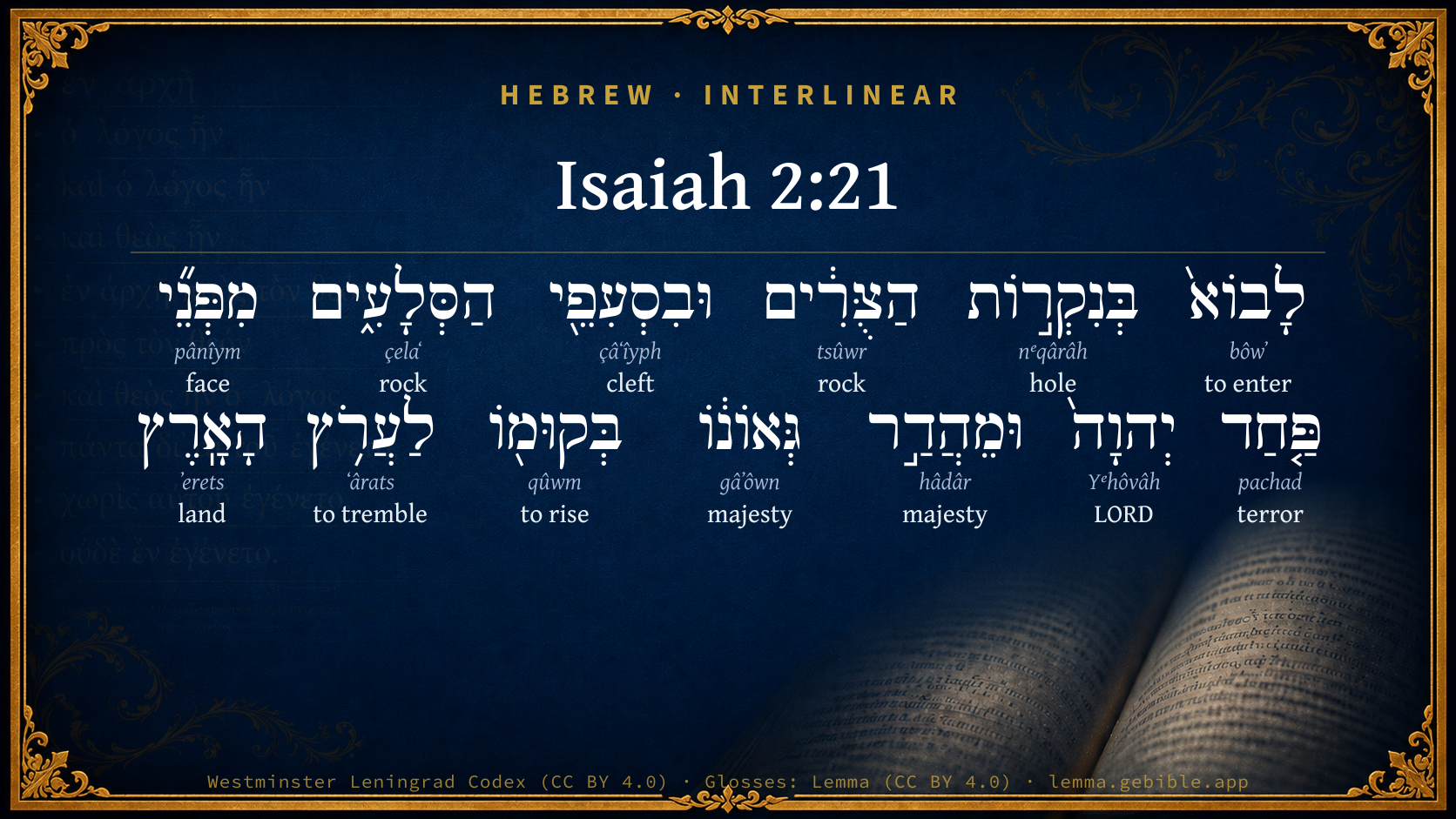
  1. לָבוֹא֙ bôwʼ H935 “to enter” Preposition + Verb, Qal, Infinitive Construct
  2. הַצֻּרִ֔ים tsûwr H6697 “the · rocks” Particle, Definite Article + Noun, Common, Masculine, Plural, Absolute
  3. וּבִסְעִפֵ֖י çâʻîyph H5585 “and · in/at · clefts of” Conjunction + Preposition + Noun, Common, Masculine, Plural, Construct
  4. הַסְּלָעִ֑ים çelaʻ H5553 “the · rocks” Particle, Definite Article + Noun, Common, Masculine, Plural, Absolute
  5. מִפְּנֵ֞י pânîym H6440 “from · face(s) of” Preposition + Noun, Common, Both, Plural, Construct
  6. פַּ֤חַד pachad H6343 “terror of” Noun, Common, Masculine, Singular, Construct
  7. יְהוָה֙ Yᵉhôvâh H3068 “LORD” Noun, Proper
  8. וּמֵהֲדַ֣ר hâdâr H1926 “and · from · majesty of” Conjunction + Preposition + Noun, Common, Masculine, Singular, Construct
  9. גְּאוֹנ֔וֹ gâʼôwn H1347 “majesty · his” Noun, Common, Masculine, Singular, Construct + Suffix, Personal, 3rd Person, Masculine, Singular
  10. בְּקוּמ֖וֹ qûwm H6965 “in/at · to rise · him” Preposition + Verb, Qal, Infinitive Construct + Suffix, Personal, 3rd Person, Masculine, Singular
  11. לַעֲרֹ֥ץ ʻârats H6206 “to tremble” Preposition + Verb, Qal, Infinitive Construct
  12. הָאָֽרֶץ ʼerets H776 “the · land” Particle, Definite Article + Noun, Common, Both, Singular, Absolute

About this verse

These counts appear in no published source. They are computed here, from the morphology-tagged text and Lemma’s own curated glosses. What Lemma adds →

13
words
13
distinct lemmas
Prophets
section

Notable vocabulary

The rarest word here is בְּנִקְר֣וֹת hole H5366 — appearing just 2 times in the whole Hebrew Bible.

Shared distinctive vocabulary

בְּנִקְר֣וֹת hole H5366 occurs in 2 verses of the Hebrew Bible. Also found in:

Grammatical profile

  • 3 verbs
  • 10 nouns

Verb forms

  • לָבוֹא֙ Qal · Infinitive Construct
  • בְּקוּמ֖וֹ Qal · Infinitive Construct
  • לַעֲרֹ֥ץ Qal · Infinitive Construct

Hebrew & Septuagint length

In English translation the verse runs 37 words from the Hebrew and 39 from the Septuagint (LXX English) — closely comparable.

A rough comparison of the two English renderings, which tokenize alike — not a word-level alignment.

Word counts can differ between the Hebrew and the Greek without any difference in meaning — e.g. the Hebrew direct-object marker אֵת has no separate Greek word, and Greek often adds the article ὁ.

Cross-references

5

Topical passages linked to Isaiah 2:21 in the Treasury of Scripture Knowledge — connected by theme and wording, ordered by reader-vote popularity; previews shown in the World English Bible.

  • Isaiah 2:19 Men shall go into the caves of the rocks, And into the holes of the earth, From before the terror of Yahweh, And from the glory of his majesty, When he arises to shake the earth mightily.
  • Exodus 33:22 It will happen, while my glory passes by, that I will put you in a cleft of the rock, and will cover you with my hand until I have passed by;
  • Job 30:6 So that they dwell in frightful valleys, And in holes of the earth and of the rocks.
  • Song of Solomon 2:14 My dove in the clefts of the rock, In the hiding places of the mountainside, Let me see your face. Let me hear your voice; For your voice is sweet, and your face is lovely.
  • Isaiah 2:10 Enter into the rock, And hide in the dust, From before the terror of Yahweh, And from the glory of his majesty.

Cross-references courtesy of OpenBible.info (CC BY 4.0).

Hebrew and Greek witnesses Masoretic Hebrew ↔ Greek Septuagint

The same verse in the two great witnesses to the Old Testament, shown verse-for-verse.

These are two independent witnesses, not word-aligned to each other, and the Septuagint is shown in lemma (dictionary) form.

Hebrew Isaiah 2:21 Masoretic · Westminster Leningrad Codex

לָבוֹא֙ בְּנִקְר֣וֹת הַצֻּרִ֔ים וּבִסְעִפֵ֖י הַסְּלָעִ֑ים מִפְּנֵ֞י פַּ֤חַד יְהוָה֙ וּמֵהֲדַ֣ר גְּאוֹנ֔וֹ בְּקוּמ֖וֹ לַעֲרֹ֥ץ הָאָֽרֶץ

To go into the caverns of the rocks, And into the clefts of the ragged rocks, From before the terror of Yahweh, And from the glory of his majesty, When he arises to shake the earth mightily.

World English Bible · Public Domain

Greek LXX Isaiah 2:21 Septuagint · lemma form

ὁ εἰςἔρχομαι εἰς ὁ τρώγλν ὁ στερεός πέτρα καί εἰς ὁ σχίσμν ὁ πέτρος ἀπό πρόσωπον ὁ φόβος κύριος καί ἀπό ὁ δόξα ὁ ἰσχύς αὐτός ὅταν ἀναἵστημι θραύω ὁ γῆ

to enter into the caverns of the solid rock, and into the clefts of the rocks, for fear of the Lord, and by reason of the glory of his might, when he shall arise to strike terribly the earth.

LXX2012 (modern English Septuagint) · Public Domain

On this verse, Keil & Delitzsch discusses the Septuagint’s reading. Read the note in Commentary ↓

Hebrew: Westminster Leningrad Codex (CC BY 4.0). Greek: Septuagint (public domain); English from LXX2012 (modern English Septuagint) (Public Domain). How the Septuagint differs from the Hebrew →

Targum (Aramaic paraphrase)

1

The Targum is the ancient Jewish Aramaic paraphrase of the Hebrew Scriptures — an interpretive translation, not the Hebrew text itself. Onkelos (literal) and Pseudo-Jonathan (expansive) render the Torah, and Jonathan the Prophets. Coverage is partial: where no permissively-licensed English translation exists for a verse, only the Aramaic is shown. This is verse-level text, not a word-by-word alignment to the Hebrew.

  1. Targum Jonathan Prophets (Joshua–Malachi)
    לְמֵיעַל בִמְעָרַת טִנָרַיָא וּבִשְׁקִיפֵי כֵיפָא מִן קֳדָם דַחַלְתָּא דַייָ וּמִזִיו יְקָרֵיהּ בְּאִתְגַלְיוּתֵיהּ לְמִתְבַּר רַשִׁיעֵי אַרְעָא:

    To go into the caves of the rocks, and into the holes of the rocks, for the fear of the Lord and for the brightness of His glory, when He shall be revealed to destroy the wicked of the earth.

    Targum Jonathan — Aramaic: “Mikraot Gedolot” (public domain). English: “Sefaria Community Translation” (CC0 1.0 (public-domain dedication)); “London "Chaldee Paraphrase," 1871” (public domain). Text via Sefaria.

Commentary

Notes on Isaiah 2:21 from classic Christian and Jewish commentators (each source and its license shown beneath its notes). The classic Christian expositions comment on the surrounding passage and are grouped to its opening verse, so a note may address several verses; the Jewish commentaries on the Tanakh (Rashi and others) are per-verse, so they appear only where the commentator wrote on this verse.

Lemma curates 59 commentaries, every one of them public domain or Creative Commons licensed, each selected and text-cleaned for this edition rather than reprinted as found. About our sources →

Trapp's Complete Commentary

John Trapp

Isa 2:21 To go into the clefts of the rocks, and into the tops of the ragged rocks, for fear of the LORD, and for the glory of his majesty, when he ariseth to shake terribly the earth.

Ver. 21. To go into the clefts of the rocks.] See Isa 2:10. Only here the double repetition of this dreadful judgment is very emphatic, and may serve to teach preachers to inculcate upon their hearers God’s severity against sinners, and to remind them much of those last things, death, judgment, hell. Utinam ubique de his dissereretur, saith Chrysostom, that excellent preacher. Oh that these things might resound from all pulpits!

John Trapp, A Commentary or Exposition upon All the Books of the Old and New Testament (1647–1656) — public domain. Text from a community e-Sword module.

Whedon's Commentary on the Bible

Daniel D. Whedon

21. The warning begun in Isa_2:10 continues.

To go — This is an infinitive of purpose — that these frightened idol worshippers may go into hiding-places away from the coming terror of Jehovah.

It is easy to conceive our prophet as delivering this fearful message in the temple courts at Jerusalem, or even in the royal courts, with his disciples about him (for it is presumable that he had a school of young prophets within or near Jerusalem) furnishing the choral refrains at Isa_2:11; Isa_2:17; Isa_2:19; Isa_2:21.

Daniel D. Whedon (gen. ed.), Commentary on the Old and New Testaments (1874–1909) — public domain. Text from a community e-Sword module.

Adam Clarke's Commentary

Verse 21. See Clarke on Isa 2:19.

Adam Clarke's Commentary on the Bible (1810–1826) — public domain. Text from a community e-Sword/MySword module.

Ellicott's Commentary for English Readers

(21) To go into the clefts of the rocks . . .—Comp. for the phrase, Exo_33:22. The picture of Isa_2:19 is reproduced, with some noticeable variations. As men feel shock after shock of the earthquake, and see the flashing fires, and hear the crash of the thunder, they leave the larger caverns in which they had at first sought shelter, and where they have left the idols that were once so precious, and fly to the smaller and higher openings, the “clefts of the rocks,” and the rents of the crags, in their unspeakable panic.

A Bible Commentary for English Readers, edited by Charles John Ellicott (1878–1897) — public domain. Text from a community e-Sword module.

The Cambridge Bible for Schools and Colleges

gen. ed. J. J. S. Perowne

21. See on Isa_2:10; Isa_2:19. Translate: to enter into the hollows of the rocks and clefts of the crags, &c.

The Cambridge Bible for Schools and Colleges (gen. ed. J. J. S. Perowne; Cambridge University Press, 1878–1918) — public domain. Text from a community e-Sword module.

Albert Barnes' Notes on the Bible

To go - That is, that he may go.

Clefts of the rocks - see the note at Isa 2:19.

Into the tops ... - The tops of such rocks were not easily accessible, and were, therefore, deemed places of safety. We may remark here, how vain were the refuges to which they would resort - as if they were safe from “God,” when they had fled to the places in which they sought safety from “man.” The image here is, however, one that is very sublime. The earth shaking; the consternation and alarm of the people; their renouncing confidence in all to which they had trusted; their rapid flight; and their appearing on the high projecting cliffs, are all sublime and terrible images. They denote the severity of God’s justice, and the image is a faint representation of the consternation of people when Christ shall come to judge the earth; Rev 6:15-17.

Albert Barnes' Notes on the Bible (1834–1885) — public domain. Text from a community e-Sword/MySword module.

The Pulpit Commentary

To go into; or, as they go into; i.e. "as they make their escape, they shall fling the idols away." The clefts of the rocks. (comp. Exo_33:22, the only other passage of Scripture where the word occurs) The tops of the ragged rocks; rather, the rents, or crevices. The idea of hiding themselves from the awful majesty of God is kept up throughout. (cf. vers. 10 and 19; and see also Luk_23:30)

The Pulpit Commentary (1880–1919), ed. H.D.M. Spence-Jones & Joseph S. Exell — public domain. Text from a community e-Sword module.

Keil & Delitzsch

C. F. Keil & F. Delitzsch

"To creep into the cavities of the stone-blocks, and into the clefts of the rocks, before the terrible look of Jehovah, and before the glory of His majesty, when He arises to put the earth in terror." Thus ends the fourth strophe of this "dies irae, dies illa," which is appended to the earlier prophetic word. But there follows, as an epiphonem, this nota bene in Isa 2:22 : Oh, then, let man go, in whose nose is a breath; for what is he estimated at? The Septuagint leaves this v. out altogether. But was it so utterly unintelligible then? Jerome adopted a false pointing, and has therefore given this marvellous rendering: excelsus (bâmâh!) reputatus est ipse, by which Luther was apparently misled. But if we look backwards and forwards, it is impossible to mistake the meaning of the verse, which must be regarded not only as the resultant of what precedes it, but also as the transition to what follows. It is preceded by the prediction of the utter demolition of everything which ministers to the pride and vain confidence of men; and in Isa 3:1. the same prediction is resumed, with a more special reference to the Jewish state, from which Jehovah is about to take away every prop, so that it shall utterly collapse. Accordingly the prophet exhorts, in Isa 2:22, to a renunciation of trust in man, and everything belonging to him, just as in Psa 118:8-9; Psa 146:3, and Jer 17:5. The construction is as general as that of a gnome. The dat. Commodi לכם (Ges. 154, 3, e) renders the exhortation both friendly and urgent: from regard to yourselves, for your own good, for your own salvation, desist from man, i.e., from your confidence in him, in whose nose (in cujus naso, the singular, as in Job 27:3; whereas the plural is used in Gen 2:7 in the same sense, in nares ejus, "into his nostrils") is a breath, a breath of life, which God gave to him, and can take back as soon as He will (Job 34:14; Psa 104:29). Upon the breath, which passes out and in through his nose, his whole earthly existence is suspended; and this, when once lost, is gone for ever (Job 7:7). It is upon this breath, therefore, that all the confidence placed in man must rest - a bad soil and foundation! Under these conditions, and with this liability to perish in a moment, the worth of man as a ground of confidence is really nothing. This thought is expressed here in the form of a question: At (for) what is he estimated, or to be estimated? The passive participle nechshâb combines with the idea of the actual (aestimatus) that of the necessary (aestimandus), and also of the possible or suitable (aestimabilis); and that all the more because the Semitic languages have no special forms for the latter notions. The Beth is Beth pretı̄, corresponding to the Latin genitive (quanti) or ablative (quanto) - a modification of the Beth instrumenti, the price being regarded as the medium of exchange or purchase: "at what is he estimated," not with what is he compared, which would be expressed by ‛eth (Isa 53:12; compare μετά, Luk 22:37) or ‛im (Psa 88:5). The word is בּמּה, not בּמּה, because this looser form is only found in cases where a relative clause follows (eo quod, Ecc 3:22), and not bama=h, because this termination with ā is used exclusively where the next word begins with Aleph, or where it is a pausal word (as in Kg1 22:21); in every other case we have bammeh. The question introduced with this quanto (quanti), "at what," cannot be answered by any positive definition of value. The worth of man, regarded in himself, and altogether apart from God, is really nothing.

The proclamation of judgment pauses at this porisma, but only for the purpose of gathering fresh strength. The prophet has foretold in four strophes the judgment of God upon every exalted thing in the kosmos that has fallen away from communion with God, just as Amos commences his book with a round of judgments, which are uttered in seven strophes of uniform scope, bursting like seven thunder-claps upon the nations of the existing stage of history. The seventh stroke falls upon Judah, over which the thunderstorm rests after finding such abundant booty. And in the same manner Isaiah, in the instance before us, reduces the universal proclamation of judgment to one more especially affecting Judah and Jerusalem. The current of the address breaks through the bounds of the strophe; and the exhortation in Isa 2:22 not to trust in man, the reason for which is assigned in what precedes, also forms a transition from the universal proclamation of judgment to the more special one in Isa 3:1, where the prophet assigns a fresh ground for the exhortation.

Keil & Delitzsch — Biblical Commentary on the Old Testament (1861–1891) — public domain (CC PDM 1.0). Text via the HelloAO Bible API. (Old Testament only.)

J. A. Alexander on Isaiah

Joseph Addison Alexander

Continuing the sentence, he declares the end for which they should throw away their idols, namely, to save themselves, casting them off as worthless encumbrances in order the more quickly to take refuge in the rocks. “To go into the clefts of the rocks, and into the fissures of the cliffs (or crags) from before the terror of Jehovah, and from the glory of His majesty in His arising to terrify the earth,” or as Lowth more poetically renders it, to strike the earth with terror. The final recurrence of the same refrain which closed the eleventh and seventeenth verses, marks the conclusion of the choral or strophical arrangement at this verse, the next beginning a new context.

Joseph Addison Alexander, The Prophecies of Isaiah (1846–1847; New York: Scribner, 1870–1878) — public domain. Text from a community e-Sword module.

Ibn Ezra

Rabbi Abraham ibn Ezra

נקרת The clefts of. Literally a hollowed place of.

סעפי. Branchlike pieces projecting from the rocks, where people can hide themselves.

לערוץ To be mighty. Root ערץ; comp. עריץ mighty. According to others, it is a transitive verb, meaning to terrify; אל תערץ (Jos. 1:9) has, perhaps, the same meaning, the word לבך thine heart, being supplied—do not terrify or discourage thine heart—and עריץ (29:20), is then a transitive adjective, terrible, like אימים (Gen. 14:5), the terrifying ones.

Ibn Ezra on the Tanakh — English translations: “Sefaria Community Translation” (CC0 1.0 (public-domain dedication)); “Yalkut, Sifsei Chachomim Chumash, Metsudah Publications, 2009” (CC BY 4.0); and “Commentary of Ibn Ezra on Isaiah - trans. by M. Friedlander, 1873” (public domain). Text via Sefaria.

Lesson kit

Teaching starters — assembled from the data on this page, not authored interpretation. Every prompt links to the verse data it draws on. Edit before teaching.

Isaiah, in the Prophets, opens this verse with 13 words (13 distinct Hebrew lemmas). Its most distinctive word is nᵉqârâh (“hole”). A historical commentator’s framing appears above. Read the whole chapter for the surrounding context.

Discussion questions

  1. What does “hole” (nᵉqârâh) contribute to the verse as a whole?
  2. Exodus 33:22 shares the word «hole» with this verse. How do the two illuminate each other?
  3. These translations render this verse differently; the difference is in the English rendering, not the original. What questions does that raise?
  4. The verb «לָבוֹא֙» is Qal Infinitive Construct. How does its form color the action?
  5. Reading how Trapp's Complete Commentary and Whedon's Commentary on the Bible read this verse, where do the two commentators agree and where do they part?

Things to notice

Reading settings

Reading text

Shown beneath each verse's original-language words.

Old Testament
Old Testament edition

Read the OT as the Masoretic Hebrew (MT) or the Greek Septuagint (LXX).

English shown for the Greek Septuagint (in the Hebrew ↔ Greek comparison).

Comparing translations? Open the Compare panel on any verse page to stack up to four side by side.