Galatians 2:7

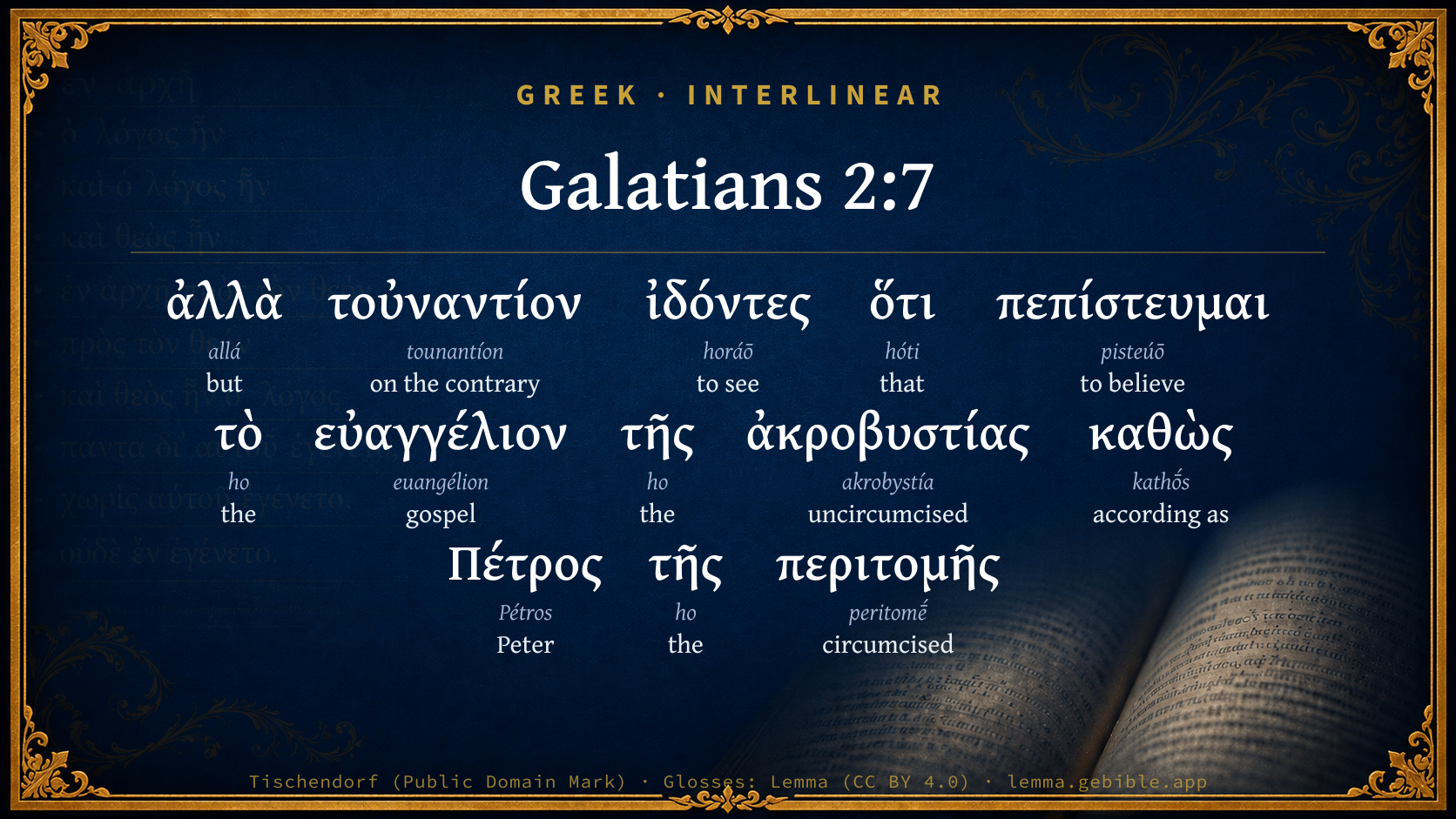
Greek (Tischendorf 8th ed.) Galatians 2:7 appears in the Greek New Testament. The text above is from the Tischendorf 8th edition. Each word links to its Strong’s number and a concise gloss. Click any word for its full Thayer’s Greek Lexicon entry.
Download image
Cite this verse

Galatians 2:7 (World English Bible). Public Domain. Lemma interlinear Bible study tool, https://lemma.gebible.app/v/galatians/2/7.

Show BibTeX & RIS
BibTeX
RIS
English Translation
but to the contrary, when they saw that I had been entrusted with the Gospel for the uncircumcision, even as Peter with the Gospel for the circumcision
World English Bible · Public Domain
Download a study sheet

One document with this verse’s original text, its word-by-word gloss line, the meaning frame, cross-references with their text, attributed commentary, and full source and license credits — printable, and it pastes into notes with its structure intact.

This verse Autodidact and up

Study sheet (.html) Plain text (.txt)

A passage Seminary Student

Up to 50 verses in one chapter. A passage sheet keeps up to 6 commentary sources and 12 cross-references per verse, in the order this page ranks them, and says so on the sheet whenever that leaves anything out. Ask for a single verse and you get the Autodidact verse sheet above.

Everything on this page stays free to read, with no account — the sheet is a download of what is already on screen, not access to it.

Want to remove ads? Support Godless Engineer
Compare translations 3

The same verse in 3 English versions, stacked beneath the original-language interlinear above. Click any original word for its lexicon entry.

Each is an independent rendering of the whole verse — the interlinear is not word-aligned to these translations.

Highlighted words mark where these versions differ — a whole-verse word diff, not a word-by-word alignment.

  • World English Bible Public Domain
    but to the contrary, when they saw that I had been entrusted with the Gospel for the uncircumcision, even as Peter with the Gospel for the circumcision
  • King James Version Public Domain
    But contrariwise, when they saw that the gospel of the uncircumcision was committed unto me, as the gospel of the circumcision was unto Peter;
  • unfoldingWord Literal Text CC BY-SA 4.0
    But on the contrary, having seen that I had been entrusted with the gospel to the uncircumcision, just as Peter to the circumcision

unfoldingWord Literal Text — © unfoldingWord, licensed CC BY-SA 4.0. Word-aligned USFM3 via Door43 (git.door43.org/unfoldingWord/en_ult).

Versions to compare (up to 4)

3 of 4 selected

Show all 19 translations

Every available English version of this verse, each an independent rendering of the whole verse.

  • World English Bible Public Domain
    but to the contrary, when they saw that I had been entrusted with the Gospel for the uncircumcision, even as Peter with the Gospel for the circumcision
  • Berean Standard Bible Public Domain
    On the contrary, they saw that I had been entrusted to preach the gospel to the uncircumcised, just as Peter had been to the circumcised.
  • Majority Standard Bible Public Domain
    On the contrary, they saw that I had been entrusted to preach the gospel to the uncircumcised, just as Peter had been to the circumcised.
  • King James Version Public Domain
    But contrariwise, when they saw that the gospel of the uncircumcision was committed unto me, as the gospel of the circumcision was unto Peter;
  • American Standard Version (1901) Public Domain
    but contrariwise, when they saw that I had been intrusted with the gospel of the uncircumcision, even as Peter with `the gospel' of the circumcision
  • Revised Version (1885) Public Domain
    but contrariwise, when they saw that I had been intrusted with the gospel of the uncircumcision, even as Peter with the gospel of the circumcision
  • Geneva Bible (1599) Public Domain
    But contrariwise, when they saw that ye Gospel ouer ye vncircumcision was comitted vnto me, as the Gospel ouer ye circumcision was vnto Peter:
  • Douay-Rheims (1899) Public Domain
    But contrariwise, when they had seen that to me was committed the gospel of the uncircumcision, as to Peter was that of the circumcision.
  • Young's Literal Translation Public Domain
    but, on the contrary, having seen that I have been entrusted with the good news of the uncircumcision, as Peter with `that' of the circumcision,
  • Literal Standard Version CC BY-SA 4.0
    but on the contrary, having seen that I have been entrusted with the good news of the uncircumcision, as Peter with [that] of the circumcision,
  • Unlocked Literal Bible CC BY-SA 4.0
    On the contrary, they saw that I had been entrusted with the gospel to those who are uncircumcised, just as Peter had been entrusted with the gospel to those who are circumcised.
  • unfoldingWord Literal Text CC BY-SA 4.0
    But on the contrary, having seen that I had been entrusted with the gospel to the uncircumcision, just as Peter to the circumcision
  • Darby Bible Public Domain
    but, on the contrary, seeing that the glad tidings of the uncircumcision were confided to me, even as to Peter that of the circumcision,
  • World Messianic Bible Public Domain
    but to the contrary, when they saw that I had been entrusted with the Good News for the uncircumcised, even as Peter with the Good News for the circumcised—
  • Webster's Bible Public Domain
    But on the contrary, when they saw that the gospel of the uncircumcision was committed to me, as the gospel of the circumcision was to Peter;
  • Free Bible Version CC BY-SA 4.0
    On the contrary, once they realized that I'd been given responsibility to share the good news with the foreigners just as Peter had been given the responsibility to share the good news with the Jews,
  • Bible in Basic English Public Domain
    But, quite the opposite, when they saw that I had been made responsible for preaching the good news to those without circumcision, even as Peter had been for those of the circumcision
  • Text-Critical English NT CC BY 4.0
    On the contrary, they saw that I had been entrusted with the gospel to the uncircumcised, just as Peter had been entrusted with the gospel to the circumcised.
  • Tyndale New Testament (1534) Public Domain
    But contrary wyse when they sawe that the gospell over the vncircumcision was committed vnto me as the gospell over the circucision was vnto Peter:

Literal Standard Version (2020), Covenant Press — licensed CC BY-SA 4.0. Text via the HelloAO Bible API (eBible.org). Unlocked Literal Bible (unfoldingWord) — licensed CC BY-SA 4.0. Text via the HelloAO Bible API (eBible.org). unfoldingWord Literal Text — © unfoldingWord, licensed CC BY-SA 4.0. Word-aligned USFM3 via Door43 (git.door43.org/unfoldingWord/en_ult). Free Bible Version, Dr. Jonathan Gallagher — licensed CC BY-SA 4.0. Text via the HelloAO Bible API (eBible.org).

Word by word

More ways to search: Search by grammar → Find every occurrence → Compare this word →

Practice this passage: Drill this verse → Learn its vocabulary →

About this verse

These counts appear in no published source. They are computed here, from the morphology-tagged text and Lemma’s own curated glosses. What Lemma adds →

13
words
11
distinct lemmas
Pauline Epistles
section

Notable vocabulary

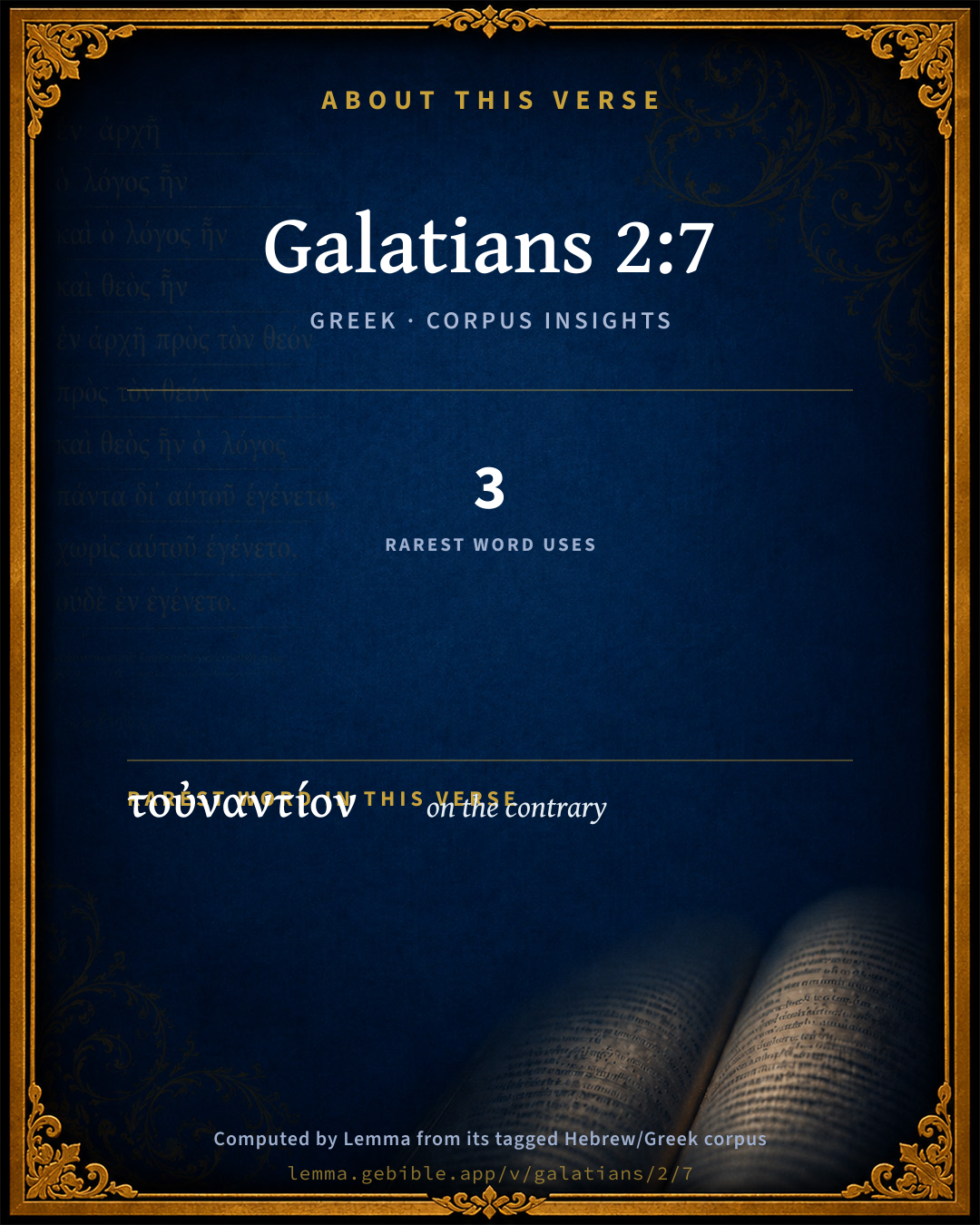
The rarest word here is τοὐναντίον on the contrary G5121 — appearing just 3 times in the whole Greek New Testament.

Shared distinctive vocabulary

τοὐναντίον on the contrary G5121 occurs in 3 verses of the Greek New Testament. Also found in:

Repetition

A word recurs within this verse:

Cross-references

16

Topical passages linked to Galatians 2:7 in the Treasury of Scripture Knowledge — connected by theme and wording, ordered by reader-vote popularity; previews shown in the World English Bible.

  • Acts 9:15 But the Lord said to him, "Go your way, for he is my chosen vessel to bear my name before the nations and kings, and the children of Israel.
  • 1 Thessalonians 2:4 But even as we have been approved by God to be entrusted with the Gospel, so we speak; not as pleasing men, but God, who tests our hearts.
  • Galatians 1:16 to reveal his Son in me, that I might preach him among the Gentiles, I didn't immediately confer with flesh and blood,
  • 1 Timothy 2:7 to which I was appointed a preacher and an apostle (I am telling the truth in Christ, not lying), a teacher of the Gentiles in faith and truth.
  • Acts 13:46–48 Paul and Barnabas spoke out boldly, and said, "It was necessary that God's word should be spoken to you first. Since indeed you thrust it from you, and judge yourselves unworthy of eternal life, behold, we turn to the Gentiles.
  • Galatians 2:9 and when they perceived the grace that was given to me, James and Cephas and John, they who were reputed to be pillars, gave to me and Barnabas the right hand of fellowship, that we should go to the Gentiles, and they to the circumcision.
  • 1 Timothy 1:11 according to the Gospel of the glory of the blessed God, which was committed to my trust.
  • 2 Timothy 1:11 For this, I was appointed as a preacher, an apostle, and a teacher of the Gentiles.
  • Acts 15:12 All the multitude kept silence, and they listened to Barnabas and Paul reporting what signs and wonders God had done among the Gentiles through them.
  • Acts 18:6 When they opposed him and blasphemed, he shook out his clothing and said to them, "Your blood be on your own heads! I am clean. From now on, I will go to the Gentiles!"
  • Acts 28:28 "Be it known therefore to you, that the salvation of God is sent to the Gentiles. They will also listen."
  • 1 Corinthians 9:17 For if I do this of my own will, I have a reward. But if not of my own will, I have a stewardship entrusted to me.
  • 2 Peter 3:15 Regard the patience of our Lord as salvation; even as our beloved brother Paul also, according to the wisdom given to him, wrote to you;
  • Acts 15:25–26 it seemed good to us, having come to one accord, to choose out men and send them to you with our beloved Barnabas and Paul,
  • Romans 1:5 through whom we received grace and apostleship, for obedience of faith among all the nations, for his name's sake;
  • Romans 11:13 For I speak to you who are Gentiles. Since then as I am an apostle to Gentiles, I glorify my ministry;

Cross-references courtesy of OpenBible.info (CC BY 4.0).

Commentary

Notes on Galatians 2:7 from classic Christian and Jewish commentators (each source and its license shown beneath its notes). The classic Christian expositions comment on the surrounding passage and are grouped to its opening verse, so a note may address several verses; the Jewish commentaries on the Tanakh (Rashi and others) are per-verse, so they appear only where the commentator wrote on this verse.

Lemma curates 59 commentaries, every one of them public domain or Creative Commons licensed, each selected and text-cleaned for this edition rather than reprinted as found. About our sources →

The Biblical Illustrator

Joseph S. Exell

Gal_2:7-8

To the apostleship of the circumcision.

The results of the conference

Barnabas must have been struck with the coincidence between his own conduct towards the newly-enfranchised converts at Antioch (Act_11:22-23) and that of the apostles towards the delegates of these converts.

I. What the apostles saw--

1. In Paul and Barnabas personally. The closest scrutiny of speech, deportment, aim, could create but one impression.

2. In their work; the conversion of the Gentles and the uprising of so many Christian Churches could be due only to Divine grace.

II. What they felt.

1. That the gospel of the uncircumcision was committed to Paul. The conclusion was irresistible.

2. That Paul was as worthy of his commission as was Peter.

III. What they did.

1. Gave the delegates the right hand of fellowship.

(1) Spontaneously. Paul did not ask for it.

(2) Heartily.

(3) Irrevocably.

2. Assigned to Paul and Peter--

(1) the spheres which each could best work;

(2) the honours to which each was entitled.

Learn:

1. That Gods grace when experienced should be employed in work for Him.

2. That true worth is determined not by rank, but by work.

3. That honest work ultimately confers the highest rank.

4. That harmonious and effective working is best promoted by a division of labour.

The gospel commission

I. The gospel is not ours but Gods.

II. The gospel is committed to human trust.

1. What an honour.

2. What a responsibility.

III. The ministers duty with reference to the gospel is--

1. To keep it.

2. To maintain the truth of it.

3. To apply it to the best use.

IV. Only God can make the gospel effective (1Co_3:7).

V. The believers duty is--

1. To hear it humbly.

2. To receive it thankfully.

3. To obey it diligently.

4. To propagate it earnestly. (W. Perkins.)

The gospel of the uncircumcision

St. Pauls attitude towards circumcision. The great controversy in which St. Paul was engaged within the Church turned upon the question whether the Jewish observances, and circumcision in particular, were necessary for Christians. A large party of Christians whose centre was Jerusalem, who were probably influenced by the current opinions in the school of Shammai, and who made free use of the names of the apostles Peter, James, and John, maintained that these observances were necessary. To these men St. Pauls work appeared to be radically revolutionary; and where they could they went over the ground which St. Paul had evangelized. They insisted that if the Gentile converts would be really good Christians, they too must be circumcised. St. Paul maintained that while if a man happened to be circumcised it did him no sort of harm, to insist upon circumcision as necessary for a Christian was to deny fundamental truth, for there were two points of the gravest importance which really were involved in this apparent trifle.

1. Was the work of Christ, as the Restorer of man to a state of righteousness before God, complete in itself; or was it merely a supplement to the Jewish creed? Was the system of the Jewish law, after all, able to make men righteous; and, if it was, where was the need of the work of Christ? If this was the case, moreover, was it even conceivable that Christ was greater than Moses and the prophets--greater in His essential nature? [[he Judaising theory that the law in its entirety was still obligatory meant, at bottom, that Christs work was not nearly complete, and so that His Person was really only human.

2. Was Christianity meant to be the religion of mankind, or only of a small sub-division of the Jewish world? Was it to be merely national, or to be catholic? If Christianity was serious in its claim to be the true, the absolute religion, it could not but also claim to be universal. (Canon Liddon.)

Diversity of gifts

We discover a diversity of gifts by a reference to Whitfield and Handel. The one was in eloquence what the other was in sacred song; the one appealing, through the understanding, to the heart and conscience, calling on men everywhere to repent and turn to God; the other drawing out, and bearing upward, as a sweet incense before the altar of the upper sanctuary, the devout aspirations of the new-born soul. There was an air, a soul, a movement, in the oratory of Whitfield which created indescribable emotions in his vast assemblies. Handel equally electrified the multitudes in Westminster Abbey. His power of song, while he performed the Messiah, raised them to their feet; and yet greater wonders did Whitfield when preaching the Messiah to the scores of thousands in Moorfields. (H. Read.)

Power of grace in saints

Longfellow in his Hiawatha sings of--

The pleasant watercourses,

You could trace them through the valley,

By the rushing in the Spring-time,

By the alders in the Summer,

By the white fog in the Autumn,

By the black line in the Winter.

So traceable are the lives of really gracious men and women. They are not solicitous to be observed, but the gracious signs following are sure to reveal them. Like their Master they cannot be hid. (C. H. Spurgeon.)

The Biblical Illustrator, edited by Joseph S. Exell (c. 1880s–1900s) — public domain. Text from a community e-Sword module.

Tyndale Open Study Notes

Tyndale Open Resources

2:7-8 The apostles in Jerusalem saw that Paul and Peter had different scopes of ministry (for Peter’s, see Acts 1:1–5:42; 9:1–10:48; for Paul’s, see Acts 13:1–28:31), but they both preached the same gospel.

Tyndale Open Study Notes — © Tyndale Open Resources, licensed CC BY-SA 4.0. Text via the HelloAO Bible API.

Bengel's Gnomon

Johann Albrecht Bengel

Gal 2:7. Ἰδόντες) seeing from the effect itself, which I pointed out to them, Gal 2:8; Act 15:12.—τῆς ἀκροβυστίας, of the uncircumcision) i.e. of the Gentiles, who were to be brought to the faith without circumcision.

Bengel's Gnomon of the New Testament — English translation (T&T Clark, Edinburgh, 1860) — public domain. Text from a community e-Sword module.

Meyer's Critical & Exegetical Commentary

Heinrich August Wilhelm Meyer

Gal_2:7. Ἀλλὰ τοὐναντίον] to be separated merely by a comma from the preceding, being still connected with γάρ. To me they made no kind of communication; but, on the contrary, when they had seen etc., the three pillar-apostles concluded with me and Barnabas the apostolic alliance, etc. (Gal_2:9). Hofmann, with a view to extort a regimen for ἀπὸ τῶν δοκούντων in Gal_2:6, very arbitrarily tears asunder the clear and simple connection which the words obviously present, taking ἀλλὰ τοὐναντίον by itself and dissevered from what follows, and supplementing the sense by the insertion, They have not proposed anything to me, but conversely, I to them. Comp. on τοὐναντίον, 2Co_2:7, 1Pe_3:9; very frequently (also τἀναντία) occurring in Greek authors (Schaefer, ad Bos. Ell. p. 297). But this strange ellipsis is a device utterly unprecedented.[77]

ἰδόντες] after they had seen, namely, from the way in which I to them κατʼ ἰδίαν ἀνεθέμην τὸ εὐαγγ. ὃ κηρύσσω ἐν τοῖς ἔθνεσι (Gal_2:2). Usteri, from the blessed result of my preaching. So also Rosenmüller, Winer, Baur, Hilgenfeld, Holsten, Hofmann; Rückert, Schott, de Wette, Wieseler, mix the two views; and Fritzsche includes the previous labours of the apostle among the Gentiles, e.g. in Tarsus and Antioch, among the grounds of knowledge. But nothing beyond what we have just given can be gathered from the context. Erasmus appropriately paraphrases, ubi communicato cum illis evangelio meo perspexissent.

ὅτι πεπίστ. τ. εὐαγγ. τ. ἀκροβ. κ.τ.λ.] The emphasis is laid on καθὼς Πέτρος τῆς περιτ., as Gal_2:8 shows. They saw that my having been divinely entrusted with the gospel for the Gentiles was just such (just as undoubted, true, direct, etc.), as was Peters divine trust with the gospel for the Jews; consequently there could be no question of any προσαναθεῖναι, and nothing could follow but complete recognition (Gal_2:9). The construction (comp. Rom_3:2; 1Co_9:17) in the sense of πεπίστευταί μοι τὸ εὐαγγ. (as F G, 19*, 46** actually read) is regular; as to the perfect, used of the enduring subsistence of the act, see Winer, p. 255 [E. T. 339].

τῆς ἀκροβυστίας] that is, τῶν ἀκροβύστων (Rom_2:26; Rom_3:30; Eph_2:11), the gospel which belonged to the uncircumcised, and was to be preached to them.

καθὼς Πέτρος τῆς περιτομ.] Thus Peter appears as the representative of the Jewish apostles, in accordance with his superiority among them (Mat_16:18; Acts 2, 3, 4, 5 et al.). The destination of Peter as an apostle to the Gentiles also (Act_15:7; 1Pe_1:1) is not negatived, but a potiori fit denominatio.

That this passage relates not to two different gospels, but to the same gospel for two different circles of recipients, to whose peculiarities respectively the nature and mode of preaching required special adaptation, is obvious of itself, and is clear from Gal_2:8-9. But the passage cannot be worse misunderstood than it has been by Baur, according to whom there was a special gospel of the uncircumcision and a special gospel of the circumcision, differing in this respect, that the one maintained the necessity of circumcision, while the other allowed it to drop. Comp. Holsten, who discovers the distinctive feature of the Gentile gospel in the gnosis of the death of the cross, in spite of 1Co_1:23 f. In opposition to such a separation, see also Ritschl, altkath. K. p. 127 f.

[77] Certainly the ἀλλὰ τοὐναντίον was, for Hofmann at least, the most refractory part of the sentence, which had in some sort of way to be forcibly torn from its natural connection with ἰδόντες,a connection justly unassailed by expositors. And he has managed it by the device of the above mentioned ellipsis!

Meyer — Critical and Exegetical Commentary on the New Testament — English translation by Peter Christie, edited by Frederick Crombie (T&T Clark, 1880) — public domain. Text from a community e-Sword module.

Expositor's Greek Testament

ed. W. Robertson Nicoll

Gal 2:7 . The emphatic opening of this verse, Ἀλλὰ τοὐναντίον , gives prominence to the thorough contrast presented by James, Cephas and John to the cold reserve of these suspicious and prejudiced opponents. It is perfectly clear in the Greek text, though unfortunately not in the English versions, that they are the subject throughout Gal 2:7-9 , and that the participles ἰδόντες and γνόντες refer to them as well as the verb ἔδωκαν . But contrariwise James and Cephas and John … when they saw … and perceived the grace that was given unto me, gave to me and Barnabas right hands of fellowship . They saw in the marvellous success of Paul and Barnabas a visible token of their divine commission and of the grace bestowed upon them. These were doubtless the real authors of the final resolution adopted by the Council; and its hearty appreciation of their beloved Barnabas and Paul, men that have hazarded their lives for the name of the Lord Jesus Christ coincides with the language of the Epistle. Πέτρος . In this and the next verse the Greek name is used to designate the Apostle of the circumcision, probably because he was already known to the whole Greek world as an Apostle under that name. In Jerusalem, however, and as a man, he habitually went by his Hebrew surname Cephas, and that name is accordingly given him elsewhere in the Epistle.

The Expositor's Greek Testament, edited by W. Robertson Nicoll (1897–1910) — public domain. Text from a community e-Sword module.

Cambridge Greek Testament for Schools and Colleges

7. ἀλλὰ τοὐναντίον, 2Co 2:7; 1Pe 3:9; 3Ma 3:22[74]. So far from adding to my knowledge of the Gospel, they (a) accepted my statement of my commission (Gal 2:7) and recognized what God had wrought through me (Gal 2:9 a); (b) treated me and Barnabas as in full fellowship (Gal 2:9 b); (c) dividing our spheres of work, that we should go to the Gentiles, and they to the Jews (Gal 2:9 c).

[74] Is affixed it means that all the passages are mentioned where the word occurs in the Greek Bible.

ἰδόντες. From my statements (Gal 2:2). Perhaps also more literally in the person of Titus a fruit of my work.

ὅτι πεπίστευμαι, i.e. my work has not been of my own seeking, it has been entrusted to me, 1Co 9:17; 1Ti 1:11; cf. Rom 3:2. The perfect suggests “throughout my ministry.”

Deissmann compares the application of the term to the secretary who was charged by the emperor with his Greek correspondence (ὁ τὰς Ἑλληνικὰς ἐπιστολὰς πράττειν πεπιστευμένος, Licht vom Osten, p. 273).

τὸ εὐαγγέλιον τῆς ἀκροβυστίας. The phrase is unique, but like the following τῆς περιτομῆς. The difference is probably not solely that of the sphere or direction. Though essentially the Gospel was but one (Gal 1:6-7), yet both in its presentment and its relation to previous religious training it differed. Tertullian’s words in De Praescr. Haer. § 23, inter se distributionem officii ordinaverunt, non separationem evangelii, nec ut aliud alter, sed ut aliis alter praedicarent, Petrus in circumcisionem, Paulus in nationes, though true in contrast both to Marcionism and to the Tübingen theory, are too narrow. See note on Gal 2:2.

καθὼς Πέτρος. See the note on Κηφᾶν, Gal 1:18.

τῆς περιτομῆς. Rom 15:8. Euphony forbade the repetition of τὸ εὐαγγέλιον.

Cambridge Greek Testament for Schools and Colleges (Cambridge University Press, 1896; 21 vols, various authors incl. Carr, Maclear, Plummer, Farrar, Lumby, Moule, M. R. James, Simcox) — public domain. Text from a community e-Sword module.

Geneva Bible (1599)

Geneva Bible translators

Among the Gentiles, as Peter had to preach it among the Jews.

Geneva Bible (1599) marginal notes — public domain. Text via Bolls.life.

Jamieson, Fausset & Brown

Robert Jamieson, A. R. Fausset & David Brown

contrariwise--on the contrary. So far from adding any new light to ME, THEY gave in THEIR adhesion to the new path on which Barnabas and I, by independent revelation, had entered. So far from censuring, they gave a hearty approval to my independent course, namely, the innovation of preaching the Gospel without circumcision to the Gentiles.

when they saw--from the effects which I showed them, were "wrought" (Gal 2:8; Act 15:12).

was committed unto me--Greek, "I was entrusted with."

gospel of the uncircumcision--that is, of the Gentiles, who were to be converted without circumcision being required.

circumcision . . . unto Peter--Peter had originally opened the door to the Gentiles (Acts 10:1-48; Act 15:7). But in the ultimate apportionment of the spheres of labor, the Jews were assigned to him (compare Pe1 1:1). So Paul on the other hand wrote to the Hebrews (compare also Col 4:11), though his main work was among the Gentiles. The non-mention of Peter in the list of names, presciently through the Spirit, given in the sixteenth chapter of Romans, shows that Peter's residence at Rome, much more primacy, was then unknown. The same is palpable from the sphere here assigned to him.

Jamieson, Fausset & Brown — Commentary Critical and Explanatory on the Whole Bible (1871) — public domain (CC PDM 1.0). Text via the HelloAO Bible API.

Adam Clarke's Commentary

Verse 7. But contrariwise] They were so far from wishing me to alter my plan, or to introduce any thing new in my doctrine to the Gentiles, that they saw plainly that my doctrine was the same as their own, coming immediately from the same source; and therefore gave to me and to Barnabas the right hand of fellowship.

The Gospel of the uncircumcision] They saw, to their utmost satisfaction, that I was as expressly sent by God to preach the Gospel to the Gentiles, as Peter was to preach it to the Jews.

Adam Clarke's Commentary on the Bible (1810–1826) — public domain. Text from a community e-Sword/MySword module.

John Calvin's Commentaries

7. But, on the contrary. They immediately gave him the right hand of fellowship. (Galatians 2:9.) Consequently they gave their testimony to his doctrine, and without any exception; for they produced nothing on the other side, as is commonly done on debated points, but acknowledged that he held the same gospel in common with them, and was therefore entitled to the honors and rank of an associate. Now, one condition of this fellowship was, that they distributed the provinces among themselves. They were therefore equal, and there was no subjection on the part of Paul. To “give the right hands of fellowship” means here, to have a partnership settled by mutual agreement.

When they saw that the gospel of the uncircumcision was committed to me. He asserts that he was not indebted to the apostles for the favor of being made an apostle by their consent and approbation, but that, in conceding to him the apostleship, they only refused to take away what God had given. He constantly urges that he was made an apostle by the gift and appointment of God, but adds here that he was acknowledged as such by the apostles themselves. Hence it followed, that those unprincipled men were attempting, what the apostles durst not have attempted, to oppose the election of God.

And here he begins to claim what belonged to himself in preference to others, the apostleship of the uncircumcision. For Paul and Barnabas differed from the rest in this respect, that they had been appointed to be apostles of the Gentiles. (Acts 13:2.) That had been done by a Divine revelation, which the apostles not only did not oppose, but determined to ratify, because not to obey it, would have been impious. This shows us in what manner they arranged their respective duties, in compliance with a Divine revelation, namely, that Paul and Barnabas should be the apostles of the Gentiles, and that the others should be the apostles of the Jews.

But this appears to be at variance with the command of Christ, which enjoins that the twelve shall

“go unto all the world, and preach the gospel to every creature.” (Mark 16:15.)

I reply, that command was not intended to apply specifically to each individual, but describes in general terms the design of the apostolic office, which was, that salvation must be proclaimed to all nations by the doctrine of the gospel. For the apostles evidently did not travel over the whole world; nay, it is probable that not one of the twelve ever passed into Europe. What they allege about Peter may, for aught I know, be fabulous, and is, at all events, quite uncertain.

All of them, it will be objected, had still a commission both to Gentiles and to Jews. I own they had, as occasion offered. Each apostle, I grant, was entrusted with the publication of the gospel both among Gentiles and Jews; for the distribution was not of such a nature as to assign them fixed boundaries, like those of kingdoms, principalities, and provinces, which could not lawfully be passed. We see that Paul, wherever he went, uniformly offered his labors and services, in the first instance, to the Jews. As he had a right, while living among the Gentiles, to offer himself as an apostle and teacher to the Jews; so the others were at liberty, wherever they had it in their power, to bring Gentiles to Christ; and we find Peter exercising this privilege with regard to Cornelius and others. (Acts 10:1.) But as there were other apostles in that district, which was almost wholly inhabited by Jews, Paul traveled through Asia, Greece, and other distant parts, and on this occasion was specially ordained to be an apostle to the Gentiles. Nay, when the Lord first commanded him to be set apart, he directed him to leave Antioch and Syria, and perform voyages to distant countries for the sake of the Gentiles. On ordinary occasions, therefore, he was the apostle of the Gentiles, and on extraordinary occasions, he was the apostle of the Jews. The other apostles, again, took the Jews for their own department, but with the understanding that, when an opportunity occurred, they would be at liberty to direct their ministrations to the Gentiles; this last, however, being in their case an extraordinary service.

But if Peter’s apostleship had a peculiar reference to the Jews, let the Romanists see on what ground they derive from him their succession to the primacy. If the Pope of Rome claims the primacy because he is Peter’s successor, he ought to exercise it over the Jews. Paul is here declared to be the chief apostle of the Gentiles, yet they affirm that he was not bishop of Rome; and, therefore, if the Pope would establish any claim to his primacy, let him gather churches from among the Jews. He who by a decree of the Holy Spirit, and by the consent of the whole apostolic college, has been solemnly declared to be one of the apostles, cannot but be acknowledged by us in that character. Those who would transfer that right to Peter set aside all ordination, both human and divine. It is unnecessary to explain here the well-known metaphor in the words circumcision and uncircumcision, as applied to Jews and Gentiles.

John Calvin's Commentaries (1540-1563) — public domain. Text from the Calvin Translation Society English edition (1840s-50s) via the Christian Classics Ethereal Library (ccel.org). Calvin's coverage is partial (roughly two-thirds of the Bible); uncommented books and verses are honest gaps, never fabricated. The 19th-century editor's footnotes and remarks are omitted so the notes are faithfully Calvin's own voice.

Ellicott's Commentary for English Readers

(7) Gospel of the uncircumcision—i.e., a gospel for the uncircumcised. The elder Apostles recognised St. Paul because they saw that his teaching was fundamentally the same as their own. At the same time, the success of St. Paul among the Gentiles proved that his mission to them had the divine sanction, just as the success of St. Peter among the Jews specially marked him out as the “Apostle of the circumcision.”

(7-9) So far from contributing anything new to my stock of doctrine, they were content to confirm and ratify what I taught already.

A Bible Commentary for English Readers, edited by Charles John Ellicott (1878–1897) — public domain. Text from a community e-Sword module.

The Cambridge Bible for Schools and Colleges

gen. ed. J. J. S. Perowne

7. contrariwise] See 2Co_2:6-7; 1Pe_3:9. In both these passages the word expresses the strongest possible contrast. It is used absolutely, ‘The very reverse was the case—when they saw, &c.’

when they saw] ‘They’ is used with reference to ‘those of reputation’, before mentioned, and is restricted (Gal_2:9) to three Apostles specified by name.

the gospel of the uncircumcision … to Peter] Clearly not two different Gospels, as Jowett understands the passage. This would be to contradict what had been said ch. Gal_1:6-9. It can only mean ‘the work of evangelising Gentiles and Jews’. So we read of “the beginning of the Gospel” Php_4:15, i.e. the early days of missionary effort. In the Greek the word ‘Gospel’ is not repeated, but has been supplied (in Italics) in both A.V. and R.V. A more exact rendering would be, “I have been entrusted with the Gospel for the Gentiles, even as Peter was for the Jews”. The disease is one and the same, however the symptoms may vary in different individuals or classes, Rom_3:9; Isa_53:6, and the remedy is one, Rom_1:16; Rom_3:28-30.

was committed] Lit. ‘has been entrusted’, comp. 1Th_2:4; 1Co_4:1.

7–9. ‘So far from their communicating any further revelation to me, their conduct was the very opposite of this. They recognised the completeness of the Gospel which I preach, by consenting to the arrangement by which I was to go to the Gentiles and they to the Jews’.

Two causes combined to bring about this result—they ‘saw’ the success of St Paul’s missionary labours, ‘the signs and wonders God had wrought among the Gentiles’ by Paul and Barnabas (Act_15:12); and they recognised the cause of this success, the grace of God, which alone can make a weak and sinful man to be an able minister of the new covenant.

The Cambridge Bible for Schools and Colleges (gen. ed. J. J. S. Perowne; Cambridge University Press, 1878–1918) — public domain. Text from a community e-Sword module.

John Gill's Exposition

But contrariwise, when they saw that the Gospel,.... James, Cephas, and John, were so far from blaming or correcting anything in the apostle's ministry, or adding anything to it, that they highly approved of it; and as a token of their agreement with him and Barnabas, gave them the right hand of fellowship: the reasons of their so doing are inserted here, and in the following verse, and in the next to that: the reason here given is, because

they saw that the Gospel of the uncircumcision was committed unto me, as the Gospel of the circumcision was to Peter; by "the uncircumcision and circumcision" are meant the Gentiles and Jews; see Rom 2:26 by the Gospel of the one, and the Gospel of the other, two Gospels are not designed, for there is but one Gospel, and not another. Paul did not preach one Gospel unto the uncircumcised Gentiles, and Peter another to the circumcised Jews; but the same Gospel was preached by both, and is so called with respect to the different persons to whom it was preached by these apostles. The Apostle Paul was ordained a minister of the Gentiles, and he chiefly preached among them, though not to them only. Peter was principally employed among the Jews, though also as he had opportunity he sometimes preached to the Gentiles: however, the subject of both their ministrations was the Gospel, which is said to be "committed" to them, as a trust deposited in their hands, not by man, but by God; the management of which required both prudence and faithfulness, and which were eminently seen in these good stewards of the mysteries of God. This being observed by the apostles at Jerusalem, they came into an agreement that one part should discharge their ministry among the Gentiles, and the other among the Jews.

John Gill's Exposition of the Whole Bible (1746–1763) — public domain (CC PDM 1.0). Text via the HelloAO Bible API.

Trapp's Complete Commentary

John Trapp

7 But contrariwise, when they saw that the gospel of the uncircumcision was committed unto me, as the gospel of the circumcision was unto Peter;

Ver. 7. As the gospel of, &c.] He equalizeth himself to Peter in office and dignity; though pseudo-apostles and pseudo-catholics deny him that honour. St Peter, Jesuits commend for a worthy spirit, when they censure St Paul for a hot-headed person, &c. And because James is named before Peter, Gal 2:9, Bellarmine saith that this text is corrupted ( Latini quidem Petrum praeponunt non sine falsi crimine); but what will he say to 1Co 9:5; Joh 1:44; Act 15:13; Act 21:18, where it appeareth that not Peter but James was president of the council, because he spake the last, and concluded all?

John Trapp, A Commentary or Exposition upon All the Books of the Old and New Testament (1647–1656) — public domain. Text from a community e-Sword module.

Albert Barnes' Notes on the Bible

The gospel of the uncircumcision - The duty of preaching the gospel to the uncircumcised part of the world; that is, to the Gentiles Paul had received this as his unique office when he was converted and called to the ministry (see Act 9:15; Act 22:21); and they now perceived that he had been specially intrusted with this office, from the remarkable success which had attended his labors. It is evidently not meant here that Paul was to preach only to the Gentiles and Peter only to the Jews, for Paul often preached in the synagogues of the Jews, and Peter was the first who preached to a Gentile Acts 10; but it is meant that it was the main business of Paul to preach to the Gentiles, or that this was especially entrusted to him.

As the gospel of the circumcision - As the office of preaching the gospel to the Jews.

Was unto Peter - Peter was to preach principally to the circumcised Jews. It is evident that until this time Peter had been principally employed in preaching to the Jews. Paul selects Peter here particularly, doubtless because he was the oldest of the apostles, and in order to show that he was himself regarded as on a level in regard to the apostleship with the most aged and venerable of those who had been called to the apostolic office by the personal ministry of the Lord Jesus.

Albert Barnes' Notes on the Bible (1834–1885) — public domain. Text from a community e-Sword/MySword module.

Haydock's Catholic Bible Commentary

As to Peter was that of the circumcision. Calvin pretends to prove by this, that St. Peter and his successors are not head of the whole Church, because St. Peter was only the apostle of the Jews. But St. Paul speaks not here of the power and jurisdiction, but of the manner that St. Peter and he were to be employed. It was judged proper that St. Peter would preach chiefly to the Jews, who had been the elect people of God, and that St. Paul should be sent to the Gentiles; yet both of them preached both to Jews and Gentiles: and St. Peter, by receiving Cornelius, first opened the gate of salvation to the Gentiles, as he says of himself, (Acts xv. 7.) that God made choice of him, that the Gentiles by his mouth should hear the gospel, and believe. That St. Peter was head of the Church, see the notes on Matthew xvi. and John xxi. (Witham)

George Leo Haydock (1774–1849), Haydock's Catholic Family Bible and Commentary, 1859 edition — public domain. Excludes Psalms (Douay-Rheims chapter numbering differs from Protestant) and Deuterocanonical books (Catholic canon only).

Matthew Poole's English Annotations

But contrariwise, when they saw; they were so far from contradicting any thing that I had preached, that when they understood from me, and Barnabas, {who Act 15:12, declared in the council what miracles and wonders God had wrought among the Gentiles by them} that the gospel of the uncircumcision, that the business of preaching the gospel to those who were no Jews, (for that is meant by

uncircumcision; not simply those that were not circumcised, for some of the heathens were circumcised, yet all go in Scripture under the name of uncircumcised),

was committed unto me, as the gospel of the circumcision was unto Peter; as the preaching of the gospel to the Jews was committed to Peter, and not to him only, but to James and John. It must not be so understood, as if Paul might not preach to the Jews, or Peter might not preach to the Gentiles, (for the contrary is evident from Act 9:15, as to Paul, and from Peter’s preaching to Cornelius, Act 10:1-48), but because God designed the Gentiles to be more especially the province for Paul to exercise his ministry in, Act 26:17, (and accordingly he was specially sent out by the church, Act 13:3), as Peter’s chief work was among the Jews.

Matthew Poole's English Annotations on the Holy Bible (1683–1685) — public domain. Text from a community e-Sword/MySword module.

Whedon's Commentary on the Bible

Daniel D. Whedon

7. Contrariwise—Instead of undertaking to impart to me, they recognised my co-equal mission with the chief pillar Peter.

Of the uncircumcision—Chiefly, but not exclusively. Paul could convert Jews and Peter Gentiles, but their principal fields were thus designated.

Daniel D. Whedon (gen. ed.), Commentary on the Old and New Testaments (1874–1909) — public domain. Text from a community e-Sword module.

The Pulpit Commentary

But contrariwise (ajllaon) 1 as 2 Corinthians ntev; 1Pe_3:9. This contrariwise" is illustrated by the foregoing note. When they saw (ijdo) when they got to see. This implies that the fact was new to them. A few of them, no doubt, were apprised of it previously, Cephas in particular; (see Gal_1:18 and note) but the majority of that assemblage of apostles and elders knew Paul chiefly by hearsay, and hearsay not always the most friendly to him. The three named in the next verse are to be conceived of as acting as they did in order to give expression to this newly awakened feeling of the general body, and not merely to their own individual judgment. That the gospel of the uncircumcision was committed unto me, as the gospel of the circumcision was unto Peter (oti pepisteumai tolion thv ajkrobustiav kaqwtrob thv peritomhv); that I had been put in trust of the gospel as Peter of that of, etc. The perfect present pepisteumai, viewed from the time of their seeing it. So the present ojrqopodousin in ver. 14, and menai in Joh_1:40. The perfect is used anti not the aorist, (cf. Rom_3:2) as marking the then still continuing holding of the trust, and also perhaps, as implying the con-tinning identity of the doctrine preached. (For the construction of the accusative eujaggelion, after pepisteumai, comp. 1Th_2:4; 1Ti_1:11) Gospel of the uncircumcision. The word "gospel" is frequently used by St. Paul to denote, not so much the substance of its doctrine as the business of proclaiming it. (comp. Rom_1:1, 9 15:19; 1Co_9:14, 1Co_9:18; 2Co_2:12) and thus the gospel of the uncircumcision does not indicate any diversity in the doctrine communicated to the uncircumcision from that communicatcd to the Jews, but simply a diversity in the sphere of its proclamation. jAkrobustia denotes the class of the uncircumcised in contrast to peritomh, that of the circumcised, as in Rom_3:30. As Peter of that of the circumcision. This distinction between the spheres of work entrusted severally to the two apostles held good of them only as viewed in the main in either case; for as St. Peter was, in fact, the first who opened the gospel to the Gentiles, and afterwards, towards the close of Iris work, cared for the welfare of Gentile Christians by writing his two Epistles to them, so also St. Paul everywhere in his ministerial work addressed himself in the first instance to the Jews. Nevertheless, in the main, Peter was the head of the Church of the circumcised, Paul of that of the uncircumcised. But how completely the substance of Peter"s doctrine was one with that of Paul"s is strikingly evinced by his two Epistles. (see 1Pe_5:12) It is difficult to feel that St. Paul could have written as he here does, if he was aware that St. Peter had been constituted by the Lord Jesus to be his own vicar upon earth, supreme over the whole Church and all its ministers.

HOMILIES BY W.F. ADENEY Ver. 7.

Diversities of administrations.

I THE GOSPEL IS OFFERED TO MEN IS ALL CIRCUMSTANCES OF LIFE. It is for men of every race, practising all varieties of social habits, living in different stages of civilization, holding the utmost diversities of creed, viewing the gospel itself from many distinct standpoints. None are so privileged as not to need it the circumcised want it. None are so neglected as to be excluded from it the uncircumcised have it preached to them. In the breadth of Divine love God has so ordered it that means shall be found for spreading his grace in the various directions where it is needed.

II DIFFERENT MEN ARE CALLED TO DIFFERENT FIELDS OF CHRISTIAN WORK. Division of labour is as valuable in the Church as in business. This principle is generally recognized in foreign missions. It would greatly economize work and money and save much unseemly strife if it were equally acknowledged at home. It is to the shame of the Church that so much of its efforts is spent in maintaining the rivalry of the sects and parties, while the great world lies neglected. If the labourers are few it is a scandal that they should be quarrelling for their rights on the little patch already cleared. We are too short-sighted. We should "lift up our eyes." There the fields white to the harvest would call us out to broader efforts.

III THE VARIOUS FUNCTIONS OF CHRISTIAN WORK ARE DETERMINED BY THE VARIOUS GIFTS OF THE CHRISTIAN LABOURERS. St. Paul was most fitted for Gentiles, St. Peter for Jews. They wisely recognized their diversity of vocations. It is important to see that we are in the right work. What is the best work for one man may be very unsuitable for another. We shall fail if we slavishly copy the most successful servants of Christ in a line that may not be ours. Butler could not organize a revival; nor could Wesley confute deism. We may be discouraged needlessly at our failure. Try some other work till the right work is discovered. The important point is to find our mission in our capacities rather than in our inclinations. We are not necessarily most fit for the work we like best. Still sympathy with a particular work is one great aid to success; only let us see that we do not confound this with self-will or ambition.

IV DIVERSITY OF ADMINISTRATIONS IMPLIES SO DISCORD. Rather it is the best security for harmony. When all attempt the same work jealousy and rivalry spring up. If we differ naturally we are sure to come in conflict when trying to do the same thing. The ox and the ass are useful beasts, but bad yokefellows. The Apostles Paul and Peter could not have remained on friendly terms if they had kept to the same field. We should show friendship for those who are carrying on a different work from our own, recognizing them as fellow-servants with one Master.

V THE SAME TRUTH AND GRACE ARE FOUND IN DIVERSITIES OF ADMINISTRATIONS. St. Paul and St. Peter preached essentially the same gospel. There is but one Christ and one narrow way. Diversity cannot go beyond the one gospel without becoming apostasy. W.F.A.

The Pulpit Commentary (1880–1919), ed. H.D.M. Spence-Jones & Joseph S. Exell — public domain. Text from a community e-Sword module.

John Wesley's Explanatory Notes

But when they saw - By the effects which I laid before them, ver. 8; Acts xv, 12. That I was intrusted with the gospel of the uncircumcision - That is, with the charge of preaching it to the uncircumcised heathens.

John Wesley, Explanatory Notes Upon the Whole Bible (1754–1765) — public domain. Text via the GEBible commentary corpus.

Luther on Galatians

Martin Luther

VERSES 7, 8. But contrariwise, when they saw that the gospel of the uncircumcision was committed unto me, as the gospel of the circumcision was unto Peter; [For he that wrought effectually in Peter to the apostleship of the circumcision, the same was mighty in me toward the Gentiles.]

Here the Apostle claims for himself the same authority which the false apostles attributed to the true apostles. Paul simply inverts their argument. "to bolster their evil cause," says he, "the false apostles quote the authority of the great apostles against me. I can quote the same authority against them, for the apostles are on my side. They gave me the right hand of fellowship. They approved my ministry. O my Galatians, do not believe the counterfeit apostles!"

What does Paul mean by saying that the gospel of the uncircumcision was committed unto him, and that of the circumcision to Peter? Did not Paul preach to the Jews, while Peter preached to the Gentiles also? Peter converted the Centurion. Paul’s custom was to enter into the synagogues of the Jews, there to preach the Gospel. Why then should he call himself the apostle of the Gentiles, while he calls Peter the apostle of the circumcision?

Paul refers to the fact that the other apostles remained in Jerusalem until the destruction of the city became imminent. But Paul was especially called the apostle of the Gentiles. Even before the destruction of Jerusalem Jews dwelt here and there in the cities of the Gentiles. Coming to a city, Paul customarily entered the synagogues of the Jews and first brought to them as the children of the kingdom, the glad tidings that the promises made unto the fathers were fulfilled in Jesus Christ. When the Jews refused to hear these glad tidings, Paul turned to the Gentiles. He was the apostle of the Gentiles in a special sense, as Peter was the apostle of the Jews.

Paul reiterates that Peter, James, and John, the accepted pillars of the Church, taught him nothing, nor did they commit unto him the office of preaching the Gospel unto the Gentiles. Both the knowledge of the Gospel and the commandment to preach it to the Gentiles, Paul received directly from God. His case was parallel to that of Peter’s, who was particularly commissioned to preach the Gospel to the Jews.

The apostles had the same charge, the identical Gospel. Peter did not proclaim a different Gospel, nor had he appointed his fellow apostles. They were equals. They were all taught of God. None was greater than the other, none could point to prerogatives above the other. To justify his usurped primacy in the Church the Pope claims that Peter was the chief of the apostles. This is an impudent falsehood.

Martin Luther — Commentary on the Epistle to the Galatians (1535), English translation by Theodore Graebner (Zondervan, 1939) — public domain (U.S. copyright not renewed). Text from a community e-Sword module.

Burkitt's Expository Notes on the New Testament

William Burkitt

Note here, 1. That the ordinance both of Peter and Paul, for the office and work of apostles, was alike divine. The former, St. Peter, was to be the minister of the circumcision: that is to exercise his ministry among the Jews, and St. Paul, by virtue of the same divine ordinance, was to exercise his office among the Gentiles, called the uncircumcision; yet this must not be so understood, as if Paul might not preach to the Jews, nor St. Peter to the Gentiles, which they both did upon occasion, but because their more special and particular province was thus, St. Peter to preach to the Jews, and St. Paul to the Gentiles.

Learn hence, that the office of preaching the gospel is a special trust, committed by God himself to such as he qualifies for it; and as none must enterprise it, but such as he calls unto it, so must all that undertake, be accountable to him for it; The gospel of the uncircumcision was committed unto me, and the gospel of the circumcision was committed unto Peter.

Note, 2. How this great apostle ascribes the success and efficacy of his own ministry among the Gentiles, and of St. Peter’s amongst the Jews, alike to God; He that wrought effectually is Peter, was also mighty in me: it is neither the person or pains of the minister, nor any natural energy or efficacy in the word preached, upon which the success of the gospel depends, but upon the effectual working of the holy Spirit; He that wrought effectually in Peter, was also mighty in me. The word of God works not as a natural agent, but as a moral instrument in the hand of the Spirit. The weapons of our ministerial warfare are then mighty, when made mighty through God, for the pulling down the strong-holds of sin and Satan.

Note, 3. The duty of the ministers of Christ implicitly declared, namely, to be pillars; not seeming to be so, but really so. As pillars, they are to uphold the truth, but their doctrine and diligence; as pillars, to be constant in defending the truth against all the blasts and storms of error and false doctrine; as pillars, to adorn the truth by an innocent life, and instructive example, whereby they ought not only to shine before others, but also to outshine others. When James, Cephas, and John seemed to be pillars.

These three apostles under Christ, were the great supporters of the church of Christ, by their diligence and faithfulness: yet observe, James is here named before St. Peter; which shews the weakness of the Papists arguments for Peter’s primacy, because sometimes first named: But it is evident he is not always so; St. James is here mentioned before him, because, say some, bishop of Jerusalem, and the Lord’s brother, or near kinsman; but certain it is, that St. Paul paid not here any deference to Peter, upon the account of his primacy or supremacy, which is now so much contended for, but was not then thought of, because it is the apostle’s great drift and design to shew that he was in every respect equal with Peter and the rest of the apostles, and in no respect inferior to any of them; and consequently, that neither in his mission nor his message, neither in his office nor his doctrine, neither in his external authority, nor his internal gifts and graces, did he come behind the chiefest apostles, as the false apostles had misrepresented him.

Note farther, St. Peter’s integrity with James’s and John’s, in this matter, they being all very well satisfied, by convincing evidence, that Almighty God had certainly called Paul to be an apostle no less than themselves; they own and acknowledge him for such, no doubt, to the grief, as well as to the shame of the false apostles, who had vilified his person, lessened his authority, and disparaged his doctrine: When James, Cephas, and John, perceived the grace that was given unto me; that is, the grace of apostleship, they, in the name of all the apostles, and the whole church, gave unto me, and Barnabas my fellow-labourer, the right hand of fellowship: that is, they owned us to be pillars as much as themselves, and acknowleged us to be apostles no less than themselves; and it was agreed and concluded upon, that we should continue to preach chiefly to the Gentiles, and they to the Jews:

So far were the apostles of Jerusalem from condemning St. Paul’s doctrine, or undervaluing his calling, which was the thing that the false apostles were so desirous of, and hoped for.

Note lastly, that as an evidence of the happy agreement of Peter, James, and John, with Paul and Barnabas, and of the their owning them as apostles and ministers of Jesus Christ, they recommended to St. Paul’s charitable consideration, the poverty of the Jewish converts to Christianity, desiring him to make collections in the Gentiles churches for the Christian Jews.

Here observe, 1. That the Jews were generally poorer than the Gentiles; it is frequently the lot of those who are rich in grace, to be poor in goods, and to be reduced to such straits, as to be forced to live upon some charitable supplies from others.

Observe, 2. That although those who are our own poor, and live within our bounds, near us, and about us, are chiefly to be believed by us; yet in cases of extreme necessity, such poor as live remote from us, whose faces were never seen by us, ought to be sharers in our charity.

Observe, 3. That the care of God’s poor, and the supplying of the outward necessities of his saints, is an employment not unworthy the highest apostle, much less unbecoming the ordinary ministers of Christ; They would that we should remember the poor.

Observe, 4. That the faithful ministers of Christ ought, upon just and fit occasions, to excite and stir up their people to duties of charity, as well as piety; to costly and expensive duties, as well as those that are easy and less burdensome; these being no less profitable to the church, and much more evidential of a real work of grace upon the heart. Thus did St. Paul here, the apostles desired me to remember the poor: the same which I also was forward to do.

William Burkitt's Expository Notes on the New Testament (1700–1703) — public domain. Text from a community e-Sword module.

McGarvey & Pendleton's Commentaries

J. W. McGarvey

but contrariwise, when they saw that I had been intrusted with the gospel of the uncircumcision, even as Peter with the gospel of the circumcision

J. W. McGarvey (with Philip Y. Pendleton), Commentaries on the New Testament (The Fourfold Gospel, 1914; Acts; and the epistles) — public domain. Text from a community e-Sword/MySword module.

The People's New Testament

B. W. Johnson

7. When they saw. They perceived that I had been sent to the Gentiles, as Peter had the leading part in preaching to the Jews.

B. W. Johnson's The People's New Testament with Notes (1889–1891) — public domain. Electronic text from the Christian Classics Ethereal Library (CCEL) ThML edition.

Alford’s Greek Testament

Henry Alford

7.] Not only did they impart nothing to me, but, on the contrary, they gave in their adhesion to the course which I and Barnabas had been (independently) pursuing. “In what does this opposition (ἀλλὰ τοὐναντίον) consist? Apparently in this, that instead of strengthening the hands of Paul, they left him to fight his own battle (practically: but they added the weight of their approval: see Ellic.). They said, ‘Take your own course: preach the Gospel of the uncircumcision to Gentiles, and we will preach the Gospel of the circumcision to Jews.’ ” Jowett.

ἰδόντες, viz. by the communication mentioned ver. 2, coupled with the now manifest results of his preaching among the Gentiles. Compare Act 15:12.

πεπίστ. (for construction see reff. Acts and 1 Cor. and other examples in Winer, Gram., § 39. 1. a) has the emphasis: they saw that I was (lit. am: the state being one still abiding) entrusted with the Gospel of the uncircumcision, as Peter with that of the circumcision; therefore they had only to accede to the appointment of God.

τῆς ἀκροβ.] i.e. belonging to, addressed to, the uncircumcised (οὐ τὰ πράγματα λέγων αὐτά, ἀλλὰ τὰ ἀπὸ τούτων γνωριζόμενα ἔθνη, Chrys.). Peter was not the Apostle of the circumcision only, for he had opened the door to the Gentiles (Act_10, to which he refers, ib. 15:7), but in the ultimate assignment of the apostolic work, he wrought less among the Gentiles and more among the Jews than Paul: see 1Pe 1:1, and note. But his own Epistles are sufficient testimonies that, in his hands at least, the Gospel of the circumcision did not differ in any essential point from that of the uncircumcision. Cf., as an interesting trait on the other side, Col 4:11.

Henry Alford, The Greek Testament (1849–1861) — public domain. Text from a community e-Sword module.

International Critical Commentary

7. ἀλλὰ τοὐναντίον ἰδόντες ὅτι πεπίστευμαι τὸ εὐαγγέλιον τῆς ἀκροβυστίας καθὼς Πέτρος τῆς περιτομῆς, “but on the contrary when they saw that I had been entrusted with the gospel to the uncircumcised as Peter with the gospel to the circumcised.” ἀλλὰ (Germ. “sondern”) introduces the positive side of the fact which is negatively stated in ἔμοὶ γάρ, etc. The participle ἰδόντες, giving the reason for the fact about to be stated, δεξιὰς ἔδωκαν, v. 9, implies that what they had learned led them to take this step, and so that they had in some sense changed their minds. There is an obvious relation between the words of this v. and v. 2. But whether the decision of the Jerusalem apostles to recognise Paul’s right of leadership in the Gentile field was based on his statement of the content of his gospel (v. 2), or on his story of how he received it (1:15), or on the recital of its results, or in part on the spirit which he himself manifested, or on all these combined, is not here stated. The last supposition is perhaps the most probable.*

That Paul regarded the distinction between the gospel of the uncircumcision entrusted to him and that of the circumcision entrusted to Peter as fundamentally not one of content but of the persons to whom it was addressed is plain from that which this verse implies and the next verse distinctly affirms, that the same God commissioned both Paul and Peter each for his own work. It is implied, moreover, that this essential identity of both messages was recognised by the Jerusalem apostles as well as by Paul; for it was their recognition of the divine source of Paul’s apostleship, which of course they claimed for their own, that, Paul says, led them to give to him and to Barnabas hands of fellowship. At the same time it is evident that Paul, contending for the right to preach this one gospel to the Gentiles without demanding that they should accept circumcision, and so to make it in content also a gospel of uncircumcision, expected that Peter also would preach it to the circumcised Jews without demanding that they should abandon circumcision. Thus even in content there was an important and far-reaching difference between the gospel that Paul preached and that which Peter preached, the difference, in fact, between a legalistic and a non-legalistic gospel. But even this difference, it is important to note, sprang from a fundamental identity of principle, viz., that the one message of salvation is to be offered to men, as they are, whether circumcised or uncircumcised. Whether this principle was clearly recognised by the Jerusalem apostles is not certain, but that it was for Paul not only implicit but explicit seems clear from chap. 5:6, 1Co 7:17-24. Thus for him at least the one gospel itself involved the principle of adaptation to men’s opinions and convictions, and consequent mutual tolerance. And for such tolerance he contended as essential. For differences of opinion and practice in the Christian community there must be room, but not for intolerance of such differences. That in other things as well as in circumcision there might be a difference of practice on the part of those who received the one gospel in accordance with the circumstances of those addressed and the convictions of those who preached, is logically involved in the decision respecting circumcision, and is clearly implied in the terms of v. 9 (q. v.). But there is nothing in the present passage (2:1-10) to indicate that other matters were explicitly discussed at this time or that the applicability of the principle to other questions, such, e. g., as clean and unclean foods, the Sabbath, and fasting, was explicitly recognised.

The genitives τῆς ἀκροβυστίας and τῆς περιτομῆς can not be more accurately described than as genitives of connection, being practically equivalent to τοῖς ἐν ἀκροβυστίᾳ (in uncircumcision) and τοῖς περιτετμημένοις. Cf. vv. 8, 9 and 1Co 7:18, Rom 4:9. Both nouns are used by metonymy, ἀκροβυστία by double metonymy, the word signifying, first, “membrum virile, ” then “uncircumcision,” then “uncircumcised person”; on the form of the word, see Th. and M. and M. Voc. s. v. The word εὐαγγέλιον, referring primarily, no doubt, to the content of the message (cf. on 1:7, 11, 2:2 and detached note on εὐαγγέλιον, p. 422), by the addition of the genitives denoting to whom the message is to be presented acquires a secondary reference to the work of presenting it.

For the construction of εὐαγγέλιον with πεπίστευμαι, see W. XXXII 5 (WM. p. 287), Butt, p. 190, and Rom 3:2, 1Co 9:17, 1Ti 1:11. The perfect tense has here—and appropriately—its regular force, denoting a past fact and its existing result. BMT 74. Its translation by the pluperfect is necessitated by the fact that it stands in indirect discourse after a past tense. BMT 353.

That in this verse and the following Paul speaks only of himself (as also in vv. 5, 6) and Peter, omitting mention of Barnabas on the one side and of James and John on the other, doubtless reflects the fact that Paul was recognised as the leader of the work among the Gentiles, and Peter as the leader, not indeed of the Jewish Christian church, but of the missionary work of the Jerusalem party. When in v. 9 the reference is again to the conference, Barnabas is again named, though after Paul, and James is named first among the three Jerusalem apostles.

7. Of any discussion at Jerusalem of the question of the obligation of the Gentile Christians in respect to foods there is no intimation in Paul’s narrative; and any decision restricting their liberty in this matter is decisively excluded by the statement that the only qualification of the entire and strict division of the field between himself and Peter, with implication that each was to follow his own conviction in his own field (since without this implied provision the question that was raised was still as much unsettled as ever), was that he and Barnabas should remember the poor of the Jewish Christian community. Cf. p. 99.

International Critical Commentary — older volumes (1896–1929), various authors — public domain. Text from a community e-Sword module.

Vincent's Word Studies in the New Testament

Marvin R. Vincent

The gospel of the uncircumcision (to eujaggelion thv ajkrobustiav). The phrase only here in N. T. The gospel which was to be preached to the uncircumcised - the Gentiles. Lightfoot aptly says : "It denotes a distinction of sphere, and not a difference of type."

Marvin R. Vincent, Word Studies in the New Testament (1887–1900) — public domain. Text from a community e-Sword/MySword module.

Lesson kit

Teaching starters — assembled from the data on this page, not authored interpretation. Every prompt links to the verse data it draws on. Edit before teaching.

Galatians, in the Pauline Epistles, opens this verse with 13 words (11 distinct Greek lemmas). Its most distinctive word is tounantíon (“on the contrary”). A historical commentator’s framing appears above. Read the whole chapter for the surrounding context.

Discussion questions

  1. How does “on the contrary” (tounantíon) shape what this verse is saying?
  2. How does 2 Corinthians 2:7, which shares the word «on the contrary», read alongside this verse?
  3. What does the repetition of “the” (3× in this one verse) do in this verse?
  4. The translations on this page render this verse differently — a whole-verse word diff, not a word-by-word alignment. What might account for the different wordings?
  5. Compare how The Biblical Illustrator and Tyndale Open Study Notes read this verse. Where do they agree or differ?

Things to notice

Reading settings

Reading text

Shown beneath each verse's original-language words.

Old Testament
Old Testament edition

Read the OT as the Masoretic Hebrew (MT) or the Greek Septuagint (LXX).

English shown for the Greek Septuagint (in the Hebrew ↔ Greek comparison).

Comparing translations? Open the Compare panel on any verse page to stack up to four side by side.