
Mark 14:29

Greek (Tischendorf 8th ed.) Mark 14:29 appears in the Greek New Testament. The text above is from the Tischendorf 8th edition. Each word links to its Strong’s number and a concise gloss. Click any word for its full Thayer’s Greek Lexicon entry.
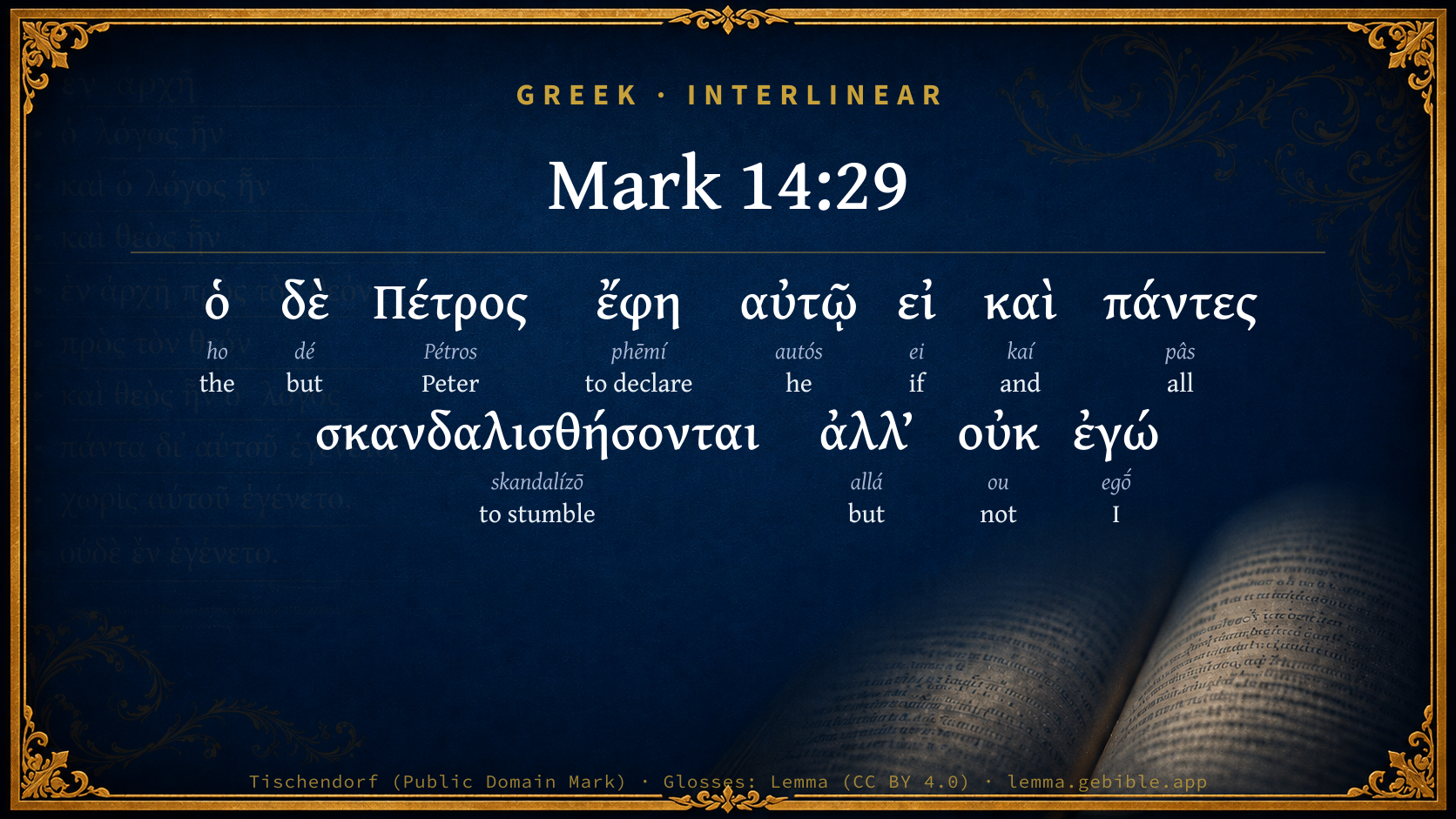
Download image
Cite this verse

Mark 14:29 (World English Bible). Public Domain. Lemma interlinear Bible study tool, https://lemma.gebible.app/v/mark/14/29.

Show BibTeX & RIS
BibTeX
RIS
English Translation
But Peter said to him, "Although all will be offended, yet I will not."
World English Bible · Public Domain
Download a study sheet

One document with this verse’s original text, its word-by-word gloss line, the meaning frame, cross-references with their text, attributed commentary, and full source and license credits — printable, and it pastes into notes with its structure intact.

This verse Autodidact and up

Study sheet (.html) Plain text (.txt)

A passage Seminary Student

Up to 50 verses in one chapter. A passage sheet keeps up to 6 commentary sources and 12 cross-references per verse, in the order this page ranks them, and says so on the sheet whenever that leaves anything out. Ask for a single verse and you get the Autodidact verse sheet above.

Everything on this page stays free to read, with no account — the sheet is a download of what is already on screen, not access to it.

Want to remove ads? Support Godless Engineer
Compare translations 3

The same verse in 3 English versions, stacked beneath the original-language interlinear above. Click any original word for its lexicon entry.

Each is an independent rendering of the whole verse — the interlinear is not word-aligned to these translations.

Highlighted words mark where these versions differ — a whole-verse word diff, not a word-by-word alignment.

  • World English Bible Public Domain
    But Peter said to him, "Although all will be offended, yet I will not."
  • King James Version Public Domain
    But Peter said unto him, Although all shall be offended, yet will not I.
  • unfoldingWord Literal Text CC BY-SA 4.0
    But Peter was saying to him, “Even if all will be caused to stumble, yet not I.”

unfoldingWord Literal Text — © unfoldingWord, licensed CC BY-SA 4.0. Word-aligned USFM3 via Door43 (git.door43.org/unfoldingWord/en_ult).

Versions to compare (up to 4)

3 of 4 selected

Show all 19 translations

Every available English version of this verse, each an independent rendering of the whole verse.

  • World English Bible Public Domain
    But Peter said to him, "Although all will be offended, yet I will not."
  • Berean Standard Bible Public Domain
    Peter declared, “Even if all fall away, I never will.”
  • Majority Standard Bible Public Domain
    Peter declared, “Even if all fall away, I never will.”
  • King James Version Public Domain
    But Peter said unto him, Although all shall be offended, yet will not I.
  • American Standard Version (1901) Public Domain
    But Peter said unto him, Although all shall be offended, yet will not I.
  • Revised Version (1885) Public Domain
    But Peter said unto him, Although all shall be offended, yet will not I.
  • Geneva Bible (1599) Public Domain
    And Peter saide vnto him, Although all men should be offended at thee, yet would not I.
  • Douay-Rheims (1899) Public Domain
    But Peter saith to him: Although all shall be scandalized in thee, yet not I.
  • Young's Literal Translation Public Domain
    And Peter said to him, `And if all shall be stumbled, yet not I;'
  • Literal Standard Version CC BY-SA 4.0
    And Peter said to Him, “And if all will be stumbled, yet not I.”
  • Unlocked Literal Bible CC BY-SA 4.0
    Peter said to him, “Even if all fall away, I will not.”
  • unfoldingWord Literal Text CC BY-SA 4.0
    But Peter was saying to him, “Even if all will be caused to stumble, yet not I.”
  • Darby Bible Public Domain
    But Peter said to him, Even if all should be offended, yet not *I*.
  • World Messianic Bible Public Domain
    But Peter said to him, “Although all will be offended, yet I will not.”
  • Webster's Bible Public Domain
    But Peter said to him, Although all shall be offended, yet will not I.
  • Free Bible Version CC BY-SA 4.0
    “I won't abandon you even if everyone else does,” Peter replied.
  • Bible in Basic English Public Domain
    But Peter said to him, Though the others may be turned away from you, I will not.
  • Text-Critical English NT CC BY 4.0
    But Peter said to him, “Even if everyone else falls away, I will not.”
  • Tyndale New Testament (1534) Public Domain
    Peter sayde vnto him: And though all men shuld be offended yet wolde not I.

Literal Standard Version (2020), Covenant Press — licensed CC BY-SA 4.0. Text via the HelloAO Bible API (eBible.org). Unlocked Literal Bible (unfoldingWord) — licensed CC BY-SA 4.0. Text via the HelloAO Bible API (eBible.org). unfoldingWord Literal Text — © unfoldingWord, licensed CC BY-SA 4.0. Word-aligned USFM3 via Door43 (git.door43.org/unfoldingWord/en_ult). Free Bible Version, Dr. Jonathan Gallagher — licensed CC BY-SA 4.0. Text via the HelloAO Bible API (eBible.org).

Word by word

More ways to search: Search by grammar → Find every occurrence → Compare this word →

Practice this passage: Drill this verse → Learn its vocabulary →

σκανδαλισθήσονται
skandalízō
G4624
“to stumble”
Verb, Future, Passive, Indicative, 3rd person, Plural
Part of Speech
Verb
Tense
Future
Voice
Passive
Mood
Indicative
Person
3rd person
Number
Plural
Full Thayer's Definition

Origin: from G4625

TDNT: 12:39,1

1. to put a stumbling block or impediment in the way, upon which another may trip and fall, metaph. to offend a. to entice to sin b. to cause a person to begin to distrust and desert one whom he ought to trust and obey 1. to cause to fall away 2. to be offended in one, i.e. to see in another what I disapprove of and what hinders me from acknowledging his authority 3. to cause one to judge unfavourably or unjustly of another c. since one who stumbles or whose foot gets entangled feels annoyed 1. to cause one displeasure at a thing 2. to make indignant 3. to be displeased, indignant
  1. ὁ ho G3588 “the” Article, Nominative, Singular, Masculine
  2. δὲ dé G1161 “but” Conjunction
  3. Πέτρος Pétros G4074 “Peter” Noun, Nominative, Singular, Masculine
  4. ἔφη phēmí G5346 “to declare” Verb, Imperfect, Active, Indicative, 3rd person, Singular
  5. αὐτῷ autós G846 “he” Personal pronoun, Dative, Singular, Masculine
  6. εἰ ei G1487 “if” Conditional
  7. καὶ kaí G2532 “and” Conjunction
  8. πάντες pâs G3956 “all” Adjective, Nominative, Plural, Masculine
  9. ἀλλ’ allá G235 “but” Conjunction
  10. οὐκ ou G3756 “not” Particle, Negative
  11. ἐγώ egṓ G1473 “I” Personal pronoun, 1st person, Nominative, Singular

About this verse

These counts appear in no published source. They are computed here, from the morphology-tagged text and Lemma’s own curated glosses. What Lemma adds →

12
words
12
distinct lemmas
Gospels
section

Shared distinctive vocabulary

σκανδαλισθήσονται to stumble G4624 occurs in 27 verses of the Greek New Testament. Also found in:
Cross-references

4

Topical passages linked to Mark 14:29 in the Treasury of Scripture Knowledge — connected by theme and wording, ordered by reader-vote popularity; previews shown in the World English Bible.

  • Matthew 26:33–35 But Peter answered him, "Even if all will be made to stumble because of you, I will never be made to stumble."
  • Luke 22:33–34 He said to him, "Lord, I am ready to go with you both to prison and to death!"
  • John 13:36–38 Simon Peter said to him, "Lord, where are you going?" Jesus answered, "Where I am going, you can't follow now, but you will follow afterwards."
  • John 21:15 So when they had eaten their breakfast, Jesus said to Simon Peter, "Simon, son of Jonah, do you love me more than these?" He said to him, "Yes, Lord; you know that I have affection for you." He said to him, "Feed my lambs."

Cross-references courtesy of OpenBible.info (CC BY 4.0).

Commentary

Notes on Mark 14:29 from classic Christian and Jewish commentators (each source and its license shown beneath its notes). The classic Christian expositions comment on the surrounding passage and are grouped to its opening verse, so a note may address several verses; the Jewish commentaries on the Tanakh (Rashi and others) are per-verse, so they appear only where the commentator wrote on this verse.

Lemma curates 59 commentaries, every one of them public domain or Creative Commons licensed, each selected and text-cleaned for this edition rather than reprinted as found. About our sources →

The Biblical Illustrator

Joseph S. Exell

Mar_14:29

Although all shall be offended, yet will not I.

Peters aim was a threefold one

It consisted in-

1. His vehement contradiction of the words of Christ.

2. His preferring himself to and putting himself above the rest of the apostles.

3. His self-confidence and boastfulness of his own strength. The remedy against temptation is such a knowledge of our own natural weakness, as may lead us to distrust ourselves, to rely on God, and to seek His protection in all things. (W. Denton, M. A.)

Peters rash zeal

Peters action in this instance was at the same time commendable for some things and faulty for others.

I. Commendable in the following particulars.

1. His purpose and resolution of mind, not to take offence at Christ, which purpose and resolution he professes sincerely and from his heart, speaking as he really thought.

2. It is also commendable in him, that he was so zealous and forward above the other disciples to show his love to Christ

II. Yet he was at fault in being so confident.

1. In that he directly contradicts the express words of Christ, whereby He had plainly told him and the rest, that they should all be offended at Him.

2. In presuming rashly and confidently upon his own strength or ability to hold out constantly, and to stick close to the Saviour in the time of trouble and danger now at hand.

3. In arrogantly preferring himself to his fellow disciples, affirming that though all should be offended, yet he would not. (George Petter.)

Enthusiasm

Enthusiasm is the glow of the soul; it is the lever by which men are raised above their average level and enterprise, and become capable of a goodness and benevolence which, but for it, would be quite impossible. There is not too much enthusiasm of any sort or for any object, in a world like ours, and Christians had better not join in sneering at a force, which, in its purest form, founded and reared the Church of Jesus Christ. True, enthusiasm often loses its way, spends itself on mistaken causes, on imperfect systems, on worthless ideals, but that is no reason for saying that all enthusiasm is bad. Mistaken enthusiasm, like Peters, will in time be rudely tested by experience; and meanwhile those who have any reason to hope that their enthusiasm is not mistaken, can afford to be generous and hopeful about others. He that is not against us is, unconsciously perhaps, on our side. (Canon Liddon.)

Peters rashness

Here we have an instance (as many elsewhere) of Peters temerity and rashness, not well considering his weakness, and what spirit he was of. He betrays great infirmity, arrogating much more than was in him.

1. He directly contradicts his Lord, who said, All ye; Peter says, No, not all-he will not; not this night-no, never.

2. He believes not the oracle of the prophet Zechariah (Zec_13:7), but would shift it off with pomp of words, as not concerning him; he was not one of the sheep that should be scattered, though the Pastor was smitten.

3. He presumes too much upon his own strength, and of that which is out of his own power, never mentioning or including the help and strength of God, by whom alone he could stand. He neither considers his own frailty, which will overthrow him, nor yet the power of God, which can sustain and uphold him.

4. He sets himself too much above other men; as if all men were weak in comparison with Peter, and Peter the champion.

5. He is bold, hardy, and vainly confident in a thing yet to come, in which he has never tried his strength. Knowing his present affection, he will take no notice of his future peril; nay, he disclaims and almost scorns the danger, little thinking how close it is to him. (Dr. Thomas Taylor.)

Self-deception

Louis XV, in his disgusting depravity, exposed himself to the smallpox, then the dread of all society. Though flattered for a time into the belief that there was no danger, he was at length undeceived; but, owing to the prevalence of court intrigue, the information was only conveyed to him at the latest possible moment. He caused his guilty companions to be sent away, telling them that he would recall them should he recover from his disorder. Just before dismissing one of the most degraded among them, he said: I would fain die as a believer, and not as an infidel. I have been a great sinner, doubtless; but I have ever observed Lent with a most scrupulous exactitude; I have caused more than a hundred thousand masses to be said for the repose of unhappy souls; I have respected the clergy, and punished the authors of all impious works; so that I flatter myself I have not been a very bad Christian.

Extreme self-dependence

There is a famous speech recorded of an old Norseman thoroughly characteristic of the Teuton. I believe neither in idols nor demons, said he; I put my sole trust in my own strength of body and soul. (S. Smiles.)

Danger of presumption

A scientific gentleman, deputed by the Government, was, not many years ago, examining the scene of a fatal explosion. He was accompanied by the underviewer of the colliery, and as they were inspecting the edges of a goaf (a region of foul air), it was observed that the Davy lamps which they carried were afire. I suppose, said the inspector, that there is a good deal of fire damp hereabouts. Thousands and thousands of cubic feet all through the goaf, coolly replied his companion. Why, exclaimed the official, do you mean to say that there is nothing but that shred of wire gauze between us and eternity? Nothing at all, replied the underviewer, very composedly. Theres nothing here where we stand but that gauze wire to keep the whole mine from being blown into the air. The precipitate retreat of the Government official was instantaneous. And thus it should be with the sinner: his retreat from the ways of sin-those goafs of poisonous air-should be instantaneous. Sir Humphrey Davys lamp was never designed, as a substitute for caution if accidentally or unknowingly carried into foul air, whereas many do so knowingly and habitually.

The Biblical Illustrator, edited by Joseph S. Exell (c. 1880s–1900s) — public domain. Text from a community e-Sword module.

Tyndale Open Study Notes

Tyndale Open Resources

14:29-31 Peter’s protests and Jesus’ rebuke recall 8:32-33. Despite Peter’s protests, his denial took place within a few hours.

Tyndale Open Study Notes — © Tyndale Open Resources, licensed CC BY-SA 4.0. Text via the HelloAO Bible API.

Expositor's Greek Testament

ed. W. Robertson Nicoll

Mar 14:29 . It is the former part of the Master’s speech that lays hold of Peter’s mind; hence he promptly proceeds to make protestations of fidelity. εἰ καὶ , etc.: even if (as is likely) all the rest shall be offended (the future, because the case put is conceived to be probable), yet certainly ( ἀλλʼ strongly opposing what follows to what goes before; vide Klotz, p. 93, on the force of ἀλλὰ in the apodosis of a conditional proposition) not I .

The Expositor's Greek Testament, edited by W. Robertson Nicoll (1897–1910) — public domain. Text from a community e-Sword module.

Geneva Bible (1599)

Geneva Bible translators

Here is set forth in an excellent person, a most sorrowful example of man’s rashness and weakness.

Geneva Bible (1599) marginal notes — public domain. Text via Bolls.life.

The Cambridge Bible for Schools and Colleges

gen. ed. J. J. S. Perowne

29. But Peter said unto him] Ardent and impulsive as ever, the Apostle could not endure the thought of such desertion. His protestations of fidelity are more fully given in Mat_26:33 and Joh_13:37.

The Cambridge Bible for Schools and Colleges (gen. ed. J. J. S. Perowne; Cambridge University Press, 1878–1918) — public domain. Text from a community e-Sword module.

John Gill's Exposition

And Jesus saith unto him, verily I say unto thee,.... As confident as thou art of standing by me, and abiding with me;

that this day, which was then begun; for the Jews reckoned their days from evening, as in Gen 1:5;

even in this night; this night to be observed, this night of the passover, before it is past:

before the cock crow twice; for there was a first and second cock crowing, the one at midnight, and the other near break of day, and which last is properly the cock crowing: the word "twice" is left out in the Ethiopic version:

thou shalt deny me thrice; as he did; See Gill on Mat 26:34.

John Gill's Exposition of the Whole Bible (1746–1763) — public domain (CC PDM 1.0). Text via the HelloAO Bible API.

The Pulpit Commentary

But Peter said unto him, Although all shall be offended, yet will not I Our Lord had just distinctly stated that they would all be offended, and therefore these words of St. Peter were very presumptuous. Conscious of his own infirmities, he ought to have said, "I know that through my own infirmity this may easily happen. Nevertheless, I trust to thy mercy and goodness to save me." Just such is the Christian"s daily experience. We often think that we are strong in the faith, strong in purity, strong in patience. But when temptation arises, we falter and fall. The true remedy against temptation is the consciousness of our own weakness, and supplication for Divine strength.

The Pulpit Commentary (1880–1919), ed. H.D.M. Spence-Jones & Joseph S. Exell — public domain. Text from a community e-Sword module.

Cambridge Greek Testament for Schools and Colleges

29. Εἰ καί ([3148][3149][3150][3151][3152][3153]) rather than Καὶ εἰ ([3154][3155][3156][3157][3158][3159]).

[3148] Codex Sinaiticus. 4th cent. Discovered by Tischendorf in 1859 at the Monastery of St Katharine on Mount Sinai. Now at St Petersburg. The whole Gospel, ending at Mar 16:8. Photographic facsimile, 1911.

[3149] Codex Vaticanus. 4th cent., but perhaps a little later than א. In the Vatican Library almost since its foundation by Pope Nicolas V., and one of its greatest treasures. The whole Gospel, ending at Mar 16:8. Photographic facsimile, 1889.

[3150] Codex Ephraemi. 5th cent. A palimpsest: the original writing has been partially rubbed out, and the works of Ephraem the Syrian have been written over it; but a great deal of the original writing has been recovered; of Mark we have Mar 1:17 to Mar 6:31, Mar 8:5 to Mar 12:29, Mar 13:19 to Mar 16:20. In the National Library at Paris.

[3151] Codex Seidelianus I. 9th or 10th cent. Contains Mar 1:13 to Mar 14:18; Mar 14:25 to Mar 16:20.

[3152] Codex Regius. 8th cent. An important witness. At Paris. Contains Mar 1:1 to Mar 10:15; Mar 10:30 to Mar 15:1; Mar 15:20 to Mar 16:20, but the shorter ending is inserted between Mar 16:8 and Mar 16:9, showing that the scribe preferred it to the longer one.

[3153] Codex Athous Laurae. 8th cent. Like N and Σ, it is written in silver letters on purple vellum. Contains Mar 9:5 to Mar 16:20, and, as in L, the shorter ending is inserted between Mar 16:8 and Mar 16:9. As in Δ, the text of Mark is specially good.

[3154] Codex Alexandrinus. 5th cent. Brought by Cyril Lucar, Patriarch of Constantinople, from Alexandria, and afterwards presented by him to King Charles I. in 1628. In the British Museum. The whole Gospel. Photographic facsimile, 1879.

[3155] Codex Bezae. 6th cent. Has a Latin translation (d) side by side with the Greek text, and the two do not quite always agree. Presented by Beza to the University Library of Cambridge in 1581. Remarkable for its frequent divergences from other texts. Contains Mark, except Mar 16:15-20, which has been added by a later hand. Photographic facsimile, 1899.

[3156] Codex Monacensis. 10th cent. Contains Mar 6:47 to Mar 16:20. Many verses in 14, 15, 16 are defective.

[3157] Codex Oxoniensis. 9th cent. Contains Mark, except Mar 3:35 to Mar 6:20.

[3158] Codex Sangallensis. 9th or 10th cent. Contains the Gospels nearly complete, with an interlinear Latin translation. The text of Mark is specially good, agreeing often with CL. At St Gall.

[3159] Codex Petropolitanus. 9th cent. Gospels almost complete. Mar 16:18-20 is in a later hand.

29. ὁ δὲ Πέτρος. For the second time Peter impulsively contradicts a prediction of the Master, whose severe rebuke (Mar 8:33) has for the moment been forgotten. The emphatic repudiation of the possibility of his own faithlessness is thoroughly characteristic of his affection and of his self-confidence. On a former occasion he claimed credit for the whole band (Mar 10:28). Here he claims exemption from weakness for himself. He admits the possibility of the others breaking away.

Εἰ καί. See crit. note. This combination indicates that what is supposed is conceded as being a fact (Luk 11:8; Luk 18:4; 2Co 12:11; etc.). The exact difference between εἰ καί and καὶ εἰ is not easy to mark in English, and is not always the same. In most of the instances of καὶ εἰ in N.T. καί is a mere conjunction, “and if”; e.g. Mat 11:14. Winer, p. 554.

ἀλλʼ οὐκ ἐγώ. We often have ἀλλά after εἰ καί. Anything else may be possible, but not that Peter will fail. It is strange that Jerome should say of this non est temeritas.

Cambridge Greek Testament for Schools and Colleges (Cambridge University Press, 1896; 21 vols, various authors incl. Carr, Maclear, Plummer, Farrar, Lumby, Moule, M. R. James, Simcox) — public domain. Text from a community e-Sword module.

Alford’s Greek Testament

Henry Alford

29.] εἰ καὶ πάντες—if even all: καὶ εἰ πάντες—‘even if all.’ The καί before εἰ intensifies the whole hypothesis: the και after εἰ intensifies only that word which it introduces in the hypothesis. See Klotz on Devar. p. 519 f.: where however the account is not quite as clear as might be desired. ἀλλά has here its full adversative exceptional force—notwithstanding: cf. Il. θ. 153, 154, εἴπερ γάρ σʼ Ἕκτωρ γε κακὸν καὶ ἀνάλκιδα φήσει, ἀλλʼ οὐ πείσονται Τρῶες καὶ Δαρδανίωνες: and Klotz on Devar. p. 93.

Henry Alford, The Greek Testament (1849–1861) — public domain. Text from a community e-Sword module.

International Critical Commentary

29. Εἰ καὶ πάντες σκανδαλισθήσονται, ἀλλʼ οὐκ ἐγώ—Even if all fall away, yet not I. Strictly speaking, εἰ και does not strengthen the statement as much as καὶ εἰ. But the difference is too minute for a style like that of the N.T. Greek.1

Εἰ καί, instead of καὶ εἰ, Tisch. Treg. WH. RV. א BCGL 1, 13, 69.

International Critical Commentary — older volumes (1896–1929), various authors — public domain. Text from a community e-Sword module.

Lesson kit

Teaching starters — assembled from the data on this page, not authored interpretation. Every prompt links to the verse data it draws on. Edit before teaching.

Mark, in the Gospels, opens this verse with 12 words (12 distinct Greek lemmas). Its most distinctive word is skandalízō (“to stumble”). A historical commentator’s framing appears above. Read the whole chapter for the surrounding context.

Discussion questions

  1. What does “to stumble” (skandalízō) contribute to the verse as a whole?
  2. How does Matthew 5:29, which shares the word «to stumble», read alongside this verse?
  3. These translations render this verse differently. What is at stake in choosing one wording over another?
  4. Compare how The Biblical Illustrator and Tyndale Open Study Notes read this verse. Where do they agree or differ?

Things to notice

Reading settings

Reading text

Shown beneath each verse's original-language words.

Old Testament
Old Testament edition

Read the OT as the Masoretic Hebrew (MT) or the Greek Septuagint (LXX).

English shown for the Greek Septuagint (in the Hebrew ↔ Greek comparison).

Comparing translations? Open the Compare panel on any verse page to stack up to four side by side.