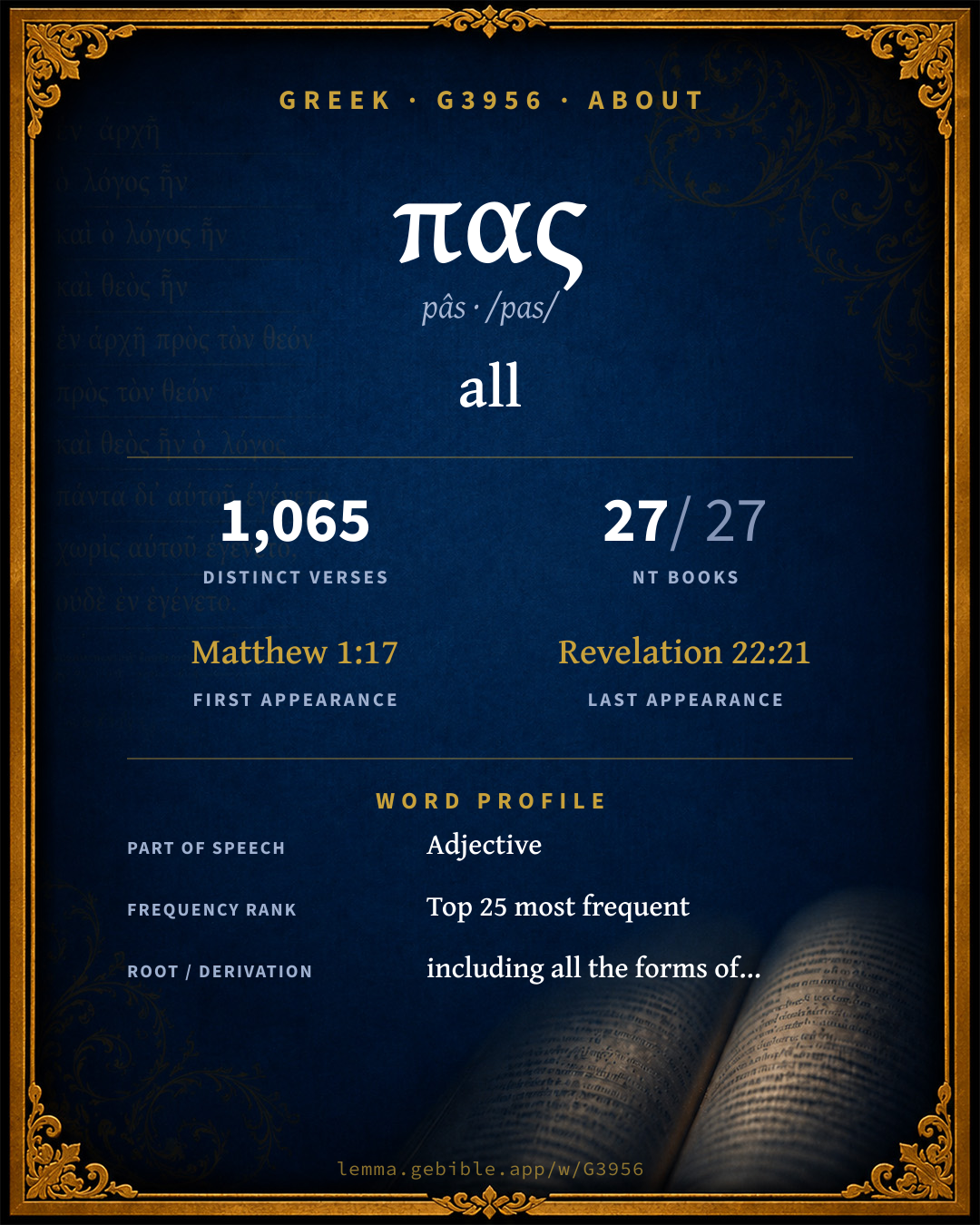
πᾶς
all
‘all’ is one of 2 main senses fuller range ↓
Full lexicon entry — Thayer's Greek Lexicon
From Thayer's Greek Lexicon
Where this word appears
See every Nominative-case word in the Greek New Testament →
Grammar key — what these labels mean
Part of speech
- Adjective
- A word that describes or qualifies a noun.
Case
- Nominative
- The case of the subject (and the predicate nominative).
- Accusative
- The case of the direct object and of extent.
- Genitive
- The case of source, possession, or “of” — answers “whose / from what.”
- Dative
- The case of the indirect object, means, or location — “to / for / with / in.”
Gender
- Masculine
- Grammatically masculine.
- Neuter
- Grammatically neuter.
- Feminine
- Grammatically feminine.
Number
- Plural
- More than one.
- Singular
- One.
29 verses where G3956 appears in the Nominative case in the Book of Mark. Filtered view — show all forms. Click any verse to open its interlinear word-by-word view. Verse text shown in the World English Bible for context — . Each verse’s Greek form is shown with its reference; the English is not keyword-highlighted, since the data carries no word-level English alignment. Use “Compare translations” on any verse to read it across multiple English versions. This concordance covers the Greek New Testament; Septuagint (Greek Old Testament) occurrences of this word are not indexed here.
Mark
- Mark 1:5 πᾶσα πάντες adj nom sg fem adj nom pl masc All the country of Judea and all those of Jerusalem went out to him. They were baptized by him in the Jordan river, confessing their sins.
- Mark 1:37 πάντες adj nom pl masc and they found him, and told him, "Everyone is looking for you."
- Mark 2:13 πᾶς adj nom sg masc He went out again by the seaside. All the multitude came to him, and he taught them.
- Mark 3:28 πάντα adj nom pl neut Most assuredly I tell you, all of the children of men's sins will be forgiven them, including their blasphemies with which they may blaspheme;
- Mark 4:1 πᾶς adj nom sg masc Again he began to teach by the seaside. A great multitude was gathered to him, so that he entered into a boat in the sea, and sat down. All the multitude were on the land by the sea.
- Mark 4:11 πάντα adj nom pl neut He said to them, "To you is given the mystery of the Kingdom of God, but to those who are outside, all things are done in parables,
- Mark 5:20 πάντες adj nom pl masc He went his way, and began to proclaim in Decapolis how Jesus had done great things for him, and everyone marveled.
- Mark 6:42 πάντες adj nom pl masc They all ate, and were filled.
- Mark 6:50 πάντες adj nom pl masc for they all saw him, and were troubled. But he immediately spoke with them, and said to them, "Cheer up! It is I! Don't be afraid."
- Mark 7:3 πάντες adj nom pl masc (For the Pharisees, and all the Jews, don't eat unless they wash their hands and forearms, holding to the tradition of the elders.
- Mark 7:14 πάντες adj nom pl masc He called all the multitude to himself, and said to them, "Hear me, all of you, and understand.
- Mark 7:18 πᾶν adj nom sg neut He said to them, "Are you thus without understanding also? Don't you perceive that whatever goes into the man from outside can't defile him,
- Mark 7:23 πάντα adj nom pl neut All these evil things come from within, and defile the man."
- Mark 9:15 πᾶς adj nom sg masc Immediately all the multitude, when they saw him, were greatly amazed, and running to him greeted him.
- Mark 9:23 πάντα adj nom pl neut Jesus said to him, "If you can believe, all things are possible to him who believes."
- Mark 9:49 πᾶς adj nom sg masc For everyone will be salted with fire, and every sacrifice will be seasoned with salt.
- Mark 10:27 πάντα adj nom pl neut Jesus, looking at them, said, "With men it is impossible, but not with God, for all things are possible with God."
- Mark 11:18 πᾶς adj nom sg masc The chief priests and the scribes heard it, and sought how they might destroy him. For they feared him, because all the multitude was astonished at his teaching.
- Mark 12:44 πάντες πάντα adj nom pl masc adj acc pl neut for they all gave out of their abundance, but she, out of her poverty, gave all that she had to live on."
- Mark 13:20 πᾶσα adj nom sg fem Unless the Lord had shortened the days, no flesh would have been saved; but for the sake of the chosen ones, whom he picked out, he shortened the days.
- Mark 13:30 πάντα adj nom pl neut Most assuredly I say to you, this generation will not pass away until all these things happen.
- Mark 14:23 πάντες adj nom pl masc He took the cup, and when he had given thanks, he gave to them. They all drank of it.
- Mark 14:27 πάντες adj nom pl masc Jesus said to them, "All of you will be made to stumble because of me tonight, for it is written, 'I will strike the shepherd, and the sheep will be scattered.'
- Mark 14:29 πάντες adj nom pl masc But Peter said to him, "Although all will be offended, yet I will not."
- Mark 14:31 πάντες adj nom pl masc But he spoke all the more, "If I must die with you, I will not deny you." They all said the same thing.
- Mark 14:36 πάντα adj nom pl neut He said, "Abba, Father, all things are possible to you. Please remove this cup from me. However, not what I desire, but what you desire."
- Mark 14:50 πάντες adj nom pl masc They all left him, and fled.
- Mark 14:53 πάντες adj nom pl masc They led Jesus away to the high priest. All the chief priests, the elders, and the scribes came together with him.
- Mark 14:64 πάντες adj nom pl masc You have heard the blasphemy! What do you think?" They all condemned him to be worthy of death.
About this entry
At a glance — auto-summarized from this page’s data, not written by a person. Every figure links to its source below. This summary describes the numbers; it doesn’t interpret them.
At its core, πας (pâs) means “all.” Scripture first uses it in Matthew 1:17. Spanning 1,065 verses in 27 books, it ranks among the most common words of the Greek New Testament. Catalogued under 2 senses, its meaning is not single-sense. From the same root come παμπληθει, παμπολυς and πανδοχειον. Each statement above links to its evidence; the full detail follows below.
Gloss history
Strong's 1890 vs modern scholarship
About this word
Strong's G3956 catalogs a Greek word from the Greek New Testament.
These counts are not copied from any lexicon or concordance. They are computed here, from the morphology-tagged Greek New Testament. What Lemma adds →
- 1,065
- distinct verses
- The word appears in 1,065 distinct verses.
- 27 / 27
- NT books
- The word appears in 27 of 27 New Testament books.
- #16
- by frequency
- Top 25 most frequent Greek words (rank 16 of 5,347 Greek words by occurrence).
View all 1,065 occurrences in the concordance →
By section of the New Testament
By traditional corpus
Conventional, traditional groupings — biblical authorship is debated, so this is a traditional corpus grouping, not an authorship claim. Some books belong to more than one corpus (Luke is in both the Gospels and the Lukan corpus, and so on), so these shares overlap and need not total 100%. Each figure is a share of the word’s 1,065 distinct verses.
- Gospels 382 verses · 36%
- Pauline corpus 366 verses · 34%
- Lukan (Luke–Acts) 298 verses · 28%
- Johannine 138 verses · 13%
- General (Catholic) Epistles 65 verses · 6%
- Revelation 50 verses · 5%
- Hebrews 44 verses · 4%
How translations render this word
Counts come from each version’s own published word-to-Strong’s tagging or interlinear alignment — an approximate guide to how each version renders this word, not a word-level alignment the data otherwise carries. Because each total is that version’s own tagged count, the per-version totals vary from one another and need not match the appearance or distinct-verse counts above. These counts may also differ from a printed concordance because Lemma counts each distinctly tagged rendering and does not collapse phrase taggings into a single head-word total. This is a fixed set of word-tagged versions (KJV, ASV, BSB, ULT) and does not change with the reading translation you choose elsewhere. Each version’s license is shown beside its name below (and on Sources).
- King James Version: All 754×, All things 150×, Every 115×
- American Standard Version: All 706×, Every 136×, All things 135×
- Berean Standard Bible: All 537×, Everyone 127×, Every 125×
- unfoldingWord Literal Text: All 776×, Every 152×, Everyone 101×
King James Version Public Domain
Renders G3956 across 1,212 tagged occurrences — most commonly:
Plus other, less common renderings. Plus 18 renderings that appear only once — usually multi-word phrases or single function words the recovered tagging swept in, not distinct renderings. Not rendered by a distinct English word in 33 further occurrences.
American Standard Version Public Domain
Renders G3956 across 1,197 tagged occurrences — most commonly:
Plus other, less common renderings. Plus 66 renderings that appear only once — usually multi-word phrases or single function words the recovered tagging swept in, not distinct renderings.
Berean Standard Bible Public Domain
Renders G3956 across 1,134 tagged occurrences — most commonly:
Plus other, less common renderings. Plus 44 renderings that appear only once — usually multi-word phrases or single function words the recovered tagging swept in, not distinct renderings. Not rendered by a distinct English word in 62 further occurrences.
unfoldingWord Literal Text CC BY-SA 4.0
Renders G3956 across 1,285 tagged occurrences — most commonly:
Plus other, less common renderings. Plus 22 renderings that appear only once — usually multi-word phrases or single function words the recovered tagging swept in, not distinct renderings.
Senses in Thayer's
The 2 senses Thayer's distinguishes for this word, in lexicon order (not ranked by frequency or importance). The full entry — with sub-senses — is in the Lexicon Entry tab.
- individually
- collectively
Word origin
Origin: including all the forms of declension
Including all the forms of declension; apparently a primary word; all any every the whole : - all (manner of means) alway (-s) any (one) X daily + ever every (one way) as many as + no (-thing) X throughly whatsoever whole whosoever.
— Strong’s Exhaustive Concordance (1890), public domain.
Forms in the corpus
The 26 distinct written forms G3956 takes in the Greek New Testament, most frequent first — each parse links to that case’s occurrences in the concordance.
Same root — word family
Other Thayer's entries built from the same root as G3956, grouped by Strong’s listed origin. These share a root / origin per the lexicon — not necessarily a shared meaning. Each links to that word’s own entry.
Derived from this word
- παμπληθει pamplētheí G3826 all together
- παμπολυς pámpolys G3827 very great
- πανδοχειον pandocheîon G3829 inn
- πανηγυρις panḗgyris G3831 public assembly
- πανοικι panoikí G3832 with whole family
- πανοπλια panoplía G3833 full armor
- πανουργος panoûrgos G3835 skillful
- πανταχου pantachoû G3837 everywhere
- παντελης pantelḗs G3838 completely
- παντη pántē G3839 everywhere
- παντοθεν pántothen G3840 from every quarter
- παντοτε pántote G3842 always
- παντως pántōs G3843 altogether
- παρρησια parrhēsía G3954 boldness
Proper names from this root
People and places named from this root — a name, not an additional meaning of the word.
Compare all same-root words → Showing 4 of 17 — not the complete family. 2 of the same-root words are proper names (people or places). They share a root, not necessarily a meaning.
Septuagint usage
The same Greek word πας appears 5,232 times in the Greek Old Testament (Septuagint), across 4,096 verses in 38 books.
- 5,232
- LXX occurrences
- Tagged occurrences of this Greek word in the Septuagint.
- 4,096
- verses
- Distinct Septuagint verses containing this word.
- 38 / 39
- OT books
- The word appears in 38 of the 39 Old Testament books.
Sample Septuagint occurrences
- Genesis 1:21 πᾶς
- Exodus 1:5 πᾶς
- Leviticus 1:9 πᾶς
- Numbers 1:2 πᾶς
- Deuteronomy 1:1 πᾶς
- Joshua 1:2 πᾶς
- Judges 2:4 πᾶς
- Ruth 1:19 πᾶς
- 1 Samuel 1:17 πᾶς
- 2 Samuel 1:9 πᾶς
- 1 Kings 1:3 πᾶς
- 2 Kings 3:19 πᾶς
Septuagint occurrences (same lexeme)
Every verse where the same Strong’s number (G3956) appears in the Greek Septuagint — showing the first 50 of 4,096. Verse text shown in the World English Bible for context; the Greek form is the matched word — the English is not keyword-highlighted.
- Genesis 1:21 πᾶς God created the large sea creatures, and every living creature that moves, with which the waters swarmed, after their kind, and every winged bird after its kind. God saw that it was good.
- Genesis 1:25 πᾶς God made the animals of the earth after their kind, and the cattle after their kind, and everything that creeps on the ground after its kind. God saw that it was good.
- Genesis 1:26 πᾶς God said, "Let us make man in our image, after our likeness: and let them have dominion over the fish of the sea, and over the birds of the sky, and over the cattle, and over all the earth, and over every creeping thing that creeps on the earth."
- Genesis 1:28 πᾶς God blessed them. God said to them, "Be fruitful, multiply, fill the earth, and subdue it. Have dominion over the fish of the sea, over the birds of the sky, and over every living thing that moves on the earth."
- Genesis 1:29 πᾶς God said, "Behold, I have given you every herb yielding seed, which is on the surface of all the earth, and every tree, which bears fruit yielding seed. It will be your food.
- Genesis 1:30 πᾶς To every animal of the earth, and to every bird of the sky, and to everything that creeps on the earth, in which there is life, I have given every green herb for food." And it was so.
- Genesis 1:31 πᾶς God saw everything that he had made, and, behold, it was very good. There was evening and there was morning, the sixth day.
- Genesis 2:1 πᾶς The heavens and the earth were finished, and all the host of them.
- Genesis 2:2 πᾶς On the seventh day God finished his work which he had made; and he rested on the seventh day from all his work which he had made.
- Genesis 2:3 πᾶς God blessed the seventh day, and made it holy, because he rested in it from all his work which he had created and made.
- Genesis 2:5 πᾶς No plant of the field was yet in the earth, and no herb of the field had yet sprung up; for Yahweh God had not caused it to rain on the earth. There was not a man to till the ground,
- Genesis 2:6 πᾶς but a mist went up from the earth, and watered the whole surface of the ground.
- Genesis 2:9 πᾶς Out of the ground Yahweh God made every tree to grow that is pleasant to the sight, and good for food; the tree of life also in the midst of the garden, and the tree of the knowledge of good and evil.
- Genesis 2:11 πᾶς The name of the first is Pishon: this is the one which flows through the whole land of Havilah, where there is gold;
- Genesis 2:13 πᾶς The name of the second river is Gihon: the same river that flows through the whole land of Cush.
- Genesis 2:16 πᾶς Yahweh God commanded the man, saying, "Of every tree of the garden you may freely eat:
- Genesis 2:19 πᾶς Out of the ground Yahweh God formed every animal of the field, and every bird of the sky, and brought them to the man to see what he would call them. Whatever the man called every living creature, that was its name.
- Genesis 2:20 πᾶς The man gave names to all cattle, and to the birds of the sky, and to every animal of the field; but for man there was not found a helper suitable for him.
- Genesis 3:1 πᾶς Now the serpent was more subtle than any animal of the field which Yahweh God had made. He said to the woman, "Yes, has God said, 'You shall not eat of any tree of the garden?'"
- Genesis 3:14 πᾶς Yahweh God said to the serpent, "Because you have done this, cursed are you above all cattle, and above every animal of the field. On your belly shall you go, and you shall eat dust all the days of your life.
- Genesis 3:17 πᾶς To Adam he said, "Because you have listened to your wife's voice, and have eaten of the tree, of which I commanded you, saying, 'You shall not eat of it,' cursed is the ground for your sake. In toil you will eat of it all the days of your life.
- Genesis 3:20 πᾶς The man called his wife Eve, because she was the mother of all living.
- Genesis 4:14 πᾶς Behold, you have driven me out this day from the surface of the ground. I will be hidden from your face, and I will be a fugitive and a wanderer in the earth. It will happen that whoever finds me will kill me."
- Genesis 4:15 πᾶς Yahweh said to him, "Therefore whoever slays Cain, vengeance will be taken on him sevenfold." Yahweh appointed a sign for Cain, lest any finding him should strike him.
- Genesis 5:5 πᾶς All the days that Adam lived were nine hundred thirty years, then he died.
- Genesis 5:8 πᾶς All the days of Seth were nine hundred twelve years, then he died.
- Genesis 5:11 πᾶς All the days of Enosh were nine hundred five years, then he died.
- Genesis 5:14 πᾶς and all the days of Kenan were nine hundred ten years, then he died.
- Genesis 5:17 πᾶς All the days of Mahalalel were eight hundred ninety-five years, then he died.
- Genesis 5:20 πᾶς All the days of Jared were nine hundred sixty-two years, then he died.
- Genesis 5:23 πᾶς all the days of Enoch were three hundred sixty-five years.
- Genesis 5:27 πᾶς All the days of Methuselah were nine hundred sixty-nine years, then he died.
- Genesis 5:31 πᾶς All the days of Lamech were seven hundred seventy-seven years, then he died.
- Genesis 6:2 πᾶς that God's sons saw that men's daughters were beautiful, and they took for themselves wives of all that they chose.
- Genesis 6:5 πᾶς Yahweh saw that the wickedness of man was great in the earth, and that every imagination of the thoughts of his heart was only evil continually.
- Genesis 6:12 πᾶς God saw the earth, and saw that it was corrupt, for all flesh had corrupted their way on the earth.
- Genesis 6:13 πᾶς God said to Noah, "The end of all flesh has come before me, for the earth is filled with violence through them. Behold, I will destroy them with the earth.
- Genesis 6:17 πᾶς I, even, I do bring the flood of waters on this earth, to destroy all flesh having the breath of life from under the sky. Everything that is in the earth will die.
- Genesis 6:19 πᾶς Of every living thing of all flesh, you shall bring two of every sort into the ark, to keep them alive with you. They shall be male and female.
- Genesis 6:20 πᾶς Of the birds after their kind, of the cattle after their kind, of every creeping thing of the ground after its kind, two of every sort shall come to you, to keep them alive.
- Genesis 6:21 πᾶς Take with you of all food that is eaten, and gather it to you; and it will be for food for you, and for them."
- Genesis 6:22 πᾶς Thus Noah did. According to all that God commanded him, so he did.
- Genesis 7:1 πᾶς Yahweh said to Noah, "Come with all of your household into the ark, for I have seen your righteousness before me in this generation.
- Genesis 7:3 πᾶς Also of the birds of the sky, seven and seven, male and female, to keep seed alive on the surface of all the earth.
- Genesis 7:4 πᾶς In seven days, I will cause it to rain on the earth for forty days and forty nights. Every living thing that I have made, I will destroy from the surface of the ground."
- Genesis 7:5 πᾶς Noah did everything that Yahweh commanded him.
- Genesis 7:8 πᾶς Clean animals, animals that are not clean, birds, and everything that creeps on the ground
- Genesis 7:11 πᾶς In the six hundredth year of Noah's life, in the second month, on the seventeenth day of the month, on the same day all the fountains of the great deep were burst open, and the sky's windows were opened.
- Genesis 7:14 πᾶς they, and every animal after its kind, all the cattle after their kind, every creeping thing that creeps on the earth after its kind, and every bird after its kind, every bird of every sort.
- Genesis 7:15 πᾶς They went to Noah into the ark, by pairs of all flesh with the breath of life in them.
These are occurrences of the same Greek lexeme (G3956) in the Septuagint — not a translation of any one Hebrew word. The store carries no word-level Hebrew↔Greek alignment, so no Hebrew original is asserted here. Counts come from the recovered LXX Strong's tagging — high-frequency vocabulary is well covered, while rare or late forms may be untagged — so they reflect tagged occurrences and may slightly undercount.