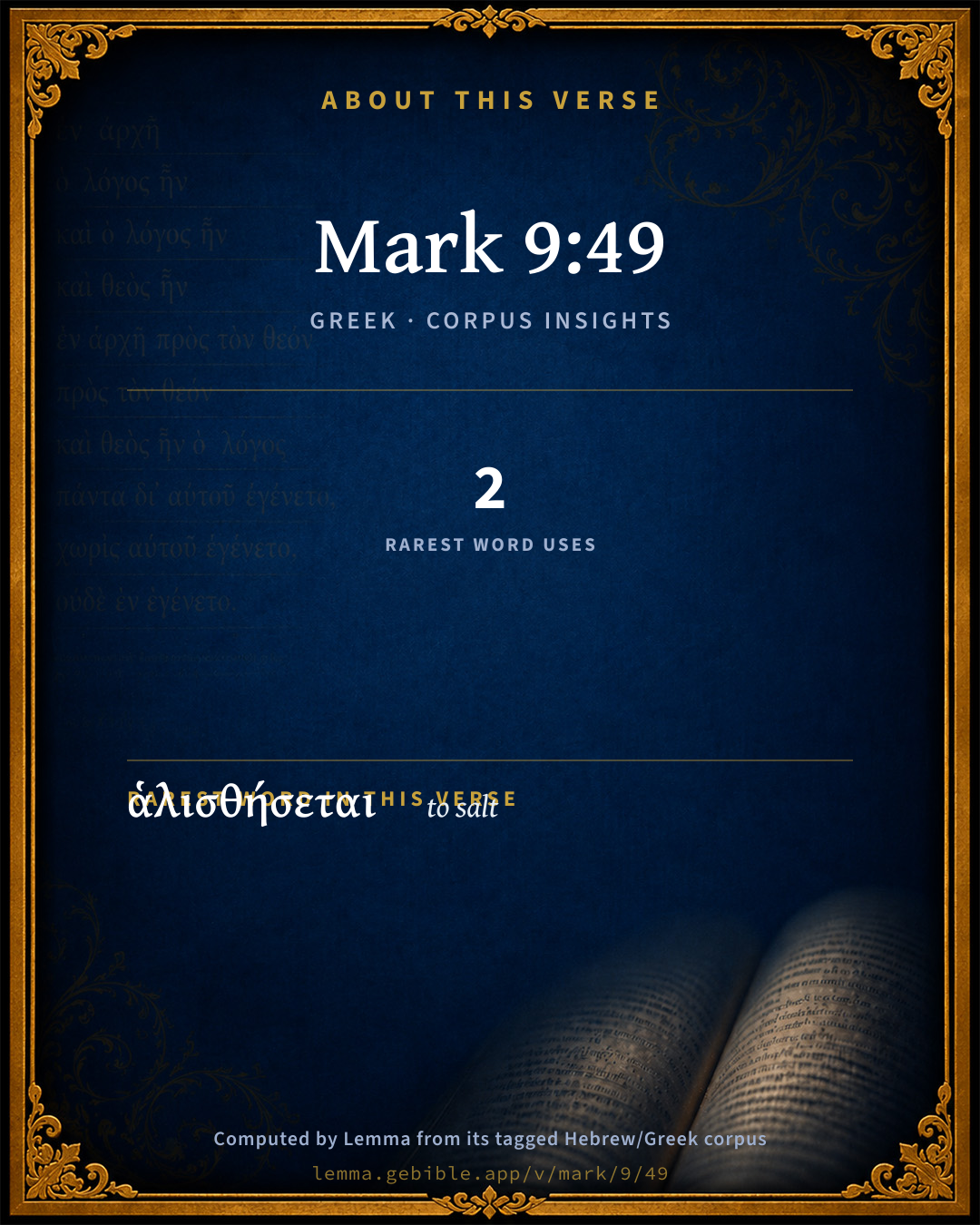
Mark 9:49

Greek (Tischendorf 8th ed.) Mark 9:49 appears in the Greek New Testament. The text above is from the Tischendorf 8th edition. Each word links to its Strong’s number and a concise gloss. Click any word for its full Thayer’s Greek Lexicon entry.

Download image
Cite this verse

Mark 9:49 (World English Bible). Public Domain. Lemma interlinear Bible study tool, https://lemma.gebible.app/v/mark/9/49.

Show BibTeX & RIS
BibTeX
RIS
English Translation
For everyone will be salted with fire, and every sacrifice will be seasoned with salt.
World English Bible · Public Domain
Download a study sheet

One document with this verse’s original text, its word-by-word gloss line, the meaning frame, cross-references with their text, attributed commentary, and full source and license credits — printable, and it pastes into notes with its structure intact.

This verse Autodidact and up

Study sheet (.html) Plain text (.txt)

A passage Seminary Student

Up to 50 verses in one chapter. A passage sheet keeps up to 6 commentary sources and 12 cross-references per verse, in the order this page ranks them, and says so on the sheet whenever that leaves anything out. Ask for a single verse and you get the Autodidact verse sheet above.

Everything on this page stays free to read, with no account — the sheet is a download of what is already on screen, not access to it.

Want to remove ads? Support Godless Engineer
Compare translations 3

The same verse in 3 English versions, stacked beneath the original-language interlinear above. Click any original word for its lexicon entry.

Each is an independent rendering of the whole verse — the interlinear is not word-aligned to these translations.

Highlighted words mark where these versions differ — a whole-verse word diff, not a word-by-word alignment.

  • World English Bible Public Domain
    For everyone will be salted with fire, and every sacrifice will be seasoned with salt.
  • King James Version Public Domain
    For every one shall be salted with fire, and every sacrifice shall be salted with salt.
  • unfoldingWord Literal Text CC BY-SA 4.0
    For everyone will be salted with fire.

unfoldingWord Literal Text — © unfoldingWord, licensed CC BY-SA 4.0. Word-aligned USFM3 via Door43 (git.door43.org/unfoldingWord/en_ult).

Versions to compare (up to 4)

3 of 4 selected

Show all 19 translations

Every available English version of this verse, each an independent rendering of the whole verse.

  • World English Bible Public Domain
    For everyone will be salted with fire, and every sacrifice will be seasoned with salt.
  • Berean Standard Bible Public Domain
    For everyone will be salted with fire.
  • Majority Standard Bible Public Domain
    For everyone will be salted with fire, and every sacrifice will be salted with salt.
  • King James Version Public Domain
    For every one shall be salted with fire, and every sacrifice shall be salted with salt.
  • American Standard Version (1901) Public Domain
    For every one shall be salted with fire.
  • Revised Version (1885) Public Domain
    For every one shall be salted with fire.
  • Geneva Bible (1599) Public Domain
    For euery man shalbe salted with fire: and euery sacrifice shalbe salted with salt.
  • Douay-Rheims (1899) Public Domain
    Salt is good. But if the salt became unsavory; wherewith will you season it? Have salt in you, and have peace among you.
  • Young's Literal Translation Public Domain
    for every one with fire shall be salted, and every sacrifice with salt shall be salted.
  • Literal Standard Version CC BY-SA 4.0
    for everyone will be salted with fire, and every sacrifice will be salted with salt.
  • Unlocked Literal Bible CC BY-SA 4.0
    For everyone will be salted with fire.
  • unfoldingWord Literal Text CC BY-SA 4.0
    For everyone will be salted with fire.
  • Darby Bible Public Domain
    For every one shall be salted with fire, and every sacrifice shall be salted with salt.
  • World Messianic Bible Public Domain
    For everyone will be salted with fire, and every sacrifice will be seasoned with salt.
  • Webster's Bible Public Domain
    For every one shall be salted with fire, and every sacrifice shall be salted with salt.
  • Free Bible Version CC BY-SA 4.0
    Everybody will be ‘salted’ by fire.
  • Bible in Basic English Public Domain
    Everyone will be salted with fire.
  • Text-Critical English NT CC BY 4.0
    For everyone will be salted with fire, and every sacrifice will be seasoned with salt.
  • Tyndale New Testament (1534) Public Domain
    Every man therfore shalbe salted with fyre: And every sacrifise shalbe seasoned with salt.

Literal Standard Version (2020), Covenant Press — licensed CC BY-SA 4.0. Text via the HelloAO Bible API (eBible.org). Unlocked Literal Bible (unfoldingWord) — licensed CC BY-SA 4.0. Text via the HelloAO Bible API (eBible.org). unfoldingWord Literal Text — © unfoldingWord, licensed CC BY-SA 4.0. Word-aligned USFM3 via Door43 (git.door43.org/unfoldingWord/en_ult). Free Bible Version, Dr. Jonathan Gallagher — licensed CC BY-SA 4.0. Text via the HelloAO Bible API (eBible.org).

Word by word

More ways to search: Search by grammar → Find every occurrence → Compare this word →

Practice this passage: Drill this verse → Learn its vocabulary →

About this verse

These counts appear in no published source. They are computed here, from the morphology-tagged text and Lemma’s own curated glosses. What Lemma adds →

4
words
4
distinct lemmas
Gospels
section

Notable vocabulary

The rarest word here is ἁλισθήσεται to salt G233 — appearing just 2 times in the whole Greek New Testament.

Shared distinctive vocabulary

ἁλισθήσεται to salt G233 occurs in 2 verses of the Greek New Testament. Also found in:

Cross-references

2

Topical passages linked to Mark 9:49 in the Treasury of Scripture Knowledge — connected by theme and wording, ordered by reader-vote popularity; previews shown in the World English Bible.

  • Leviticus 2:13 Every offering of your meal offering you shall season with salt; neither shall you allow the salt of the covenant of your God to be lacking from your meal offering. With all your offerings you shall offer salt.
  • Ezekiel 43:24 You shall bring them near before Yahweh, and the priests shall cast salt on them, and they shall offer them up for a burnt offering to Yahweh.

Cross-references courtesy of OpenBible.info (CC BY 4.0).

Where the printed editions differ

1 variant

Places in this verse where the major printed Greek editions disagree on the wording in a way that affects the translation — a comparison of editions, not a manuscript-by-manuscript collation. The editions are the modern critical texts (Nestlé-Aland 28/27, SBL, Westcott-Hort, Tregelles, Tyndale House) and the traditional texts behind the KJV (the Textus Receptus and the Byzantine/Majority text). It is not a claim about which reading is original.

  1. Extra text
    καὶ πᾶσα θυσία ἁλὶ ἁλισθήσεται.

    “and all sacrifice with salt will be salted.”

    In TregTRByz Not in NA28NA27TynSBLWH

    καὶ πᾶσα θυσία ἁλὶ ἁλισθήσεται. (kai pasa thusia hali halisthēsetai) 'and all sacrifice with salt will be salted.' is only in traditional manuscripts (Treg+TR+Byz)

Textual data: Translators Amalgamated Greek New Testament (STEPBible TAGNT) · CC BY 4.0.

Commentary

Notes on Mark 9:49 from classic Christian and Jewish commentators (each source and its license shown beneath its notes). The classic Christian expositions comment on the surrounding passage and are grouped to its opening verse, so a note may address several verses; the Jewish commentaries on the Tanakh (Rashi and others) are per-verse, so they appear only where the commentator wrote on this verse.

Lemma curates 59 commentaries, every one of them public domain or Creative Commons licensed, each selected and text-cleaned for this edition rather than reprinted as found. About our sources →

The Biblical Illustrator

Joseph S. Exell

Mar_9:49

For everyone shall he salted with fire.

The salt and the fire

The Lords people are represented as being themselves offered up to Him, as His spiritual sacrifices, both by Isaiah and St. Paul. It was a custom ordained of God in the Levitical code (Lev_2:13) that Every oblation of thy meat offering shalt thou season with salt. Collecting, then, the points to which we have adverted, we have seen that believers are represented as the Lords sacrifices: that His sacrifices were anciently purified by the typical salt; that the object of the salt, or grace, is to preserve them from the corruption of the worm of indwelling sin and the fire of ultimate judgment; and that in the whole chamber of imagery is inculcated the duty of sacrificing the lusts of the flesh in order to our being edified in the spirit, and promoting the edification of others. We recognize in the text a force and a beauty not discernible to the superficial student, in the declaration of the gracious effect of those sanctifying trials and mortifications in which all believers have their share; for everyone shall be salted with fire, and every sacrifice shall be salted with salt. Let us, therefore, consider the teaching of the Spirit in this text to imply, first, an awful denunciation on the man of unmortified lusts-Every such one shall be salted with fire; secondly, the gracious result of fleshly mortification-every sacrifice shall be salted with salt; that is, every believer who presents his body a living sacrifice, shall be salted with salt-that is, not with fire to consume, but with salt to preserve. This is the contrast: on the one hand penal destruction; on the other, gracious preservation.

I. The career of unfortified lust entails a fearful penalty. This declaration of Scripture is continually receiving fearful illustrations in the premonitory dealings of Providence. Days of indulgence are succeeded by nights of pain; a youth of profligacy, if not prematurely cut short, entails a feeble, diseased, and miserable old age. Sin receives judgment by installments; the salting fire of the Divine displeasure falls upon the wretched sinner, in many a striking instance, even in this life, presenting, like the shock before the earthquake, prelusive warning of the catastrophe about to follow. It is admitted that the expression in the text is figurative. But the figures of Scripture never exaggerate the facts of reality. The lost, unransomed soul, exposed to the searching and protracted agonies of a fire that salts, that is, perpetuates the anguish of its miserable victims, exhibits the torments of the unbelieving in a broad glare of horror, as if the letters were illuminated by the reflection of the lake that burneth.

II. The gracious effects of fleshly mortification. The believer is to be also salted, but with constraining love, with preserving grace, with sanctifying trial. The grace of mortification is that to the soul which salt is to the body; it preserves it from putrefaction, and renders it savoury. Inferences:

1. That there is in every believer some lust to be subdued-for every sacrifice shall be salted with salt. We do not apply salt except to those things which have a natural tendency to corruption. If believers must have salt in themselves, it follows that there is in them the principle of corruption. One man is attacked through the medium of his ambition; the lust of secular distinction desolates his heart of all piety. Another man is drawn aside by his avarice. Another man is seduced by his animal lusts, and the unchecked vagrancy of the eye. Another man is tempted through the medium of temper, and his ebullitions of frightful rage shock the ears of his household. Another man is led astray by his pride. Lastly, the figure suggests the doctrine, that the spiritual health of the believer is to be promoted and attained by fleshly mortification. It is by this means that the soul is to be clarified from sin and preserved in grace. (J. B. Owen, M. A.)

A double salting, either with fire or with salt

Every man that lives in the world must be a sacrifice to God. The wicked are a sacrifice to Gods justice; but the godly are a sacrifice dedicated and offered to Him, that they may be capable of His mercy. The first are a sacrifice against their wills, but the godly are a free-will offering, a sacrifice not taken but offered. The grace of mortification is very necessary for all those who are devoted to God.

I. That the true notion of a Christian is that he is a sacrifice, or a thank offering to God (Rom_12:1). Under the law, beasts were offered to God, but in the gospel men are offered to Him; not as beasts were, to be destroyed, slain, and burnt in the fire, but to be preserved for Gods use and service. In offering anything to God, two things were of consideration.

1. There is a separation of ourselves from a common use. The beast was separated from the flock or herd for this special purpose (2Co_5:15).

2. There is a dedicating ourselves to God, to serve, please, honour, and glorify Him.

We must be sincere in this-

1. Because the truth of our dedication will be known by our use; many give up themselves to God, but in the use of themselves there is no such matter; they carry it as though their tongues were their own (Psa_12:4).

2. Because God will one day call us to account.

3. Because we are under the eye and inspection of God.

II. That the grace of mortification is the true salt wherewith this offering and sacrifice should be seasoned.

1. Salt preserves flesh from putrefaction by consuming that superfluous and excrementitious moisture, which otherwise would soon corrupt: and so the salt of the covenant doth prevent and subdue those lusts which would cause us to deal unfaithfully with God. Alas! meat is not so apt to be tainted as we are to be corrupted and weakened in our resolutions to God, without the mortifying grace of the Spirit.

2. Salt hath an acrimony, and doth macerate things and pierce into them; and so the grace of mortification is painful and troublesome to the carnal nature. We either must suffer the pains of hell or the pains of mortification; we must be salted with fire or salted with salt. It is better to pass to heaven with difficulty and austerity, than to avoid these difficulties and run into sin, and so be in danger of eternal fire. The strictness of Christianity is nothing so grievous as the punishment of sin.

3. Salt makes things savoury, so grace makes us savoury, which may be interpreted with respect either to God or man. We must be seasoned by the grace of Christ, and so become acceptable in the sight of God; the more we are salted and mortified, the more we shall do good to others.

III. There is a necessity of this salt in all those that have entered into covenant with God and have dedicated and devoted themselves to Him.

1. By our covenant vow we are bound to the strictest duties, and that upon the highest penalties. The duty to which we are bound is very strict.

2. The abundance of sin that yet remains in us, and the marvellous activity of it in our souls. We cannot get rid of this cursed inmate till our tabernacle be dissolved, and this house of clay tumbled into the dust, Well, then, since sin is not nullified, it must be mortified.

3. Consider the sad consequences of letting sin alone, both either as to further sin or punishment. If lust be not mortified, it grows outrageous. Sins prove mortal if they be not mortified. The unmortified person spares the sin and destroys his own soul; the sin lives, but he dies. Now to make application.

I. For the reproof of those that cannot abide to hear of mortification. The unwillingness and impatience of this doctrine may arise from several causes.

1. From sottish atheism and unbelief.

2. It may come from libertinism. And these harden their hearts in sinning by a mistaking the gospel.

(1) Some vainly imagine as if God by Jesus Christ were made more reconcilable to sin, that it needs not so much to be stood upon, nor need we to be so exact, to keep such ado to mortify, and subdue the inclinations that lead to it. They altogether run to the comforts of the gospel and neglect the duties thereof. Christ died for sinners, therefore we need not to be troubled about it.

(2) Another sort think such discourses may be well spared among a company of believers, and they need not this watchfulness and holy care, especially against grievous sins; that they have such good command of themselves that they can keep within compass well enough.

(3) A third sort are such as think believers are not to be scared with threatenings, but only oiled with grace.

3. It may arise from another cause, the passionateness of carnal affections. There is no hope; it is an evil and I must bear it. Consider the doleful condition of those that indulge their carnal affections; and that either threatened by God, or executed upon the wicked.

(1) Consider it as it is threatened by God. If God threaten so great a misery, it is for our profit, that we may take heed and escape it. There is mercy in the severest threatenings, that we may avoid the bait when we see the hook, that we may digest the strictness of a holy life, rather than venture upon such dreadful evils.

(2) Consider which trouble is most intolerable-to be salted with salt, or to be salted with fire; with unpleasing mortification, or the pains of hell; the trouble of physic, or the danger of a mortal disease. Surely to preserve the life of the body, men will endure the bitterest pill, take the most loathsome potion. Better be macerated by repentance, than broken in hell by torments. Which is worse, discipline or execution? Here the question is put: you must be troubled first or last. Would you have a sorrow mixed with love and hope, or else mixed with desperation? Would you have a drop or an ocean? Would you have your souls cured or tormented? Would you have trouble in the short moment of this life, or have it eternal in the world to come? (J. Manton, D. D.)

The church the salt of the earth

The first expression demanding our attention is salt. Salt is an object of external nature, endued with certain properties. It possesses the property of penetration into the masses of animal matter, to which it shall be applied in sufficient abundance and with sufficient perseverance; and it possesses the property of extending a preserving savour as it pervades the mass. Here is the basis of its suitability to represent Christs church on the earth, a characteristic of the population of this fallen world is, moral corruption. The men of this world, even those who are most advanced in morals and in respectability amongst their fellows, are nevertheless described in the Word of God as being corrupt according to their deceitful lusts and defilements. Selfishness, ostentation, envy, jealousy, taint their boasted morals; and as surely as a mass of animal matter left to its natural tendencies in our atmosphere would proceed from one degree of corruption to another, until it reached the putrefaction of dissolution, so surely would the population of this world, left to its own natural tendency, make progress from one degree of moral corruption to another, until they all reached the putrefaction of damnation. Christs church is the salt of the earth; it is the Lords preserve and the Lords preservative. This brings us to the next word here, which is fire. Fire is another object of external nature possessing certain properties. It possesses the properties of penetrating and melting, and separating the dross from the pure ore; and so in this respect it becomes suitable as an emblem of sanctified affliction, which separates a man from the common and downward course of a heedless and worldly population, and causes him to pause and meditate, and take himself to task, and look around and look before him, and to fall upon his knees and cry to God to have mercy upon him. I have said sanctified affliction; because affliction itself, considered apart from the special use made of it by the Spirit of God, has no such power over a mans character. The sorrow of this world worketh death; mere trouble considered in its natural operation upon man, however it may subdue him for a season, however it may make him pause in his course, does not change him. But this is not all, the Lord says in our text. Everyone-not every Christian only, but-everyone shall be salted with fire. This leads us to remark, that fire possesses other properties, the power of consuming the stubble and all the rubbish; and it is thereby suitable to express those tremendous judgments, which shall overwhelm the adversaries at the second glorious appearing of the Lord Jesus, when, as the apostle sublimely tells us, The Lord shall be revealed from heaven in flames of fire, taking vengeance on them that know not God and that obey not the gospel of our Lord Jesus Christ, who shall be punished with everlasting destruction from the presence of the Lord, and from the glory of His power. Every ungodly man shall, as it were, be salted with fire-shall be seasoned with fire-rendered inconsumable in the fire that burneth-preserved in burning. Salted with fire! This is a tremendous saying, a dreadful thought. Immortalized in endurance! preserved from burning out! Salted with fire! Well, well might He call upon them to cut off right hands, pluck out right eyes, to separate themselves from the dearest lust, from the most fostered and cherished indulgence, rather than be cast into that eternal fire. But how shall this exhortation be obeyed? There is no native power in man, whereby he can rescue himself from what he loves. He must love something; and except he be supplied with something better to love, he must go on to follow what he now loves. It is only the power of something he loves better, that can separate him from what he loves well. What can induce him to part with his sin, which is as precious to his corrupt heart as his eyes are to the enjoyment of his body? What can induce him to do it? Everyone then, both he that believeth and he that believeth not, shall be salted with fire. He that believeth shall be purified by affliction, and he that believeth not shall be immortalized in the endurance of agony. And every sacrifice shall be salted with fire. Here is another figure, not derived from external nature, but derived from the Mosaic ritual-a sacrifice. A sacrifice is an offering devoted to God. Hence a sacrifice is suitable to represent a member of Christs Church. He is not separated from the common actions and lawful actions of the world, for that would be to take him out of the world; but he is separated from the common state of mind in which those actions are performed. Instead of withdrawing from the duties of life, it engages him in them for conscience sake, as well as for convenience or reputation or gum. It makes every action of his life religious; it invests the very drudgeries of the lowest grade of life with a sanctity, as being done in the service of God. So then, a believer becomes a sacrifice, and so the Apostle Paul having enlarged upon the glorious blessings of the gospel, whereby men are so separated, improves the statement thus: I beseech you therefore, brethren, by the mercies of God, that ye present your bodies a living sacrifice, holy, acceptable unto God, which is your reasonable service; and be not conformed to this world, but be ye transformed by the renewing of your mind, that ye may prove what is that good and acceptable and perfect will of God. All the sacrifices of the Jewish ritual were seasoned with salt. In the second chapter of the book of Leviticus and at the thirteenth verse you will find the commandment, And every oblation of thy meat offering shalt thou season with salt; neither shalt thou suffer the salt of the covenant of thy God to be lacking from thy meat offering: with all thy offerings thou shalt offer salt. Every sacrifice, every true believer, shall be salted with salt. Now what is the force of this expression, salted with salt? We have seen that to be salted with fire signifies to be personally purified; to be salted with salt signifies to be made relatively a blessing. The Christian is salted with fire for his own personal purification, and he is salted with salt for his extended usefulness among others. He shall be blessed and he shall be a blessing, as was said of the father of the faithful, Abraham. We inherit this blessing of Abraham, to be salted with fire and to be salted with salt. To this our Lord clearly refers, when He calls His church the salt of the earth. (H. McNeile, M. A.)

How is the body, it may be said, to become a sacrifice

Let the eye look upon no evil thing, and it has become a sacrifice; let the tongue speak nothing filthy, and it has become an offering; let thy hand do no lawless deed, and it has become a whole burnt offering. Or, rather, this is not enough, but we must have good works also. Let the hand do alms, the mouth bless them that curse one; and the hearing find leisure evermore for the lections of Scripture. For sacrifice allows of no unclean thing. Sacrifice is a first fruit of the other actions. Let us then from our hands, and feet, and mouth, and all other members yield a first fruit unto God. (Chrysostom.)

Preservation from corruption

Christ is not, in either of these terms (salted, fire), referring to the literal realities. It is salting and fire, metaphorically viewed, of which He speaks. Among the various uses of salt, two are popularly outstanding-seasoning and preserving from corruption. The reference here is to the latter. In hot countries, in particular, killed meat hastens to a tainted condition, and could not be preserved from spoiling, for any appreciable length of time, were it not for salting. It is on this antiseptic property of salt that Christs representation is founded. Every one of His disciples shall be preserved from corruption by fire. The fire referred to, however, is not penal, like the inextinguishable fire of Gehenna. It is intentionally purificatory, But, though not penal, it is painful. It scorches, and pierces to the quick. What, then, is this fire? It is the unsparing spirit of self-sacrifice-the spirit that parts, for righteousness sake, with a hand, a foot, an eye. Every disciple of Christ is preserved from corruption, and consequent everlasting destruction, by unsparing self-sacrifice. (J. Morison, D. D.)

The Biblical Illustrator, edited by Joseph S. Exell (c. 1880s–1900s) — public domain. Text from a community e-Sword module.

Joseph Benson's Commentary

Mar 9:49-50. For every one shall be salted with fire — These words seem to refer to the preceding, respecting the punishment of those who will not cut off the offending members, which render them obnoxious to future punishment: and so the import of them must be, that all such shall be “seasoned with fire itself, so as to become inconsumable, and shall endure for ever to be tormented, and therefore may be said to be salted with fire, in allusion to that property of salt which is to preserve things from corruption.” — Whitby. This interpretation supposes the word πας, every one, to signify the same as if the expression had been πας γαρ αυτων, for every one of them, namely, whose fire is not quenched; shall be salted with, or in the fire; that is, preserved from corruption, in and by it. So Mar 12:44, παντες γαρ, for all, that is, all they, as our translators render it, all those rich men, there spoken of. So Luk 16:16, The kingdom of God is preached, και πας, and every one, (namely, who believes,) presseth into it. And Luk 21:32, This generation shall not pass away, εως αν παντα γενηται, till all things be done, that is, παντα ταυτα, all these things, there mentioned. The reader may see many other instances in Grotius. The sense, therefore, of the clause is, Every one, who does not comply with the preceding advice, and consequently is cast into hell, shall be, as it were, salted with fire, preserved, not consumed, thereby. And every sacrifice — That is, every person who offers himself unto God in repentance, faith, and new obedience, as a living sacrifice; shall be salted with salt — Even with the salt of divine grace, which purifies the soul, (though frequently with pain,) and preserves it from corruption. It is evident that there is an allusion here to that part of the law of Moses which required every meat-offering, or sacrifice, to be seasoned with salt. See Lev 2:13. Salt is good — Highly beneficial to the world in many respects: But if the salt — Which should season other things; have lost its own saltness; Αναλον γενηται, become insipid; wherewith will ye season it? — By what means will ye restore its saltness, or seasoning quality, to it? Thus, if you, whom I have termed the salt of the earth, (Mat 5:13; where see the note,) and have appointed to be the chief instruments in seasoning the rest of mankind with truth and grace, with wisdom and piety, should lose your own grace, and your faith in, and relish for, the truths of my gospel, or should cease to be properly influenced thereby, wherewith can you be seasoned? Beware, therefore, of apostatizing from the truth, and of falling from grace: see that you retain your savour, and the seasoning virtue wherewith I have endued you, and, as a proof of it, have peace one with another.

More largely this obscure text might be paraphrased thus: As every burnt- offering was salted with salt, in order to its being cast into the fire of the altar, so every one who will not part with his hand or eye, shall fall a sacrifice to divine justice, and be cast into hell-fire, which will not consume, but preserve him from a cessation of being. And on the other hand, every one who, denying himself, and taking up his cross, offers up himself as a living sacrifice to God, shall be seasoned with grace, which, like salt, will make him savoury, and preserve him from destruction for ever. As salt is good for preserving meats, and making them savoury, so it is good that ye be seasoned with grace, for the purifying your hearts and lives, and for spreading the savour of my knowledge, both in your own souls, and wherever ye go. But as salt, if it loses its saltness, is fit for nothing, so ye, if ye lose your faith and love, are fit for nothing but to be utterly destroyed. See therefore that grace abide in you, and that ye no more contend, Who shall be greatest?

Joseph Benson's Commentary on the Old and New Testaments (1811–1818) — public domain. Text from a community e-Sword module.

Whedon's Commentary on the Bible

Daniel D. Whedon

49. Salted with fire — As salt, from its antiseptic qualities, was an ancient emblem of purification, so salted here is equivalent to purified, and “salted with fire” is equivalent to “purified with fire.” Now every one (who is purified) is indeed purified by the fire of the Spirit of God. See note on Mat_3:11. And that same fire of God’s holiness which purifies the saint, constitutes the penal fire of the obdurate sinner, so that the essential base of the fire in Mar_9:48-49 is the same. The particle for connects Mar_9:49 with Mar_9:47, and shows that the severity of the purgation which is expressed by fire here is the same as that expressed by cutting off in the previous verses. Undergo this purgative severity of cutting off and plucking out all the members of sin, for it is by this severe and fiery ordeal that we are purified, as a meat offering is purified by salt. And every sacrifice shall be salted with salt — The Greek word for and might better be rendered as. There is a comparison thus introduced. Every soul is purified with fire as every sacrifice is salted with salt. See Lev_2:13.

Daniel D. Whedon (gen. ed.), Commentary on the Old and New Testaments (1874–1909) — public domain. Text from a community e-Sword module.

Godbey's Commentary on the New Testament

William B. Godbey

SAVED WITH FIRE

Mar 9:49-50. “For every one shall be salted with fire.” The E.V. adds the clause, “and every sacrifice shall be salted with salt,” which does not appear in the original, evidently having been interpolated by some one, who thought the salt had a physical signification, which is entirely incorrect; the meaning of it being purely spiritual, natural salt augmenting the force of spiritual truth by the powerful symbolism, appertaining to its economy in the conservation of natural life in the material world; as the salt in the ocean alone prevents putrefaction and stagnation; whereas the watery world is the conservator of atmospheric purity, by which animal life is perpetuated; the sea-breezes carrying out the pure air from the ocean for the inhalation of animals, and carrying back the malarious atmosphere from the continents, to be purified by resting on the salt water. If there were no salt in the ocean, his stagnant and putrefied waters would so contaminate the aerial world as to fill the continents with poisonous malaria, which would quickly kill all the people and all air-breathing animals. Hence the transcendent force of the affirmation, “Every soul shall be salted with fire.” Salted means saved. Hence the only possible evasion of the hell-fire, here revealed by the warning voice of Jesus, is to get well salted; i.e., thoroughly sanctified with heavenly fire. If you have not the humility, courage, and perseverance to seek the baptism of the Holy Ghost and fire in this life, you are bound to take hell-fire, as here described, through all eternity.

“Salt is good; but if the salt may lose its savor, with what will you salt it?”

As our Savior well says, in His memorable Sermon on the Mount, “It is henceforth good for nothing, but to be thrown out, and trodden under feet by the people.” You do not want this dead salt in the washes nor the ditches, as it obliterates all hope of restoring their fertility, turning the space of its occupancy into a perpetual desert. As Jesus says, it is fit for nothing but to make walks. The salt here means the Holy Ghost, who is the life of religion. Hence, when your religion is forsaken by the Holy Ghost, Spiritless, lifeless, and dead, it is like the salt which has lost its savor, and fit for nothing but to make walks. In a similar manner, all unspiritual religion is fit for nothing but to pave the road to hell, making it comfortable for travelers, soothing their guilty consciences, blinding their eyes, and even filling them with the false peace and joy of heavenly anticipation, till they plunge headlong into endless woe.

“Have salt in yourselves, and live in peace with one another.” When a community is well salted with the fire of the Holy Ghost, burning up all envy, jealousy, revenge, retaliation, enmity, animosity, strife, bigotry, hatred, rivalry, pride, vanity, folly, and all sorts or Satanic foolery,

“Heaven will come down, all souls to greet, And glory crown the mercy-seat.”

William B. Godbey, Commentary on the New Testament (1896–1900) — public domain. Text from a community e-Sword module.

Tyndale Open Study Notes

Tyndale Open Resources

9:49-50 tested with fire: Literally salted with fire. The fire of testing has a purifying effect, like salt (see also 1 Pet 1:7; 4:12; Rev 3:18). Salt also refers to Christian character. Genuine Christian character will have a genuinely purifying influence. • But if it loses its flavor: The salt mined from the Dead Sea often contained gypsum, so although it looked like perfectly good salt, it was useless. It did not taste salty, and it created a disposal problem.

Tyndale Open Study Notes — © Tyndale Open Resources, licensed CC BY-SA 4.0. Text via the HelloAO Bible API.

Bengel's Gnomon

Johann Albrecht Bengel

Mar 9:49. Πᾶς, every, all) Every [all] is here put without the noun being added. Some have supplied ἄρτος, bread; others, ἄνθρωπος, man. They seem to have felt, that it is hardly in accordance with usage, that πᾶς, all or every, should be put thus absolutely in the masculine. For where it seems to be put absolutely, the determining of the subject is left to be sought [gathered] from the predicate. Mat 13:19, πάντος ἀκούοντος τὸν λόγον, when any (hearer) heareth the word, etc.; Luk 6:40, κατηρτισμένος δὲ πᾶς, κ.τ.λ., every (disciple) if he shall be perfected, shall be as his teacher; [Luke] Luk 16:16, πᾶς εἰς αὐτὴν βιάζεται, every one, who employs violence, by the employment of violence enters into the kingdom of heaven: Joh 2:10, Every man (who hath a marriage-feast, and sets forth wine) sets forth first the good wine. Phrases of this kind are to be met everywhere. So in this passage, Every one, who shall be salted at all, shall surely be salted with fire. But we will explain the idea of the passage a little more fully. It stands in position midway between the words concerning the fire which is not quenched, and the words concerning salt and its goodness. There are therefore three degrees: to be salted with salt; to be salted with fire; to be cast into the fire that never shall be quenched. The first degree is the most desirable: the third is the most bitter of the three: the second is intermediate, corresponding with the third in the mention of the fire (which in this passage is more often spoken of by Homonymy, i.e., the calling of things that differ in nature by the same name by analogy [Append.], as in Mat 3:10-12), whilst it has a closer correspondence with the first in the mention of the salting. Salting, which is a process most natural and suitable, is effected by means of salt: this salt implies the Divine discipline, gently training us to the denial of self, and to the cultivation of peace and harmony with others. They who are thus salted become thereby a sacrifice pleasing to God, the type of which [spiritual sacrifice] existed in the Levitical sacrifices; Lev 2:13. They who shrink from and evade the salting by salt, are salted by fire (for even salt has in it the power of burning, Deu 29:23; and again, in turn, that there is in natural fire the power also of salting, is shown even by flesh that is roasted; and in Plutarch, fire is said to be τῶν ἡδυσμάτων ἄριστον καὶ ἥδιστον, the best and sweetest of modes of sweetening or seasoning); i.e. according to what approaches most closely in analogy, they are salted by a Divine discipline of a severer kind, lest through the stumblingblock, occasioned by the hand, the foot, or the eye waxing stronger, they should go on to the fire that cannot be quenched. Therefore the connection and the idea of the passage stand thus: Without a moment’s delay, and casting aside all self-indulgence, meet and counteract the stumbling-block occasioned by the hand, the foot, or the eye; for otherwise it will thrust you on into hell, and hell’s eternal fire. For every one, who is about to be salted in any way, and who is by that salting to be snatched from the eternal fire, shall be salted, if not by salt, the milder remedy, but by fire, the more severe cure, yet still in this life [shall be so salted, not in the life to come]: and every sacrifice shall be salted with salt, which is a most lenient and excellent kind of salting. Therefore submit to [admit within you] and have this salt, so that, every stumbling-block [occasion of offence] having been laid aside, peace may flourish among you. You are certainly about [you are sure] to have to experience the salt and the fire: see that ye require to undergo [defungamini, perform] as lenient a salting as possible.—ἁλισθήσεται, shall be salted) The future: by which there is intimated the commandment as to the sacrifices of the Old Test, [which was couched in the future, Lev 2:13], as also their typical bearing in reference to the sacrifices of the New Test.—καὶ πᾶσα θυσία ἁλὶ ἁλισθήσεται) This is extant in Lev 2:13, καὶ πᾶν δῶρον θυσίας ὑμῶν ἁλὶ ἁλισθήσεται. Hence the sentiment in the former clause of the verse is inferred, πᾶς γὰρ πυρὶ ἁλισθ., which is more universal, inasmuch as the being salted with salt is now in fine added as if in the way of exception [qualification] to θυσίας, with the limitation standing in apposition [i.e. shall be salted with salt, in apposition to and qualifying the more universal, shall be salted with fire].

Bengel's Gnomon of the New Testament — English translation (T&T Clark, Edinburgh, 1860) — public domain. Text from a community e-Sword module.

Meyer's Critical & Exegetical Commentary

Heinrich August Wilhelm Meyer

Mar_9:49. Without any parallel; but the very fact of its enigmatical peculiarity[128] tells in favour of its originality (in opposition to de Wette, Weiss, and many others). See on the passage, Schott, Opusc. II. p. 5 ff., and Dissert. 1819; Grohmann in the bibl. Stud. Sächs. Geistl. 1844, p. 91 ff.; Bähr in the Stud. u. Krit. 1849, p. 673; Lindemann in the Mecklenb. Zeitschr. 1864, p. 299 ff. In order to its correct interpretation the following points must be kept closely in view: (1) The logical connection (γάρ) is argumentative, and that in such a way that γάρ is related to the πῦρ in Mar_9:48 (because to this the πυρί must correspond), not to the entire thought, Mar_9:43 ff. (2) Πᾶς cannot be every disciple (Lindemann), nor yet can it be every one in general, but it must, in accordance with the context, be limited to those who are designated in the 48th verse by αὐτῶν (comp. Luk_6:40), because afterwards with πᾶσα θυσία another class is distinguished from that meant by πᾶς, and something opposed to what is predicated of the latter is affirmed of it. (3) Πυρί and ἁλί are contrasts; like the latter, so also the former can only be explained instrumentally (not therefore: for the fire, as Baumgarten-Crusius and Linder in the Stud. u. Krit. 1854, p. 515, will have it), and the former can, according to the context, apply to nothing else than to the fire of hell, not to the fire of trial (1Co_3:13), as Theophylact and others (including Köstlin, p. 326 f.) would take it, nor yet to the sanctifying fire of the divine word (Lindemann). (4) Καί may not be taken as: just as (ὡς, καθώς), to which, following the majority, Lindemann also ultimately comes, but which καί never expresses; but rather: and, joining on to those who are meant by πᾶς and its predicate others with another predicate. (5) The two futures must be taken in a purely temporal sense; and in accordance with the context (Mar_9:43-48) can only be referred to the time of the Messianic decision at the establishment of the kingdom. Hence, also, (6) it is beyond doubt that πᾶσα θυσία cannot apply to actual sacrifices, but must denote men, who in an allegorical sense may be called sacrifices. (7) The meaning of ἁλισθήσεται may not be apprehended as deviating from the meaning (presupposed by Jesus as well known) which the application of salt in sacrifices had (see Lev_2:13, where meat-offerings are spoken of; comp. in respect of the animal offerings, Eze_43:24; Joseph. Antt. iii. 9. 1; and see in general, Lund. Jüd. Heiligth., ed. Wolf, p. 648; Ewald, Alterth. p. 37; Bähr, Symbol. d. Mos. Cult. II. p. 324; and Stud. u. Krit. l.c. p. 675 ff.; Knobel on Lev. p. 369 f.) It was, namely, salt of the covenant (מלח ברית) of God (comp. also Num_18:19; 2Ch_13:5), i.e. it represented symbolically the covenant with Jehovah as regarded its imperishableness,represented that the sacrifice was offered in accordance therewith, and for the renewing thereof. Comp. Pressel in Herzogs Encykl. XIII. p. 343 f.

Consequently we must translate and explain: With warrant I speak of their fire (Mar_9:48); for every one of those who come into Gehenna will be salted therein with fire, i.e. none of them will escape the doom of having represented in him by means of fire that which is done in sacrifices by means of salt, namely, the imperishable validity of the divine covenant, and (to add now the argumentum e contrario for my assertion concerning the fire, Mar_9:48) every sacrifice, i.e. every pious man unseduced, who, as such, resembles a (pure) sacrifice (comp. Rom_12:1), shall be salted with salt, i.e. he shall at his entrance into the Messianic kingdom (comp. ΕἸΣΕΛΘΕῖΝ ΕἸς Τ. ΖΩΉΝ, Mar_9:43-47), by reception of higher wisdom (comp. Mar_9:50; Col_4:6; and as to the subject-matter, 1Co_13:9-12), represent in himself that validity of the divine covenant, as in the case of an actual sacrifice this is effected by its becoming salted. Accordingly, it is in brief: for in every one of them the ever-during validity of the divine covenant shall be represented by means of fire, and in every pious person resembling a sacrifice this shall be accomplished by the communication of higher wisdom. It is to be observed, further: (1) that the figure of the salt of the covenant refers, in the case of those condemned to Gehenna, to the threatening aspect of the divine covenant, in the case of the pious, to its aspect of promise; (2) that Jesus does not accidentally set forth the pious as a sacrifice, but is induced to do so by the fact He has just been speaking of ethical self-sacrifice by cutting off the hand, the foot, etc. And the conception of sacrifice, under which He regards the pious, suggests to Him as a designation of its destined counterpart the sacrificial expression ἁλίζεσθαι. (3) Analogous to the twofold distinction of ἁλίζεσθαι in the passage before us, although different in the figurative conception, is the βαπτίζειν πυρί and πνεύματι ἁγίῳ, Mat_3:11.

Of the many diverging explanations, which in the light of what has just been stated are opposed to the context, or to the language of the passage, or to both, we may note historically the following:(1) Euthymius Zigabenus: Πᾶς ΠΙΣΤῸς ΠΥΡῚ Τῆς ΠΡῸς ΘΕῸΝ ΠΊΣΤΕΩς, Ἢ Τῆς ΠΡῸς ΤῸΝ ΠΛΗΣΊΟΝ ἈΓΆΠΗς ἉΛΙΣΘΉΣΕΤΑΙ, ἬΓΟΥΝ ΤῊΝ ΣΗΠΕΔΌΝΑ (corruption) Τῆς ΚΑΚΊΑς ἈΠΟΒΑΛΕῖ … ΠᾶΣΑ ΘΥΣΊΑ ΠΝΕΥΜΑΤΙΚῊ, ΕἼΤΕ ΔΙʼ ΕὐΧῆς, ΕἼΤΕ ΔΙʼ ἘΛΕΗΜΟΣΎΝΗς, ΕἼΤΕ ΤΡΌΠΟΝ ἝΤΕΡΟΝ ΓΙΝΟΜΈΝΗ, Τῷ ἍΛΑΤΙ Τῆς ΠΊΣΤΕΩς Ἢ Τῆς ἈΓΆΠΗς ἉΛΙΣΘΉΣΕΤΑΙ, ΕἼΤΟΥΝ ἉΛΙΣΘῆΝΑΙ ὈΦΕΊΛΕΙ (2) Luther: In the O. T. every sacrifice was salted, and of every sacrifice something was burnt up with fire. This Christ here indicates and explains it spiritually, namely, that through the gospel, as through a fire and salt, the old man becomes crucified, seared, and well salted; for our body is the true sacrifice, Romans 12. He is followed by Spanheim, Calovius, L. Cappel, and others: a similar view is given by Beza, and in substance again by Lindemann.[129] (3) Grotius: Omnino aliqua desumtio homini debetur, aut per modum saliturae (extirpation of the desires), aut per modum incendii (in hell); haec impiorum est, illa piorum; the godless are likened to the whole burnt-offerings, the pious to the mincha. He is followed by Hammond, comp. Clericus and Schleusner. (4) Lightfoot: Nam unusquisque eorum ipso igne salietur, ita ut inconsumtibilis fiat et in aeternum duret torquendus, prout sal tuetur a corruptione: … at is, qui vero Deo victima, condietur sale gratiae ad incorruptionem gloriae. Wolf and Michaelis follow this view; comp. also Jablonsky, Opusc. II. p. 458 ff. (5) Rosenmüller (comp. Storr, Opusc. II. p. 210 ff.): Quivis enim horum hominum perpetuo igni cruciabitur; … sed quivis homo Deo consecratus sale verae sapientiae praeparari debet ad aeternam felicitatem. (6) Kuinoel (taking πῦρ, with Flacius and others, as a figurative designation of sufferings): Quilibet sectatorum meorum calamitatibus (these are held to be the pains that arise by suppression of the desires) veluti saliri, praeparari debet, quo consequatur salutem, sicuti omnes oblationes sale condiri, praeparari debent, quo sint oblationes Deo acceptae. (7) Schott: Quivis illorum hominum (qui supplicio Geennae sunt obnoxii) nunc demum hoc igne sale (quod ipsis in vita terrestri versantibus defuit) imbuetur, i.e. nunc demum poenis vitae futurae discet resipiscere. Alio sensu illi salientur, quam victimae Deo sacrae, de quibus loco illo scriptum legitur: victima quaevis sale est conspergenda. His enim similes sunt homines in hac vita terrestri animis suis sapientiae divinae sale imbuendis prospicientes. (8) According to Fritzsche, γάρ assigns the reason of the exhortation to suffer rather the loss of members of their body than to let themselves be seduced, and the meaning is (in the main as according to Kuinoel, comp. Vatablus): Quippe omnes (in general) aerumnis ad vitae aeternae felicitatem praeparabuntur, sicut omnes victimae e Mosis decreto sale sunt ad immolationem praeparandae. So in substance also Bleek. (9) Olshausen: On account of the general sinfulness of the race every one must be salted with fire, whether by entering voluntarily upon self-denial and earnest cleansing from sins, or by being carried involuntarily to the place of punishment; and therefore [in order to be the symbolical type of this spiritual transaction] every sacrifice is (as is written) to be salted with salt.[130] Similarly Lange. (10) According to de Wette, πυρὶ ἁλίζεσθαι is nearly (?) tantamount to the receiving by purification the holy seasoning and consecration (of purity and wisdom), and καί is comparative. (11) Grohmann takes the first clause in substance as does Olshausen, and the second thus: as every sacrifice shall be made savoury with salt, so also shall every one, who desires to offer himself as a sacrifice to God, be salted,that is, shall from without, by sufferings, privations, and the like, be stirred up, quickened, and pervaded by a higher, fresh spiritual power. (12) Bähr: As according to the law there must in no sacrifice be wanting the symbol of the covenant of sanctification that consecrates it the salt; so also must every one be purified and refined in and with the sacrifice of self-surrender; … this refining process, far from being of a destructive nature, is rather the very thing which preserves and maintains unto true and eternal life. (13) According to Ewald, the meaning is that every one who yields to seductive impulses, because he allows the saltwherewith from the beginning God has seasoned mans spiritto become insipid, must first be salted again by the fire of hell, in order that this sacrifice may not remain without the salt which, according to Lev_2:13, belongs to every sacrifice; no other salt (no other purification) is left save the fire of hell itself, when the salt in man has become savourless. (14) By Hilgenfeld the fire, is alleged to be even that of internal desire, through which (this is held to mean: by overcoming the desire!) one is said to be salted, i.e. led to Christian wisdom; thereby one is to offer a sacrifice of which the salt is Christian discernment.

This great diversity of interpretation is a proof of the obscurity of the utterance, which probably was spoken by Jesus in an explanatory connection which has not been preserved.

The second clause of the verse has been held by Gersdorf, p. 376 f., on linguistic grounds that are wholly untenable, to be spurious; and, as it is wanting also in B L Δ א, min. and some vss. (on account of the twice occurring ἁλισθήσ by transcribers error), it is declared also by Schulz to be a gloss.

[128] Baur judges very harshly on the subject (Markusev. p. 79), holding that Mark in this independent conclusion, ver. 49 f., gives only a new proof how little he could accomplish from his own resources, inasmuch as the thought only externally annexed is obscure, awkward, and without unity of conception. By Hilgenfeld the discourse is alleged to be a mitigation of the harsh saying as to cutting off the hand and the foot, and so to confirm the later position of Mark after Matthew. According to Weiss, vv. 49, 50 are an artificial elaboration of Mat_5:13. But how specifically different are the two utterances! And what would there have been to elaborate in the plain saying of Mat_5:13? and to elaborate in such a way? According to Weizsäcker, ver. 49 f. is only added here on account of the assonance as respects the figure. This would amount to mere mechanical work. Holtzmann, however, justly maintains the independent conception of the (primitive-) Mark.

[129] As every sacrifice is salted by salt, i.e. by the word of God is made a holy offering, so also every disciple is to be salted by fire [of the divine word].

[130] According to Olshausen, we are to find here an authentic explanation as to the significance of the sacrifices, and of the ritual of their salting.

Meyer — Critical and Exegetical Commentary on the New Testament — English translation by Peter Christie, edited by Frederick Crombie (T&T Clark, 1880) — public domain. Text from a community e-Sword module.

Expositor's Greek Testament

ed. W. Robertson Nicoll

Mar 9:49-50 . Salting inevitable and indispensable . These verses appear only in Mk. as part of this discourse. The logion in Mar 9:50 corresponds to Mat 5:13 , Luk 14:34-35 .

Mar 9:49 is a crux interpretum , and has given rise to great diversity of interpretation ( vide Meyer, ad loc. ). Three questions may be asked. (1) What is the correct form of the saying? (2) Was it spoken at this time by Jesus? (3) If it was, how is it to be connected with the previous context? As to (1) some important MSS. ( [78] [79] [80] [81] and the new Syr. Sin [82] ) omit the second half of the sentence, retaining only “every one shall be salted with fire”. D and some copies of the old Lat. omit the first part and retain the second. W. and H [83] retain only part 1. Weiss and Schanz think that the text must be taken in its entirety, and that part 2 fell out by homoeoteleuton , or was omitted because of its difficulty. Holtzmann, H. C., is inclined to favour the reading of [84] . It is difficult to decide between these alternatives, though I personally lean to the first of the three, not only because of the weighty textual testimony, but, as against D, on account of the startling character of the thought, salted with fire , its very boldness witnessing for its authenticity. As to (2) I think it highly probable that such thoughts as Mar 9:49-50 contain were spoken at this time by Jesus. The two thoughts, salting inevitable and salting indispensable, were thoroughly apposite to the situation: a master teaching men in danger of moral shipwreck through evil passion, and unless reformed sure to prove unfit for the work to which they were destined. I cannot therefore agree with Holtzmann (H. C.) that Mk., misled by the word πῦρ in Mar 9:48 , has brought in here a logion spoken at some other time. As to (3) I see no necessity to regard γὰρ , Mar 9:49 , as binding us down to a close exclusive connection with Mar 9:48 , requiring us to interpret Mar 9:49 a thus: every one that does not cut off the offending member shall be salted by the fire of hell; itself quenchless, and not destroying its victim, as it is the nature of ordinary fire to do, but rather preserving him for eternal torment, like salt. Thus viewed, Mar 9:49 a is a mere comment on the words οὐ σβέννυται . The saying should rather be taken in connection with the whole course of thought in Mar 9:43-48 , in which case it will bear this sense: “every one must be salted somehow , either with the unquenchable fire of gehenna, or with the fire of severe self-discipline. Wise is he who chooses the latter alternative.” If we ignore the connection with Mar 9:48 , and restrict πᾶς to the disciple-circle, this alternative rendering will be avoided, and the idea will be: every man who is to come to any good, will, must, be salted with fire. In that case, however, it is difficult to account for the unusual combination of salt and fire, whose functions are so opposed. 49b is of quite subordinate importance, merely at best a parabolic aid to thought. Grotius and others divide the sacrifices into two classes answering to the two forms of salting: burnt offerings typifying those consumed in hell, peace offerings those preserved by self-discipline.

[78] Codex Sinaiticus (sæc. iv.), now at St. Petersburg, published in facsimile type by its discoverer, Tischendorf, in 1862.

[79] Codex Vaticanus (sæc. iv.), published in photographic facsimile in 1889 under the care of the Abbate Cozza-Luzi.

[80] Codex Regius--eighth century, represents an ancient text, and is often in agreement with א and B.

[81] Codex Sangallensis, a Graeco-Latin MS. of the tenth century, and having many ancient readings, especially in Mark.

[82] Sin. Sinaitic Syriac (recently discovered).

[83] Westcott and Hort.

[84] Codex Bezae

The Expositor's Greek Testament, edited by W. Robertson Nicoll (1897–1910) — public domain. Text from a community e-Sword module.

Cambridge Greek Testament for Schools and Colleges

49. [2075][2076][2077][2078] omit καὶ πᾶσα θυσία ἁλὶ ἁλισθήσεται, which comes from Lev 2:13.

[2075] Codex Sinaiticus. 4th cent. Discovered by Tischendorf in 1859 at the Monastery of St Katharine on Mount Sinai. Now at St Petersburg. The whole Gospel, ending at Mar 16:8. Photographic facsimile, 1911.

[2076] Codex Vaticanus. 4th cent., but perhaps a little later than א. In the Vatican Library almost since its foundation by Pope Nicolas V., and one of its greatest treasures. The whole Gospel, ending at Mar 16:8. Photographic facsimile, 1889.

[2077] Codex Regius. 8th cent. An important witness. At Paris. Contains Mar 1:1 to Mar 10:15; Mar 10:30 to Mar 15:1; Mar 15:20 to Mar 16:20, but the shorter ending is inserted between Mar 16:8 and Mar 16:9, showing that the scribe preferred it to the longer one.

[2078] Codex Sangallensis. 9th or 10th cent. Contains the Gospels nearly complete, with an interlinear Latin translation. The text of Mark is specially good, agreeing often with CL. At St Gall.

49. πᾶς γὰρ πυρὶ ἁλισθήσεται. A very difficult statement. Each of the two metaphors is capable of different interpretations, and the two seem to be opposed, for fire destroys and salt preserves. Moreover the connexion with what precedes is not clear. These sentences may be isolated Sayings which Mk has put together here, because the common idea of “salt” seems to unite them, while that of “fire” connects the first sentence with what precedes, although in reality the sentences have no connexion with one another or with the preceding words. If there is connexion with what precedes (γάρ), we must find it with Mar 9:43-49 as a whole, and not simply with τὸ πῦρ in Mar 9:49. “I have been speaking of fire, for with fire of some kind every man shall be salted.” The way to escape the penal fire hereafter is to seek the purifying and preservative fire here, the fire of the Divine Presence (Heb 12:29; Deu 4:24; Deu 9:3; Mal 3:2; Mal 4:1). A sense of God’s Presence burns up all that is base, and preserves all that is akin to Him. Ignis purgat, et urit, et illuminat, et calefacit. Spiritus sanctus purgat sordes vitiorum, et urit cor ab humore libidinum, illuminat mentem notitia veritatis, et calefacit incendio caritatis (Herveius Burgidolensis). The Christian, salted and illumined by communing with God, becomes himself salt and light to others. Another possible meaning is that the aim of penal suffering is to purify. See crit. note.

Cambridge Greek Testament for Schools and Colleges (Cambridge University Press, 1896; 21 vols, various authors incl. Carr, Maclear, Plummer, Farrar, Lumby, Moule, M. R. James, Simcox) — public domain. Text from a community e-Sword module.

Geneva Bible (1599)

Geneva Bible translators

We must be seasoned and powdered by God, both that we may be acceptable sacrifices unto him: and also that we being knit together, may season one another.

That is, shall be consecrated to God, being seasoned with the incorruptible word.

Geneva Bible (1599) marginal notes — public domain. Text via Bolls.life.

Adam Clarke's Commentary

Verse 49. For every one shall be salted with fire] Every one of those who shall live and die in sin: but there is great difficulty in this verse. The Codex Bezae, and some other MSS., have omitted the first clause; and several MSS. keep the first, and omit the last clause - and every sacrifice shall be salted with salt. There appears to be an allusion to Isa 66:24. It is generally supposed that our Lord means, that as salt preserves the flesh with which it is connected from corruption, so this everlasting fire, το πυρ το ασβεστον, this inconsumable fire, will have the property, not only of assimilating all things cast into it to its own nature, but of making them inconsumable like itself.

Scaliger supposes, that instead of πας πυρι, πασα πυρια, every sacrifice (of flour) should be read, "Every sacrifice (of flour) shall be salted, and every burnt offering shall be salted." This, I fear, is taking the text by storm. Some take the whole in a good sense, as referring to the influence of the Spirit of God in the hearts of believers, which shall answer the same end to the soul, in preserving it from the contagion that is in the world, as salt did in the sacrifices offered to God to preserve them from putrefaction. Old Trapp's note on the place pleases me as much as any I have seen: - "The Spirit, as salt, must dry up those bad humours in us which breed the never-dying worm; and, as fire, must waste our corruptions, which else will carry us on to the unquenchable fire." Perhaps the whole is an allusion to the purification of vessels, and especially such metallic vessels as were employed in the service of the sanctuary. Probably the following may be considered as a parallel text: - Every thing that may abide the fire, ye shalt make go through the fire, and it shall be clean; and all that abideth not the fire, ye shall make go through the water, Nu 31:23. Ye, disciples, are the Lord's sacrifice; ye shall go through much tribulation, in order to enter into my kingdom: but ye are salted, ye are influenced by the Spirit of God, and are immortal till your work is done; and should ye be offered up, martyred, this shall be a means of establishing more fully the glad tidings of the kingdom: and this Spirit shall preserve all who believe on me from the corruption of sin, and from eternal perdition. That converts to God are represented as his offering, see Isa 66:20, the very place which our Lord appears to have here in view.

If this passage be taken according to the common meaning, it is awful indeed! Here may be seen the greatness, multiplicity, and eternity, of the pains of the damned. They suffer without being able to die; they are burned without being consumed; they are sacrificed without being sanctified - are salted with the fire of hell, as eternal victims of the Divine Justice. We must of necessity be sacrificed to God, after one way or other, in eternity; and we have now the choice either of the unquenchable fire of his justice, or of the everlasting flame of his love. Quesnel.

Adam Clarke's Commentary on the Bible (1810–1826) — public domain. Text from a community e-Sword/MySword module.

Ellicott's Commentary for English Readers

(49) Every one shall be salted with fire.—The verse presents considerable difficulties, both as regards the reading and the interpretation. Many of the best MSS. omit the latter clause; one of the best omits the first. It is as if transcribers felt that either clause was more intelligible by itself than the two taken together. Accepting both clauses as, on the whole, sufficiently authenticated, we have to deal with their meaning. (1) The most generally received interpretation of the first clause is that which eliminates from the process of salting the idea of purifying, or preserving from corruption, and sees in it only the symbol of perpetuation. So taken, the words become an emphatic assertion of the endlessness of future punishment—as in Keble’s lines:

“Salted with fire, they seem to show

How spirits lost in endless woe

May undecaying live.”

Against this, however, it may be urged (a) that it arbitrarily limits the “every one” of the sentence to those who are finally condemned and are cast into Gehenna; (b) that it is scarcely conceivable that the same word, “salted,” should be used in such contrasted senses in the same verse; (c) that the uniform symbolism of “salt,” as representing the spiritual element that purifies and preserves from taint (see Mat_5:13; Luk_14:34; Col_4:6; Lev_2:13), is against this application of it. We have to ask whether “fire” appears with a like symbolism and with an application as universal as that of this verse. And the answer is found partly in “the baptism with the Holy Ghost and with fire,” of which the Baptist spoke (Mat_3:11); the “fire already kindled” of our Lord’s teaching (Luk_12:49); the “fire” which “shall try every man’s work of what sort it is” of 1Co_3:13; the “fire that tries men’s faith” of 1Pe_1:7. In these passages there can be no shadow of doubt that “fire” represents the righteousness of God manifested as punishing and chastising—the discipline, in other words, of suffering. Of that discipline, our Lord says “every one” shall be a partaker. He shall thus be “salted with fire,” for the tendency of that fire, the aim of the sufferings which it represents, is to purify and cleanse. Even when manifested in its most awful forms, it is still true that they who “walk righteously and speak uprightly” may dwell with “everlasting burnings”—i.e., with the perfect and consuming holiness of God (Isa_33:14). (2) The second clause is obviously far simpler. The “sacrifice” throws us back upon the ritual of Lev_2:13, which prescribed that salt should be added, as the natural symbol of incorruption, to every sacrifice. Here our Lord speaks of the spiritual sacrifice which each man offers of his body, soul, and spirit (Rom_12:1), and declares that “salt,” the purifying grace of the Eternal Spirit, is needed that it may be acceptable. Punishment, the pain which we feel when brought into contact with the infinite Righteousness represented by fire, may do its work in part; but it requires something more for completeness. The sacrifice must be “salted with salt,” as well as with “fire.” To use another figure, there must be the baptism of the Holy Ghost, as well as that of fire (Mat_3:11).

A Bible Commentary for English Readers, edited by Charles John Ellicott (1878–1897) — public domain. Text from a community e-Sword module.

The Cambridge Bible for Schools and Colleges

gen. ed. J. J. S. Perowne

49. every one shall be salted with fire] Salt and fire have properties in common. Salt, like a subtle flame, penetrates all that is corruptible, and separates that which is decaying and foul, whilst it fixes and quickens that which is sound. Fire destroys that which is perishable, and thereby establishes the imperishable in its purest perfection, and leads to new and more beautiful forms of being. Thus both effect a kind of transformation. Now “every one,” our Lord saith, “shall be salted with fire;” either (1) by his voluntary entering upon a course of self-denial and renunciation of his sins, and so submitting to the purifying fire of self-transformation; or (2) by his being involuntarily salted with the fire of condemning judgment (Heb_10:27; Heb_12:29), as the victims on the altar were salted with salt (Lev_2:13; Eze_43:24). See Lange.

The Cambridge Bible for Schools and Colleges (gen. ed. J. J. S. Perowne; Cambridge University Press, 1878–1918) — public domain. Text from a community e-Sword module.

Trapp's Complete Commentary

John Trapp

49 For every one shall be salted with fire, and every sacrifice shall be salted with salt.

Ver. 49. For every one shall be salted with fire] The spirit, as salt, must dry up those bad humours in us that breed the never dying worm; and as fire, must waste our corruptions, which else will carry us on to the unquenchable fire.

John Trapp, A Commentary or Exposition upon All the Books of the Old and New Testament (1647–1656) — public domain. Text from a community e-Sword module.

Haydock's Catholic Bible Commentary

Become unsavoury; i.e. if he, who has once received the faith, should apostatize from it, what is there that can possibly convert him from his wicked ways? since even the salt, with which he was salted, is become unsavoury, i.e. the doctrines he formerly received are no longer of any use. (Nicholas of Lyra)

George Leo Haydock (1774–1849), Haydock's Catholic Family Bible and Commentary, 1859 edition — public domain. Excludes Psalms (Douay-Rheims chapter numbering differs from Protestant) and Deuterocanonical books (Catholic canon only).

Matthew Poole's English Annotations

The phrase of this text is so difficult, and the sense of it so necessary to be understood, that it hath deservedly exercised the parts of many interpreters, and given them a latitude to abound in interpretations. Those who would rightly understand it,

1. Must have a retrospection to the six verses immediately preceding, where our Lord had persuaded to the mortification of our most beloved and profitable or pleasant lust, under the notion of cutting off the right hand or foot offending, and plucking out the right eye, under the penalty of going into a fire that shall never be quenched: as also to the law, Lev 2:13, which runs thus: And every oblation of thy meat offering shalt thou season with salt; neither shalt thou suffer the salt of the covenant of thy God to be lacking from thy meat offering: with all thine offerings thou shalt offer salt.

2. They must next consider the nature of salt and fire. It is of the nature of salt, by drying up the over much moisture in meats, to preserve them from putrefaction; and to cause smart to living flesh. And of fire, to separate things not of the same kind in compounded bodies, and also to cause pain and smart.

3. They must know, that every one in the former part of the verse is the same with every sacrifice in the latter part; for every man and woman living will, or shall, be a sacrifice to God. Godly men are not only priests, 1Pe 2:5,9; Re 1:6; 5:10, but sacrifices, Rom 12:1.

Wicked men, though indeed they be no priests, (voluntarily giving up themselves unto God), yet they shall be sacrifices, like the sacrifice in Bozrah, Isa 34:6, or in the north country by the river Euphrates, Jer 46:10; see also Eze 39:17; Zep 1:7. The saints are both priests and sacrifices. These things premised, the difficulty of the text is not great. Our Lord had been in the former verses persuading the mortification of men’s dearest lusts, under the notions of cutting off the right hand or foot, and plucking out the right eye; and pressing this exhortation, from the eligibility of it, rather than (keeping them) to be thrust into hell, where the worm never dies, and where the fire never goeth out. Now saith he in this verse, For every one shall be salted with fire, and every sacrifice shall be salted with salt. God hath a fire, and a salt, which every man must endure. He hath a purging fire, to take away men’s dross and tin. Some he baptizeth with the Holy Ghost, and with fire, Mat 3:11; Luk 3:16. And he hath a consuming, tormenting fire, a fiery indignation, which shall devour the adversaries, Heb 10:27. It is true, the Lord’s sacred fire of his Holy Spirit will, like fire and salt, cause smart while it purgeth out our lusts, like the cutting off of a right hand or foot; but judge you whether it be not better to endure that smart than to endure hell fire, for every one must endure one of these. Yea, and every one must be salted with fire. The saints shall be seasoned with influences of grace, Eph 4:29; Col 4:6; and they shall by the Holy Spirit of God be preserved by faith through the power of God to salvation, till their purity of heart and holiness of life shall issue in an incorruptibility of being and blessed state, 1Co 15:52-54. They shall be salted in or with fire, that is, preserved in or by the holy fire of God’s Holy Spirit; (nor is salting with fire so hard a metaphor as being baptized with fire seems to be, nothing being so contrary to fire as water is); others, viz. wicked and ungodly men, who will not endure this fire, nor be salted with this salt, shall yet be salted with another fire, and with another salt, which is the fire that never goes out mentioned Mar 9:44,46,48, which will cause them a much greater pain and smart, and in which, being separated from all their comforts and satisfactions, they shall be salted, that is (as to their beings) preserved, that they may be the objects of the eternal wrath and justice of God; for every one must go through one or the other fire, every soul must be seasoned with the one or other salt. Now judge you then whether it be not more advisable for you to be seasoned with this salt, though you indeed shall endure some smart in your acts of mortification and self-denial, than to endure hell fire, where you will be salted too, as well as burned; that is, not tormented only, but preserved in torments, so as you shall never consume, but be ever dying; for with one or other of these fires every person, every man or woman breathing, must be salted and seasoned, as of old every sacrifice was to be with salt.

Matthew Poole's English Annotations on the Holy Bible (1683–1685) — public domain. Text from a community e-Sword/MySword module.

The Pulpit Commentary

For every one shall be salted with fire; and every sacrifice shall be salted with salt. According to the most approved authorities, the second clause of this verse should be omitted, although it is evident that our Lord had in his mind the words in Lev_2:13, "Every oblation of thy meat offering shalt thou season with salt." Every one shall be salted with fire. "Every one." The statement is general in its application. There is no limitation. The good and the evil alike shall be "salted with fire." There is an apparent incongruity here. But it must be remembered that both the salt and the fire are here used in a metaphorical sense; and there is a fire which is penal, and there is a fire which purifies. In the case of the wicked the fire is penal; and the salting with fire in their case can only mean the anguish of a tormented conscience, which must be commensurate with its existence in the same moral condition. But there is a fire which purifies. St. Peter, addressing the Christians of the Dispersion, (1Pe_4:12) bids them not to think it strange concerning the "fiery trial" which was among them. This was their "salting with fire." Those persecutions which they suffered were their discipline of affliction, through which God was purifying and preserving them. This discipline is necessary for all Christians. They must arm themselves with the same mind, even though they may not live in a time of outward persecution. He who parts with the hand, or the foot, or the eye; that is, he who surrenders what is dear to him he who parts with what, if he was only to confer with flesh and blood, he would rather keep, for the sake of Christ, is going through the discipline of self-sacrifice, which is often painful and severe, but nevertheless purifying. He is salted with fire; but he is pro-served by the power of God through faith unto salvation.

Vers. 49, 50. Christian purity its origin and influence.

These verses have been the subject of much controversy. They are obscure and difficult"; but the context is of great assistance, and a uniform interpretation of the term "salted" in the first and second clauses of ver. 50 will do much to remove the hindrances in the way of construing them together. Manuscript authority is not strong enough to compel the rejection of either clause, although our revisers have omitted the latter. Everything turns upon the sense given to "salted." It is evidently "purified," "preserved from corruption," in the second clause. So ought it to be understood in the first. "Consumed "is a sense implied in the sense "purified," and secondary to it. The whole emphasis of the passage is thus in favor of Christian purification. Again, the second clause of ver. 50 does not appear to have been quoted merely in confirmatory or illustrative allusion, but as a statement of the consequence which will flow from the first; the conjunction having a slightly illative force.

I HOW SPIRITUAL PURITY IS PRODUCED AND SUSTAINED,

1. With fire:" a figurative term, relating itself to the fire that is not quenched of the preceding passage, and the description of the baptism of the Holy Ghost. (Mat_3:11, Mat_3:12) "Even when manifested in its most awful forms, it is still true that they who "walk righteously and speak uprightly" may dwell with "everlasting burnings" (Plumptre). "Thy God is a consuming fire; (Deu_4:24) and that to the evil in his people, as well as that out of which they are taken. This may refer

a. to the general spiritual experience of the child of God as subject to the influences of the Holy Spirit;

b. to Divine chastisement;

c. to "the spirit to which our Savior refers in vers. 43-48, the spirit that parts, for righteousnesssake, with a hand, a foot, an eye" (Morison). It is "an alternative fire," "which indeed scorches the sensibility to agony, but which in the end consumes only what is bad, and leaves the soul freed from those moral combustibles on which the penal fire of Gehenna could feed." "He is preserved from corruption, and consequent everlasting destruction, by the fire of unsparing self-sacrifice" (ibid.).

2. This is the universal experience of true. Christians. Because it is essential to the Divine life in the soul, if indeed it be not rather identical with it. Have we endured this "scourging," without which no son is received by our Father? Is this our spirit? Herein we can examine ourselves.

II ITS INFLUENCE. It affects:

1. Christians

(1) individually;

(2) collectively.

"Have suit in yourselves, and be at peace one with another." Purity of aim and spirit will obviate misunderstandings, and allay bitternesses between true believers.

2. Their sacrifices. It is in a sense the spirit of Christ"s sacrifice communicated to theirs. As it was a law of the Levitical code that "every sacrifice should be salted with salt," so it is a law of the spiritual life, fulfilled through the spirit of self-sacrifice communicated to the particular act and object of sacrifice. This applies to the whole outcome and expression of the spiritual life of the children of God, their thought, word, action, as well as to their gifts to the cause of Christ.

3. The general life of the world. "Ye are the salt of the earth." An indirect and incomplete, but still a positive blessing to the world of the unconverted. For this constant renewals of grace are required, from a source independent of ourselves. Watchfulness, prayer, ceaseless self-sacrifice in the spirit of Christ. M.

The Pulpit Commentary (1880–1919), ed. H.D.M. Spence-Jones & Joseph S. Exell — public domain. Text from a community e-Sword module.

John Wesley's Explanatory Notes

Everyone - Who does not cut off the offending member, and consequently is cast into hell, shall be, as it were, salted with fire, preserved, not consumed thereby whereas every acceptable sacrifice shall be salted with another kind of salt, even that of Divine grace, which purifies the soul, (though frequently with pain) and preserves it from corruption.

John Wesley, Explanatory Notes Upon the Whole Bible (1754–1765) — public domain. Text via the GEBible commentary corpus.

MacLaren's Expositions of Holy Scripture

Alexander MacLaren

Mark

SALTED WITH FIRE

Mark ix. 49.

Our Lord has just been uttering some of the most solemn words that ever came from His gracious lips. He has been enjoining the severest self-suppression, extending even to mutilation and excision of the eye, the hand, or the foot, that might cause us to stumble. He has been giving that sharp lesson on the ground of plain common sense and enlightened self-regard. It is better, obviously, to live maimed than to die whole. The man who elects to keep a mortified limb, and thereby to lose life, is a suicide and a fool. It is a solemn thought that a similar mad choice is possible in the moral and spiritual region.

To these stern injunctions, accompanied by the awful sanctions of that consideration, our Lord appends the words of my text. They are obscure and have often been misunderstood. This is not the place to enter on a discussion of the various explanations that have been proposed of them. A word or two is all that is needful to put us in possession of the point of view from which I wish to lay them on your hearts at this time.

I take the ‘every one’ of my text to mean not mankind generally, but every individual of the class whom our Lord is addressing-that is to say, His disciples. He is laying down the law for all Christians. I take the paradox which brings together ‘salting’ and ‘fire,’ to refer, not to salt as a means of communicating savour to food, but as a means of preserving from putrefaction. And I take the ‘fire’ here to refer, not to the same process which is hinted at in the awful preceding words, ‘the fire in not quenched,’ but to be set in opposition to that fire, and to mean something entirely different. There is a fire that destroys, and there is a fire that preserves; and the alternative for every man is to choose between the destructive and the conserving influences. Christian disciples have to submit to be ‘salted with fire,’ lest a worse thing befall them,

I. And so the first point that I would ask you to notice here is-that fiery cleansing to which every Christian must yield.

Now I have already referred to the relation between the words of my text and those immediately preceding, as being in some sense one of opposition and contrast. I think we are put on the right track for understanding the solemn words of this text if we remember the great saying of John the Baptist, where, in precisely similar fashion, there are set side by side the two conceptions of the chaff being cast into the unquenchable fire {the same expression as in our text}, and ‘He shall baptize you with the Holy Ghost and with fire.’

The salting fire, then, which cleanses and preserves, and to which every Christian soul must submit itself, to be purged thereby, is, as I take it, primarily and fundamentally the fire of that Divine Spirit which Christ Himself told us that He had come to cast upon the earth, and yearned, in a passion of desire, to see kindled. The very frequent use of the emblem in this same signification throughout Scripture, I suppose I need not recall to you. It seems to me that the only worthy interpretation of the words before us, which goes down into their depths and harmonises with the whole of the rest of the teaching of Scripture, is that which recognises these words of my text as no unwelcome threat, as no bitter necessity, but as a joyful promise bringing to men, laden and burdened with their sins, the good news that it is possible for them to be purged from them entirely by the fiery ministration of that Divine Spirit. Just as we take a piece of foul clay and put it into the furnace, and can see, as it gets red-hot, the stains melt away, as a cloud does in the blue, from its surface, so if we will plunge ourselves into the influences of that divine power which Christ has come to communicate to the world, our sin and all our impurities will melt from off us, and we shall be clean. No amount of scrubbing with soap and water will do it. The stain is a great deal too deep for that, and a mightier solvent than any that we can apply, if unaided and unsupplied from above, is needed to make us clean. ‘Who can bring a clean thing out of an unclean,’ especially when the would-be bringer is himself the unclean thing? Surely not one. Unless there be a power ab extra, unparticipant of man’s evils, and yet capable of mingling with the evil man’s inmost nature, and dealing with it, then I believe that universal experience and our individual experience tell us that there is no hope that we shall ever get rid of our transgressions.

Brethren, for a man by his own unaided effort, however powerful, continuous, and wisely directed it may be, to cleanse himself utterly from his iniquity, is as hopeless as it would be for him to sit down with a hammer and a chisel and try by mechanical means to get all the iron out of a piece of ironstone. The union is chemical, not mechanical. And so hammers and chisels will only get a very little of the metal out. The one solvent is fire. Put the obstinate crude ore into your furnace, and get the temperature up, and the molten metal will run clear. There should be mountains of scoriae, the dross and relics of our abandoned sins, around us all.

If we desire to be delivered, let us go into the fire. It will burn up all our evil, and it will burn up nothing else. Keep close to Christ. Lay your hearts open to the hallowing influences of the motives and the examples that lie in the story of His life and death. Seek for the fiery touch of that transforming Spirit, and be sure that you quench Him not, nor grieve Him. And then your weakness will be reinvigorated by celestial powers, and the live coal upon your lips will burn up all your iniquity.

But, subordinately to this deepest meaning, as I take it, of the great symbol of our text, let me remind you of another possible application of it, which follows from the preceding. God’s Spirit cleanses men mainly by raising their spirits to a higher temperature. For coldness is akin to sin, and heavenly warmth is akin to righteousness. Enthusiasm always ennobles, delivers men, even on the lower reaches of life and conduct from many a meanness and many a sin. And when it becomes a warmth of spirit kindled by the reception of the fire of God, then it becomes the solvent which breaks the connection between me and my evil. It is the cold Christian who makes no progress in conquering his sin. The one who is filled with the love of God, and has the ardent convictions and the burning enthusiasm which that love ought to produce in our hearts, is the man who will conquer and eject his evils.

Nor must we forget that there is still another possible application of the words. For whilst, on the one hand, the Divine Spirit’s method of delivering us is very largely that of imparting to us the warmth of ardent, devout emotion; on the other hand, a part of this method is the passing of us through the fiery trials and outward disciplines of life. ‘Every one shall be salted with fire’ in that sense. And we have learned, dear brethren, but little of the loving kindness of the Lord if we are not able to say, ‘I have grown more in likeness to Jesus Christ by rightly accepted sorrows than by anything besides.’ Be not afraid of calamities; be not stumbled by disaster. Take the fiery trial which is sent to you as being intended to bring about, at the last, the discovery ‘unto praise and honour and glory’ of your faith, that is ‘much more precious than gold that perisheth, though it be tried with fire.’ ‘Every one shall be salted with fire,’ the Christian law of life is, Submit to the fiery cleansing. Alas! alas! for the many thousands of professing Christians who are wrapping themselves in such thick folds of non-conducting material that that fiery energy can only play on the surface of their lives, instead of searching them to the depths. Do you see to it, dear brethren, that you lay open your whole natures, down to the very inmost roots, to the penetrating, searching, cleansing power of that Spirit. And let us all go and say to Him, ‘Search me, O God! and try me, and see if there be any wicked way in me.’

II. Notice the painfulness of this fiery cleansing.

The same ideas substantially are conveyed in my text as are expressed, in different imagery, by the solemn words that precede it. The ‘salting with fire’ comes substantially to the same thing as the amputation of the hand and foot, and the plucking out of the eye, that cause to stumble. The metaphor expresses a painful process. It is no pleasant thing to submit the bleeding stump to the actual cautery, and to press it, all sensitive, upon the hot plate that will stop the flow of blood. But such pain of shrinking nerves is to be borne, and to be courted, if we are wise, rather than to carry the hand or the eye that led astray unmutilated into total destruction. Surely that is common sense.

The process is painful because we are weak. The highest ideal of Christian progress would be realised if one of the metaphors with which our Lord expresses it were adequate to cover the whole ground, and we grew as the wheat grows, ‘first the blade, then the ear, after that the full corn in the ear.’ But the tranquillity of vegetable growth, and the peaceful progress which it symbolises, are not all that you and I have to expect. Emblems of a very different kind have to be associated with that of the quiet serenity of the growing corn, in order to describe all that a Christian man has to experience in the work of becoming like his Master. It is a fight as well as a growth; it is a building requiring our continuity of effort, as well as a growth. There is something to be got rid of as well as much to be appropriated. We do not only need to become better, we need to become less bad. Squatters have camped on the land, and cling to it and hold it vi et armis; and these have to be ejected before peaceful settlement is possible.

One might go on multiplying metaphors ad libitum, in order to bring out the one thought that it needs huge courage to bear being sanctified, or, if you do not like the theological word, to bear being made better. It is no holiday task, and unless we are willing to have a great deal that is against the grain done to us, and in us, and by us, we shall never achieve it. We have to accept the pain. Desires have to be thwarted, and that is not pleasant. Self has to be suppressed, and that is not delightsome. A growing conviction of the depth of one’s own evil has to be cherished, and that is not a grateful thought for any of us. Pains external, which are felt by reason of disciplinary sorrows, are not worthy to be named in the same day as those more recondite and inward agonies. But, brother, they are all ‘light’ as compared with the exceeding weight of ‘glory,’ coming from conformity to the example of our Master, which they prepare for us.

And so I bring you Christ’s message: He will have no man to enlist in His army under false pretences. He will not deceive any of us by telling us that it is all easy work and plain sailing. Salting by fire can never be other than to the worse self an agony, just because it is to the better self a rapture. And so let us make up our minds that no man is taken to heaven in his sleep, and that the road is a rough one, judging from the point of view of flesh and sense; but though rough, narrow, often studded with sharp edges, like the plough coulters that they used to lay in the path in the old rude ordeals, it still leads straight to the goal, and bleeding feet are little to pay for a seat at Christ’s right hand.

III. Lastly, notice the preservative result of this painful cleansing.

Our Lord brings together, in our text, as is often His wont, two apparently contradictory ideas, in order, by the paradox, to fix our attention the more vividly upon His words. Fire destroys; salt preserves. They are opposites. But yet the opposites may be united in one mighty reality, a fire which preserves and does not destroy. The deepest truth is that the cleansing fire which the Christ will give us preserves us, because it destroys that which is destroying us. If you kill the germs of putrefaction in a hit of dead flesh, you preserve the flesh; and if you bring to bear upon a man the power which will kill the thing that is killing him, its destructive influence is the condition of its conserving one.

And so it is, in regard to that great spiritual influence which Jesus Christ is ready to give to every one of us. It slays that which is slaying us, for our sins destroy in us the true life of a man, and make us but parables of walking death. When the three Hebrews were cast into the fiery furnace in Babylon, the flames burned nothing but their bonds, and they walked at liberty in the fire. And so it will be with us. We shall be preserved by that which slays the sins that would otherwise slay us.

Let me lay on your hearts before I close the solemn alternative to which I have already referred, and which is suggested by the connection of my text with the preceding words. There is a fire that destroys and is not quenched. Christ’s previous words are much too metaphorical for us to build dogmatic definitions upon. But Jesus Christ did not exaggerate. If here and now sin has so destructive an effect upon a man, O, who will venture to say that he knows the limits of its murderous power in that future life, when retribution shall begin with new energy and under new conditions? Brethren, whilst I dare not enlarge, I still less dare to suppress; and I ask you to remember that not I, or any man, but Jesus Christ Himself, has put before each of us this alternative-either the fire unquenchable, which destroys a man, or the merciful fire, which slays his sins and saves him alive.

Social reformers, philanthropists, you that have tried and failed to overcome your evil, and who feel the loathly thing so intertwisted with your being that to pluck it from your heart is to tear away the very heart’s walls themselves, here is a hope for you. Closely as our evil is twisted in with the fibres of our character, there is a hand that can untwine the coils, and cast away the sin, and preserve the soul. And although we sometimes feel as if our sinfulness and our sin were so incorporated with ourselves that it made oneself, with a man’s head and a serpent’s tail, let us take the joyful assurance that if we trust ourselves to Christ, and open our hearts to His power, we can shake off the venomous beast into the fire and live a fuller life, because the fire has consumed that which would otherwise have consumed us.

Alexander MacLaren, Expositions of Holy Scripture (1904–1910) — public domain. Text from a community e-Sword module.

Burkitt's Expository Notes on the New Testament

William Burkitt

Everyone shall be salted with fire; that is, everyone of them mentioned in the foregoing verses, who refuses to cut off a right hand, and pluck out a right eye; that is, to mortify their bosom lusts, and beloved corruptions, which are as dear as a right hand or a right eye; every such wicked and unmortified person shall be salted with fire; that is, thrown into hell-fire, where the worm dieth not, and the fire is not quenched; as our Saviour speaks, Mar 9:44.

And their being salted with fire, imports and implies, that as to their beings they shall be preserved, even as salt preserves things from corruption, that they may be the objects of the eternal wrath of God. So that for sinners to be salted with fire, is to be given up to everlasting destruction.

Learn hence, That all such unsavoury sinners as indulge their corrupt lust and affections, shall be salted with fire; that is given up to everlasting destruction in hell-fire! but every sacrifice shall be salted with salt; that is, every Christian who has given up himself a real sacrifice unto God, shall be salted, not with fire, but with salt, to be preserved and kept savoury. The grace of mortification is that to the soul, which salt is to the body; it preserves it from putrefaction, and renders it savoury.

Learn hence, 1. That every Christian in this life ought to be a spiritual sacrifice or oblation unto God.

2. That there is a putrid and corrupt part in every sacrifice, in every Christian, which must be purged out, and the sacrifice purified and cleansed from.

3. That the grace of mortification is the true salt which must clarify the soul, and with which every sacrifice must be salted, that will be a savoury offering unto God; Everyone shall be salted with fire, and every sacrifice shall be salted with salt.

William Burkitt's Expository Notes on the New Testament (1700–1703) — public domain. Text from a community e-Sword module.

The People's New Testament

B. W. Johnson

49. For. Our Lord is alluding to the pervading idea of verses 45–48. These sacrifices of hand, foot, eye, must be made; for—every one shall be salted with fire. Fire is used in the Scripture to denote suffering, persecution, trial, distress of any kind. Salt is used to denote permanence, preservation from corruption. Every one, good and bad, must suffer.

B. W. Johnson's The People's New Testament with Notes (1889–1891) — public domain. Electronic text from the Christian Classics Ethereal Library (CCEL) ThML edition.

unfoldingWord translationNotes

Door43 World Missions Community

everyone will be salted with fire

This can be stated in active form. AT: "God will salt everyone with fire" or "Just as salt purifies a sacrifice, God will purify everyone by allowing them to suffer" (See: Metaphor and Active or Passive)

will be salted with fire

Here "fire" is a metaphor for suffering, and putting salt on people is a metaphor for purifying them. So "will be salted with fire" is a metaphor for being purified through suffering. AT: "will be made pure in the fire of suffering" or "will suffer in order to be purified as a sacrifice is purified with salt" (See: Metaphor)

its saltiness

"its salty taste"

how can you make it salty again?

This can be written as a statement. AT: "you cannot make it salty again." (See: Rhetorical Question)

salty again

"taste salty again"

Have salt among yourselves

Jesus speaks of doing good things for one another as if good things were salt that people possess. AT: "Do good to each other, like salt adds flavor to food" (See: Metaphor)

translationWords

fire

peace

unfoldingWord translationNotes — © Distant Shores Media and the Door43 World Missions Community, licensed CC BY-SA 4.0. Source: git.door43.org/Door43/en_tn.

Alford’s Greek Testament

Henry Alford

49.] In order to understand this difficult verse, it will be necessary first to examine its connexion and composition. (1) What is γάρ? It connects it with the solemn assertions in vv. 43-48, καλόν ἐστίν σε … and furnishes a reason why it is better for us to cut off and cast away, &c. πᾶς then is every one, absolutely: referring back both to the σε, and the αὐτῶν above—πᾶσα θυσία is (not opposed to (Meyer), but) parallel with πᾶς, and καί equivalent to just as. (2) This being stated, let us now enquire into the symbolic terms used. Fire is the refiner’s fire of Mal 3:2, to which indeed there seems to be a reference; the fire of Mat 3:11 and Act 2:3; of Eze 28:14 (see my Hulsean Lectures for 1841, pp. 9-12). Fire is the symbol of the divine purity and presence:—our God is a consuming fire, not only to his foes, but to his people: but in them, the fire shall only burn up what is impure and requires purifying out, 1Co 3:13: 1Pe 1:7; 1Pe 4:12, 1Pe 4:17. This very fire shall be to them as a preserving salt. The salt of the covenant of God (ref. Levit.) was to be mixed with every sacrifice; and it is with fire that all men are to be salted. This fire is the divine purity and judgment in the covenant, whose promise is, ‘I will dwell among them.’ And in and among this purifying fire shall the people of God ever walk and rejoice everlastingly. Rev 21:23. This is the right understanding of Isa 33:14, Isa 33:15, ‘Who among us shall dwell with the devouring fire? &c. He that walketh in righteousness,’ &c. And thus the connexion with the preceding verses is,—‘it is better for thee to cut off,’ &c.—‘for it is part of the salting of thee, the living sacrifice (Rom 12:1), that every offence and scandal must be burnt out of thee before thou canst enter into life.’

Henry Alford, The Greek Testament (1849–1861) — public domain. Text from a community e-Sword module.

International Critical Commentary

49, 50. πᾶς γὰρ πυρὶ ἁλισθήσεται. καλὸν τὸ ἅλα(ς)—For every one shall be salted with fire. Salt is good.

Omit καὶ πᾶσα θυσία ἁλὶ ἁλισθήσεται, and every sacrifice shall be salted with salt, Tisch. Treg. marg. (Treg.) WH. RV. א BL Δ 1, 61, 73, 118, 205, 206, 209, 229, 251, 258, 435, one ms. Lat. Vet. Memph. edd.

This is confessedly one of the most difficult passages to interpret in the N.T. In the first place, it seems necessary to connect πυρὶ with πῦρ, v. 48, and ἁλισθήσεται in v. 49 with ἅλας in v. 50. And it is this connection with what precedes and follows that makes trouble. For πυρὶ is also connected with ἁλισθήσεται, and ἁλισθήσεται, from its connection with ἅλας, gets a good meaning, and πυρὶ, from its connection with πῦρ, gets a bad meaning. That makes the crux of the situation. Meyer is about the only one who faces this, and gives us a key that fits into all the wards of the lock. This he does by obtaining his interpretation of ἁλισθήσεται from Lev 2:13, where it is called the salt of the covenant. To be salted would mean, therefore, for any one to have the covenant fulfilled on himself. πᾶς would refer thus to those who suffer the doom of Gehenna, and the meaning would be that every one of these shall have the covenant fulfilled on him by its fires. And on the other hand, every sacrifice, such as those make who cut off hand or foot, or eye, to preserve themselves from spiritual loss, will have the covenant fulfilled on them by the salt of purifying wisdom. The difficulty with this very ingenious, and otherwise satisfactory interpretation is, that it involves a recondite allusion to the usages and meanings of ceremonial law, which is entirely foreign to our Lord’s manner of speech. And then, it gives also a double meaning to ἅλας, one in the verb ἁλισθήσεται, and another in the noun itself. This breaks up the connection made by the recurrence of the same keywords, not so badly, to be sure, as when different meanings are assigned to πῦρ in v. 48, 49, but still enough to constitute a difficulty. Another very serious difficulty is, that it requires the retention of the second clause of v. 49, κ. πᾶσα θυσία, etc. This clause is, to say the least, extremely doubtful. And yet, it furnishes the only use of ἅλας giving us a transition to the ἅλας of v. 50, as the meaning of ἁλισθήσεται makes no connection with that. No, we shall have to find an interpretation that will enable us to pass right over from the first clause of v. 49 to v. 50, and that at the same time will preserve the connection with v. 48. Salt in that case will have to denote a purifying element, to connect 49 and 50, and fire will have to denote a destroying element, to connect 48 and 49. That is, we have brought together in this v. 49 the purifying element salt, and the destroying element fire, and the statement is that the destructive element performs a purifying part. The object of all retributions, even of the penal retributions of Gehenna, is to purify. They serve, like sickness in the physical being, to warn man against violations of the law of his being. But the statement is not restricted to these, but is extended, as the unlimited πᾶς naturally suggests, to the cutting off of hand and foot and eye also. Every one shall be purified either by the loss of parts, self-inflicted to preserve the whole, or by the destroying fires of Gehenna. This is the law of our being, and every one has to submit to it, in one form or another.

καλὸν τὸ ἅλας1—salt is good. The special form of purification meant is that of affliction. But the statement is general—that which purifies is good. ἄναλον—literally saltless. ἀρτύσετε2—will you season? The meaning of the proverb is, that there are certain things in the world having special qualities which they can impart to other substances; and if they lose these qualities, what can impart them to the very things which possess them as their special character? In other words, what can perfume the rose? what can salt salt? spice spice? or restore grace where it is lost? So, if loss loses its power to chasten, what will chasten loss? τὸ ἅλα. ἔχετε ἐν ἑαυτοῖς ἅλα—have salt in yourselves. Our Lord’s injunction is that they have the purifying element in themselves, instead of being dependent on outside agencies, such as loss and retribution, for it. This is the condition of purifying power in the outward agencies. Taste in the man himself is necessary to the savor of salt, feeling to the heat of fire, faith to the grace of God. εἰρηνεύετε ἐν ἀλλήλοις1—cultivate peace, or be at peace, among yourselves. This injunction is the special form of the previous general admonition fitted to the present case. They had been disputing about precedence among themselves, and about rights with another man, whose place among themselves they ought to have recognized.

ἄλας in the first two clauses of v. 50, ABCDNX Π etc. ἅλα, Tisch. א * L Δ. ἅλα in last clause, Tisch. Treg. WH. א * AB * DL Δ 1, 28, 209.

This discourse is evidently one in which the connections of thought have been obscured, and interpretation hindered, by the imperfectness of the report. But our Gospel has preserved for us, however imperfectly, thoughts and connections both characteristic and valuable. In Mt. the setting of the discourse is the same, in Capernaum after the return from the mountain of Transfiguration. And the connections of thought in the conversation are the same, until we come to Mk.’s peculiar ending. Instead of this, we have the parable of the lost sheep, and from that it runs on into different discourse. Lk. introduces the discourse in the same way, but carries it on only through the part relating to the man healing in his name. The danger of leading astray a disciple he introduces elsewhere. But Mk.’s ending, however peculiar and difficult, has an air of verisimilitude, not in form, but in matter.

1 This Greek word is the exact equivalent of the Latin-English words transfigure and transform.

2 This word does not occur elsewhere in the N.T.

Tisch. Tischendorf.

Treg. Tregelles.

WH. Westcott and Hort.

RV. Revised Version.

אԠCodex Sinaiticus.

B Codex Vaticanus.

C Codex Bezae.

L Codex Regius.

Δ̠Codex Sangallensis

1 .Codex Basiliensis

Lat. Vet. Vetus Latina.

Vulg. Vulgate.

N Codex Purpureus.

13 Codex Regius.

28 Codex Regius.

33 Codex Regius.

69 Codex Leicestrensis.

346 Codex Ambrosianus.

Egyptt. Egyptian Versions.

1 See Deu 34:6, Deu 34:2 K. 2:11.

2 The prep. in ἔκφοβοι denotes completeness. (English, out and out.) Thay.-Grm. Lex. under ἐκ.

Memph. Memphitic.

marg. Revided Version marg.

Pesh. Peshito.

Harcl. Harclean.

X Codex Wolfi A.

Γ̠Codex Tischendorfianus

Π̠Codex Petropolitianus

3 ἐξάπινα is a rare, late word for ἐξαίφνης.

D Codex Ephraemi.

Latt. Latin Versions.

1 We say out of the mountain in Eng., thinking of it as something to be penetrated.

1 See Thay.-Grm. Lex.

2 See Win. 18 a, 3, for the use of the art. with the inf.; also Burton, 392, 393.

3 See Burton, 349; Win. 24, 4.

A Codex Alexandrinus.

1 The answer in full would be, It has been written that he suffer, as if it said, it has been decreed, that he suffer. It is this idea of decree that explains the use of ἵνα. Burton, 212 (a), 223.

2 A Biblical word.

1 See on ἔκφοβοι, v. 6.

209 An unnamed, valuable manuscript.

2 On this use of ἐὰν, instead of ἂν, see on 8:38.

K Codex Cyprius.

1 On the use of ἵνα after a verb of entreaty, see Burton, 200.

F Codex Borelli.

Syrr. Syriac Versions.

2 This use of ἕως with a temporal adverb is rare in classical Greek. Win. 54, 6.

3 The acc. is the regular construction after ἀνέχομαι.

1 See on v. 18. The compound verb is found elsewhere only in Maximus Tyrius, a writer of the second century b.c.

2 On the pleonasm, see Win. 65, 2. παιδιόθεν is a late word. The Greeks said ἐκ παιδός.

3 See Win. 64, 4. δύνῃ is a rare poetical and later form for δύνασαι.

4 On the use of the art. with εἰ δύνῃ, see Win. 18 a, 3.

1 This compound occurs only here in the N.T. and nowhere in profane authors.

2 On the preference of N.T. Grk. for the inf. to express result after ὣστε, see Burton, 235, 369-371.

1 On this use of the gen. abs., instead of the participle agreeing with its noun or pronoun found elsewhere in the sentence, see Win. 30, 11, Note.

1 γνοῖ is an irregular form of the sec. aor. subj. ἵνα with the subj. after ἤθελεν is one of the signs of the degeneracy of the language, in which the distinctive meaning of words is gradually weakened, and finally disappears. Burton, 191, 203; Win. 44, 8.

2 See Burton, 15; Win. 40, 2. Win. admits the use of the historical present, but inconsistently denies the use of the pres. for the fut., which involves the same principle. Future is still future, though conceived as present.

AV. Authorised Version.

1 On the plup. element in the aor., see Burton, 48, 52.

2 35, 4.

1 Cf. Mat 18:2-5.

1 κακολογῆσαι comes within the classical period, but κακῶς λέγειν is more usual.

M Codex Campianus.

1 The comp. of καλός (or καλῶς) is found only once in the N.T. (Act 25:10).

E Codex Basiliensis.

H Codex Wolfi B.

V Codex Mosquensis.

1 On this use of the pos. instead of the comp., well, instead of better, see Win. 35. 2.c.

1 ἅλα in the last clause is formed regularly from ἅλς, which is regular, but not found here; also from ἅλα, the reading of Tisch. in the first two clauses, and a later form. But it is not to be formed regularly from ἅλας, though the two are conjoined in the authorities followed by Treg. WH. ἅλας is also a later form.

2 This word means strictly to prepare food, and only in comic writers and the Bible, to season it.

1 To make this phrase consistent, either the pron. should be changed to the reflexive, or the prep. to μετὰ.

International Critical Commentary — older volumes (1896–1929), various authors — public domain. Text from a community e-Sword module.

Lesson kit

Teaching starters — assembled from the data on this page, not authored interpretation. Every prompt links to the verse data it draws on. Edit before teaching.

Mark, in the Gospels, opens this verse with 4 words (4 distinct Greek lemmas). Its most distinctive word is halízō (“to salt”). A historical commentator’s framing appears above. Read the whole chapter for the surrounding context.

Discussion questions

  1. The word halízō carries the sense “to salt.” How does it shape the verse?
  2. How does Matthew 5:13, which shares the word «to salt», read alongside this verse?
  3. These translations render this verse differently; the difference is in the English rendering, not the original. What questions does that raise?
  4. Compare how The Biblical Illustrator and Joseph Benson's Commentary read this verse. Where do they agree or differ?

Things to notice

Reading settings

Reading text

Shown beneath each verse's original-language words.

Old Testament
Old Testament edition

Read the OT as the Masoretic Hebrew (MT) or the Greek Septuagint (LXX).

English shown for the Greek Septuagint (in the Hebrew ↔ Greek comparison).

Comparing translations? Open the Compare panel on any verse page to stack up to four side by side.