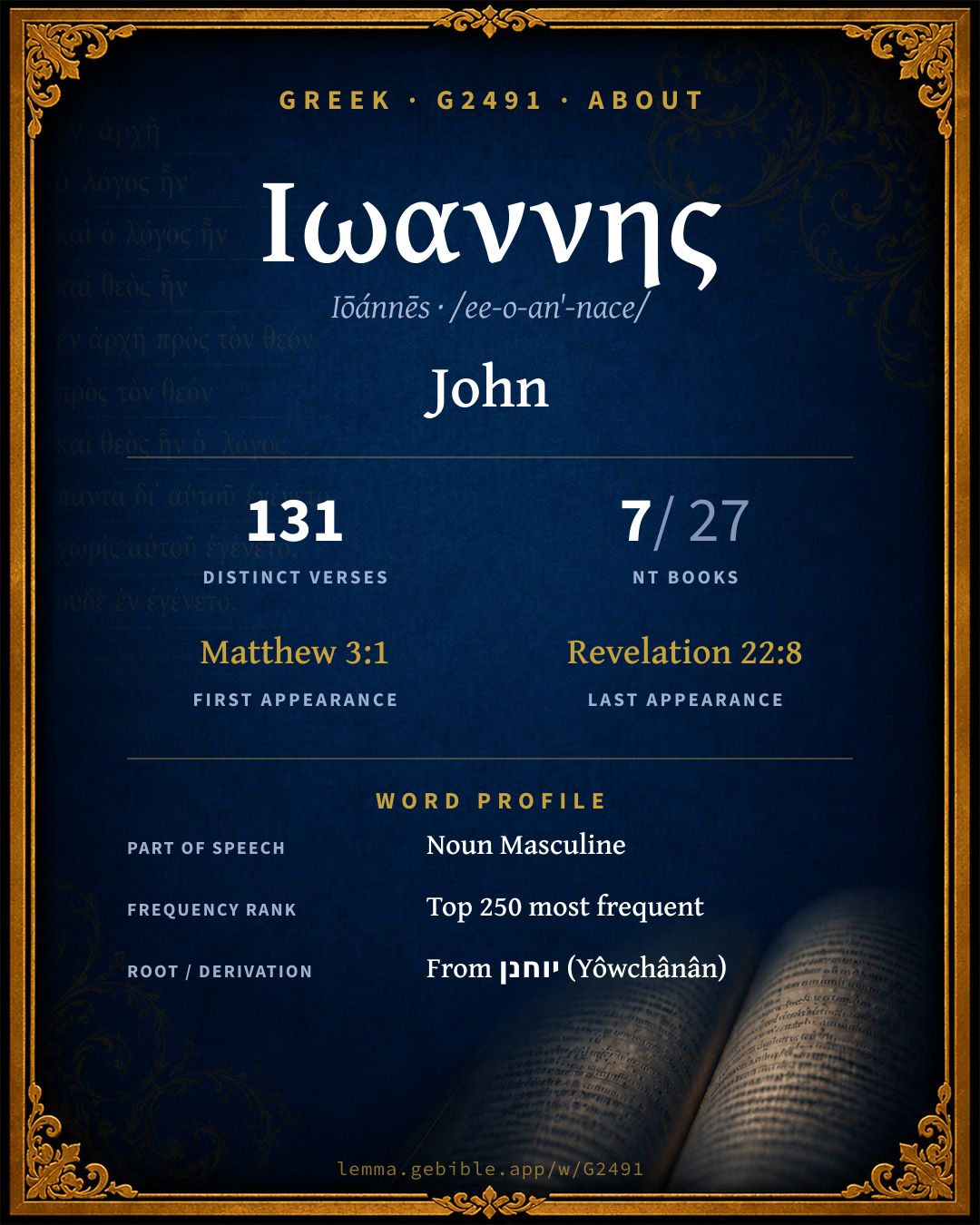
Ἰωάννης
John
Thayer's lists 5 entries for ‘John’ fuller range ↓
Full lexicon entry — Thayer's Greek Lexicon
From Thayer's Greek Lexicon
Where this word appears
See every Nominative-case word in the Greek New Testament →
Grammar key — what these labels mean
Part of speech
- Noun
- A naming word — a person, place, thing, or idea.
Case
- Nominative
- The case of the subject (and the predicate nominative).
- Genitive
- The case of source, possession, or “of” — answers “whose / from what.”
- Accusative
- The case of the direct object and of extent.
- Dative
- The case of the indirect object, means, or location — “to / for / with / in.”
Gender
- Masculine
- Grammatically masculine.
Number
- Singular
- One.
Grammatical forms
- Noun, Nominative, Singular, Masculine 53 times (40%)
- Noun, Genitive, Singular, Masculine 39 times (29%)
- Noun, Accusative, Singular, Masculine 37 times (28%)
- Noun, Dative, Singular, Masculine 5 times (4%)
Parsed forms decoded from the imported morphology (Robinson–Tischendorf, public domain), counted across 134 parsed occurrences — not distinct verses.
Every verse where G2491 appears — 131 distinct verses across 7 books. Click any verse to open its interlinear word-by-word view. Verse text shown in the World English Bible for context — . Each verse’s Greek form is shown with its reference; the English is not keyword-highlighted, since the data carries no word-level English alignment. Use “Compare translations” on any verse to read it across multiple English versions. This concordance covers the Greek New Testament; Septuagint (Greek Old Testament) occurrences of this word are not indexed here.
Matthew 25 verses
- Matthew 3:1 Ἰωάννης n nom sg masc In those days, John the Baptizer came, preaching in the wilderness of Judea, saying,
- Matthew 3:4 Ἰωάννης n nom sg masc Now John himself wore clothing made of camel's hair, with a leather belt around his waist. His food was locusts and wild honey.
- Matthew 3:13 Ἰωάννην n acc sg masc Then Jesus came from Galilee to the Jordan to John, to be baptized by him.
- Matthew 4:12 Ἰωάννης n nom sg masc Now when Jesus heard that John was delivered up, he withdrew into Galilee.
- Matthew 4:21 Ἰωάννην n acc sg masc Going on from there, he saw two other brothers, James the son of Zebedee, and John his brother, in the boat with Zebedee their father, mending their nets. He called them.
- Matthew 9:14 Ἰωάννου n gen sg masc Then John's disciples came to him, saying, "Why do we and the Pharisees fast often, but your disciples don't fast?"
- Matthew 10:2 Ἰωάννης n nom sg masc Now the names of the twelve apostles are these. The first, Simon, who is called Peter; Andrew, his brother; James the son of Zebedee; John, his brother;
- Matthew 11:2 Ἰωάννης n nom sg masc Now when John heard in the prison the works of Christ, he sent two of his disciples
- Matthew 11:4 Ἰωάννῃ n dat sg masc Jesus answered them, "Go and tell John the things which you hear and see:
- Matthew 11:7 Ἰωάννου n gen sg masc As these went their way, Jesus began to say to the multitudes concerning John, "What did you go out into the wilderness to see? A reed shaken by the wind?
- Matthew 11:11 Ἰωάννου n gen sg masc Most assuredly I tell you, among those who are born of women there has not arisen anyone greater than John the Baptizer; yet he who is least in the Kingdom of Heaven is greater than he.
- Matthew 11:12 Ἰωάννου n gen sg masc From the days of John the Baptizer until now, the Kingdom of Heaven suffers violence, and the violent take it by force.
- Matthew 11:13 Ἰωάννου n gen sg masc For all the prophets and the law prophesied until John.
- Matthew 11:18 Ἰωάννης n nom sg masc For John came neither eating nor drinking, and they say, 'He has a demon.'
- Matthew 14:2 Ἰωάννης n nom sg masc and said to his servants, "This is John the Baptizer. He is risen from the dead. That is why these powers work in him."
- Matthew 14:3 Ἰωάννην n acc sg masc For Herod had laid hold of John, and bound him, and put him in prison for the sake of Herodias, his brother Philip's wife.
- Matthew 14:4 Ἰωάννης n nom sg masc For John said to him, "It is not lawful for you to have her."
- Matthew 14:8 Ἰωάννου n gen sg masc She, being prompted by her mother, said, "Give me here on a platter the head of John the Baptizer."
- Matthew 14:10 Ἰωάννην n acc sg masc and he sent and beheaded John in the prison.
- Matthew 16:14 Ἰωάννην n acc sg masc They said, "Some say John the Baptizer, some, Elijah, and others, Jeremiah, or one of the prophets."
- Matthew 17:1 Ἰωάννην n acc sg masc After six days, Jesus took with him Peter, James, and John his brother, and brought them up into a high mountain by themselves.
- Matthew 17:13 Ἰωάννου n gen sg masc Then the disciples understood that he spoke to them of John the Baptizer.
- Matthew 21:25 Ἰωάννου n gen sg masc The baptism of John, where was it from? From heaven or from men?" They reasoned with themselves, saying, "If we say, 'From heaven,' he will ask us, 'Why then did you not believe him?'
- Matthew 21:26 Ἰωάννην n acc sg masc But if we say, 'From men,' we fear the multitude, for all hold John as a prophet."
- Matthew 21:32 Ἰωάννης n nom sg masc For John came to you in the way of righteousness, and you didn't believe him, but the tax collectors and the prostitutes believed him. When you saw it, you didn't even repent afterward, that you might believe him.
Mark 25 verses
- Mark 1:4 Ἰωάννης n nom sg masc John came baptizing in the wilderness and preaching the baptism of repentance for forgiveness of sins.
- Mark 1:6 Ἰωάννης n nom sg masc John was clothed with camel's hair and a leather belt around his loins. He ate locusts and wild honey.
- Mark 1:9 Ἰωάννου n gen sg masc It happened in those days, that Jesus came from Nazareth of Galilee, and was baptized by John in the Jordan.
- Mark 1:14 Ἰωάννην n acc sg masc Now after John was taken into custody, Jesus came into Galilee, preaching the Gospel of the Kingdom of God,
- Mark 1:19 Ἰωάννην n acc sg masc Going on a little further from there, he saw James the son of Zebedee, and John, his brother, who were also in the boat mending the nets.
- Mark 1:29 Ἰωάννου n gen sg masc Immediately, when they had come out of the synagogue, they came into the house of Simon and Andrew, with James and John.
- Mark 2:18 Ἰωάννου Ἰωάννου n gen sg masc n gen sg masc John's disciples and the Pharisees were fasting, and they came and asked him, "Why do John's disciples and the disciples of the Pharisees fast, but your disciples don't fast?"
- Mark 3:17 Ἰωάννην n acc sg masc James the son of Zebedee; John, the brother of James, and he surnamed them Boanerges, which means, Sons of Thunder;
- Mark 5:37 Ἰωάννην n acc sg masc He allowed no one to follow him, except Peter, James, and John the brother of James.
- Mark 6:14 Ἰωάννης n nom sg masc King Herod heard this, for his name had become known, and he said, "John the Baptizer has risen from the dead, and therefore these powers are at work in him."
- Mark 6:16 Ἰωάννην n acc sg masc But Herod, when he heard this, said, "This is John, whom I beheaded. He has risen from the dead."
- Mark 6:17 Ἰωάννην n acc sg masc For Herod himself had sent out and arrested John, and bound him in prison for the sake of Herodias, his brother Philip's wife, for he had married her.
- Mark 6:18 Ἰωάννης n nom sg masc For John said to Herod, "It is not lawful for you to have your brother's wife."
- Mark 6:20 Ἰωάννην n acc sg masc for Herod feared John, knowing that he was a righteous and holy man, and kept him safe. When he heard him, he did many things, and he heard him gladly.
- Mark 6:24 Ἰωάννου n gen sg masc She went out, and said to her mother, "What shall I ask?" She said, "The head of John the Baptizer."
- Mark 6:25 Ἰωάννου n gen sg masc She came in immediately with haste to the king, and asked, "I want you to give me right now the head of John the Baptizer on a platter."
- Mark 8:28 Ἰωάννην n acc sg masc They told him, "John the Baptizer, and others say Elijah, but others: one of the prophets."
- Mark 9:2 Ἰωάννην n acc sg masc After six days Jesus took with him Peter, James, and John, and brought them up onto a high mountain privately by themselves, and he was changed into another form in front of them.
- Mark 9:38 Ἰωάννης n nom sg masc John said to him, "Teacher, we saw someone who doesn't follow us casting out demons in your name; and we forbade him, because he doesn't follow us."
- Mark 10:35 Ἰωάννης n nom sg masc James and John, the sons of Zebedee, came near to him, saying, "Teacher, we want you to do for us whatever we will ask."
- Mark 10:41 Ἰωάννου n gen sg masc When the ten heard it, they began to be indignant towards James and John.
- Mark 11:30 Ἰωάννου n gen sg masc The baptism of John -- was it from heaven, or from men? Answer me."
- Mark 11:32 Ἰωάννην n acc sg masc If we should say, 'From men'"--they feared the people, for all held John to really be a prophet.
- Mark 13:3 Ἰωάννης n nom sg masc As he sat on the Mount of Olives opposite the temple, Peter, James, John, and Andrew asked him privately,
- Mark 14:33 Ἰωάννην n acc sg masc He took with him Peter, James, and John, and began to be greatly troubled and distressed.
Luke 30 verses
- Luke 1:13 Ἰωάννην n acc sg masc But the angel said to him, "Don't be afraid, Zacharias, because your request has been heard, and your wife, Elizabeth, will bear you a son, and you shall call his name John.
- Luke 1:60 Ἰωάννης n nom sg masc His mother answered, "Not so; but he will be called John."
- Luke 1:63 Ἰωάννης n nom sg masc He asked for a writing tablet, and wrote, "His name is John." They all marveled.
- Luke 3:2 Ἰωάννην n acc sg masc in the high priesthood of Annas and Caiaphas, the word of God came to John, the son of Zacharias, in the wilderness.
- Luke 3:15 Ἰωάννου n gen sg masc As the people were in expectation, and all men reasoned in their hearts concerning John, whether perhaps he was the Christ,
- Luke 3:16 Ἰωάννης n nom sg masc John answered them all, "I indeed baptize you with water, but he comes who is mightier than I, the latchet of whose sandals I am not worthy to loosen. He will baptize you in the Holy Spirit and fire,
- Luke 3:20 Ἰωάννην n acc sg masc added this also to them all, that he shut up John in prison.
- Luke 5:10 Ἰωάννην n acc sg masc and so also were James and John, sons of Zebedee, who were partners with Simon. Jesus said to Simon, "Don't be afraid. From now on you will be catching people alive."
- Luke 5:33 Ἰωάννου n gen sg masc They said to him, "Why do John's disciples often fast and pray, likewise also the disciples of the Pharisees, but yours eat and drink?"
- Luke 6:14 Ἰωάννην n acc sg masc Simon, whom he also named Peter; Andrew, his brother; James; John; Philip; Bartholomew;
- Luke 7:18 Ἰωάννει n dat sg masc The disciples of John told him about all these things.
- Luke 7:19 Ἰωάννης n nom sg masc John, calling to himself two of his disciples, sent them to Jesus, saying, "Are you the one who is coming, or should we look for another?"
- Luke 7:20 Ἰωάννης n nom sg masc When the men had come to him, they said, "John the Baptizer has sent us to you, saying, 'Are you he who comes, or should we look for another?'"
- Luke 7:22 Ἰωάννει n dat sg masc Jesus answered them, "Go and tell John the things which you have seen and heard: that the blind receive their sight, the lame walk, the lepers are cleansed, the deaf hear, the dead are raised up, and the poor have good news preached to them.
- Luke 7:24 Ἰωάννου Ἰωάννου n gen sg masc n gen sg masc When John's messengers had departed, he began to tell the multitudes about John, "What did you go out into the wilderness to see? A reed shaken by the wind?
- Luke 7:28 Ἰωάννου n gen sg masc "For I tell you, among those who are born of women there is not a greater prophet than John the Baptizer, yet he who is least in the Kingdom of God is greater than he."
- Luke 7:29 Ἰωάννου n gen sg masc When all the people and the tax collectors heard this, they declared God to be just, having been baptized with John's baptism.
- Luke 7:33 Ἰωάννης n nom sg masc For John the Baptizer came neither eating bread nor drinking wine, and you say, 'He has a demon.'
- Luke 8:51 Ἰωάννην n acc sg masc When he came to the house, he didn't allow anyone to enter in, except Peter, John, James, the father of the child, and her mother.
- Luke 9:7 Ἰωάννης n nom sg masc Now Herod the tetrarch heard of all that was done by him; and he was very perplexed, because it was said by some that John had risen from the dead,
- Luke 9:9 Ἰωάννην n acc sg masc Herod said, "John I beheaded, but who is this, about whom I hear such things?" He sought to see him.
- Luke 9:19 Ἰωάννην n acc sg masc They answered, "'John the Baptizer,' but others say, 'Elijah,' and others, that one of the old prophets is risen again."
- Luke 9:28 Ἰωάννην n acc sg masc It happened about eight days after these sayings, that he took with him Peter, John, and James, and went up onto the mountain to pray.
- Luke 9:49 Ἰωάννης n nom sg masc John answered, "Master, we saw someone casting out demons in your name, and we forbade him, because he doesn't follow with us."
- Luke 9:54 Ἰωάννης n nom sg masc When his disciples, James and John, saw this, they said, "Lord, do you want us to command fire to come down from the sky, and destroy them, just as Elijah did?"
- Luke 11:1 Ἰωάννης n nom sg masc It happened, that when he finished praying in a certain place, one of his disciples said to him, "Lord, teach us to pray, just as John also taught his disciples."
- Luke 16:16 Ἰωάννου n gen sg masc The law and the prophets were until John. From that time the Gospel of the Kingdom of God is preached, and everyone is forcing his way into it.
- Luke 20:4 Ἰωάννου n gen sg masc the baptism of John, was it from heaven, or from men?"
- Luke 20:6 Ἰωάννην n acc sg masc But if we say, 'From men,' all the people will stone us, for they are persuaded that John was a prophet."
- Luke 22:8 Ἰωάννην n acc sg masc He sent Peter and John, saying, "Go and prepare the Passover for us, that we may eat."
John 22 verses
- John 1:6 Ἰωάννης n nom sg masc There came a man, sent from God, whose name was John.
- John 1:15 Ἰωάννης n nom sg masc John testified about him. He cried out, saying, "This was he of whom I said, 'He who comes after me has surpassed me, for he was before me.'"
- John 1:19 Ἰωάννου n gen sg masc This is John's testimony, when the Jews sent priests and Levites from Jerusalem to ask him, "Who are you?"
- John 1:26 Ἰωάννης n nom sg masc John answered them, "I baptize in water, but among you stands one whom you don't know.
- John 1:28 Ἰωάννης n nom sg masc These things were done in Bethany beyond the Jordan, where John was baptizing.
- John 1:32 Ἰωάννης n nom sg masc John testified, saying, "I have seen the Spirit descending like a dove out of heaven, and it remained on him.
- John 1:35 Ἰωάννης n nom sg masc Again, the next day, John was standing with two of his disciples,
- John 1:41 Ἰωάννου n gen sg masc He first found his own brother, Simon, and said to him, "We have found the Messiah!" (which is, being interpreted, Christ).
- John 1:43 Ἰωάννου n gen sg masc On the next day, he was determined to go out into Galilee, and he found Philip. Jesus said to him, "Follow me."
- John 3:23 Ἰωάννης n nom sg masc John also was baptizing in Enon near Salim, because there was much water there. They came, and were baptized.
- John 3:24 Ἰωάννης n nom sg masc For John was not yet thrown into prison.
- John 3:25 Ἰωάννου n gen sg masc There arose therefore a questioning on the part of John's disciples with some Jews about purification.
- John 3:26 Ἰωάννην n acc sg masc They came to John, and said to him, "Rabbi, he who was with you beyond the Jordan, to whom you have testified, behold, the same baptizes, and everyone is coming to him."
- John 3:27 Ἰωάννης n nom sg masc John answered, "A man can receive nothing, unless it has been given him from heaven.
- John 4:1 Ἰωάννης n nom sg masc Therefore when the Lord knew that the Pharisees had heard that Jesus was making and baptizing more disciples than John
- John 5:33 Ἰωάννην n acc sg masc You have sent to John, and he has testified to the truth.
- John 5:36 Ἰωάννου n gen sg masc But the testimony which I have is greater than that of John, for the works which the Father gave me to accomplish, the very works that I do, testify about me, that the Father has sent me.
- John 10:40 Ἰωάννης n nom sg masc He went away again beyond the Jordan into the place where John was baptizing at first, and there he stayed.
- John 10:41 Ἰωάννης Ἰωάννης n nom sg masc n nom sg masc Many came to him. They said, "John indeed did no sign, but everything that John said about this man is true."
- John 21:15 Ἰωάννου n gen sg masc So when they had eaten their breakfast, Jesus said to Simon Peter, "Simon, son of Jonah, do you love me more than these?" He said to him, "Yes, Lord; you know that I have affection for you." He said to him, "Feed my lambs."
- John 21:16 Ἰωάννου n gen sg masc He said to him again a second time, "Simon, son of Jonah, do you love me?" He said to him, "Yes, Lord; you know that I have affection for you." He said to him, "Tend my sheep."
- John 21:17 Ἰωάννου n gen sg masc He said to him the third time, "Simon, son of Jonah, do you have affection for me?" Peter was grieved because he asked him the third time, "Do you have affection for me?" He said to him, "Lord, you know everything. You know that I have affection for you." Jesus said to him, "Feed my sheep.
Acts 24 verses
- Acts 1:5 Ἰωάννης n nom sg masc For John indeed baptized in water, but you will be baptized in the Holy Spirit not many days from now."
- Acts 1:13 Ἰωάννης n nom sg masc When they had come in, they went up into the upper room, where they were staying; that is Peter, John, James, Andrew, Philip, Thomas, Bartholomew, Matthew, James the son of Alphaeus, Simon the Zealot, and Judas the son of James.
- Acts 1:22 Ἰωάννου n gen sg masc beginning from the baptism of John, to the day that he was received up from us, of these one must become a witness with us of his resurrection."
- Acts 3:1 Ἰωάννης n nom sg masc Peter and John were going up into the temple at the hour of prayer, the ninth hour.
- Acts 3:3 Ἰωάννην n acc sg masc Seeing Peter and John about to go into the temple, he asked to receive gifts for the needy.
- Acts 3:4 Ἰωάννῃ n dat sg masc Peter, fastening his eyes on him, with John, said, "Look at us."
- Acts 3:11 Ἰωάννην n acc sg masc As the lame man who was healed held on to Peter and John, all the people ran together to them in the porch that is called Solomon's, greatly wondering.
- Acts 4:6 Ἰωάννης n nom sg masc Annas the high priest was there, with Caiaphas, John, Alexander, and as many as were relatives of the high priest.
- Acts 4:13 Ἰωάννου n gen sg masc Now when they saw the boldness of Peter and John, and had perceived that they were unlearned and ignorant men, they marveled. They recognized that they had been with Jesus.
- Acts 4:19 Ἰωάννης n nom sg masc But Peter and John answered them, "Whether it is right in the sight of God to listen to you rather than to God, judge for yourselves,
- Acts 8:14 Ἰωάννην n acc sg masc Now when the apostles who were at Jerusalem heard that Samaria had received the word of God, they sent Peter and John to them,
- Acts 10:37 Ἰωάννης n nom sg masc that spoken word you yourselves know, which was proclaimed throughout all Judea, beginning from Galilee, after the baptism which John preached;
- Acts 11:16 Ἰωάννης n nom sg masc I remembered the word of the Lord, how he said, 'John indeed baptized in water, but you will be baptized in the Holy Spirit.'
- Acts 12:2 Ἰωάννου n gen sg masc He killed James, the brother of John, with the sword.
- Acts 12:12 Ἰωάννου n gen sg masc Thinking about that, he came to the house of Mary, the mother of John whose surname was Mark, where many were gathered together and were praying.
- Acts 12:25 Ἰωάννην n acc sg masc Barnabas and Saul returned to Jerusalem, when they had fulfilled their service, also taking with them John whose surname was Mark.
- Acts 13:5 Ἰωάννην n acc sg masc When they were at Salamis, they proclaimed the word of God in the synagogues of the Jews. They had also John as their attendant.
- Acts 13:13 Ἰωάννης n nom sg masc Now Paul and his company set sail from Paphos, and came to Perga in Pamphylia. John departed from them and returned to Jerusalem.
- Acts 13:24 Ἰωάννου n gen sg masc before his coming, when John had first preached the baptism of repentance to Israel.
- Acts 13:25 Ἰωάννης n nom sg masc As John was fulfilling his course, he said, 'What do you suppose that I am? I am not he. But behold, one comes after me the sandals of whose feet I am not worthy to untie.'
- Acts 15:37 Ἰωάννην n acc sg masc Barnabas planned to take John, who was called Mark, with them also.
- Acts 18:25 Ἰωάννου n gen sg masc This man had been instructed in the way of the Lord; and being fervent in spirit, he spoke and taught accurately the things concerning Jesus, although he knew only the baptism of John.
- Acts 19:3 Ἰωάννου n gen sg masc He said, "Into what then were you baptized?" They said, "Into John's baptism."
- Acts 19:4 Ἰωάννης n nom sg masc Paul said, "John indeed baptized with the baptism of repentance, saying to the people that they should believe in the one who would come after him, that is, in Jesus."
Galatians 1 verse
Revelation 4 verses
- Revelation 1:1 Ἰωάννῃ n dat sg masc This is the Revelation of Jesus Christ, which God gave him to show to his servants the things which must happen soon, which he sent and made known by his angel to his servant, John,
- Revelation 1:4 Ἰωάννης n nom sg masc John, to the seven assemblies that are in Asia: Grace to you and peace, from God, who is and who was and who is to come; and from the seven Spirits who are before his throne;
- Revelation 1:9 Ἰωάννης n nom sg masc I John, your brother and partner with you in oppression, Kingdom, and perseverance in Christ Jesus, was on the isle that is called Patmos because of God's Word and the testimony of Jesus Christ.
- Revelation 22:8 Ἰωάννης n nom sg masc Now I, John, am the one who heard and saw these things. When I heard and saw, I fell down to worship before the feet of the angel who had shown me these things.
About this entry
At a glance — auto-summarized from this page’s data, not written by a person. Every figure links to its source below. This summary describes the numbers; it doesn’t interpret them.
Ιωαννης — transliterated Iōánnēs — is a Greek name carrying the sense “John.” Debuting at Matthew 3:1, it then recurs through the corpus. The Greek New Testament uses it across 131 verses — common. Each statement above links to its evidence; the full detail follows below.
Gloss history
Strong's 1890 vs modern scholarship
About this word
Strong's G2491 catalogs a Greek word from the Greek New Testament.
These counts are not copied from any lexicon or concordance. They are computed here, from the morphology-tagged Greek New Testament. What Lemma adds →
- 131
- distinct verses
- The word appears in 131 distinct verses.
- 7 / 27
- NT books
- The word appears in 7 of 27 New Testament books.
- #125
- by frequency
- Top 250 most frequent Greek words (rank 125 of 5,347 Greek words by occurrence).
View all 131 occurrences in the concordance →
By section of the New Testament
By traditional corpus
Conventional, traditional groupings — biblical authorship is debated, so this is a traditional corpus grouping, not an authorship claim. Some books belong to more than one corpus (Luke is in both the Gospels and the Lukan corpus, and so on), so these shares overlap and need not total 100%. Each figure is a share of the word’s 131 distinct verses.
- Gospels 102 verses · 78%
- Lukan (Luke–Acts) 54 verses · 41%
- Johannine 26 verses · 20%
- Revelation 4 verses · 3%
- Pauline corpus 1 verse · 1%
How translations render this word
Counts come from each version’s own published word-to-Strong’s tagging or interlinear alignment — an approximate guide to how each version renders this word, not a word-level alignment the data otherwise carries. Because each total is that version’s own tagged count, the per-version totals vary from one another and need not match the appearance or distinct-verse counts above. These counts may also differ from a printed concordance because Lemma counts each distinctly tagged rendering and does not collapse phrase taggings into a single head-word total. This is a fixed set of word-tagged versions (KJV, ASV, BSB, ULT) and does not change with the reading translation you choose elsewhere. Each version’s license is shown beside its name below (and on Sources).
- King James Version: John 129×, John's 2×
- American Standard Version: John 121×
- Berean Standard Bible: John 115×, John’s 13×, Than john 2×
- unfoldingWord Literal Text: John 131×, Son of john 3×
King James Version Public Domain
Renders G2491 across 133 tagged occurrences — most commonly:
Plus 2 renderings that appear only once — usually multi-word phrases or single function words the recovered tagging swept in, not distinct renderings.
American Standard Version Public Domain
Renders G2491 across 130 tagged occurrences — most commonly:
Plus 9 renderings that appear only once — usually multi-word phrases or single function words the recovered tagging swept in, not distinct renderings.
Berean Standard Bible Public Domain
Renders G2491 across 131 tagged occurrences — most commonly:
Plus 1 rendering that appears only once — usually multi-word phrases or single function words the recovered tagging swept in, not distinct renderings. Not rendered by a distinct English word in 4 further occurrences.
unfoldingWord Literal Text CC BY-SA 4.0
Renders G2491 across 136 tagged occurrences — most commonly:
Plus 2 renderings that appear only once — usually multi-word phrases or single function words the recovered tagging swept in, not distinct renderings.
Senses in Thayer's
The 5 senses Thayer's distinguishes for this word, in lexicon order (not ranked by frequency or importance). The full entry — with sub-senses — is in the Lexicon Entry tab.
- John = "Jehovah is a gracious giver"
- John the Baptist was the son of Zacharias and Elisabeth…
- John the apostle…
- John surnamed Mark, the companion of Barnabas and Paul. Acts 12:12
- John a certain man, a member of the Sanhedrin Acts 5:6
Word origin
Derived from יוחנן (Yôwchânân) (H3110) — Johanan.
Of hebrew origin [ H3110 ]; Joannes (that is Jochanan ) the name of four Israelites : - John.
— Strong’s Exhaustive Concordance (1890), public domain.
Forms in the corpus
The 5 distinct written forms G2491 takes in the Greek New Testament, most frequent first — each parse links to that case’s occurrences in the concordance.
| Form | Parsing | Example | Uses |
|---|---|---|---|
| Ἰωάννης Iōánnēs | Noun, Nominative, Singular, Masculine | Matthew 3:1 | 53 |
| Ἰωάννου Iōánnou | Noun, Genitive, Singular, Masculine | Matthew 9:14 | 39 |
| Ἰωάννην Iōánnēn | Noun, Accusative, Singular, Masculine | Matthew 3:13 | 37 |
| Ἰωάννῃ Iōánnē | Noun, Dative, Singular, Masculine | Matthew 11:4 | 3 |
| Ἰωάννει Iōánnei | Noun, Dative, Singular, Masculine | Luke 7:18 | 2 |
Same root — word family
Other Thayer's entries built from the same root as G2491, grouped by Strong’s listed origin. These share a root / origin per the lexicon — not necessarily a shared meaning. Each links to that word’s own entry.
Derives from
Proper names from this root
People and places named from this root — a name, not an additional meaning of the word.
Compare all same-root words → Showing 4 of 5 — not the complete family. 4 of the same-root words are proper names (people or places). They share a root, not necessarily a meaning.
Bible dictionary
Public-domain dictionary articles matched to this entry by name (John). A biblical name can be shared by more than one person or place, so an article may treat several.
Easton's Bible Dictionary · M. G. Easton, 1897
(1.) One who, with Annas and Caiaphas, sat in judgment on the apostles Peter and John (Acts 4:6). He was of the kindred of the high priest; otherwise unknown.
(2.) The Hebrew name of Mark (q.v.). He is designated by this name in the acts of the Apostles (12:12, 25; 13:5, 13; 15:37).
(3.) THE APOSTLE, brother of James the "Greater" (Matt. 4:21; 10:2; Mark 1:19; 3:17; 10:35). He was one, probably the younger, of the sons of Zebedee (Matt. 4:21) and Salome (Matt. 27:56; comp. Mark 15:40), and was born at Bethsaida. His father was apparently a man of some wealth (comp. Mark 1:20; Luke 5:3; John 19:27). He was doubtless trained in all that constituted the ordinary education of Jewish youth. When he grew up he followed the occupation of a fisherman on the Lake of Galilee. When John the Baptist began his ministry in the wilderness of Judea, John, with many others, gathered round him, and was deeply influenced by his teaching. There he heard the announcement, "Behold the Lamb of God," and forthwith, on the invitation of Jesus, became a disciple and ranked among his followers (John 1:36, 37) for a time. He and his brother then returned to their former avocation, for how long is uncertain. Jesus again called them (Matt. 4: 21; Luke 5:1-11), and now they left all and permanently attached themselves to the company of his disciples. He became one of the innermost circle (Mark 5:37; Matt. 17:1; 26:37; Mark 13:3). He was the disciple whom Jesus loved. In zeal and intensity of character he was a "Boanerges" (Mark 3:17). This spirit once and again broke out (Matt. 20:20-24; Mark 10:35-41; Luke 9:49, 54). At the betrayal he and Peter follow Christ afar off, while the others betake themselves to hasty flight (John 18:15). At the trial he follows Christ into the council chamber, and thence to the praetorium (18:16, 19, 28) and to the place of crucifixion (19:26, 27). To him and Peter, Mary first conveys tidings of the resurrection (20:2), and they are the first to go and see what her strange words mean. After the resurrection he and Peter again return to the Sea of Galilee, where the Lord reveals himself to them (21:1, 7). We find Peter and John frequently after this together (Acts 3:1; 4:13). John remained apparently in Jerusalem as the leader of the church there (Acts 15:6; Gal. 2:9). His subsequent history is unrecorded. He was not there, however, at the time of Paul's last visit (Acts 21:15-40). He appears to have retired to Ephesus, but at what time is unknown. The seven churches of Asia were the objects of his special care (Rev. 1:11). He suffered under persecution, and was banished to Patmos (1:9); whence he again returned to Ephesus, where he died, probably about A.D. 98, having outlived all or nearly all the friends and companions even of his maturer years. There are many interesting traditions regarding John during his residence at Ephesus, but these cannot claim the character of historical truth.
Smith's Bible Dictionary · William Smith, 1863
the same name as Johanan, a contraction of Jehoanan, Jehovah's gift .
+ One of the high priest's family, who, with Annas and Caiaphas, sat in judgment upon the apostles Peter and John. (Acts 6:6) + The Hebrew name of the evangelist Mark. (Acts 12:12,25; 13:5,13; 15:37)
Hitchcock's Bible Names Dictionary · Roswell D. Hitchcock, 1869
the grace or mercy of the Lord
Classic public-domain reference works; full attribution on Sources.