Acts 4:6

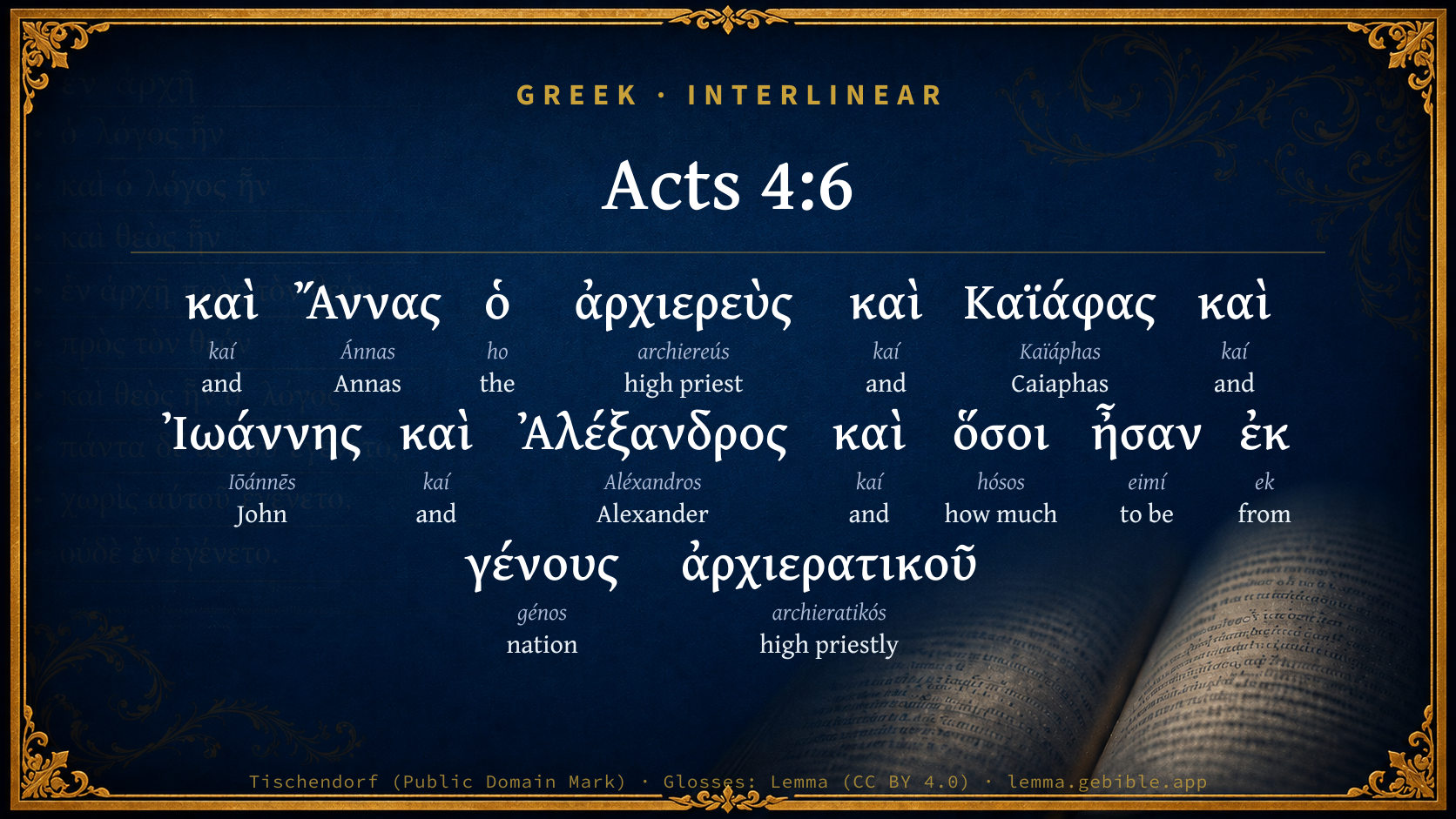
Greek (Tischendorf 8th ed.) Acts 4:6 appears in the Greek New Testament. The text above is from the Tischendorf 8th edition. Each word links to its Strong’s number and a concise gloss. Click any word for its full Thayer’s Greek Lexicon entry.
Download image
Cite this verse

Acts 4:6 (World English Bible). Public Domain. Lemma interlinear Bible study tool, https://lemma.gebible.app/v/acts/4/6.

Show BibTeX & RIS
BibTeX
RIS
English Translation
Annas the high priest was there, with Caiaphas, John, Alexander, and as many as were relatives of the high priest.
World English Bible · Public Domain
Highlights
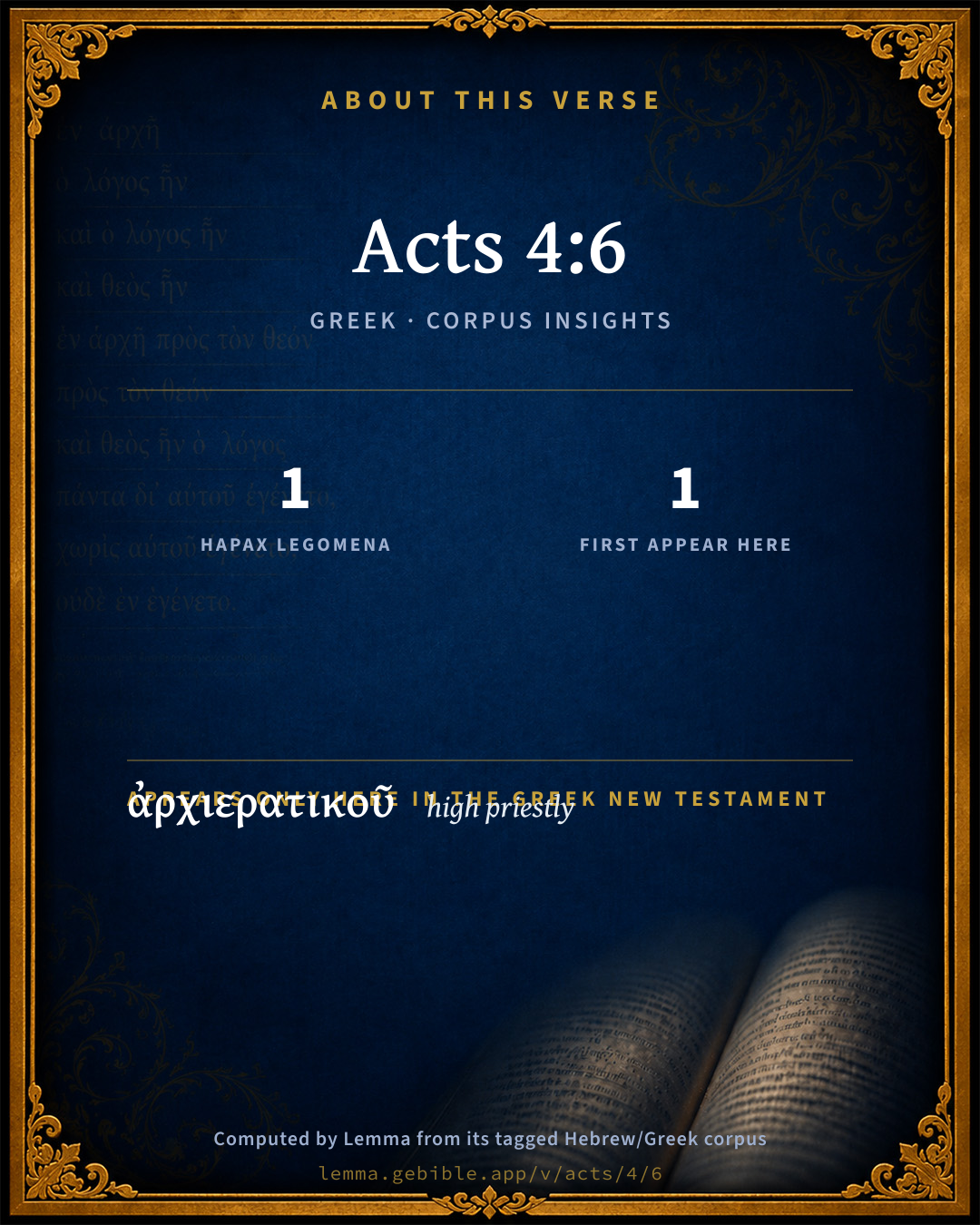
  • 1 hapax legomenon — only here in the Greek New Testament
  • 1 first appearance in the Greek New Testament
Full analysis ↓
Download a study sheet

One document with this verse’s original text, its word-by-word gloss line, the meaning frame, cross-references with their text, attributed commentary, and full source and license credits — printable, and it pastes into notes with its structure intact.

This verse Autodidact and up

Study sheet (.html) Plain text (.txt)

A passage Seminary Student

Up to 50 verses in one chapter. A passage sheet keeps up to 6 commentary sources and 12 cross-references per verse, in the order this page ranks them, and says so on the sheet whenever that leaves anything out. Ask for a single verse and you get the Autodidact verse sheet above.

Everything on this page stays free to read, with no account — the sheet is a download of what is already on screen, not access to it.

Want to remove ads? Support Godless Engineer
Compare translations 3

The same verse in 3 English versions, stacked beneath the original-language interlinear above. Click any original word for its lexicon entry.

Each is an independent rendering of the whole verse — the interlinear is not word-aligned to these translations.

Highlighted words mark where these versions differ — a whole-verse word diff, not a word-by-word alignment.

  • World English Bible Public Domain
    Annas the high priest was there, with Caiaphas, John, Alexander, and as many as were relatives of the high priest.
  • King James Version Public Domain
    And Annas the high priest, and Caiaphas, and John, and Alexander, and as many as were of the kindred of the high priest, were gathered together at Jerusalem.
  • unfoldingWord Literal Text CC BY-SA 4.0
    and Annas the high priest, and Caiaphas, and John, and Alexander, and as many as were from the high priestly family.

unfoldingWord Literal Text — © unfoldingWord, licensed CC BY-SA 4.0. Word-aligned USFM3 via Door43 (git.door43.org/unfoldingWord/en_ult).

Versions to compare (up to 4)

3 of 4 selected

Show all 19 translations

Every available English version of this verse, each an independent rendering of the whole verse.

  • World English Bible Public Domain
    Annas the high priest was there, with Caiaphas, John, Alexander, and as many as were relatives of the high priest.
  • Berean Standard Bible Public Domain
    along with Annas the high priest, Caiaphas, John, Alexander, and many others from the high priest’s family.
  • Majority Standard Bible Public Domain
    along with Annas the high priest, Caiaphas, John, Alexander, and many others from the high priest’s family.
  • King James Version Public Domain
    And Annas the high priest, and Caiaphas, and John, and Alexander, and as many as were of the kindred of the high priest, were gathered together at Jerusalem.
  • American Standard Version (1901) Public Domain
    and Annas the high priest `was there', and Caiaphas, and John, and Alexander, and as many as were of the kindred of the high priest.
  • Revised Version (1885) Public Domain
    and Annas the high priest was there, and Caiaphas, and John, and Alexander, and as many as were of the kindred of the high priest.
  • Geneva Bible (1599) Public Domain
    And Annas the chiefe Priest, and Caiaphas, and Iohn, and Alexander, and as many as were of the kindred of the hie Priestes.
  • Douay-Rheims (1899) Public Domain
    And Annas the high priest, and Caiphas, and John, and Alexander, and as many as were of the kindred of the high priest.
  • Young's Literal Translation Public Domain
    and Annas the chief priest, and Caiaphas, and John, and Alexander, and as many as were of the kindred of the chief priest,
  • Literal Standard Version CC BY-SA 4.0
    and Annas the chief priest, and Caiaphas, and John, and Alexander, and as many as were of the family of the chief priest,
  • Unlocked Literal Bible CC BY-SA 4.0
    Annas the high priest was there, and Caiaphas, and John, and Alexander, and all who were relatives of the high priest.
  • unfoldingWord Literal Text CC BY-SA 4.0
    and Annas the high priest, and Caiaphas, and John, and Alexander, and as many as were from the high priestly family.
  • Darby Bible Public Domain
    and Annas the high priest, and Caiaphas, and John, and Alexander, and as many as were of [the] high priestly family;
  • World Messianic Bible Public Domain
    Annas the high priest was there, with Caiaphas, Yochanan, Alexander, and as many as were relatives of the high priest.
  • Webster's Bible Public Domain
    And Annas the high priest, and Caiaphas, and John, and Alexander, and as many as were of the kindred of the high priest, were assembled at Jerusalem.
  • Free Bible Version CC BY-SA 4.0
    They included the high priest Annas, Caiaphas, John, Alexander, and others of the high priest's family.
  • Bible in Basic English Public Domain
    And Annas, the high priest, was there, and Caiaphas and John and Alexander, and all the relations of the high priest.
  • Text-Critical English NT CC BY 4.0
    along with Annas the high priest, Caiaphas, John, Alexander, and all who were members of the high-priestly family.
  • Tyndale New Testament (1534) Public Domain
    as Annas the chefe Prest and Cayphas and Iohn and Alexander and as many as were of the kynred of the hye prestes gadered to geder at Ierusalem

Literal Standard Version (2020), Covenant Press — licensed CC BY-SA 4.0. Text via the HelloAO Bible API (eBible.org). Unlocked Literal Bible (unfoldingWord) — licensed CC BY-SA 4.0. Text via the HelloAO Bible API (eBible.org). unfoldingWord Literal Text — © unfoldingWord, licensed CC BY-SA 4.0. Word-aligned USFM3 via Door43 (git.door43.org/unfoldingWord/en_ult). Free Bible Version, Dr. Jonathan Gallagher — licensed CC BY-SA 4.0. Text via the HelloAO Bible API (eBible.org).

Word by word

More ways to search: Search by grammar → Find every occurrence → Compare this word →

Practice this passage: Drill this verse → Learn its vocabulary →

ἀρχιερατικοῦ
archieratikós
G748
“high priestly”
Adjective, Genitive, Singular, Neuter
Part of Speech
Adjective
Case
Genitive
Number
Singular
Gender
Neuter
Full Thayer's Definition

Origin: from G746 and a derivative of G2413

TDNT: None

1. high priestly, pontifical
  1. καὶ kaí G2532 “and” Conjunction
  2. Ἄννας Ánnas G452 “Annas” Noun, Nominative, Singular, Masculine
  3. ὁ ho G3588 “the” Article, Nominative, Singular, Masculine
  4. ἀρχιερεὺς archiereús G749 “high priest” Noun, Nominative, Singular, Masculine
  5. καὶ kaí G2532 “and” Conjunction
  6. Καϊάφας Kaïáphas G2533 “Caiaphas” Noun, Nominative, Singular, Masculine
  7. καὶ kaí G2532 “and” Conjunction
  8. Ἰωάννης Iōánnēs G2491 “John” Noun, Nominative, Singular, Masculine
  9. καὶ kaí G2532 “and” Conjunction
  10. Ἀλέξανδρος Aléxandros G223 “Alexander” Noun, Nominative, Singular, Masculine
  11. καὶ kaí G2532 “and” Conjunction
  12. ὅσοι hósos G3745 “how much” Correlative pronoun, Nominative, Plural, Masculine
  13. ἦσαν eimí G1510 “to be” Verb, Imperfect, Active, Indicative, 3rd person, Plural
  14. ἐκ ek G1537 “from” Preposition
  15. γένους génos G1085 “nation” Noun, Genitive, Singular, Neuter

About this verse

These counts appear in no published source. They are computed here, from the morphology-tagged text and Lemma’s own curated glosses. What Lemma adds →

16
words
12
distinct lemmas
Acts
section

Notable vocabulary

1 hapax legomenon — a word that appears only here in the entire Greek New Testament:

  • ἀρχιερατικοῦ high priestly G748

First appearance in Scripture

This word makes its first canonical appearance in the Greek New Testament here:

  • ἀρχιερατικοῦ high priestly G748

Shared distinctive vocabulary

Ἄννας Annas G452 occurs in 4 verses of the Greek New Testament. Also found in:

Repetition

A word recurs within this verse:

Cross-references

5

Topical passages linked to Acts 4:6 in the Treasury of Scripture Knowledge — connected by theme and wording, ordered by reader-vote popularity; previews shown in the World English Bible.

  • Luke 3:2 in the high priesthood of Annas and Caiaphas, the word of God came to John, the son of Zacharias, in the wilderness.
  • Matthew 26:3 Then the chief priests, the scribes, and the elders of the people were gathered together in the court of the high priest, who was called Caiaphas.
  • John 18:24 Annas sent him bound to Caiaphas, the high priest.
  • John 11:49 But a certain one of them, Caiaphas, being high priest that year, said to them, "You know nothing at all,
  • John 18:13–14 and led him to Annas first, for he was father-in-law to Caiaphas, who was high priest that year.

Cross-references courtesy of OpenBible.info (CC BY 4.0).

Commentary

Notes on Acts 4:6 from classic Christian and Jewish commentators (each source and its license shown beneath its notes). The classic Christian expositions comment on the surrounding passage and are grouped to its opening verse, so a note may address several verses; the Jewish commentaries on the Tanakh (Rashi and others) are per-verse, so they appear only where the commentator wrote on this verse.

Lemma curates 59 commentaries, every one of them public domain or Creative Commons licensed, each selected and text-cleaned for this edition rather than reprinted as found. About our sources →

The Cambridge Bible for Schools and Colleges

gen. ed. J. J. S. Perowne

6. and Annas the high priest] was there. The verb is understood. Annas (called Ananus in Josephus), son of one Seth, was made high-priest (a.d. 7) by the Roman governor Quirinus [Cyrenius], and so continued till a.d. 14 (Joseph. Antiq. xviii. 2. 1). We do not find that he was ever again appointed to the office, though St Luke here calls him high-priest. But the way in which he is mentioned at the time of the trial of Christ, who was brought, as we read, before Annas first (Joh_18:13), and sent by him afterwards bound unto Caiaphas, shews that, though not actual high-priest, yet his position in the eyes of the people of Jerusalem was one which justified them in bringing Jesus to him as soon as he was seized. It is difficult to explain from the words of the New Test, the relation of these two men in their office. Caiaphas is expressly called high-priest by St John, yet we are not told why Christ was not at once brought to him. It may be that one was acting high-priest, while the other was nasi or president of the Sanhedrin. Moreover it is not improbable that Annas, having been high-priest before, and only deposed from the office by the Roman governor Gratus, would, both during the short high-priesthood of his son Eleazar (a.d. 16), and the longer high-priesthood of Caiaphas, his son-in-law (a.d. 25–37), exercise much influence by reason of his age and experience, and might, from his former tenure of the office, even be spoken of as high-priest. It is clear that he was at the head of one of the most influential Jewish families, for before his death, five of his sons had been high-priests (Joseph. Antiq. xx. 9. 1). We can see from Luk_3:2, where both Annas and Caiaphas are said to be high-priests, that there was some laxity in the common use of the title. So far only does the New Testament carry us, but when we come to examine the Old Testament, and the records of later Jewish literature, there seems every reason to conclude that the expressions which seem somewhat hard to reconcile are exactly those which would naturally be employed. We find that Moses, who is himself counted (Psa_99:6) God’s priest on the same level with Aaron, anointed not Aaron only, but his sons at the same time (Exo_40:12-15) to be high-priests. Also (Num_31:6) Phinehas the son of Eleazar is sent to the war against the Midianites with “the holy instruments” (Le. the Urim and Thummim), which shews that he was high-priest at the same time as Eleazar his father. Again in later times (2Ki_25:18) we have mention made of “Seraiah the chief priest and Zephaniah the second priest,” which the Targum explain as “high-priest and Sagan” or deputy high-priest. The Talmud makes it very clear that there was a special arrangement for providing on some occasions such a deputy for the high-priest. Thus (Mishna Joma i. 1) it says, “Seven days before the day of atonement they remove the high-priest from his house to the chamber of the assessors, and they provide another priest in his place lest any disqualification should befal him.” On this passage Rashi’s note is “to be high-priest instead of him.” and a little later on in the same treatise (T. B. Joma 39 a) it is said concerning the services of the day of atonement: “Rabbi Khanina the Sagan of the priests (and so one qualified to speak on the duties of the office) said: Why does the Sagan stand on the right hand of the high-priest (when the lots are being cast for the goats)?” The answer is, “So that if any disqualification should befal him, the Sagan may go in (to the Holy of Holies) and perform the service in his stead.” Cp. also Midrash Rabbah on Leviticus (par. 20 ad fin.). “If there was any defilement on Aaron, Eleazar served (as high-priest), and if there was any defilement on Eleazar, Ithamar served.” (On the slight matters which caused such ceremonial defilement, see note on Act_10:28.) And in the same chapter we find “Had not Elisheba (Exo_6:23, the wife of Aaron) joy in this world who saw five crowns (i.e. subjects for rejoicing) in one day? her brother-in-law (Moses) a king (Deu_33:5); her brother (Naashon) nasi, i.e. president, of the tribe of Judah; her husband high-priest; her two sons, sagans of the high-priest; and Phinehas her grandson anointed for the war.” These notices make it clear that from the earliest times down to a period posterior to the date of the Acts, there were occasions, and these not unfrequent, when two men were called high-priests at the same time.

That one who had been high-priest should still retain the title may be seen from the principle laid down in several places in the Talmud, (see Mishna Shekalim vi. 6, ed. princ. Jerus.), viz. that “you may elevate in a sacred office or service, but you cannot bring down,” as with us “once a Bishop, always a Bishop.” The illustration given is that you might lay the shewbread on a marble table first, and afterwards on a golden one, but the contrary order of proceeding was forbidden. (For another illustration, see note on Act_6:3.) Therefore Annas, having been high-priest, could, according to Jewish usage, never be called by any lower title.

The relationship between Annas and Caiaphas and the seniority of the former is enough to explain the conduct of the crowd in bringing Jesus to him first: while the omission of the word high-priest (Act_4:6) with the name of Caiaphas is no more a proof that he was not also known to be high-priest, as well as Annas, than the words of St Mark’s Gospel (Act_16:7), “Go your way, tell his disciples and Peter,” can be made evidence that Peter was not one of the disciples. For a similar phrase cp. Act_5:29 and the note there.

and Caiaphas] He was also called Joseph, and was son-in-law to Annas.

and John] This is the same name as Johanan, and Lightfoot concludes that this person was the famous Johanan ben Zaccai, who by his influence with Vespasian procured permission for many of the Jews to settle in Jamnia (Yavneh) after the destruction of their city, and himself became head of the synagogue there.

and Alexander] of whom nothing is known more than can be gathered from this mention of him.

and as many as were of the kindred of the high priest] And these would probably all be of the Sadducees’ party.

were gathered together at (MSS. in) Jerusalem] These words which A. V. places at the end of Act_4:6 are in the Greek a part of Act_4:5, and it is better to insert them there, because the MSS. of most authority make the names in Act_4:6 all nominatives and subjects to a new verb. It may have been that some of the authorities were not residents in Jerusalem, but had to be summoned.

The Cambridge Bible for Schools and Colleges (gen. ed. J. J. S. Perowne; Cambridge University Press, 1878–1918) — public domain. Text from a community e-Sword module.

Bengel's Gnomon

Johann Albrecht Bengel

Act 4:6. Τὸν ἀρχιερέα, the High Priest, the chief of the priests) This is to be understood of Caiaphas also.—Ἀλέξανδρον, Alexander) This name was frequent among the Jews from Alexander the Great.

Bengel's Gnomon of the New Testament — English translation (T&T Clark, Edinburgh, 1860) — public domain. Text from a community e-Sword module.

Expositor's Greek Testament

ed. W. Robertson Nicoll

Act 4:6 . Ἄννας : Caiaphas, the son-in-law of Annas, was the high priest actually, in office, but like other retired high priests, the latter retained not only the title, but also many of the rights and obligations of the office. Josephus certainly appears to extend the title to ex-high priests, and so in the N.T. where ἀρχιερεῖς appear at the head of the Sanhedrim as in this passage ( ἄρχοντες ), the ex-high priests are to be understood, first and foremost, as well as the high-priest actually in office. The difficulty here is that the title is given to Annas alone, and this seems to involve that he was also regarded as president of the Sadducees, whereas it is always the actual ἀρχιερεύς who presides, cf. Act 5:17 ; Act 7:1 ; Act 9:1 ; Act 22:5 ; Act 23:2 ; Act 23:4 ; Act 24:1 . But not only is the laxity of the term to be considered, but also the fact that Annas on account of his influence as the head of the γένος ἀρχιερατικόν may have remained the presiding ἀρχιερεύς in spite of all the rapid changes in the tenure of the high-priestly office under the Romans. These changes the Jews would not recognise as valid, and if the early chapters of Acts came to St. Luke as seems probable from Jewish Christian sources, Annas might easily be spoken of as high-priest. His relationship to Caiaphas helps to explain the influence and power of Annas. On Hamburger’s view ( Real-Encyclopädie des Judentums , ii., 8, p. 1151,“Synhedrion”), that a Rabbi and not the high-priest presided over the Sadducees, see Edersheim, History of the Jewish Nation , p. 522, and Schürer, u. s. , p. 180. For Annas, see Jos., Ant. , xviii., 2, 12, xx., 9, 1, and see further “Annas” in B.D. 2 and Hastings’ B.D. Ἰωάννης : identified by J. Lightfoot ( cf. also Wetstein) with the famous Johanan ben Zacchai, president of the Great Synagogue after its removal to Jamnia, who obtained leave from Vespasian for many of the Jews to settle in the place. But the identification is very uncertain, and does not appear to commend itself to Schürer; see critical note above. Ἀλέξανδρος : of him too nothing is known, as there is no confirmatory evidence to identify him with the brother of Philo, alabarch of Alexandria, and the first man of his time amongst the Jews of that city, Jos., Ant. , xviii., 8, 1, xix., 5, 1, xx., 5, B.D. 2 and Hastings’ B. D., “Alexander”.

The Expositor's Greek Testament, edited by W. Robertson Nicoll (1897–1910) — public domain. Text from a community e-Sword module.

Cambridge Greek Testament for Schools and Colleges

6. Ἄννας κ.τ.λ. All the names in this verse are in the nominative with אAB. The Vulg. has also nominatives but the construction of the previous verse in the Latin brings the words there also into the same case.

6. καὶ Ἄννας ὁ ἀρχιερεύς, and Annas the high-priest was there. The verb in this sentence is understood. Annas (called Ananus in Josephus) son of one Seth was made high-priest (A.D. 7) by the Roman governor Quirinus [Cyrenius], and so continued till A.D. 14 (Joseph. Antiq. XVIII. 2. 1). We do not find that he was ever again appointed to the office, though St Luke here calls him high-priest. But the way in which he is mentioned at the time of the trial of Christ, who was brought, as we read, before Annas first (Joh 18:13), and sent by him afterwards bound unto Caiaphas, shews that, though not actual high-priest, yet in the eyes of the people of Jerusalem his position was one which justified them in bringing Jesus to him as soon as he was seized. It is difficult to explain from the words of the New Test. the relation of these two men in their office. Caiaphas is expressly called high-priest by St John, yet we are not told why Christ was not at once brought to him. It may be that one was acting high-priest, while the other was nasi or president of the Sanhedrin. Moreover it is not improbable that Annas, having been high-priest before, and only deposed from the office by the Roman governor Gratus, would, both during the short high-priesthood of his son Eleazar (A.D. 16), and the longer high-priesthood of Caiaphas, his son-in-law (A.D. 25–37), exercise much influence by reason of his age and experience, and might from his former tenure of the office even be spoken of as high-priest. It is clear that he was at the head of one of the most influential Jewish families, for before his death, five of his sons had been high-priests (Joseph. Antiq. XX. 9. 1). We can see from Luk 3:2, where both Annas and Caiaphas are said to be high-priests, that there was some laxity in the common use of the title. So far only does the New Testament carry us, but when we come to examine the Old Testament, and the records of later Jewish literature, there seems every reason to conclude that the expressions which seem somewhat hard to reconcile are exactly those which would naturally be employed. We find that Moses, who is himself counted (Psa 99:6) high-priest on the same level with Aaron, anointed not Aaron only, but his sons at the same time (Exo 40:12-15) to be high-priests. Also (Num 31:6) Phinehas the son of Eleazar is sent to the war against the Midianites with ‘the holy instruments’ (i.e. the Urim and Thummim), which shews that he was high-priest at the same time as Eleazar his father. Again in later times (2Ki 25:18) we have mention made of ‘Seraiah the chief priest and Zephaniah the second priest,’ which the Targum explains as ‘high-priest and Sagan’ or deputy high-priest. The Talmud makes it very clear that there was a special arrangement for providing on some occasions such a deputy for the high-priest. Thus (Mishna Joma I. 1) it says, ‘Seven days before the day of atonement they remove the high-priest from his house to the chamber of the assessors, and they provide another priest in his place lest any disqualification should befall him.’ On this passage Rashi’s note is ‘to be high-priest instead of him’: and a little later on in the same treatise (T. B. Joma 39 a) it is said concerning the services of the Day of Atonement: ‘Rabbi Khanina the Sagan of the priests (and so one qualified to speak on the duties of the office) said: “Why does the Sagan stand on the right hand of the high-priest (when the lots are being cast for the goats)? “The answer is, “So that if any disqualification should befall him, the Sagan may go in (to the Holy of Holies) and perform the service in his stead.” ’ Cp. also Midrash Rabbah on Leviticus (par. 20 ad fin.). ‘If there was any defilement on Aaron, Eleazar served (as high-priest), and if there was any defilement on Eleazar, Ithamar served.’ (On the slight matters which caused such ceremonial defilement, see note on Act 10:28.) And in the same chapter we find ‘Had not Elisheba (Exo 6:23, the wife of Aaron) joy in this world who saw five crowns (i.e. subjects for rejoicing) in one day; her brother-in-law (Moses) a king (Deu 33:5); her brother (Naashon) nasi, i.e. president of the Sanhedrin; her husband high-priest; her two sons, Sagans of the high-priest; and Phinehas her grandson anointed for the war?’ These notices make it clear that from the earliest times down to a period posterior to the date of the Acts, there were occasions, and these not unfrequent, when two men were called high-priests at the same time.

That one who had been high-priest should still retain the title may be seen from the principle laid down in several places in the Talmud, (see Mishna Shekalim VI. 6, ed. princ. Jerus.), viz. that ‘you may elevate in a sacred office or service, but you cannot bring down’: as with us ‘once a Bishop, always a Bishop.’ The illustration given is that you might lay the shewbread on a marble table first, and afterwards on a golden one, but the contrary order of proceeding was forbidden. (For another illustration, see note on Act 6:3.) Therefore Annas, having been high-priest could, according to Jewish usage, never be called by any lower title.

The relationship between Annas and Caiaphas and the seniority of the former is enough to explain the conduct of the crowd in bringing Jesus to him first: while the omission of the word high-priest (Act 4:6) with the name of Caiaphas is no more a proof that he was not also known to be high-priest, as well as Annas, than the words of St Mark’s Gospel (Act 16:7), ‘Go your way, tell His disciples and Peter’ can be made evidence that Peter was not one of the disciples. For a similar phrase see chap. Act 5:29 and the note there.

καὶ Καϊάφας, and Caiaphas. He was called Joseph Caiaphas (Joseph. Ant. XVIII. 22), and was son-in-law of Annas.

καὶ Ἰωάννης, and John. This is the same name as Johanan, and Lightfoot concludes that this person was the famous Johanan ben Zaccai, who by his influence with Vespasian procured permission for many of the Jews to settle in Jamnia (Jafneh) after the destruction of their city, and himself became head of the synagogue there.

καὶ Ἀλέξανδρος, and Alexander, of whom we have no other notice than this. The adoption of a Greek name, and his being by that best known, is a sign that foreign influence was at this time strong among the Jews.

ἀρχιερατικοῦ. The adjective is of rare occurrence. It occurs of the chief priest’s dress τὸ ἔνδυμα τὸ ἀρχιερατικόν in the Acta Philippi in Hellade §§ 9 and 23; also Joseph. Ant. XI. 8. 2. Here ‘the kindred of the high priest’ would most likely all of them belong to the sect of the Sadducees.

Cambridge Greek Testament for Schools and Colleges (Cambridge University Press, 1896; 21 vols, various authors incl. Carr, Maclear, Plummer, Farrar, Lumby, Moule, M. R. James, Simcox) — public domain. Text from a community e-Sword module.

Geneva Bible (1599)

Geneva Bible translators

Of whom the high Priests were wont to be chosen and made, the execution of the yearly office being now changed them.

Geneva Bible (1599) marginal notes — public domain. Text via Bolls.life.

Jamieson, Fausset & Brown

Robert Jamieson, A. R. Fausset & David Brown

Annas . . . and Caiaphas--(See on Luk 3:2).

John and Alexander--of whom nothing is known.

Jamieson, Fausset & Brown — Commentary Critical and Explanatory on the Whole Bible (1871) — public domain (CC PDM 1.0). Text via the HelloAO Bible API.

Adam Clarke's Commentary

Verse 6. Annas] Though this man was not now actually in the office of high priest, yet he had possessed it for eleven years, bore the title all his life, and had the honour of seeing five of his sons fill that eminent place after him-an honour that never happened to any other person from the commencement of the Mosaic institution. He is the same who is called Ananus by Josephus, Ant. b. xx. c. 8.

And Caiaphas] He was son-in-law to Annas, Joh 18:13, was now high priest, and the same who, a short time before, condemned Christ to be crucified.

And John] Dr. Lightfoot conjectures, with great probability that this was Jochanan ben Zaccai, who was very famous at that time in the Jewish nation. Of him it is said in the Talmud, Jucas. fol. 60: "Rabbin Jochanan ben Zaccai the priest lived 120 years. He found favour in the eyes of Caesar, from whom he obtained Jafneh. When he died, the glory of wisdom ceased." The following is a remarkable passage: Yoma, fol. 39: Forty years before the destruction of the city, (the very time of which St. Luke now treats,) when the gates of the temple flew open of their own accord, Rab. Jochanan ben Zaccai said, "O temple! temple! why dost thou disturb thyself? I know thy end, that thou shalt be destroyed, for so the Prophet Zachary hath spoken concerning thee: open thy doors, O Lebanon! that the fire may devour thy cedars." See Lightfoot and Schoettgen.

And Alexander] This was probably Alexander Lysimachus, one of the richest Jews of his time, who made great presents to the temple, and was highly esteemed by King Agrippa. See Calmet. He was brother to the famous Philo Judaeus, and father of Alexander Tiberius, who married Berenice, the daughter of Agrippa the elder, and was governor of Judea after Cuspius Fadus. See Josephus, Ant. l. xix. c. 5, s. 1.

Of the kindred of the high priest] Or rather, as Bp. Pearce renders it, "of the race of the high priests, i.e. of the family out of which the high priests were chosen." It may, however, comprehend those who belonged to the families of Annas and Caiaphas, and all who were connected with the sacerdotal family. Luke distinctly mentions all these, to show how formidable the enemies were against whom the infant Church of Christ had to contend.

Adam Clarke's Commentary on the Bible (1810–1826) — public domain. Text from a community e-Sword/MySword module.

Ellicott's Commentary for English Readers

(6) And Annas the high priest . . .—These are mentioned by themselves as representing the section that had probably convened the meeting, and came in as if to dominate its proceedings. The order of the first two names is the same as in Luk_3:2, and as that implied in Joh_18:13; Joh_18:24. Annas, or Ananus, had been made high priest by Quirinus, the Governor of Syria, filled the office A.D. 7-15, and lived to see five of his sons occupy it after him. At this time, Joseph Caiaphas was the actual high priest (see Note on Joh_11:49), having been appointed in A.D. 17. He was deposed A.D. 37. He had married the daughter of Annas; and the latter seems to have exercised a dominant influence, perhaps, as the Nasi, the Prince, or President, of the Sanhedrin, during the remainder of his life. If he presided on this occasion, it may explain St. Luke’s calling him “the high priest.”

John.—This may have been the Johanan ben Zaccai, who is reported by Jewish writers to have been at the height of his fame forty years before the destruction of the Temple, and to have been President of the Great Synagogue after its removal to Jamnia. The identification is, at the best, uncertain; but the story told of his death-bed, in itself full of pathos, becomes, on this assumption, singularly interesting. His disciples asked him why he wept: “O light or Israel, . . . . whence these tears?” And he replied: “If I were going to appear before a king of flesh and blood, he is one who to-day is and to-morrow is in the grave; if he were wroth with me, his wrath is not eternal; if he were to cast me into chains, those chains are not for ever; if he slay me, that death is not eternal; I might soothe him with words or appease him with a gift. But they are about to bring me before the King of kings, the Lord, the Holy and Blessed One, who liveth and abideth for ever. And if He is wroth with me, His wrath is eternal; and if He bind, His bonds are eternal; if He slay, it is eternal death; and Him I cannot soothe with words or appease with gifts. And besides all this, there are before me two paths, one to Paradise and the other to Gehenna, and I know not in which they are about to lead me. How can I do aught else but weep?” (Bab-Beracoth, fol. 28, in Lightfoot: Cent.-Chorogr., Acts 15)

Alexander.—This name has been identified by many scholars with Alexander, the brother of Philo, the Alabarch, or magistrate of Alexandria (Jos. Ant. xviii. 8, § 1; xix. 5, § 1). There is, however, not the shadow of any evidence for the identification.

As many as were of the kindred of the high priest.—The same phrase is used by Josephus (Ant. xv. 3, § 1), and may mean either those who were personally related by ties of blood with the high priest for the time being, or the heads of the four-and-twenty courses of priests. (See Notes on Mat_2:4; Luk_1:5.) All these had probably taken part in our Lord’s condemnation.

A Bible Commentary for English Readers, edited by Charles John Ellicott (1878–1897) — public domain. Text from a community e-Sword module.

John Gill's Exposition

And Annas the high priest,.... So called, either because he had been an high priest, though he was not now, but Caiaphas his son-in-law; or because he was the Sagan of the high priest, and had all the other priests under his government; and is mentioned first, because he was father-in-law to Caiaphas; See Gill on Luk 3:2 he could not be called so, because he was "prince", or president of the council; for not he, but Gamaliel, was president at this time. And

Caiaphas; who was properly high priest, and continued so for three years after the death of Christ:

and John; who is thought by Dr. Lightfoot to be the same with Jochanan, or John ben Zaccai; a famous Jewish Rabbi, who lived at this time, and until, and after the destruction of Jerusalem: this Rabbi was "a priest" (t), as this John was, of the kindred of the high priest; he lived also at Jerusalem; for it is said of him (u), that he sat in the shadow of the temple, and expounded all the whole day; and a very remarkable story is told of him, which happened just about this time (w); which is, that

"forty years before the destruction of the temple--the doors of the temple opened of themselves, when Rabban Jochanan ben Zaccai reproved them, saying, O temple, temple, wherefore dost thou fright thyself? I know thee, that thine end shall be, to be destroyed; for so prophesied of thee Zechariah, the son of Iddo, Zac 11:1. "Open thy doors, O Lebanon", &c.''

The chief objection to him, as that learned writer observes, is, that he lived and died a Pharisee, whereas this John seems to have been a Sadducee; see Act 5:17. This puts me in mind of John the high priest, who ministered in the high priesthood fourscore years, and at last became a Sadducee (x): Beza's ancient copy reads "Jonathan: and Alexander"; whose surname was Lysimachus, and had the title of "Alabarcha"; he was a very rich man (y): after Alexander the great had been at Jerusalem, this name became frequent among the Jews; and it is said (z) to be promised him, and was fulfilled, that every son that was born to the priests that year he entered Jerusalem, should be called Alexander; and therefore it is no wonder to hear of an Alexander among the kindred of the high priest; frequent mention is made of , "Rabbi Alexander", in the Jewish writings (a):

and as many as were of the kindred of the high priest; by whose means they were become members of the sanhedrim:

were gathered together at Jerusalem; where the great council only sat, until the destruction of it; it seems by this, that some of the members of it lived in the country; it may be in some of the villages adjacent, where they might be easily and quickly sent for, upon any occasion, as they very likely now were; the Syriac version leaves out the words "at Jerusalem".

(t) Juchasin, fol. 20. 2. (u) T. Bab. Pesachim, fol. 26. 1. (w) T. Bab. Yoma, fol. 39. 2. & Hieros. Yoma, fol. 43. 3. (x) T. Bab. Beracot, fol. 29. 1. (y) Joseph Antiqu. l. 20. c. 4. sect. 2. (z) Juchasin, fol. 14. 1. & 159. 1. Ganz Tzemach David, par. 1. fol. 18. 2. (a) T. Bab. Yoma, fol. 53. 2. Chagiga, fol. 5. 1. Megilla, fol. 17. 2. Nedarim, fol. 41. 1. Sanhedrin, fol. 98. 1. & passim.

John Gill's Exposition of the Whole Bible (1746–1763) — public domain (CC PDM 1.0). Text via the HelloAO Bible API.

Trapp's Complete Commentary

John Trapp

6 And Annas the high priest, and Caiaphas, and John, and Alexander, and as many as were of the kindred of the high priest, were gathered together at Jerusalem.

Ver. 6. And Annas] The same old man, still no changeling, ηη παλαι γυνη, as it was said of Helena.

John Trapp, A Commentary or Exposition upon All the Books of the Old and New Testament (1647–1656) — public domain. Text from a community e-Sword module.

Matthew Poole's English Annotations

Annas the high priest, and Caiaphas; both these are said to be high priests, Luk 3:2; whether they bare this office by turn each other year, as some think, or that the Roman power put in and out whom they pleased, and in courtesy he that was laid aside still retained the title during his life, is not very material.

John, thought to be the son of Annas.

Alexander, a man of great repute amongst them, as Josephus says.

As many as were of the kindred of the high priest; their relation many times preferring them to a place in their great council, or sanhedrim.

Were gathered together at Jerusalem; or in Jerusalem; either such as were in the city, being called together on such an extraordinary occasion; or else they sent also unto men of greatest note, that lived nigh thereunto.

Matthew Poole's English Annotations on the Holy Bible (1683–1685) — public domain. Text from a community e-Sword/MySword module.

Whedon's Commentary on the Bible

Daniel D. Whedon

6. Annas—The same court, the same judges, are to be faced who arraigned their Divine Master some sixty days ago. (See notes on Joh_18:13; Joh_18:19.)

Caiaphas—See notes on Mat_26:3; Joh_11:49.

John, and Alexander—However important these two characters were in their day, (and Luke intimates by mentioning them that they were weighty personages,) no other certain trace of them exists in any history besides this verse. They are indebted to their participation in the trial of these two humble apostles for all the sure record they have left on earth. Only some have conjectured that the first was Johanan Ben Tachai, famous in Jewish tradition; and others that Alexander was brother to Philo the Jew. (See notes on Luk_1:5; Joh_1:1.) But these were very ordinary names among the Jews; the former for its Old Testament odour and its propitious meaning, God favours; and the latter in honour of Alexander the Great, who was so gratefully remembered by the Jews for his kingly favour that they called all children of priestly rank born on the anniversary of his visit to Jerusalem by his name.

Kindred of the high priest—Meaning probably the relatives of Annas and Caiaphas in the Sanhedrin.

Gathered… Jerusalem—Coming in, perhaps, from their country homes to attend this session.

What gave this case such importance as to bring the highest dignitaries of the nation to the capital? They had a very grave case before them. A decisive miracle, attested and accredited by hundreds, had been performed within the very courts of the temple before the assembled crowds of worshipping Israel, and that in the name of the One claiming to be Messiah, whom their own high court, with these same high priests at its head, had sentenced to death. The question now to be decided is, Are these men prophets of Jehovah, or seducers to idolatry? Deu_13:1-5.

Daniel D. Whedon (gen. ed.), Commentary on the Old and New Testaments (1874–1909) — public domain. Text from a community e-Sword module.

The Pulpit Commentary

Annas the high priest was there for Annas the high priest, A.V. This is the same Annas as is mentioned in Luk_3:2 and Joh_18:13, and is described as "father-in-law to Caiaphas." He is called by Josephus, Ananus. The succession of the high priests was so irregular, and their tenure of the office so uncertain, in these later years of the Jewish commonwealth, being dependent upon the caprice of the civil rulers who appointed and deposed them at their pleasure, that it does not surprise us to find Annas and Caiaphas high priests at the commencement of John the Baptist"s ministry, then Caiaphas at the time of our Lord"s passion, and now Annas again. It is possible, however, that Annas may have continued to be president of the Sanhedrim, and be called high priest, even when not actually so. He seems to have lived to old age. He is mentioned by Josephus ("Ant. Jud:," 20, 60:1) as having had the singular felicity not only of enjoying the high priesthood himself for a great length of time, but of having five sons promoted to the dignity of high priest, viz. Eleazar, Jonathan, Theophilus, Mat-thins, and Ananus (or Annas). Caiaphas. (Joh_18:13) Of John and Alexander nothing further is known, but Farrar conjectures that John may be "the celebrated Johanan Ben Zakkai, and Alexander perhaps the wealthy brother of Philo" ("Life of St. Paul," 1. p. 107). Of the kindred of the high priest ; rather, of the high priestly race. The high priests were only taken from certain families; the members of which were called ajrciereiv, or chief priests, A.V., (Mat_16:21 Mat_26:47, etc.) Many of these would naturally be the near relations of the high priest.

The Pulpit Commentary (1880–1919), ed. H.D.M. Spence-Jones & Joseph S. Exell — public domain. Text from a community e-Sword module.

John Wesley's Explanatory Notes

Annas, who had been the high priest, and Caiaphas, who was so then.

John Wesley, Explanatory Notes Upon the Whole Bible (1754–1765) — public domain. Text via the GEBible commentary corpus.

McGarvey & Pendleton's Commentaries

J. W. McGarvey

See notes on verse 5

J. W. McGarvey (with Philip Y. Pendleton), Commentaries on the New Testament (The Fourfold Gospel, 1914; Acts; and the epistles) — public domain. Text from a community e-Sword/MySword module.

The People's New Testament

B. W. Johnson

6. Annas the high priest. Still so called, though deposed ten years before by the Romans. The Jews held him still as high priest by right. Caiaphas. Son-in-law of Annas, and the high priest now in office by Roman appointment. John and Alexander. No doubt great men at the time, but we know nothing of them. Kindred of the high priest. Of the family of Annas, all of priestly rank, and many of them holding high offices. The Sanhedrim usually met in a hall of the temple.

B. W. Johnson's The People's New Testament with Notes (1889–1891) — public domain. Electronic text from the Christian Classics Ethereal Library (CCEL) ThML edition.

Alford’s Greek Testament

Henry Alford

6.] On Annas and Caiaphas, both called high priests, Luk 3:2,—see note there. Of John and Alexander nothing is known. Lightfoot supposes John to be identical with the Jochanan ben Zacchai of the Talmud, who however (De W.) was not of the high-priestly, but only of the priestly race:—and Pearson, Wolf, Krebs, and Mangey suppose Alexander to have been the brother of Philo Judæus, mentioned by Jos. Antt. xviii. 8. 1. But this is very improbable; for he was Alabarch of the Jews at Alexandria, Jos. ibid.

Henry Alford, The Greek Testament (1849–1861) — public domain. Text from a community e-Sword module.

Lesson kit

Teaching starters — assembled from the data on this page, not authored interpretation. Every prompt links to the verse data it draws on. Edit before teaching.

Acts, in the Acts, opens this verse with 16 words (12 distinct Greek lemmas). Its most distinctive word is archieratikós (“high priestly”). A historical commentator’s framing appears above. Read the whole chapter for the surrounding context.

Discussion questions

  1. The word archieratikós carries the sense “high priestly.” How does it shape the verse?
  2. 1 word here appears nowhere else in the Greek New Testament. Why might the author reach for such rare wording?
  3. This is the first place “high priestly” appears in Scripture (first appears here). What does its debut here establish?
  4. How does Luke 3:2, which shares the word «Annas», read alongside this verse?
  5. What does the repetition of “and” (5× in this one verse) do in this verse?
  6. These translations render this verse differently; the difference is in the English rendering, not the original. What questions does that raise?
  7. Compare how The Cambridge Bible for Schools and Colleges and Bengel's Gnomon read this verse. Where do they agree or differ?

Things to notice

  • 1 word in this verse appears nowhere else in the Greek New Testament.
  • 1 word makes its first canonical appearance in Scripture here.
  • These translations choose different wording for 8 words in this verse.
  • “and” occurs 5× in this single verse.
  • 12 distinct Greek lemmas span 16 words in this verse.

Reading settings

Reading text

Shown beneath each verse's original-language words.

Old Testament
Old Testament edition

Read the OT as the Masoretic Hebrew (MT) or the Greek Septuagint (LXX).

English shown for the Greek Septuagint (in the Hebrew ↔ Greek comparison).

Comparing translations? Open the Compare panel on any verse page to stack up to four side by side.