Mark 10:41

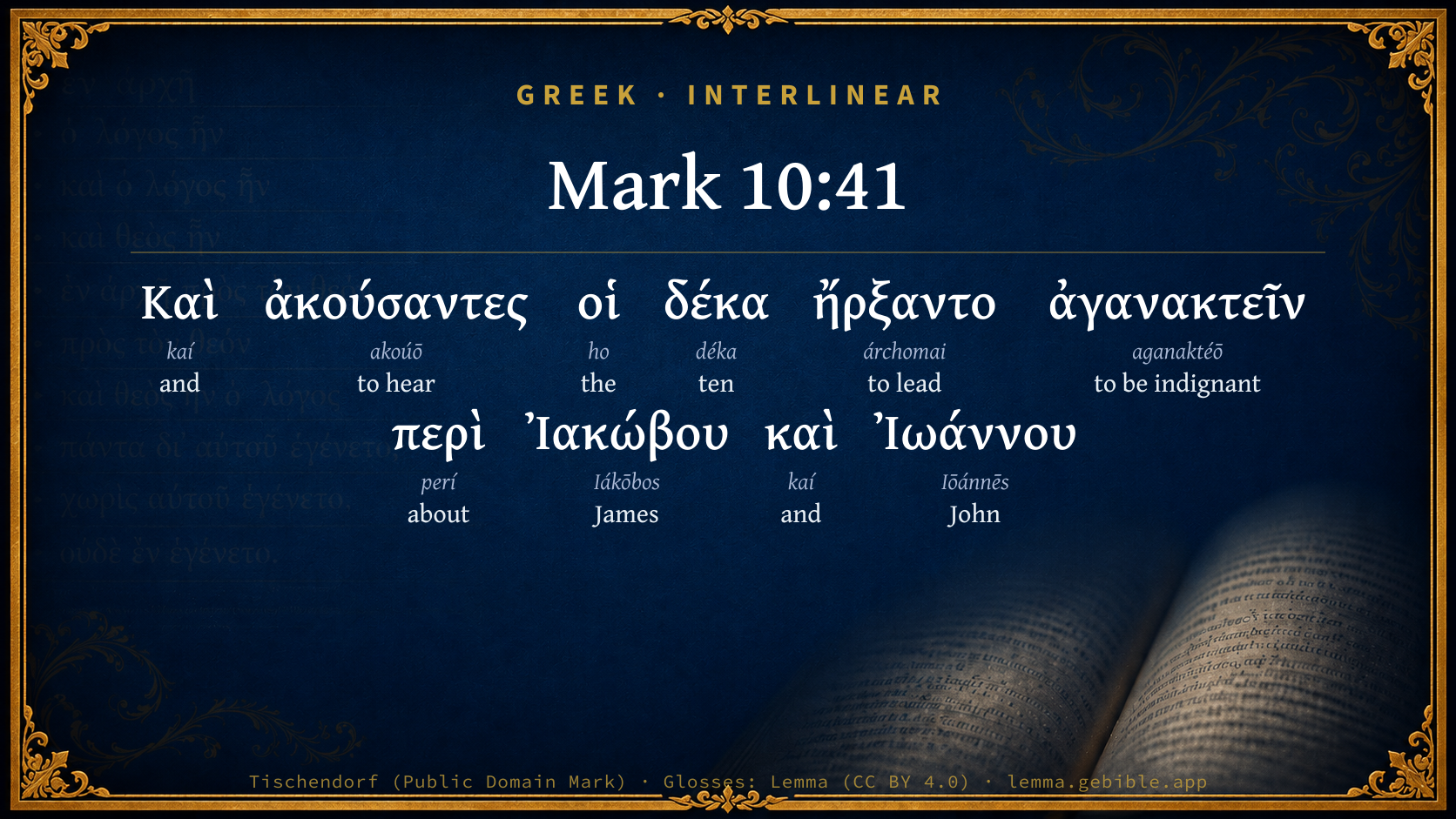
Greek (Tischendorf 8th ed.) Mark 10:41 appears in the Greek New Testament. The text above is from the Tischendorf 8th edition. Each word links to its Strong’s number and a concise gloss. Click any word for its full Thayer’s Greek Lexicon entry.
Download image
Cite this verse

Mark 10:41 (World English Bible). Public Domain. Lemma interlinear Bible study tool, https://lemma.gebible.app/v/mark/10/41.

Show BibTeX & RIS
BibTeX
RIS
English Translation
When the ten heard it, they began to be indignant towards James and John.
World English Bible · Public Domain
Download a study sheet

One document with this verse’s original text, its word-by-word gloss line, the meaning frame, cross-references with their text, attributed commentary, and full source and license credits — printable, and it pastes into notes with its structure intact.

This verse Autodidact and up

Study sheet (.html) Plain text (.txt)

A passage Seminary Student

Up to 50 verses in one chapter. A passage sheet keeps up to 6 commentary sources and 12 cross-references per verse, in the order this page ranks them, and says so on the sheet whenever that leaves anything out. Ask for a single verse and you get the Autodidact verse sheet above.

Everything on this page stays free to read, with no account — the sheet is a download of what is already on screen, not access to it.

Want to remove ads? Support Godless Engineer
Compare translations 3

The same verse in 3 English versions, stacked beneath the original-language interlinear above. Click any original word for its lexicon entry.

Each is an independent rendering of the whole verse — the interlinear is not word-aligned to these translations.

Highlighted words mark where these versions differ — a whole-verse word diff, not a word-by-word alignment.

  • World English Bible Public Domain
    When the ten heard it, they began to be indignant towards James and John.
  • King James Version Public Domain
    And when the ten heard it, they began to be much displeased with James and John.
  • unfoldingWord Literal Text CC BY-SA 4.0
    And having heard this, the ten began to be very angry with James and John.

unfoldingWord Literal Text — © unfoldingWord, licensed CC BY-SA 4.0. Word-aligned USFM3 via Door43 (git.door43.org/unfoldingWord/en_ult).

Versions to compare (up to 4)

3 of 4 selected

Show all 19 translations

Every available English version of this verse, each an independent rendering of the whole verse.

  • World English Bible Public Domain
    When the ten heard it, they began to be indignant towards James and John.
  • Berean Standard Bible Public Domain
    When the ten heard about this, they became indignant with James and John.
  • Majority Standard Bible Public Domain
    When the ten heard about this, they became indignant with James and John.
  • King James Version Public Domain
    And when the ten heard it, they began to be much displeased with James and John.
  • American Standard Version (1901) Public Domain
    And when the ten heard it, they began to be moved with indignation concerning James and John.
  • Revised Version (1885) Public Domain
    And when the ten heard it, they began to be moved with indignation concerning James and John.
  • Geneva Bible (1599) Public Domain
    And when the ten heard that, they began to disdaine at Iames and Iohn.
  • Douay-Rheims (1899) Public Domain
    And the ten hearing it, began to be much displeased at James and John.
  • Young's Literal Translation Public Domain
    And the ten having heard, began to be much displeased at James and John,
  • Literal Standard Version CC BY-SA 4.0
    And the ten having heard, began to be much displeased at James and John,
  • Unlocked Literal Bible CC BY-SA 4.0
    When the other ten disciples heard about this, they began to be very angry with James and John.
  • unfoldingWord Literal Text CC BY-SA 4.0
    And having heard this, the ten began to be very angry with James and John.
  • Darby Bible Public Domain
    And the ten having heard [of it], began to be indignant about James and John.
  • World Messianic Bible Public Domain
    When the ten heard it, they began to be indignant toward Jacob and Yochanan.
  • Webster's Bible Public Domain
    And when the ten heard it, they began to be much displeased with James and John.
  • Free Bible Version CC BY-SA 4.0
    When the other ten disciples heard about this, they started getting upset with James and John.
  • Bible in Basic English Public Domain
    And hearing this, the ten became very angry with James and John.
  • Text-Critical English NT CC BY 4.0
    When the ten heard this, they started becoming indignant with James and John.
  • Tyndale New Testament (1534) Public Domain
    And when the.x. hearde that they began to disdayne at Iames and Iohn.

Literal Standard Version (2020), Covenant Press — licensed CC BY-SA 4.0. Text via the HelloAO Bible API (eBible.org). Unlocked Literal Bible (unfoldingWord) — licensed CC BY-SA 4.0. Text via the HelloAO Bible API (eBible.org). unfoldingWord Literal Text — © unfoldingWord, licensed CC BY-SA 4.0. Word-aligned USFM3 via Door43 (git.door43.org/unfoldingWord/en_ult). Free Bible Version, Dr. Jonathan Gallagher — licensed CC BY-SA 4.0. Text via the HelloAO Bible API (eBible.org).

Word by word

More ways to search: Search by grammar → Find every occurrence → Compare this word →

Practice this passage: Drill this verse → Learn its vocabulary →

About this verse

These counts appear in no published source. They are computed here, from the morphology-tagged text and Lemma’s own curated glosses. What Lemma adds →

10
words
9
distinct lemmas
Gospels
section

Notable vocabulary

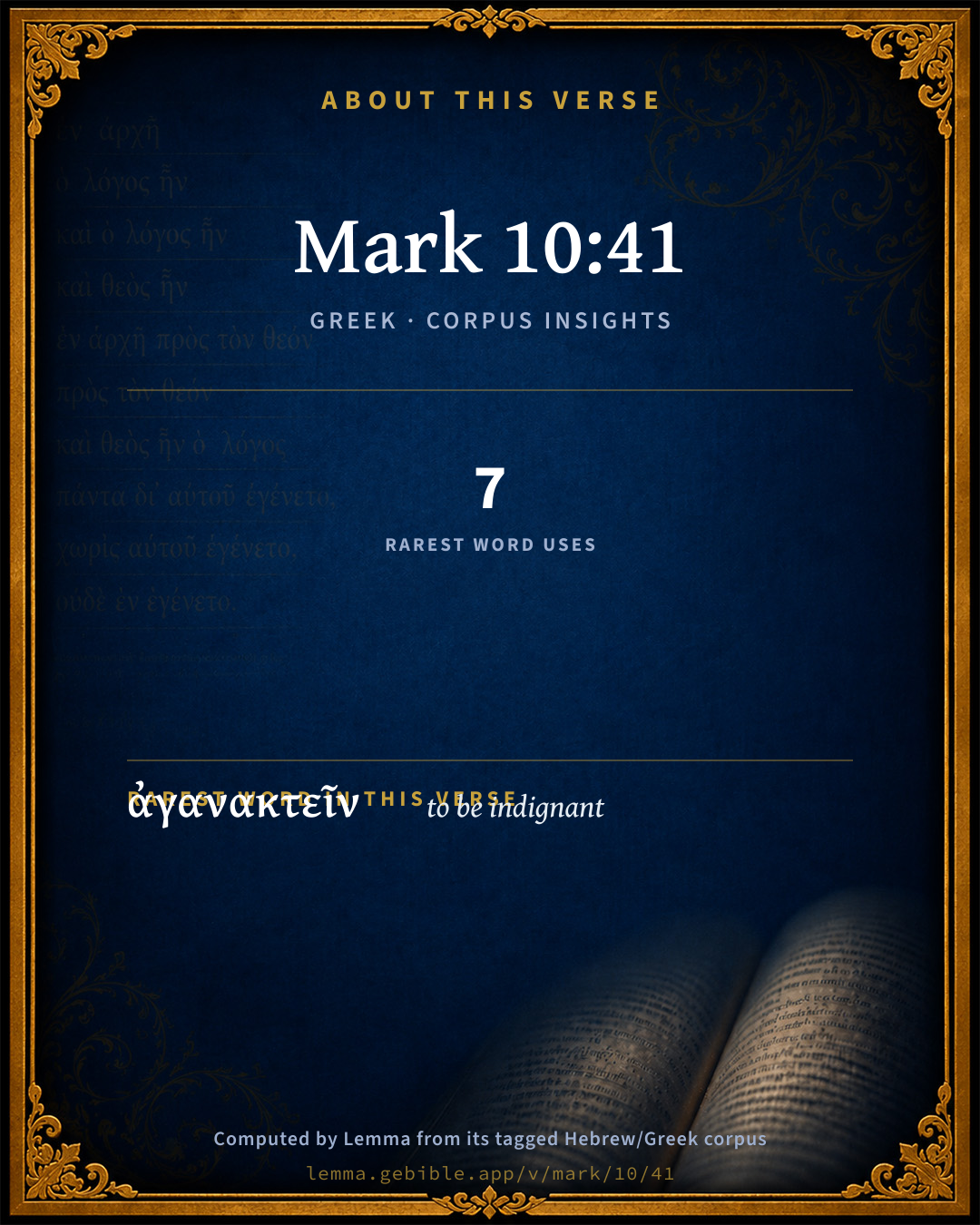
The rarest word here is ἀγανακτεῖν to be indignant G23 — appearing just 7 times in the whole Greek New Testament.

Shared distinctive vocabulary

ἀγανακτεῖν to be indignant G23 occurs in 7 verses of the Greek New Testament. Also found in:

Repetition

A word recurs within this verse:

Cross-references

7

Topical passages linked to Mark 10:41 in the Treasury of Scripture Knowledge — connected by theme and wording, ordered by reader-vote popularity; previews shown in the World English Bible.

  • Matthew 20:24 When the ten heard it, they were indignant with the two brothers.
  • Proverbs 13:10 Pride only breeds quarrels, But with ones who take advice is wisdom.
  • Romans 12:10 In love of the brothers be tenderly affectionate one to another; in honor preferring one another;
  • Philippians 2:3 doing nothing through rivalry or through conceit, but in humility, each counting others better than himself;
  • Mark 9:33–36 He came to Capernaum, and when he was in the house he asked them, "What were you arguing among yourselves on the way?"
  • Luke 22:24 There arose also a contention among them, which of them was considered to be greatest.
  • James 4:5 Or do you think that the Scripture says in vain, "The Spirit who lives in us yearns jealously"?

Cross-references courtesy of OpenBible.info (CC BY 4.0).

Commentary

Notes on Mark 10:41 from classic Christian and Jewish commentators (each source and its license shown beneath its notes). The classic Christian expositions comment on the surrounding passage and are grouped to its opening verse, so a note may address several verses; the Jewish commentaries on the Tanakh (Rashi and others) are per-verse, so they appear only where the commentator wrote on this verse.

Lemma curates 59 commentaries, every one of them public domain or Creative Commons licensed, each selected and text-cleaned for this edition rather than reprinted as found. About our sources →

Joseph Benson's Commentary

Mar 10:41-45. When the ten heard it — See on Mat 20:24-28. A ransom for many — Even for as many souls as needed such a ransom, 2Co 5:15.

Joseph Benson's Commentary on the Old and New Testaments (1811–1818) — public domain. Text from a community e-Sword module.

The Expositor's Bible

CHAPTER 10:41-45 (Mar_10:41-45)

THE LAW OF GREATNESS

"And when the ten heard it, they began to be moved with indignation concerning James and John. And Jesus called them to Him, and saith unto them, Ye know that they which are accounted to rule over the Gentiles lord it over them; and their great ones exercise authority over them. But it is not so among you: but whosoever would become great among you, shall be your minister: and whosoever would be first among you, shall be servant of all. For verily the Son of man came not to be ministered unto, but to minister, and to give His life a ransom for many." Mar_10:41-45 (R.V.)

WHEN the ten heard that James and John had asked for the chief places in the kingdom, they proved, by their indignation, that they also nourished the same ambitious desires which they condemned. But Jesus called them to Him, for it was not there that angry passions had broken out. And happy are they who hear and obey His summons to approach, when, removed from His purifying gaze by carelessness or willfulness, ambition and anger begin to excite their hearts.

Now Jesus addressed them as being aware of their hidden emulation. And His treatment of it is remarkable. He neither condemns, nor praises it, but simply teaches them what Christian greatness means, and the conditions on which it may be won.

The greatness of the world is measured by authority and lordliness. Even there it is an uncertain test; for the most real power is often wielded by some anonymous thinker, or by some crafty intriguer, content with the substance of authority while his puppet enjoys the trappings. Something of this may perhaps be detected in the words, "They which are accounted to rule over the Gentiles lord it over them." And it is certain that "their great ones exercise authority over them." But the Divine greatness is a meek and gentle influence. To minister to the Church is better than to command it, and whoever desires to be the chief must become the servant of all. Thus shall whatever is vainglorious and egoistic in our ambition defeat itself; the more one struggles to be great the more he is disqualified: even benefits rendered to others with this object will not really be service done for them but for self; nor will any calculated assumption of humility help one to become indeed the least, being but a subtle assertion that he is great, and like the last place in an ecclesiastical procession, when occupied in a self-conscious spirit. And thus it comes to pass that the Church knows very indistinctly who are its greatest sons. As the gift of two mites by the widow was greater than that of large sums by the rich, so a small service done in the spirit of perfect self-effacement, -- a service which thought neither of its merit nor of its reward, but only of a brother's need, shall be more in the day of reckoning than sacrifices which are celebrated by the historians and sung by the poets of the Church. For it may avail nothing to give all my goods to feed the poor, and my body to be burned; while a cup of cold water, rendered by a loyal hand, shall in no wise lose its reward.

Thus Jesus throws open to all men a competition which has no charms for flesh and blood. And as He spoke of the entry upon His service, bearing a cross, as being the following of Himself, so He teaches us, that the greatness of lowliness, to which we are called, is His own greatness. "For verily the Son of Man came not to be ministered unto but to minister." Not here, not in this tarnished and faded world, would He Who was from everlasting with the Father have sought His own ease or honor. But the physician came to them that were sick, and the good Shepherd followed His lost sheep until He found it. Now this comparison proves that we also are to carry forward the same restoring work, or else we might infer that, because He came to minister to us, we may accept ministration with a good heart. It is not so. We are the light and the salt of the earth, and must suffer with Him that we may also be glorified together.

But He added another memorable phrase. He came "to give His life a ransom in exchange for many." It is not a question, therefore, of the inspiring example of His life. Something has been forfeited which must be redeemed, and Christ has paid the price. Nor is this done only on behalf of many, but in exchange for them.

So then the crucifixion is not a sad incident in a great career; it is the mark towards which Jesus moved, the power by which He redeemed the world.

Surely, we recognize here the echo of the prophet's words, "Thou shalt make His soul an offering for sin . . . by His knowledge shall My righteous servant justify many, and He shall bear their iniquities" (Isa_53:10-11).

The elaborated doctrine of the atonement may not perhaps be here, much less the subtleties of theologians who have, to their own satisfaction, known the mind of the Almighty to perfection. But it is beyond reasonable controversy that in this verse Jesus declared that His sufferings were vicarious, and endured in the sinners' stead.

William Robertson Nicoll, ed., The Expositor's Bible (London: Hodder & Stoughton, 1887–1910) — public domain. 65 of 66 books (1 Corinthians is not separately keyed, as that volume carries no machine-parseable verse references); section-level commentary keyed to the opening verse. Introductory and overview sections not keyed to a specific passage are excluded.

Tyndale Open Study Notes

Tyndale Open Resources

10:41 the ten other disciples . . . were indignant: Perhaps they wanted the special places requested by James and John for themselves. All of Jesus’ disciples needed a new understanding of what leadership in God’s Kingdom means (10:42-45).

Tyndale Open Study Notes — © Tyndale Open Resources, licensed CC BY-SA 4.0. Text via the HelloAO Bible API.

Adam Clarke's Commentary

Verse 41. When the ten heard it] See Mt 20:24-28.

Adam Clarke's Commentary on the Bible (1810–1826) — public domain. Text from a community e-Sword/MySword module.

The Cambridge Bible for Schools and Colleges

gen. ed. J. J. S. Perowne

41. began to be much displeased] “hadden endignacioun,” Wyclif. The sons of Zebedee had been in a better social position than most of their brethren, and this attempt to secure a pre-eminence of honour kindled a storm of jealousy.

The Cambridge Bible for Schools and Colleges (gen. ed. J. J. S. Perowne; Cambridge University Press, 1878–1918) — public domain. Text from a community e-Sword module.

John Gill's Exposition

And whosoever of you will be the chiefest,.... Is desirous of the highest place and the greatest honour

shall be servant of all: for the ministers of the Gospel are not only the servants of Christ Jesus, but also of the churches for his sake; and in serving them, they serve Christ: not that they are to be the servants of men and to take their instructions from them and act according to rules prescribed by them; or seek to please men for then they would not be the servants of Christ: but they become servants to all that they may win souls to Christ, and increase his churches, and enlarge his interest; and such as are most useful this way are the chiefest in the Gospel church state; they are honoured by Christ and esteemed by his people; See Gill on Mat 20:27.

John Gill's Exposition of the Whole Bible (1746–1763) — public domain (CC PDM 1.0). Text via the HelloAO Bible API.

The Pulpit Commentary

And when the ten heard it, they began to be moved with indignation concerning James and John. How did they hear it? It is most likely that Salome and her two sons sought this favor secretly from Christ, lest they should excite the envy of the ethers. But they, the ten, must have noticed the approach of James and John with their mother to our Lord. They came in a formal manner, worshipping him first, and then making their request. (see Mat_20:20) The ten would naturally be desirous to know the nature of this interview; and when it was explained to them, they began to show indignation. Our Lord perceived that they were disputing; and he then called them and addressed the whole body. For he saw that they were all laboring under this disease of ambition; and he wished to apply the remedy at once to all, as we see in the words which follow.

The Pulpit Commentary (1880–1919), ed. H.D.M. Spence-Jones & Joseph S. Exell — public domain. Text from a community e-Sword module.

Kretzmann's Popular Commentary

Paul E. Kretzmann

Another lesson in humility:

v. 41. And when the ten heard it, they began to be much displeased with James and John.

v. 42. But Jesus called them to Him, and saith unto them, Ye know that they which are accounted to rule over the Gentiles exercise lordship over them; and their great ones exercise authority upon them.

v. 43. But so shall it not be among you; but whosoever will be great among you shall be your minister;

v. 44. and whosoever of you will be the chiefest shall be servant of all.

v. 45. For even the Son of Man came not to be ministered unto, but to minister, and to give His life a ransom for many.

The other ten apostles had witnessed the entire incident with jealous apprehension and growing indignation. Not that they did not have the. same aspirations, but that others had voiced them first and probably been near accomplishing their design. Jesus believed the time appropriate to repeat the lesson of a short time ago. He called the Twelve to Him, apart from the rest of the disciples that. were with them. He then placed a contrast before them. Those who pass for, and are esteemed as, rulers by the Gentiles lord it over them, and the great ones of the world exercise dominion, use their power as they see fit, chiefly to enlarge their power. That is the case in earthly matters. But within the kingdom of Christ things are, or at least ought to be, far different. There greatness is measured, not by the amount of authority exercised, but by the amount of service rendered. The greater the service that is rendered, in unselfish humility, the higher will be the standing of a person in God’s kingdom. The more thorough the self-abasement in the interest of one’s neighbor and for love of Christ, the greater it will be accounted on God’s credit slip. And in this the apostles and all Christians have the most glorious example before their eyes always: He, the great Lord of heaven, who came to earth as the Son of Man, who might have demanded and enforced the service of all creation, did not demand and accept this service, but Himself became the lowest servant of all. That was one object of His coming. And the other is closely connected with this. He freely gave His life as a ransom, as the price of redemption. His life, His blood, was given to pay the guilt of the whole world, and though there is a large number that reject His redemption, there are also, by His grace, many that believe on Him and are saved by such faith. "Mark especially the verse where Christ says: The Son of Man is come to give His life as a ransom for many. For this verse teaches.... of the forgiveness of sins, and how we may obtain it. With our works and merit we are lost; for we owe God such a great sum that it is impossible for us to pay it. How may we then become rid of the guilt? In no other way but that our dear Lord Jesus Christ accepts our guilt and takes our sins from us and lays them on His back and suffers death, which we had earned by our sins, in order that we might be free and liberated from death."

Paul E. Kretzmann, Popular Commentary of the Bible (1921–1924) — public domain. Text from a community e-Sword module.

unfoldingWord translationNotes

Door43 World Missions Community

heard about this

The word "this" refers to James and John asking to sit at Jesus' right and left hands.

Jesus called them

"Jesus called his disciples"

those who are considered rulers of the Gentiles

This can be stated in active form. Possible meanings are 1) people in general consider these people the rulers of the Gentiles. AT: "those whom people consider to be the rulers of the Gentiles" or 2) the Gentiles consider these people their rulers. AT: "those whom the Gentiles think of as their rulers" (See: Active or Passive)

dominate

have control or power over

exercise authority

"flaunt their authority." This means that they show or use their authority in an overbearing way.

translationWords

disciple

James (son of Zebedee)

John (the apostle)

rule

Gentile

authority

unfoldingWord translationNotes — © Distant Shores Media and the Door43 World Missions Community, licensed CC BY-SA 4.0. Source: git.door43.org/Door43/en_tn.

Bengel's Gnomon

Johann Albrecht Bengel

[41. Οἱ δέκα, the ten) When one of two persons seeks some special privilege, the other takes it ill, who would have been contented of himself.—V. g.]

Bengel's Gnomon of the New Testament — English translation (T&T Clark, Edinburgh, 1860) — public domain. Text from a community e-Sword module.

Cambridge Greek Testament for Schools and Colleges

41. ἀγανακτεῖν. Cf. Mar 10:14. Christ had already rebuked the spirit of ambition and jealousy in the Twelve (Mar 9:35), but it was not extinguished; and the other ten are indignant with the two brothers for trying to get special promotion for themselves. We do not, however, read of the nine being indignant when Christ gave special honour to Peter, James, and John. It was the brothers’ asking for special favour which gave offence.

Cambridge Greek Testament for Schools and Colleges (Cambridge University Press, 1896; 21 vols, various authors incl. Carr, Maclear, Plummer, Farrar, Lumby, Moule, M. R. James, Simcox) — public domain. Text from a community e-Sword module.

International Critical Commentary

41. οἱ δέκα ἤρξαντο ἀγανακτεῖν2—the ten began to be indignant. There was reason for this strong feeling on the part of the other disciples. The condition seems to have been, that Peter, James, and John were singled out by Jesus himself for such eminence among the twelve, as the twelve had among the other disciples. If there was any jealousy caused by this, it would be allayed by the fact that the Master selected those manifestly fit, and that it was unaccompanied by any outward advantage. But, now, there was an attempt to secure places in the coming kingdom and its glory, and Peter, the real leader of the twelve, was left out of the scheme. It was the introduction of political methods, such as invariably go with the materializing of ideas, the use of principles to secure power, and of power to advance principles in the world.

International Critical Commentary — older volumes (1896–1929), various authors — public domain. Text from a community e-Sword module.

Lesson kit

Teaching starters — assembled from the data on this page, not authored interpretation. Every prompt links to the verse data it draws on. Edit before teaching.

Mark, in the Gospels, opens this verse with 10 words (9 distinct Greek lemmas). Its most distinctive word is aganaktéō (“to be indignant”). A historical commentator’s framing appears above. Read the whole chapter for the surrounding context.

Discussion questions

  1. The word aganaktéō carries the sense “to be indignant.” How does it shape the verse?
  2. How does Matthew 20:24, which shares the word «to be indignant», read alongside this verse?
  3. What does the repetition of “and” (2× in this one verse) do in this verse?
  4. The translations on this page render this verse differently — a whole-verse word diff, not a word-by-word alignment. What might account for the different wordings?
  5. Compare how Joseph Benson's Commentary and The Expositor's Bible read this verse. Where do they agree or differ?

Things to notice

  • These translations choose different wording for 8 words in this verse.
  • “and” occurs 2× in this single verse.
  • 9 distinct Greek lemmas span 10 words in this verse.

Reading settings

Reading text

Shown beneath each verse's original-language words.

Old Testament
Old Testament edition

Read the OT as the Masoretic Hebrew (MT) or the Greek Septuagint (LXX).

English shown for the Greek Septuagint (in the Hebrew ↔ Greek comparison).

Comparing translations? Open the Compare panel on any verse page to stack up to four side by side.