Acts 12:25

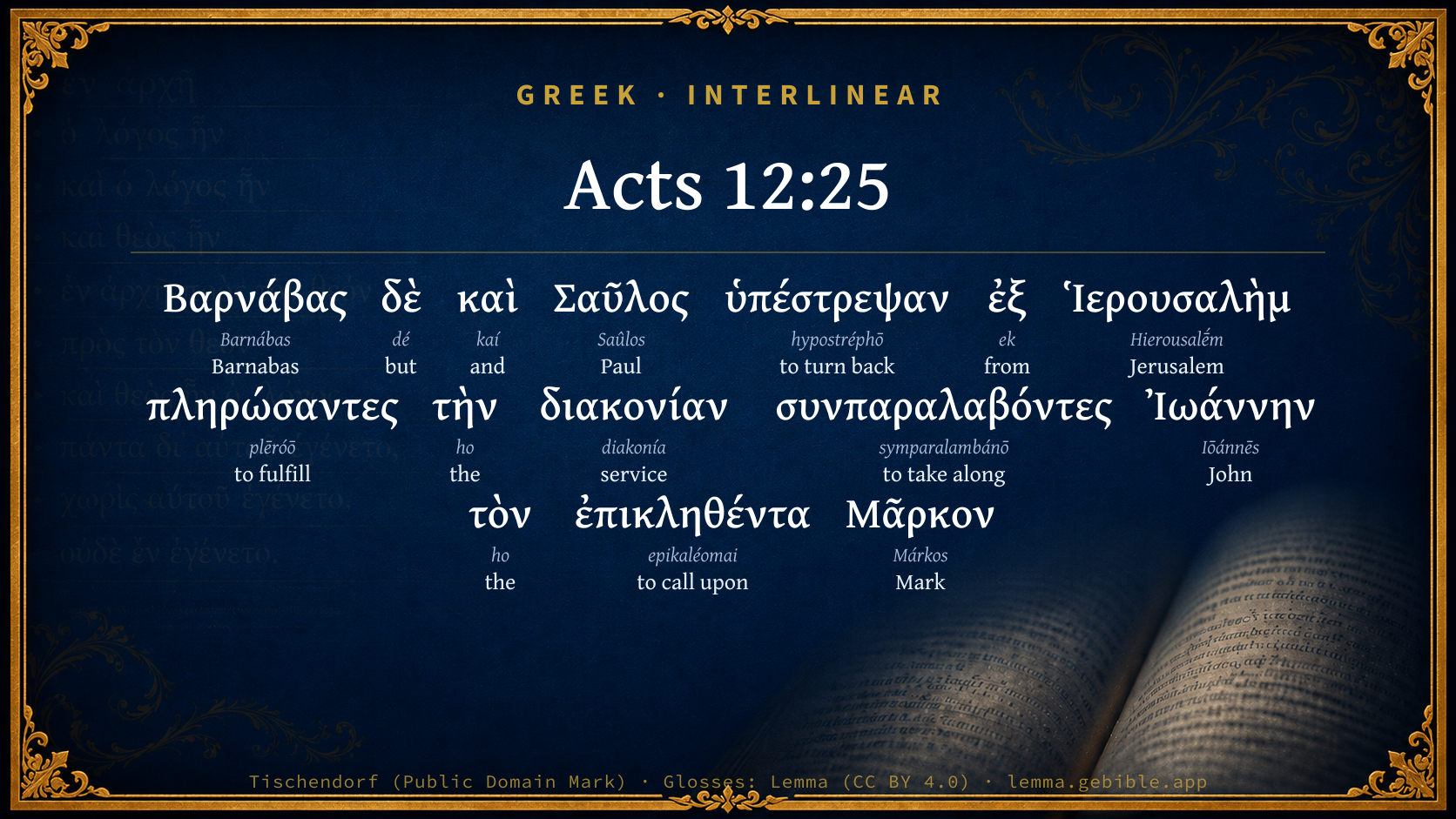
Greek (Tischendorf 8th ed.) Acts 12:25 appears in the Greek New Testament. The text above is from the Tischendorf 8th edition. Each word links to its Strong’s number and a concise gloss. Click any word for its full Thayer’s Greek Lexicon entry.
Download image
Cite this verse

Acts 12:25 (World English Bible). Public Domain. Lemma interlinear Bible study tool, https://lemma.gebible.app/v/acts/12/25.

Show BibTeX & RIS
BibTeX
RIS
English Translation
Barnabas and Saul returned to Jerusalem, when they had fulfilled their service, also taking with them John whose surname was Mark.
World English Bible · Public Domain
Highlights
  • 1 first appearance in the Greek New Testament
Full analysis ↓
Download a study sheet

One document with this verse’s original text, its word-by-word gloss line, the meaning frame, cross-references with their text, attributed commentary, and full source and license credits — printable, and it pastes into notes with its structure intact.

This verse Autodidact and up

Study sheet (.html) Plain text (.txt)

A passage Seminary Student

Up to 50 verses in one chapter. A passage sheet keeps up to 6 commentary sources and 12 cross-references per verse, in the order this page ranks them, and says so on the sheet whenever that leaves anything out. Ask for a single verse and you get the Autodidact verse sheet above.

Everything on this page stays free to read, with no account — the sheet is a download of what is already on screen, not access to it.

Want to remove ads? Support Godless Engineer
Compare translations 3

The same verse in 3 English versions, stacked beneath the original-language interlinear above. Click any original word for its lexicon entry.

Each is an independent rendering of the whole verse — the interlinear is not word-aligned to these translations.

Highlighted words mark where these versions differ — a whole-verse word diff, not a word-by-word alignment.

  • World English Bible Public Domain
    Barnabas and Saul returned to Jerusalem, when they had fulfilled their service, also taking with them John whose surname was Mark.
  • King James Version Public Domain
    And Barnabas and Saul returned from Jerusalem, when they had fulfilled their ministry, and took with them John, whose surname was Mark.
  • unfoldingWord Literal Text CC BY-SA 4.0
    Then Barnabas and Saul returned to Jerusalem, having completed their service, bringing with them John, called Mark.

unfoldingWord Literal Text — © unfoldingWord, licensed CC BY-SA 4.0. Word-aligned USFM3 via Door43 (git.door43.org/unfoldingWord/en_ult).

Versions to compare (up to 4)

3 of 4 selected

Show all 19 translations

Every available English version of this verse, each an independent rendering of the whole verse.

  • World English Bible Public Domain
    Barnabas and Saul returned to Jerusalem, when they had fulfilled their service, also taking with them John whose surname was Mark.
  • Berean Standard Bible Public Domain
    When Barnabas and Saul had fulfilled their mission to Jerusalem, they returned, bringing with them John, also called Mark.
  • Majority Standard Bible Public Domain
    When Barnabas and Saul had fulfilled their mission to Jerusalem, they returned, bringing with them John, also called Mark.
  • King James Version Public Domain
    And Barnabas and Saul returned from Jerusalem, when they had fulfilled their ministry, and took with them John, whose surname was Mark.
  • American Standard Version (1901) Public Domain
    And Barnabas and Saul returned from Jerusalem, when they had fulfilled their ministration, taking with them John whose surname was Mark.
  • Revised Version (1885) Public Domain
    And Barnabas and Saul returned from Jerusalem, when they had fulfilled their ministration, taking with them John whose surname was Mark.
  • Geneva Bible (1599) Public Domain
    So Barnabas and Saul returned from Hierusalem, when they had fulfilled their office, and tooke with them Iohn, whose surname was Marke.
  • Douay-Rheims (1899) Public Domain
    And Barnabas and Saul returned from Jerusalem, having fulfilled their ministry, taking with them John, who was surnamed Mark.
  • Young's Literal Translation Public Domain
    and Barnabas and Saul did turn back out of Jerusalem, having fulfilled the ministration, having taken also with `them' John, who was surnamed Mark.
  • Literal Standard Version CC BY-SA 4.0
    and Barnabas and Saul turned back out of Jerusalem, having fulfilled the ministry, having also taken John with [them], who was surnamed Mark.
  • Unlocked Literal Bible CC BY-SA 4.0
    So when Barnabas and Saul had completed their mission, they returned from Jerusalem, bringing with them John, also called Mark.
  • unfoldingWord Literal Text CC BY-SA 4.0
    Then Barnabas and Saul returned to Jerusalem, having completed their service, bringing with them John, called Mark.
  • Darby Bible Public Domain
    And Barnabas and Saul returned from Jerusalem, having fulfilled the service [entrusted to them], taking also with them John, surnamed Mark.
  • World Messianic Bible Public Domain
    Barnabas and Saul returned to Jerusalem when they had fulfilled their service, also taking with them Yochanan who was called Mark.
  • Webster's Bible Public Domain
    And Barnabas and Saul returned from Jerusalem, when they had fulfilled their ministry, and took with them John, whose surname was Mark.
  • Free Bible Version CC BY-SA 4.0
    Barnabas and Saul returned from Jerusalem once they had finished their mission, taking John Mark with them.
  • Bible in Basic English Public Domain
    And Barnabas and Saul came back from Jerusalem, when their work was ended, taking with them John named Mark.
  • Text-Critical English NT CC BY 4.0
    And when Barnabas and Saul completed their ministry, they returned to Jerusalem and brought with them John, who was called Mark.
  • Tyndale New Testament (1534) Public Domain
    And Barnabas and Paul returned to Ierusalem when they had fulfilled their office and toke with them Iohn which was also called Marcus.

Literal Standard Version (2020), Covenant Press — licensed CC BY-SA 4.0. Text via the HelloAO Bible API (eBible.org). Unlocked Literal Bible (unfoldingWord) — licensed CC BY-SA 4.0. Text via the HelloAO Bible API (eBible.org). unfoldingWord Literal Text — © unfoldingWord, licensed CC BY-SA 4.0. Word-aligned USFM3 via Door43 (git.door43.org/unfoldingWord/en_ult). Free Bible Version, Dr. Jonathan Gallagher — licensed CC BY-SA 4.0. Text via the HelloAO Bible API (eBible.org).

Word by word

More ways to search: Search by grammar → Find every occurrence → Compare this word →

Practice this passage: Drill this verse → Learn its vocabulary →

συνπαραλαβόντες
symparalambánō
G4838
“to take along”
Verb, Aorist, Active, Participle, Nominative, Plural, Masculine
Part of Speech
Verb
Tense
Aorist
Voice
Active
Mood
Participle
Case
Nominative
Number
Plural
Gender
Masculine
Full Thayer's Definition

Origin: from G4862 and G3880

TDNT: None

1. to take along together with 2. in the NT to take with one as a companion
  1. Βαρνάβας Barnábas G921 “Barnabas” Noun, Nominative, Singular, Masculine
  2. δὲ dé G1161 “but” Conjunction
  3. καὶ kaí G2532 “and” Conjunction
  4. Σαῦλος Saûlos G4569 “Paul” Noun, Nominative, Singular, Masculine
  5. ὑπέστρεψαν hypostréphō G5290 “to turn back” Verb, Aorist, Active, Indicative, 3rd person, Plural
  6. ἐξ ek G1537 “from” Preposition
  7. Ἱερουσαλὴμ Hierousalḗm G2419 “Jerusalem” Noun, Proper, indeclinable
  8. πληρώσαντες plēróō G4137 “to fulfill” Verb, Aorist, Active, Participle, Nominative, Plural, Masculine
  9. τὴν ho G3588 “the” Article, Accusative, Singular, Feminine
  10. διακονίαν diakonía G1248 “service” Noun, Accusative, Singular, Feminine
  11. Ἰωάννην Iōánnēs G2491 “John” Noun, Accusative, Singular, Masculine
  12. τὸν ho G3588 “the” Article, Accusative, Singular, Masculine
  13. ἐπικληθέντα epikaléomai G1941 “to call upon” Verb, Aorist, Passive, Participle, Accusative, Singular, Masculine
  14. Μᾶρκον Márkos G3138 “Mark” Noun, Accusative, Singular, Masculine

About this verse

These counts appear in no published source. They are computed here, from the morphology-tagged text and Lemma’s own curated glosses. What Lemma adds →

15
words
14
distinct lemmas
Acts
section

Notable vocabulary

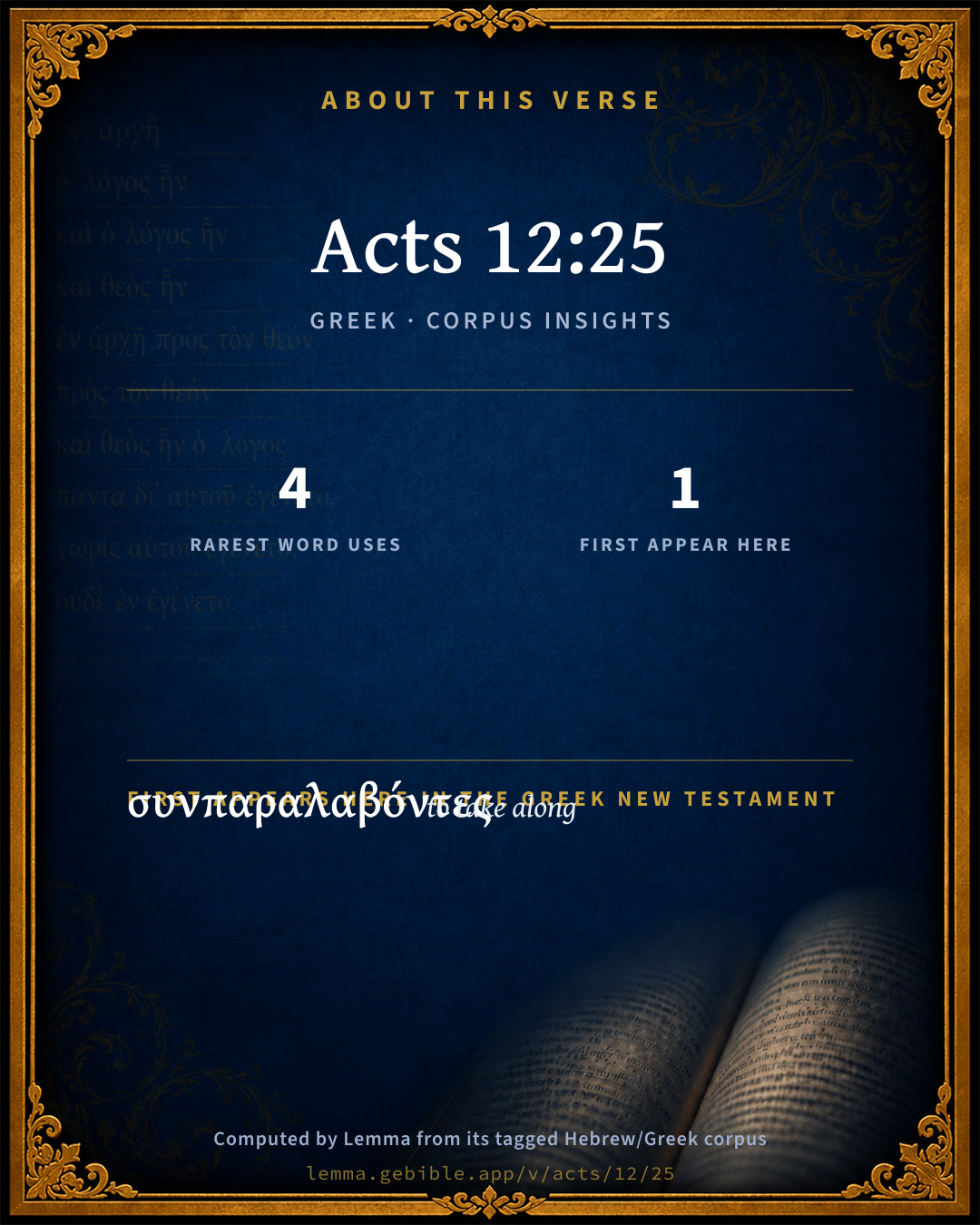
The rarest word here is συνπαραλαβόντες to take along G4838 — appearing just 4 times in the whole Greek New Testament.

First appearance in Scripture

This word makes its first canonical appearance in the Greek New Testament here:

  • συνπαραλαβόντες to take along G4838

Shared distinctive vocabulary

συνπαραλαβόντες to take along G4838 occurs in 4 verses of the Greek New Testament. Also found in:

Repetition

A word recurs within this verse:

Cross-references

6

Topical passages linked to Acts 12:25 in the Treasury of Scripture Knowledge — connected by theme and wording, ordered by reader-vote popularity; previews shown in the World English Bible.

  • Acts 12:12 Thinking about that, he came to the house of Mary, the mother of John whose surname was Mark, where many were gathered together and were praying.
  • Acts 15:37 Barnabas planned to take John, who was called Mark, with them also.
  • 1 Peter 5:13 She who is in Babylon, chosen together with you, greets you; and so does Mark, my son.
  • Acts 4:36 Joses, who by the apostles was surnamed Barnabas (which is, being interpreted, Son of Encouragement), a Levite, a man of Cyprus by race,
  • Acts 11:29–30 As any of the disciples had plenty, each determined to send relief to the brothers who lived in Judea;
  • Acts 13:1–52 Now in the assembly that was at Antioch there were some prophets and teachers: Barnabas, Simeon who was called Niger, Lucius of Cyrene, Manaen the foster-brother of Herod the tetrarch, and Saul.

Cross-references courtesy of OpenBible.info (CC BY 4.0).

Where the printed editions differ

1 variant

Places in this verse where the major printed Greek editions disagree on the wording in a way that affects the translation — a comparison of editions, not a manuscript-by-manuscript collation. The editions are the modern critical texts (Nestlé-Aland 28/27, SBL, Westcott-Hort, Tregelles, Tyndale House) and the traditional texts behind the KJV (the Textus Receptus and the Byzantine/Majority text). It is not a claim about which reading is original.

  1. Different wording
    εἰς

    “to”

    In NA28NA27TynSBLWHByz Not in TregTR

    ἐξ (ex) 'from' occurs in traditional manuscripts (Treg+TR) instead of εἰς (eis) 'to' in older manuscripts (NA28+NA27+Tyn+SBL+WH+Byz)

Textual data: Translators Amalgamated Greek New Testament (STEPBible TAGNT) · CC BY 4.0.

Commentary

Notes on Acts 12:25 from classic Christian and Jewish commentators (each source and its license shown beneath its notes). The classic Christian expositions comment on the surrounding passage and are grouped to its opening verse, so a note may address several verses; the Jewish commentaries on the Tanakh (Rashi and others) are per-verse, so they appear only where the commentator wrote on this verse.

Lemma curates 59 commentaries, every one of them public domain or Creative Commons licensed, each selected and text-cleaned for this edition rather than reprinted as found. About our sources →

Bengel's Gnomon

Johann Albrecht Bengel

Act 12:25. Ὑπέστρεψαν, returned) to Antioch: ch. Act 11:30, having been sent thence with relief unto the brethren in Judea.—συμπαραλάβοντες, having taken with them) Jerusalem was a nursery (seed-bed) of workmen.—Ἰωάννην, John) Act 12:12. He too had both a foreign and a Hebrew name. Comp. ch. Act 13:1; Act 13:8-9. This variety of names accords with the beginning of the union of Jews and Gentiles.

Bengel's Gnomon of the New Testament — English translation (T&T Clark, Edinburgh, 1860) — public domain. Text from a community e-Sword module.

Meyer's Critical & Exegetical Commentary

Heinrich August Wilhelm Meyer

Act_12:25. Ὑπέστρεψαν] they returned, namely, to Antioch, Act_11:27-30, Act_13:1. The statement in Act_12:25 takes up again the thread of the narrative, which had been dropped for a time by the episode (Act_12:1-24), and leads over to the continuation of the historical course of events in chap, 13. The taking of ὑπέστρεψαν in the sense of the pluperfect (jam ante Herodis obitum, etc., Heinrichs, Kuinoel), rests on the erroneous assumption that the collection-journey of this passage coincides with Galatians 2. The course of events, according to the Book of Acts, is as follows:

While (κατ ̓ ἐκεῖνον τὸν καιρόν, Act_12:1) Barnabas and Saul are sent with the collection to Judaea (Act_11:30), there occurs in Jerusalem the execution of James and the imprisonment and deliverance of Peter (Act_12:2-18), and then (Act_12:19), at Caesarea, the death of Herod (Act_12:20-23). But Barnabas and Saul return from Jerusalem to Antioch (Act_12:25). From this it follows that, according to the Acts, they visited first the other churches of Judaea and came to Jerusalem last; so that the episode, Act_12:1-23, is to be assigned to that time which Barnabas and Saul on their journey in Judaea spent with the different churches, before they came to Jerusalem, from which, as from the termination of their journey, they returned to Antioch. Perhaps what Barnabas had heard on his journey among the country-churches of Judaea as to the persecution of the Christians by Agrippa, and as to what befell James and Peter, induced him (in regard to Paul, see on Act_11:30) not to resort to the capital, until he had heard of the departure and perhaps also of the death of the king.

συμπαραλαβ. κ.τ.λ.] from Jerusalem; see Act_12:12.

Meyer — Critical and Exegetical Commentary on the New Testament — English translation by Peter Christie, edited by Frederick Crombie (T&T Clark, 1880) — public domain. Text from a community e-Sword module.

Expositor's Greek Testament

ed. W. Robertson Nicoll

Act 12:25 . ὑπέστρεψαν ἐξ Ἱ ., see critical notes, and Ramsay, St. Paul , pp. 63, 64, and note on Act 22:17 , below. πληρ . τὴν διακ .; if the visit extended over as long a period as Ramsay believes, viz. , from the time when the failure of harvest in 46 turned scarcity into famine until the beginning of 47 ( u. s. , pp. 51, 63), no doubt the delegates could not have simply delivered a sum of money to the elders, but would have administered the relief (not money), and carried a personal message of cheer to the distressed (Ramsay, p. 49 ff., u. s. ), and so have “fulfilled” their ministry. But the word διακονία does not of necessity involve this personal and continuous ministration, e.g., cf. Rom 15:31 , where St. Paul uses the word of the money collection brought by him to Jerusalem for the poor, a passage in which the Western gloss is δωροφορία , cf. Rom 15:25 , 2Co 8:4 ; 2Co 9:1 ; 2Co 9:12-13 . Grimm writes that the word is used of those who succour need by either collecting or bestowing benefactions; see further, Expositor , March and July, 1896 (Ramsay), April, 1896 (Sanday), also Hort, Ecclesia , p. 206, and above on Act 11:29 . Σαῦλος , see critical notes for Western addition. συμπαραλαβόντες , cf. Act 15:37-38 , of bringing as a companion in N.T., only once elsewhere in same sense, Gal 2:1 . ( cf. 3MMal 1:1 ). This incidental notice of John Mark may well emphasise the fact that he was taken with Paul and Barnabas as a supernumerary, and to mark his secondary character as compared with them. In view of subsequent events, it would be important to make this clear by introducing him in a way which showed that he was not essential to the expedition, Ramsay, St. Paul , pp. 71, 170, 177; cf. Act 15:37 ; Act 15:40 .

The Expositor's Greek Testament, edited by W. Robertson Nicoll (1897–1910) — public domain. Text from a community e-Sword module.

Jamieson, Fausset & Brown

Robert Jamieson, A. R. Fausset & David Brown

Barnabas and Saul returned from Jerusalem--where, it thus appears, they had remained during all this persecution.

when they had fulfilled their ministry--or service; that mentioned on Act 11:29-30.

took with them John . . . Mark--(See on Act 12:12), not to be confounded with the second Evangelist, as is often done. As his uncle was Barnabas, so his spiritual father was Peter (Pe1 5:13).

PAUL'S FIRST MISSIONARY JOURNEY:

In Company with Barnabas.

Next: Acts Chapter 13

Jamieson, Fausset & Brown — Commentary Critical and Explanatory on the Whole Bible (1871) — public domain (CC PDM 1.0). Text via the HelloAO Bible API.

Adam Clarke's Commentary

Verse 25. Returned from Jerusalem] That is, to Antioch, after the death of Herod.

When they had fulfilled their ministry] When they had carried the alms of the Christians at Antioch to the poor saints at Jerusalem, according to what is mentioned, Ac 11:29-30, to support them in the time of the coming famine.

And took with them John, whose surname was Mark.] This was the son of Mary, mentioned Ac 12:12. He accompanied the apostles to Cyprus, and afterwards in several of their voyages, till they came to Perga in Pamphylia. Finding them about to take a more extensive voyage, he departed from them. See the case, Ac 13:13; Ac 15:37-40.

1. WHEN the nature, spirit, and tendency of Christianity are considered, we may well be astonished that it should ever find a persecutor among the souls it was designed to instruct and save! Devils can have no part in it, and therefore we may naturally expect them, through envy and malice, to oppose it; but that men, for whose use and salvation the wisdom and mercy of God made it, should reject its offers of mercy, and persecute to death those who proclaimed it, is the most unaccountable thing that can be conceived. What a proof is this of mere maliciousness, where the persecutor not only serves no self-interest by it, but destroys, as far as he can, all that could promote his own present and eternal happiness! This argues such blindness of understanding, hardness of heart, and derangement of mind, as can be accounted for only on the supposition of a nature totally fallen from God, righteousness, and truth. The Jews crucify Christ, and martyr Stephen; and Herod murders James; and both join together to persecute the followers of Christ and destroy his cause. Reader, consider the consequences: this bad people were permitted to remain till they had filled up the measure of their iniquity, and were then cut of by a most terrible judgment; and Herod was visited for his transgressions in such a most awful way as strongly marked the displeasure of God against persecutors. If a man contend with a man, the contest is in a certain way equal-the potsherds strive with the potsherds of the earth; but when a man enters the lists against his Maker, as every persecutor does, wo unto that man!-he must be torn in pieces, when there is none to deliver.

2. How true is the saying, there is neither counsel nor might against the Lord! In the midst of all troubles and afflictions, that kingdom of heaven which is like a grain of mustard seed grew and increased, and became a mighty tree which is now filling the whole earth, and fowl of every wing are flying to lodge in its branches. Ride on, and be thou prosperous, O Christ! We wish thee good luck with thine honour.

Adam Clarke's Commentary on the Bible (1810–1826) — public domain. Text from a community e-Sword/MySword module.

John Calvin's Commentaries

25 And Barnabas and Paul. The ministry which Luke saith Barnabas and Paul did finish, must be referred unto the alms, whereof mention was made before. For after that Agabus the prophet had foretold the famine and barrenness, the brethren gathered money at Antioch, whereby they might relieve the necessity of the church which was at Jerusalem; the carrying of this money was committed to Barnabas and Paul. Now Luke saith that they returned to Antioch, that he may pass over unto a new history. He addeth, that they took with them John, whose surname was Mark, whose mother was honorably commended before, that he might keep them company, who was afterward, as we shall see, a cause of grievous and dangerous [hurtful] discord between them.

John Calvin's Commentaries (1540-1563) — public domain. Text from the Calvin Translation Society English edition (1840s-50s) via the Christian Classics Ethereal Library (ccel.org). Calvin's coverage is partial (roughly two-thirds of the Bible); uncommented books and verses are honest gaps, never fabricated. The 19th-century editor's footnotes and remarks are omitted so the notes are faithfully Calvin's own voice.

Ellicott's Commentary for English Readers

(25) When they had fulfilled their ministry.—The same noun is used as that translated “relief” in Act_11:29. We may, perhaps, assign the vision related in Act_22:17-21, to this visit; but see Note there.

Took with them John, whose surname was Mark.—The choice is, of course, partly explained by his relationship to Barnabas, but it shows also that he entered heartily into the work of the conversion of the Gentiles; and owing, as he did, his own conversion to Peter, it would naturally be regarded as a proof of that Apostle’s interest in it.

A Bible Commentary for English Readers, edited by Charles John Ellicott (1878–1897) — public domain. Text from a community e-Sword module.

The Cambridge Bible for Schools and Colleges

gen. ed. J. J. S. Perowne

25. And Barnabas and Saul returned from Jerusalem] i.e. to their labours among the Gentile converts in Antioch.

when they had fulfilled their ministry [ministration] viz., the giving into the care of the Church the contributions of the disciples in Antioch for the support of their brethren in Judæa during the famine which Agabus had foretold (Act_11:28).

John, whose surname was Mark] See above on Act_12:12.

The Cambridge Bible for Schools and Colleges (gen. ed. J. J. S. Perowne; Cambridge University Press, 1878–1918) — public domain. Text from a community e-Sword module.

Albert Barnes' Notes on the Bible

Returned from Jerusalem - They had gone to Jerusalem to carry alms, and they now returned to Antioch, Act 11:30.

When they had fulfilled their ministry - When they had accomplished the purpose for which they had been sent there; that is, to deposit the alms of the church at Antioch in the hands of the eiders of the churches, Act 11:30.

John, whose surname was Mark - See the notes on Act 12:12. From this period the sacred historian records chiefly the labors of Paul. The labors of the other apostles are, after this, seldom referred to in this book, and the attention is fixed almost entirely on the trials and travels of the great apostle of the Gentiles. His important services, his unwearied efforts, his eminent success, and the fact that Luke was his companion, may be the reasons why his labors are made so prominent in the history. Through the previous chapters we have seen the church rise from small beginnings, until it was even now spreading into surrounding regions. We have seen it survive two persecutions, commenced and conducted with all the power and malice of Jewish rulers. We have seen the most zealous of the persecutors converted to the faith which he once destroyed, and the royal persecutor put to death by the divine judgment. And we have thus seen that God was the protector of the church; that no weapon formed against it could prosper; that, according to the promise of the Redeemer, the gates of hell could not prevail against it. In that God and Saviour who then defended the church, we may still confide, and may be assured that he who was then its friend has it still “engraved on the palms of his hands,” and designs that it shall extend until it fills the earth with light and salvation.

Albert Barnes' Notes on the Bible (1834–1885) — public domain. Text from a community e-Sword/MySword module.

Haydock's Catholic Bible Commentary

Returned from Jerusalem, to Antioch, the capital of Syria. (Witham) --- This John Mark, the companion of Sts. Paul and Barnabas, was not the evangelist who bore that name; but a cousin of Barnabas, son of Mary, in whose house the apostles generally assembled at Jerusalem. (Calmet)

George Leo Haydock (1774–1849), Haydock's Catholic Family Bible and Commentary, 1859 edition — public domain. Excludes Psalms (Douay-Rheims chapter numbering differs from Protestant) and Deuterocanonical books (Catholic canon only).

Matthew Poole's English Annotations

From Jerusalem; they returned unto Antioch, from whence they were sent, Act 11:26,30, to carry the benevolence of the church of Antioch to that of Judea.

Their ministry; this was the ministry or service they were appointed to do.

John; of whom before, Act 12:12.

Matthew Poole's English Annotations on the Holy Bible (1683–1685) — public domain. Text from a community e-Sword/MySword module.

Whedon's Commentary on the Bible

Daniel D. Whedon

25. Returned—See notes on Act_11:27-30.

Took… John… Mark— See note on Act_12:12; Act_13:4; Act_13:13; Act_15:37.

The death of Herod Agrippa is one of those events by which we gauge the chronology of the Acts. Josephus tells us that he received the entire dominions of his grandfather, the first Herod, on the accession of Claudius, namely, A.D. 41, and that he had completed his third year from this event at the time of his death. He died, therefore, A.D. 44. From this we know the time of James’ martyrdom, of Peter’s arrest and departure from Jerusalem, and of Paul’s beneficent visit thither.

Daniel D. Whedon (gen. ed.), Commentary on the Old and New Testaments (1874–1909) — public domain. Text from a community e-Sword module.

The Pulpit Commentary

Ministration for ministry, A.V.; talking for and took, A.V. The fact here stated of their taking John Mark with them, is very interesting in connection with ver. 12. Whether or no Saul and Barnabas were in the house of Mary at the time of Peter"s deliverance from prison, they evidently went there shortly before or shortly after. As regards the sequence of events related in this chapter, it is by no means necessary to suppose that Barnabas and Saul did not leave Jerusalem till after the death of Agrippa. Luke, connecting the death of Agrippa with his murder of James and his intended murder of Peter, as Eusebius and Chrysostom and others rightly say, would naturally follow up the narrative of the persecution by the narrative of the persecutor"s awful death; and then go on to relate the return of the two apostles to Antioch in continuation of Act_11:30. We have no means of deciding whether, in point of fact, they returned before or after Agrippa"s death. It seems most probable that they returned before, as, under the circumstances, they would not tarry at Jerusalem longer than was necessary for the fulfillment of their ministration.

Act_13:3. Ordination of Barnabas and Saul to the missionary work.

I The SPIRIT OF MINISTRATION will always find its opportunities opened to it. Antioch full of the zeal of new converts. Signs of the Spirit there. Eminent men representing both wide sympathies and considerable culture and intellectual power, probably accompanied with some wealth.

II The NEW ENTERPRISE should be undertaken in the spirit of prayerful dependence and self-consecration.

III ORDINATION an act of brotherhood and recognition of spiritual gifts as essential to the ministry.

IV DIVINE GRACE unites with human judgment and effort. Barnabas and Saul had approved themselves faithful by their visit to Jerusalem. Commendation by the brethren there; desire to enter on the larger field; apparent fitness for it. Loss as it was to Antioch, a Church which looks far afield for its blessings always receives them abundantly. "There is that scattereth, and yet increaseth. R.

The character of John Mark.

This man is not introduced to us for the first time in this verse, but this may be regarded as his formal introduction. For the sketch of his life, which should prepare for our study of his character, our readers are referred to our Commentary on St. Mark"s Gospel. We only recall to mind a few prominent points.

1. He was evidently at this time a comparatively young man.

2. He was directly associated with the early disciples, as they seem to have met at his mother"s house.

3. It is more than probable that he had personally known the Lord Jesus Christ.

4. He was closely related to Barnabas, being his sister"s son.

5. He was, very probably, a rich young man, and devoted his wealth to the missionary work of the Church.

6. His office, as minister or attendant on Barnabas and Paul, was one necessitated by the difficulties and perils of traveling in those times.

7. In spirit and character John Mark should be carefully compared with Timothy. We note that he always occupies a subordinate position, but that there was a precise sphere which he could occupy, and a useful work given him to do. His failure from missionary work may be regarded as an indication that he had not, at that time, found his proper sphere. The man who was to prepare a written Gospel had not the kind of boldness and energy that was necessary for dangerous traveling. As suggestive and opening the way for a full study of his character, we notice that he was sincere, studious, timid, impulsive, and patient.

I SINCERE. His failure was in no way a sign of unfaithfulness to Christ. He left Barnabas and Saul, but he did not cease to minister to Christ. Years after he is spoken of for his profitableness, and he was evidently a sincere Christian. It may be shown how sincerity is the leading Christian virtue, and how it will abide and sanctify all varieties of disposition, character, talent, and adaptations for service. We can all be sincere.

II STUDIOUS. Of a meditative and thoughtful habit, finding his right place when collecting the records of our Lord"s words and deeds, and possibly doing so under St. Peter"s supervision. God needs studious men, but they are seldom fitted for any other than their own particular work. They are hardly ever prepared for the public conflicts of life, and they have even some characteristic moral frailties. St. Paul knew the weakness of the studious Timothy, and bids him "endure hardness as a good soldier of Jesus Christ.

III TIMID. This was the secret of his unwillingness to venture on the perilous journey into Asia Minor. Shrinking from danger, and even from exertion and enterprise. Such men never can be leaders. They had better stay at home. They seldom can be men of great faith. Their mental history matches their material history they are timid about the truth, seldom quite sure of their own hold of it, and ever ready to join the foolish cry, "The Church is in danger." We get no heroic champions from the class to which John Mark belonged.

IV IMPULSIVE. Some have thought that the young man who was nearly arrested with Christ was John Mark, and that he had heard the noise, and impulsively rushed out of his house to see what was going on, and had forgotten his outer robe. The same impulsiveness is seen in his refusing to go on with the missionaries. But notice how it differs from the impulsiveness of St. Peter or of St. Paul. It was a kind of negative impulsiveness, not urging him to do, but keeping him from doing. A dangerous spirit to cherish into strength.

V PATIENT. This we may see illustrated in his Gospel, remembering that he had not the personal experiences of St. Matthew or St. John, and had to collect and collate his materials. From John Mark we may learn these things.

1. A man has his own particular work for which he is divinely fitted.

2. If a man makes the mistake of trying to do somebody else"s work, it is a blessed thing that God"s providence stops him, and turns him into the path where he may work efficiently and successfully. R.T.

The Pulpit Commentary (1880–1919), ed. H.D.M. Spence-Jones & Joseph S. Exell — public domain. Text from a community e-Sword module.

John Wesley's Explanatory Notes

Saul returned - To Antioch; taking John, surnamed Mark - The son of Mary, (at whose house the disciples met, to pray for Peter,) who was sister to Barnabas.

John Wesley, Explanatory Notes Upon the Whole Bible (1754–1765) — public domain. Text via the GEBible commentary corpus.

Godbey's Commentary on the New Testament

William B. Godbey

25. By this time Barnabas and Saul have completed their tour to Jerusalem, bearing benefactions to the poor saints, and returned to Antioch, having brought with them John Mark, the subsequent amanuensis of Mark’s gospel. He was the nephew of Barnabas, (Col 4:10), who was very anxious to make him very useful as a minister of the gospel.

William B. Godbey, Commentary on the New Testament (1896–1900) — public domain. Text from a community e-Sword module.

McGarvey & Pendleton's Commentaries

J. W. McGarvey

25. This narrative concerning the death of James, the imprisonment of Peter, and the miserable death of Herod, is thrown in between the arrival of Paul and Barnabas on their mission to the poor saints, and their return to Antioch. It is most probable that they were in Jerusalem at the feast during which Peter lay in prison. (25) " Now Barnabas and Saul returned from Jerusalem, when they had fulfilled their ministry, and took with them John who was surnamed Mark. " This is the first appearance in public life of the evangelist Mark, whose education in the house of Mary his mother, and whose subsequent familiarity, first with Barnabas and Saul, and afterward with Peter, very happily fitted him for the gospel narrative which we have from his pen. We will have more to say of him hereafter.

J. W. McGarvey (with Philip Y. Pendleton), Commentaries on the New Testament (The Fourfold Gospel, 1914; Acts; and the epistles) — public domain. Text from a community e-Sword/MySword module.

The People's New Testament

B. W. Johnson

25. Barnabas and Saul returned from Jerusalem. This verse is introductory to the next chapter, which introduces the era of Gentile missions. Acts 11:29, 30 explains why they had gone to Jerusalem. See note. Took with them John, whose surname was Mark. He was a relative of Barnabas (Col. 4:10). In the next chapter (13:5) he appears as an associate in their missionary labors.

B. W. Johnson's The People's New Testament with Notes (1889–1891) — public domain. Electronic text from the Christian Classics Ethereal Library (CCEL) ThML edition.

Cambridge Greek Testament for Schools and Colleges

25. καὶ omitted after συμπαραλαβόντες with אAB. Unrepresented in Vulg.

25. ὑπέστρεψαν ἐξ Ἱερουσαλήμ, returned from Jerusalem, i.e. to their labours among the Gentile converts in Antioch.

πληρώσαντες τὴν διακονίαν, when they had fulfilled their ministration, ἡ διακονία here means the giving into the care of the Church the contributions of the disciples in Antioch for the support of their brethren in Judæa during the famine which Agabus had foretold (Act 11:28).

Ἰωάννην, John. See above on Act 12:12.

Cambridge Greek Testament for Schools and Colleges (Cambridge University Press, 1896; 21 vols, various authors incl. Carr, Maclear, Plummer, Farrar, Lumby, Moule, M. R. James, Simcox) — public domain. Text from a community e-Sword module.

Alford’s Greek Testament

Henry Alford

25.] The journey (ch. 11:30) took place after the death, or about the time of the death, of Herod; see on ver. 1. The purpose of the mission would be very soon accomplished: Saul would naturally not remain longer in Jerusalem than was unavoidable, and would court no publicity: and hence there seems an additional reason for placing the visit after Herod’s death: for, of all the persons whose execution would be pleasing to the Jews, Saul would hold the foremost place. Our verse is probably inserted as a note of passage from the last recorded fact of Barnabas and Saul (ch. 11:30), to their being found at Antioch (13:1).

Ἰωάνν.] See above on ver. 12.

Henry Alford, The Greek Testament (1849–1861) — public domain. Text from a community e-Sword module.

Lesson kit

Teaching starters — assembled from the data on this page, not authored interpretation. Every prompt links to the verse data it draws on. Edit before teaching.

Acts, in the Acts, opens this verse with 15 words (14 distinct Greek lemmas). Its most distinctive word is symparalambánō (“to take along”). A historical commentator’s framing appears above. Read the whole chapter for the surrounding context.

Discussion questions

  1. The word symparalambánō carries the sense “to take along.” How does it shape the verse?
  2. This is the first place “to take along” appears in Scripture (first appears here). What does its debut here establish?
  3. How does Acts 15:37, which shares the word «to take along», read alongside this verse?
  4. What does the repetition of “the” (2× in this one verse) do in this verse?
  5. These translations render this verse differently; the difference is in the English rendering, not the original. What questions does that raise?
  6. Compare how Bengel's Gnomon and Meyer's Critical & Exegetical Commentary read this verse. Where do they agree or differ?

Things to notice

  • 1 word makes its first canonical appearance in Scripture here.
  • These translations choose different wording for 14 words in this verse.
  • “the” occurs 2× in this single verse.
  • 14 distinct Greek lemmas span 15 words in this verse.

Reading settings

Reading text

Shown beneath each verse's original-language words.

Old Testament
Old Testament edition

Read the OT as the Masoretic Hebrew (MT) or the Greek Septuagint (LXX).

English shown for the Greek Septuagint (in the Hebrew ↔ Greek comparison).

Comparing translations? Open the Compare panel on any verse page to stack up to four side by side.