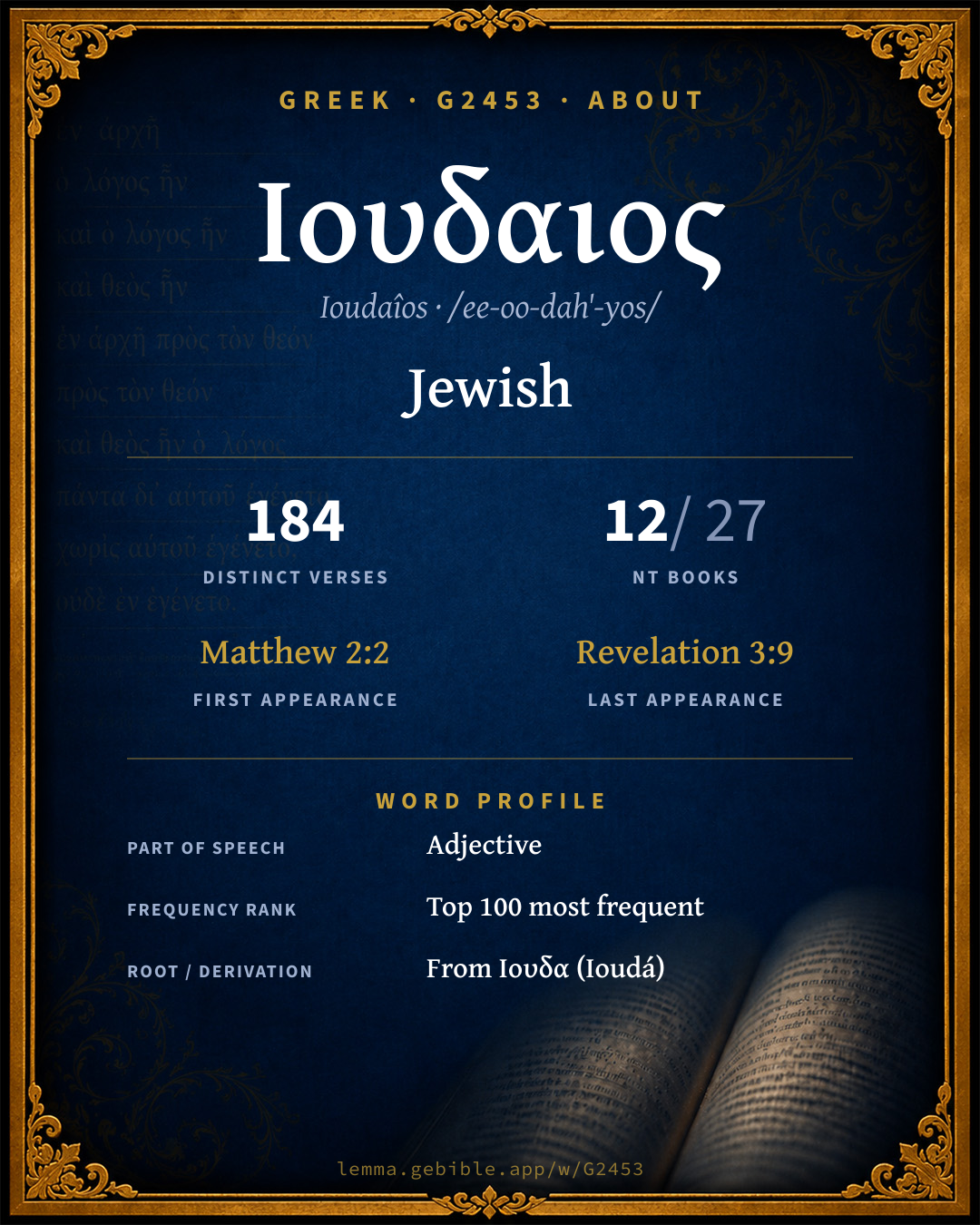
Ἰουδαῖος
Jewish
Thayer's lists 2 entries for ‘Jewish’ fuller range ↓
Full lexicon entry — Thayer's Greek Lexicon
From Thayer's Greek Lexicon
Where this word appears
See every Nominative-case word in the Greek New Testament →
Grammar key — what these labels mean
Part of speech
- Adjective
- A word that describes or qualifies a noun.
Case
- Genitive
- The case of source, possession, or “of” — answers “whose / from what.”
- Nominative
- The case of the subject (and the predicate nominative).
- Dative
- The case of the indirect object, means, or location — “to / for / with / in.”
- Accusative
- The case of the direct object and of extent.
- Vocative
- The case of direct address (“O Lord”).
Gender
- Masculine
- Grammatically masculine.
- Feminine
- Grammatically feminine.
Number
- Plural
- More than one.
- Singular
- One.
Every verse where G2453 appears in the Book of John — 67 distinct verses. Click any verse to open its interlinear word-by-word view. Verse text shown in the World English Bible for context — . Each verse’s Greek form is shown with its reference; the English is not keyword-highlighted, since the data carries no word-level English alignment. Use “Compare translations” on any verse to read it across multiple English versions. This concordance covers the Greek New Testament; Septuagint (Greek Old Testament) occurrences of this word are not indexed here.
John
- John 1:19 Ἰουδαῖοι adj nom pl masc This is John's testimony, when the Jews sent priests and Levites from Jerusalem to ask him, "Who are you?"
- John 2:6 Ἰουδαίων adj gen pl masc Now there were six water pots of stone set there after the Jews' manner of purifying, containing two or three metretes apiece.
- John 2:13 Ἰουδαίων adj gen pl masc The Passover of the Jews was at hand, and Jesus went up to Jerusalem.
- John 2:18 Ἰουδαῖοι adj nom pl masc The Jews therefore answered him, "What sign do you show us, seeing that you do these things?"
- John 2:20 Ἰουδαῖοι adj nom pl masc The Jews therefore said, "Forty-six years was this temple in building, and will you raise it up in three days?"
- John 3:1 Ἰουδαίων adj gen pl masc Now there was a man of the Pharisees named Nicodemus, a ruler of the Jews.
- John 3:22 Ἰουδαίαν adj acc sg fem After these things, Jesus came with his disciples into the land of Judea. He stayed there with them, and baptized.
- John 3:25 Ἰουδαίου adj gen sg masc There arose therefore a questioning on the part of John's disciples with some Jews about purification.
- John 4:9 Ἰουδαῖος adj nom sg masc The Samaritan woman therefore said to him, "How is it that you, being a Jew, ask for a drink from me, a Samaritan woman?" (For Jews have no dealings with Samaritans.)
- John 4:22 Ἰουδαίων adj gen pl masc You worship that which you don't know. We worship that which we know; for salvation is from the Jews.
- John 5:1 Ἰουδαίων adj gen pl masc After these things, there was a feast of the Jews, and Jesus went up to Jerusalem.
- John 5:10 Ἰουδαῖοι adj nom pl masc So the Jews said to him who was cured, "It is the Sabbath. It is not lawful for you to carry the mat."
- John 5:15 Ἰουδαίοις adj dat pl masc The man went away, and told the Jews that it was Jesus who had made him well.
- John 5:16 Ἰουδαῖοι adj nom pl masc For this cause the Jews persecuted Jesus, and sought to kill him, because he did these things on the Sabbath.
- John 5:18 Ἰουδαῖοι adj nom pl masc For this cause therefore the Jews sought all the more to kill him, because he not only broke the Sabbath, but also called God his own Father, making himself equal with God.
- John 6:4 Ἰουδαίων adj gen pl masc Now the Passover, the feast of the Jews, was at hand.
- John 6:41 Ἰουδαῖοι adj nom pl masc The Jews therefore murmured concerning him, because he said, "I am the bread which came down out of heaven."
- John 6:52 Ἰουδαῖοι adj nom pl masc The Jews therefore contended with one another, saying, "How can this man give us his flesh to eat?"
- John 7:1 Ἰουδαῖοι adj nom pl masc After these things, Jesus was walking in Galilee, for he wouldn't walk in Judea, because the Jews sought to kill him.
- John 7:2 Ἰουδαίων adj gen pl masc Now the feast of the Jews, the Feast of Booths, was at hand.
- John 7:11 Ἰουδαῖοι adj nom pl masc The Jews therefore sought him at the feast, and said, "Where is he?"
- John 7:13 Ἰουδαίων adj gen pl masc Yet no one spoke openly of him for fear of the Jews.
- John 7:15 Ἰουδαῖοι adj nom pl masc The Jews therefore marveled, saying, "How does this man know letters, having never been educated?"
- John 7:35 Ἰουδαῖοι adj nom pl masc The Jews therefore said among themselves, "Where will this man go that we won't find him? Will he go to the Dispersion among the Greeks, and teach the Greeks?
- John 8:22 Ἰουδαῖοι adj nom pl masc The Jews therefore said, "Will he kill himself, that he says, 'Where I am going, you can't come?'"
- John 8:31 Ἰουδαίους adj acc pl masc Jesus therefore said to those Jews who had believed him, "If you remain in my word, then you are truly my disciples.
- John 8:48 Ἰουδαῖοι adj nom pl masc Then the Jews answered him, "Don't we say well that you are a Samaritan, and have a demon?"
- John 8:52 Ἰουδαῖοι adj nom pl masc Then the Jews said to him, "Now we know that you have a demon. Abraham died, and the prophets; and you say, 'If a man keeps my word, he will never taste of death.'
- John 8:57 Ἰουδαῖοι adj nom pl masc The Jews therefore said to him, "You are not yet fifty years old, and have you seen Abraham?"
- John 9:18 Ἰουδαῖοι adj nom pl masc The Jews therefore did not believe concerning him, that he had been blind, and had received his sight, until they called the parents of him who had received his sight,
- John 9:22 Ἰουδαίους Ἰουδαῖοι adj acc pl masc adj nom pl masc His parents said these things because they feared the Jews; for the Jews had already agreed that if any man would confess him as Christ, he would be put out of the synagogue.
- John 10:19 Ἰουδαίοις adj dat pl masc Therefore a division arose again among the Jews because of these words.
- John 10:24 Ἰουδαῖοι adj nom pl masc The Jews therefore came around him and said to him, "How long will you hold us in suspense? If you are the Christ, tell us plainly."
- John 10:31 Ἰουδαῖοι adj nom pl masc Therefore Jews took up stones again to stone him.
- John 10:33 Ἰουδαῖοι adj nom pl masc The Jews answered him, "We don't stone you for a good work, but for blasphemy: because you, being a man, make yourself God."
- John 11:8 Ἰουδαῖοι adj nom pl masc The disciples told him, "Rabbi, the Jews were just trying to stone you, and are you going there again?"
- John 11:19 Ἰουδαίων adj gen pl masc Many of the Jews had joined the women around Martha and Mary, to console them concerning their brother.
- John 11:31 Ἰουδαῖοι adj nom pl masc Then the Jews who were with her in the house, and were consoling her, when they saw Mary, that she rose up quickly and went out, followed her, saying, "She is going to the tomb to weep there."
- John 11:33 Ἰουδαίους adj acc pl masc When Jesus therefore saw her weeping, and the Jews weeping who came with her, he groaned in the spirit, and was troubled,
- John 11:36 Ἰουδαῖοι adj nom pl masc The Jews therefore said, "See how much affection he had for him!"
- John 11:45 Ἰουδαίων adj gen pl masc Therefore many of the Jews, who came to Mary and saw what Jesus did, believed in him.
- John 11:54 Ἰουδαίοις adj dat pl masc Jesus therefore walked no more openly among the Jews, but departed from there into the country near the wilderness, to a city called Ephraim. He stayed there with his disciples.
- John 11:55 Ἰουδαίων adj gen pl masc Now the Passover of the Jews was at hand. Many went up from the country to Jerusalem before the Passover, to purify themselves.
- John 12:9 Ἰουδαίων adj gen pl masc A large crowd therefore of the Jews learned that he was there, and they came, not for Jesus' sake only, but that they might see Lazarus also, whom he had raised from the dead.
- John 12:11 Ἰουδαίων adj gen pl masc because on account of him many of the Jews went away and believed in Jesus.
- John 13:33 Ἰουδαίοις adj dat pl masc Little children, I will be with you a little while longer. You will seek me, and as I said to the Jews, 'Where I am going, you can't come,' so now I tell you.
- John 18:12 Ἰουδαίων adj gen pl masc So the detachment, the commanding officer, and the officers of the Jews, seized Jesus and bound him,
- John 18:14 Ἰουδαίοις adj dat pl masc Now it was Caiaphas who advised the Jews that it was expedient that one man should perish for the people.
- John 18:20 Ἰουδαῖοι adj nom pl masc Jesus answered him, "I spoke openly to the world. I always taught in synagogues, and in the temple, where the Jews always meet. I said nothing in secret.
- John 18:31 Ἰουδαῖοι adj nom pl masc Pilate therefore said to them, "Take him yourselves, and judge him according to your law." Therefore the Jews said to him, "It is not lawful for us to put anyone to death,"
- John 18:33 Ἰουδαίων adj gen pl masc Pilate therefore entered again into the Praetorium, called Jesus, and said to him, "Are you the King of the Jews?"
- John 18:35 Ἰουδαῖός adj nom sg masc Pilate answered, "I'm not a Jew, am I? Your own nation and the chief priests delivered you to me. What have you done?"
- John 18:36 Ἰουδαίοις adj dat pl masc Jesus answered, "My Kingdom is not of this world. If my Kingdom were of this world, then my servants would fight, that I wouldn't be delivered to the Jews. But now my Kingdom is not from here."
- John 18:38 Ἰουδαίους adj acc pl masc Pilate said to him, "What is truth?" When he had said this, he went out again to the Jews, and said to them, "I find no basis for a charge against him.
- John 18:39 Ἰουδαίων adj gen pl masc But you have a custom, that I should release someone to you at the Passover. Therefore do you want me to release to you the King of the Jews?"
- John 19:3 Ἰουδαίων adj gen pl masc They kept saying, "Hail, King of the Jews!" and they kept slapping him.
- John 19:7 Ἰουδαῖοι adj nom pl masc The Jews answered him, "We have a law, and by our law he ought to die, because he made himself the Son of God."
- John 19:12 Ἰουδαῖοι adj nom pl masc At this, Pilate was seeking to release him, but the Jews cried out, saying, "If you release this man, you aren't Caesar's friend! Everyone who makes himself a king speaks against Caesar!"
- John 19:14 Ἰουδαίοις adj dat pl masc Now it was the Preparation Day of the Passover, at about the sixth hour. He said to the Jews, "Behold, your King!"
- John 19:19 Ἰουδαίων adj gen pl masc Pilate wrote a title also, and put it on the cross. There was written, "JESUS OF NAZARETH, THE KING OF THE JEWS."
- John 19:20 Ἰουδαίων adj gen pl masc Therefore many of the Jews read this title, for the place where Jesus was crucified was near the city; and it was written in Hebrew, in Latin, and in Greek.
- John 19:21 Ἰουδαίων Ἰουδαίων Ἰουδαίων adj gen pl masc adj gen pl masc adj gen pl masc The chief priests of the Jews therefore said to Pilate, "Don't write, 'The King of the Jews,' but, 'he said, I am King of the Jews.'"
- John 19:31 Ἰουδαῖοι adj nom pl masc Therefore the Jews, because it was the Preparation Day, so that the bodies wouldn't remain on the cross on the Sabbath (for that Sabbath was a special one), asked of Pilate that their legs might be broken, and that they might be taken away.
- John 19:38 Ἰουδαίων adj gen pl masc After these things, Joseph of Arimathaea, being a disciple of Jesus, but secretly for fear of the Jews, asked of Pilate that he might take away Jesus' body. Pilate gave him permission. He came therefore and took away his body.
- John 19:40 Ἰουδαίοις adj dat pl masc So they took Jesus' body, and bound it in linen cloths with the spices, as the custom of the Jews is to bury.
- John 19:42 Ἰουδαίων adj gen pl masc Then because of the Jews' Preparation Day (for the tomb was near at hand) they laid Jesus there.
- John 20:19 Ἰουδαίων adj gen pl masc When therefore it was evening, on that day, the first day of the week, and when the doors were locked where the disciples were assembled, for fear of the Jews, Jesus came and stood in the midst, and said to them, "Peace be to you."
About this entry
At a glance — auto-summarized from this page’s data, not written by a person. Every figure links to its source below. This summary describes the numbers; it doesn’t interpret them.
At its core, Ιουδαιος (Ioudaîos) means “Jewish.” First canonically at Matthew 2:2, it enters the text early. It appears 184 verses across 12 books of the Greek New Testament, among its common vocabulary. The word gravitates to Acts (41%), then John and Romans. Dig into 184-verse concordance and the renderings breakdown below.
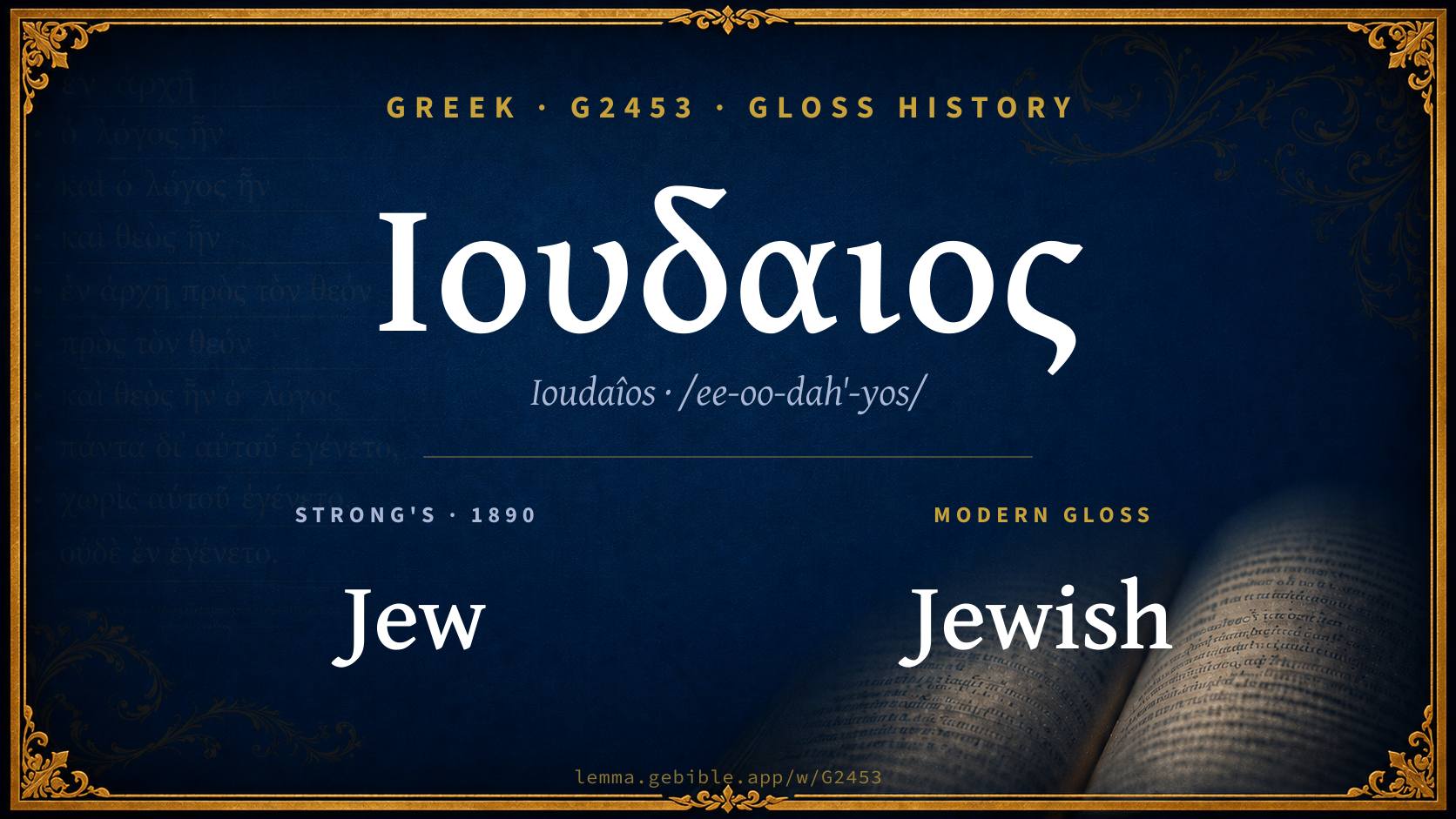
Gloss history
Strong's 1890 vs modern scholarship
About this word
Strong's G2453 catalogs a Greek word from the Greek New Testament.
These counts are not copied from any lexicon or concordance. They are computed here, from the morphology-tagged Greek New Testament. What Lemma adds →
- 184
- distinct verses
- The word appears in 184 distinct verses.
- 12 / 27
- NT books
- The word appears in 12 of 27 New Testament books.
- #83
- by frequency
- Top 100 most frequent Greek words (rank 83 of 5,347 Greek words by occurrence).
View all 184 occurrences in the concordance →
By section of the New Testament
By traditional corpus
Conventional, traditional groupings — biblical authorship is debated, so this is a traditional corpus grouping, not an authorship claim. Some books belong to more than one corpus (Luke is in both the Gospels and the Lukan corpus, and so on), so these shares overlap and need not total 100%. Each figure is a share of the word’s 184 distinct verses.
- Gospels 83 verses · 45%
- Lukan (Luke–Acts) 80 verses · 43%
- Johannine 69 verses · 38%
- Pauline corpus 24 verses · 13%
- Revelation 2 verses · 1%
How translations render this word
Counts come from each version’s own published word-to-Strong’s tagging or interlinear alignment — an approximate guide to how each version renders this word, not a word-level alignment the data otherwise carries. Because each total is that version’s own tagged count, the per-version totals vary from one another and need not match the appearance or distinct-verse counts above. These counts may also differ from a printed concordance because Lemma counts each distinctly tagged rendering and does not collapse phrase taggings into a single head-word total. This is a fixed set of word-tagged versions (KJV, ASV, BSB, ULT) and does not change with the reading translation you choose elsewhere. Each version’s license is shown beside its name below (and on Sources).
- King James Version: Jews 162×, Jew 17×, Jews' 4×
- American Standard Version: Jews 152×, Jew 19×, All the jews 2×
- Berean Standard Bible: Jews 146×, Jewish 21×, Jew 20×
- unfoldingWord Literal Text: Jews 166×, Jew 17×, Jewish 8×
King James Version Public Domain
Renders G2453 across 195 tagged occurrences — most commonly:
Plus 10 renderings that appear only once — usually multi-word phrases or single function words the recovered tagging swept in, not distinct renderings. Not rendered by a distinct English word in 1 further occurrence.
American Standard Version Public Domain
Renders G2453 across 190 tagged occurrences — most commonly:
Plus 17 renderings that appear only once — usually multi-word phrases or single function words the recovered tagging swept in, not distinct renderings.
Berean Standard Bible Public Domain
Renders G2453 across 191 tagged occurrences — most commonly:
Plus 4 renderings that appear only once — usually multi-word phrases or single function words the recovered tagging swept in, not distinct renderings. Not rendered by a distinct English word in 3 further occurrences.
unfoldingWord Literal Text CC BY-SA 4.0
Renders G2453 across 200 tagged occurrences — most commonly:
Plus 9 renderings that appear only once — usually multi-word phrases or single function words the recovered tagging swept in, not distinct renderings.
Senses in Thayer's
The 2 senses Thayer's distinguishes for this word, in lexicon order (not ranked by frequency or importance). The full entry — with sub-senses — is in the Lexicon Entry tab.
- Jewish, belonging to the Jewish nation
- Jewish as respects to birth, origin, religion
Word origin
Derived from Ιουδα (Ioudá) (G2448) — Judah.
Forms in the corpus
The 13 distinct written forms G2453 takes in the Greek New Testament, most frequent first — each parse links to that case’s occurrences in the concordance.
| Form | Parsing | Example | Uses |
|---|---|---|---|
| Ἰουδαίων Ioudaíōn | Adjective, Genitive, Plural, Masculine | Matthew 2:2 | 68 |
| Ἰουδαῖοι Ioudaîoi | Adjective, Nominative, Plural, Masculine | Mark 7:3 | 55 |
| Ἰουδαίοις Ioudaíois | Adjective, Dative, Plural, Masculine | Matthew 28:15 | 25 |
| Ἰουδαίους Ioudaíous | Adjective, Accusative, Plural, Masculine | John 8:31 | 17 |
| Ἰουδαῖος Ioudaîos | Adjective, Nominative, Singular, Masculine | John 4:9 | 10 |
| Ἰουδαίου Ioudaíou | Adjective, Genitive, Singular, Masculine | John 3:25 | 5 |
| Ἰουδαίῳ Ioudaíō | Adjective, Dative, Singular, Masculine | Acts 10:28 | 3 |
| Ἰουδαῖός Ioudaîós | Adjective, Nominative, Singular, Masculine | John 18:35 | 3 |
| Ἰουδαῖον Ioudaîon | Adjective, Accusative, Singular, Masculine | Acts 13:6 | 2 |
| Ἰουδαίαν Ioudaían | Adjective, Accusative, Singular, Feminine | John 3:22 | 1 |
| Ἰουδαίας Ioudaías | Adjective, Genitive, Singular, Feminine | Acts 16:1 | 1 |
| Ἰουδαίᾳ Ioudaía | Adjective, Dative, Singular, Feminine | Acts 24:24 | 1 |
| Ἰουδαῖοί Ioudaîoí | Adjective, Nominative, Plural, Masculine | Acts 2:10 | 1 |
Same root — word family
Other Thayer's entries built from the same root as G2453, grouped by Strong’s listed origin. These share a root / origin per the lexicon — not necessarily a shared meaning. Each links to that word’s own entry.
Derives from
Derived from this word
Proper names from this root
People and places named from this root — a name, not an additional meaning of the word.
Compare all same-root words → Showing 4 of 5 — not the complete family. 3 of the same-root words are proper names (people or places). They share a root, not necessarily a meaning.
Bible dictionary
Public-domain dictionary articles matched to this entry by name (Jewish). A biblical name can be shared by more than one person or place, so an article may treat several.
Smith's Bible Dictionary · William Smith, 1863
of or belonging to Jews; an epithet applied to their rabbinical legends. (Titus 1:14)
Classic public-domain reference works; full attribution on Sources.
Septuagint usage
The same Greek word Ιουδαιος appears 67 times in the Greek Old Testament (Septuagint), across 65 verses in 7 books.
- 67
- LXX occurrences
- Tagged occurrences of this Greek word in the Septuagint.
- 65
- verses
- Distinct Septuagint verses containing this word.
- 7 / 39
- OT books
- The word appears in 7 of the 39 Old Testament books.
Sample Septuagint occurrences
- 2 Kings 16:6 ἰουδαῖος
- Ezra 4:12 ἰουδαῖος
- Esther 2:5 ἰουδαῖος
- Isaiah 19:17 ἰουδαῖος
- Jeremiah 33:2 ἰουδαῖος
- Daniel 3:8 ἰουδαῖος
- Zechariah 8:23 ἰουδαῖος
Septuagint occurrences (same lexeme)
Every verse where the same Strong’s number (G2453) appears in the Greek Septuagint — showing the first 50 of 65. Verse text shown in the World English Bible for context; the Greek form is the matched word — the English is not keyword-highlighted.
- 2 Kings 16:6 ἰουδαῖος At that time Rezin king of Syria recovered Elath to Syria, and drove the Jews from Elath; and the Syrians came to Elath, and lived there, to this day.
- 2 Kings 25:25 ἰουδαῖος But it happened in the seventh month, that Ishmael the son of Nethaniah, the son of Elishama, of the royal seed came, and ten men with him, and struck Gedaliah, so that he died, and the Jews and the Chaldeans that were with him at Mizpah.
- Ezra 4:12 ἰουδαῖος Be it known to the king, that the Jews who came up from you are come to us to Jerusalem; they are building the rebellious and the bad city, and have finished the walls, and repaired the foundations.
- Ezra 5:1 ἰουδαῖος Now the prophets, Haggai the prophet, and Zechariah the son of Iddo, prophesied to the Jews who were in Judah and Jerusalem; in the name of the God of Israel [prophesied they] to them.
- Ezra 6:7 ἰουδαῖος let the work of this house of God alone; let the governor of the Jews and the elders of the Jews build this house of God in its place.
- Ezra 6:8 ἰουδαῖος Moreover I make a decree what you shall do to these elders of the Jews for the building of this house of God: that of the king's goods, even of the tribute beyond the River, expenses be given with all diligence to these men, that they be not hindered.
- Ezra 6:14 ἰουδαῖος The elders of the Jews built and prospered, through the prophesying of Haggai the prophet and Zechariah the son of Iddo. They built and finished it, according to the commandment of the God of Israel, and according to the decree of Cyrus, and Darius, and Artaxerxes king of Persia.
- Ezra 12:16 ἰουδαῖος
- Ezra 13:33 ἰουδαῖος
- Ezra 13:34 ἰουδαῖος
- Ezra 14:6 ἰουδαῖος
- Ezra 15:1 ἰουδαῖος
- Ezra 15:8 ἰουδαῖος
- Ezra 15:17 ἰουδαῖος
- Ezra 16:6 ἰουδαῖος
- Ezra 23:23 ἰουδαῖος
- Esther 2:5 ἰουδαῖος There was a certain Jew in Shushan the palace, whose name was Mordecai, the son of Jair, the son of Shimei, the son of Kish, a Benjamite,
- Esther 3:4 ἰουδαῖος Now it came to pass, when they spoke daily to him, and he didn't listen to them, that they told Haman, to see whether Mordecai's matters would stand: for he had told those who he was a Jew.
- Esther 3:6 ἰουδαῖος But he scorned the thought of laying hands on Mordecai alone; for they had made known to him the people of Mordecai: therefore Haman sought to destroy all the Jews who were throughout the whole kingdom of Ahasuerus, even the people of Mordecai.
- Esther 3:10 ἰουδαῖος The king took his ring from his hand, and gave it to Haman the son of Hammedatha the Agagite, the Jews' enemy.
- Esther 3:13 ἰουδαῖος Letters were sent by posts into all the king's provinces, to destroy, to kill, and to cause to perish, all Jews, both young and old, little children and women, in one day, even on the thirteenth [day] of the twelfth month, which is the month Adar, and to take the spoil of them for a prey.
- Esther 4:3 ἰουδαῖος In every province, wherever the king's commandment and his decree came, there was great mourning among the Jews, and fasting, and weeping, and wailing; and many lay in sackcloth and ashes.
- Esther 4:7 ἰουδαῖος Mordecai told him of all that had happened to him, and the exact sum of the money that Haman had promised to pay to the king's treasuries for the Jews, to destroy them.
- Esther 4:13 ἰουδαῖος Then Mordecai bade them return answer to Esther, Don't think to yourself that you shall escape in the king's house, more than all the Jews.
- Esther 4:14 ἰουδαῖος For if you altogether hold your peace at this time, then will relief and deliverance arise to the Jews from another place, but you and your father's house will perish: and who knows whether you haven't come to the kingdom for such a time as this?
- Esther 4:16 ἰουδαῖος Go, gather together all the Jews who are present in Shushan, and fast you for me, and neither eat nor drink three days, night or day: I also and my maidens will fast in like manner; and so will I go in to the king, which is not according to the law: and if I perish, I perish.
- Esther 5:7 ἰουδαῖος Then answered Esther, and said, My petition and my request is:
- Esther 5:11 ἰουδαῖος Haman recounted to them the glory of his riches, and the multitude of his children, and all the things in which the king had promoted him, and how he had advanced him above the princes and servants of the king.
- Esther 6:10 ἰουδαῖος Then the king said to Haman, Make haste, and take the clothing and the horse, as you have said, and do even so to Mordecai the Jew, who sits at the king's gate: let nothing fail of all that you have spoken.
- Esther 6:13 ἰουδαῖος Haman recounted to Zeresh his wife and all his friends everything that had happened to him. Then his wise men and Zeresh his wife said to him, If Mordecai, before whom you have begun to fall, be of the seed of the Jews, you shall not prevail against him, but shall surely fall before him.
- Esther 8:3 ἰουδαῖος Esther spoke yet again before the king, and fell down at his feet, and begged him with tears to put away the mischief of Haman the Agagite, and his device that he had devised against the Jews.
- Esther 8:5 ἰουδαῖος She said, If it please the king, and if I have found favor in his sight, and the thing seem right before the king, and I be pleasing in his eyes, let it be written to reverse the letters devised by Haman, the son of Hammedatha the Agagite, which he wrote to destroy the Jews who are in all the king's provinces:
- Esther 8:7 ἰουδαῖος Then the king Ahasuerus said to Esther the queen and to Mordecai the Jew, See, I have given Esther the house of Haman, and him they have hanged on the gallows, because he laid his hand on the Jews.
- Esther 8:9 ἰουδαῖος Then were the king's scribes called at that time, in the third month Sivan, on the three and twentieth [day] of it; and it was written according to all that Mordecai commanded to the Jews, and to the satraps, and the governors and princes of the provinces which are from India to Ethiopia, one hundred twenty-seven provinces, to every province according to the writing of it, and to every people after their language, and to the Jews according to their writing, and according to their language.
- Esther 8:13 ἰουδαῖος A copy of the writing, that the decree should be given out in every province, was published to all the peoples, and that the Jews should be ready against that day to avenge themselves on their enemies.
- Esther 8:16 ἰουδαῖος The Jews had light and gladness, and joy and honor.
- Esther 8:17 ἰουδαῖος In every province, and in every city, wherever the king's commandment and his decree came, the Jews had gladness and joy, a feast and a good day. Many from among the peoples of the land became Jews; for the fear of the Jews was fallen on them.
- Esther 9:2 ἰουδαῖος the Jews gathered themselves together in their cities throughout all the provinces of the king Ahasuerus, to lay hand on such as sought their hurt: and no man could withstand them; for the fear of them was fallen on all the peoples.
- Esther 9:3 ἰουδαῖος All the princes of the provinces, and the satraps, and the governors, and those who did the king's business, helped the Jews; because the fear of Mordecai was fallen on them.
- Esther 9:6 ἰουδαῖος In Shushan the palace the Jews killed and destroyed five hundred men.
- Esther 9:10 ἰουδαῖος the ten sons of Haman the son of Hammedatha, the Jew's enemy, killed they; but they didn't lay their hand on the spoil.
- Esther 9:12 ἰουδαῖος The king said to Esther the queen, The Jews have slain and destroyed five hundred men in Shushan the palace, and the ten sons of Haman; what then have they done in the rest of the king's provinces! Now what is your petition? and it shall be granted you: or what is your request further? and it shall be done.
- Esther 9:13 ἰουδαῖος Then said Esther, If it please the king, let it be granted to the Jews who are in Shushan to do tomorrow also according to this day's decree, and let Haman's ten sons be hanged on the gallows.
- Esther 9:14 ἰουδαῖος The king commanded it so to be done: and a decree was given out in Shushan; and they hanged Haman's ten sons.
- Esther 9:15 ἰουδαῖος The Jews who were in Shushan gathered themselves together on the fourteenth day also of the month Adar, and killed three hundred men in Shushan; but they didn't lay their hand on the spoil.
- Esther 9:16 ἰουδαῖος The other Jews who were in the king's provinces gathered themselves together, and stood for their lives, and had rest from their enemies, and killed of those who hated them seventy-five thousand; but they didn't lay their hand on the spoil.
- Esther 9:18 ἰουδαῖος But the Jews who were in Shushan assembled together on the thirteenth [day] of it, and on the fourteenth of it; and on the fifteenth [day] of the same they rested, and made it a day of feasting and gladness.
- Esther 9:19 ἰουδαῖος Therefore do the Jews of the villages, who dwell in the unwalled towns, make the fourteenth day of the month Adar [a day of] gladness and feasting, and a good day, and of sending portions one to another.
- Esther 9:20 ἰουδαῖος Mordecai wrote these things, and sent letters to all the Jews who were in all the provinces of the king Ahasuerus, both near and far,
- Esther 9:22 ἰουδαῖος as the days in which the Jews had rest from their enemies, and the month which was turned to them from sorrow to gladness, and from mourning into a good day; that they should make them days of feasting and gladness, and of sending portions one to another, and gifts to the needy.
These are occurrences of the same Greek lexeme (G2453) in the Septuagint — not a translation of any one Hebrew word. The store carries no word-level Hebrew↔Greek alignment, so no Hebrew original is asserted here. Counts come from the recovered LXX Strong's tagging — high-frequency vocabulary is well covered, while rare or late forms may be untagged — so they reflect tagged occurrences and may slightly undercount.