

Acts 2:10
Greek (Tischendorf 8th ed.) Acts 2:10 appears in the Greek New Testament. The text above is from the Tischendorf 8th edition. Each word links to its Strong’s number and a concise gloss. Click any word for its full Thayer’s Greek Lexicon entry.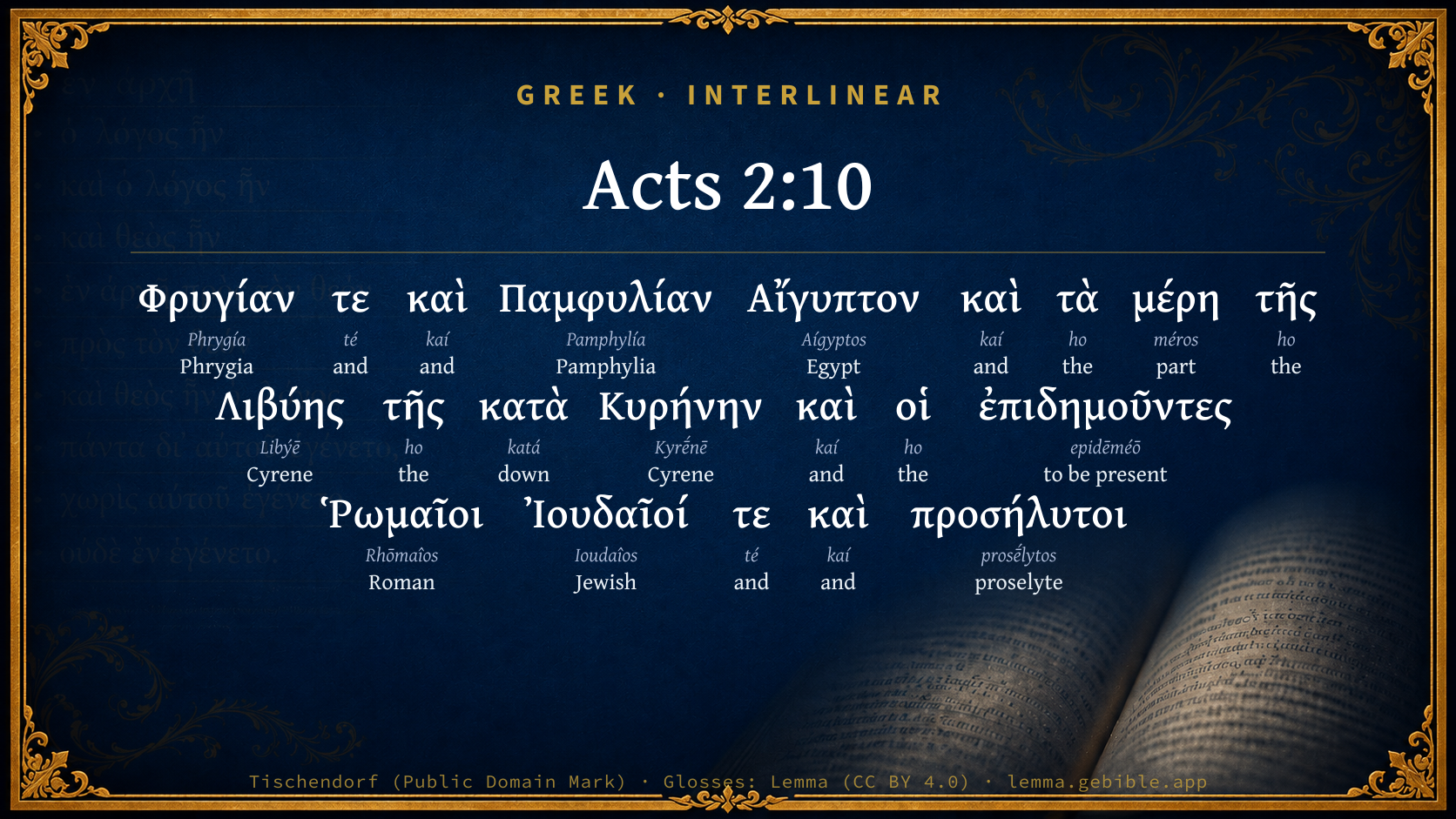
Phrygia, Pamphylia, Egypt, the parts of Libya around Cyrene, visitors from Rome, both Jews and proselytes,
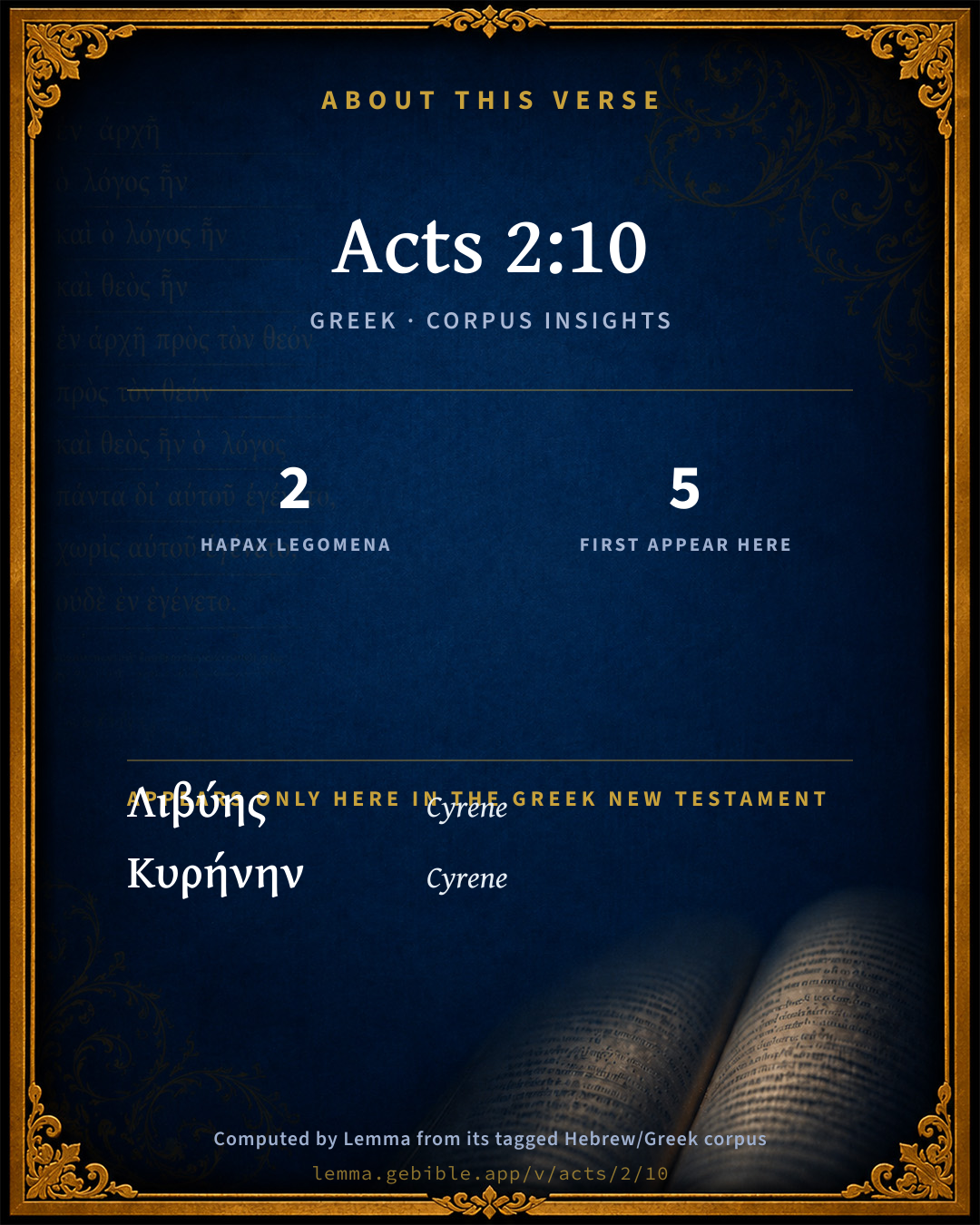
- 2 hapax legomena — only here in the Greek New Testament
- 5 first appearances in the Greek New Testament
Download a study sheet
One document with this verse’s original text, its word-by-word gloss line, the meaning frame, cross-references with their text, attributed commentary, and full source and license credits — printable, and it pastes into notes with its structure intact.
This verse Autodidact and up
A passage Seminary Student
Up to 50 verses in one chapter. A passage sheet keeps up to 6 commentary sources and 12 cross-references per verse, in the order this page ranks them, and says so on the sheet whenever that leaves anything out. Ask for a single verse and you get the Autodidact verse sheet above.
Everything on this page stays free to read, with no account — the sheet is a download of what is already on screen, not access to it.
Compare translations 3
The same verse in 3 English versions, stacked beneath the original-language interlinear above. Click any original word for its lexicon entry.
Each is an independent rendering of the whole verse — the interlinear is not word-aligned to these translations.
Highlighted words mark where these versions differ — a whole-verse word diff, not a word-by-word alignment.
-
World English Bible Public Domain
Phrygia, Pamphylia, Egypt, the parts of Libya around Cyrene, visitors from Rome, both Jews and proselytes,
-
King James Version Public Domain
Phrygia, and Pamphylia, in Egypt, and in the parts of Libya about Cyrene, and strangers of Rome, Jews and proselytes,
-
unfoldingWord Literal Text CC BY-SA 4.0
Phrygia and also Pamphylia, Egypt and the parts of Libya that near Cyrene, and Romans visiting,
unfoldingWord Literal Text — © unfoldingWord, licensed CC BY-SA 4.0. Word-aligned USFM3 via Door43 (git.door43.org/unfoldingWord/en_ult).
Show all 19 translations
Every available English version of this verse, each an independent rendering of the whole verse.
-
World English Bible Public Domain
Phrygia, Pamphylia, Egypt, the parts of Libya around Cyrene, visitors from Rome, both Jews and proselytes,
-
Berean Standard Bible Public Domain
Phrygia and Pamphylia, Egypt and the parts of Libya near Cyrene; visitors from Rome,
-
Majority Standard Bible Public Domain
Phrygia and Pamphylia, Egypt and the parts of Libya near Cyrene; visitors from Rome,
-
King James Version Public Domain
Phrygia, and Pamphylia, in Egypt, and in the parts of Libya about Cyrene, and strangers of Rome, Jews and proselytes,
-
American Standard Version (1901) Public Domain
in Phrygia and Pamphylia, in Egypt and the parts of Libya about Cyrene, and sojourners from Rome, both Jews and proselytes,
-
Revised Version (1885) Public Domain
in Phrygia and Pamphylia, in Egypt and the parts of Libya about Cyrene, and sojourners from Rome, both Jews and proselytes,
-
Geneva Bible (1599) Public Domain
And of Phrygia, and Pamphylia, of Egypt, and of the partes of Libya, which is beside Cyrene, and strangers of Rome, and Iewes, and Proselytes,
-
Douay-Rheims (1899) Public Domain
Phrygia, and Pamphylia, Egypt, and the parts of Libya about Cyrene, and strangers of Rome,
-
Young's Literal Translation Public Domain
Phrygia also, and Pamphylia, Egypt, and the parts of Libya, that `are' along Cyrene, and the strangers of Rome, both Jews and proselytes,
-
Literal Standard Version CC BY-SA 4.0
Phrygia also, and Pamphylia, Egypt, and the parts of Libya that [are] along Cyrene, and the strangers of Rome, both Jews and proselytes,
-
Unlocked Literal Bible CC BY-SA 4.0
Phrygia and Pamphylia, in Egypt and the parts of Libya toward Cyrene, and visitors from Rome,
-
unfoldingWord Literal Text CC BY-SA 4.0
Phrygia and also Pamphylia, Egypt and the parts of Libya that near Cyrene, and Romans visiting,
-
Darby Bible Public Domain
both Phrygia and Pamphylia, Egypt, and the parts of Libya which adjoin Cyrene, and the Romans sojourning [here], both Jews and proselytes,
-
World Messianic Bible Public Domain
Phrygia, Pamphylia, Egypt, the parts of Libya around Cyrene, visitors from Rome, both Jews and proselytes,
-
Webster's Bible Public Domain
Phrygia, and Pamphylia, in Egypt, and in the parts of Libya about Cyrene, and strangers of Rome, Jews and Proselytes,
-
Free Bible Version CC BY-SA 4.0
Phrygia and Pamphylia; from Egypt and the area of Libya around Cyrene; visitors from Rome, both Jews and converts,
-
Bible in Basic English Public Domain
In Phrygia and Pamphylia, in Egypt and the parts of Libya about Cyrene, and those who have come from Rome, Jews by birth and others who have become Jews,
-
Text-Critical English NT CC BY 4.0
Phrygia and Pamphylia, Egypt and the districts of Libya that are near Cyrene; visitors from Rome (both Jews and converts to Judaism),
-
Tyndale New Testament (1534) Public Domain
Phrigia Pamphilia and of Egypte and of the parties of Libia which is besyde Syrene and straungers of Rome Iewes and convertes
Literal Standard Version (2020), Covenant Press — licensed CC BY-SA 4.0. Text via the HelloAO Bible API (eBible.org). Unlocked Literal Bible (unfoldingWord) — licensed CC BY-SA 4.0. Text via the HelloAO Bible API (eBible.org). unfoldingWord Literal Text — © unfoldingWord, licensed CC BY-SA 4.0. Word-aligned USFM3 via Door43 (git.door43.org/unfoldingWord/en_ult). Free Bible Version, Dr. Jonathan Gallagher — licensed CC BY-SA 4.0. Text via the HelloAO Bible API (eBible.org).
Word by word
More ways to search: Search by grammar → Find every occurrence → Compare this word →
Practice this passage: Drill this verse → Learn its vocabulary →
- Appears 1× in the Greek New Testament
- First appears here
- Part of Speech
- Noun
- Case
- Genitive
- Number
- Singular
- Gender
- Feminine
Full Thayer's Definition
- Φρυγίαν Phrygía G5435 “Phrygia” Noun, Accusative, Singular, Feminine
- τε té G5037 “and” Particle
- καὶ kaí G2532 “and” Conjunction
- Παμφυλίαν Pamphylía G3828 “Pamphylia” Noun, Accusative, Singular, Feminine
- Αἴγυπτον Aígyptos G125 “Egypt” Noun, Accusative, Singular, Feminine
- καὶ kaí G2532 “and” Conjunction
- τὰ ho G3588 “the” Article, Accusative, Plural, Neuter
- μέρη méros G3313 “part” Noun, Accusative, Plural, Neuter
- τῆς ho G3588 “the” Article, Genitive, Singular, Feminine
- Λιβύης Libýē G3033 “Cyrene” Noun, Genitive, Singular, Feminine
- τῆς ho G3588 “the” Article, Genitive, Singular, Feminine
- κατὰ katá G2596 “down” Preposition
- Κυρήνην Kyrḗnē G2957 “Cyrene” Noun, Accusative, Singular, Feminine
- καὶ kaí G2532 “and” Conjunction
- οἱ ho G3588 “the” Article, Nominative, Plural, Masculine
- ἐπιδημοῦντες epidēméō G1927 “to be present” Verb, Present, Active, Participle, Nominative, Plural, Masculine
- Ῥωμαῖοι Rhōmaîos G4514 “Roman” Adjective, Nominative, Plural, Masculine
- Ἰουδαῖοί Ioudaîos G2453 “Jewish” Adjective, Nominative, Plural, Masculine
- τε té G5037 “and” Particle
- καὶ kaí G2532 “and” Conjunction
- προσήλυτοι prosḗlytos G4339 “proselyte” Noun, Nominative, Plural, Masculine
About this verse
These counts appear in no published source. They are computed here, from the morphology-tagged text and Lemma’s own curated glosses. What Lemma adds →
- 21
- words
- 14
- distinct lemmas
- Acts
- section
Notable vocabulary
2 hapax legomena — words that appear only here in the entire Greek New Testament:
First appearance in Scripture
These words make their first canonical appearance in the Greek New Testament here:
Shared distinctive vocabulary
ἐπιδημοῦντες to be present G1927 occurs in 2 verses of the Greek New Testament. Also found in:
Cross-references
30Topical passages linked to Acts 2:10 in the Treasury of Scripture Knowledge — connected by theme and wording, ordered by reader-vote popularity; previews shown in the World English Bible.
- Zechariah 8:23 Thus says Yahweh of Hosts: "In those days, ten men will take hold, out of all the languages of the nations, they will take hold of the skirt of him who is a Jew, saying, 'We will go with you, for we have heard that God is with you.'"
- Acts 16:6 When they had gone through the region of Phrygia and Galatia, they were forbidden by the Holy Spirit to speak the word in Asia.
- Zechariah 8:20 Thus says Yahweh of Hosts: "Many peoples, and the inhabitants of many cities will yet come;
- Acts 13:13 Now Paul and his company set sail from Paphos, and came to Perga in Pamphylia. John departed from them and returned to Jerusalem.
- Acts 13:43 Now when the synagogue broke up, many of the Jews and of the devout proselytes followed Paul and Barnabas; who, speaking to them, urged them to continue in the grace of God.
- Acts 15:38 But Paul didn't think that it was a good idea to take with them someone who had withdrawn from them in Pamphylia, and didn't go with them to do the work.
- Acts 18:23 Having spent some time there, he departed, and went through the region of Galatia, and Phrygia, in order, establishing all the disciples.
- Genesis 12:10 There was a famine in the land. Abram went down into Egypt to live as a foreigner there, for the famine was sore in the land.
- Isaiah 19:23–25 In that day shall there be a highway out of Egypt to Assyria, and the Assyrian shall come into Egypt, and the Egyptian into Assyria; and the Egyptians shall worship with the Assyrians.
- Jeremiah 46:9 Go up, you horses; and rage, you chariots; and let the mighty men go forth: Cush and Put, who handle the shield; and the Ludim, who handle and bend the bow.
- Ezekiel 30:5 Ethiopia, and Put, and Lud, and all the mixed people, and Cub, and the children of the land that is in league, shall fall with them by the sword.
- Daniel 11:43 But he shall have power over the treasures of gold and of silver, and over all the precious things of Egypt; and the Libyans and the Ethiopians shall be at his steps.
- Hosea 11:1 "When Israel was a child, then I loved him, And called my son out of Egypt.
- Matthew 27:32 As they came out, they found a man of Cyrene, Simon by name, and they compelled him to go with them, that he might carry his cross.
- Mark 15:21 They compelled one passing by, coming from the country, Simon of Cyrene, the father of Alexander and Rufus, to go with them, that he might bear his cross.
- Acts 11:20 But there were some of them, men of Cyprus and Cyrene, who, when they had come to Antioch, spoke to the Greeks, preaching the Lord Jesus.
- Acts 14:24 They passed through Pisidia, and came to Pamphylia.
- Acts 27:5 When we had sailed across the sea which is off Cilicia and Pamphylia, we came to Myra, a city of Lycia.
- Romans 1:15 So, as much as is in me, I am eager to preach the Gospel to you also who are in Rome.
- 2 Timothy 1:17 but when he was in Rome, he sought me diligently, and found me
- Esther 8:17 In every province, and in every city, wherever the king's commandment and his decree came, the Jews had gladness and joy, a feast and a good day. Many from among the peoples of the land became Jews; for the fear of the Jews was fallen on them.
- Jeremiah 9:26 Egypt, and Judah, and Edom, and the children of Ammon, and Moab, and all that have the corners [of their hair] cut off, who dwell in the wilderness; for all the nations are uncircumcised, and all the house of Israel are uncircumcised in heart.
- Matthew 2:15 and was there until the death of Herod; that it might be fulfilled which was spoken by the Lord through the prophet, saying, "Out of Egypt I called my son."
- Acts 6:5 These words pleased the whole multitude. They chose Stephen, a man full of faith and of the Holy Spirit, Philip, Prochorus, Nicanor, Timon, Parmenas, and Nicolaus, a proselyte of Antioch;
- Acts 6:9 But some of those who were of the synagogue called "The Libertines," and of the Cyrenians, of the Alexandrians, and of those of Cilicia and Asia arose, disputing with Stephen.
- Acts 13:1 Now in the assembly that was at Antioch there were some prophets and teachers: Barnabas, Simeon who was called Niger, Lucius of Cyrene, Manaen the foster-brother of Herod the tetrarch, and Saul.
- Acts 18:2 He found a certain Jew named Aquila, a man of Pontus by race, who had recently come from Italy, with his wife Priscilla, because Claudius had commanded all the Jews to depart from Rome. He came to them,
- Acts 28:15 From there the brothers, when they heard of us, came to meet us as far as The Market of Appius and The Three Taverns. When Paul saw them, he thanked God, and took courage.
- Romans 1:7 to all who are in Rome, beloved of God, called to be saints: Grace to you and peace from God our Father and the Lord Jesus Christ.
- Revelation 11:8 Their dead bodies will be in the street of the great city, which spiritually is called Sodom and Egypt, where also their Lord was crucified.
Cross-references courtesy of OpenBible.info (CC BY 4.0).
Lesson kit
Teaching starters — assembled from the data on this page, not authored interpretation. Every prompt links to the verse data it draws on. Edit before teaching.
Acts, in the Acts, opens this verse with 21 words (14 distinct Greek lemmas). Its most distinctive word is Libýē (“Cyrene”). A historical commentator’s framing appears above. Read the whole chapter for the surrounding context.
Discussion questions
- What does “Cyrene” (Libýē) contribute to the verse as a whole?
- This verse holds 2 words here found nowhere else in the Greek New Testament. What might the rare words draw attention to?
- 5 words here appear for the first time in Scripture. What is being introduced at this debut?
- Acts 17:21 shares the word «to be present» with this verse. How do the two illuminate each other?
- “and” occurs 4× in this one verse. What is the effect of the repetition?
- These translations render this verse differently. What is at stake in choosing one wording over another?
- Reading how Tyndale Open Study Notes and Bengel's Gnomon read this verse, where do the two commentators agree and where do they part?
Things to notice
- 2 words in this verse appear nowhere else in the Greek New Testament.
- 5 words make their first canonical appearance in Scripture here.
- These translations choose different wording for 12 words in this verse.
- “and” occurs 4× in this single verse.
- 14 distinct Greek lemmas span 21 words in this verse.
Commentary
Notes on Acts 2:10 from classic Christian and Jewish commentators (each source and its license shown beneath its notes). The classic Christian expositions comment on the surrounding passage and are grouped to its opening verse, so a note may address several verses; the Jewish commentaries on the Tanakh (Rashi and others) are per-verse, so they appear only where the commentator wrote on this verse.
Lemma curates 59 commentaries, every one of them public domain or Creative Commons licensed, each selected and text-cleaned for this edition rather than reprinted as found. About our sources →
Tyndale Open Study Notes
Tyndale Open Resources
Tyndale Open Study Notes — © Tyndale Open Resources, licensed CC BY-SA 4.0. Text via the HelloAO Bible API.
Bengel's Gnomon
Johann Albrecht Bengel
Bengel's Gnomon of the New Testament — English translation (T&T Clark, Edinburgh, 1860) — public domain. Text from a community e-Sword module.
Geneva Bible (1599)
Geneva Bible translators
Geneva Bible (1599) marginal notes — public domain. Text via Bolls.life.
Adam Clarke's Commentary
Adam Clarke's Commentary on the Bible (1810–1826) — public domain. Text from a community e-Sword/MySword module.
Ellicott's Commentary for English Readers
A Bible Commentary for English Readers, edited by Charles John Ellicott (1878–1897) — public domain. Text from a community e-Sword module.
John Gill's Exposition
John Gill's Exposition of the Whole Bible (1746–1763) — public domain (CC PDM 1.0). Text via the HelloAO Bible API.
Trapp's Complete Commentary
John Trapp
John Trapp, A Commentary or Exposition upon All the Books of the Old and New Testament (1647–1656) — public domain. Text from a community e-Sword module.
Albert Barnes' Notes on the Bible
Albert Barnes' Notes on the Bible (1834–1885) — public domain. Text from a community e-Sword/MySword module.
Matthew Poole's English Annotations
Matthew Poole's English Annotations on the Holy Bible (1683–1685) — public domain. Text from a community e-Sword/MySword module.
The Pulpit Commentary
The Pulpit Commentary (1880–1919), ed. H.D.M. Spence-Jones & Joseph S. Exell — public domain. Text from a community e-Sword module.
John Wesley's Explanatory Notes
John Wesley, Explanatory Notes Upon the Whole Bible (1754–1765) — public domain. Text via the GEBible commentary corpus.
McGarvey & Pendleton's Commentaries
J. W. McGarvey
J. W. McGarvey (with Philip Y. Pendleton), Commentaries on the New Testament (The Fourfold Gospel, 1914; Acts; and the epistles) — public domain. Text from a community e-Sword/MySword module.
The People's New Testament
B. W. Johnson
B. W. Johnson's The People's New Testament with Notes (1889–1891) — public domain. Electronic text from the Christian Classics Ethereal Library (CCEL) ThML edition.
Alford’s Greek Testament
Henry Alford
Henry Alford, The Greek Testament (1849–1861) — public domain. Text from a community e-Sword module.
Vincent's Word Studies in the New Testament
Marvin R. Vincent
Marvin R. Vincent, Word Studies in the New Testament (1887–1900) — public domain. Text from a community e-Sword/MySword module.