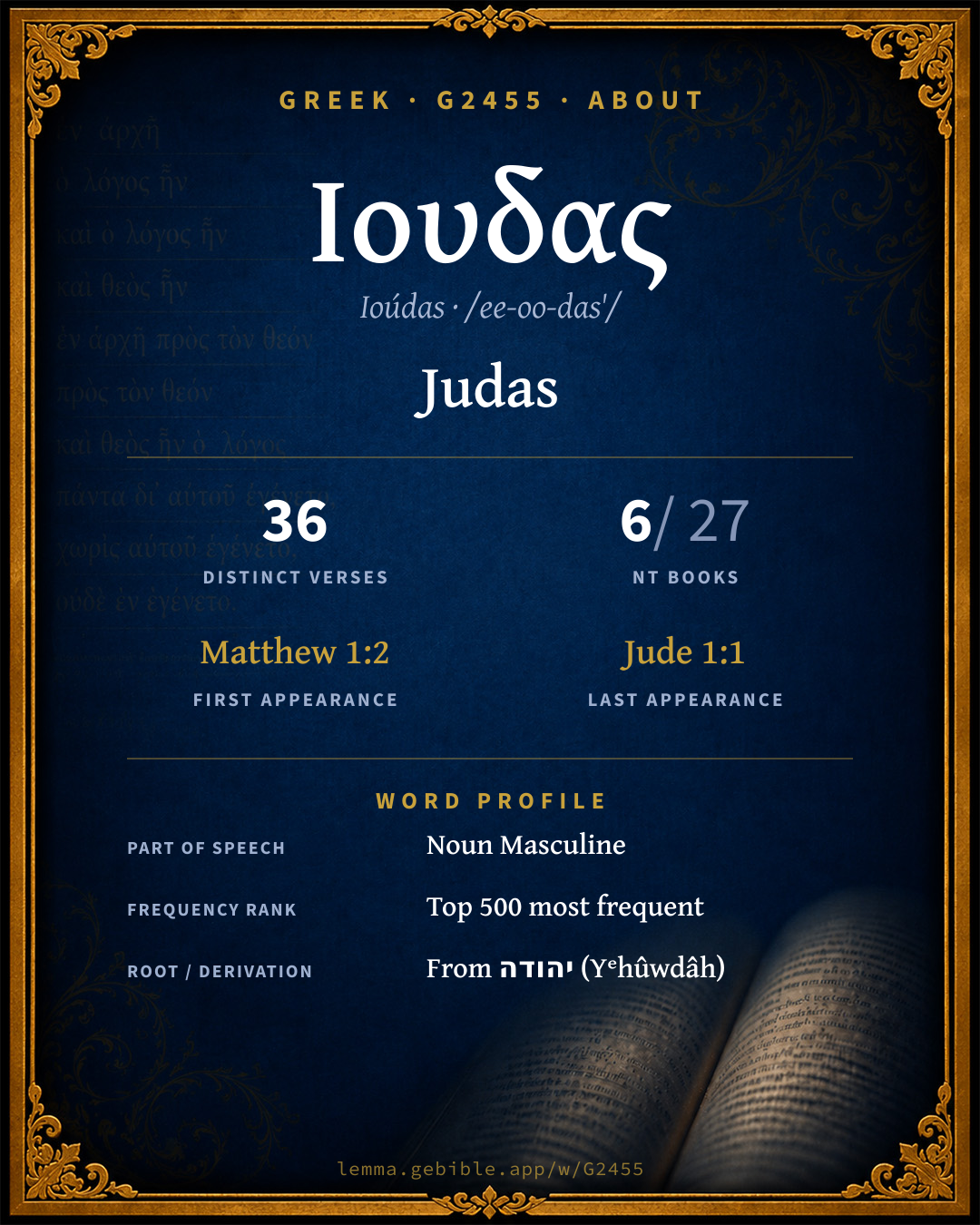
Ἰουδάς
Judas
Thayer's lists 9 entries for ‘Judas’ fuller range ↓
Full lexicon entry — Thayer's Greek Lexicon
From Thayer's Greek Lexicon
Where this word appears
See every Nominative-case word in the Greek New Testament →
Grammar key — what these labels mean
Part of speech
- Noun
- A naming word — a person, place, thing, or idea.
Case
- Nominative
- The case of the subject (and the predicate nominative).
- Accusative
- The case of the direct object and of extent.
- Genitive
- The case of source, possession, or “of” — answers “whose / from what.”
- Dative
- The case of the indirect object, means, or location — “to / for / with / in.”
- Vocative
- The case of direct address (“O Lord”).
Gender
- Masculine
- Grammatically masculine.
Number
- Singular
- One.
Grammatical forms
- Noun, Nominative, Singular, Masculine 22 times (59%)
- Noun, Accusative, Singular, Masculine 8 times (22%)
- Noun, Genitive, Singular, Masculine 5 times (14%)
- Noun, Dative, Singular, Masculine 1 time (3%)
- Noun, Vocative, Singular, Masculine 1 time (3%)
Parsed forms decoded from the imported morphology (Robinson–Tischendorf, public domain), counted across 37 parsed occurrences — not distinct verses.
Every verse where G2455 appears — 36 distinct verses across 6 books. Click any verse to open its interlinear word-by-word view. Verse text shown in the World English Bible for context — . Each verse’s Greek form is shown with its reference; the English is not keyword-highlighted, since the data carries no word-level English alignment. Use “Compare translations” on any verse to read it across multiple English versions. This concordance covers the Greek New Testament; Septuagint (Greek Old Testament) occurrences of this word are not indexed here.
Matthew 8 verses
- Matthew 1:2 Ἰούδαν n acc sg masc Abraham became the father of Isaac. Isaac became the father of Jacob. Jacob became the father of Judah and his brothers.
- Matthew 1:3 Ἰούδας n nom sg masc Judah became the father of Perez and Zerah by Tamar. Perez became the father of Hezron. Hezron became the father of Ram.
- Matthew 10:4 Ἰούδας n nom sg masc Simon the Canaanite; and Judas Iscariot, who also betrayed him.
- Matthew 13:55 Ἰούδας n nom sg masc Isn't this the carpenter's son? Isn't his mother called Mary, and his brothers, James, Joses, Simon, and Judas?
- Matthew 26:14 Ἰούδας n nom sg masc Then one of the twelve, who was called Judas Iscariot, went to the chief priests,
- Matthew 26:25 Ἰούδας n nom sg masc Judas, who betrayed him, answered, "It isn't me, is it, Rabbi?" He said to him, "You said it."
- Matthew 26:47 Ἰούδας n nom sg masc While he was still speaking, behold, Judas, one of the twelve, came, and with him a great multitude with swords and clubs, from the chief priest and elders of the people.
- Matthew 27:3 Ἰούδας n nom sg masc Then Judas, who betrayed him, when he saw that Jesus was condemned, felt remorse, and brought back the thirty pieces of silver to the chief priests and elders,
Mark 4 verses
- Mark 3:19 Ἰούδαν n acc sg masc and Judas Iscariot, who also betrayed him. He came into a house.
- Mark 6:3 Ἰούδα n gen sg masc Isn't this the carpenter, the son of Mary, and brother of James, Joses, Judas, and Simon? Aren't his sisters here with us?" They were offended at him.
- Mark 14:10 Ἰούδας n nom sg masc Judas Iscariot, who was one of the twelve, went away to the chief priests, that he might deliver him to them.
- Mark 14:43 Ἰούδας n nom sg masc Immediately, while he was still speaking, Judas, one of the twelve, came--and with him a multitude with swords and clubs, from the chief priests, the scribes, and the elders.
Luke 6 verses
- Luke 3:30 Ἰούδα n gen sg masc the son of Simeon, the son of Judah, the son of Joseph, the son of Jonan, the son of Eliakim,
- Luke 3:33 Ἰούδα n gen sg masc the son of Amminadab, the son of Aram, the son of Joram, the son of Hezron, the son of Perez, the son of Judah,
- Luke 6:16 Ἰούδαν Ἰούδαν n acc sg masc n acc sg masc Judas the son of James; and Judas Iscariot, who also became a traitor.
- Luke 22:3 Ἰούδαν n acc sg masc Satan entered into Judas, who was surnamed Iscariot, who was numbered with the twelve.
- Luke 22:47 Ἰούδας n nom sg masc While he was still speaking, behold, a multitude, and he who was called Judas, one of the twelve, was leading them. He came near to Jesus to kiss him.
- Luke 22:48 Ἰούδα n voc sg masc But Jesus said to him, "Judas, do you betray the Son of Man with a kiss?"
John 9 verses
- John 6:71 Ἰούδαν n acc sg masc Now he spoke of Judas, the son of Simon Iscariot, for it was he who would betray him, being one of the twelve.
- John 12:4 Ἰούδας n nom sg masc Then Judas Iscariot, Simon's son, one of his disciples, who would betray him, said,
- John 13:2 Ἰούδας n nom sg masc After supper, the devil having already put into the heart of Judas Iscariot, Simon's son, to betray him,
- John 13:26 Ἰούδᾳ n dat sg masc Jesus therefore answered, "It is he to whom I will give this piece of bread when I have dipped it." So when he had dipped the piece of bread, he gave it to Judas, the son of Simon Iscariot.
- John 13:29 Ἰούδας n nom sg masc For some thought, because Judas had the money box, that Jesus said to him, "Buy what things we need for the feast," or that he should give something to the poor.
- John 14:22 Ἰούδας n nom sg masc Judas (not Iscariot) said to him, "Lord, what has happened that you are about to reveal yourself to us, and not to the world?"
- John 18:2 Ἰούδας n nom sg masc Now Judas, who betrayed him, also knew the place, for Jesus often resorted there with his disciples.
- John 18:3 Ἰούδας n nom sg masc Judas then, having taken a detachment of soldiers and officers from the chief priests and the Pharisees, came there with lanterns, torches, and weapons.
- John 18:5 Ἰούδας n nom sg masc They answered him, "Jesus of Nazareth." Jesus said to them, "I AM." Judas also, who betrayed him, was standing with them.
Acts 8 verses
- Acts 1:13 Ἰούδας n nom sg masc When they had come in, they went up into the upper room, where they were staying; that is Peter, John, James, Andrew, Philip, Thomas, Bartholomew, Matthew, James the son of Alphaeus, Simon the Zealot, and Judas the son of James.
- Acts 1:16 Ἰούδα n gen sg masc "Brothers, it was necessary that this Scripture should be fulfilled, which the Holy Spirit spoke before by the mouth of David concerning Judas, who was guide to those who took Jesus.
- Acts 1:25 Ἰούδας n nom sg masc to take part in this ministry and apostleship from which Judas fell away, that he might go to his own place."
- Acts 5:37 Ἰούδας n nom sg masc After this man, Judas of Galilee rose up in the days of the enrollment, and drew away some people after him. He also perished, and all, as many as obeyed him, were scattered abroad.
- Acts 9:11 Ἰούδα n gen sg masc The Lord said to him, "Arise, and go to the street which is called Straight, and inquire in the house of Judas for one named Saul, a man of Tarsus. For behold, he is praying,
- Acts 15:22 Ἰούδαν n acc sg masc Then it seemed good to the apostles and the elders, with the whole assembly, to choose men out of their company, and send them to Antioch with Paul and Barnabas: Judas called Barsabbas, and Silas, chief men among the brothers.
- Acts 15:27 Ἰούδαν n acc sg masc We have sent therefore Judas and Silas, who themselves will also tell you the same things by word of mouth.
- Acts 15:32 Ἰούδας n nom sg masc Judas and Silas, also being prophets themselves, encouraged the brothers with many words, and strengthened them.
Jude 1 verse
About this entry
At a glance — auto-summarized from this page’s data, not written by a person. Every figure links to its source below. This summary describes the numbers; it doesn’t interpret them.
Ιουδας (Ioúdas) is a Greek name most often rendered “Judas.” It first appears in Matthew 1:2. Spanning 36 verses in 6 books, it ranks among the moderately common words of the Greek New Testament. John dominates its distribution — 9 of 36 verses. The sections below give every occurrence and version rendering.
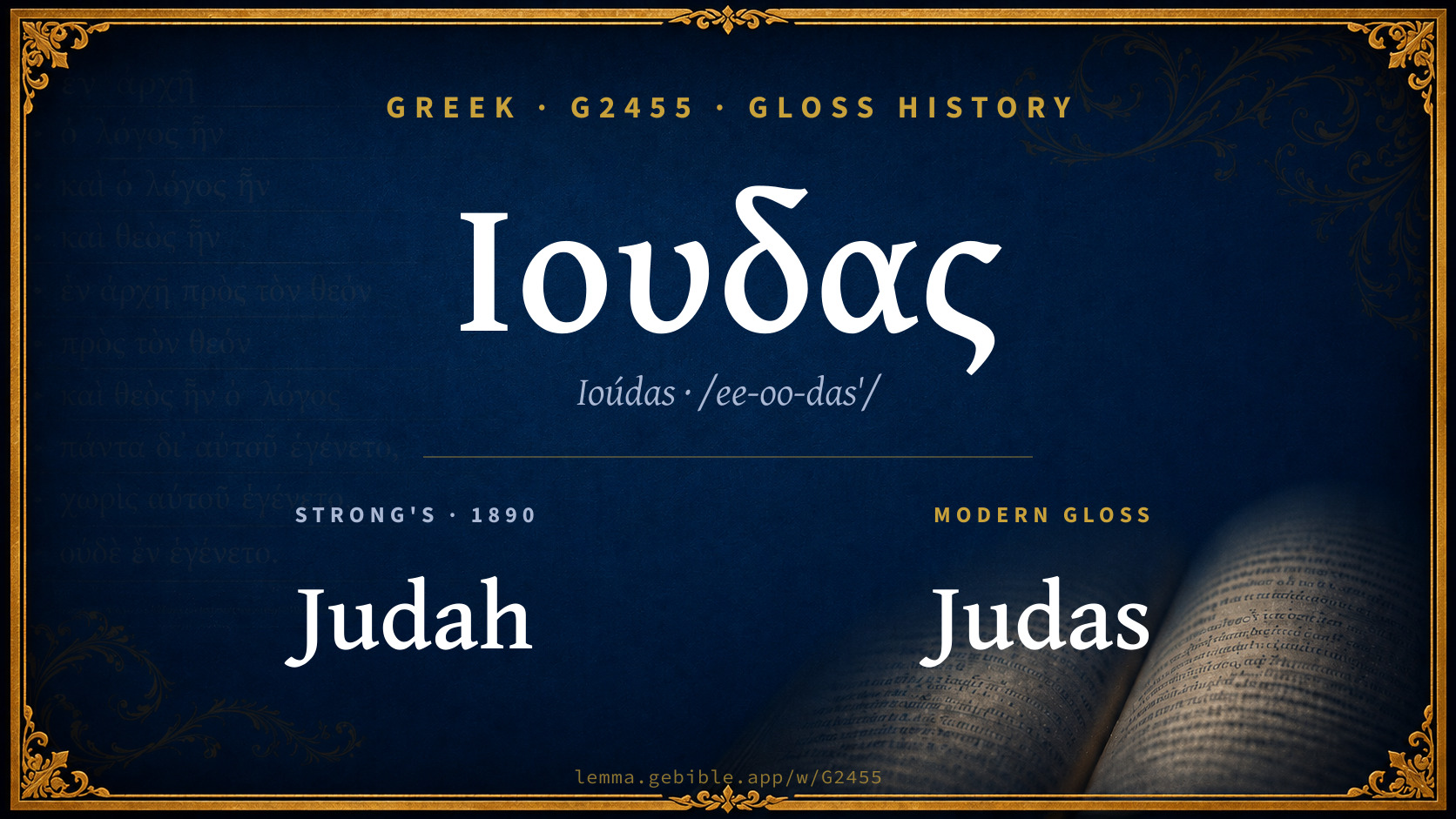
Gloss history
Strong's 1890 vs modern scholarship
About this word
Strong's G2455 catalogs a Greek word from the Greek New Testament.
These counts are not copied from any lexicon or concordance. They are computed here, from the morphology-tagged Greek New Testament. What Lemma adds →
- 36
- distinct verses
- The word appears in 36 distinct verses.
- 6 / 27
- NT books
- The word appears in 6 of 27 New Testament books.
- #397
- by frequency
- Top 500 most frequent Greek words (rank 397 of 5,347 Greek words by occurrence).
View all 36 occurrences in the concordance →
By section of the New Testament
By traditional corpus
Conventional, traditional groupings — biblical authorship is debated, so this is a traditional corpus grouping, not an authorship claim. Some books belong to more than one corpus (Luke is in both the Gospels and the Lukan corpus, and so on), so these shares overlap and need not total 100%. Each figure is a share of the word’s 36 distinct verses.
- Gospels 27 verses · 75%
- Lukan (Luke–Acts) 14 verses · 39%
- Johannine 9 verses · 25%
- General (Catholic) Epistles 1 verse · 3%
How translations render this word
Counts come from each version’s own published word-to-Strong’s tagging or interlinear alignment — an approximate guide to how each version renders this word, not a word-level alignment the data otherwise carries. Because each total is that version’s own tagged count, the per-version totals vary from one another and need not match the appearance or distinct-verse counts above. These counts may also differ from a printed concordance because Lemma counts each distinctly tagged rendering and does not collapse phrase taggings into a single head-word total. This is a fixed set of word-tagged versions (KJV, ASV, BSB, ULT) and does not change with the reading translation you choose elsewhere. Each version’s license is shown beside its name below (and on Sources).
- King James Version: Judas 32×, Juda 4×, Was the son of juda 3×
- American Standard Version: Judas 30×, Judah 2×
- Berean Standard Bible: Judas 31×, Judah 2×
- unfoldingWord Literal Text: Judas 33×, Judah 11×
King James Version Public Domain
Renders G2455 across 42 tagged occurrences — most commonly:
Plus 3 renderings that appear only once — usually multi-word phrases or single function words the recovered tagging swept in, not distinct renderings.
American Standard Version Public Domain
Renders G2455 across 37 tagged occurrences — most commonly:
Plus 5 renderings that appear only once — usually multi-word phrases or single function words the recovered tagging swept in, not distinct renderings.
Berean Standard Bible Public Domain
Renders G2455 across 35 tagged occurrences — most commonly:
Plus 2 renderings that appear only once — usually multi-word phrases or single function words the recovered tagging swept in, not distinct renderings.
unfoldingWord Literal Text CC BY-SA 4.0
Renders G2455 across 46 tagged occurrences — most commonly:
Plus 2 renderings that appear only once — usually multi-word phrases or single function words the recovered tagging swept in, not distinct renderings.
9 senses in Thayer's, in lexicon order
The 9 senses Thayer's distinguishes for this word, in lexicon order (not ranked by frequency or importance). The full entry — with sub-senses — is in the Lexicon Entry tab.
- Judah or Judas = "he shall be praised"
- the fourth son of Jacob
- an unknown ancestor of Christ
- a man surnamed the Galilean, who at the time of the census of Quirinus, excited the revolt in Galilee, Acts 5:37
- a certain Jew of Damascus, Acts 9:11
- a prophet surnamed Barsabas, of the church at Jerusalem, Acts 15:22 , 27 , 32
- the apostle, Jn 14:22 , who was surnamed Lebbaeus or Thaddaeus, and according to opinion wrote the Epistle of Jude.
- the half-brother of Jesus, Mt. 13:55
- Judas Iscariot, the apostle who betrayed Jesus
Word origin
Derived from יהודה (Yᵉhûwdâh) (H3063) — Judah.
Of hebrew origin [ H3063 ]; Judas (that is Jehudah ) the name of ten Israelites; also of the posterity of one of them and its region : - Juda (-h -s); Jude.
— Strong’s Exhaustive Concordance (1890), public domain.
Forms in the corpus
The 4 distinct written forms G2455 takes in the Greek New Testament, most frequent first — each parse links to that case’s occurrences in the concordance.
| Form | Parsing | Example | Uses |
|---|---|---|---|
| Ἰούδας Ioúdas | Noun, Nominative, Singular, Masculine | Matthew 1:3 | 22 |
| Ἰούδαν Ioúdan | Noun, Accusative, Singular, Masculine | Matthew 1:2 | 8 |
| Ἰούδα Ioúda | Noun, Genitive, Singular, Masculine | Mark 6:3 | 6 |
| Ἰούδᾳ Ioúda | Noun, Dative, Singular, Masculine | John 13:26 | 1 |
Same root — word family
Other Thayer's entries built from the same root as G2455, grouped by Strong’s listed origin. These share a root / origin per the lexicon — not necessarily a shared meaning. Each links to that word’s own entry.
Derives from
Proper names from this root
People and places named from this root — a name, not an additional meaning of the word.
Compare all same-root words → Showing 4 of 5 — not the complete family. 4 of the same-root words are proper names (people or places). They share a root, not necessarily a meaning.
Bible dictionary
Public-domain dictionary articles matched to this entry by name (Judas). A biblical name can be shared by more than one person or place, so an article may treat several.
Easton's Bible Dictionary · M. G. Easton, 1897
The Graecized form of Judah. (1.) The patriarch (Matt. 1:2, 3).
(2.) Son of Simon (John 6:71; 13:2, 26), surnamed Iscariot, i.e., a man of Kerioth (Josh. 15:25). His name is uniformly the last in the list of the apostles, as given in the synoptic (i.e., the first three) Gospels. The evil of his nature probably gradually unfolded itself till "Satan entered into him" (John 13:27), and he betrayed our Lord (18:3). Afterwards he owned his sin with "an exceeding bitter cry," and cast the money he had received as the wages of his iniquity down on the floor of the sanctuary, and "departed and went and hanged himself" (Matt. 27:5). He perished in his guilt, and "went unto his own place" (Acts 1:25). The statement in Acts 1:18 that he "fell headlong and burst asunder in the midst, and all his bowels gushed out," is in no way contrary to that in Matt. 27:5. The sucide first hanged himself, perhaps over the valley of Hinnom, "and the rope giving way, or the branch to which he hung breaking, he fell down headlong on his face, and was crushed and mangled on the rocky pavement below."
Why such a man was chosen to be an apostle we know not, but it is written that "Jesus knew from the beginning who should betray him" (John 6:64). Nor can any answer be satisfactorily given to the question as to the motives that led Judas to betray his Master. "Of the motives that have been assigned we need not care to fix on any one as that which simply led him on. Crime is, for the most part, the result of a hundred motives rushing with bewildering fury through the mind of the criminal."
(3.) A Jew of Damascus (Acts 9:11), to whose house Ananias was sent. The street called "Straight" in which it was situated is identified with the modern "street of bazaars," where is still pointed out the so-called "house of Judas."
(4.) A Christian teacher, surnamed Barsabas. He was sent from Jerusalem to Antioch along with Paul and Barnabas with the decision of the council (Acts 15:22, 27, 32). He was a "prophet" and a "chief man among the brethren."
Smith's Bible Dictionary · William Smith, 1863
surnamed Barsabas, a leading member of the apostolic church at Jerusalem, (Acts 15:22) endued with the gift of prophesy, ver. (Acts 15:32) chosen with Silas to accompany Paul and Barnabas as delegates to the church at Antioch. (A.D. 47.) Later, Judas went back to Jerusalem.
the Greek form of the Hebrew name Judah, occurring in the LXX, and the New Testament.
+ The patriarch Judah. (Matthew 1:2,3) + A man residing at Damascus, in "the street which is called Straight," in whose house Saul of Tarsus lodged after his miraculous conversion. (Acts 9:11)
Hitchcock's Bible Names Dictionary · Roswell D. Hitchcock, 1869
Jude, same as Judah
Classic public-domain reference works; full attribution on Sources.
Septuagint usage
The same Greek word Ιουδας appears 121 times in the Greek Old Testament (Septuagint), across 118 verses in 21 books.
- 121
- LXX occurrences
- Tagged occurrences of this Greek word in the Septuagint.
- 118
- verses
- Distinct Septuagint verses containing this word.
- 21 / 39
- OT books
- The word appears in 21 of the 39 Old Testament books.
Sample Septuagint occurrences
- Genesis 35:23 ἰούδας
- Exodus 1:2 ἰούδας
- Deuteronomy 27:12 ἰούδας
- Joshua 18:5 ἰούδας
- Judges 1:2 ἰούδας
- 1 Samuel 15:4 ἰούδας
- 2 Samuel 3:10 ἰούδας
- 1 Kings 15:9 ἰούδας
- 2 Kings 8:19 ἰούδας
- 1 Chronicles 5:2 ἰούδας
- 2 Chronicles 11:1 ἰούδας
- Ezra 12:7 ἰούδας
Septuagint occurrences (same lexeme)
Every verse where the same Strong’s number (G2455) appears in the Greek Septuagint — showing the first 50 of 118. Verse text shown in the World English Bible for context; the Greek form is the matched word — the English is not keyword-highlighted.
- Genesis 35:23 ἰούδας The sons of Leah: Reuben (Jacob's firstborn), Simeon, Levi, Judah, Issachar, and Zebulun.
- Genesis 37:26 ἰούδας Judah said to his brothers, "What profit is it if we kill our brother and conceal his blood?
- Genesis 38:1 ἰούδας It happened at that time, that Judah went down from his brothers, and visited a certain Adullamite, whose name was Hirah.
- Genesis 38:2 ἰούδας Judah saw there a daughter of a certain Canaanite whose name was Shua. He took her, and went in to her.
- Genesis 38:6 ἰούδας Judah took a wife for Er, his firstborn, and her name was Tamar.
- Genesis 38:8 ἰούδας Judah said to Onan, "Go in to your brother's wife, and perform the duty of a husband's brother to her, and raise up seed to your brother."
- Genesis 38:11 ἰούδας Then Judah said to Tamar, his daughter-in-law, "Remain a widow in your father's house, until Shelah, my son, is grown up;" for he said, "Lest he also die, like his brothers." Tamar went and lived in her father's house.
- Genesis 38:12 ἰούδας After many days, Shua's daughter, the wife of Judah, died. Judah was comforted, and went up to his sheep-shearers to Timnah, he and his friend Hirah, the Adullamite.
- Genesis 38:15 ἰούδας When Judah saw her, he thought that she was a prostitute, for she had covered her face.
- Genesis 38:20 ἰούδας Judah sent the kid of the goats by the hand of his friend, the Adullamite, to receive the pledge from the woman's hand, but he didn't find her.
- Genesis 38:22 ἰούδας He returned to Judah, and said, "I haven't found her; and also the men of the place said, 'There has been no prostitute here.'"
- Genesis 38:23 ἰούδας Judah said, "Let her keep it, lest we be shamed. Behold, I sent this kid, and you haven't found her."
- Genesis 38:24 ἰούδας It happened about three months later, that it was told Judah, saying, "Tamar, your daughter-in-law, has played the prostitute; and moreover, behold, she is with child by prostitution." Judah said, "Bring her forth, and let her be burnt."
- Genesis 38:26 ἰούδας Judah acknowledged them, and said, "She is more righteous than I, because I didn't give her to Shelah, my son." He knew her again no more.
- Genesis 43:3 ἰούδας Judah spoke to him, saying, "The man solemnly warned us, saying, 'You shall not see my face, unless your brother is with you.'
- Genesis 43:8 ἰούδας Judah said to Israel, his father, "Send the boy with me, and we will arise and go, so that we may live, and not die, both we, and you, and also our little ones.
- Genesis 44:14 ἰούδας Judah and his brothers came to Joseph's house, and he was still there. They fell on the ground before him.
- Genesis 44:16 ἰούδας Judah said, "What will we tell my lord? What will we speak? Or how will we clear ourselves? God has found out the iniquity of your servants. Behold, we are my lord's bondservants, both we, and he also in whose hand the cup is found."
- Genesis 44:18 ἰούδας Then Judah came near to him, and said, "Oh, my lord, please let your servant speak a word in my lord's ears, and don't let your anger burn against your servant; for you are even as Pharaoh.
- Genesis 46:28 ἰούδας He sent Judah before him to Joseph, to show the way before him to Goshen, and they came into the land of Goshen.
- Exodus 1:2 ἰούδας Reuben, Simeon, Levi, and Judah,
- Deuteronomy 27:12 ἰούδας These shall stand on Mount Gerizim to bless the people, when you are passed over the Jordan: Simeon, and Levi, and Judah, and Issachar, and Joseph, and Benjamin.
- Joshua 18:5 ἰούδας They shall divide it into seven portions: Judah shall abide in his border on the south, and the house of Joseph shall abide in their border on the north.
- Judges 1:2 ἰούδας Yahweh said, Judah shall go up: behold, I have delivered the land into his hand.
- Judges 1:3 ἰούδας Judah said to Simeon his brother, Come up with me into my lot, that we may fight against the Canaanites; and I likewise will go with you into your lot. So Simeon went with him.
- Judges 1:4 ἰούδας Judah went up; and Yahweh delivered the Canaanites and the Perizzites into their hand: and they struck of them in Bezek ten thousand men.
- Judges 1:10 ἰούδας Judah went against the Canaanites who lived in Hebron (now the name of Hebron before was Kiriath Arba); and they struck Sheshai, and Ahiman, and Talmai.
- Judges 1:17 ἰούδας Judah went with Simeon his brother, and they struck the Canaanites who inhabited Zephath, and utterly destroyed it. The name of the city was called Hormah.
- Judges 1:18 ἰούδας Also Judah took Gaza with the border of it, and Ashkelon with the border of it, and Ekron with the border of it.
- Judges 10:9 ἰούδας The children of Ammon passed over the Jordan to fight also against Judah, and against Benjamin, and against the house of Ephraim; so that Israel was sore distressed.
- Judges 20:18 ἰούδας The children of Israel arose, and went up to Bethel, and asked counsel of God; and they said, Who shall go up for us first to battle against the children of Benjamin? Yahweh said, Judah [shall go up] first.
- 1 Samuel 15:4 ἰούδας Saul summoned the people, and numbered them in Telaim, two hundred thousand footmen, and ten thousand men of Judah.
- 1 Samuel 18:9 ἰούδας Saul eyed David from that day and forward.
- 2 Samuel 3:10 ἰούδας to transfer the kingdom from the house of Saul, and to set up the throne of David over Israel and over Judah, from Dan even to Beersheba.
- 2 Samuel 5:5 ἰούδας In Hebron he reigned over Judah seven years and six months; and in Jerusalem he reigned thirty-three years over all Israel and Judah.
- 2 Samuel 11:11 ἰούδας Uriah said to David, The ark, and Israel, and Judah, abide in booths; and my lord Joab, and the servants of my lord, are encamped in the open field; shall I then go into my house, to eat and to drink, and to lie with my wife? as you live, and as your soul lives, I will not do this thing.
- 2 Samuel 20:5 ἰούδας So Amasa went to call [the men of] Judah together; but he stayed longer than the set time which he had appointed him.
- 1 Kings 15:9 ἰούδας In the twentieth year of Jeroboam king of Israel began Asa to reign over Judah.
- 1 Kings 15:17 ἰούδας Baasha king of Israel went up against Judah, and built Ramah, that he might not allow anyone to go out or come in to Asa king of Judah.
- 2 Kings 8:19 ἰούδας However Yahweh would not destroy Judah, for David his servant's sake, as he promised him to give to him a lamp for his children always.
- 2 Kings 9:29 ἰούδας In the eleventh year of Joram the son of Ahab began Ahaziah to reign over Judah.
- 2 Kings 14:10 ἰούδας You have indeed struck Edom, and your heart has lifted you up: glory of it, and abide at home; for why should you meddle to [your] hurt, that you should fall, even you, and Judah with you?
- 2 Kings 14:12 ἰούδας Judah was put to the worse before Israel; and they fled every man to his tent.
- 2 Kings 17:19 ἰούδας Also Judah didn't keep the commandments of Yahweh their God, but walked in the statutes of Israel which they made.
- 2 Kings 21:16 ἰούδας Moreover Manasseh shed innocent blood very much, until he had filled Jerusalem from one end to another; besides his sin with which he made Judah to sin, in doing that which was evil in the sight of Yahweh.
- 2 Kings 23:27 ἰούδας Yahweh said, I will remove Judah also out of my sight, as I have removed Israel, and I will cast off this city which I have chosen, even Jerusalem, and the house of which I said, My name shall be there.
- 2 Kings 25:21 ἰούδας The king of Babylon struck them, and put them to death at Riblah in the land of Hamath. So Judah was carried away captive out of his land.
- 1 Chronicles 5:2 ἰούδας For Judah prevailed above his brothers, and of him came the prince; but the birthright was Joseph's:)
- 1 Chronicles 21:5 ἰούδας Joab gave up the sum of the numbering of the people to David. All those of Israel were one million one hundred thousand men who drew sword: and in Judah were four hundred seventy thousand men who drew sword.
- 2 Chronicles 11:1 ἰούδας When Rehoboam was come to Jerusalem, he assembled the house of Judah and Benjamin, one hundred eighty thousand chosen men, who were warriors, to fight against Israel, to bring the kingdom again to Rehoboam.
These are occurrences of the same Greek lexeme (G2455) in the Septuagint — not a translation of any one Hebrew word. The store carries no word-level Hebrew↔Greek alignment, so no Hebrew original is asserted here. Counts come from the recovered LXX Strong's tagging — high-frequency vocabulary is well covered, while rare or late forms may be untagged — so they reflect tagged occurrences and may slightly undercount.