
John 11:54

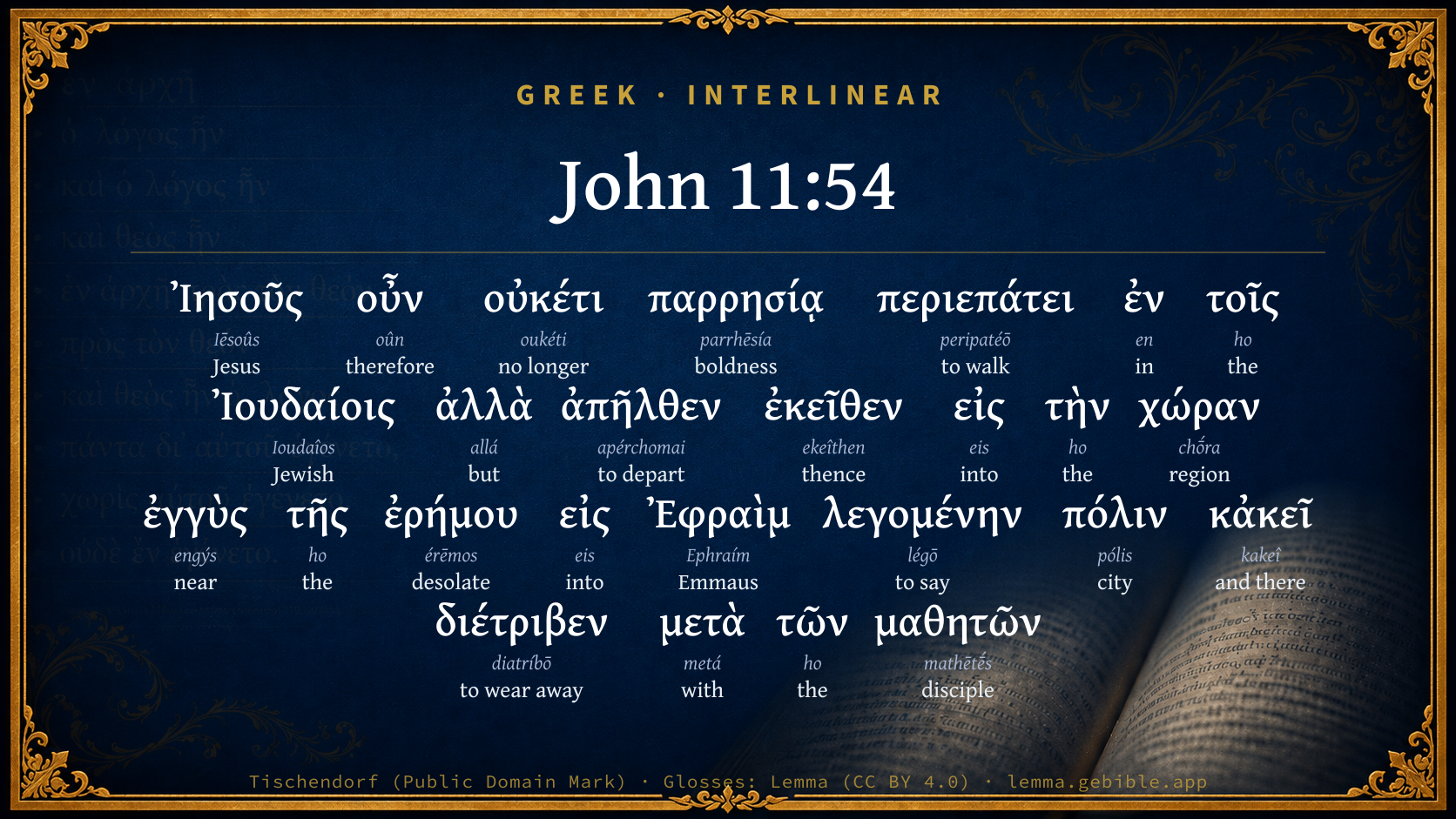
Greek (Tischendorf 8th ed.) John 11:54 appears in the Greek New Testament. The text above is from the Tischendorf 8th edition. Each word links to its Strong’s number and a concise gloss. Click any word for its full Thayer’s Greek Lexicon entry.
Download image
Cite this verse

John 11:54 (World English Bible). Public Domain. Lemma interlinear Bible study tool, https://lemma.gebible.app/v/john/11/54.

Show BibTeX & RIS
BibTeX
RIS
English Translation
Jesus therefore walked no more openly among the Jews, but departed from there into the country near the wilderness, to a city called Ephraim. He stayed there with his disciples.
World English Bible · Public Domain
Highlights
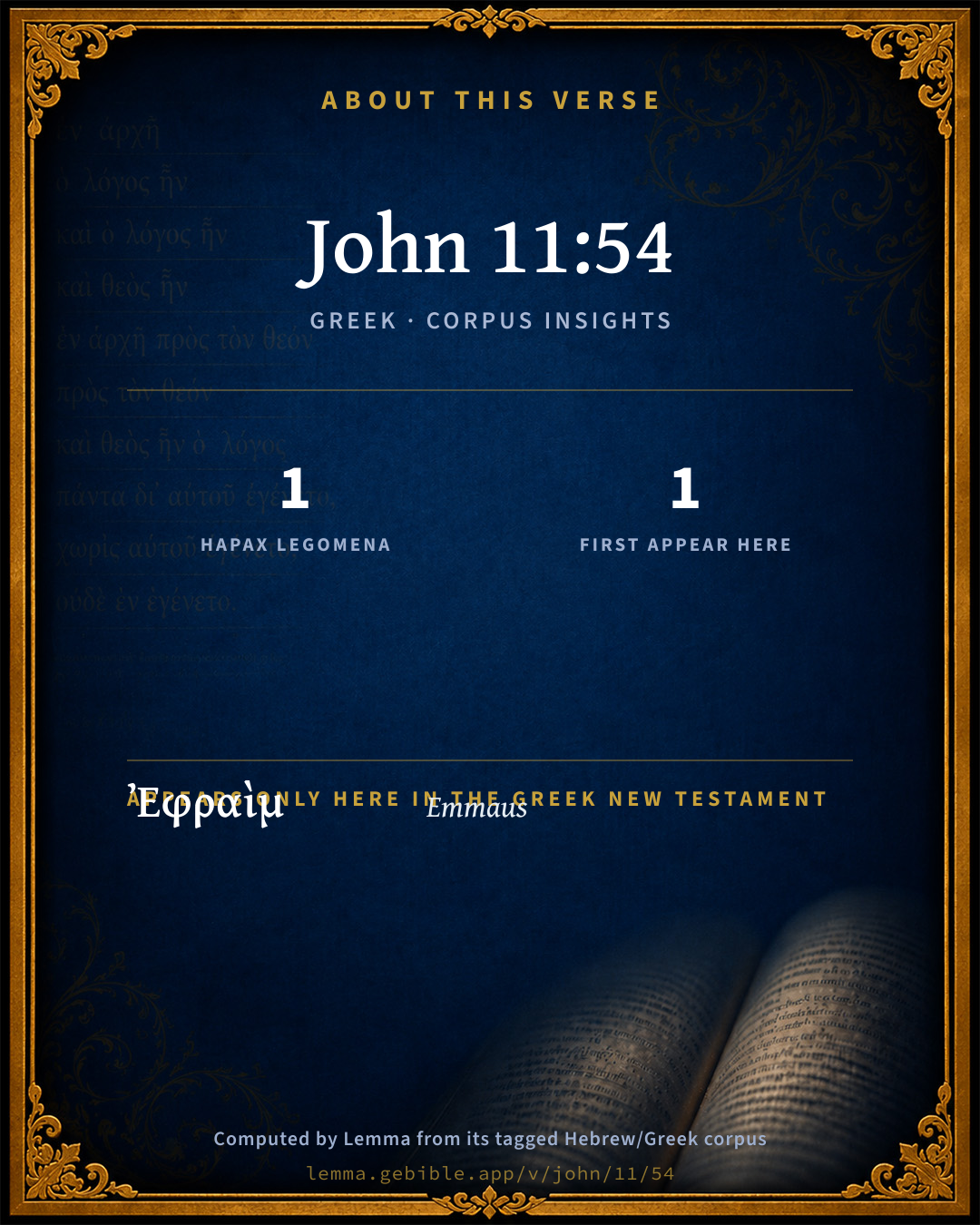
  • 1 hapax legomenon — only here in the Greek New Testament
  • 1 first appearance in the Greek New Testament
Full analysis ↓
Download a study sheet

One document with this verse’s original text, its word-by-word gloss line, the meaning frame, cross-references with their text, attributed commentary, and full source and license credits — printable, and it pastes into notes with its structure intact.

This verse Autodidact and up

Study sheet (.html) Plain text (.txt)

A passage Seminary Student

Up to 50 verses in one chapter. A passage sheet keeps up to 6 commentary sources and 12 cross-references per verse, in the order this page ranks them, and says so on the sheet whenever that leaves anything out. Ask for a single verse and you get the Autodidact verse sheet above.

Everything on this page stays free to read, with no account — the sheet is a download of what is already on screen, not access to it.

Want to remove ads? Support Godless Engineer
Compare translations 3

The same verse in 3 English versions, stacked beneath the original-language interlinear above. Click any original word for its lexicon entry.

Each is an independent rendering of the whole verse — the interlinear is not word-aligned to these translations.

Highlighted words mark where these versions differ — a whole-verse word diff, not a word-by-word alignment.

  • World English Bible Public Domain
    Jesus therefore walked no more openly among the Jews, but departed from there into the country near the wilderness, to a city called Ephraim. He stayed there with his disciples.
  • King James Version Public Domain
    Jesus therefore walked no more openly among the Jews; but went thence unto a country near to the wilderness, into a city called Ephraim, and there continued with his disciples.
  • unfoldingWord Literal Text CC BY-SA 4.0
    Therefore, Jesus no longer walked openly among the Jews, but he departed from there into the country near the wilderness, into a town called Ephraim. There he stayed with the disciples.

unfoldingWord Literal Text — © unfoldingWord, licensed CC BY-SA 4.0. Word-aligned USFM3 via Door43 (git.door43.org/unfoldingWord/en_ult).

Versions to compare (up to 4)

3 of 4 selected

Show all 19 translations

Every available English version of this verse, each an independent rendering of the whole verse.

  • World English Bible Public Domain
    Jesus therefore walked no more openly among the Jews, but departed from there into the country near the wilderness, to a city called Ephraim. He stayed there with his disciples.
  • Berean Standard Bible Public Domain
    As a result, Jesus no longer went about publicly among the Jews, but He withdrew to a town called Ephraim in an area near the wilderness. And He stayed there with the disciples.
  • Majority Standard Bible Public Domain
    As a result, Jesus no longer went about publicly among the Jews, but He withdrew to a town called Ephraim in an area near the wilderness. And He spent time there with His disciples.
  • King James Version Public Domain
    Jesus therefore walked no more openly among the Jews; but went thence unto a country near to the wilderness, into a city called Ephraim, and there continued with his disciples.
  • American Standard Version (1901) Public Domain
    Jesus therefore walked no more openly among the Jews, but departed thence into the country near to the wilderness, into a city called Ephraim; and there he tarried with the disciples.
  • Revised Version (1885) Public Domain
    Jesus therefore walked no more openly among the Jews, but departed thence into the country near to the wilderness, into a city called Ephraim; and there he tarried with the disciples.
  • Geneva Bible (1599) Public Domain
    Iesus therefore walked no more openly among the Iewes, but went thence vnto a countrey neere to the wildernes, into a citie called Ephraim, and there continued with his disciples.
  • Douay-Rheims (1899) Public Domain
    Wherefore Jesus walked no more openly among the Jews; but he went into a country near the desert, unto a city that is called Ephrem, and there he abode with his disciples.
  • Young's Literal Translation Public Domain
    Jesus, therefore, was no more freely walking among the Jews, but went away thence to the region nigh the wilderness, to a city called Ephraim, and there he tarried with his disciples.
  • Literal Standard Version CC BY-SA 4.0
    Jesus, therefore, was no longer freely walking among the Jews, but went away from there into the region near the wilderness, to a city called Ephraim, and there He tarried with His disciples.
  • Unlocked Literal Bible CC BY-SA 4.0
    No longer did Jesus walk openly among the Jews, but he departed from there into the country near to the wilderness into a town called Ephraim. There he stayed with the disciples.
  • unfoldingWord Literal Text CC BY-SA 4.0
    Therefore, Jesus no longer walked openly among the Jews, but he departed from there into the country near the wilderness, into a town called Ephraim. There he stayed with the disciples.
  • Darby Bible Public Domain
    Jesus therefore walked no longer openly among the Jews, but went away thence into the country near the desert, to a city called Ephraim, and there he sojourned with the disciples.
  • World Messianic Bible Public Domain
    Yeshua therefore walked no more openly among the Judeans, but departed from there into the country near the wilderness, to a city called Ephraim. He stayed there with his disciples.
  • Webster's Bible Public Domain
    Jesus therefore walked no more openly among the Jews; but went thence to a country near to the wilderness, into a city called Ephraim, and there continued with his disciples.
  • Free Bible Version CC BY-SA 4.0
    So Jesus did not travel openly among the Jews but went to a town called Ephraim in the region near the desert and stayed there with his disciples.
  • Bible in Basic English Public Domain
    So Jesus no longer went about publicly among the Jews, but went from there into the country near to the waste land, to a town named Ephraim, where he was for some time with the disciples.
  • Text-Critical English NT CC BY 4.0
    Therefore Jesus no longer went around openly among the Jews. Instead, he departed from there to the region near the wilderness, to a town called Ephraim, where he spent time with his disciples.
  • Tyndale New Testament (1534) Public Domain
    Iesus therfore walked no more opely amonge the Iewes: but wet his waye thence vnto a countre nye to a wildernes into a cite called Ephraim and there hauted with his disciples.

Literal Standard Version (2020), Covenant Press — licensed CC BY-SA 4.0. Text via the HelloAO Bible API (eBible.org). Unlocked Literal Bible (unfoldingWord) — licensed CC BY-SA 4.0. Text via the HelloAO Bible API (eBible.org). unfoldingWord Literal Text — © unfoldingWord, licensed CC BY-SA 4.0. Word-aligned USFM3 via Door43 (git.door43.org/unfoldingWord/en_ult). Free Bible Version, Dr. Jonathan Gallagher — licensed CC BY-SA 4.0. Text via the HelloAO Bible API (eBible.org).

Word by word

More ways to search: Search by grammar → Find every occurrence → Compare this word →

Practice this passage: Drill this verse → Learn its vocabulary →

Ἐφραὶμ
Ephraím
G2187
“Emmaus”
Noun, Proper, indeclinable
Part of Speech
Noun · Proper, indeclinable
Full Thayer's Definition

Origin: of hebrew origin, G669 or better G6085

TDNT: None

Ephraim = "double fruitfulness" 1. a city about a short day's journey from Jerusalem
  1. Ἰησοῦς Iēsoûs G2424 “Jesus” Noun, Nominative, Singular, Masculine
  2. οὖν oûn G3767 “therefore” Conjunction
  3. οὐκέτι oukéti G3765 “no longer” Adverb, Negative
  4. παρρησίᾳ parrhēsía G3954 “boldness” Noun, Dative, Singular, Feminine
  5. περιεπάτει peripatéō G4043 “to walk” Verb, Imperfect, Active, Indicative, 3rd person, Singular
  6. ἐν en G1722 “in” Preposition
  7. τοῖς ho G3588 “the” Article, Dative, Plural, Masculine
  8. Ἰουδαίοις Ioudaîos G2453 “Jewish” Adjective, Dative, Plural, Masculine
  9. ἀλλὰ allá G235 “but” Conjunction
  10. ἀπῆλθεν apérchomai G565 “to depart” Verb, Aorist, Active, Indicative, 3rd person, Singular
  11. ἐκεῖθεν ekeîthen G1564 “thence” Adverb
  12. εἰς eis G1519 “into” Preposition
  13. τὴν ho G3588 “the” Article, Accusative, Singular, Feminine
  14. χώραν chṓra G5561 “region” Noun, Accusative, Singular, Feminine
  15. ἐγγὺς engýs G1451 “near” Adverb
  16. τῆς ho G3588 “the” Article, Genitive, Singular, Feminine
  17. ἐρήμου érēmos G2048 “desolate” Adjective, Genitive, Singular, Feminine
  18. εἰς eis G1519 “into” Preposition
  19. λεγομένην légō G3004 “to say” Verb, Present, Passive, Participle, Accusative, Singular, Feminine
  20. πόλιν pólis G4172 “city” Noun, Accusative, Singular, Feminine
  21. κἀκεῖ kakeî G2546 “and there” Adverb, Aramaic form
  22. διέτριβεν diatríbō G1304 “to wear away” Verb, Imperfect, Active, Indicative, 3rd person, Singular
  23. μετὰ metá G3326 “with” Preposition
  24. τῶν ho G3588 “the” Article, Genitive, Plural, Masculine
  25. μαθητῶν mathētḗs G3101 “disciple” Noun, Genitive, Plural, Masculine

About this verse

These counts appear in no published source. They are computed here, from the morphology-tagged text and Lemma’s own curated glosses. What Lemma adds →

26
words
22
distinct lemmas
Gospels
section

Notable vocabulary

1 hapax legomenon — a word that appears only here in the entire Greek New Testament:

  • Ἐφραὶμ Emmaus G2187

First appearance in Scripture

This word makes its first canonical appearance in the Greek New Testament here:

  • Ἐφραὶμ Emmaus G2187

Shared distinctive vocabulary

διέτριβεν to wear away G1304 occurs in 10 verses of the Greek New Testament. Also found in:
Repetition

Words recur within this verse:

Cross-references

9

Topical passages linked to John 11:54 in the Treasury of Scripture Knowledge — connected by theme and wording, ordered by reader-vote popularity; previews shown in the World English Bible.

  • John 7:1 After these things, Jesus was walking in Galilee, for he wouldn't walk in Judea, because the Jews sought to kill him.
  • 2 Chronicles 13:19 Abijah pursued after Jeroboam, and took cities from him, Bethel with the towns of it, and Jeshanah with the towns of it, and Ephron with the towns of it.
  • John 7:4 For no one does anything in secret, and himself seeks to be known openly. If you do these things, reveal yourself to the world."
  • 2 Samuel 13:23 It happened after two full years, that Absalom had sheep-shearers in Baal Hazor, which is beside Ephraim: and Absalom invited all the king's sons.
  • John 4:1–3 Therefore when the Lord knew that the Pharisees had heard that Jesus was making and baptizing more disciples than John
  • John 7:10 But when his brothers had gone up to the feast, then he also went up, not publicly, but as it were in secret.
  • John 7:13 Yet no one spoke openly of him for fear of the Jews.
  • John 10:40 He went away again beyond the Jordan into the place where John was baptizing at first, and there he stayed.
  • John 18:20 Jesus answered him, "I spoke openly to the world. I always taught in synagogues, and in the temple, where the Jews always meet. I said nothing in secret.

Cross-references courtesy of OpenBible.info (CC BY 4.0).

Commentary

Notes on John 11:54 from classic Christian and Jewish commentators (each source and its license shown beneath its notes). The classic Christian expositions comment on the surrounding passage and are grouped to its opening verse, so a note may address several verses; the Jewish commentaries on the Tanakh (Rashi and others) are per-verse, so they appear only where the commentator wrote on this verse.

Lemma curates 59 commentaries, every one of them public domain or Creative Commons licensed, each selected and text-cleaned for this edition rather than reprinted as found. About our sources →

Bengel's Gnomon

Johann Albrecht Bengel

Joh 11:54. Οὐκέτι, no more) This was not the result of fear.—Ἐφραΐμ, Ephraim) See 2Sa 13:23, “Baal-hazor, beside Ephraim.”

Bengel's Gnomon of the New Testament — English translation (T&T Clark, Edinburgh, 1860) — public domain. Text from a community e-Sword module.

Expositor's Greek Testament

ed. W. Robertson Nicoll

Joh 11:54 . Jesus accordingly, Ἰησοῦς οὖν , not to precipitate matters, οὐκ ἔτι … αὐτοῦ , “no longer went about openly among the Jews, but departed thence ( i.e. , from Bethany or Jerusalem and its neighbourhood) to the country near the desert ( χώραν in contrast to the city; the particular part being the wilderness of Bethaven, a few miles north-east of Jerusalem) to a city called Ephraim (now Et-Taiyibeh, anciently Ophrah, see Smith’s Hist. Geog. , 256, 352; ‘perched on a conspicuous eminence and with an extensive view, thirteen miles north of Jerusalem,’ Henderson’s Palestine , p. 161), and there He spent some time with His disciples”.

The Expositor's Greek Testament, edited by W. Robertson Nicoll (1897–1910) — public domain. Text from a community e-Sword module.

Godet's Commentaries

Frédéric Louis Godet

Jesus is forced to withdraw to a retired place. On their part, the rulers take a new step in the path on which they have now entered.

Vv. 54-57. “Jesus therefore abode no more openly among the Jews; but he departed thence and went into the country near to the wilderness, into a city called Ephraim;and he remained there with his disciples. 55. Now the Passover of the Jews was at hand; and many went up to Jerusalem out of the country before the Passover, to purify themselves. 56. They sought for Jesus therefore and said among themselves, as they stood in the temple, What think you? Do you think that he will not come to the feast? 57. Now the chief priests and the Pharisees had also given commandment that, if any one knew where he was, he should declare it, in order that they might take him.”

Ephraim is mentioned sometimes with Bethel (2Ch 13:19; Joseph. Bell. Jud. 4.9. 9). This city was therefore a few leagues northward of Jerusalem; according to Eusebius, eight miles, according to Jerome, twenty miles to the northeast of that capital. This locality, by reason of its retired situation and its proximity to the desert, was favorable to the design of Jesus. He might in the solitude prepare His disciples for His approaching end and, if He was pursued, He might retire into the desert. This desert is, as Lange says, the northern extremity of the barren strip of country by which the plateau of the mountains of Judah and Benjamin is separated throughout its whole length from the valley of the Jordan and the Dead Sea. From this place Jesus could, at will, on the approach of the Passover, either join the pilgrims from Galilee who went directly to Jerusalem through Samaria, or go down to Jericho, in the plain of the Jordan, to put Himself at the head of the caravan which came from Peraea. We know from the Synoptics that He took the latter course. Μετά (Joh 11:54) is not synonymous with σύν; the meaning is: “He confined Himself there to the society of His disciples;” and not only: He was there with them.

᾿Εκ τῆς χωρᾶς (Joh 11:55) does not refer to the country of Ephraim in particular (Grotius, Olshausen) but to thecountry region in general, in opposition to the capital (Joh 11:54): “They went up from different parts of the country.” The law did not prescribe special purifications before the Passover; but, in several passages of the Old Testament, it was ordained that the people should purify themselves on the eve of any important occasion (Gen 35:2; Exo 19:10-11, etc.). This principle had naturally been applied to the Passover feast (2Ch 30:16-20).

Frédéric Louis Godet — Commentaries on Luke, John, Romans, and 1 Corinthians — English translation (T&T Clark, Edinburgh, 1870s–1890s) — public domain. Text from a community e-Sword module.

Geneva Bible (1599)

Geneva Bible translators

We may give place to the rage of the wicked, when it is expedient so to do, but yet in such sort, that we swerve not from God’s vocation.

Geneva Bible (1599) marginal notes — public domain. Text via Bolls.life.

Adam Clarke's Commentary

Verse 54. Walked no more openly] παρρησια, He did not go as before through the cities and villages, teaching, preaching, and healing the sick.

Near to the wilderness] Some MSS. add, of Samphourein, or Samphourim, or Sapfurim.

A city chilled Ephraim] Variously written in the MSS., Ephraim, Ephrem, Ephram, and Ephratha. This was a little village, situated in the neighbourhood of Bethel; for the scripture, 2Ch 13:19, and Josephus, War, b. iv. c. 8. s. 9, join them both together. Many believe that this city or village was the same with that mentioned, 1 Macc. 5:46; 2 Macc. 12:27. Joshua gave it to the tribe of Judah, Jos 15:9; and Eusebius and Jerome say it was about twenty miles north of Jerusalem.

And there continued] Calmet says, following Toynard, that he stayed there two months, from the 24th of January till the 24th of March.

Adam Clarke's Commentary on the Bible (1810–1826) — public domain. Text from a community e-Sword/MySword module.

John Calvin's Commentaries

54. Which is called Ephraim. As to the name of the town which is mentioned here, I think that either it was pronounced at that time in a corrupted manner, or it was entirely new. For we know how greatly the language was changed after the captivity into Babylon, and likewise how different was the appearance of the country; so that we need not be surprised that some places are mentioned, which in ancient times were altogether unknown.

And there he dwelt with his disciples. By calling them disciples of Christ, he means not those who had received his doctrine, but those who were his constant companions, and who were wont to live under the same roof.

John Calvin's Commentaries (1540-1563) — public domain. Text from the Calvin Translation Society English edition (1840s-50s) via the Christian Classics Ethereal Library (ccel.org). Calvin's coverage is partial (roughly two-thirds of the Bible); uncommented books and verses are honest gaps, never fabricated. The 19th-century editor's footnotes and remarks are omitted so the notes are faithfully Calvin's own voice.

Ellicott's Commentary for English Readers

(54) Jesus therefore walked no more openly among the Jews.—He had heard of the decree of the Sanhedrin which had been publicly made known (Joh_11:57), and therefore avoided persons who would have carried it into effect.

“The Jews” are, as before, the hostile party. The passage is a good illustration of St. John’s use of the term, for He was of course among Jews, in the ordinary meaning of the word, during the sojourn at Ephraim. (Comp. Note on Joh_1:19.)

But went thence unto a country near to the wilderness.—All the better MSS. read “unto the country . . .” as in contrast to the city, Jerusalem, where “the Jews” dwelt. He went from Bethany, when He had heard of what had taken place at Jerusalem, “into the country.” This is further defined as “near to the wilderness,” and then the name of the city is given.

Into a city called Ephraim.—The position of this “city” is not known. The MSS. spell it variously as Ephraim, Ephrem, Ephram, and Ephratha. Eusebius and Jerome both assumed it to be the same place as Ephron, but differed as to its position, the former fixing it at eight, and the latter at twenty miles, north-east from Jerusalem. Both would place it, therefore, in Judæa; and this agrees with its position “near to the wilderness,” for the desert of Judæa extended nearly as far as Jericho. In 2Ch_13:19, we have an Ephrain or Ephron (according to the written text and the LXX.) in connection with the neighbourhood of Bethel. This is mentioned by Josephus (Wars, iv. 9, § 9), and is near to the wilderness of Bethaven. It is possibly the place named here; but a Jew would naturally use the phrase, “the wilderness,” to mean the desert of Judæa. Dr. Robinson would identify Ephraim and Ephron with Ophrah (Jos_18:23; 1Sa_17:23), and fix the locality at the modern el-Taiyibeh, four or five miles east from Bethel, and sixteen from Jerusalem, which would agree roughly with the position assigned by Jerome. We must be content to leave the matter in this uncertainty. (Comp. Note on Luk_17:11.)

A Bible Commentary for English Readers, edited by Charles John Ellicott (1878–1897) — public domain. Text from a community e-Sword module.

The Cambridge Bible for Schools and Colleges

gen. ed. J. J. S. Perowne

54. therefore] The decree of the Sanhedrin for His apprehension had been published (Joh_11:57); the sentence of death was probably a secret among themselves.

openly] Comp. Joh_7:10. He withdraws from all intercourse with His adversaries.

went thence unto a country] Departed thence into the country.

the wilderness] The desert of Judæa, which extended to the confines of Jericho, would naturally be meant by ‘the wilderness.’

Ephraim] This place cannot be identified with certainty. Eusebius makes it eight miles, Jerome twenty miles, N.E. of Jerusalem: both make it the same as Ephron. If the Ephraim of 2Ch_13:19 and Josephus (B. J. iv. ix. 9) be meant, the wilderness would be that of Bethaven.

The Cambridge Bible for Schools and Colleges (gen. ed. J. J. S. Perowne; Cambridge University Press, 1878–1918) — public domain. Text from a community e-Sword module.

John Gill's Exposition

Jesus therefore,.... Knowing the resolution the sanhedrim had taken to put him to death, and the schemes they were forming to apprehend him:

walked no more openly among the Jews; at, or near Jerusalem; he did not teach in their streets, nor work miracles, nor appear in public company:

but went thence, from Bethany:

unto a country near to the wilderness: whether this was the wilderness of Judea, where John came preaching, and near to which our Lord was before he came to Bethany, or the wilderness of Bethaven, Jos 18:12, is not certain:

into a city called Ephraim; the Vulgate Latin, Syriac, Arabic, and Persic versions, call it Ephren, and so some copies; it seems to be the same with the Ephraim of the Misnic and Talmudic doctors; concerning which they say (r),

"Micmas and Mezonicha are the first for fine flour, and the next to them is Ephraim in the valley.''

For it seems there were two Ephraims, one in the valley, and another in the mount (s) it was a place very fruitful for wheat; hence that saying of Jannes and Jambres, the magicians of Egypt, to Moses (t);

"do you bring straw to Ephraim?''

which was a proverbial expression, the same with ours of carrying coals to Newcastle: they seeing Moses do signs and wonders, supposed he did them by enchantment; and the sense of their proverb is, do you bring enchantments into Egypt, where there are so many already? This Ephraim, the Jews say (u), is the same with that in Ch2 13:19, and as there Bethel is mentioned with it, it seems to have been in the tribe of Benjamin: and it may be observed, that Josephus (w) speaks of an Ephraim, along with Bethel likewise; so that they all seem to mean the same place; and according to the same writer, it was but a little city, and it may be an obscure one, for which reason Christ withdrew to it. Epiphanius (x) makes mention of the wilderness of Bethel and Ephraim, through which he travelled, accompanied by a Jew, as he came up from Jericho to the hill country; and is very likely the same wilderness which is here spoken of; and by some called Quarentana, and placed by the river Chereth, in the tribe of Benjamin, north east of Jerusalem; and the same writer elsewhere calls (y) Ephraim, the city of the wilderness: according to Jerom (z), it was twenty miles from Aelia, or Jerusalem; though according to Eusebius, it was but eight miles, which is thought to be the truest account; and by them both is said to be a very large village, and in which they may not differ from Josephus; for it might be a large village, and yet a little city. Jerom (a) takes notice of a place called Aphra, in the tribe of Benjamin, which he says at that time was called the village Effrem, and was five miles from Bethel eastward; and of another called Aphraim, a city in the tribe of Issachar, which in his time went by the name of the village Affarea, six miles from the legion, northward; the former agrees best with this Ephraim.

And there continued with his disciples; spending his time in private conversation with them, teaching and instructing them in things concerning the kingdom of God, his time with them being now but short.

(r) Misn. Menachot, c. 8. sect. 1. (s) Barlenora in ib. (t) T. Bab. Menachot, fol. 85. 1. Gloss. in ib. Tzcror Hammor, fol. 170. 2. Bereshit Rabba, sect. 86. fol. 75. 4. (u) Yom. Tob. in Misn. Menachot, c. 8. sect. 1. & Gloss. in T. Bab. Menachot, fol. 83. 2. (w) De Bello Jud. l. 4. c. 9. sect. 9. (x) Adv. Haeres. l. 1. Tom. II. Haeres. 30. (y) Ib. Haeres. 29. (z) De locis Hebraicis, fol. 91. A. (a) lb. fol. 88. H. I.

John Gill's Exposition of the Whole Bible (1746–1763) — public domain (CC PDM 1.0). Text via the HelloAO Bible API.

Trapp's Complete Commentary

John Trapp

54 Jesus therefore walked no more openly among the Jews; but went thence unto a country near to the wilderness, into a city called Ephraim, and there continued with his disciples.

Ver. 54. Into a city called Ephraim] Not elsewhere mentioned; built, perhaps, in honour of their father Ephraim, by the posterity of those rash sons of his, that had brought grief to his heart, and to make amends for their miscarriage. See 1Ch 7:21-22.

John Trapp, A Commentary or Exposition upon All the Books of the Old and New Testament (1647–1656) — public domain. Text from a community e-Sword module.

Albert Barnes' Notes on the Bible

No more openly - No more publicly, in the cities and towns. Jesus never exposed his life unnecessarily to hazard. Although the time of his death was determined in the counsel of God, yet this did not prevent his using proper means to preserve his life.

The wilderness - See the notes at Mat 3:1.

A city called Ephraim - This was probably a small town in the tribe of Ephraim, about five miles west of Jericho.

Albert Barnes' Notes on the Bible (1834–1885) — public domain. Text from a community e-Sword/MySword module.

Haydock's Catholic Bible Commentary

Ephrem was a small city or town in the neighbourhood of Bethel. Some suppose it to be the same as Ephron, mentioned in 2 Paralipomenon xiii 19., and 1 Machabees v., 2 Machabees xii. 17. Eusebius and St. Jerome say it was situated about 20 miles to the north of Jerusalem. (Calmet) --- Here he remained with his disciples till the time in which he had resolved to deliver himself up into the hands of his enemies. (Bible de Vence)

George Leo Haydock (1774–1849), Haydock's Catholic Family Bible and Commentary, 1859 edition — public domain. Excludes Psalms (Douay-Rheims chapter numbering differs from Protestant) and Deuterocanonical books (Catholic canon only).

Matthew Poole's English Annotations

Jesus therefore walked no more openly among the Jews; for he being the true paschal Lamb, was to be slain at that feast, and put an end to that type, and would therefore reserve himself for that time, which was now at hand. A

city called Ephraim: what this Ephren or Ephraim was, interpreters vainly busy themselves in inquiring; it was some obscure city, and near the wilderness; some think it was in the lot of Benjamin, others think it was in the lot of Ephraim, and obtained its name from the tribe in whose lot it was. The Scripture no where mentions it; and it cannot be expected, but that in so many changes of government as had befallen the Jews, the names of places should be so altered, that we should be at loss for many of them: wherever it was, it is said that Christ and his disciples continued there in some privacy.

Matthew Poole's English Annotations on the Holy Bible (1683–1685) — public domain. Text from a community e-Sword/MySword module.

Whedon's Commentary on the Bible

Daniel D. Whedon

54. To a city called Ephraim—Ephraim or Ephron is identified by Robinson with the modern Taiyibeh, which is situated about twenty Roman miles northeast of Jerusalem. It is about six miles from Bethel; it stands upon a high eminence, and commands a view of the vales of the Jordan. It seems to be mentioned in 2Ch_13:19 in connection with Bethel. Driven now twice from the capital, Jesus takes refuge first, in Bethabara, (Joh_1:28,) and last, in Ephraim. In each he remained some five or six weeks; in the last, until he departed for the last Passover. In the former, distance and the Jordan have interposed between himself and Jerusalem, and being under another jurisdiction, he spent his time in teaching and preaching. But in the latter, being but a few miles distant, he is evidently in concealment; so that eager inquiries are made after him at the prelude to the next Passover.

He continued with his disciples—They had anticipated the danger, (Joh_11:8,) and now they share the concealment.

Daniel D. Whedon (gen. ed.), Commentary on the Old and New Testaments (1874–1909) — public domain. Text from a community e-Sword module.

The Pulpit Commentary

This constituted the close of his earthly ministry after his ordinary method. Jesus therefore walked (cf. Joh_7:1) no more openly (parrhsia ; cf. Joh_7:4) among the Jews; but he deputed thence into the country nigh unto the wilderness, to a city called Ephraim. Westcott says the place is mentioned in connection with Bethel. (2Ch_13:19) Not far from Bethel, on the border between Benjamin and Ephraim, is Taiyibeh a conical hill with a village perched aloft, which Robinson ("Bibl. Res.," 2:127) and Stanley ("Sinai and Palestine," p. 210) identify with this Ephraim. In this form the word does not appear in the Old Testament, but Ensebius and Jerome make it twelve miles from Jerusalem, on the east of the road leading to Sichem; and Josephus ("Bell. Jud:," 4:9:9) speaks of "two little towns of Bethela and Ephraim, through which Vespasian passed and left garrisons." Hengstenberg identifies it with "Baal-hazor, which is by Ephraim". (2Sa_13:23) The maps of Van der Welt and of the Palestine Exploration Society place it on the site of Ephraim, Ephron, (2Ch_13:19) or Ophrah, (Jos_18:23) about seven miles north-east from Bethel, and give as second designation Apharaim. The intelligence must have reached our Lord that the Sanhedrin had formally pronounced sentence against him. This may have induced him to retire from Jerusalem until the next great feast, when he would publicly challenge their allegiance. From this neighborhood our Lord could (as we learn from the synoptists) have easily joined the caravan from Persea, which, after crossing Jordan near Jericho, there set its face towards Jerusalem, or the caravan which may have come through Samaria to Bethel. There he abode a (tarried) with the disciples. Meta (says Godet) is not synonymous with sun , but equivalent to he confined himself in the desert region north-east of Jerusalem to the company of the twelve.

Vers. 54-57. A brief period of retirement.

Jesus was now forced to withdraw for a time into a lonely place, so as to place himself beyond the reach of the Sanhedrim

I THE PLACE OF HIS RETIREMENT. "Jesus therefore walked no more openly among the Jews; but went thence into a country near to the wilderness, into a city called Ephraim, and there continued with his disciples .

1. The place lay some distance north of Jerusalem, on the borders of the desert.

2. It was well adapted for a brief period of quiet and unbroken intercourse with his disciples, that he might prepare them for his approaching end.

II THE CURIOSITY OF THE COUNTRY PEOPLE AT JERUSALEM RESPECTING JESUS.

1. It was near the time of the Passover, and many Jews had gone up to purify themselves for the feast.

2. They had heard so much respecting his miracles, his parables, his discourses, that they sought him out to gratify a not unnatural curiosity. "They said among themselves, What think ye, that he will not come to the feast? The question suggests that, aware of the plot of the Sanhedrin for his destruction, Jesus might stay away from the feast.

3. They had been made acquainted with the decree of the Sanhedrin. "Now the chief priests and the Pharisees had also given a commandment, that, if any man heard where he was, he should show it, that they might take him.

(1) Jesus had disappeared from Bethany immediately after the raising of Lazarus. The Jews could not trace his movements after that event.

(2) The commandment of the chief priests and Pharisees betrays an extreme anxiety to arrest Jesus, and put an end. to a career so fatally disturbing to all their ideas and hopes.

The Pulpit Commentary (1880–1919), ed. H.D.M. Spence-Jones & Joseph S. Exell — public domain. Text from a community e-Sword module.

The People's New Testament

B. W. Johnson

54. Jesus therefore walked no more openly. He avoided them until his “hour was come,” and retired to Ephraim, a city sixteen miles northeast of Jerusalem on the borders of the wilderness.

B. W. Johnson's The People's New Testament with Notes (1889–1891) — public domain. Electronic text from the Christian Classics Ethereal Library (CCEL) ThML edition.

unfoldingWord translationNotes

Door43 World Missions Community

General Information:

Jesus leaves Bethany and goes to Ephraim. In verse 55 the story shifts to telling about what many of the Jews are doing now that Passover is near.

walk openly among the Jews

Here "Jews" is a synecdoche for the Jewish leaders and "walk openly" is a metaphor for "live where everyone could see him." AT: "live where all the Jews could see him" or "walk openly among the Jewish leaders who opposed him"

the country

the rural area outside cities where fewer people live

There he stayed with the disciples

Jesus and his disciples stayed in Ephraim for a while. AT: "There he stayed with his disciples for a short period of time" (See: Assumed Knowledge and Implicit Information)

went up to Jerusalem

The phrase "went up" is used here because Jerusalem is higher in elevation than the surrounding areas.

translationWords

walk

Jew

desert

Ephraim

disciple

Passover

Jerusalem

pure

unfoldingWord translationNotes — © Distant Shores Media and the Door43 World Missions Community, licensed CC BY-SA 4.0. Source: git.door43.org/Door43/en_tn.

Cambridge Greek Testament for Schools and Colleges

54. ἔμεινεν (אBL), S. John’s favourite word, is probably to be preferred to διέτριβεν (AD from Joh 3:22?)

54. Ἰ. οὖν. Jesus therefore, because He knew that in raising His friend He had signed His own death-warrant, and that He must wait until His hour was come (Joh 13:1). For παρρησίᾳ see on Joh 7:13; for περιεπάτει Joh 7:1. The time for freedom of speech and freedom of movement among them is over.

εἰς τ. χώραν ἐγγὺς τ. ἐρ. Into the country near the wilderness, a place of greater retirement than Peraea (Joh 10:40). The wilderness of Judaea is probably meant. But Ephraim cannot be identified with certainty. Eusebius makes it eight miles, Jerome twenty miles, N.E. of Jerusalem: both make it the same as Ephron. If the Ephraim of 2Ch 13:19 and Josephus (B. J. VI. Joh 9:9) be meant, the wilderness would be that of Bethaven.

Cambridge Greek Testament for Schools and Colleges (Cambridge University Press, 1896; 21 vols, various authors incl. Carr, Maclear, Plummer, Farrar, Lumby, Moule, M. R. James, Simcox) — public domain. Text from a community e-Sword module.

Alford’s Greek Testament

Henry Alford

54.] Observe the Ἰουδαῖοι here as the official body. He was still among Jews at Ephraim. This city is mentioned 2 Chron. 8:19 in connexion with Bethel, as also by Jos. B. J. iv. 9. 9.

ἐγγ. τ. ἐρ., near the desert of Judah. Its situation is at present unknown (see Winer, Realw. edn. 3, sub voce). Robinson (Harmony, p. 204) supposes it to be the same with Ophrah (Jos 18:23: 1Sa 13:17: not Jdg 6:11, Jdg 6:24; Jdg 8:27) and Ephron of the O.T. (2Ch 13:19, עֶפְריִן, Keri; עֶפְּרוֹן, Cetibh), and the modern et-Taiyibeh, twenty R. miles from Jerusalem. See also Van de Velde, Memoir to accompany the Map of the Holy Land, under Ophrah, p. 338: and Stanley’s Sinai and Palestine, p. 214.

Henry Alford, The Greek Testament (1849–1861) — public domain. Text from a community e-Sword module.

International Critical Commentary

54. ὁ οὖν (because of the machinations of His enemies) Ἰησοῦς οὐκέτι παρρησίᾳ (see for this word on 7:4) περιεπάτει (see on 7:1) ἐν τοῖς Ἰουδαίοις (the hostile Jews; see on 1:19, 5:10).

He withdrew “to the country near the desert,” i.e. the hill country to the north-east of Jerusalem, which was thinly populated. The town or village of Ephraim is not mentioned elsewhere in the N.T. “But it is mentioned by Josephus (Bell. Jud. IV. ix. 9), in connexion with the mountain district (ἡ ὀρεινή) north of Jerusalem, as a small fort (πολίχνιον). … Josephus couples it with Bethel, and it is a coincidence that where it occurs in 2Ch 13:19 (τὴν Ἐφρών) Bethel is named with it. The two places were probably not far apart.”1 It is generally identified with El-Tayibeh, 4 miles north-east of Bethel, on the road from Samaria to Jericho, from which it is distant about 15 miles.

Cod. Bezæ after χώραν inserts ςαμφουρειμ (Sapfurim). Harris1 ingeniously suggests that Σαμφουρείμ “is a mere corruption from the Syriac words answering to whose name is Ephraim, ” which were inserted as a gloss, σαμ standing for the Hebrew שֵׁם. Sepphoris in Galilee has been supposed by some to be indicated by Σαμφουρείμ, but this place is too far away to suit the conditions of the narrative.

κἀκεῖ ἔμεινεν. This is the reading of אBLW (cf. 10:40). ADΓΔΘ read διέτριβεν, which occurs at 3:22 ἐκεῖ διέτριβεν μετʼ αὐτῶν. μένειν is a favourite word with Jn. (cf. e.g. 2:12, 4:40), and is used with μέτα, as here, at 1Jn 2:19.

The rec. text adds αὐτοῦ after μαθητῶν: om. אBDLW See on 2:2.

International Critical Commentary — older volumes (1896–1929), various authors — public domain. Text from a community e-Sword module.

Vincent's Word Studies in the New Testament

Marvin R. Vincent

Wilderness. The wild hill - country, northeast of Jerusalem.

Ephraim. The site is uncertain. Commonly taken as Ophrah (1Sa 13:17), or Ephraim (2Ch 13:19), and identified with el - Taiyibeh, sixteen miles from Jerusalem, and situated on a hill which commands the Jordan valley.

55 - 57. Joh 12:1 - 11. Compare Mt 26:6 - 13; Mr 14:3 - 9.

Marvin R. Vincent, Word Studies in the New Testament (1887–1900) — public domain. Text from a community e-Sword/MySword module.

Lesson kit

Teaching starters — assembled from the data on this page, not authored interpretation. Every prompt links to the verse data it draws on. Edit before teaching.

John, in the Gospels, opens this verse with 26 words (22 distinct Greek lemmas). Its most distinctive word is Ephraím (“Emmaus”). A historical commentator’s framing appears above. Read the whole chapter for the surrounding context.

Discussion questions

  1. The word Ephraím carries the sense “Emmaus.” How does it shape the verse?
  2. This verse holds 1 word here found nowhere else in the Greek New Testament. What might the rare word draw attention to?
  3. The word “Emmaus” first appears here in Scripture. What is being introduced at this debut?
  4. John 3:22 shares the word «to wear away» with this verse. How do the two illuminate each other?
  5. “into” occurs 2× in this one verse. What is the effect of the repetition?
  6. These translations render this verse differently; the difference is in the English rendering, not the original. What questions does that raise?
  7. Reading how Bengel's Gnomon and Expositor's Greek Testament read this verse, where do the two commentators agree and where do they part?

Things to notice

  • 1 word in this verse appears nowhere else in the Greek New Testament.
  • 1 word makes its first canonical appearance in Scripture here.
  • These translations choose different wording for 9 words in this verse.
  • “into” occurs 2× in this single verse.
  • 22 distinct Greek lemmas span 26 words in this verse.

Reading settings

Reading text

Shown beneath each verse's original-language words.

Old Testament
Old Testament edition

Read the OT as the Masoretic Hebrew (MT) or the Greek Septuagint (LXX).

English shown for the Greek Septuagint (in the Hebrew ↔ Greek comparison).

Comparing translations? Open the Compare panel on any verse page to stack up to four side by side.