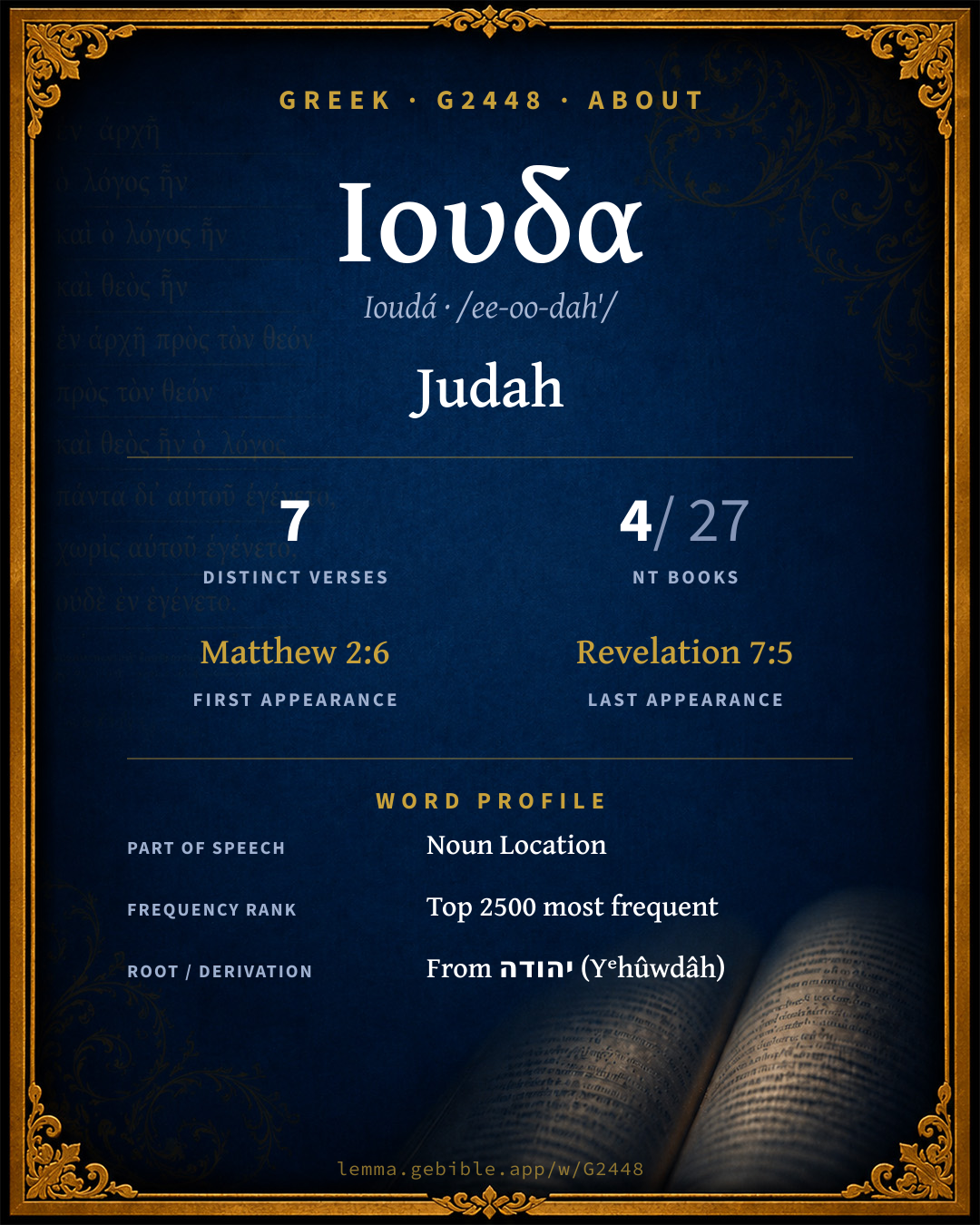
Ἰουδά
Judah
Thayer's lists 5 entries for ‘Judah’ fuller range ↓
Full lexicon entry — Thayer's Greek Lexicon
From Thayer's Greek Lexicon
Where this word appears
Grammar key — what these labels mean
Part of speech
- Noun
- A naming word — a person, place, thing, or idea.
Case
- Genitive
- The case of source, possession, or “of” — answers “whose / from what.”
Gender
- Masculine
- Grammatically masculine.
Number
- Singular
- One.
Grammatical forms
- Noun, Genitive, Singular, Masculine 7 times (88%)
- Noun, Proper, indeclinable 1 time (13%)
Parsed forms decoded from the imported morphology (Robinson–Tischendorf, public domain), counted across 8 parsed occurrences — not distinct verses.
Every verse where G2448 appears — 7 distinct verses across 4 books. Click any verse to open its interlinear word-by-word view. Verse text shown in the World English Bible for context — . Each verse’s Greek form is shown with its reference; the English is not keyword-highlighted, since the data carries no word-level English alignment. Use “Compare translations” on any verse to read it across multiple English versions. This concordance covers the Greek New Testament; Septuagint (Greek Old Testament) occurrences of this word are not indexed here.
Matthew 1 verse
Luke 2 verses
Hebrews 2 verses
- Hebrews 7:14 Ἰούδα n gen sg masc For it is evident that our Lord has sprung out of Judah, about which tribe Moses spoke nothing concerning priesthood.
- Hebrews 8:8 Ἰούδα n gen sg masc For finding fault with them, he said, "Behold, the days come," says the Lord, "That I will make a new covenant with the house of Israel and with the house of Judah;
Revelation 2 verses
- Revelation 5:5 Ἰούδα n gen sg masc One of the elders said to me, "Don't weep. Behold, the Lion who is of the tribe of Judah, the Root of David, has overcome; he who opens the book and its seven seals."
- Revelation 7:5 Ἰούδα n gen sg masc Of the tribe of Judah were sealed twelve thousand, Of the tribe of Reuben twelve thousand, Of the tribe of Gad twelve thousand,
About this entry
At a glance — auto-summarized from this page’s data, not written by a person. Every figure links to its source below. This summary describes the numbers; it doesn’t interpret them.
Ιουδα (Ioudá) is a Greek name most often rendered “Judah.” Scripture first uses it in Matthew 2:6. It turns up in 7 verses across 4 books, an uncommon footprint. It concentrates in Luke, which alone accounts for 29% of its uses. For the data behind this summary, explore 7-verse concordance and the renderings breakdown below.
Gloss history
Strong's 1890 vs modern scholarship
About this word
Strong's G2448 catalogs a Greek word from the Greek New Testament.
These counts are not copied from any lexicon or concordance. They are computed here, from the morphology-tagged Greek New Testament. What Lemma adds →
- 7
- distinct verses
- The word appears in 7 distinct verses.
- 4 / 27
- NT books
- The word appears in 4 of 27 New Testament books.
- #1,240
- by frequency
- Top 2500 most frequent Greek words (rank 1,240 of 5,347 Greek words by occurrence).
View all 7 occurrences in the concordance →
Most concentrated in
- Luke 2 verses 29%
- Hebrews 2 verses 29%
- Revelation 2 verses 29%
By section of the New Testament
By traditional corpus
Conventional, traditional groupings — biblical authorship is debated, so this is a traditional corpus grouping, not an authorship claim. Some books belong to more than one corpus (Luke is in both the Gospels and the Lukan corpus, and so on), so these shares overlap and need not total 100%. Each figure is a share of the word’s 7 distinct verses.
- Gospels 3 verses · 43%
- Lukan (Luke–Acts) 2 verses · 29%
- Johannine 2 verses · 29%
- Hebrews 2 verses · 29%
- Revelation 2 verses · 29%
How translations render this word
Counts come from each version’s own published word-to-Strong’s tagging or interlinear alignment — an approximate guide to how each version renders this word, not a word-level alignment the data otherwise carries. Because each total is that version’s own tagged count, the per-version totals vary from one another and need not match the appearance or distinct-verse counts above. These counts may also differ from a printed concordance because Lemma counts each distinctly tagged rendering and does not collapse phrase taggings into a single head-word total. This is a fixed set of word-tagged versions (KJV, ASV, BSB, ULT) and does not change with the reading translation you choose elsewhere. Each version’s license is shown beside its name below (and on Sources).
- King James Version: Juda 3×
- American Standard Version: Judah 7×
- Berean Standard Bible: Judah 9×
King James Version Public Domain
Renders G2448 across 3 tagged occurrences — most commonly:
American Standard Version Public Domain
Renders G2448 across 7 tagged occurrences — most commonly:
Berean Standard Bible Public Domain
Renders G2448 across 10 tagged occurrences — most commonly:
Plus 1 rendering that appears only once — usually multi-word phrases or single function words the recovered tagging swept in, not distinct renderings.
Senses in Thayer's
The 5 senses Thayer's distinguishes for this word, in lexicon order (not ranked by frequency or importance). The full entry — with sub-senses — is in the Lexicon Entry tab.
- Judah = "he shall be praised"
- the fourth son of the patriarch Jacob
- the tribe that were the offspring of Judah
- the region occupied by the tribe
- a city of the tribe of Judah…
Word origin
Derived from יהודה (Yᵉhûwdâh) (H3063) — Judah.
Forms in the corpus
The 2 distinct written forms G2448 takes in the Greek New Testament, most frequent first — each parse links to that case’s occurrences in the concordance.
| Form | Parsing | Example | Uses |
|---|---|---|---|
| Ἰούδα Ioúda | Noun, Genitive, Singular, Masculine | Matthew 2:6 | 7 |
| Ἰωδὰ Iōdà | Noun, Proper, indeclinable | Luke 3:26 | 1 |
Same root — word family
Other Thayer's entries built from the same root as G2448, grouped by Strong’s listed origin. These share a root / origin per the lexicon — not necessarily a shared meaning. Each links to that word’s own entry.
Derives from
Proper names from this root
People and places named from this root — a name, not an additional meaning of the word.
- Ιουδας Ioúdas G2455 Judas
- יהוד Yᵉhûwd H3061 Judah
- יהודי Yᵉhûwdîy H3064 Jew
- Ιουδαιος Ioudaîos G2453 Jewish
Compare all same-root words → Showing 4 of 6 — not the complete family. 5 of the same-root words are proper names (people or places). They share a root, not necessarily a meaning.
Bible dictionary
Public-domain dictionary articles matched to this entry by name (Judah). A biblical name can be shared by more than one person or place, so an article may treat several.
Easton's Bible Dictionary · M. G. Easton, 1897
Praise, the fourth son of Jacob by Leah. The name originated in Leah's words of praise to the Lord on account of his birth: "Now will I praise [Heb. odeh] Jehovah, and she called his name Yehudah" (Gen. 29:35).
It was Judah that interposed in behalf of Joseph, so that his life was spared (Gen. 37:26, 27). He took a lead in the affairs of the family, and "prevailed above his brethren" (Gen. 43:3-10; 44:14, 16-34; 46:28; 1 Chr. 5:2).
Soon after the sale of Joseph to the Ishmaelites, Judah went to reside at Adullam, where he married a woman of Canaan. (See ONAN; TAMAR.) After the death of his wife Shuah, he returned to his father's house, and there exercised much influence over the patriarch, taking a principal part in the events which led to the whole family at length going down into Egypt. We hear nothing more of him till he received his father's blessing (Gen. 49:8-12).
Smith's Bible Dictionary · William Smith, 1863
(praised, celebrated), the fourth son of Jacob and the fourth of Leah. (B.C. after 1753.) Of Judah's personal character more traits are preserved than of any other of the patriarchs, with the exception of Joseph, whose life he in conjunction with Reuben saved. (Genesis 37:26-28) During the second visit to Egypt for corn it was Judah who understood to be responsible for the safety of Benjamin, ch. (Genesis 43:3-10) and when, through Joseph's artifice, the brothers were brought back to the palace, he is again the leader and spokesman of the band. So too it is Judah who is sent before Jacob to smooth the way for him in the land of Goshen. ch. (Genesis 46:28) This ascendancy over his brethren is reflected in the last words addressed to him by his father. The families of Judah occupy a position among the tribes similar to that which their progenitor had taken among the patriarchs. The numbers of the tribe at the census at Sinai were 74,600. (Numbers 1:26,27) On the borders of the promised land they were 76,500. (Genesis 26:22) The boundaries and contents of the territory allotted to Judah are narrated at great length, and with greater minuteness than the others, in (Joshua 15:20-63) The north boundary, for the most part coincident with the south boundary of Benjamin, began at the embouchure of the Jordan and ended on the west at Jabneel on the coast of the Mediterranean, four miles south of Joppa. On the east the Dead Sea, and on the west the Mediterranean, formed the boundaries. The southern line is hard to determine, since it is denoted by places many of which have not been identified. It left the Dead Sea at its extreme south end, and joined the Mediterranean at the Wady el-Arish. This territory is in average length about 45 miles, and in average breadth about 50.
Hitchcock's Bible Names Dictionary · Roswell D. Hitchcock, 1869
the praise of the Lord; confession
Classic public-domain reference works; full attribution on Sources.
Septuagint usage
The same Greek word Ιουδα appears 627 times in the Greek Old Testament (Septuagint), across 580 verses in 30 books.
- 627
- LXX occurrences
- Tagged occurrences of this Greek word in the Septuagint.
- 580
- verses
- Distinct Septuagint verses containing this word.
- 30 / 39
- OT books
- The word appears in 30 of the 39 Old Testament books.
Sample Septuagint occurrences
- Genesis 29:35 ιουδα
- Exodus 31:2 ιουδα
- Numbers 1:7 ιουδα
- Deuteronomy 33:7 ιουδα
- Joshua 7:1 ιουδα
- Judges 1:8 ιουδα
- Ruth 1:1 ιουδα
- 1 Samuel 11:8 ιουδα
- 2 Samuel 1:12 ιουδα
- 1 Kings 1:9 ιουδα
- 2 Kings 1:18 ιουδα
- 1 Chronicles 2:1 ἰουδά
Septuagint occurrences (same lexeme)
Every verse where the same Strong’s number (G2448) appears in the Greek Septuagint — showing the first 50 of 580. Verse text shown in the World English Bible for context; the Greek form is the matched word — the English is not keyword-highlighted.
- Genesis 29:35 ιουδα She conceived again, and bare a son. She said, "This time will I praise Yahweh." Therefore she named him Judah. Then she stopped bearing.
- Genesis 38:7 ιουδα Er, Judah's firstborn, was wicked in the sight of Yahweh. Yahweh killed him.
- Genesis 38:12 ιουδα After many days, Shua's daughter, the wife of Judah, died. Judah was comforted, and went up to his sheep-shearers to Timnah, he and his friend Hirah, the Adullamite.
- Genesis 38:24 ιουδα It happened about three months later, that it was told Judah, saying, "Tamar, your daughter-in-law, has played the prostitute; and moreover, behold, she is with child by prostitution." Judah said, "Bring her forth, and let her be burnt."
- Genesis 46:12 ιουδα The sons of Judah: Er, Onan, Shelah, Perez, and Zerah; but Er and Onan died in the land of Canaan. The sons of Perez were Hezron and Hamul.
- Genesis 49:8 ιουδα "Judah, your brothers will praise you: Your hand will be on the neck of your enemies; Your father's sons will bow down before you.
- Genesis 49:9 ιουδα Judah is a lion's cub. From the prey, my son, you have gone up. He stooped down, he crouched as a lion, As a lioness. Who will rouse him up?
- Genesis 49:10 ιουδα The scepter will not depart from Judah, Nor the ruler's staff from between his feet, Until he comes to whom it belongs. To him will the obedience of the peoples be.
- Exodus 31:2 ιουδα "Behold, I have called by name Bezalel the son of Uri, the son of Hur, of the tribe of Judah:
- Exodus 35:30 ιουδα Moses said to the children of Israel, "Behold, Yahweh has called by name Bezalel the son of Uri, the son of Hur, of the tribe of Judah.
- Exodus 37:20 ιουδα In the lampstand were four cups made like almond-blossoms, its buds and its flowers;
- Numbers 1:7 ιουδα Of Judah: Nahshon the son of Amminadab.
- Numbers 1:24 ιουδα Of the children of Gad, their generations, by their families, by their fathers' houses, according to the number of the names, from twenty years old and upward, all who were able to go out to war;
- Numbers 1:25 ιουδα those who were numbered of them, of the tribe of Gad, were forty-five thousand six hundred fifty.
- Numbers 2:3 ιουδα Those who encamp on the east side toward the sunrise shall be of the standard of the camp of Judah, according to their divisions: and the prince of the children of Judah shall be Nahshon the son of Amminadab.
- Numbers 2:9 ιουδα All who were numbered of the camp of Judah were one hundred eighty-six thousand four hundred, according to their divisions. They shall set out first.
- Numbers 7:12 ιουδα He who offered his offering the first day was Nahshon the son of Amminadab, of the tribe of Judah,
- Numbers 10:14 ιουδα In the first [place] the standard of the camp of the children of Judah set forward according to their hosts: and over his host was Nahshon the son of Amminadab.
- Numbers 13:6 ιουδα Of the tribe of Judah, Caleb the son of Jephunneh.
- Numbers 26:15 ιουδα The sons of Gad after their families: of Zephon, the family of the Zephonites; of Haggi, the family of the Haggites; of Shuni, the family of the Shunites;
- Numbers 26:16 ιουδα of Ozni, the family of the Oznites; of Eri, the family of the Erites;
- Numbers 26:18 ιουδα These are the families of the sons of Gad according to those who were numbered of them, forty thousand and five hundred.
- Numbers 34:19 ιουδα These are the names of the men: Of the tribe of Judah, Caleb the son of Jephunneh.
- Deuteronomy 33:7 ιουδα This is [the blessing] of Judah: and he said, Hear, Yahweh, the voice of Judah, Bring him in to his people. With his hands he contended for himself; You shall be a help against his adversaries.
- Deuteronomy 34:2 ιουδα and all Naphtali, and the land of Ephraim and Manasseh, and all the land of Judah, to the hinder sea,
- Joshua 7:1 ιουδα But the children of Israel committed a trespass in the devoted thing; for Achan, the son of Carmi, the son of Zabdi, the son of Zerah, of the tribe of Judah, took of the devoted thing: and the anger of Yahweh was kindled against the children of Israel.
- Joshua 7:16 ιουδα So Joshua rose up early in the morning, and brought Israel near by their tribes; and the tribe of Judah was taken:
- Joshua 11:21 ιουδα Joshua came at that time, and cut off the Anakim from the hill-country, from Hebron, from Debir, from Anab, and from all the hill-country of Judah, and from all the hill-country of Israel: Joshua utterly destroyed them with their cities.
- Joshua 14:6 ιουδα Then the children of Judah drew near to Joshua in Gilgal: and Caleb the son of Jephunneh the Kenizzite said to him, You know the thing that Yahweh spoke to Moses the man of God concerning me and concerning you in Kadesh-barnea.
- Joshua 15:1 ιουδα The lot for the tribe of the children of Judah according to their families was to the border of Edom, even to the wilderness of Zin southward, at the uttermost part of the south.
- Joshua 15:12 ιουδα The west border was to the great sea, and the border [of it]. This is the border of the children of Judah round about according to their families.
- Joshua 15:13 ιουδα To Caleb the son of Jephunneh he gave a portion among the children of Judah, according to the commandment of Yahweh to Joshua, even Kiriath Arba, [which Arba was] the father of Anak (the same is Hebron).
- Joshua 15:20 ιουδα This is the inheritance of the tribe of the children of Judah according to their families.
- Joshua 15:21 ιουδα The uttermost cities of the tribe of the children of Judah toward the border of Edom in the South were Kabzeel, and Eder, and Jagur,
- Joshua 15:63 ιουδα As for the Jebusites, the inhabitants of Jerusalem, the children of Judah couldn't drive them out: but the Jebusites dwell with the children of Judah at Jerusalem to this day.
- Joshua 18:11 ιουδα The lot of the tribe of the children of Benjamin came up according to their families: and the border of their lot went out between the children of Judah and the children of Joseph.
- Joshua 18:14 ιουδα The border extended [there], and turned about on the west quarter southward, from the mountain that lies before Beth Horon southward; and the goings out of it were at Kiriath Baal (the same is Kiriath Jearim), a city of the children of Judah: this was the west quarter.
- Joshua 19:1 ιουδα The second lot came out for Simeon, even for the tribe of the children of Simeon according to their families: and their inheritance was in the midst of the inheritance of the children of Judah.
- Joshua 19:9 ιουδα Out of the part of the children of Judah was the inheritance of the children of Simeon; for the portion of the children of Judah was too much for them: therefore the children of Simeon had inheritance in the midst of their inheritance.
- Joshua 19:48 ιουδα This is the inheritance of the tribe of the children of Dan according to their families, these cities with their villages.
- Joshua 20:4 ιουδα He shall flee to one of those cities, and shall stand at the entrance of the gate of the city, and declare his cause in the ears of the elders of that city; and they shall take him into the city to them, and give him a place, that he may dwell among them.
- Joshua 21:4 ιουδα The lot came out for the families of the Kohathites: and the children of Aaron the priest, who were of the Levites, had by lot out of the tribe of Judah, and out of the tribe of the Simeonites, and out of the tribe of Benjamin, thirteen cities.
- Joshua 21:9 ιουδα They gave out of the tribe of the children of Judah, and out of the tribe of the children of Simeon, these cities which are [here] mentioned by name:
- Joshua 21:11 ιουδα They gave them Kiriath Arba, [which Arba was] the father of Anak (the same is Hebron), in the hill-country of Judah, with the suburbs of it round about it.
- Judges 1:8 ιουδα The children of Judah fought against Jerusalem, and took it, and struck it with the edge of the sword, and set the city on fire.
- Judges 1:9 ιουδα Afterward the children of Judah went down to fight against the Canaanites who lived in the hill-country, and in the South, and in the lowland.
- Judges 1:16 ιουδα The children of the Kenite, Moses' brother-in-law, went up out of the city of palm trees with the children of Judah into the wilderness of Judah, which is in the south of Arad; and they went and lived with the people.
- Judges 1:19 ιουδα Yahweh was with Judah; and drove out [the inhabitants of] the hill-country; for he could not drive out the inhabitants of the valley, because they had chariots of iron.
- Judges 15:9 ιουδα Then the Philistines went up, and encamped in Judah, and spread themselves in Lehi.
- Judges 15:10 ιουδα The men of Judah said, Why are you come up against us? They said, To bind Samson are we come up, to do to him as he has done to us.
These are occurrences of the same Greek lexeme (G2448) in the Septuagint — not a translation of any one Hebrew word. The store carries no word-level Hebrew↔Greek alignment, so no Hebrew original is asserted here. Counts come from the recovered LXX Strong's tagging — high-frequency vocabulary is well covered, while rare or late forms may be untagged — so they reflect tagged occurrences and may slightly undercount.