
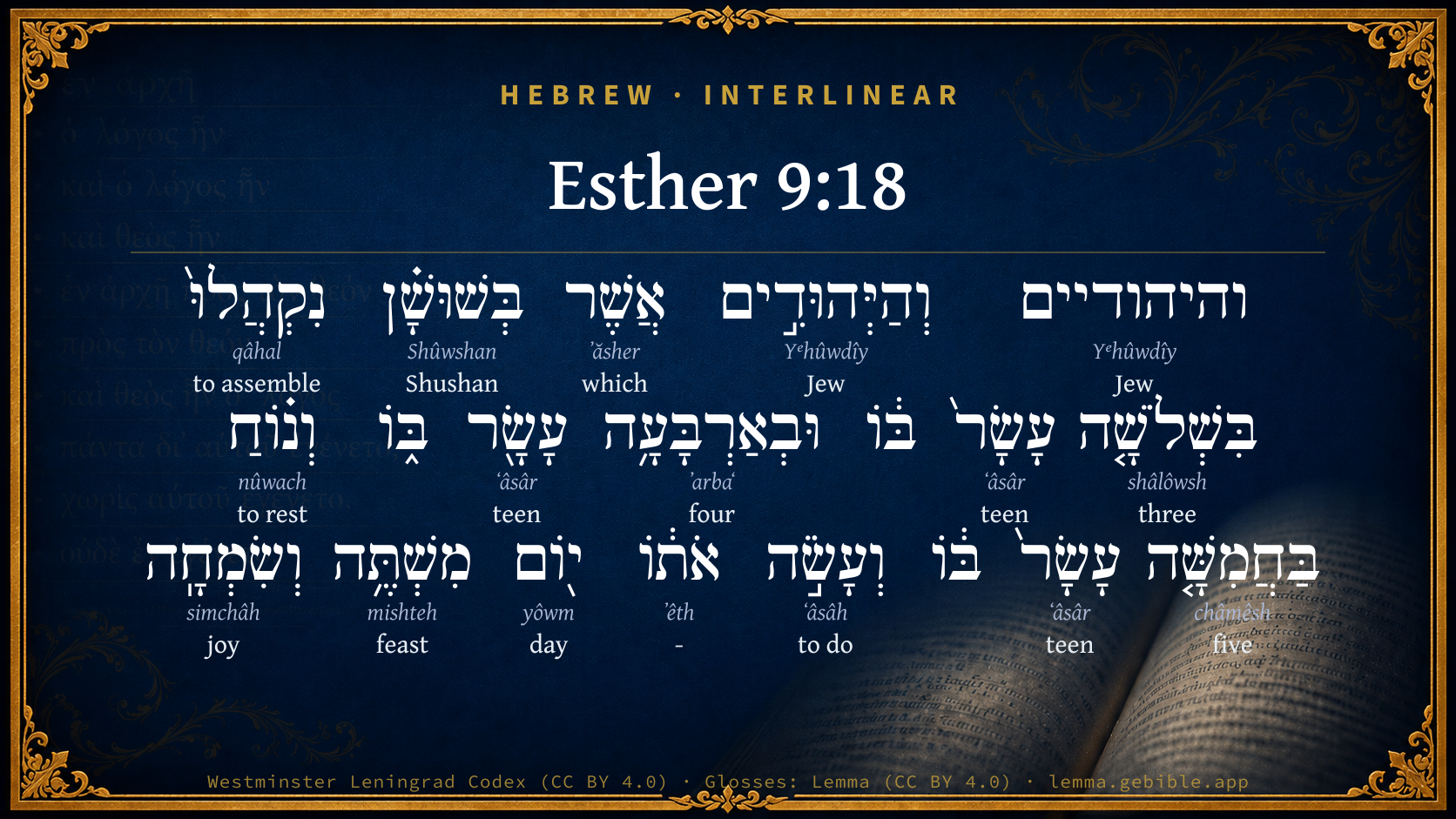
Esther 9:18

Hebrew (Westminster Leningrad Codex) Esther 9:18 appears in the Hebrew Old Testament. The text above is from the Westminster Leningrad Codex. Each word links to its Strong’s number, a concise gloss, and parsing drawn from the Open Scriptures Hebrew Bible morphology. Click any word for its full Brown-Driver-Briggs (BDB) entry.
Download image
Cite this verse

Esther 9:18 (World English Bible). Public Domain. Lemma interlinear Bible study tool, https://lemma.gebible.app/v/esther/9/18.

Show BibTeX & RIS
BibTeX
RIS
English Translation
But the Jews who were in Shushan assembled together on the thirteenth [day] of it, and on the fourteenth of it; and on the fifteenth [day] of the same they rested, and made it a day of feasting and gladness.
World English Bible · Public Domain
Download a study sheet

One document with this verse’s original text, its word-by-word gloss line, the meaning frame, cross-references with their text, attributed commentary, and full source and license credits — printable, and it pastes into notes with its structure intact.

This verse Autodidact and up

Study sheet (.html) Plain text (.txt)

A passage Seminary Student

Up to 50 verses in one chapter. A passage sheet keeps up to 6 commentary sources and 12 cross-references per verse, in the order this page ranks them, and says so on the sheet whenever that leaves anything out. Ask for a single verse and you get the Autodidact verse sheet above.

Everything on this page stays free to read, with no account — the sheet is a download of what is already on screen, not access to it.

Want to remove ads? Support Godless Engineer
Compare translations 3

The same verse in 3 English versions, stacked beneath the original-language interlinear above. Click any original word for its lexicon entry.

Each is an independent rendering of the whole verse — the interlinear is not word-aligned to these translations.

Highlighted words mark where these versions differ — a whole-verse word diff, not a word-by-word alignment.

  • World English Bible Public Domain
    But the Jews who were in Shushan assembled together on the thirteenth [day] of it, and on the fourteenth of it; and on the fifteenth [day] of the same they rested, and made it a day of feasting and gladness.
  • King James Version Public Domain
    But the Jews that were at Shushan assembled together on the thirteenth day thereof, and on the fourteenth thereof; and on the fifteenth day of the same they rested, and made it a day of feasting and gladness.
  • unfoldingWord Literal Text CC BY-SA 4.0
    But the Jews who were in Susa assembled themselves on the thirteenth of it and on the fourteenth of it. And they rested on the fifteenth of it, and they made it a day of feasting and rejoicing.

unfoldingWord Literal Text — © unfoldingWord, licensed CC BY-SA 4.0. Word-aligned USFM3 via Door43 (git.door43.org/unfoldingWord/en_ult).

Versions to compare (up to 4)

3 of 4 selected

Show all 18 translations

Every available English version of this verse, each an independent rendering of the whole verse.

  • World English Bible Public Domain
    But the Jews who were in Shushan assembled together on the thirteenth [day] of it, and on the fourteenth of it; and on the fifteenth [day] of the same they rested, and made it a day of feasting and gladness.
  • Berean Standard Bible Public Domain
    The Jews in Susa, however, had assembled on the thirteenth and the fourteenth days of the month. So they rested on the fifteenth day, making it a day of feasting and joy.
  • Majority Standard Bible Public Domain
    The Jews in Susa, however, had assembled on the thirteenth and the fourteenth days of the month. So they rested on the fifteenth day, making it a day of feasting and joy.
  • King James Version Public Domain
    But the Jews that were at Shushan assembled together on the thirteenth day thereof, and on the fourteenth thereof; and on the fifteenth day of the same they rested, and made it a day of feasting and gladness.
  • American Standard Version (1901) Public Domain
    But the Jews that were in Shushan assembled together on the thirteenth `day' thereof, and on the fourteenth thereof; and on the fifteenth `day' of the same they rested, and made it a day of feasting and gladness.
  • Revised Version (1885) Public Domain
    But the Jews that were in Shushan assembled together on the thirteenth day thereof, and on the fourteenth thereof; and on the fifteenth day of the same they rested, and made it a day of feasting and gladness.
  • Geneva Bible (1599) Public Domain
    But the Iewes that were in Shushan assembled themselues on the thirteenth day, and on the fourteenth therof, and they rested on the fifteenth of the same, and kept it a day of feasting and ioy.
  • Douay-Rheims (1899) Public Domain
    But they that were killing in the city of Susan, were employed in the slaughter on the thirteenth and fourteenth day of the same month: and on the fifteenth day they rested. And therefore they appointed that day to be a holy day of feasting and gladness.
  • Young's Literal Translation Public Domain
    And the Jews who `are' in Shushan have been assembled, on the thirteenth day of it, and on the fourteenth of it, even to rest on the fifteenth of it, and to make it a day of banquet and of joy.
  • Literal Standard Version CC BY-SA 4.0
    And the Jews who [are] in Shushan have been assembled, on the thirteenth day of it, and on the fourteenth of it, even to rest on the fifteenth of it, and to make it a day of banquet and of joy.
  • Unlocked Literal Bible CC BY-SA 4.0
    But the Jews who were in Susa assembled together on the thirteenth and the fourteenth days. On the fifteenth day they rested and made it a day of feasting and gladness.
  • unfoldingWord Literal Text CC BY-SA 4.0
    But the Jews who were in Susa assembled themselves on the thirteenth of it and on the fourteenth of it. And they rested on the fifteenth of it, and they made it a day of feasting and rejoicing.
  • Darby Bible Public Domain
    But the Jews that were at Shushan gathered themselves together on the thirteenth [day] thereof, and on the fourteenth thereof; and on the fifteenth of the same they rested, and made it a day of feasting and joy.
  • World Messianic Bible Public Domain
    But the Jews who were in Susa assembled together on the thirteenth and on the fourteenth days of the month; and on the fifteenth day of that month, they rested, and made it a day of feasting and gladness.
  • Webster's Bible Public Domain
    But the Jews that were at Shushan assembled on the thirteenth day of the month, and on the fourteenth of it: and on the fifteenth day of the same they rested, and made it a day of feasting and gladness.
  • Free Bible Version CC BY-SA 4.0
    However, the Jews in Susa had gathered to fight on the thirteenth and the fourteenth days of the month. So they rested on the fifteenth day, and made that a day of feasting and celebration.
  • Bible in Basic English Public Domain
    But the Jews in Shushan came together on the thirteenth and on the fourteenth day of the month; and on the fifteenth day they took their rest, and made it a day of feasting and joy.
  • JPS Tanakh (1917) Public Domain
    But the Jews that were in Shushan assembled together on the thirteenth day thereof, and on the fourteenth thereof; and on the fifteenth day of the same they rested, and made it a day of feasting and gladness.

Literal Standard Version (2020), Covenant Press — licensed CC BY-SA 4.0. Text via the HelloAO Bible API (eBible.org). Unlocked Literal Bible (unfoldingWord) — licensed CC BY-SA 4.0. Text via the HelloAO Bible API (eBible.org). unfoldingWord Literal Text — © unfoldingWord, licensed CC BY-SA 4.0. Word-aligned USFM3 via Door43 (git.door43.org/unfoldingWord/en_ult). Free Bible Version, Dr. Jonathan Gallagher — licensed CC BY-SA 4.0. Text via the HelloAO Bible API (eBible.org).

Word by word

More ways to search: Search by grammar → Find every occurrence → Compare this word →

Practice this passage: Drill this verse → Learn its vocabulary →

בְּשׁוּשָׁ֗ן
Shûwshan
H7800
“in/at · Shushan”
Preposition + Noun, Proper
Part of Speech
Preposition + Noun
Type
Proper
Full BDB Definition

Origin: the same as H7799

TWOT: None

Shushan or Susa = "lily" - the winter residence of the Persian kings; located on the river Ulai or Choaspes
  1. והיהודיים Yᵉhûwdîy H3064 “and · the · Jews” Conjunction + Particle, Definite Article + Noun, Common, Masculine, Plural, Absolute
  2. וְהַיְּהוּדִ֣ים Yᵉhûwdîy H3064 “and · the · Jews” Conjunction + Particle, Definite Article + Noun, Common, Masculine, Plural, Absolute
  3. אֲשֶׁר ʼăsher H834 “which” Particle, Relative
  4. נִקְהֲלוּ֙ qâhal H6950 “to assemble” Verb, Niphal, Perfect, 3rd Person, Common, Plural
  5. בִּשְׁלֹשָׁ֤ה shâlôwsh H7969 “in/at · three” Preposition + Adjective, Cardinal number, Masculine, Singular, Absolute
  6. עָשָׂר֙ ʻâsâr H6240 “teen” Adjective, Cardinal number, Masculine, Singular, Absolute
  7. וּבְאַרְבָּעָ֥ה ʼarbaʻ H702 “and · in/at · four” Conjunction + Preposition + Adjective, Cardinal number, Masculine, Singular, Absolute
  8. עָשָׂ֖ר ʻâsâr H6240 “teen” Adjective, Cardinal number, Masculine, Singular, Absolute
  9. וְנ֗וֹחַ nûwach H5117 “and · rest” Conjunction + Noun, Common, Masculine, Singular, Absolute
  10. בַּחֲמִשָּׁ֤ה châmêsh H2568 “in/at the · five” Preposition, Determined + Adjective, Cardinal number, Masculine, Singular, Absolute
  11. עָשָׂר֙ ʻâsâr H6240 “teen” Adjective, Cardinal number, Masculine, Singular, Absolute
  12. וְעָשֹׂ֣ה ʻâsâh H6213 “and · to do” Conjunction + Verb, Qal, Infinitive Absolute
  13. אֹת֔וֹ ʼêth H853 “- · him” Particle, Direct Object + Suffix, Personal, 3rd Person, Masculine, Singular
  14. י֖וֹם yôwm H3117 “day of” Noun, Common, Masculine, Singular, Construct
  15. מִשְׁתֶּ֥ה mishteh H4960 “feast” Noun, Common, Masculine, Singular, Absolute
  16. וְשִׂמְחָֽה simchâh H8057 “and · joy” Conjunction + Noun, Common, Feminine, Singular, Absolute

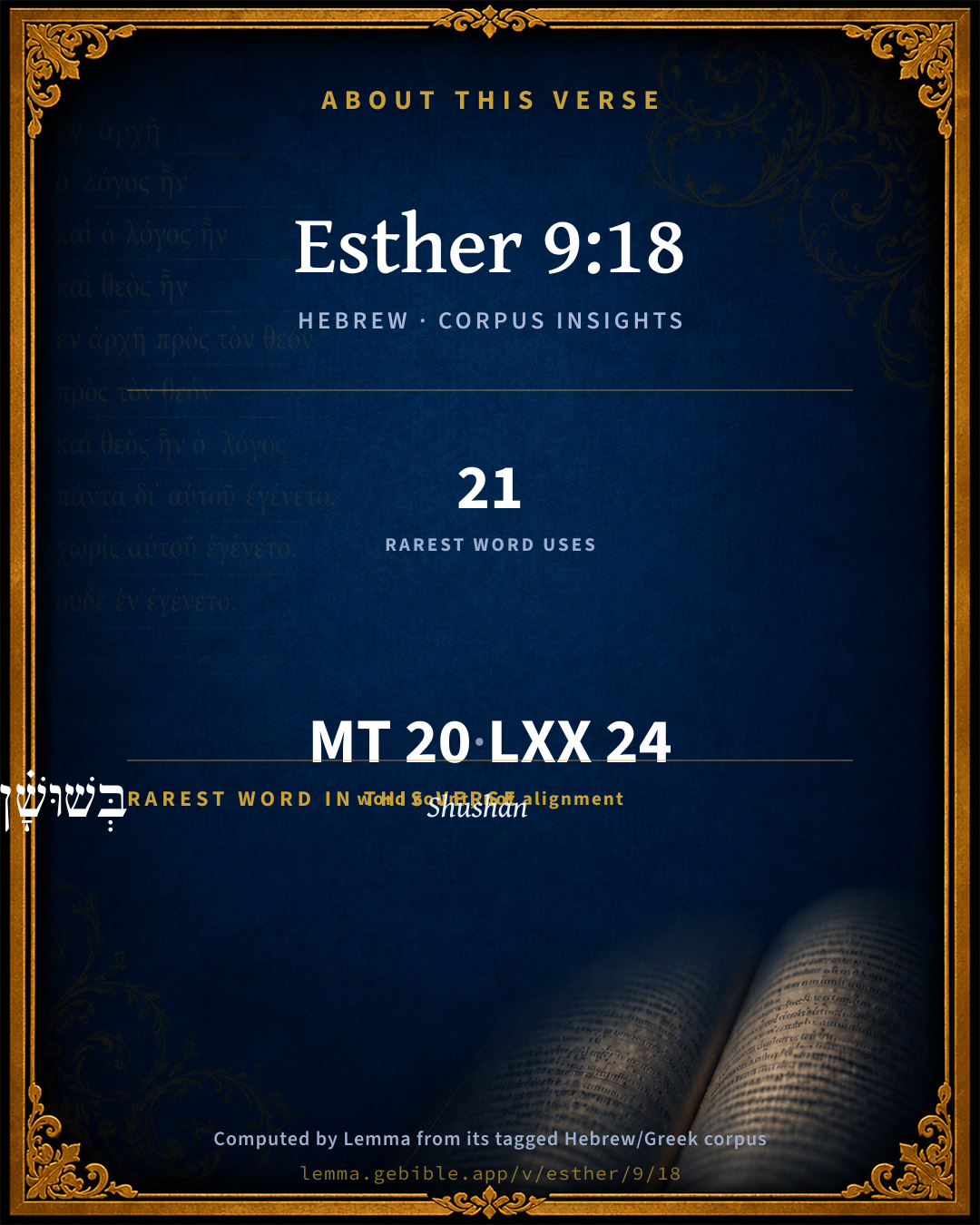
About this verse

These counts appear in no published source. They are computed here, from the morphology-tagged text and Lemma’s own curated glosses. What Lemma adds →

20
words
14
distinct lemmas
Historical
section

Notable vocabulary

The rarest word here is בְּשׁוּשָׁ֗ן Shushan H7800 — appearing just 21 times in the whole Hebrew Bible.

Shared distinctive vocabulary

בְּשׁוּשָׁ֗ן Shushan H7800 occurs in 19 verses of the Hebrew Bible. Also found in:

Grammatical profile

  • 2 verbs
  • 7 nouns
  • 6 adjectives
  • 3 prepositions
  • 2 particles

Verb forms

  • נִקְהֲלוּ֙ Niphal · Perfect
  • וְעָשֹׂ֣ה Qal · Infinitive Absolute

Repetition

Words recur within this verse — often emphatic in Hebrew:

  • עָשָׂר֙ teen H6240 ×3
  • והיהודיים Jew H3064 ×2

Hebrew & Septuagint length

In English translation the verse runs 40 words from the Hebrew and 25 from the Septuagint (LXX English) — the Septuagint runs noticeably shorter here. See the side-by-side →

A rough comparison of the two English renderings, which tokenize alike — not a word-level alignment.

Word counts can differ between the Hebrew and the Greek without any difference in meaning — e.g. the Hebrew direct-object marker אֵת has no separate Greek word, and Greek often adds the article ὁ.

In the original languages it is 20 Hebrew tokens and 24 Greek tokens — but the two are counted differently (Hebrew bundles its prefixes and suffixes into one token; the Greek is in lemma form), so that isn’t a like-for-like length.

Cross-references

5

Topical passages linked to Esther 9:18 in the Treasury of Scripture Knowledge — connected by theme and wording, ordered by reader-vote popularity; previews shown in the World English Bible.

  • Esther 9:21 to enjoin those who they should keep the fourteenth day of the month Adar, and the fifteenth day of the same, yearly,
  • Esther 9:1 Now in the twelfth month, which is the month Adar, on the thirteenth day of the same, when the king's commandment and his decree drew near to be put in execution, on the day that the enemies of the Jews hoped to have rule over them, (whereas it was turned to the contrary, that the Jews had rule over those who hated them),
  • Esther 9:13 Then said Esther, If it please the king, let it be granted to the Jews who are in Shushan to do tomorrow also according to this day's decree, and let Haman's ten sons be hanged on the gallows.
  • Esther 9:15 The Jews who were in Shushan gathered themselves together on the fourteenth day also of the month Adar, and killed three hundred men in Shushan; but they didn't lay their hand on the spoil.
  • Esther 9:11 On that day the number of those who were slain in Shushan the palace was brought before the king.

Cross-references courtesy of OpenBible.info (CC BY 4.0).

Hebrew and Greek witnesses Masoretic Hebrew ↔ Greek Septuagint

The same verse in the two great witnesses to the Old Testament, shown verse-for-verse.

Here the Septuagint runs noticeably shorter than the Hebrew — LXX2012 (modern English Septuagint) 25 words vs World English Bible 40. A rough length comparison of the two English translations, not a word-level alignment — read both below.

These are two independent witnesses, not word-aligned to each other, and the Septuagint is shown in lemma (dictionary) form.

Hebrew Esther 9:18 Masoretic · Westminster Leningrad Codex

והיהודיים וְהַיְּהוּדִ֣ים אֲשֶׁר בְּשׁוּשָׁ֗ן נִקְהֲלוּ֙ בִּשְׁלֹשָׁ֤ה עָשָׂר֙ בּ֔וֹ וּבְאַרְבָּעָ֥ה עָשָׂ֖ר בּ֑וֹ וְנ֗וֹחַ בַּחֲמִשָּׁ֤ה עָשָׂר֙ בּ֔וֹ וְעָשֹׂ֣ה אֹת֔וֹ י֖וֹם מִשְׁתֶּ֥ה וְשִׂמְחָֽה

But the Jews who were in Shushan assembled together on the thirteenth [day] of it, and on the fourteenth of it; and on the fifteenth [day] of the same they rested, and made it a day of feasting and gladness.

World English Bible · Public Domain

Greek LXX Esther 9:18 Septuagint · lemma form

ὁ δέ ἰουδαῖος ὁ ἐν σουσά ὁ πόλις συνἄγω καί ὁ οςτεσσαρεσκαιδέκατ καί οὐ ἀναπαύω ἄγω δέ καί ὁ πεντεκαιδέκατος μετά χαρά καί εὐφροσύνη

And the Jews in the city Susa assembled also on the fourteenth day and rested; and they kept also the fifteenth with joy and gladness.

LXX2012 (modern English Septuagint) · Public Domain

Hebrew: Westminster Leningrad Codex (CC BY 4.0). Greek: Septuagint (public domain); English from LXX2012 (modern English Septuagint) (Public Domain). How the Septuagint differs from the Hebrew →

Commentary

Notes on Esther 9:18 from classic Christian and Jewish commentators (each source and its license shown beneath its notes). The classic Christian expositions comment on the surrounding passage and are grouped to its opening verse, so a note may address several verses; the Jewish commentaries on the Tanakh (Rashi and others) are per-verse, so they appear only where the commentator wrote on this verse.

Lemma curates 59 commentaries, every one of them public domain or Creative Commons licensed, each selected and text-cleaned for this edition rather than reprinted as found. About our sources →

Trapp's Complete Commentary

John Trapp

Est 9:18 But the Jews that [were] at Shushan assembled together on the thirteenth [day] thereof, and on the fourteenth thereof; and on the fifteenth [day] of the same they rested, and made it a day of feasting and gladness.

Ver. 18. On the thirteenth day thereof, and on the fourteenth] What they could not do on one day they did it on another. Men must be sedulous and strenuous in God’s work, doing it with all their might, and redeeming time for that purpose, Ecc 9:10.

On both these days they destroyed their enemies] They did their work thoroughly. Let us do so in slaying our spiritual enemies; not sparing any Agag, not reserving this Zoar or that Rimmon; but dealing by the whole body of sin as the king of Moab did with the king of Edom, Amo 2:1, burn the bones of it to lime; destroy it not to the halves, as Saul, but hew it in pieces before the Lord, as Samuel. As Joshua destroyed all the Canaanites he could lay hold on; as Asa spared not his own mother; as Solomon drew Joab from the altar to the slaughter; and put to death Adonijah, the darling, so must we deal with our corruptions, ferreting and fetching them out of their lurking holes, as these Jews did their enemies on the fourteenth day, that had escaped the day before. Since we must either kill them up all, or be killed by them; for as that one bastard Abimelech slew all Gideon’s sons upon one stone, so one lust left unmortified will undo the soul. And as one sinner, so one sin, may destroy much good, Ecc 9:18.

And on the fifteenth day of the month they rested] So shall the saints do after death, which will be the accomplishment of mortification, for he that is dead is freed from sin, Rom 6:7, and filled with joy, Isa 35:10. The ransomed of the Lord shall then return and come to Zion with songs, and everlasting joy upon their heads; they shall obtain joy and gladness, and sorrow and sighing shall flee away.

John Trapp, A Commentary or Exposition upon All the Books of the Old and New Testament (1647–1656) — public domain. Text from a community e-Sword module.

Adam Clarke's Commentary

Verse 18. The Jews - assembled - on the thirteenth - and on the fourteenth] These two days they were employed in slaying their enemies; and they rested on the fifteenth.

Adam Clarke's Commentary on the Bible (1810–1826) — public domain. Text from a community e-Sword/MySword module.

Ellicott's Commentary for English Readers

(18) On the fifteenth day . . . they rested.—Both the fourteenth and fifteenth days are now kept as the festival of Purim, the former day being the chief.

A Bible Commentary for English Readers, edited by Charles John Ellicott (1878–1897) — public domain. Text from a community e-Sword module.

The Cambridge Bible for Schools and Colleges

gen. ed. J. J. S. Perowne

18. The inability of the Jews dwelling in Shushan to make their festival synchronize with that of their countrymen elsewhere brought about the custom that both the fourteenth and the fifteenth days should be kept. Such is the habit of the Jews to this day, except that the former day is held to be the chief one in the observance (see note on Est_3:13). In 2Ma_15:36 the 14th of Adar is called ‘the day of Mordecai.’

The Cambridge Bible for Schools and Colleges (gen. ed. J. J. S. Perowne; Cambridge University Press, 1878–1918) — public domain. Text from a community e-Sword module.

John Gill's Exposition

And Mordecai wrote these things,.... The transactions of those two days, and the causes of them, as well as the following letter; some conclude from hence that he was the penman of the book; and so he might be, but it does not necessarily follow from hence:

and sent letters unto all the Jews that were in all the provinces of the King Ahasuerus, both nigh and far; such as were near the city Shushan, and those that were at the greatest distance from it; these were more especially the things he wrote.

John Gill's Exposition of the Whole Bible (1746–1763) — public domain (CC PDM 1.0). Text via the HelloAO Bible API.

Albert Barnes' Notes on the Bible

See Est 3:13 note.

Albert Barnes' Notes on the Bible (1834–1885) — public domain. Text from a community e-Sword/MySword module.

The Pulpit Commentary

The Jews which were at Shushan assembled together. i.e. "gathered themselves together to bathe." The verb is the same as that used in ver. 16 of this chapter; and in Est_8:11 Est_9:2.

The Pulpit Commentary (1880–1919), ed. H.D.M. Spence-Jones & Joseph S. Exell — public domain. Text from a community e-Sword module.

Keil & Delitzsch

C. F. Keil & F. Delitzsch

The Jews in Susa, on the other hand, who were both on the 13th and 14th Adar still fighting against their enemies, and did not rest till the 15th, made this latter their day of rejoicing. - In Est 9:19 it is again stated that the Jews in the country towns and villages made the 14th their day of gladness, and this statement is appended by על־כּן to make this appear the result of what precedes. The Chethiv הפּרוזים is perhaps an Aramaic expression for פּרזים, Deu 3:5 and Sa1 6:18. פּרוזי means the inhabitants of the open, i.e., unfortified, towns and villages of the plains in contrast to the fortified capital; see on Deu 3:5. On פּרזות, compare Eze 38:11; Zac 2:8. וגו מנות משׁלוח, and of mutual sending of gifts, i.e., portions of food; comp. Neh 8:10, Neh 8:12.

Keil & Delitzsch — Biblical Commentary on the Old Testament (1861–1891) — public domain (CC PDM 1.0). Text via the HelloAO Bible API. (Old Testament only.)

Lesson kit

Teaching starters — assembled from the data on this page, not authored interpretation. Every prompt links to the verse data it draws on. Edit before teaching.

Esther, in the Historical, opens this verse with 20 words (14 distinct Hebrew lemmas). Its most distinctive word is Shûwshan (“Shushan”). The Greek Septuagint runs shorter here. A historical commentator’s framing appears above. Read the whole chapter for the surrounding context.

Discussion questions

  1. How does “Shushan” (Shûwshan) shape what this verse is saying?
  2. How does Nehemiah 1:1, which shares the word «Shushan», read alongside this verse?
  3. What does the repetition of “teen” (3× in this one verse) do in this verse?
  4. The Septuagint runs shorter here than the Hebrew. What might account for the difference?
  5. These translations render this verse differently. What is at stake in choosing one wording over another?
  6. «נִקְהֲלוּ֙» is a Niphal Perfect verb. How does that grammatical form shape the action described?
  7. Compare how Trapp's Complete Commentary and Adam Clarke's Commentary read this verse. Where do they agree or differ?

Things to notice

Reading settings

Reading text

Shown beneath each verse's original-language words.

Old Testament
Old Testament edition

Read the OT as the Masoretic Hebrew (MT) or the Greek Septuagint (LXX).

English shown for the Greek Septuagint (in the Hebrew ↔ Greek comparison).

Comparing translations? Open the Compare panel on any verse page to stack up to four side by side.