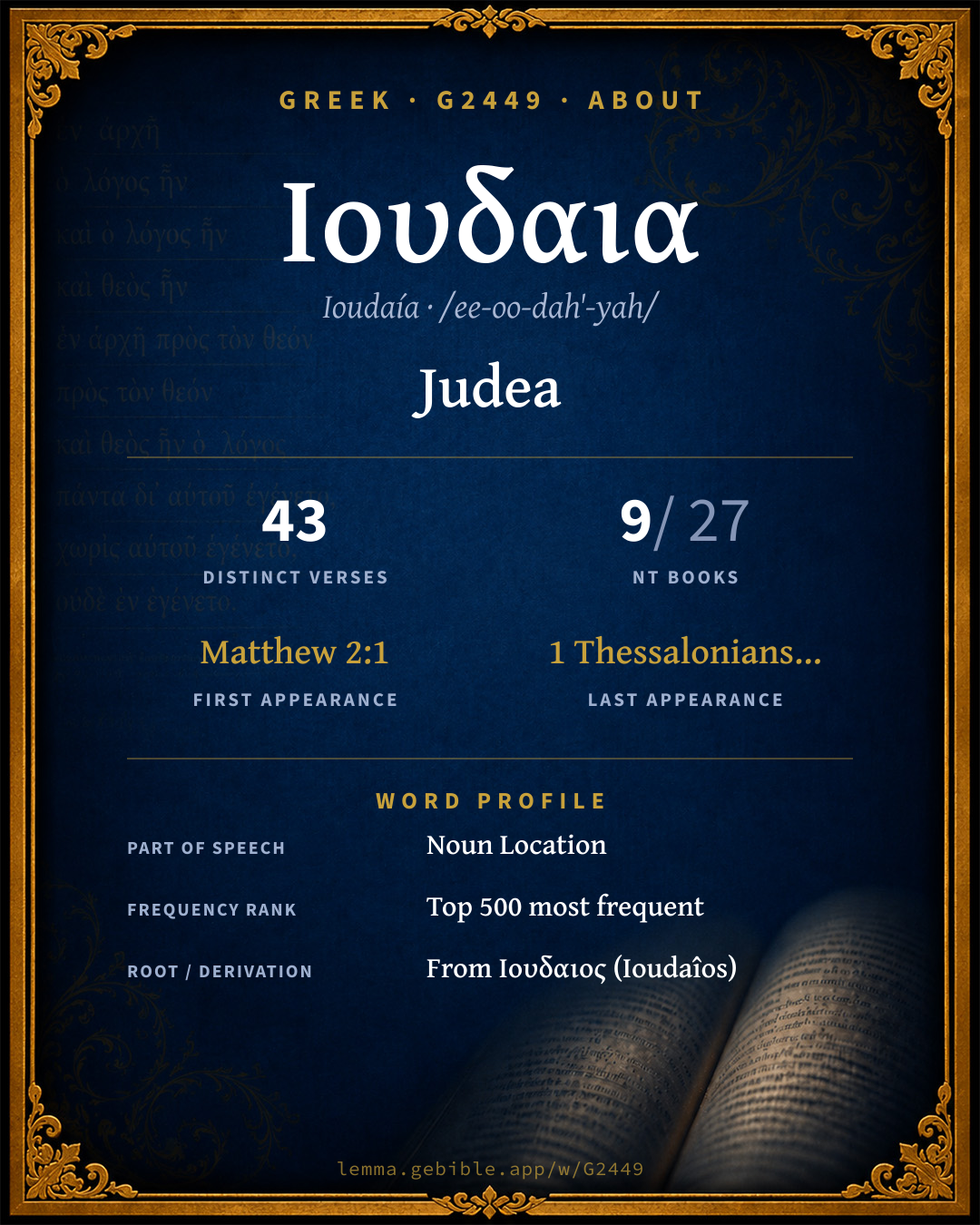
Ἰουδαία
Judea
Thayer's lists 3 entries for ‘Judea’ fuller range ↓
Full lexicon entry — Thayer's Greek Lexicon
From Thayer's Greek Lexicon
Where this word appears
See every Genitive-case word in the Greek New Testament →
Grammar key — what these labels mean
Part of speech
- Noun
- A naming word — a person, place, thing, or idea.
Case
- Genitive
- The case of source, possession, or “of” — answers “whose / from what.”
- Dative
- The case of the indirect object, means, or location — “to / for / with / in.”
- Accusative
- The case of the direct object and of extent.
- Nominative
- The case of the subject (and the predicate nominative).
Gender
- Feminine
- Grammatically feminine.
Number
- Singular
- One.
Grammatical forms
- Noun, Genitive, Singular, Feminine 25 times (58%)
- Noun, Dative, Singular, Feminine 9 times (21%)
- Noun, Accusative, Singular, Feminine 7 times (16%)
- Noun, Nominative, Singular, Feminine 2 times (5%)
Parsed forms decoded from the imported morphology (Robinson–Tischendorf, public domain), counted across 43 parsed occurrences — not distinct verses.
Every verse where G2449 appears — 43 distinct verses across 9 books. Click any verse to open its interlinear word-by-word view. Verse text shown in the World English Bible for context — . Each verse’s Greek form is shown with its reference; the English is not keyword-highlighted, since the data carries no word-level English alignment. Use “Compare translations” on any verse to read it across multiple English versions. This concordance covers the Greek New Testament; Septuagint (Greek Old Testament) occurrences of this word are not indexed here.
Matthew 8 verses
- Matthew 2:1 Ἰουδαίας n gen sg fem Now when Jesus was born in Bethlehem of Judea in the days of Herod the king, behold, wise men from the east came to Jerusalem, saying,
- Matthew 2:5 Ἰουδαίας n gen sg fem They said to him, "In Bethlehem of Judea, for thus it is written through the prophet,
- Matthew 2:22 Ἰουδαίας n gen sg fem But when he heard that Archelaus was reigning over Judea in the place of his father, Herod, he was afraid to go there. Being warned in a dream, he withdrew into the region of Galilee,
- Matthew 3:1 Ἰουδαίας n gen sg fem In those days, John the Baptizer came, preaching in the wilderness of Judea, saying,
- Matthew 3:5 Ἰουδαία n nom sg fem Then people from Jerusalem, all of Judea, and all the region around the Jordan went out to him.
- Matthew 4:25 Ἰουδαίας n gen sg fem Great multitudes from Galilee, Decapolis, Jerusalem, Judea and from beyond the Jordan followed him.
- Matthew 19:1 Ἰουδαίας n gen sg fem It happened when Jesus had finished these words, he departed from Galilee, and came into the borders of Judea beyond the Jordan.
- Matthew 24:16 Ἰουδαίᾳ n dat sg fem then let those who are in Judea flee to the mountains.
Mark 4 verses
- Mark 1:5 Ἰουδαία n nom sg fem All the country of Judea and all those of Jerusalem went out to him. They were baptized by him in the Jordan river, confessing their sins.
- Mark 3:7 Ἰουδαίας n gen sg fem Jesus withdrew to the sea with his disciples, and a great multitude followed him from Galilee, from Judea,
- Mark 10:1 Ἰουδαίας n gen sg fem He arose from there and came into the borders of Judea and beyond the Jordan. Multitudes came together to him again. As he usually did, he was again teaching them.
- Mark 13:14 Ἰουδαίᾳ n dat sg fem But when you see the abomination of desolation, spoken of by Daniel the prophet, standing where it ought not (let the reader understand), then let those who are in Judea flee to the mountains,
Luke 9 verses
- Luke 1:5 Ἰουδαίας n gen sg fem There was in the days of Herod, the king of Judea, a certain priest named Zacharias, of the priestly division of Abijah. He had a wife of the daughters of Aaron, and her name was Elizabeth.
- Luke 1:65 Ἰουδαίας n gen sg fem Fear came on all who lived around them, and all these sayings were talked about throughout all the hill country of Judea.
- Luke 2:4 Ἰουδαίαν n acc sg fem Joseph also went up from Galilee, out of the city of Nazareth, into Judea, to the city of David, which is called Bethlehem, because he was of the house and family of David;
- Luke 3:1 Ἰουδαίας n gen sg fem Now in the fifteenth year of the reign of Tiberius Caesar, Pontius Pilate being governor of Judea, and Herod being tetrarch of Galilee, and his brother Philip tetrarch of the region of Ituraea and Trachonitis, and Lysanias tetrarch of Abilene,
- Luke 5:17 Ἰουδαίας n gen sg fem It happened on one of those days, that he was teaching; and there were Pharisees and teachers of the law sitting by, who had come out of every village of Galilee, Judea, and Jerusalem. The power of the Lord was with him to heal them.
- Luke 6:17 Ἰουδαίας n gen sg fem He came down with them, and stood on a level place, with a crowd of his disciples, and a great number of the people from all Judea and Jerusalem, and the sea coast of Tyre and Sidon, who came to hear him and to be healed of their diseases;
- Luke 7:17 Ἰουδαίᾳ n dat sg fem This report went out concerning him in the whole of Judea, and in all the surrounding region.
- Luke 21:21 Ἰουδαίᾳ n dat sg fem Then let those who are in Judea flee to the mountains. Let those who are in the midst of her depart. Let those who are in the country not enter therein.
- Luke 23:5 Ἰουδαίας n gen sg fem But they insisted, saying, "He stirs up the people, teaching throughout all Judea, beginning from Galilee even to this place."
John 6 verses
- John 4:3 Ἰουδαίαν n acc sg fem he left Judea, and departed into Galilee.
- John 4:47 Ἰουδαίας n gen sg fem When he heard that Jesus had come out of Judea into Galilee, he went to him, and begged him that he would come down and heal his son, for he was at the point of death.
- John 4:54 Ἰουδαίας n gen sg fem This is again the second sign that Jesus did, having come out of Judea into Galilee.
- John 7:1 Ἰουδαίᾳ n dat sg fem After these things, Jesus was walking in Galilee, for he wouldn't walk in Judea, because the Jews sought to kill him.
- John 7:3 Ἰουδαίαν n acc sg fem His brothers therefore said to him, "Depart from here, and go into Judea, that your disciples also may see your works which you do.
- John 11:7 Ἰουδαίαν n acc sg fem Then after this he said to the disciples, "Let's go into Judea again."
Acts 12 verses
- Acts 1:8 Ἰουδαίᾳ n dat sg fem But you will receive power when the Holy Spirit has come upon you. You will be witnesses to me in Jerusalem, in all Judea and Samaria, and to the uttermost parts of the earth."
- Acts 2:9 Ἰουδαίαν n acc sg fem Parthians, Medes, Elamites, and people from Mesopotamia, Judea, Cappadocia, Pontus, Asia,
- Acts 8:1 Ἰουδαίας n gen sg fem Saul was consenting to his death. A great persecution arose against the assembly which was in Jerusalem in that day. They were all scattered abroad throughout the regions of Judea and Samaria, except for the apostles.
- Acts 9:31 Ἰουδαίας n gen sg fem So the assemblies throughout all Judea and Galilee and Samaria had peace, and were built up. They were multiplied, walking in the fear of the Lord and in the comfort of the Holy Spirit.
- Acts 10:37 Ἰουδαίας n gen sg fem that spoken word you yourselves know, which was proclaimed throughout all Judea, beginning from Galilee, after the baptism which John preached;
- Acts 11:1 Ἰουδαίαν n acc sg fem Now the apostles and the brothers who were in Judea heard that the Gentiles had also received the word of God.
- Acts 11:29 Ἰουδαίᾳ n dat sg fem As any of the disciples had plenty, each determined to send relief to the brothers who lived in Judea;
- Acts 12:19 Ἰουδαίας n gen sg fem When Herod had sought for him, and didn't find him, he examined the guards, and commanded that they should be put to death. He went down from Judea to Caesarea, and stayed there.
- Acts 15:1 Ἰουδαίας n gen sg fem Some men came down from Judea and taught the brothers, "Unless you are circumcised after the custom of Moses, you can't be saved."
- Acts 21:10 Ἰουδαίας n gen sg fem As we stayed there some days, a certain prophet named Agabus came down from Judea.
- Acts 26:20 Ἰουδαίας n gen sg fem but declared first to them of Damascus, at Jerusalem, and throughout all the country of Judea, and also to the Gentiles, that they should repent and turn to God, doing works worthy of repentance.
- Acts 28:21 Ἰουδαίας n gen sg fem They said to him, "We neither received letters from Judea concerning you, nor did any of the brothers come here and report or speak any evil of you.
Romans 1 verse
2 Corinthians 1 verse
Galatians 1 verse
1 Thessalonians 1 verse
About this entry
At a glance — auto-summarized from this page’s data, not written by a person. Every figure links to its source below. This summary describes the numbers; it doesn’t interpret them.
“Judea” is the headline sense of the Greek name Ιουδαια (Ioudaía). Scripture first uses it in Matthew 2:1. It appears 43 verses across 9 books of the Greek New Testament, among its moderately common vocabulary. More than a quarter of its appearances fall in Acts. See 43-verse concordance and the renderings breakdown below.
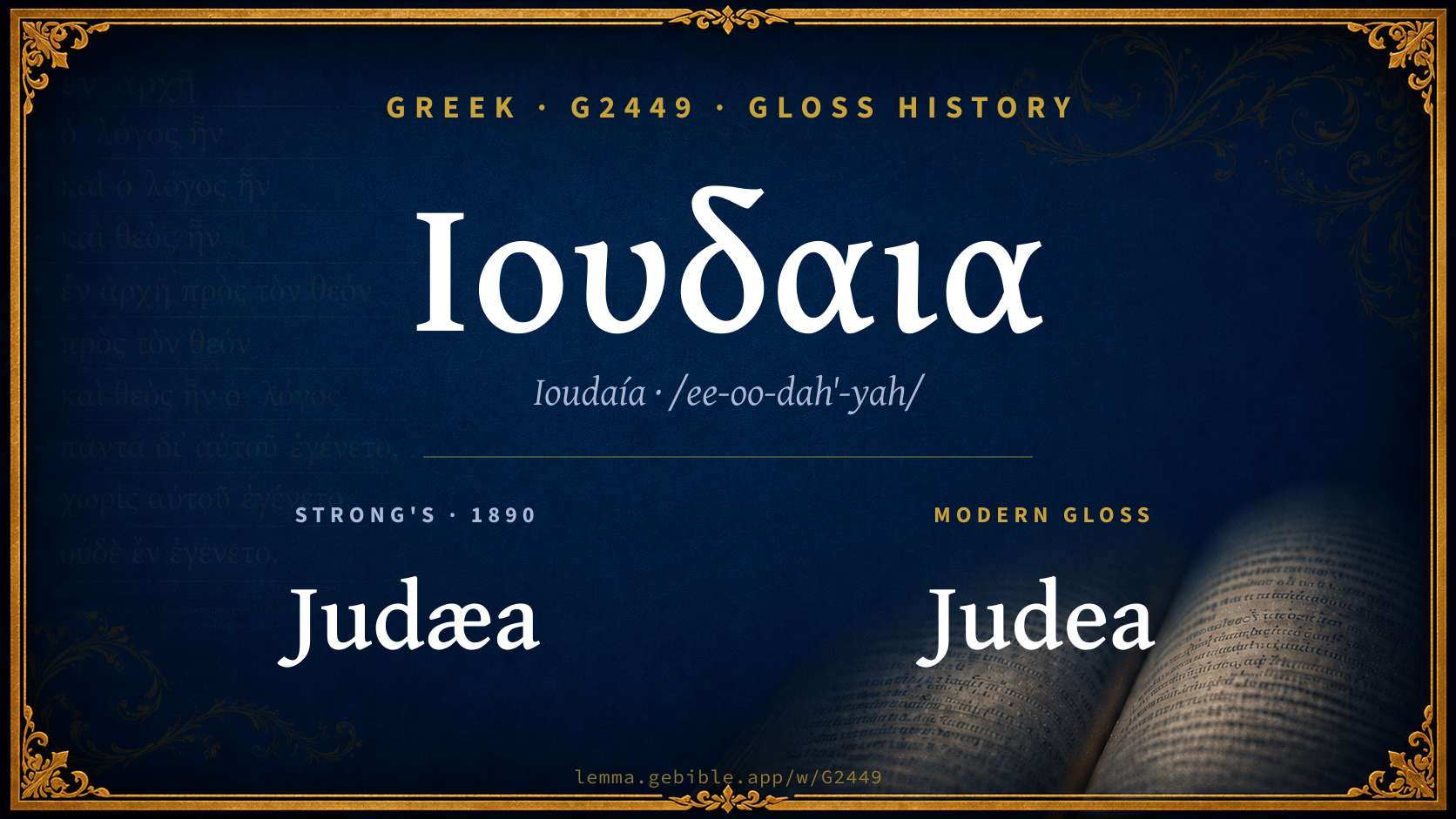
Gloss history
Strong's 1890 vs modern scholarship
About this word
Strong's G2449 catalogs a Greek word from the Greek New Testament.
These counts are not copied from any lexicon or concordance. They are computed here, from the morphology-tagged Greek New Testament. What Lemma adds →
- 43
- distinct verses
- The word appears in 43 distinct verses.
- 9 / 27
- NT books
- The word appears in 9 of 27 New Testament books.
- #347
- by frequency
- Top 500 most frequent Greek words (rank 347 of 5,347 Greek words by occurrence).
View all 43 occurrences in the concordance →
By section of the New Testament
By traditional corpus
Conventional, traditional groupings — biblical authorship is debated, so this is a traditional corpus grouping, not an authorship claim. Some books belong to more than one corpus (Luke is in both the Gospels and the Lukan corpus, and so on), so these shares overlap and need not total 100%. Each figure is a share of the word’s 43 distinct verses.
- Gospels 27 verses · 63%
- Lukan (Luke–Acts) 21 verses · 49%
- Johannine 6 verses · 14%
- Pauline corpus 4 verses · 9%
How translations render this word
Counts come from each version’s own published word-to-Strong’s tagging or interlinear alignment — an approximate guide to how each version renders this word, not a word-level alignment the data otherwise carries. Because each total is that version’s own tagged count, the per-version totals vary from one another and need not match the appearance or distinct-verse counts above. These counts may also differ from a printed concordance because Lemma counts each distinctly tagged rendering and does not collapse phrase taggings into a single head-word total. This is a fixed set of word-tagged versions (KJV, ASV, BSB, ULT) and does not change with the reading translation you choose elsewhere. Each version’s license is shown beside its name below (and on Sources).
- King James Version: Judaea 42×, Jewry 2×
- American Standard Version: Judaea 39×, Judea 2×
- Berean Standard Bible: Judea 44×
- unfoldingWord Literal Text: Judea 43×
King James Version Public Domain
Renders G2449 across 44 tagged occurrences — most commonly:
American Standard Version Public Domain
Renders G2449 across 41 tagged occurrences — most commonly:
Berean Standard Bible Public Domain
Renders G2449 across 44 tagged occurrences — most commonly:
unfoldingWord Literal Text CC BY-SA 4.0
Renders G2449 across 44 tagged occurrences — most commonly:
Plus 1 rendering that appears only once — usually multi-word phrases or single function words the recovered tagging swept in, not distinct renderings.
Senses in Thayer's
The 3 senses Thayer's distinguishes for this word, in lexicon order (not ranked by frequency or importance). The full entry — with sub-senses — is in the Lexicon Entry tab.
- Judaea = "he shall be praised"
- in a narrower sense…
- in a broader sense, referring to all Palestine
Word origin
Derived from Ιουδαιος (Ioudaîos) (G2453) — Jewish.
Forms in the corpus
The 4 distinct written forms G2449 takes in the Greek New Testament, most frequent first — each parse links to that case’s occurrences in the concordance.
| Form | Parsing | Example | Uses |
|---|---|---|---|
| Ἰουδαίας Ioudaías | Noun, Genitive, Singular, Feminine | Matthew 2:1 | 25 |
| Ἰουδαίᾳ Ioudaía | Noun, Dative, Singular, Feminine | Matthew 24:16 | 9 |
| Ἰουδαίαν Ioudaían | Noun, Accusative, Singular, Feminine | Luke 2:4 | 7 |
| Ἰουδαία Ioudaía | Noun, Nominative, Singular, Feminine | Matthew 3:5 | 2 |
Same root — word family
Other Thayer's entries built from the same root as G2449, grouped by Strong’s listed origin. These share a root / origin per the lexicon — not necessarily a shared meaning. Each links to that word’s own entry.
Derives from
Shares the same root
Proper names from this root
People and places named from this root — a name, not an additional meaning of the word.
Compare all same-root words → 2 of the same-root words are proper names (people or places). They share a root, not necessarily a meaning.
Bible dictionary
Public-domain dictionary articles matched to this entry by name (Judea). A biblical name can be shared by more than one person or place, so an article may treat several.
Easton's Bible Dictionary · M. G. Easton, 1897
After the Captivity this name was applied to the whole of the country west of the Jordan (Hag. 1:1, 14; 2:2). But under the Romans, in the time of Christ, it denoted the southernmost of the three divisions of Palestine (Matt. 2:1, 5; 3:1; 4:25), although it was also sometimes used for Palestine generally (Acts 28:21).
The province of Judea, as distinguished from Galilee and Samaria, included the territories of the tribes of Judah, Benjamin, Dan, Simeon, and part of Ephraim. Under the Romans it was a part of the province of Syria, and was governed by a procurator.
Classic public-domain reference works; full attribution on Sources.
Septuagint usage
The same Greek word Ιουδαια appears 51 times in the Greek Old Testament (Septuagint), across 50 verses in 13 books.
- 51
- LXX occurrences
- Tagged occurrences of this Greek word in the Septuagint.
- 50
- verses
- Distinct Septuagint verses containing this word.
- 13 / 39
- OT books
- The word appears in 13 of the 39 Old Testament books.
Sample Septuagint occurrences
- 1 Samuel 17:1 ἰουδαία
- 2 Samuel 2:4 ἰουδαία
- 2 Chronicles 1:15 ἰουδαία
- Ezra 1:2 ἰουδαία
- Psalms 47:12 ἰουδαία
- Proverbs 25:1 ἰουδαία
- Isaiah 1:1 ἰουδαία
- Jeremiah 7:2 ἰουδαία
- Lamentations 1:3 ἰουδαία
- Ezekiel 21:25 ἰουδαία
- Daniel 1:1 ἰουδαία
- Joel 4:20 ἰουδαία
Septuagint occurrences (same lexeme)
Every verse where the same Strong’s number (G2449) appears in the Greek Septuagint. Verse text shown in the World English Bible for context; the Greek form is the matched word — the English is not keyword-highlighted.
- 1 Samuel 17:1 ἰουδαία Now the Philistines gathered together their armies to battle; and they were gathered together at Socoh, which belongs to Judah, and encamped between Socoh and Azekah, in Ephesdammim.
- 1 Samuel 23:3 ἰουδαία David's men said to him, Behold, we are afraid here in Judah: how much more then if we go to Keilah against the armies of the Philistines?
- 1 Samuel 27:6 ἰουδαία Then Achish gave him Ziklag that day: why Ziklag pertains to the kings of Judah to this day.
- 1 Samuel 27:10 ἰουδαία Achish said, Against whom have you made a raid today? David said, Against the South of Judah, and against the South of the Jerahmeelites, and against the South of the Kenites.
- 1 Samuel 30:14 ἰουδαία We made a raid on the South of the Cherethites, and on that which belongs to Judah, and on the South of Caleb; and we burned Ziklag with fire.
- 2 Samuel 2:4 ἰουδαία The men of Judah came, and there they anointed David king over the house of Judah. They told David, saying, The men of Jabesh Gilead were those who buried Saul.
- 2 Chronicles 1:15 ἰουδαία The king made silver and gold to be in Jerusalem as stones, and cedars made he to be as the sycamore trees that are in the lowland, for abundance.
- 2 Chronicles 11:5 ἰουδαία Rehoboam lived in Jerusalem, and built cities for defense in Judah.
- 2 Chronicles 17:12 ἰουδαία Jehoshaphat grew great exceedingly; and he built in Judah castles and cities of store.
- 2 Chronicles 17:13 ἰουδαία He had many works in the cities of Judah; and men of war, mighty men of valor, in Jerusalem.
- 2 Chronicles 17:19 ἰουδαία These were those who waited on the king, besides those whom the king put in the fortified cities throughout all Judah.
- 2 Chronicles 31:1 ἰουδαία Now when all this was finished, all Israel who were present went out to the cities of Judah, and broke in pieces the pillars, and hewed down the Asherim, and broke down the high places and the altars out of all Judah and Benjamin, in Ephraim also and Manasseh, until they had destroyed them all. Then all the children of Israel returned, every man to his possession, into their own cities.
- 2 Chronicles 36:23 ἰουδαία Thus says Cyrus king of Persia, All the kingdoms of the earth has Yahweh, the God of heaven, given me; and he has charged me to build him a house in Jerusalem, which is in Judah. Whoever there is among you of all his people, Yahweh his God be with him, and let him go up.
- Ezra 1:2 ἰουδαία Thus says Cyrus king of Persia, All the kingdoms of the earth has Yahweh, the God of heaven, given me; and he has charged me to build him a house in Jerusalem, which is in Judah.
- Ezra 1:3 ἰουδαία Whoever there is among you of all his people, his God be with him, and let him go up to Jerusalem, which is in Judah, and build the house of Yahweh, the God of Israel (he is God), which is in Jerusalem.
- Ezra 5:8 ἰουδαία Be it known to the king, that we went into the province of Judah, to the house of the great God, which is built with great stones, and timber is laid in the walls; and this work goes on with diligence and prospers in their hands.
- Ezra 7:14 ἰουδαία Because you are sent of the king and his seven counselors, to inquire concerning Judah and Jerusalem, according to the law of your God which is in your hand,
- Psalms 47:12 ἰουδαία
- Psalms 62:1 ἰουδαία My soul rests in God alone. My salvation is from him.
- Psalms 68:36 ἰουδαία
- Psalms 75:2 ἰουδαία When I choose the appointed time, I will judge blamelessly.
- Psalms 96:8 ἰουδαία Ascribe to Yahweh the glory due to his name. Bring an offering, and come into his courts.
- Psalms 113:2 ἰουδαία Blessed be the name of Yahweh, From this time forth and forevermore.
- Proverbs 25:1 ἰουδαία These also are proverbs of Solomon, which the men of Hezekiah king of Judah copied out.
- Isaiah 1:1 ἰουδαία The vision of Isaiah the son of Amoz, which he saw concerning Judah and Jerusalem, in the days of Uzziah, Jotham, Ahaz, and Hezekiah, kings of Judah.
- Isaiah 2:1 ἰουδαία This is what Isaiah the son of Amoz saw concerning Judah and Jerusalem.
- Isaiah 3:1 ἰουδαία For, behold, the Lord, Yahweh of Hosts, takes away from Jerusalem and from Judah supply and support, The whole supply of bread, And the whole supply of water;
- Isaiah 3:8 ἰουδαία For Jerusalem is ruined, and Judah is fallen; Because their tongue and their doings are against Yahweh, To provoke the eyes of his glory.
- Isaiah 7:6 ἰουδαία "Let's go up against Judah, and tear it apart, and let's divide it among ourselves, and set up a king in the midst of it, even the son of Tabeel."
- Isaiah 8:8 ἰουδαία and it shall sweep onward into Judah; it shall overflow and pass through; it shall reach even to the neck; and the stretching out of its wings shall fill the breadth of your land, Immanuel.
- Isaiah 8:23 ἰουδαία
- Isaiah 36:1 ἰουδαία Now it happened in the fourteenth year of king Hezekiah, that Sennacherib king of Assyria came up against all the fortified cities of Judah, and took them.
- Isaiah 37:10 ἰουδαία Thus shall you speak to Hezekiah king of Judah, saying, Don't let your God in whom you trust deceive you, saying, Jerusalem shall not be given into the hand of the king of Assyria.
- Isaiah 37:31 ἰουδαία The remnant that is escaped of the house of Judah shall again take root downward, and bear fruit upward.
- Isaiah 38:9 ἰουδαία The writing of Hezekiah king of Judah, when he had been sick, and was recovered of his sickness.
- Isaiah 44:26 ἰουδαία who confirms the word of his servant, and performs the counsel of his messengers; who says of Jerusalem, She shall be inhabited; and of the cities of Judah, They shall be built, and I will raise up the waste places of it;
- Jeremiah 7:2 ἰουδαία Stand in the gate of Yahweh's house, and proclaim there this word, and say, Hear the word of Yahweh, all you of Judah, who enter in at these gates to worship Yahweh.
- Jeremiah 9:25 ἰουδαία Behold, the days come, says Yahweh, that I will punish all those who are circumcised in [their] uncircumcision:
- Jeremiah 14:2 ἰουδαία Judah mourns, and the gates of it languish, they sit in black on the ground; and the cry of Jerusalem is gone up.
- Jeremiah 17:20 ἰουδαία and tell them, Hear you the word of Yahweh, you kings of Judah, and all Judah, and all the inhabitants of Jerusalem, that enter in by these gates:
- Jeremiah 41:21 ἰουδαία
- Lamentations 1:3 ἰουδαία Judah is gone into captivity because of affliction, and because of great servitude; She dwells among the nations, she finds no rest: All her persecutors overtook her within the straits.
- Ezekiel 21:25 ἰουδαία You, deadly wounded wicked one, the prince of Israel, whose day is come, in the time of the iniquity of the end,
- Daniel 1:1 ἰουδαία In the third year of the reign of Jehoiakim king of Judah came Nebuchadnezzar king of Babylon to Jerusalem, and besieged it.
- Daniel 1:2 ἰουδαία The Lord gave Jehoiakim king of Judah into his hand, with part of the vessels of the house of God; and he carried them into the land of Shinar to the house of his god: and he brought the vessels into the treasure-house of his god.
- Daniel 1:6 ἰουδαία Now among these were, of the children of Judah, Daniel, Hananiah, Mishael, and Azariah.
- Daniel 2:25 ἰουδαία Then Arioch brought in Daniel before the king in haste, and said thus to him, I have found a man of the children of the captivity of Judah, who will make known to the king the interpretation.
- Daniel 5:10 ἰουδαία [Now] the queen by reason of the words of the king and his lords came into the banquet house: the queen spoke and said, O king, live forever; don't let your thoughts trouble you, nor let your face be changed.
- Joel 4:20 ἰουδαία
- Zechariah 12:2 ἰουδαία "Behold, I will make Jerusalem a cup of reeling to all the surrounding peoples, and on Judah also will it be in the siege against Jerusalem.
These are occurrences of the same Greek lexeme (G2449) in the Septuagint — not a translation of any one Hebrew word. The store carries no word-level Hebrew↔Greek alignment, so no Hebrew original is asserted here. Counts come from the recovered LXX Strong's tagging — high-frequency vocabulary is well covered, while rare or late forms may be untagged — so they reflect tagged occurrences and may slightly undercount.