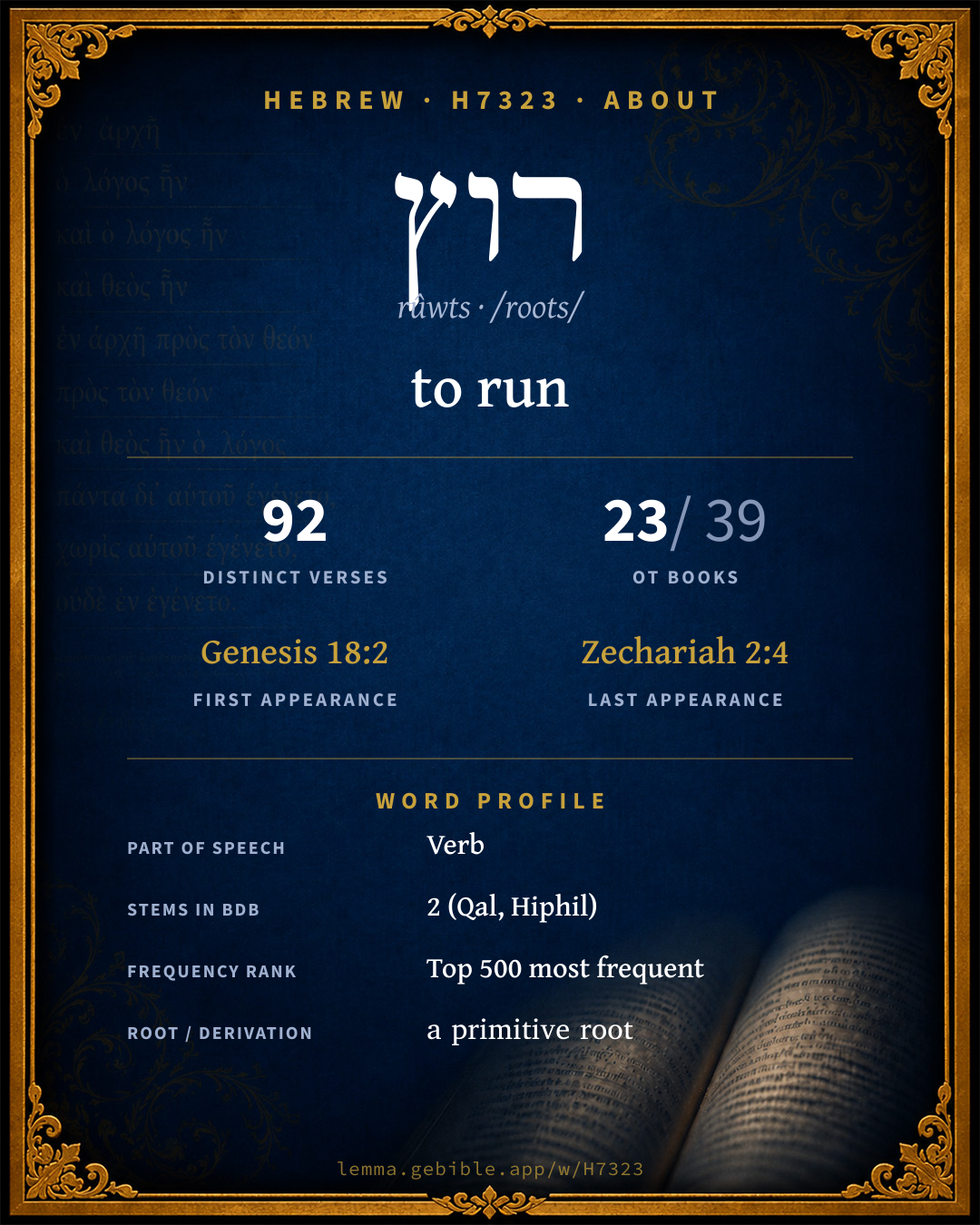
רוּץ
to run
‘to run’ is one of 2 main senses fuller range ↓
Full lexicon entry — Brown-Driver-Briggs (BDB)
From Brown-Driver-Briggs (BDB)
Where this word appears
See every Qal verb in the Hebrew Bible →
Grammar key — what these labels mean
Part of speech
- Verb
- An action or state-of-being word.
Stem
- Qal
- The basic, simple active stem — the plain form of the verb (“he wrote”). Here: ‘run’
- Hiphil
- The causative active stem (“he caused / brought about”). Here: ‘cause to run’
- Polel
- A stem of hollow/geminate roots functioning like the Piel — intensive active.
Form
- Sequential Imperfect
- An imperfect with prefixed waw — the standard past-narrative form (waw-consecutive imperfect).
- Participle Active
- A verbal adjective expressing ongoing or characteristic action (“writing / one who writes”).
- Imperfect
- An incomplete, ongoing, or future action (“he will / would write”).
- Imperative
- A direct command (“write!”).
- Infinitive Construct
- A bound verbal noun, frequently with prepositions (“to write / in writing”).
- Cohortative
- A first-person volitional form expressing wish or resolve (“let me / let us write”).
- Perfect
- A completed action or state — Hebrew marks aspect (completeness) more than strict tense (“he wrote”).
- Sequential Perfect
- A perfect with prefixed waw continuing a preceding imperfect or command (waw-consecutive perfect).
State
- Absolute
- The independent form of a noun, not bound to a following word.
Person
- 3rd Person
- The one spoken about (“he / she / it / they”).
- 1st Person
- The speaker (“I / we”).
- 2nd Person
- The one addressed (“you”).
Gender
- Masculine
- Grammatically masculine.
- Feminine
- Grammatically feminine.
- Common
- Either gender — not distinguished for this form.
Number
- Singular
- One.
- Plural
- More than one (in Hebrew, generally three or more).
Grammatical forms 23 distinct
- Verb, Qal, Participle Active, Masculine, Plural, Absolute 25 times (24%)
- Verb, Qal, Sequential Imperfect, 3rd Person, Masculine, Singular 19 times (18%)
- Verb, Qal, Imperfect, 3rd Person, Masculine, Plural 9 times (9%)
- Verb, Qal, Participle Active, Masculine, Singular, Absolute 8 times (8%)
- Verb, Qal, Imperfect, 3rd Person, Masculine, Singular 6 times (6%)
- Verb, Qal, Imperfect, 1st Person, Common, Singular 6 times (6%)
- Verb, Qal, Sequential Imperfect, 3rd Person, Feminine, Singular 4 times (4%)
- Verb, Qal, Imperative, 2nd Person, Masculine, Singular 4 times (4%)
+15 more forms (23 occurrences)
Parsed forms decoded from the imported morphology (morphhb / Westminster Leningrad Codex — WLC text public domain, morphhb tagging CC BY 4.0), counted across 104 parsed occurrences — not distinct verses.
Every verse where H7323 appears — 92 distinct verses across 23 books. Click any verse to open its interlinear word-by-word view. Verse text shown in the World English Bible for context — . Each verse’s Hebrew form is shown with its reference; the English is not keyword-highlighted, since the data carries no word-level English alignment. Use “Compare translations” on any verse to read it across multiple English versions. This concordance covers the Hebrew Bible; Septuagint (Greek Old Testament) occurrences are not indexed here.
Genesis 10 verses
- Genesis 18:2 וַ/יָּ֤רָץ conj + Qal wimpf 3ms He lifted up his eyes and looked, and saw that three men stood opposite him. When he saw them, he ran to meet them from the tent door, and bowed himself to the earth,
- Genesis 18:7 רָ֣ץ Qal pf 3ms Abraham ran to the herd, and fetched a tender and good calf, and gave it to the servant. He hurried to dress it.
- Genesis 24:17 וַ/יָּ֥רָץ conj + Qal wimpf 3ms The servant ran to meet her, and said, "Please give me a drink, a little water from your pitcher."
- Genesis 24:20 וַ/תָּ֥רָץ conj + Qal wimpf 3fs She hurried, and emptied her pitcher into the trough, and ran again to the well to draw, and drew for all his camels.
- Genesis 24:28 וַ/תָּ֨רָץ֙ conj + Qal wimpf 3fs The young lady ran, and told her mother's house about these words.
- Genesis 24:29 וַ/יָּ֨רָץ conj + Qal wimpf 3ms Rebekah had a brother, and his name was Laban. Laban ran out to the man, to the spring.
- Genesis 29:12 וַ/תָּ֖רָץ conj + Qal wimpf 3fs Jacob told Rachel that he was her father's brother, and that he was Rebekah's son. She ran and told her father.
- Genesis 29:13 וַ/יָּ֤רָץ conj + Qal wimpf 3ms It happened, when Laban heard the news of Jacob, his sister's son, that he ran to meet Jacob, and embraced him, and kissed him, and brought him to his house. Jacob told Laban all these things.
- Genesis 33:4 וַ/יָּ֨רָץ conj + Qal wimpf 3ms Esau ran to meet him, embraced him, fell on his neck, kissed him, and they wept.
- Genesis 41:14 וַ/יְרִיצֻ֖/הוּ conj + Hiphil wimpf 3mp + sfx pers 3ms Then Pharaoh sent and called Joseph, and they brought him hastily out of the dungeon. He shaved himself, changed his clothing, and came in to Pharaoh.
Numbers 2 verses
- Numbers 11:27 וַ/יָּ֣רָץ conj + Qal wimpf 3ms There ran a young man, and told Moses, and said, Eldad and Medad do prophesy in the camp.
- Numbers 16:47 וַ/יָּ֨רָץ֙ conj + Qal wimpf 3ms Aaron took as Moses spoke, and ran into the midst of the assembly; and, behold, the plague was begun among the people: and he put on the incense, and made atonement for the people.
Joshua 2 verses
- Joshua 7:22 וַ/יָּרֻ֖צוּ conj + Qal wimpf 3mp So Joshua sent messengers, and they ran to the tent; and, behold, it was hid in his tent, and the silver under it.
- Joshua 8:19 וַ/יָּר֨וּצוּ֙ conj + Qal wimpf 3mp The ambush arose quickly out of their place, and they ran as soon as he had stretched out his hand, and entered into the city, and took it; and they hurried and set the city on fire.
Judges 2 verses
- Judges 7:21 וַ/יָּ֧רָץ conj + Qal wimpf 3ms They stood every man in his place round about the camp; and all the host ran; and they shouted, and put [them] to flight.
- Judges 13:10 וַ/תָּ֖רָץ conj + Qal wimpf 3fs The woman made haste, and ran, and told her husband, and said to him, Behold, the man has appeared to me, who came to me the [other] day.
1 Samuel 11 verses
- 1 Samuel 3:5 וַ/יָּ֣רָץ conj + Qal wimpf 3ms He ran to Eli, and said, Here am I; for you called me. He said, I didn't call; lie down again. He went and lay down.
- 1 Samuel 4:12 וַ/יָּ֤רָץ conj + Qal wimpf 3ms There ran a man of Benjamin out of the army, and came to Shiloh the same day, with his clothes torn, and with earth on his head.
- 1 Samuel 8:11 וְ/רָצ֖וּ conj + Qal wpf 3cp He said, This will be the manner of the king who shall reign over you: he will take your sons, and appoint them to him, for his chariots, and to be his horsemen; and they shall run before his chariots;
- 1 Samuel 10:23 וַ/יָּרֻ֨צוּ֙ conj + Qal wimpf 3mp They ran and fetched him there; and when he stood among the people, he was higher than any of the people from his shoulders and upward.
- 1 Samuel 17:17 וְ/הָרֵ֥ץ conj + Hiphil impv 2ms Jesse said to David his son, Take now for your brothers an ephah of this parched grain, and these ten loaves, and carry [them] quickly to the camp to your brothers;
- 1 Samuel 17:22 וַ/יָּ֖רָץ conj + Qal wimpf 3ms David left his baggage in the hand of the keeper of the baggage, and ran to the army, and came and greeted his brothers.
- 1 Samuel 17:48 וַ/יָּ֥רָץ conj + Qal wimpf 3ms It happened, when the Philistine arose, and came and drew near to meet David, that David hurried, and ran toward the army to meet the Philistine.
- 1 Samuel 17:51 וַ/יָּ֣רָץ conj + Qal wimpf 3ms Then David ran, and stood over the Philistine, and took his sword, and drew it out of the sheath of it, and killed him, and cut off his head therewith. When the Philistines saw that their champion was dead, they fled.
- 1 Samuel 20:6 לָ/רוּץ֙ prep + Qal inf.cs If your father miss me at all, then say, David earnestly asked leave of me that he might run to Bethlehem his city; for it is the yearly sacrifice there for all the family.
- 1 Samuel 20:36 רֻ֗ץ רָ֔ץ Qal impv 2ms Qal pf 3ms He said to his boy, Run, find now the arrows which I shoot. As the boy ran, he shot an arrow beyond him.
- 1 Samuel 22:17 לָ/רָצִים֩ prep det + Qal ptcp.act mp The king said to the guard who stood about him, Turn, and kill the priests of Yahweh; because their hand also is with David, and because they knew that he fled, and didn't disclose it to me. But the servants of the king wouldn't put forth their hand to fall on the priests of Yahweh.
2 Samuel 8 verses
- 2 Samuel 15:1 רָצִ֥ים Qal ptcp.act mp It happened after this, that Absalom prepared him a chariot and horses, and fifty men to run before him.
- 2 Samuel 18:19 אָר֣וּצָה Qal coh 1cs Then said Ahimaaz the son of Zadok, Let me now run, and bear the king news, how that Yahweh has avenged him of his enemies.
- 2 Samuel 18:21 וַ/יָּרֹֽץ conj + Qal wimpf 3ms Then said Joab to the Cushite, Go, tell the king what you have seen. The Cushite bowed himself to Joab, and ran.
- 2 Samuel 18:22 אָרֻֽצָה רָץ֙ Qal coh 1cs Qal ptcp.act ms Then said Ahimaaz the son of Zadok yet again to Joab, But come what may, Please let me also run after the Cushite. Joab said, Why will you run, my son, seeing that you will have no reward for the news?
- 2 Samuel 18:23 אָר֔וּץ ר֑וּץ וַ/יָּ֤רָץ Qal impf 1cs Qal impv 2ms conj + Qal wimpf 3ms But come what may, [said he], I will run. He said to him, Run. Then Ahimaaz ran by the way of the Plain, and outran the Cushite.
- 2 Samuel 18:24 רָ֥ץ Qal ptcp.act ms Now David was sitting between the two gates: and the watchman went up to the roof of the gate to the wall, and lifted up his eyes, and looked, and, behold, a man running alone.
- 2 Samuel 18:26 רָץ֒ רָ֣ץ Qal ptcp.act ms Qal ptcp.act ms The watchman saw another man running; and the watchman called to the porter, and said, Behold, [another] man running alone. The king said, He also brings news.
- 2 Samuel 22:30 אָר֣וּץ Qal impf 1cs For by you I run on a troop; By my God do I leap over a wall.
1 Kings 5 verses
- 1 Kings 1:5 רָצִ֥ים Qal ptcp.act mp Then Adonijah the son of Haggith exalted himself, saying, I will be king: and he prepared him chariots and horsemen, and fifty men to run before him.
- 1 Kings 14:27 הָ/רָצִ֔ים ptcl def.art + Qal ptcp.act mp King Rehoboam made in their place shields of brass, and committed them to the hands of the captains of the guard, who kept the door of the king's house.
- 1 Kings 14:28 הָֽ/רָצִ֔ים הָ/רָצִֽים ptcl def.art + Qal ptcp.act mp ptcl def.art + Qal ptcp.act mp It was so, that as often as the king went into the house of Yahweh, the guard bore them, and brought them back into the guard-chamber.
- 1 Kings 18:46 וַ/יָּ֨רָץ֙ conj + Qal wimpf 3ms and the hand of Yahweh was on Elijah; and he girded up his loins, and ran before Ahab to the entrance of Jezreel.
- 1 Kings 19:20 וַ/יָּ֨רָץ֙ conj + Qal wimpf 3ms He left the oxen, and ran after Elijah, and said, Let me, I pray you, kiss my father and my mother, and then I will follow you. He said to him, Go back again; for what have I done to you?
2 Kings 11 verses
- 2 Kings 4:22 וְ/אָר֛וּצָה conj + Qal impf 1cs She called to her husband, and said, Please send me one of the servants, and one of the donkeys, that I may run to the man of God, and come again.
- 2 Kings 4:26 רֽוּץ Qal impv 2ms please run now to meet her, and ask her, Is it well with you? is it well with your husband? is it well with the child? She answered, It is well.
- 2 Kings 5:20 רַ֣צְתִּי Qal pf 1cs But Gehazi the servant of Elisha the man of God, said, Behold, my master has spared this Naaman the Syrian, in not receiving at his hands that which he brought: as Yahweh lives, I will run after him, and take somewhat of him.
- 2 Kings 5:21 רָ֣ץ Qal ptcp.act ms So Gehazi followed after Naaman. When Naaman saw one running after him, he alighted from the chariot to meet him, and said, Is all well?
- 2 Kings 10:25 לָ/רָצִ֨ים הָֽ/רָצִים֙ prep det + Qal ptcp.act mp ptcl def.art + Qal ptcp.act mp It happened, as soon as he had made an end of offering the burnt offering, that Jehu said to the guard and to the captains, Go in, and kill them; let none come forth. They struck them with the edge of the sword; and the guard and the captains cast them out, and went to the city of the house of Baal.
- 2 Kings 11:4 וְ/לָ֣/רָצִ֔ים conj + prep det + Qal ptcp.act mp In the seventh year Jehoiada sent and fetched the captains over hundreds of the Carites and of the guard, and brought them to him into the house of Yahweh; and he made a covenant with them, and took an oath of them in the house of Yahweh, and shown them the king's son.
- 2 Kings 11:6 הָ/רָצִ֑ים ptcl def.art + Qal ptcp.act mp A third part shall be at the gate Sur; and a third part at the gate behind the guard: so shall you keep the watch of the house, and be a barrier.
- 2 Kings 11:11 הָ/רָצִ֜ים ptcl def.art + Qal ptcp.act mp The guard stood, every man with his weapons in his hand, from the right side of the house to the left side of the house, along by the altar and the house, by the king round about.
- 2 Kings 11:13 הָֽ/רָצִ֖ין ptcl def.art + Qal ptcp.act mp When Athaliah heard the noise of the guard [and of] the people, she came to the people into the house of Yahweh:
- 2 Kings 11:19 הָ/רָצִ֜ים הָ/רָצִ֖ים ptcl def.art + Qal ptcp.act mp ptcl def.art + Qal ptcp.act mp He took the captains over hundreds, and the Carites, and the guard, and all the people of the land; and they brought down the king from the house of Yahweh, and came by the way of the gate of the guard to the king's house. He sat on the throne of the kings.
- 2 Kings 23:12 וַ/יָּ֣רָץ conj + Qal wimpf 3ms The altars that were on the roof of the upper chamber of Ahaz, which the kings of Judah had made, and the altars which Manasseh had made in the two courts of the house of Yahweh, did the king break down, and beat [them] down from there, and cast the dust of them into the brook Kidron.
2 Chronicles 6 verses
- 2 Chronicles 12:10 הָ/רָצִ֔ים ptcl def.art + Qal ptcp.act mp King Rehoboam made in their place shields of brass, and committed them to the hands of the captains of the guard, who kept the door of the king's house.
- 2 Chronicles 12:11 הָ/רָצִים֙ הָ/רָצִֽים ptcl def.art + Qal ptcp.act mp ptcl def.art + Qal ptcp.act mp It was so, that as often as the king entered into the house of Yahweh, the guard came and bore them, and brought them back into the guard-chamber.
- 2 Chronicles 23:12 הָֽ/רָצִ֔ים ptcl def.art + Qal ptcp.act mp When Athaliah heard the noise of the people running and praising the king, she came to the people into the house of Yahweh:
- 2 Chronicles 30:6 הָ/רָצִ֨ים ptcl def.art + Qal ptcp.act mp So the posts went with the letters from the king and his princes throughout all Israel and Judah, and according to the commandment of the king, saying, You children of Israel, turn again to Yahweh, the God of Abraham, Isaac, and Israel, that he may return to the remnant that have escaped of you out of the hand of the kings of Assyria.
- 2 Chronicles 30:10 הָ/רָצִ֜ים ptcl def.art + Qal ptcp.act mp So the posts passed from city to city through the country of Ephraim and Manasseh, even to Zebulun: but they ridiculed them, and mocked them.
- 2 Chronicles 35:13 וַ/יָּרִ֖יצוּ conj + Hiphil wimpf 3mp They roasted the Passover with fire according to the ordinance: and the holy offerings boiled they in pots, and in caldrons, and in pans, and carried them quickly to all the children of the people.
Esther 4 verses
- Esther 3:13 הָ/רָצִים֮ ptcl def.art + Qal ptcp.act mp Letters were sent by posts into all the king's provinces, to destroy, to kill, and to cause to perish, all Jews, both young and old, little children and women, in one day, even on the thirteenth [day] of the twelfth month, which is the month Adar, and to take the spoil of them for a prey.
- Esther 3:15 הָֽ/רָצִ֞ים ptcl def.art + Qal ptcp.act mp The posts went forth in haste by the king's commandment, and the decree was given out in Shushan the palace. The king and Haman sat down to drink; but the city of Shushan was perplexed.
- Esther 8:10 הָ/רָצִ֨ים ptcl def.art + Qal ptcp.act mp He wrote the name of king Ahasuerus, and sealed it with the king's ring, and sent letters by post on horseback, riding on swift steeds that were used in the king's service, bred of the stud:
- Esther 8:14 הָ/רָצִ֞ים ptcl def.art + Qal ptcp.act mp So the posts who rode on swift steeds that were used in the king's service went out, being hurried and pressed on by the king's commandment; and the decree was given out in Shushan the palace.
Job 3 verses
- Job 9:25 רָ֑ץ Qal ptcp.act ms "Now my days are swifter than a runner. They flee away, they see no good,
- Job 15:26 יָר֣וּץ Qal impf 3ms He runs at him with a stiff neck, With the thick shields of his bucklers;
- Job 16:14 יָרֻ֖ץ Qal impf 3ms He breaks me with breach on breach. He runs on me like a giant.
Psalms 6 verses
- Psalms 18:29 אָרֻ֣ץ Qal impf 1cs For by you, I advance through a troop. By my God, I leap over a wall.
- Psalms 19:5 לָ/ר֥וּץ prep + Qal inf.cs Which is as a bridegroom coming out of his chamber, Like a strong man rejoicing to run his course.
- Psalms 59:4 יְרוּצ֣וּ/ן Qal impf 3mp + sfx n I have done no wrong, yet they are ready to attack me. Rise up, behold, and help me!
- Psalms 68:31 תָּרִ֥יץ Hiphil impf 3fs Princes shall come out of Egypt. Ethiopia shall hurry to stretch out her hands to God.
- Psalms 119:32 אָר֑וּץ Qal impf 1cs I run in the path of your commandments, For you have set my heart free.
- Psalms 147:15 יָר֥וּץ Qal impf 3ms He sends out his commandment to the earth. His word runs very swiftly.
Proverbs 4 verses
- Proverbs 1:16 יָר֑וּצוּ Qal impf 3mp For their feet run to evil. They hurry to shed blood.
- Proverbs 4:12 תָּ֝ר֗וּץ Qal impf 2ms When you go, your steps will not be hampered. When you run, you will not stumble.
- Proverbs 6:18 לָ/ר֥וּץ prep + Qal inf.cs A heart that devises wicked schemes, Feet that are swift in running to mischief,
- Proverbs 18:10 יָר֖וּץ Qal impf 3ms The name of Yahweh is a strong tower: The righteous run to him, and are safe.
Song of Solomon 1 verse
Isaiah 3 verses
- Isaiah 40:31 יָר֨וּצוּ֙ Qal impf 3mp but those who wait for Yahweh shall renew their strength; they shall mount up with wings as eagles; they shall run, and not be weary; they shall walk, and not faint.
- Isaiah 55:5 יָר֑וּצוּ Qal impf 3mp Behold, you shall call a nation that you don't know; and a nation that didn't know you shall run to you, because of Yahweh your God, and for the Holy One of Israel; for he has glorified you.
- Isaiah 59:7 יָרֻ֔צוּ Qal impf 3mp Their feet run to evil, and they make haste to shed innocent blood: their thoughts are thoughts of iniquity; desolation and destruction are in their paths.
Jeremiah 5 verses
- Jeremiah 12:5 רַ֨צְתָּה֙ Qal pf 2ms If you have run with the footmen, and they have wearied you, then how can you contend with horses? and though in a land of peace you are secure, yet how will you do in the pride of the Jordan?
- Jeremiah 23:21 רָ֑צוּ Qal pf 3cp I sent not these prophets, yet they ran: I didn't speak to them, yet they prophesied.
- Jeremiah 49:19 אֲרִיצֶ֨/נּוּ Hiphil impf 1cs + sfx pers 3ms Behold, he shall come up like a lion from the pride of the Jordan against the strong habitation: for I will suddenly make them run away from it; and whoever is chosen, him will I appoint over it: for who is like me? and who will appoint me a time? and who is the shepherd who will stand before me?
- Jeremiah 50:44 ארוצ/ם אֲרִיצֵ/ם֙ Qal impf 1cs + sfx pers 3mp Hiphil impf 1cs + sfx pers 3mp Behold, [the enemy] shall come up like a lion from the pride of the Jordan against the strong habitation: for I will suddenly make them run away from it; and whoever is chosen, him will I appoint over it: for who is like me? and who will appoint me a time? and who is the shepherd who can stand before me?
- Jeremiah 51:31 רָ֤ץ רָץ֙ יָר֔וּץ Qal ptcp.act ms Qal ptcp.act ms Qal impf 3ms One post shall run to meet another, and one messenger to met another, to show the king of Babylon that his city is taken on every quarter:
Daniel 1 verse
Joel 3 verses
- Joel 2:4 יְרוּצֽוּ/ן Qal impf 3mp + sfx n The appearance of them is as the appearance of horses, And as horsemen, so do they run.
- Joel 2:7 יְרֻצ֔וּ/ן Qal impf 3mp + sfx n They run like mighty men. They climb the wall like warriors. They each march in his line, and they don't swerve off course.
- Joel 2:9 יְרֻצ֔וּ/ן Qal impf 3mp + sfx n They rush on the city. They run on the wall. They climb up into the houses. They enter in at the windows like thieves.
Amos 1 verse
Nahum 1 verse
Habakkuk 1 verse
Haggai 1 verse
Zechariah 1 verse
About this entry
At a glance — auto-summarized from this page’s data, not written by a person. Every figure links to its source below. This summary describes the numbers; it doesn’t interpret them.
At its core, רוץ (rûwts) means “to run.” The King James Version usually renders it “ran,” while modern versions prefer “runners” (unfoldingWord Literal Text) — see the renderings breakdown. With 92 verses in 23 books, it is a moderately common word in the Hebrew Bible. Scripture first uses it in Genesis 18:2. Different stems carry different senses — BDB groups them under 2 stems, among them Qal and Hiphil. Dig into 92-verse concordance and the renderings breakdown below.
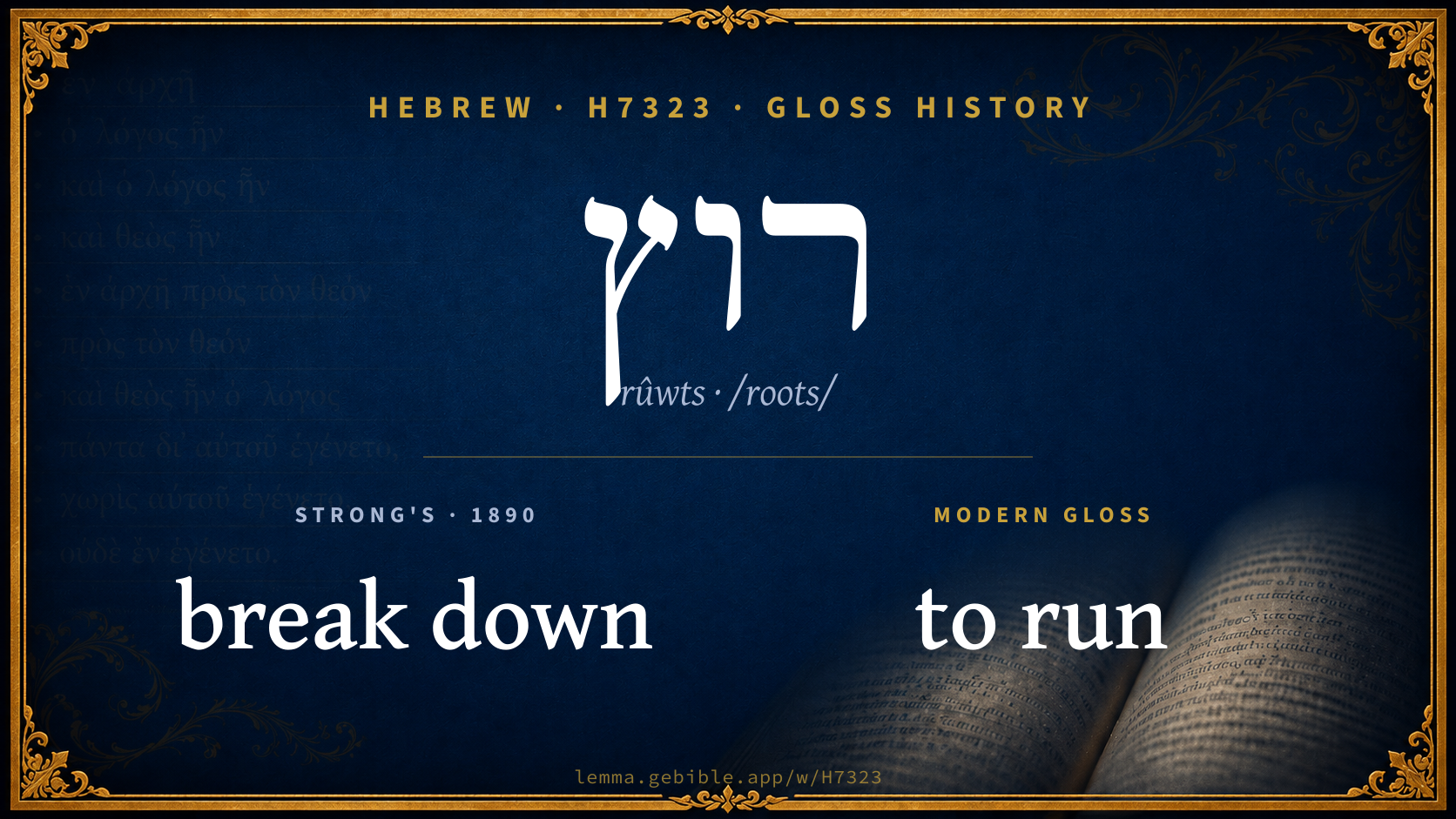
Gloss history
Strong's 1890 vs modern scholarship
About this word
Strong's H7323 catalogs a Hebrew word from the Hebrew Old Testament.
These counts are not copied from any lexicon or concordance. They are computed here, from the morphology-tagged Hebrew Old Testament. What Lemma adds →
- 92
- distinct verses
- The word appears in 92 distinct verses.
- 23 / 39
- OT books
- The word appears in 23 of 39 Old Testament books.
- #410
- by frequency
- Top 500 most frequent Hebrew words (rank 410 of 8,640 Hebrew words by occurrence).
View all 92 occurrences in the concordance →
By section of the Old Testament
By traditional corpus
Conventional, traditional groupings — biblical authorship is debated, so this is a traditional corpus grouping, not an authorship claim. Each share is this word’s portion of its verses in that division of the Hebrew canon. Each figure is a share of the word’s 92 distinct verses.
- Prophets (Nevi'im) 55 verses · 60%
- Writings (Ketuvim) 25 verses · 27%
- Torah (Pentateuch) 12 verses · 13%
How translations render this word
Counts come from each version’s own published word-to-Strong’s tagging or interlinear alignment — an approximate guide to how each version renders this word, not a word-level alignment the data otherwise carries. Because each total is that version’s own tagged count, the per-version totals vary from one another and need not match the appearance or distinct-verse counts above. These counts may also differ from a printed concordance because Lemma counts each distinctly tagged rendering and does not collapse phrase taggings into a single head-word total. This is a fixed set of word-tagged versions (KJV, ASV, BSB, ULT) and does not change with the reading translation you choose elsewhere. Each version’s license is shown beside its name below (and on Sources).
- King James Version: Ran 20×, Guard 14×, Run 11×
- American Standard Version: Ran 20×, Guard 13×, Run 8×
- Berean Standard Bible: Ran 16×, Run 12×, Guards 11×
- unfoldingWord Literal Text: Runners 21×, Ran 14×, Run 12×
King James Version Public Domain
Renders H7323 across 104 tagged occurrences — most commonly:
Plus 30 renderings that appear only once — usually multi-word phrases or single function words the recovered tagging swept in, not distinct renderings. Not rendered by a distinct English word in 1 further occurrence.
American Standard Version Public Domain
Renders H7323 across 104 tagged occurrences — most commonly:
Plus other, less common renderings. Plus 33 renderings that appear only once — usually multi-word phrases or single function words the recovered tagging swept in, not distinct renderings.
Berean Standard Bible Public Domain
Renders H7323 across 103 tagged occurrences — most commonly:
Plus 43 renderings that appear only once — usually multi-word phrases or single function words the recovered tagging swept in, not distinct renderings.
unfoldingWord Literal Text CC BY-SA 4.0
Renders H7323 across 113 tagged occurrences — most commonly:
Plus other, less common renderings. Plus 18 renderings that appear only once — usually multi-word phrases or single function words the recovered tagging swept in, not distinct renderings.
8 senses and sub-senses in the full BDB
Hebrew verbs can shift meaning by stem (binyan): Qal is the basic action, Niphal is often passive or reflexive, Piel often intensifies or makes it factitive, and Hiphil is typically causative. The senses below are grouped under the stem BDB assigns to each.
What do BDB’s symbols mean?
BDB uses these scholarly abbreviations:
| Symbol | Meaning |
|---|---|
| 𝔊 | the Septuagint (the ancient Greek translation, LXX) |
| 𝔙 | the Vulgate (the Latin translation) |
| 𝔖 | the Syriac version (the Peshitta) |
| 𝔗 | the Targum (the Aramaic translation) |
| ψ | the Psalms |
| √ | root (the underlying root or stem) |
| ‖ | parallel passage (a synonymous or contrasted parallel) |
| † | the dagger: every passage where the word occurs is cited |
The 8 senses and sub-senses the full Brown-Driver-Briggs lexicon distinguishes for this word, in lexicon order (not ranked by frequency), with BDB’s own verbatim wording and sub-sense lettering. Shown in Hebrew script with BDB’s own scholarly abbreviations. The condensed entry is in the Lexicon Entry tab. See also the Forms in the corpus table below.
Qal
- Pf. 3 ms. רָץ Gn 18:7; 2 ms. רַצְתָּה Je 12:5, etc.; Impf. יָרוּץ Hb 2:2 +, יָרֻץ Jb 16:14, וַיָּ֫רָץ Gn 18:2 +, וַיָּרֹ֑ץ 2 S 18:21; 1 s. sf. ארוצם Je 50:44 Kt (but רצץ]; Imv. ms. רוּץ 2 S 18:23 2 K 4:26, רֻץ 1 S 20:36 Zc 2:8; Inf. cstr. לָרוּץ 1 S 20:6 +; Pt. רָץ 2 S 18:22 +, pl. רָצִים 1 S 22:17 +, רָצִין 2 K 11:13 (Ges§ 87 e);— e.g. Genesis 18:7
- 1. run, c. אֶל loc. Gn 18:7; 24:20 (both J), Nu 17:12 (P), אֶל pers. Gn 24:29 (J; + ה loc.), 1 S 3:5; Is 55:5 (fig.), with hostility, against, Jb 15:26 (fig.), so goat against ram Dn 8:6, עַלִ pers., against Jb 16:14; ה loc. also Jos 7:22, לְבֵיתוֹ Hg 1:9, לָרַע Is 59:7; Pr 1:16; acc. loc. 1 S 20:6; 17:22, 48 (+ לִקְרַאת); ב loc. on (ב II. 2), of horses Am 6:12, locusts Jo 2:9; into Pr 18:10 (fig.); מִן loc. 1 S 4:12, so MT 2 K 23:12 (= he went quickly thence, but text perhaps corrupt, v. Kit Benz, and cf.> Hiph. infr.); אַחֲרֵי pers. 2 S 18:22; 1 K 19:20; 2 K 5:20, 21; Ct 1:4, עַד pers. 2 K 4:22; לִפְנֵי pers. 2 S 15:1; 1 K 1:5 (both of royal escort, 2), 18:46 (+ עַד loc.), לִפְנֵי rei 1 S 8:11; אֵת pers. accomp. Je 12:5; c. acc. of way, אֹרַח ψ 19:6, דֶּרֶךְ 2 S 18:23; ψ 119:132 (fig.); as prelim., + inf. לִקְרַאת run to meet Gn 18:2; 24:17; 29:13; 33:4 (all J), 2 K 4:26; Je 51:31 + vb. fin. Gn 24:28; 29:12 (both J), Nu 11:27; Jos 8:19 (both JE), Ju 7:21; 13:10; 1 S 10:23; 17:51; 2 S 18:19; ψ 59:5; as imv. + imv. 1 S 20:36; Zc 2:8; abs. 1 S 20:36; Is 40:31; 2 Ch 23:12 (v. 2 a), Pr 4:12; 6:18 (of feet), of locusts Jo 2:4, 7; specif., run as messenger 2 S 18:21, 22, 23(×2), 24, 26(×2), fig. of prophet’s activity Je 23:21, of י׳’s word ψ 147:15; fig. of reading smoothly, יָרוּץ קוֹרֵא בוֹ Hb 2:2.—ψ 18:30 = 2 S 22:30 read אָרֹץ (for אָרֻץ, אָרוּץ), √ רצץ Ew Ol Che Bae al. e.g. Genesis 18:7
- 2. Pt. as subst.:
- a. pl. הָרָצִים the runners (proposes 3, as royal escort, cf. vb. 2 S 15:1; 1 K 1:5; then) of royal body-guard 1 S 22:17; 1 K 14:27, 28(×2) = 2 Ch 12:10, 11(×2); 2 K 10:25(×2); 11:4, 6, 11, 19(×2).—(הָעָם) הָרָצִין v13 is gloss (Kit Benz; whence [easier] הָעָם הָרָצִים 2 Ch 23:12 v. 1).—Pr 29:6 for יָרֻן Pinsk Toy favour יָרוּץ. e.g. 2 Samuel 15:1
- b. runner = (royal messenger, post, late), רָץ Je 51:31(×2) (‖ מַגִּיד), cf. Jb 9:25 (as swift); הָרָצִים 2 Ch 30:6, 10; Est 3:13, 15, riders הָר׳ בַּסּוּסִים 8:10, הָר׳ רֹכְבֵי הָרֶכֶשׁ v14. Pōʿlēl Impf. 3 mpl. יְרוֹצֵ֑צוּ Na 2:5 they run swiftly, dart (like lightning; of chariots). e.g. Jeremiah 51:31
Hiphil
- cause to run:
- 1. bring, or move, quickly, Impf. 3 mpl. sf. וַיְרִיצֻהוּ, מִן loc. Gn 41:14 (E), read perhaps also 3 ms. וַיָּרֶץ 2 K 23:12 (acc. om.; for MT וַיָּרָץ v. Qal); ל pers., acc. rei om. וַיָּרִיצוּ 2 Ch 35:13; Imv. ms. הָרֵץ 1 S 17:17 (+ acc. loc., ל pers.); Impf. 3 fs. תָּרִיץ יָדָיו ψ 68:32 quickly stretch out hands, לֵאלֹהִים (viz. with offerings). e.g. Genesis 41:14
- 2. c. מֵעַל = drive away from, 1 s., sf. 3 ms., אֲרִיצֶנּוּ Je 49:19, so read prob. also in ‖ 50:44 (Qr אֲרִיצֵם, > Kt ארוצם). e.g. Jeremiah 49:19
Senses from the full Brown-Driver-Briggs lexicon (Brown, Driver, Briggs; Oxford 1906 — public domain), digitized via Sefaria, supplemented by the OpenScriptures HebrewLexicon (CC BY 4.0). Full attribution on Sources.
Word origin
vb. run (NH id. (rare); Ethiopic ሮጸ Zinj. Pf. 1 s. רצת; = Aramaic רְהַט; ܪܗܰܛ (WSG 47); cf. Assyrian râṣu, be helpful (i.e. run to help?));—
— Brown-Driver-Briggs (Oxford 1906, public domain), digitized via Sefaria, supplemented by the OpenScriptures HebrewLexicon (CC BY 4.0). See Sources.
Origin: a primitive root
Jastrow Dictionary
A second Hebrew/Aramaic lexicon for comparison, covering Aramaic and post-biblical (Talmudic, Targumic, Midrashic) usage that the biblical-Hebrew BDB does not. Matched by lemma rather than by Strong’s number, so a lemma may carry more than one Jastrow headword (shown separately below), and the entries cover usage well beyond the Bible.
רוּץ
- (b. h.) to run. Sabb. 153ᵇ רָץ תחתיה וכ׳ he must run under it (with the burden on his shoulders) until he reaches his home, opp. קלי קלי. Ber. 6ᵇ לעולם יָרוּץ אדם וכ׳ man should always run to hear the word of the hălakhah, even on the Sabbath. Pes. 112ᵃ; Ab. V, 20 רץ כצבי quick like a deer. Snh. 96ᵃ יכול אני לָרוּץ וכ׳ I can run for three parasangs in front of horses. Ib. ומה בשכר … שרץ thou wonderest at the reward for four steps which that wicked man (Baladan) ran for my honor’s sake; שרָצוּ לפני וכ׳ who ran before me like horses; a. fr.
- to make run, hasten. Mekh. B’shall., Shir., s. 2 למה רַצְתָּ … מצרי הֱרִיצַנִי וכ׳ why didst thou run after my children?, and he (the horse) says, the Egyptian made me run against my will; הסוס הריצני וכ׳ the horse carried me swiftly against my will. Ib. B’shall., s. 2 שהיו מְרִיצִים המרכבה who drove the chariot. Y. Shek. VIII, 51ᵃ bot. מְרִיצִין, v. מְרִיצָה. Koh. R. to XII, 6 (play on ותרץ, ib.) ומְרִיצָה וכ׳, v. גָּלָה; Lev. R. s. 18 ומריקה (corr. acc.). Gen. R. s. 13 אר̇ץ̇ כנגד … שהיא מר̇יצ̇ה וכ׳ the earth is called erets, corresponding to the spring season, when she hastens her fruits to come forth. Lev. R. s. 28 דברים שהן מריצין לבני מעים things which make the bowels run (loosen the bowels); Yalk. Ez. 344; Pesik. R. s. 18 מצירים (corr. acc.); (Pesik. Haʿomer, p. 71 משלשלום); a. fr.—[Num. R. s. 20; Tanḥ. Balak 4 הכל מריצים, v. רָצַץ.]
A Dictionary of the Targumim, the Talmud Babli and Yerushalmi, and the Midrashic Literature (Marcus Jastrow; London, Luzac, 1903) — Public Domain. Digitized via Sefaria. Digitized via Sefaria. Full attribution on Sources.
Forms in the corpus
The 77 distinct written forms H7323 takes in the Hebrew Bible, most frequent first — each parse links to that stem’s occurrences in the concordance. Hebrew forms include their vowel points and cantillation, so a single lemma takes many written forms.
The 60 most common forms are shown; 17 rarer forms follow in the full concordance.
Same root — word family
Other BDB entries built from the same root as H7323, grouped by Strong’s listed origin. These share a root / origin per the lexicon — not necessarily a shared meaning. Each links to that word’s own entry.
Derived from this word
Compare all same-root words → They share a root, not necessarily a meaning.
Septuagint verse parallels
This word appears in 83 verses that also exist in the Greek Old Testament (Septuagint), out of the 92 Hebrew verses it occurs in. You can read those verses in Greek by switching the Old Testament edition to the Septuagint.
Read these verses in the Septuagint
- Genesis 18:2
- Numbers 11:27
- Joshua 7:22
- Judges 7:21
- 1 Samuel 3:5
- 2 Samuel 15:1
- 1 Kings 1:5
- 2 Kings 4:22
- 2 Chronicles 12:10
- Esther 3:13
- Job 9:25
- Psalms 19:5
This is a verse-level parallel only — the same verses exist in both the Hebrew and Greek Old Testaments. No word-level Hebrew↔Greek correspondence is claimed: the data carries no such alignment, so no Greek word is shown as this Hebrew word’s translation. Coverage is not total — the Septuagint omits the deuterocanon and renumbers the Psalms, so some Hebrew verses have no direct Greek parallel.