

Psalms 147:15

Hebrew (Westminster Leningrad Codex) Psalms 147:15 appears in the Hebrew Old Testament. The text above is from the Westminster Leningrad Codex. Each word links to its Strong’s number, a concise gloss, and parsing drawn from the Open Scriptures Hebrew Bible morphology. Click any word for its full Brown-Driver-Briggs (BDB) entry.
Download image
Cite this verse

Psalms 147:15 (World English Bible). Public Domain. Lemma interlinear Bible study tool, https://lemma.gebible.app/v/psalms/147/15.

Show BibTeX & RIS
BibTeX
RIS
English Translation
He sends out his commandment to the earth. His word runs very swiftly.
World English Bible · Public Domain
Download a study sheet

One document with this verse’s original text, its word-by-word gloss line, the meaning frame, cross-references with their text, attributed commentary, and full source and license credits — printable, and it pastes into notes with its structure intact.

This verse Autodidact and up

Study sheet (.html) Plain text (.txt)

A passage Seminary Student

Up to 50 verses in one chapter. A passage sheet keeps up to 6 commentary sources and 12 cross-references per verse, in the order this page ranks them, and says so on the sheet whenever that leaves anything out. Ask for a single verse and you get the Autodidact verse sheet above.

Everything on this page stays free to read, with no account — the sheet is a download of what is already on screen, not access to it.

Want to remove ads? Support Godless Engineer
Compare translations 3

The same verse in 3 English versions, stacked beneath the original-language interlinear above. Click any original word for its lexicon entry.

Each is an independent rendering of the whole verse — the interlinear is not word-aligned to these translations.

Highlighted words mark where these versions differ — a whole-verse word diff, not a word-by-word alignment.

  • World English Bible Public Domain
    He sends out his commandment to the earth. His word runs very swiftly.
  • King James Version Public Domain
    He sendeth forth his commandment upon earth: his word runneth very swiftly.
  • unfoldingWord Literal Text CC BY-SA 4.0
    The one sending his command the earth, his word runs to swiftness.

unfoldingWord Literal Text — © unfoldingWord, licensed CC BY-SA 4.0. Word-aligned USFM3 via Door43 (git.door43.org/unfoldingWord/en_ult).

Versions to compare (up to 4)

3 of 4 selected

Show all 17 translations

Every available English version of this verse, each an independent rendering of the whole verse.

  • World English Bible Public Domain
    He sends out his commandment to the earth. His word runs very swiftly.
  • Berean Standard Bible Public Domain
    He sends forth His command to the earth; His word runs swiftly.
  • Majority Standard Bible Public Domain
    He sends forth His command to the earth; His word runs swiftly.
  • King James Version Public Domain
    He sendeth forth his commandment upon earth: his word runneth very swiftly.
  • American Standard Version (1901) Public Domain
    He sendeth out his commandment upon earth; His word runneth very swiftly.
  • Revised Version (1885) Public Domain
    He sendeth out his commandment upon earth; his word runneth very swiftly.
  • Geneva Bible (1599) Public Domain
    He sendeth foorth his commandement vpon earth, and his worde runneth very swiftly.
  • Young's Literal Translation Public Domain
    Who is sending forth His saying `on' earth, Very speedily doth His word run.
  • Literal Standard Version CC BY-SA 4.0
    Who is sending forth His saying [on] earth, || His word runs very speedily.
  • Unlocked Literal Bible CC BY-SA 4.0
    He sends out his commandment to earth, his command runs very swiftly.
  • unfoldingWord Literal Text CC BY-SA 4.0
    The one sending his command the earth, his word runs to swiftness.
  • Darby Bible Public Domain
    He sendeth forth his oracles to the earth: his word runneth very swiftly.
  • World Messianic Bible Public Domain
    He sends out his commandment to the earth. His word runs very swiftly.
  • Webster's Bible Public Domain
    He sendeth forth his commandment upon earth: his word runneth very swiftly.
  • Free Bible Version CC BY-SA 4.0
    He sends his commands around the world—they're quickly implemented.
  • Bible in Basic English Public Domain
    He sends out his orders to the earth; his word goes out quickly.
  • JPS Tanakh (1917) Public Domain
    He sendeth out His commandment upon earth; His word runneth very swiftly.

Literal Standard Version (2020), Covenant Press — licensed CC BY-SA 4.0. Text via the HelloAO Bible API (eBible.org). Unlocked Literal Bible (unfoldingWord) — licensed CC BY-SA 4.0. Text via the HelloAO Bible API (eBible.org). unfoldingWord Literal Text — © unfoldingWord, licensed CC BY-SA 4.0. Word-aligned USFM3 via Door43 (git.door43.org/unfoldingWord/en_ult). Free Bible Version, Dr. Jonathan Gallagher — licensed CC BY-SA 4.0. Text via the HelloAO Bible API (eBible.org).

Word by word

More ways to search: Search by grammar → Find every occurrence → Compare this word →

Practice this passage: Drill this verse → Learn its vocabulary →

About this verse

These counts appear in no published source. They are computed here, from the morphology-tagged text and Lemma’s own curated glosses. What Lemma adds →

7
words
7
distinct lemmas
Wisdom
section

Notable vocabulary

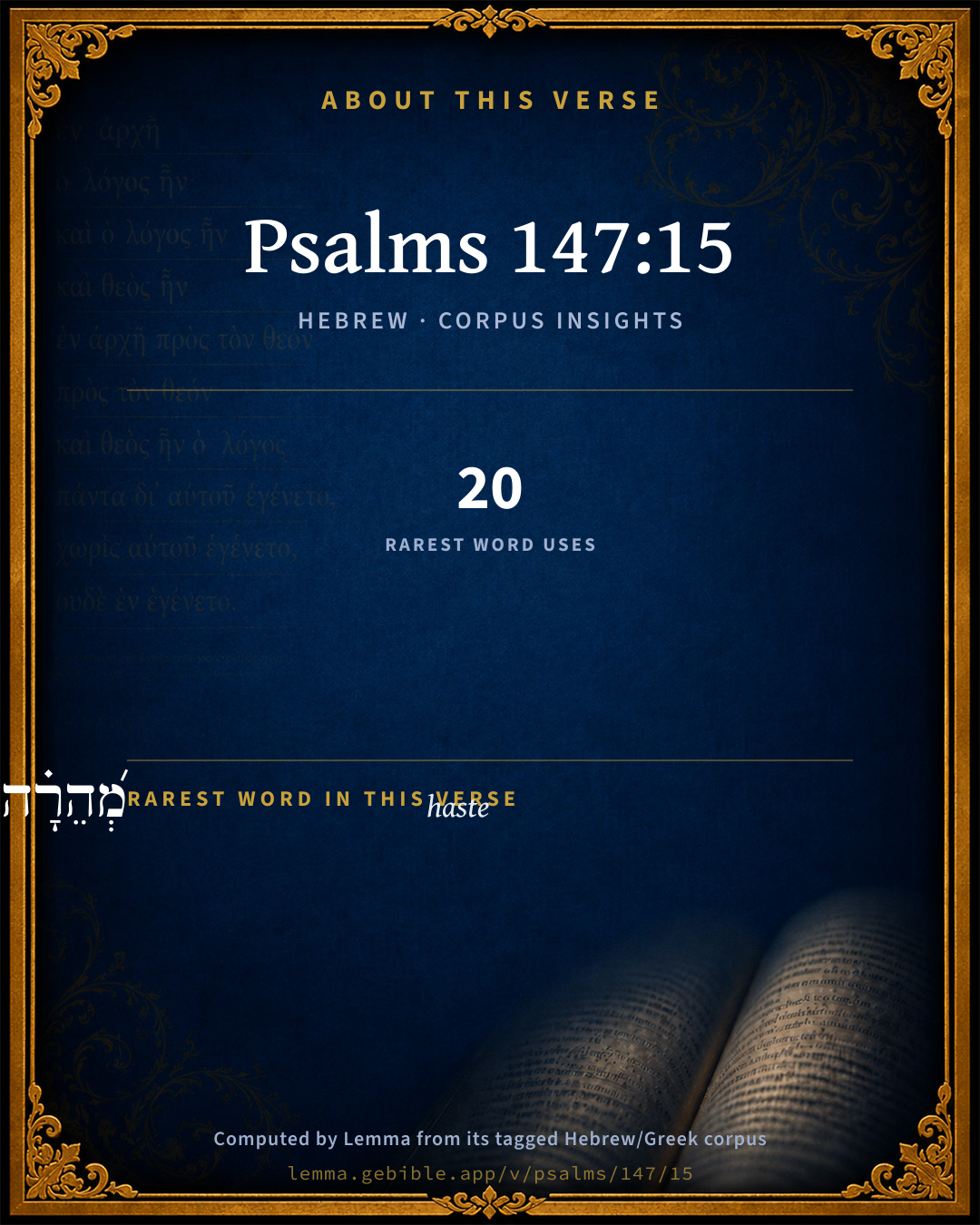
The rarest word here is מְ֝הֵרָ֗ה haste H4120 — appearing just 20 times in the whole Hebrew Bible.

Shared distinctive vocabulary

מְ֝הֵרָ֗ה haste H4120 occurs in 20 verses of the Hebrew Bible. Also found in:

Grammatical profile

  • 2 verbs
  • 4 nouns
  • 1 preposition

Verb forms

  • הַשֹּׁלֵ֣חַ Qal · Participle Active
  • יָר֥וּץ Qal · Imperfect

Cross-references

10

Topical passages linked to Psalms 147:15 in the Treasury of Scripture Knowledge — connected by theme and wording, ordered by reader-vote popularity; previews shown in the World English Bible.

  • Job 37:12 It is turned round about by his guidance, That they may do whatever he commands them On the surface of the habitable world,
  • Psalms 107:20 He sends his word, and heals them, And delivers them from their graves.
  • 2 Thessalonians 3:1 Finally, brothers, pray for us, that the word of the Lord may spread rapidly and be glorified, even as also with you;
  • Job 34:29 When he gives quietness, who then can condemn? When he hides his face, who then can see him? Alike whether to a nation, or to a man:
  • Psalms 33:9 For he spoke, and it was done. He commanded, and it stood firm.
  • Matthew 8:8–9 The centurion answered, "Lord, I'm not worthy for you to come under my roof. Just say the word, and my servant will be healed.
  • Matthew 8:13 Jesus said to the centurion, "Go your way. Let it be done for you as you have believed." His servant was healed in that hour.
  • Psalms 68:11 The Lord announced the word. The ones who proclaim it are a great company.
  • Psalms 107:25 For he commands, and raises the stormy wind, Which lifts up its waves.
  • Jonah 1:4 But Yahweh sent out a great wind on the sea, and there was a mighty tempest on the sea, so that the ship was likely to break up.

Cross-references courtesy of OpenBible.info (CC BY 4.0).

Hebrew and Greek witnesses Masoretic Hebrew ↔ Greek Septuagint

The same verse in the two great witnesses to the Old Testament, shown verse-for-verse.

You’re reading Greek Psalm 146 (Hebrew Psalm 147). The Septuagint counts the superscription, so verse numbers can differ from the Hebrew — chapter-level alignment, not verse-by-verse. Numbering follows Rahlfs.

These are two independent witnesses, not word-aligned to each other, and the Septuagint is shown in lemma (dictionary) form.

Hebrew Psalms 147:15 Masoretic · Westminster Leningrad Codex

הַשֹּׁלֵ֣חַ אִמְרָת֣וֹ אָ֑רֶץ עַד מְ֝הֵרָ֗ה יָר֥וּץ דְּבָרֽוֹ

He sends out his commandment to the earth. His word runs very swiftly.

World English Bible · Public Domain

Hebrew: Westminster Leningrad Codex (CC BY 4.0). Greek: Septuagint (public domain); English from a public-domain English Septuagint. How the Septuagint differs from the Hebrew →

Commentary

Notes on Psalms 147:15 from classic Christian and Jewish commentators (each source and its license shown beneath its notes). The classic Christian expositions comment on the surrounding passage and are grouped to its opening verse, so a note may address several verses; the Jewish commentaries on the Tanakh (Rashi and others) are per-verse, so they appear only where the commentator wrote on this verse.

Lemma curates 59 commentaries, every one of them public domain or Creative Commons licensed, each selected and text-cleaned for this edition rather than reprinted as found. About our sources →

Trapp's Complete Commentary

John Trapp

Psa 147:15 He sendeth forth his commandment [upon] earth: his word runneth very swiftly.

Ver. 15. He sendeth forth his commandment, &c.] He speaketh the word, and it is done immediately; he can make a nation to conceive and bring forth all at once, Isa 66:7-8. Ahasuerus had his posts to carry abroad his edict; God needeth none such; all creatures are at his beck and check.

John Trapp, A Commentary or Exposition upon All the Books of the Old and New Testament (1647–1656) — public domain. Text from a community e-Sword module.

The Biblical Illustrator

Joseph S. Exell

Psa_147:15

His Word runneth very swiftly.

The swiftly-running Word

A word is the expression of the mind, the manifestation of the man. peak, said the old philosopher, that I may see thee. More of a man is seen in his words than in anything else belonging to him. You may look into his face and be mistaken; you may visit his house and not discern him; you may scan his business and misunderstand him; but if you hear his daily conversation you shall soon know him. And this is so with the Lord our God. If you wish to know God you must know His Word. That Word takes several forms. At first it came forth as a fiat: Let it be, and it was. Then as a command, giving statutes to men. Then as teaching, promise, threatening. But chief of all is the Word, of whom it is said, In the beginning was the Word. Now, by that Word God most of all speaks out His heart. But to all forms of Gods Word the truth of the text applies.

I. The lessons it teaches.

1. That the Divine Word still works. All things continue by virtue of it. Else had they long since ceased to be.

2. And with the same degree of force His Word runneth, that is to say, it keeps its ancient pace.

3. But silently.

4. Effectually. Nought can set it aside.

5. And all this in the realm of grace as well as nature.

II. Some particular instances of it. Creation; providence; mercy. But especially is this seen in Christ, the eternal Word. How diligent He was. See this truth, again, in the matters of grace. Conviction of sin; regeneration; justification. And so the individual heart can be speedily revived and quickened, and Churches likewise.

III. What should we learn from all this?

1. The seeking sinner can be saved now.

2. The Word can overtake those who run away from it. Sheep never run so fast after the shepherd as away from him.

3. The Lord can at once give us light and peace. I have a great trouble, say you; and if I do not get help by Monday night I do not know what will become of me. Well, God can deliver you by Monday night, for His Word runneth very swiftly. He can cause your dry rod to bud and blossom and bear fruit in an hour. (C. H. Spurgeon.)

The Word of God

We may take the Word of God to mean any expression of the will of God. Such an expression may be the text of a language or the execution of an act. It is the mind of God coming into form, within our apprehension and beyond it. There are two kinds of testimony by which the Deity is revealed to us. There is a message from God which is brought to us very swiftly from afar, and proclaimed in a speech without words; and there is a witness also nearer home, delivered in the same silence within the human heart and addressed to the human consciousness. They are both described in this psalm (verses 3, 4). Here is a witness speaking to us of God; and here is God His own witness speaking within the human soul. Let us speak of this second testimony, Gods witness of Himself.

I. In the teachings of men. We acknowledge with thankfulness that God has selected channels for the conveyance of His mind to men, outside the acknowledged authorities of Christian truth. God draws near to the prayer of a heathen, and permits Himself to be touched by the eager apprehension of the seeker. There are times when the God nature within man moves him to seek a power above himself. In those terrible conflicts, common to most men, where passion and judgment contend for the mastery, there are certain perturbations of thought and feeling which are inexplicable on any other supposition than the nearness of a great Presence; and men feel after it if, haply, they may find it. Some of the finest compositions in the literature of the classical world describe these searchings after God. The attitude of the mind in this warfare is to the last degree pathetic. There is within it a feeling that it has a right to that which it cannot find, and it wanders through a wilderness of anxious conjecture, crying out in the desert, Where is the way, and the truth, and the life? This partial revelation, even when not supplemented by Christian truths has in every age accomplished a great mission. And we cannot praise too generously those noble students of life who have taken the rudiments of this law and framed systems of morality for the conduct of men and the government of states.

II. Gods witness of Himself in the person and revelation of Christ. Every preceding revelation, in whatever form presented and wherever found, points to Jesus Christ. Whatever men were prompted to inquire after in respect of their origin, in respect of the limitations of their knowledge, in respect of the destiny of their intellectual powers, in respect of the design of their creation, is answered in Christ either in exact terms or in affirmative events. The feeling of men after God is expressed in two ways: by thinkers in abstract reasonings and speculations, and by the common people in embodying their hopes and fears in the imageries of worship. Both these forms of search touchingly represent a common humanity. The philosopher cannot rest in abstract ideas; the idolater can find no satisfaction in the incarnations of his own passions. They start from remote points; they meet together in the region of despair. They are both men, and there are depths of want in each of them which neither science nor superstition can reach. But in the person and teaching of Christ both these typical forms of search are anticipated and satisfied. Here is a revelation from the lips of the great Teacher Himself in which the most subtle and exacting demands of metaphysical thought are met, and the sublimest ideal of the imagination is surpassed, God is a Spirit, and they that worship Him must worship in spirit and truth. A kindred revelation is the answer to the cry of the peoples of the earth. The problems of human suffering and sorrow which from the first have perplexed and defied the wisdom of the wise are not only unravelled in the light of Christs doctrine, but their very springs are explored, and exhausted in the consummation of His work; and the death to which they lead is a new birth of life from which they are shut out. It is the love of God in its aspect of pity and sympathy for the sufferings of men which is destined to conquer the world. This new attribute of tenderness, new outside Christianity, invests the Christ of the Gospel with a strange power, which Buddha never possessed, to attract and charm the races of the East. Here is the distinction between him and the Man of Sorrows. Christ is not for Himself, but for us. It is this contrast which is just now awakening the curiosity of the educated and stimulating the hope of the masses in India. This unselfish love, which is the master-spirit of the Gospel, is the regenerating force of personal and national life. Every nation has its special need, some want made conspicuous by the ruling condition of the people. It may be truth, it may be righteousness where truth is known, it may be freedom, it may be a pure and strong family life, it may be the reign of kindness, but whatever it be, in personal or national demand, a Gospel of universal love meets the condition equally of every people. I want no other evidence of the divinity of its mission. This Gospel is Gods witness of Himself. It is the Word of God, and the Christ of these Scriptures is its central light, a light that brings within our sight and interprets the remotest past, and its illimitable ray pierces the unfolding destinies of the future. The scope of the transit of this Word is all time, and it runs very swiftly from age to age. But we must not interpret swiftness to mean merely or chiefly the rate of apparent transit, or the distance popularly covered between two periods. We must bring into the account the obstacles removed, the revolutions accomplished, the victories achieved. And these in their nature do not admit of exact calculation. Many of them belong to a sphere of which we have no present knowledge. When in making our estimate of the progress attained we have arrived at a certain figure, we have the right to extend the record and bring in unseen results. In this sense of transit Gods Word always runs swiftly because His Word is His Will. It goes straight to its object. There can be no resistance even to check it, for the opposition it meets is made the instrument of its advancement. But there is another element of meaning in the idea of swiftness as applied to the movement of the Word of God. It is running to reach an end: the goal it is destined to win is the accomplishment of a purpose, which I have no hesitation in saying has been the dreaming prophecy of all times, of all history, and of all races. The purpose is not to make the Word a mere literary factor in the education of mankind, but a spiritual power to change the nations--first to give individual man a new soul, then to rebuild the fallen structure of family life, then to change the aims and policy of governments, to make a new earth wherein shall dwell righteousness. The progress of this advancing change was never so rapid as it is this day. The world has been prepared for it by a series of unprecedented occurrences, under the influence of which change is inevitable and becomes not a temporary innovation, but a tide of deep and irresistible current. Take this example, which has been furnished within the period of my public life--the nations fifty years ago and the nations to-day. Then--how well I remember it! throughout the great non-Christian world there was rest--the rest of immemorial usage, the rest of torpor, the rest of insensibility. India was asleep, and China and Japan. There had been in the mind of these vast empires an almost unbroken slumber for ages. Now, thank God! there is unrest; instead of that fatal peace, a sword, not the military weapon, but the dividing edge of truth, the unrest of awakened intelligence, the unrest of a disturbed faith, and that is unrest; of doubt, of suspicion, of uncertainty; the unrest of an eager search for new foundations of belief, and for new principles of society and of life. If I ask which of the active forces of thought and change has had most influence in bringing this about, the educationist will point to the achievements of science, and the amazing triumphs of modern education, the statesman will attribute it to the political knowledge which has quickened and informed the public opinion of nations, resulting in the displacement of effete institutions, and in broader, more enlightened, and more enterprising methods of government. Without disputing the contributions of these immense agencies, and omitting for the present the pervasive influence and activities of the great Churches, I wilt venture to place beyond any single institution, both in the range of its power and in the ever-expanding effects of its operations, the British and Foreign Bible Society. Nothing is easier than to point out that these newly Christianized peoples are living far below the religion of the Bible which has made them what they are. I am afraid that we are in the same condemnation. But there is the standard to rebuke them; and to live under its rebuke is to have a constant incentive to recover what they have lost. Use it or misuse it, believe it or reject it, attach it to myth, parable, or picture, the indestructible power is there, a savour of life or a savour of death. When we consider that the Bible Society is the angel of the, Churches, in going before them to lodge this Word in the languages of the earth and make straight the missionarys path to the intelligence of the nations, we are bound, as the disciples of Jesus, whose Gospel it is the province of the Word to reveal, to sanctify this glorious institution by our prayers, to strengthen it by our co-operation, and to support it by our gifts. (E. E. Jenkins, LL. D.)

The Biblical Illustrator, edited by Joseph S. Exell (c. 1880s–1900s) — public domain. Text from a community e-Sword module.

Joseph Benson's Commentary

Psa 147:15. He sendeth forth his commandment, &c. — Which is sufficient, without any instruments, to execute whatsoever pleaseth him, either in the works of nature or of providence. For, as the world was first made, so it is still upheld and governed by the almighty word of God’s power. His word runneth very swiftly — The thing is done with out delay or difficulty, for nothing can oppose or retard the execution of his counsel. As the lightning, which passeth through the air in an instant, such is the word of God’s providence, and such the word of his grace, when it is sent forth with commission, Luk 17:25.

Joseph Benson's Commentary on the Old and New Testaments (1811–1818) — public domain. Text from a community e-Sword module.

J. A. Alexander on Psalms

Joseph Addison Alexander

15. (Psa 147:15) He that sendeth his commandment (upon) earth very swiftly runs his word. The construction is like that in the preceding verse. He that sendeth, the (one) sending. Commandment, literally saying, what he says. Very swiftly, literally even to swiftness. The authoritative word of God is here personified as his messenger or agent, whose swift running signifies the prompt execution of the divine will.

Joseph Addison Alexander, The Psalms Translated and Explained (1850) — public domain. Text from a community e-Sword module.

Tyndale Open Study Notes

Tyndale Open Resources

147:15-18 Simply by speaking his command, the Lord can change the season from unbearable winter to refreshing spring (see 147:8; 148:5-6).

Tyndale Open Study Notes — © Tyndale Open Resources, licensed CC BY-SA 4.0. Text via the HelloAO Bible API.

Geneva Bible (1599)

Geneva Bible translators

For immediately and without resisting all things obey him.

His secret working in all creatures is as a commandment to keep them in order, and to give them moving and force.

Geneva Bible (1599) marginal notes — public domain. Text via Bolls.life.

Jamieson, Fausset & Brown

Robert Jamieson, A. R. Fausset & David Brown

God's Word, as a swift messenger, executes His purpose, for with Him to command is to perform (Gen 1:3; Psa 33:9), and He brings about the wonders of providence as easily as men cast crumbs.

Jamieson, Fausset & Brown — Commentary Critical and Explanatory on the Whole Bible (1871) — public domain (CC PDM 1.0). Text via the HelloAO Bible API.

Adam Clarke's Commentary

Verse 15. He sendeth forth his commandment] His substantial word. It is here personified, מימרא meymra, Chaldee; and appears to be a very active agent running every where, and performing the purposes of his will.

Adam Clarke's Commentary on the Bible (1810–1826) — public domain. Text from a community e-Sword/MySword module.

John Calvin's Commentaries

15. While he sends forth, etc. He again touches upon some instances of the operation of God, everywhere to be seen in the system of nature. And as the changes which take place in the air, and upon the earth, and which should be considered evidences of his power, may perhaps be regarded by the world as the effect of chance, the Psalmist, before proceeding to speak of the snow, hoar frost, and ice, expressly declares, that earth is governed by his power and control. The sending forth of his word is nothing else than the secret influence by which he regulates and governs all things, for without his orders and appointment no movement could take place among the elements, nor could they be borne, now one way and now another, upon their own spontaneous impulse without his foregoing secret decree. He says, that his word runneth quickly, because, when once God has intimated his will, all things concur to carry it into effect. If we do not hold fast by this principle, however acutely we may investigate second causes, all our perspicacity will come to nothing. It is thus that Aristotle, for example, has shown such ingenuity upon the subject of meteors, that he discusses their natural causes most exactly, while he omits the main point of all, upon which the merest child, at least having any religion, has the superiority over him. He must have little discernment who, in the sudden snows and hoar-frosts, does not perceive how quickly the word of God runs. If, then, we would avoid a senseless natural philosophy, we must always start with this principle, that everything in nature depends upon the will of God, and that the whole course of nature is only the prompt carrying into effect of his orders. When the waters congeal, when the hail spreads through the air, and hoar frosts darken the sky, surely we have proof how effectual his word is. But if all these wonders produce no effect upon most men, at least the piercing cold which benumbs our bodies, should force us to recognize the power of God. When the heat of the sun scorches us in summer, and again, upon the succession of winter, all things are bound up, such a change as this, which must have appeared incredible had we not been accustomed to it, cries out loudly that there is a being who reigns above.

John Calvin's Commentaries (1540-1563) — public domain. Text from the Calvin Translation Society English edition (1840s-50s) via the Christian Classics Ethereal Library (ccel.org). Calvin's coverage is partial (roughly two-thirds of the Bible); uncommented books and verses are honest gaps, never fabricated. The 19th-century editor's footnotes and remarks are omitted so the notes are faithfully Calvin's own voice.

Ellicott's Commentary for English Readers

(15) Psalms 33 is still in the poet’s thought, and Psa_147:6-7 especially; but some extraordinary season of frost seems to have kindled his inspiration, so that he not only elaborates but improves on his model. The word of God is personified as a messenger who runs swiftly forth to do his bidding, at first in binding the earth and sheaves up with frost, and then (Psa_147:18) in suddenly thawing and releasing them.

A Bible Commentary for English Readers, edited by Charles John Ellicott (1878–1897) — public domain. Text from a community e-Sword module.

The Cambridge Bible for Schools and Colleges

gen. ed. J. J. S. Perowne

15, 16. A reminiscence of Isa_55:10-11. As in Psa_107:20 the Word or command of God is personified. The word for commandment (lit. ‘saying’) is cognate with the verb spake in Psa_33:9; Gen_1:3, &c.

The Cambridge Bible for Schools and Colleges (gen. ed. J. J. S. Perowne; Cambridge University Press, 1878–1918) — public domain. Text from a community e-Sword module.

John Gill's Exposition

He sendeth forth his commandment upon earth,.... Which Kimchi interprets of rain, which causes the wheat to grow; since afterwards mention is made of snow, and of hoar frost and ice. Aben Ezra understands it of the decree of God, which he executes on earth. The Targum, of the "Memra", or Word of the Lord; the essential Word, the Messiah; whom the Lord sent on earth to perform the great work of redemption and salvation; and who came speedily, and tarried not when the fulness of time was come, as follows. It may design God's word of providence, which answers to his word of power in the first creation of all things; and which orders everything done in the earth, and is instantly obeyed; which agrees with Psa 147:18. Or rather the word of the Gospel; the doctrines and ordinances of divine revelation, agreeably to Psa 147:19; and so may have respect to the mission of the apostles of Christ, and ministers of the word, to go into all the earth, and preach the Gospel to every creature;

his word runneth very swiftly; so the Gospel did in the first times of it, like lightning, from one end of the heaven to the other; the words of it went into all the world, and the sound of it unto the ends of the earth; it had a free course, and was glorified: and so it will in the latter day, when many shall run to and fro, and knowledge shall be increased; see Rom 10:18.

John Gill's Exposition of the Whole Bible (1746–1763) — public domain (CC PDM 1.0). Text via the HelloAO Bible API.

Albert Barnes' Notes on the Bible

He sendeth forth his commandment upon earth - That is, with reference to the productions of the earth; to the changes which occur; to the seasons; to snow, frost, ice, cold, heat, wind; and he is universally and immediately obeyed. Nature everywhere yields a ready acquiescence to his will.

His word runneth very swiftly - As if it hastened to obey him. There is no delay. Compare the notes at Psa 33:9 : “He spake, and it was done; he commanded, and it stood fast.” Snow, and frost, and ice, and cold, and heat, and wind, are entirely obedient to him. There is no reluctance in obeying him; there is no delay.

Albert Barnes' Notes on the Bible (1834–1885) — public domain. Text from a community e-Sword/MySword module.

Matthew Poole's English Annotations

His commandment; which is sufficient without any instruments to execute whatsoever pleaseth him, either in works of nature or of providence. His word runneth very swiftly; the thing is done without delay or difficulty.

Matthew Poole's English Annotations on the Holy Bible (1683–1685) — public domain. Text from a community e-Sword/MySword module.

The Treasury of David

Charles H. Spurgeon

Ver. 15. He sendeth forth his commandment upon earth. His messages fly throughout his dominions: upon earth his warrants are executed as well as in heaven. From his church his word goes forth; from Zion he missions the nations with the word of life. His word runneth very swiftly: his purposes of love are speedily accomplished. Oriental monarchs laboured hard to establish rapid postal communication; the desire, will, and command of the Lord flash in an instant from pole to pole, yea, from heaven to earth. We who dwell in the centre of the Lord's dominions may exceedingly rejoice that to the utmost extremity of the realm the divine commandment speeds with sure result, and is not hindered by distance or time. The Lord can deliver his people right speedily, or send them supplies immediately from his courts above. God's commands in nature and providence are fiats against which no opposition is ever raised; say, rather, to effect which all things rush onward with alacrity. The expressions in the text are so distinctly in the present that they are meant to teach us the present mission and efficiency of the word of the Lord, and thus to prompt us to present praise.

Ver. 15. His word runneth very swiftly. There is not a moment between the shooting out of the arrow and the fastening of it in the mark; both are done in the very same atom and point of time. Therefore we read in the Scripture of the immediate effects of the word of Christ. Saith he to the leprous man; "Be thou clean. And immediately his leprosy was cleansed": Mt 8:3. And to the blind man, "Go thy way; thy faith hath made thee whole. And immediately he received his sight"; Mr 10:52. No arrow makes so immediate an impression in the mark aimed at as the arrow of Christ's word. No sooner doth Christ say to the soul, Be enlightened, be quickened, be comforted, but the work is done. Ralph Robinson.

Ver. 15. (second clause). See "Spurgeon's Sermons", No. 1607: "The Swiftly Running Word."

Psalms 147:16*

Charles H. Spurgeon's The Treasury of David (1869–1885) — public domain. Psalms only. Text from a community e-Sword/MySword module.

Whedon's Commentary on the Bible

Daniel D. Whedon

15. The allusion is to the creative energy: “And God said.” The effect of his word was instantaneous.

Daniel D. Whedon (gen. ed.), Commentary on the Old and New Testaments (1874–1909) — public domain. Text from a community e-Sword module.

The Pulpit Commentary

He sendeth forth his commandment upon earth. Heavy crops, good harvests, abundant food, result from God"s providential ordering of his world, to which he gives commands that are obeyed instantly, since his word runneth very swiftly.

The Pulpit Commentary (1880–1919), ed. H.D.M. Spence-Jones & Joseph S. Exell — public domain. Text from a community e-Sword module.

John Wesley's Explanatory Notes

Commandment - Which is sufficient without any instruments to execute whatsoever pleaseth him. Swiftly - The thing is done without delay.

John Wesley, Explanatory Notes Upon the Whole Bible (1754–1765) — public domain. Text via the GEBible commentary corpus.

unfoldingWord translationNotes

Door43 World Missions Community

his command runs very swiftly

The writer describes God's command as if it were a messenger that moves quickly to deliver God's message. (See: Personification)

He makes the snow like wool, he scatters the frost like ashes

These emphasize how easy it is for him to do these things. He covers the ground with snow as easily as a person covers something with a wool blanket. And, he removes the frost as easily as the wind blows ashes. (See: Simile)

translationWords

send

command

earth

snow

unfoldingWord translationNotes — © Distant Shores Media and the Door43 World Missions Community, licensed CC BY-SA 4.0. Source: git.door43.org/Door43/en_tn.

Ibn Ezra

Rabbi Abraham ibn Ezra

His word runs - the reason for the double language, either on the way or on the clouds, who are commanded to quickly fulfill commands, so we are commanded to quicken.

Ibn Ezra on the Tanakh — English translations: “Sefaria Community Translation” (CC0 1.0 (public-domain dedication)); “Yalkut, Sifsei Chachomim Chumash, Metsudah Publications, 2009” (CC BY 4.0); and “Commentary of Ibn Ezra on Isaiah - trans. by M. Friedlander, 1873” (public domain). Text via Sefaria.

Lesson kit

Teaching starters — assembled from the data on this page, not authored interpretation. Every prompt links to the verse data it draws on. Edit before teaching.

Psalms, in the Wisdom, opens this verse with 7 words (7 distinct Hebrew lemmas). Its most distinctive word is mᵉhêrâh (“haste”). A historical commentator’s framing appears above. Read the whole chapter for the surrounding context.

Discussion questions

  1. What does “haste” (mᵉhêrâh) contribute to the verse as a whole?
  2. Numbers 16:46 shares the word «haste» with this verse. How do the two illuminate each other?
  3. These translations render this verse differently. What is at stake in choosing one wording over another?
  4. The verb «הַשֹּׁלֵ֣חַ» is Qal Participle Active. How does its form color the action?
  5. Reading how Trapp's Complete Commentary and The Biblical Illustrator read this verse, where do the two commentators agree and where do they part?

Things to notice

Reading settings

Reading text

Shown beneath each verse's original-language words.

Old Testament
Old Testament edition

Read the OT as the Masoretic Hebrew (MT) or the Greek Septuagint (LXX).

English shown for the Greek Septuagint (in the Hebrew ↔ Greek comparison).

Comparing translations? Open the Compare panel on any verse page to stack up to four side by side.