1 Kings 18:46

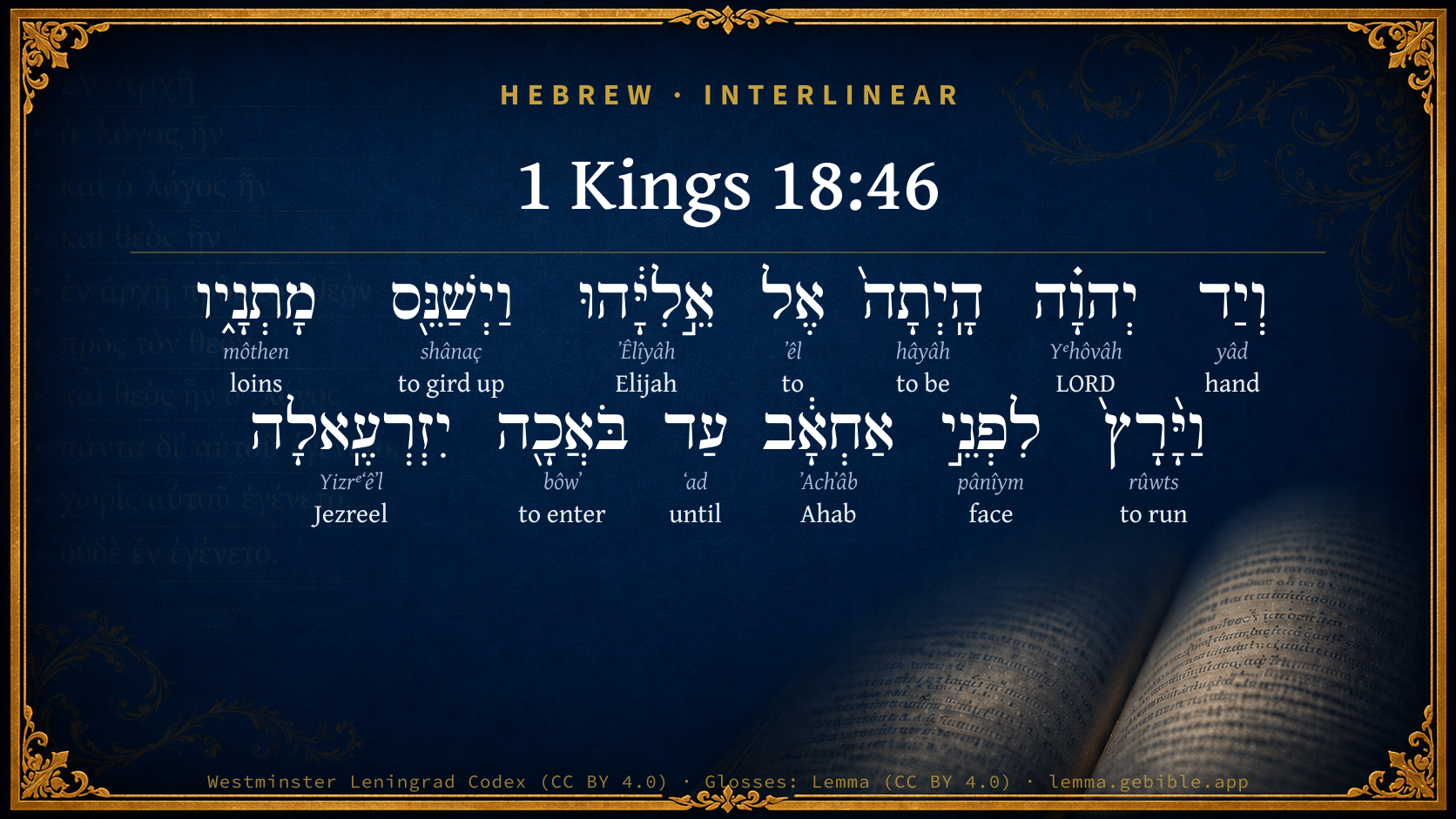
Hebrew (Westminster Leningrad Codex) 1 Kings 18:46 appears in the Hebrew Old Testament. The text above is from the Westminster Leningrad Codex. Each word links to its Strong’s number, a concise gloss, and parsing drawn from the Open Scriptures Hebrew Bible morphology. Click any word for its full Brown-Driver-Briggs (BDB) entry.
Download image
Cite this verse

1 Kings 18:46 (World English Bible). Public Domain. Lemma interlinear Bible study tool, https://lemma.gebible.app/v/1-kings/18/46.

Show BibTeX & RIS
BibTeX
RIS
English Translation
and the hand of Yahweh was on Elijah; and he girded up his loins, and ran before Ahab to the entrance of Jezreel.
World English Bible · Public Domain
Highlights
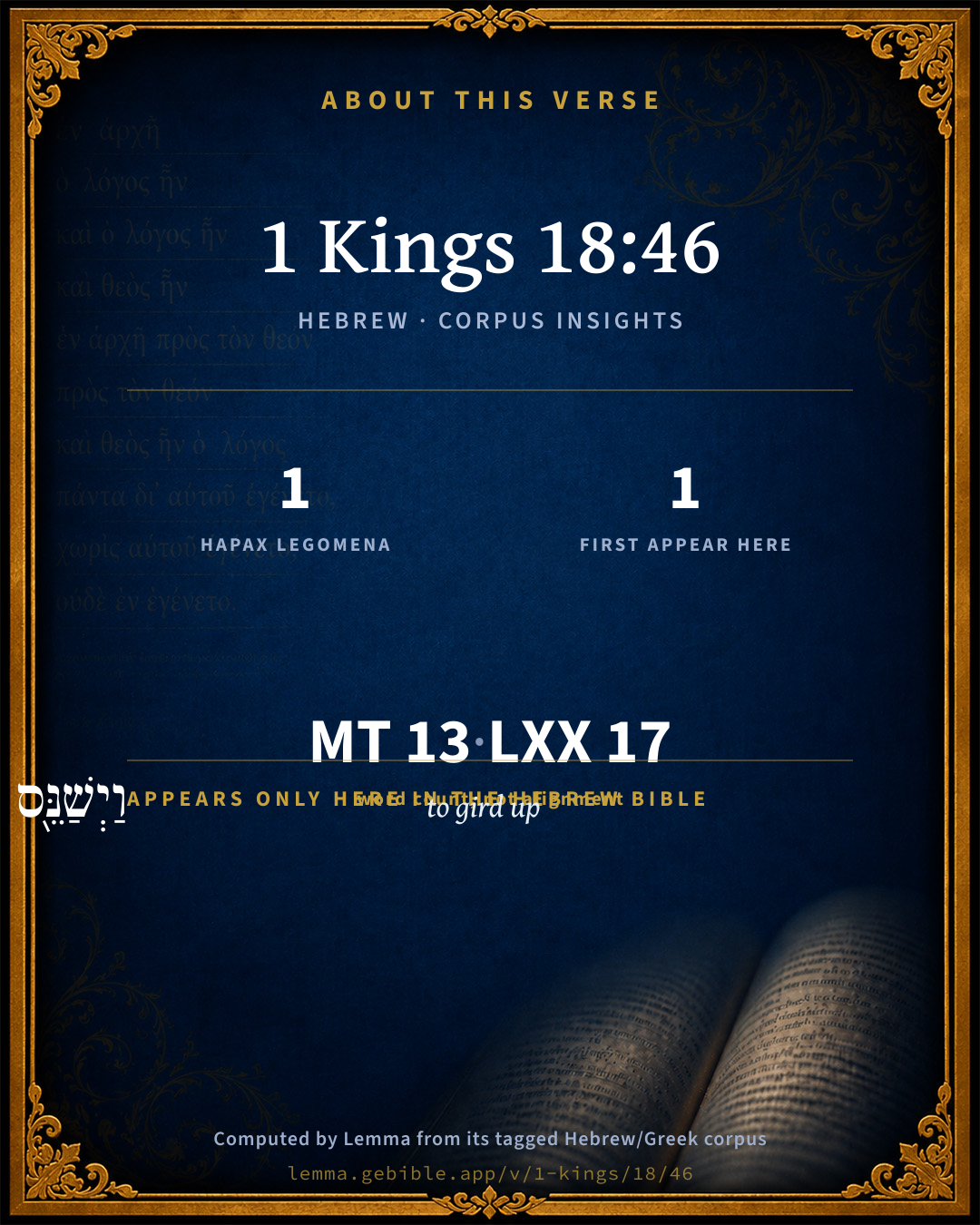
  • 1 hapax legomenon — only here in the Hebrew Bible
  • 1 first appearance in the Hebrew Bible
Full analysis ↓
Download a study sheet

One document with this verse’s original text, its word-by-word gloss line, the meaning frame, cross-references with their text, attributed commentary, and full source and license credits — printable, and it pastes into notes with its structure intact.

This verse Autodidact and up

Study sheet (.html) Plain text (.txt)

A passage Seminary Student

Up to 50 verses in one chapter. A passage sheet keeps up to 6 commentary sources and 12 cross-references per verse, in the order this page ranks them, and says so on the sheet whenever that leaves anything out. Ask for a single verse and you get the Autodidact verse sheet above.

Everything on this page stays free to read, with no account — the sheet is a download of what is already on screen, not access to it.

Want to remove ads? Support Godless Engineer
Compare translations 3

The same verse in 3 English versions, stacked beneath the original-language interlinear above. Click any original word for its lexicon entry.

Each is an independent rendering of the whole verse — the interlinear is not word-aligned to these translations.

Highlighted words mark where these versions differ — a whole-verse word diff, not a word-by-word alignment.

  • World English Bible Public Domain
    and the hand of Yahweh was on Elijah; and he girded up his loins, and ran before Ahab to the entrance of Jezreel.
  • King James Version Public Domain
    And the hand of the LORD was on Elijah; and he girded up his loins, and ran before Ahab to the entrance of Jezreel.
  • unfoldingWord Literal Text CC BY-SA 4.0
    And the hand of Yahweh was on Elijah, and he girded up his loins, and he ran to the face of Ahab to your coming Jezreel.

unfoldingWord Literal Text — © unfoldingWord, licensed CC BY-SA 4.0. Word-aligned USFM3 via Door43 (git.door43.org/unfoldingWord/en_ult).

Versions to compare (up to 4)

3 of 4 selected

Show all 18 translations

Every available English version of this verse, each an independent rendering of the whole verse.

  • World English Bible Public Domain
    and the hand of Yahweh was on Elijah; and he girded up his loins, and ran before Ahab to the entrance of Jezreel.
  • Berean Standard Bible Public Domain
    And the hand of the LORD came upon Elijah, and he tucked his cloak into his belt and ran ahead of Ahab all the way to Jezreel.
  • Majority Standard Bible Public Domain
    And the hand of the LORD came upon Elijah, and he tucked his cloak into his belt and ran ahead of Ahab all the way to Jezreel.
  • King James Version Public Domain
    And the hand of the LORD was on Elijah; and he girded up his loins, and ran before Ahab to the entrance of Jezreel.
  • American Standard Version (1901) Public Domain
    and the hand of Jehovah was on Elijah; and he girded up his loins, and ran before Ahab to the entrance of Jezreel.
  • Revised Version (1885) Public Domain
    and the hand of the LORD was on Elijah; and he girded up his loins, and ran before Ahab to the entrance of Jezreel.
  • Geneva Bible (1599) Public Domain
    And the hand of the Lord was on Eliiah, and he girded vp his Ioynes, and ran before Ahab till he came to Izreel.
  • Douay-Rheims (1899) Public Domain
    And the hand of the Lord was upon Elias, and he girded up his loins and ran before Achab, till he came to Jezrahel.
  • Young's Literal Translation Public Domain
    and the hand of Jehovah hath been on Elijah, and he girdeth up his loins, and runneth before Ahab, till thine entering Jezreel.
  • Literal Standard Version CC BY-SA 4.0
    and the hand of YHWH has been on Elijah, and he girds up his loins, and runs before Ahab, until your entering Jezreel.
  • Unlocked Literal Bible CC BY-SA 4.0
    but the hand of Yahweh was on Elijah. He tucked his robe in his belt and ran before Ahab to the entrance of Jezreel.
  • unfoldingWord Literal Text CC BY-SA 4.0
    And the hand of Yahweh was on Elijah, and he girded up his loins, and he ran to the face of Ahab to your coming Jezreel.
  • Darby Bible Public Domain
    And the hand of Jehovah was upon Elijah; and he girded up his loins, and ran before Ahab to the entrance of Jizreel.
  • World Messianic Bible Public Domain
    The LORD’s hand was on Elijah; and he tucked his cloak into his belt and ran before Ahab to the entrance of Jezreel.
  • Webster's Bible Public Domain
    And the hand of the LORD was on Elijah; and he girded his loins, and ran before Ahab to the entrance of Jezreel.
  • Free Bible Version CC BY-SA 4.0
    The Lord gave his power to Elijah—he tucked his cloak into his belt and ran ahead of Ahab all the way to Jezreel.
  • Bible in Basic English Public Domain
    And the hand of the Lord was on Elijah; and he made himself strong, and went running before Ahab till they came to Jezreel.
  • JPS Tanakh (1917) Public Domain
    And the hand of the LORD was on Elijah; and he girded up his loins, and ran before Ahab to the entrance of Jezreel.

Literal Standard Version (2020), Covenant Press — licensed CC BY-SA 4.0. Text via the HelloAO Bible API (eBible.org). Unlocked Literal Bible (unfoldingWord) — licensed CC BY-SA 4.0. Text via the HelloAO Bible API (eBible.org). unfoldingWord Literal Text — © unfoldingWord, licensed CC BY-SA 4.0. Word-aligned USFM3 via Door43 (git.door43.org/unfoldingWord/en_ult). Free Bible Version, Dr. Jonathan Gallagher — licensed CC BY-SA 4.0. Text via the HelloAO Bible API (eBible.org).

Word by word

More ways to search: Search by grammar → Find every occurrence → Compare this word →

Practice this passage: Drill this verse → Learn its vocabulary →

וַיְשַׁנֵּ֖ס
shânaç
H8151
“and · to gird up”
Conjunction + Verb, Piel, Sequential Imperfect, 3rd Person, Masculine, Singular
Part of Speech
Conjunction + Verb
Stem
Piel
Form
Sequential Imperfect
Person
3rd Person
Gender
Masculine
Number
Singular
Full BDB Definition

Origin: a primitive root

TWOT: 2423

(Piel) to gird up
  1. וְיַד yâd H3027 “and · hand of” Conjunction + Noun, Common, Both, Singular, Construct
  2. יְהוָ֗ה Yᵉhôvâh H3068 “LORD” Noun, Proper
  3. הָֽיְתָה֙ hâyâh H1961 “to be” Verb, Qal, Perfect, 3rd Person, Feminine, Singular
  4. אֶל ʼêl H413 “to” Preposition
  5. אֵ֣לִיָּ֔הוּ ʼÊlîyâh H452 “Elijah” Noun, Proper
  6. מָתְנָ֑יו môthen H4975 “loins · his” Noun, Common, Masculine, Dual, Construct + Suffix, Personal, 3rd Person, Masculine, Singular
  7. וַיָּ֨רָץ֙ rûwts H7323 “and · to run” Conjunction + Verb, Qal, Sequential Imperfect, 3rd Person, Masculine, Singular
  8. לִפְנֵ֣י pânîym H6440 “to/for · face(s) of” Preposition + Noun, Common, Both, Plural, Construct
  9. אַחְאָ֔ב ʼAchʼâb H256 “Ahab” Noun, Proper
  10. עַד ʻad H5704 “until” Preposition
  11. בֹּאֲכָ֖ה bôwʼ H935 “to enter · you” Verb, Qal, Infinitive Construct + Suffix, Personal, 2nd Person, Masculine, Singular
  12. יִזְרְעֶֽאלָה Yizrᵉʻêʼl H3157 “Jezreel · toward” Noun, Proper + Suffix, Demonstrative

About this verse

These counts appear in no published source. They are computed here, from the morphology-tagged text and Lemma’s own curated glosses. What Lemma adds →

13
words
13
distinct lemmas
Historical
section

Notable vocabulary

1 hapax legomenon — a word that appears only here in the entire Hebrew Bible:

  • וַיְשַׁנֵּ֖ס to gird up H8151

First appearance in Scripture

This word makes its first canonical appearance in the Hebrew Bible here:

  • וַיְשַׁנֵּ֖ס to gird up H8151

Shared distinctive vocabulary

יִזְרְעֶֽאלָה Jezreel H3157 occurs in 32 verses of the Hebrew Bible. Also found in:

Grammatical profile

  • 4 verbs
  • 7 nouns
  • 2 prepositions

Verb forms

  • הָֽיְתָה֙ Qal · Perfect
  • וַיְשַׁנֵּ֖ס Piel · Sequential Imperfect
  • וַיָּ֨רָץ֙ Qal · Sequential Imperfect
  • בֹּאֲכָ֖ה Qal · Infinitive Construct

Hebrew & Septuagint length

In English translation the verse runs 23 words from the Hebrew and 21 from the Septuagint (LXX English) — closely comparable.

A rough comparison of the two English renderings, which tokenize alike — not a word-level alignment.

Word counts can differ between the Hebrew and the Greek without any difference in meaning — e.g. the Hebrew direct-object marker אֵת has no separate Greek word, and Greek often adds the article ὁ.

In the original languages it is 13 Hebrew tokens and 17 Greek tokens — but the two are counted differently (Hebrew bundles its prefixes and suffixes into one token; the Greek is in lemma form), so that isn’t a like-for-like length.

Cross-references

12

Topical passages linked to 1 Kings 18:46 in the Treasury of Scripture Knowledge — connected by theme and wording, ordered by reader-vote popularity; previews shown in the World English Bible.

  • Ezekiel 3:14 So the Spirit lifted me up, and took me away; and I went in bitterness, in the heat of my spirit; and the hand of Yahweh was strong on me.
  • Ezekiel 1:3 the word of Yahweh came expressly to Ezekiel the priest, the son of Buzi, in the land of the Chaldeans by the river Chebar; and the hand of Yahweh was there on him.
  • 2 Kings 3:15 But now bring me a minstrel. It happened, when the minstrel played, that the hand of Yahweh came on him.
  • 2 Kings 9:1 Elisha the prophet called one of the sons of the prophets, and said to him, Gird up your loins, and take this vial of oil in your hand, and go to Ramoth-gilead.
  • Isaiah 8:11 For Yahweh spoke thus to me with a strong hand, and instructed me not to walk in the way of this people, saying,
  • Jeremiah 1:17 You therefore gird up your loins, and arise, and speak to them all that I command you: don't be dismayed at them, lest I dismay you before them.
  • Matthew 22:21 They said to him, "Caesar's." Then he said to them, "Give therefore to Caesar the things that are Caesar's, and to God the things that are God's."
  • 1 Peter 1:13 Therefore, prepare your minds for action, be sober and set your hope fully on the grace that will be brought to you at the revelation of Jesus Christ--
  • 2 Kings 4:29 Then he said to Gehazi, Gird up your loins, and take my staff in your hand, and go your way: if you meet any man, Don't greet him; and if anyone greets you, don't answer him again: and lay my staff on the face of the child.
  • Ephesians 6:14 Stand therefore, having the utility belt of truth buckled around your waist, and having put on the breastplate of righteousness,
  • 1 Peter 2:17 Honor all men. Love the brotherhood. Fear God. Honor the king.
  • Job 38:3 Brace yourself like a man, For I will question you, then you answer me!

Cross-references courtesy of OpenBible.info (CC BY 4.0).

Hebrew and Greek witnesses Masoretic Hebrew ↔ Greek Septuagint

The same verse in the two great witnesses to the Old Testament, shown verse-for-verse.

These are two independent witnesses, not word-aligned to each other, and the Septuagint is shown in lemma (dictionary) form.

Hebrew 1 Kings 18:46 Masoretic · Westminster Leningrad Codex

וְיַד יְהוָ֗ה הָֽיְתָה֙ אֶל אֵ֣לִיָּ֔הוּ וַיְשַׁנֵּ֖ס מָתְנָ֑יו וַיָּ֨רָץ֙ לִפְנֵ֣י אַחְאָ֔ב עַד בֹּאֲכָ֖ה יִזְרְעֶֽאלָה

and the hand of Yahweh was on Elijah; and he girded up his loins, and ran before Ahab to the entrance of Jezreel.

World English Bible · Public Domain

Greek LXX 1 Kings 18:46 Septuagint · lemma form

καί χείρ κύριος ἐπί ὁ ηλιου καί συνσπίγγω ὁ ὀσφύς αὐτός καί τρέχω ἔμπροσθεν αχααβ ἕως ιεζραελ

And the hand of the Lord was upon Eliu, and he girded up his loins, and ran before Achaab to Jezrael.

LXX2012 (modern English Septuagint) · Public Domain

Hebrew: Westminster Leningrad Codex (CC BY 4.0). Greek: Septuagint (public domain); English from LXX2012 (modern English Septuagint) (Public Domain). How the Septuagint differs from the Hebrew →

Targum (Aramaic paraphrase)

1

The Targum is the ancient Jewish Aramaic paraphrase of the Hebrew Scriptures — an interpretive translation, not the Hebrew text itself. Onkelos (literal) and Pseudo-Jonathan (expansive) render the Torah, and Jonathan the Prophets. Coverage is partial: where no permissively-licensed English translation exists for a verse, only the Aramaic is shown. This is verse-level text, not a word-by-word alignment to the Hebrew.

  1. Targum Jonathan Prophets (Joshua–Malachi)
    וְרוּחַ גְבוּרָא מִן קֳדָם יְיָ הֲוַת עִם אֵלִיָהוּ וְזָרֵיז חַרְצֵיהּ וּרְהַט קֳדָם אַחְאָב עַד דַאֲתָא לְיִזְרְעֶאל:

    (no public-domain English translation for this verse)

    Targum Jonathan — Aramaic: “Mikraot Gedolot” (public domain). English: “Sefaria Community Translation” (CC0 1.0 (public-domain dedication)); “London "Chaldee Paraphrase," 1871” (public domain). Text via Sefaria.

Commentary

Notes on 1 Kings 18:46 from classic Christian and Jewish commentators (each source and its license shown beneath its notes). The classic Christian expositions comment on the surrounding passage and are grouped to its opening verse, so a note may address several verses; the Jewish commentaries on the Tanakh (Rashi and others) are per-verse, so they appear only where the commentator wrote on this verse.

Lemma curates 59 commentaries, every one of them public domain or Creative Commons licensed, each selected and text-cleaned for this edition rather than reprinted as found. About our sources →

Trapp's Complete Commentary

John Trapp

1Ki 18:46 And the hand of the LORD was on Elijah; and he girded up his loins, and ran before Ahab to the entrance of Jezreel.

Ver. 46. And the hand of the Lord was on Elijah.] He was filled with, and acted by a supernatural ability and agility, ut pedes regem equitantem anteiret, that he run before the king’s chariot, whereinto the king should have done well to have taken him.

John Trapp, A Commentary or Exposition upon All the Books of the Old and New Testament (1647–1656) — public domain. Text from a community e-Sword module.

Joseph Benson's Commentary

1Ki 18:46. The hand of the Lord was on Elijah — God gave him more than natural strength, whereby he was enabled to outrun Ahab’s chariot for so many miles together. And he girded up his loins — That his garments, which were long and loose, like those in use in that country, might not hinder him. And ran before Ahab — To show how ready he was to honour and serve the king; that by this humble and self-denying carriage, it might appear, what he had done was not from envy or passion, but only from a just zeal for God’s glory; that by his presence with the king and his courtiers, he might animate and oblige them to proceed in the reformation of religion; and, to demonstrate, that he was neither ashamed of, nor afraid for what he had done, but durst venture himself in the midst of his enemies. But surely, if Ahab had paid the respect to Elijah that he deserved, he would have taken him into his chariot, as the eunuch did Philip, that he might honour him before the elders of Israel, and confer with him further about the reformation of the kingdom: but his pride and ambition, and other corrupt dispositions, got the better of his conviction; and he was glad to get quit of him, as Felix of Paul, when he dismissed him, and adjourned his conference with him to a more convenient season.

Joseph Benson's Commentary on the Old and New Testaments (1811–1818) — public domain. Text from a community e-Sword module.

Tyndale Open Study Notes

Tyndale Open Resources

18:46 He tucked his cloak into his belt so he could run more easily ahead of Ahab’s chariot. The Hebrew idiom refers to doing anything vigorously or enthusiastically (2 Kgs 4:29). • Jezreel was between Megiddo and Beth-shan in the southeastern portion of the valley of Jezreel, about seventeen miles from Mount Carmel.

Tyndale Open Study Notes — © Tyndale Open Resources, licensed CC BY-SA 4.0. Text via the HelloAO Bible API.

Geneva Bible (1599)

Geneva Bible translators

He was so strengthened with God’s spirit, that he ran faster than the chariot was able to run.

Geneva Bible (1599) marginal notes — public domain. Text via Bolls.life.

Jamieson, Fausset & Brown

Robert Jamieson, A. R. Fausset & David Brown

Elijah . . . girded up his loins, and ran before Ahab--It was anciently, and still is in some countries of the East, customary for kings and nobles to have runners before their chariots, who are tightly girt for the purpose. The prophet, like the Bedouins of his native Gilead, had been trained to run; and, as the Lord was with him, he continued with unabated agility and strength. It was, in the circumstances, a most proper service for Elijah to render. It tended to strengthen the favorable impression made on the heart of Ahab and furnished an answer to the cavils of Jezebel for it showed that he who was so zealous in the service of God, was, at the same time, devotedly loyal to his king. The result of this solemn and decisive contest was a heavy blow and great discouragement to the cause of idolatry. But subsequent events seem to prove that the impressions, though deep, were but partial and temporary.

Next: 1 Kings Chapter 19

Jamieson, Fausset & Brown — Commentary Critical and Explanatory on the Whole Bible (1871) — public domain (CC PDM 1.0). Text via the HelloAO Bible API.

Adam Clarke's Commentary

Verse 46. Ran before Ahab] Many think that Elijah ran before the king in order to do him honour; and much learned labour has been spent on this passage in order to show that Elijah had put himself at the head of a company of chanters who ran before the king reciting his praises, or the praises of God; a custom which still exists in Arabian countries! I believe all these entirely mistake the writer's meaning: Ahab yoked his chariot, and made all speed to Jezreel. The hand of the Lord, or, as the Targum says, the spirit of strength, came upon Elijah, and he girded up his loins, that is, tucked up his long garments in his girdle, and ran; and notwithstanding the advantage the king had by means of his chariot, the prophet reached Jezreel before him. There is no intimation here that he ran before the horses' heads. All this was intended to show that he was under the peculiar influence and inspiration of the Almighty, that the king might respect and fear him, and not do or permit to be done to him any kind of outrage.

Adam Clarke's Commentary on the Bible (1810–1826) — public domain. Text from a community e-Sword/MySword module.

Ellicott's Commentary for English Readers

(46) The hand of the Lord was on Elijah—in a striking reaction of enthusiastic thankfulness after the stern calmness of his whole attitude throughout the great controversy, and his silent earnestness of prayer. At the head of the people he brings the king, conquered, if not repentant, home in triumph. To our conception of a prophet this frenzied excitement seems strange. Nor could it have belonged to a Samuel, an Elisha, or an Isaiah. In the simple and enthusiastic warrior of God it is natural enough.

A Bible Commentary for English Readers, edited by Charles John Ellicott (1878–1897) — public domain. Text from a community e-Sword module.

The Cambridge Bible for Schools and Colleges

gen. ed. J. J. S. Perowne

46. the hand of the Lord was on Elijah] A divine impulse which directed and supported him in what he was to do. If there was still hope of a change in Ahab, neither God nor His prophet would be wanting to help him in the struggle after better courses. The running was a sign of Bedouin endurance, the halting outside the city, at the entrance of Jezreel, was a piece of Bedouin wariness.

The Cambridge Bible for Schools and Colleges (gen. ed. J. J. S. Perowne; Cambridge University Press, 1878–1918) — public domain. Text from a community e-Sword module.

Albert Barnes' Notes on the Bible

Divinely directed, and divinely upheld, Elijah, instead of resting, ran in advance of the king’s chariot the entire distance of at least 16 miles to the entrance of Jezreel. He thus showed himself ready to countenance and uphold the irresolute monarch, if he would turn from his evil courses, and proceed to carry out the religious reformation which the events of the day had inaugurated.

The entrance of Jezreel - Modern “Zerin.” Ahab had not removed the capital from Samaria 1Ki 22:10, 1Ki 22:37; but he had built himself a palace at Jezreel 1Ki 21:1, and appears to have resided there ordinarily. A contemporary Assyrian inscription speaks of him as “Ahab of Jezreel.”

Elijah’s caution in accompanying Ahab only to “the entrance” is like that of the modern Arabs, who can seldom be induced to trust themselves within walls. He rested on the outskirts of the town, waiting to learn what Jezebel would say or do, knowing that it was she, and not Ahab, who really governed the country.

Albert Barnes' Notes on the Bible (1834–1885) — public domain. Text from a community e-Sword/MySword module.

Haydock's Catholic Bible Commentary

Before Achab, notwithstanding the king was drawn by horses, (Calmet) and Elias was advanced in years, chap. xix. 4. (Menochius) --- The invigorating spirit gave him such strength and agility, (Haydock) as Jezrahel was 12 or 15 leagues, (Calmet) or about 36 miles, from Carmel. In the Levant, impostors still run very swiftly before the chariots of princes, to imitate Elias. (Calmet)

George Leo Haydock (1774–1849), Haydock's Catholic Family Bible and Commentary, 1859 edition — public domain. Excludes Psalms (Douay-Rheims chapter numbering differs from Protestant) and Deuterocanonical books (Catholic canon only).

Matthew Poole's English Annotations

The hand of the Lord was on Elijah: God gave him more than natural and ordinary strength, whereby he was enabled to outrun Ahab’s chariot, and that for so many miles together.

He girded up his loins, that his garments, which were then long, might not hinder him. See 2Ki 4:29 9:1.

Ran before Ahab; partly, to show how ready he was to honour and serve the king, if he did not exalt himself above or against God; partly, that by this humble and selfdenying carriage it might appear that what he had done was not from envy, or ambition, or human passion, but only from a just zeal for God’s glory; partly, that by his presence with the king, and his courtiers who attended upon him, he might animate and oblige them to proceed in the well-begun reformation of religion; and partly, to demonstrate that he was neither ashamed of, nor afraid for, what he had done, though he knew how Jezebel would resent it, but durst venture himself in the midst of his enemies, as being confident of the Divine power and protection.

Matthew Poole's English Annotations on the Holy Bible (1683–1685) — public domain. Text from a community e-Sword/MySword module.

Whedon's Commentary on the Bible

Daniel D. Whedon

46. Hand of the Lord was on Elijah — He was in the Spirit, and he and all around him were conscious that the mighty power of God was with him.

Girded up his loins — Twisted the leather garment which he wore (2Ki_1:8) tightly about him, that he might run more freely.

Ran before Ahab — “As the Bedouins of his native Gilead would still run, with inexhaustible strength.” “The mode of doing honour to Ahab by running before his chariot was in accordance with the customs of the East, even to this day. I was reminded of this incident when Mohammed Ali, with a large army, came to Jaffa to quell the rebellion of Palestine. The officers were constantly going or coming, preceded by runners, who always kept just in advance of the horses, however furiously they were ridden; and in order to run with greater ease, they not only girded their loins very tightly, but also tucked up their loose garments under the girdle, lest they should be incommoded by them. Thus, no doubt, did Elijah. The distance from the base of Carmel across the plain to Jezreel is not less than twelve miles, and the race was probably accomplished in two hours in the face of a tremendous storm of rain and wind.” — Thomson. This “running” was a humble and servant-like act on the part of Elijah, and was probably done to convince Ahab that the stern and fiery-spirited prophet, whom he had so much hated, was a faithful and obedient subject, having no desire to injure the king or his people, but zealous to defend the honour and worship of the God of their fathers.

Daniel D. Whedon (gen. ed.), Commentary on the Old and New Testaments (1874–1909) — public domain. Text from a community e-Sword module.

The Pulpit Commentary

And the hand of the Lord was on Elijah Same expression 2Ki_3:15; Eze_1:3 Eze_3:14 Eze_8:1 Eze_33:22; cf. also Exo_9:3; Jud_1:2:15; Rth_1:13; Act_11:21 Act_13:11. Some of the commentators understand the words of Divine guidance, some of a supernatural strengthening. There is no need to exclude either interpretation. An impulse from on high impelled him to "gird up his loins" and go with the king; a strength not his own sustained him whilst "he ran," etc. The distance across the plain to Jezreel is about fourteen miles; the royal chariot would drive furiously, and whatever fleetness and endurance the prophet had acquired in the wilds of Gilead, it seems hardly likely that, after the fatigues and excitement of that day, he would have been able, without the hand of the Lord upon him, to keep ahead of the chariot horses, and he girded up his loins i.e. , gathered round his waist the abba, or "mantle the trDa (cf. 1Ki_19:13, 1Ki_19:19; 2Ki_2:13, 2Ki_2:14) was so-called from its ample size which would otherwise have impeded his movements. Probably this, apart from the girdle, was his sole garment. (See Dict. Bib. vol. 2. p. 232), and ran before Ahab Thomson (vol. 2. p. 227) mentions an interesting illustration of this incident which he witnessed. The forerunners of Mohammed All Pasha "kept just ahead of the horses, no matter how furiously they were ridden, and in order to run with the greatest ease they not only girded their loins very tightly, but also tucked up their loose garments under the girdle." But such a spectacle is of common occurrence in the East. Kitto remarks that the Shatirs of Persia keep pace with case with their masters" horses. They also are tightly girded. His object was apparently twofold. First, to honour the sovereign whom he had that day humbled in the presence of his subjects. The great prophet, by assuming the lowly office of a footman, or forernnner (see note, 1Ki_1:5) would give due reverence to the Lord"s anointed, like Samuel on a somewhat similar occasion. (1Sa_15:30, 1Sa_15:31) Secondly, he may have hoped by his presence near the king and court to strengthen any good resolves which the former might have made, and to further the work of reformation which he could not but hope the proceedings of that day would inaugurate. That this tribute of respect would be grateful to Ahab, who hitherto had only regarded Elijah as an adversary, it is impossible to doubt. And that Elijah believed he had struck a death blow to the foreign superstitions fostered by the court, and especially by the queen, is equally certain. It is not clear, as Bahr assumes, that his servant accompanied him on the road. He may have rejoined him later on in the day or night to the entrance Heb. until thou comest to. The Arab aversion, which Elijah is supposed to have shared, to entering cities, has often been remarked. But there were other and deeper reasons why he should not adventure himself within the city. Probably the same guiding hand which led him to Jezreel impelled him to lodge outside the walls. It was impossible to say what Jezebel, in her transports of rage, might do. After such a day, too, any prophet would shrink from familiar contact with men and from the strife of tongues of Jezreel. Ahab had a palace here. (1Ki_21:1) But Samaria was still the capital, and so remained till the captivity (1Ki_22:37; 2Ki_15:13, 14 17:5, 6) The selection of Jezreel as a royal residence is easily accounted for. It stands on "a knoll 500 feet high" (Conder), overlooking both the plain of Esdraelon and the valley of Jezreel. In fact, it is the finest situation in the "Great Plain." Hence perhaps its name "the sowing place of God." See Stanley, S. and P. pp. 336 sqq.; Porter, p. 353; Dict. Bib. vol. 1.p. 1080; Van de Velde, vol. 2. p. 370.

The Pulpit Commentary (1880–1919), ed. H.D.M. Spence-Jones & Joseph S. Exell — public domain. Text from a community e-Sword module.

John Wesley's Explanatory Notes

The hand, &c. - God gave him more than natural strength, whereby he was enabled to outrun Ahab's chariot, for so many miles together. He girded, &c. - That his garments, which were long, might not hinder him. Ran before Ahab - To shew how ready he was to honour and serve the king, that by this humble and self-denying carriage, it might appear, what he had done was not from envy or passion, but only from a just zeal for God's glory: that by his presence with the king and his courtiers, he might animate and oblige them to proceed in the reformation of religion: and, to demonstrate, that he was neither ashamed of, nor afraid for what he had done, but durst venture himself in the midst of his enemies.

John Wesley, Explanatory Notes Upon the Whole Bible (1754–1765) — public domain. Text via the GEBible commentary corpus.

Rashi

Rabbi Shlomo Yitzchaki (Rashi)

And the hand [the spirit] of Adonoy. [Targum Yonoson rendered,] “a spirit of strength from before Adonoy,” [i.e.,] he became endowed with strength to run on foot before the chariot, so that Achov would not go alone, for he treated royalty with respect.

And he girded his loins. [וישנס means] the same as ויאזור [=and he girded], but there is no similar word [in Scripture], and it came only to teach [us] an expression of acting quickly, [i.e.,] he was as quick as a mighty man.

Rashi on the Tanakh — English translations: “The Judaica Press complete Tanach with Rashi, translated by A. J. Rosenberg” (CC BY 4.0); “Pentateuch with Rashi's commentary by M. Rosenbaum and A.M. Silbermann, 1929-1934” (public domain); “The Metsudah Tanach series, Lakewood, N.J” (CC BY 4.0); and “The Book of Joshua, Metsudah Publications, 1997” (CC BY 4.0). Text via Sefaria.

Lesson kit

Teaching starters — assembled from the data on this page, not authored interpretation. Every prompt links to the verse data it draws on. Edit before teaching.

1 Kings, in the Historical, opens this verse with 13 words (13 distinct Hebrew lemmas). Its most distinctive word is shânaç (“to gird up”). A historical commentator’s framing appears above. Read the whole chapter for the surrounding context.

Discussion questions

  1. How does “to gird up” (shânaç) shape what this verse is saying?
  2. This verse holds 1 word here found nowhere else in the Hebrew Bible. What might the rare word draw attention to?
  3. The word “to gird up” first appears here in Scripture. What is being introduced at this debut?
  4. Joshua 15:56 shares the word «Jezreel» with this verse. How do the two illuminate each other?
  5. These translations render this verse differently. What is at stake in choosing one wording over another?
  6. The verb «הָֽיְתָה֙» is Qal Perfect. How does its form color the action?
  7. Reading how Trapp's Complete Commentary and Joseph Benson's Commentary read this verse, where do the two commentators agree and where do they part?

Things to notice

Reading settings

Reading text

Shown beneath each verse's original-language words.

Old Testament
Old Testament edition

Read the OT as the Masoretic Hebrew (MT) or the Greek Septuagint (LXX).

English shown for the Greek Septuagint (in the Hebrew ↔ Greek comparison).

Comparing translations? Open the Compare panel on any verse page to stack up to four side by side.