
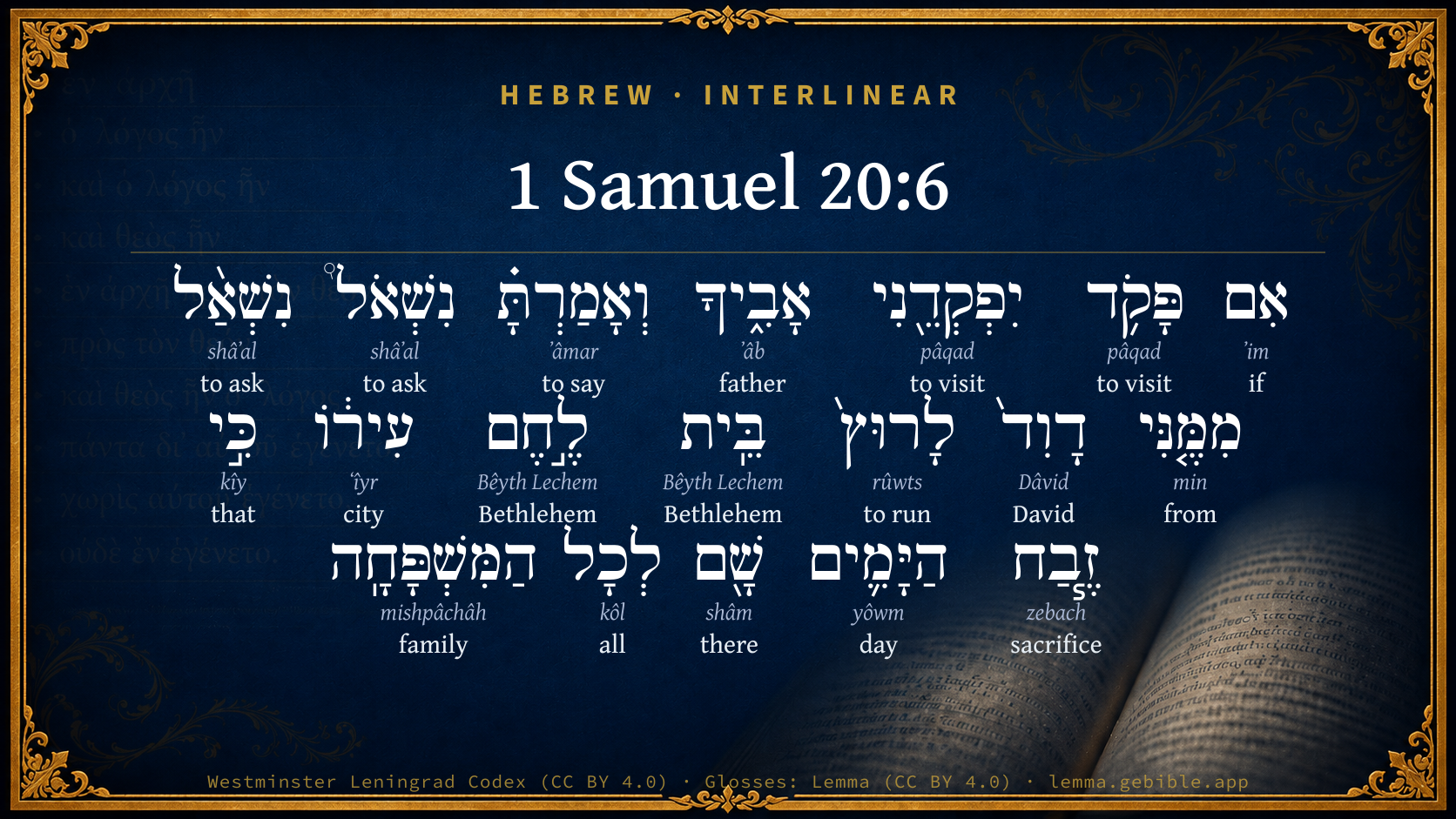
1 Samuel 20:6

Hebrew (Westminster Leningrad Codex) 1 Samuel 20:6 appears in the Hebrew Old Testament. The text above is from the Westminster Leningrad Codex. Each word links to its Strong’s number, a concise gloss, and parsing drawn from the Open Scriptures Hebrew Bible morphology. Click any word for its full Brown-Driver-Briggs (BDB) entry.
Download image
Cite this verse

1 Samuel 20:6 (World English Bible). Public Domain. Lemma interlinear Bible study tool, https://lemma.gebible.app/v/1-samuel/20/6.

Show BibTeX & RIS
BibTeX
RIS
English Translation
If your father miss me at all, then say, David earnestly asked leave of me that he might run to Bethlehem his city; for it is the yearly sacrifice there for all the family.
World English Bible · Public Domain
Download a study sheet

One document with this verse’s original text, its word-by-word gloss line, the meaning frame, cross-references with their text, attributed commentary, and full source and license credits — printable, and it pastes into notes with its structure intact.

This verse Autodidact and up

Study sheet (.html) Plain text (.txt)

A passage Seminary Student

Up to 50 verses in one chapter. A passage sheet keeps up to 6 commentary sources and 12 cross-references per verse, in the order this page ranks them, and says so on the sheet whenever that leaves anything out. Ask for a single verse and you get the Autodidact verse sheet above.

Everything on this page stays free to read, with no account — the sheet is a download of what is already on screen, not access to it.

Want to remove ads? Support Godless Engineer
Compare translations 3

The same verse in 3 English versions, stacked beneath the original-language interlinear above. Click any original word for its lexicon entry.

Each is an independent rendering of the whole verse — the interlinear is not word-aligned to these translations.

Highlighted words mark where these versions differ — a whole-verse word diff, not a word-by-word alignment.

  • World English Bible Public Domain
    If your father miss me at all, then say, David earnestly asked leave of me that he might run to Bethlehem his city; for it is the yearly sacrifice there for all the family.
  • King James Version Public Domain
    If thy father at all miss me, then say, David earnestly asked leave of me that he might run to Bethlehem his city: for there is a yearly sacrifice there for all the family.
  • unfoldingWord Literal Text CC BY-SA 4.0
    If missing, your father misses me, then you shall say, ‘Asking, David asked from me to run Bethlehem, his city, for the sacrifice of days there for all of the clan.’

unfoldingWord Literal Text — © unfoldingWord, licensed CC BY-SA 4.0. Word-aligned USFM3 via Door43 (git.door43.org/unfoldingWord/en_ult).

Versions to compare (up to 4)

3 of 4 selected

Show all 18 translations

Every available English version of this verse, each an independent rendering of the whole verse.

  • World English Bible Public Domain
    If your father miss me at all, then say, David earnestly asked leave of me that he might run to Bethlehem his city; for it is the yearly sacrifice there for all the family.
  • Berean Standard Bible Public Domain
    If your father misses me at all, tell him, ‘David urgently requested my permission to hurry to Bethlehem, his hometown, because there is an annual sacrifice for his whole clan.’
  • Majority Standard Bible Public Domain
    If your father misses me at all, tell him, ‘David urgently requested my permission to hurry to Bethlehem, his hometown, because there is an annual sacrifice for his whole clan.’
  • King James Version Public Domain
    If thy father at all miss me, then say, David earnestly asked leave of me that he might run to Bethlehem his city: for there is a yearly sacrifice there for all the family.
  • American Standard Version (1901) Public Domain
    If thy father miss me at all, then say, David earnestly asked leave of me that he might run to Beth-lehem his city; for it is the yearly sacrifice there for all the family.
  • Revised Version (1885) Public Domain
    If thy father miss me at all, then say, David earnestly asked leave of me that he might run to Beth-lehem his city: for it is the yearly sacrifice there for all the family.
  • Geneva Bible (1599) Public Domain
    If thy father make mention of me, then say, Dauid asked leaue of me, that he might goe to Beth-lehem to his owne citie: for there is a yeerely sacrifice for all that familie.
  • Douay-Rheims (1899) Public Domain
    If thy father look and inquire for me, thou shalt answer him: David asked me that he might run to Bethlehem his own city: because there are solemn sacrifices there for all his tribe.
  • Young's Literal Translation Public Domain
    if thy father at all look after me, and thou hast said, David asked earnestly of me to run to Beth-Lehem his city, for a sacrifice of the days `is' there for all the family.
  • Literal Standard Version CC BY-SA 4.0
    if your father looks after me at all, then you have said, David earnestly asked of me to run to his city of Beth-Lehem, for there [is] a sacrifice of the days for all the family.
  • Unlocked Literal Bible CC BY-SA 4.0
    If your father misses me at all, then say, 'David earnestly asked leave of me that he might run to Bethlehem his city; because it is the yearly sacrifice there for all the clan.'
  • unfoldingWord Literal Text CC BY-SA 4.0
    If missing, your father misses me, then you shall say, ‘Asking, David asked from me to run Bethlehem, his city, for the sacrifice of days there for all of the clan.’
  • Darby Bible Public Domain
    If thy father should actually miss me, then say, David earnestly asked leave of me that he might run to Bethlehem his city; for there is a yearly sacrifice there for all the family.
  • World Messianic Bible Public Domain
    If your father misses me at all, then say, ‘David earnestly asked leave of me that he might run to Bethlehem, his city; for it is the yearly sacrifice there for all the family.’
  • Webster's Bible Public Domain
    If thy father shall at all miss me, then say, David earnestly asked leave of me, that he might run to Beth-lehem his city: for there is a yearly sacrifice there for all the family.
  • Free Bible Version CC BY-SA 4.0
    If your father does indeed miss me, tell him, ‘David had to urgently ask my permission to hurry down to Bethlehem, his hometown, because of a yearly sacrifice there for his whole family group.’
  • Bible in Basic English Public Domain
    And if your father takes note of the fact that I am away, say, David made a request to me for himself that he might go to Beth-lehem, to his town: for it is the time when his family make their offering year by year.
  • JPS Tanakh (1917) Public Domain
    If thy father miss me at all, then say: David earnestly asked leave of me that he might run to Beth-lehem his city; for it is the yearly sacrifice there for all the family.

Literal Standard Version (2020), Covenant Press — licensed CC BY-SA 4.0. Text via the HelloAO Bible API (eBible.org). Unlocked Literal Bible (unfoldingWord) — licensed CC BY-SA 4.0. Text via the HelloAO Bible API (eBible.org). unfoldingWord Literal Text — © unfoldingWord, licensed CC BY-SA 4.0. Word-aligned USFM3 via Door43 (git.door43.org/unfoldingWord/en_ult). Free Bible Version, Dr. Jonathan Gallagher — licensed CC BY-SA 4.0. Text via the HelloAO Bible API (eBible.org).

Word by word

More ways to search: Search by grammar → Find every occurrence → Compare this word →

Practice this passage: Drill this verse → Learn its vocabulary →

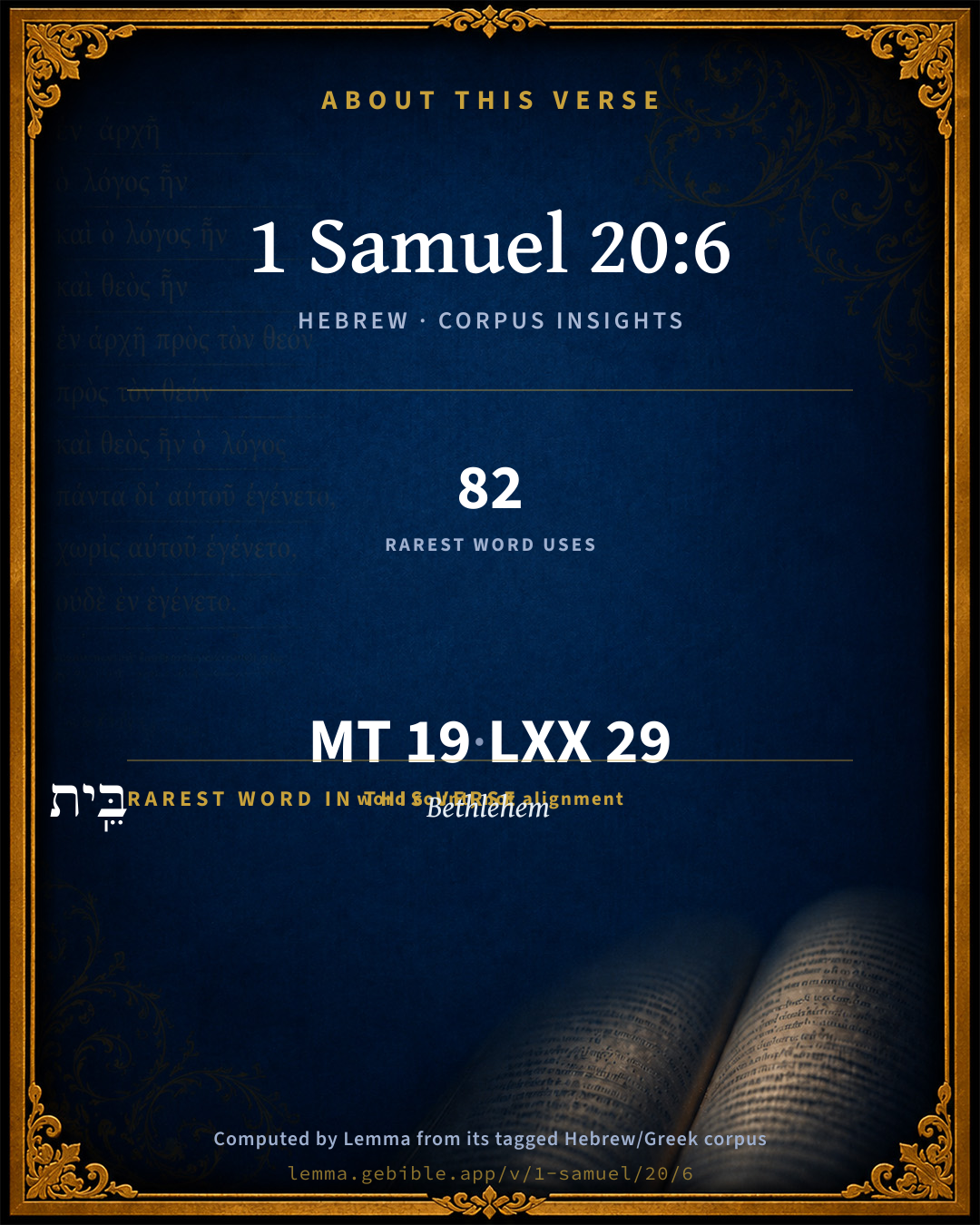
בֵּֽית
Bêyth Lechem
H1035
“Bethlehem”
Noun, Proper
Part of Speech
Noun
Type
Proper
Full BDB Definition

Origin: from H1004 and H3899

TWOT: 241b

Beth-lehem = "house of bread (food)" - a city in Judah, birthplace of David - a place in Zebulun
  1. אִם ʼim H518 “if” Conjunction
  2. פָּקֹ֥ד pâqad H6485 “to visit” Verb, Qal, Infinitive Absolute
  3. יִפְקְדֵ֖נִי pâqad H6485 “to visit · me” Verb, Qal, Imperfect, 3rd Person, Masculine, Singular + Suffix, Personal, 1st Person, Common, Singular
  4. אָבִ֑יךָ ʼâb H1 “father · your” Noun, Common, Masculine, Singular, Construct + Suffix, Personal, 2nd Person, Masculine, Singular
  5. וְאָמַרְתָּ֗ ʼâmar H559 “and · to say” Conjunction + Verb, Qal, Sequential Perfect, 2nd Person, Masculine, Singular
  6. נִשְׁאֹל֩ shâʼal H7592 “to ask” Verb, Niphal, Infinitive Absolute
  7. נִשְׁאַ֨ל shâʼal H7592 “to ask” Verb, Niphal, Perfect, 3rd Person, Masculine, Singular
  8. מִמֶּ֤נִּי min H4480 “from · me” Preposition + Suffix, Personal, 1st Person, Common, Singular
  9. דָוִד֙ Dâvid H1732 “David” Noun, Proper
  10. לָרוּץ֙ rûwts H7323 “to run” Preposition + Verb, Qal, Infinitive Construct
  11. לֶ֣חֶם Bêyth Lechem H1035 “Bethlehem” Noun, Proper
  12. עִיר֔וֹ ʻîyr H5892 “city · his” Noun, Common, Feminine, Singular, Construct + Suffix, Personal, 3rd Person, Masculine, Singular
  13. כִּ֣י kîy H3588 “that” Conjunction
  14. זֶ֧בַח zebach H2077 “sacrifice of” Noun, Common, Masculine, Singular, Construct
  15. הַיָּמִ֛ים yôwm H3117 “the · days” Particle, Definite Article + Noun, Common, Masculine, Plural, Absolute
  16. שָׁ֖ם shâm H8033 “there” Adverb
  17. לְכָל kôl H3605 “to/for · all of” Preposition + Noun, Common, Masculine, Singular, Construct
  18. הַמִּשְׁפָּחָֽה mishpâchâh H4940 “the · family” Particle, Definite Article + Noun, Common, Feminine, Singular, Absolute

About this verse

These counts appear in no published source. They are computed here, from the morphology-tagged text and Lemma’s own curated glosses. What Lemma adds →

19
words
16
distinct lemmas
Historical
section

Grammatical profile

  • 6 verbs
  • 9 nouns
  • 1 preposition
  • 2 conjunctions
  • 1 adverb

Verb forms

  • פָּקֹ֥ד Qal · Infinitive Absolute
  • יִפְקְדֵ֖נִי Qal · Imperfect
  • וְאָמַרְתָּ֗ Qal · Sequential Perfect
  • נִשְׁאֹל֩ Niphal · Infinitive Absolute
  • נִשְׁאַ֨ל Niphal · Perfect
  • לָרוּץ֙ Qal · Infinitive Construct

Repetition

Words recur within this verse — often emphatic in Hebrew:

  • פָּקֹ֥ד to visit H6485 ×2
  • נִשְׁאֹל֩ to ask H7592 ×2
  • בֵּֽית Bethlehem H1035 ×2

Hebrew & Septuagint length

In English translation the verse runs 34 words from the Hebrew and 37 from the Septuagint (LXX English) — closely comparable.

A rough comparison of the two English renderings, which tokenize alike — not a word-level alignment.

Word counts can differ between the Hebrew and the Greek without any difference in meaning — e.g. the Hebrew direct-object marker אֵת has no separate Greek word, and Greek often adds the article ὁ.

In the original languages it is 19 Hebrew tokens and 29 Greek tokens — but the two are counted differently (Hebrew bundles its prefixes and suffixes into one token; the Greek is in lemma form), so that isn’t a like-for-like length.

Cross-references

5

Topical passages linked to 1 Samuel 20:6 in the Treasury of Scripture Knowledge — connected by theme and wording, ordered by reader-vote popularity; previews shown in the World English Bible.

  • 1 Samuel 9:12 They answered them, and said, He is; behold, [he is] before you: make haste now, for he is come today into the city; for the people have a sacrifice today in the high place:
  • 1 Samuel 17:58 Saul said to him, Whose son are you, you young man? David answered, I am the son of your servant Jesse the Bethlehemite.
  • Deuteronomy 12:5 But to the place which Yahweh your God shall choose out of all your tribes, to put his name there, even to his habitation shall you seek, and there you shall come;
  • 1 Samuel 16:2–5 Samuel said, How can I go? if Saul hear it, he will kill me. Yahweh said, Take a heifer with you, and say, I am come to sacrifice to Yahweh.
  • John 7:42 Hasn't the Scripture said that the Christ comes of the seed of David, and from Bethlehem, the village where David was?"

Cross-references courtesy of OpenBible.info (CC BY 4.0).

Hebrew and Greek witnesses Masoretic Hebrew ↔ Greek Septuagint

The same verse in the two great witnesses to the Old Testament, shown verse-for-verse.

These are two independent witnesses, not word-aligned to each other, and the Septuagint is shown in lemma (dictionary) form.

Hebrew 1 Samuel 20:6 Masoretic · Westminster Leningrad Codex

אִם פָּקֹ֥ד יִפְקְדֵ֖נִי אָבִ֑יךָ וְאָמַרְתָּ֗ נִשְׁאֹל֩ נִשְׁאַ֨ל מִמֶּ֤נִּי דָוִד֙ לָרוּץ֙ בֵּֽית לֶ֣חֶם עִיר֔וֹ כִּ֣י זֶ֧בַח הַיָּמִ֛ים שָׁ֖ם לְכָל הַמִּשְׁפָּחָֽה

If your father miss me at all, then say, David earnestly asked leave of me that he might run to Bethlehem his city; for it is the yearly sacrifice there for all the family.

World English Bible · Public Domain

Greek LXX 1 Samuel 20:6 Septuagint · lemma form

ἐάν ἐπισκέπτομαι ἐπισκέπτομαι ἐγώ ὁ πατήρ σύ καί εἶπον παρααἰτέω παρααἰτέω ἀπό ἐγώ δαυίδ τρέχω ἕως εἰς βηθλεεμ ὁ πόλις αὐτός ὅτι θυσία ὁ ἡμέρα ἐκεῖ ὅλος ὁ φυλή

And if your father do in anyway enquire for me, then shall you say, David earnestly asked leave of me to run to Bethleem his city, for there is there, a yearly sacrifice for all the family.

LXX2012 (modern English Septuagint) · Public Domain

Hebrew: Westminster Leningrad Codex (CC BY 4.0). Greek: Septuagint (public domain); English from LXX2012 (modern English Septuagint) (Public Domain). How the Septuagint differs from the Hebrew →

Targum (Aramaic paraphrase)

1

The Targum is the ancient Jewish Aramaic paraphrase of the Hebrew Scriptures — an interpretive translation, not the Hebrew text itself. Onkelos (literal) and Pseudo-Jonathan (expansive) render the Torah, and Jonathan the Prophets. Coverage is partial: where no permissively-licensed English translation exists for a verse, only the Aramaic is shown. This is verse-level text, not a word-by-word alignment to the Hebrew.

  1. Targum Jonathan Prophets (Joshua–Malachi)
    אִם מִבְעָא יִבְעִינַנִי אֲבוּךְ וְתֵימַר אִשְׁתְּאָלָא אִשְׁתְּאַל מִנִי דָוִד לְמֵיזַל לְבֵית לֶחֶם קַרְתֵּיהּ אֲרֵי שֵׁירוּי נִכְסַת קוּדְשַׁיָא יוֹמָא דֵין תַּמָן לְכָל זַרְעִיתָא:

    (no public-domain English translation for this verse)

    Targum Jonathan — Aramaic: “Mikraot Gedolot” (public domain). English: “Sefaria Community Translation” (CC0 1.0 (public-domain dedication)); “London "Chaldee Paraphrase," 1871” (public domain). Text via Sefaria.

Commentary

Notes on 1 Samuel 20:6 from classic Christian and Jewish commentators (each source and its license shown beneath its notes). The classic Christian expositions comment on the surrounding passage and are grouped to its opening verse, so a note may address several verses; the Jewish commentaries on the Tanakh (Rashi and others) are per-verse, so they appear only where the commentator wrote on this verse.

Lemma curates 59 commentaries, every one of them public domain or Creative Commons licensed, each selected and text-cleaned for this edition rather than reprinted as found. About our sources →

Trapp's Complete Commentary

John Trapp

1Sa 20:6 If thy father at all miss me, then say, David earnestly asked [leave] of me that he might run to Bethlehem his city: for [there is] a yearly sacrifice there for all the family.

Ver. 6. For there is a yearly sacrifice there.] This might very well be a true excuse; and he might in prudence take the opportunity, for the safeguard of his precious life, so much sought after.

John Trapp, A Commentary or Exposition upon All the Books of the Old and New Testament (1647–1656) — public domain. Text from a community e-Sword module.

The Biblical Illustrator

Joseph S. Exell

1Sa_20:6

A yearly sacrifice for all the family.

The family festival

The word in this verse rendered sacrifice is in the margin of our English Bible rendered with somewhat greater felicity feast. There comes to view, therefore, in the narrative an unusually interesting fact; namely, that the family of Jesse continued to keep up their residence in Bethlehem, and carefully observed the household festivals through the year, as in earlier days they had been accustomed. The members of that scattered circle summoned each other regularly to a social reunion annually.

I. The advantages found in the observance of this yearly thanksgiving festival.

1. Of course, first and chief of these is the consideration that for all Gods love and care for us there is due at least full acknowledgment of the hand which has given them to us. Count up your mercies. A day in each year is surely not too much to be given to this formal rehearsal before God of our plentiful gains and prosperities.

2. In the second place, there is manifest advantage in these annual festivals growing out of the cultivation of our domestic affections and the perpetuation of our home tastes and feelings. It mingles religion with our best sympathies. He cannot be called a manly man who did not feel himself a weaker man from the month when his praying mother died and was buried, or who does not feel himself a braver, better man, if now perhaps the beloved old voice still lives to be his counsel and his inspiration.

3. Again: there is a manifest advantage in these thanksgiving festivals found in the perpetuation of ancestral memories to which they are calculated most strongly to minister. It is instinctive in the heart of every true man and woman to desire to live beyond the limits of an immediate generation. We toil hard for many a season to keep our name unsullied and preserve our fair fame unstained for the sake of our offspring.

4. And this leads me on to mention a fourth advantage derived from this annual feast; namely, the opportunity it offers for kindling and quickening a true patriotism in the hearts of the people.

II. With this exhibition of manifest advantages I can hardly need to argue further for such observance of the day. If we go with David at all on his errand, it must be in imagination only. And I think it will be profitable now to ask and answer where he did go.

1. To his own city.

2. In the second place, I suppose David went straight as was possible to his own home in Bethlehem.

3. Then, finally, I imagine David would want to go to various houses of his brethren. I take this from the fact that this days invitation was given by his brother. (C. S. Robinson, D. D.)

Christmas and New Year festivities

I. Remember to exalt God in your family festivities.

II. Thoroughly survey the history of the year since your last family festivities.

1. It was a yearly sacrifice. Year short space in time, but may be long in events. What changes may crowd into its weeks. Christmas does not always find the family in the old home.

2. On some homes shadows lie thick, others bathed in sunshine. Here Jacob has lost his Joseph, or Rachel mourns her children; here sportive childhood cries, Oh, call my brother back to me, I cannot play alone.

3. And then, they who come to the festivities come from such various scenes. Here at Bethlehem was David from the court; and Eliab, Abinadab, and Shammah from the camp.

4. Nor will any true heart give a secondary place to changes on character the year has produced.

III. Consider the personal obligations each owes to the family.

IV. In your festivities think of others. (G. B. Johnson.)

The Biblical Illustrator, edited by Joseph S. Exell (c. 1880s–1900s) — public domain. Text from a community e-Sword module.

Joseph Benson's Commentary

1Sa 20:6. Say, David earnestly asked of me — Jonathan, being the king’s son and deputy, used, it seems, to give license to military men to depart for a season upon just occasions. There is a yearly sacrifice for all the family — It is likely it was a custom among pious families to meet together once a year, and praise God for his mercies toward them all.

Joseph Benson's Commentary on the Old and New Testaments (1811–1818) — public domain. Text from a community e-Sword module.

Tyndale Open Study Notes

Tyndale Open Resources

20:6-7 Israelite families might designate one of the new moon festivals as an opportunity for an annual family sacrifice (see, e.g., 1:3).

Tyndale Open Study Notes — © Tyndale Open Resources, licensed CC BY-SA 4.0. Text via the HelloAO Bible API.

Geneva Bible (1599)

Geneva Bible translators

Read 1 Sam. 1:21.

Geneva Bible (1599) marginal notes — public domain. Text via Bolls.life.

Ellicott's Commentary for English Readers

(6) A yearly sacrifice.—The Mosaic Law (Deu_12:5 and following verses) strictly required these great sacrificial feasts to be kept at the Tabernacle, “unto the place which the Lord your God shall choose out of all your tribes;” but ever since the destruction of the Tabernacle of Shiloh there had been no central sanctuary, and these solemn feasts had been held, most probably, in tribal centres. “In the then disorganised condition of public worship to which David first gave regular form, family usages of this sort, after the manner of other nations, had established themselves, which were contrary to the (Mosaic) prescriptions concerning the unity of Divine worship.”—O. von Gerlach, in Lange. It is highly probable that the festival in question was at this time being held at Bethlehem. It is, however, clear that David did not purpose being present at it, and therefore the excuse was a feigned one. The morality of this request of David is by no means sanctioned by the compiler of the history; he simply relates the story.

A Bible Commentary for English Readers, edited by Charles John Ellicott (1878–1897) — public domain. Text from a community e-Sword module.

The Cambridge Bible for Schools and Colleges

gen. ed. J. J. S. Perowne

6. a yearly sacrifice there for all the family] This request incidentally throws light on the religious customs of the age. The annual meeting of the family or clan for sacrifice may have been a partial observance of the command in Deu_12:5 ff.; but in the unsettled state of religion the obligation to go up to the central sanctuary was neglected. It is not clear whether David really wanted to go to Bethlehem, and meant to hide “in the field” afterwards, or whether he regarded the story as a justifiable deception to avoid exciting Saul’s anger.

The Cambridge Bible for Schools and Colleges (gen. ed. J. J. S. Perowne; Cambridge University Press, 1878–1918) — public domain. Text from a community e-Sword module.

John Gill's Exposition

If thy father at all miss me,.... Or diligently inquires after me:

then say, David earnestly asked leave of me, that he might run to Bethlehem his city: the place of his birth, called the city of David, where he was born and had lived, Luk 2:4, which was not far from Gibeah, and whither he could soon run; and which shows the haste he proposed to make, and his eager desire to be there, and which also is signified by his earnest and importunate request; for all this might be true, and no lie of David, framed for an excuse; and after he had hid himself some time in the field, until it was evening, he might go to Bethlehem, and return soon enough to meet Jonathan in the field at the time fixed by them on the third day:

for there is a yearly sacrifice there for all the family; it was customary for the family of Jesse one day in a year, and as it should seem on a first day of the month, and perhaps the first day of the first month, or New Year's Day, to have an anniversary feast by way of gratitude and thankfulness for the mercies of the year past, and for the continuance of them for time to come; in which the family rejoiced together at the great goodness of God unto them, Sa1 9:12.

John Gill's Exposition of the Whole Bible (1746–1763) — public domain (CC PDM 1.0). Text via the HelloAO Bible API.

Haydock's Catholic Bible Commentary

Tribe. It might seem an effect of pride, not to accept of such invitations of the king, without some good excuse. Ovid speaks of feasts instituted for relations alone. (Fast. ii.) Proxima cognati dixere Charistia cari

Et venit ad socios turba propinqua Deos. (Menochius)

--- Saul might pretend that his throwing his spear at David, was an effect of his distemper; and as the latter had returned to his palace after the first attempt, he might judge that he would do the like now, though he had so lately sought his life. David probably retired to Bethlehem, and returned the third day, when he bid adieu to Jonathan and to the court of Saul for ever, (ver. 21.; Calmet) though he saw Jonathan once more at Ziph, chap. xxiii. 16.

George Leo Haydock (1774–1849), Haydock's Catholic Family Bible and Commentary, 1859 edition — public domain. Excludes Psalms (Douay-Rheims chapter numbering differs from Protestant) and Deuterocanonical books (Catholic canon only).

Matthew Poole's English Annotations

Quest.

How could David imagine that Saul would expect his company, whom he had once and again endeavoured to kill?

Answ. First, He might suppose that David would ascribe all that to his madness and frantic fits, which being over, he would promise himself safety in the king’s presence. Secondly, David might not think that Saul would indeed expect him to feast with him, considering his late and great danger from Saul; but that Saul would make use of this pretence, and require his presence, that he might lay hold upon him; and therefore he desired to try the experiment.

Asked leave of me, who being the king’s son and deputy, used to give licence to military men to depart for a season upon just occasions.

His city, i.e. the place of his birth and education, Joh 7:42.

A yearly sacrifice; a sacrifice which was offered up in some high place there yearly, upon some special occasion not mentioned in Scripture, which was accompanied with a feast; or, a yearly feast, as the Hebrew word is sometimes used.

For all the family; wherein all the members of our family used to meet together, when they will earnestly expect me above others, and will charge me with pride and unnaturalness, if I neglect their invitation.

Matthew Poole's English Annotations on the Holy Bible (1683–1685) — public domain. Text from a community e-Sword/MySword module.

Whedon's Commentary on the Bible

Daniel D. Whedon

6. David earnestly asked leave of me — The whole narrative assumes that the king’s son had authority to grant such leave of absence.

A yearly sacrifice there for all the family — Jesse was now a very old man, (1Sa_17:12,) and once a year, at the time of some set sacrifice for all the people, he had his children and his children’s children come together at his own city for the purpose of a great sacrifice and festival. It is probable that such family gatherings were not uncommon things in Israel. At this time, however, David hid himself in a field near Gibeah, and did not meet with his father’s family.

Daniel D. Whedon (gen. ed.), Commentary on the Old and New Testaments (1874–1909) — public domain. Text from a community e-Sword module.

John Wesley's Explanatory Notes

Asked me - Who being the king's son and deputy, used to give license to military men to depart for a season upon just occasions.

John Wesley, Explanatory Notes Upon the Whole Bible (1754–1765) — public domain. Text via the GEBible commentary corpus.

unfoldingWord translationNotes

Door43 World Missions Community

Connecting Statement:

David's continues to describe the test he proposes.

asked leave of me

"asked me if I would allow him to leave"

he says ... he is ... he has decided

The word "he" refers to Saul.

your servant will have peace

David speaks of himself as if he were another person to show that he respects Jonathan. AT: "I, your servant, will have peace" (See: Pronouns)

translationWords

David

Bethlehem

sacrifice

family

servant

peace

anger

evil

unfoldingWord translationNotes — © Distant Shores Media and the Door43 World Missions Community, licensed CC BY-SA 4.0. Source: git.door43.org/Door43/en_tn.

Rashi

Rabbi Shlomo Yitzchaki (Rashi)

Asked. He asked me for permission.

An annual feast-offering. From year to year at this time.

Rashi on the Tanakh — English translations: “The Judaica Press complete Tanach with Rashi, translated by A. J. Rosenberg” (CC BY 4.0); “Pentateuch with Rashi's commentary by M. Rosenbaum and A.M. Silbermann, 1929-1934” (public domain); “The Metsudah Tanach series, Lakewood, N.J” (CC BY 4.0); and “The Book of Joshua, Metsudah Publications, 1997” (CC BY 4.0). Text via Sefaria.

Lesson kit

Teaching starters — assembled from the data on this page, not authored interpretation. Every prompt links to the verse data it draws on. Edit before teaching.

1 Samuel, in the Historical, opens this verse with 19 words (16 distinct Hebrew lemmas). Its most distinctive word is Bêyth Lechem (“Bethlehem”). A historical commentator’s framing appears above. Read the whole chapter for the surrounding context.

Discussion questions

  1. What does “Bethlehem” (Bêyth Lechem) contribute to the verse as a whole?
  2. 1 Samuel 9:12 shares this passage’s theme. How do the two illuminate each other?
  3. “to visit” occurs 2× in this one verse. What is the effect of the repetition?
  4. The translations on this page render this verse differently — a whole-verse word diff, not a word-by-word alignment. What might account for the different wordings?
  5. The verb «פָּקֹ֥ד» is Qal Infinitive Absolute. How does its form color the action?
  6. Reading how Trapp's Complete Commentary and The Biblical Illustrator read this verse, where do the two commentators agree and where do they part?

Things to notice

Reading settings

Reading text

Shown beneath each verse's original-language words.

Old Testament
Old Testament edition

Read the OT as the Masoretic Hebrew (MT) or the Greek Septuagint (LXX).

English shown for the Greek Septuagint (in the Hebrew ↔ Greek comparison).

Comparing translations? Open the Compare panel on any verse page to stack up to four side by side.